


Charles Curtis
Charles Curtis | |||||||||||||||||||||||||||||||||||||||||||||||||||
|---|---|---|---|---|---|---|---|---|---|---|---|---|---|---|---|---|---|---|---|---|---|---|---|---|---|---|---|---|---|---|---|---|---|---|---|---|---|---|---|---|---|---|---|---|---|---|---|---|---|---|---|
 Curtis, c. 1920s | |||||||||||||||||||||||||||||||||||||||||||||||||||
| 31st Vice President of the United States | |||||||||||||||||||||||||||||||||||||||||||||||||||
| In office March 4, 1929 – March 4, 1933 | |||||||||||||||||||||||||||||||||||||||||||||||||||
| President | Herbert Hoover | ||||||||||||||||||||||||||||||||||||||||||||||||||
| Preceded by | Charles G. Dawes | ||||||||||||||||||||||||||||||||||||||||||||||||||
| Succeeded by | John Nance Garner | ||||||||||||||||||||||||||||||||||||||||||||||||||
| |||||||||||||||||||||||||||||||||||||||||||||||||||
| United States Senator from Kansas | |||||||||||||||||||||||||||||||||||||||||||||||||||
| In office March 4, 1915 – March 3, 1929 | |||||||||||||||||||||||||||||||||||||||||||||||||||
| Preceded by | Joseph L. Bristow | ||||||||||||||||||||||||||||||||||||||||||||||||||
| Succeeded by | Henry Justin Allen | ||||||||||||||||||||||||||||||||||||||||||||||||||
| In office January 29, 1907 – March 3, 1913 | |||||||||||||||||||||||||||||||||||||||||||||||||||
| Preceded by | Alfred W. Benson | ||||||||||||||||||||||||||||||||||||||||||||||||||
| Succeeded by | William Howard Thompson | ||||||||||||||||||||||||||||||||||||||||||||||||||
| Member of the U.S. House of Representatives from Kansas | |||||||||||||||||||||||||||||||||||||||||||||||||||
| In office March 4, 1893 – January 28, 1907 | |||||||||||||||||||||||||||||||||||||||||||||||||||
| Preceded by | Case Broderick | ||||||||||||||||||||||||||||||||||||||||||||||||||
| Succeeded by | James Monroe Miller | ||||||||||||||||||||||||||||||||||||||||||||||||||
| Constituency |
| ||||||||||||||||||||||||||||||||||||||||||||||||||
| Personal details | |||||||||||||||||||||||||||||||||||||||||||||||||||
| Born | January 25, 1860 North Topeka, Kansas Territory, U.S. | ||||||||||||||||||||||||||||||||||||||||||||||||||
| Died | February 8, 1936 (aged 76) Washington, D.C., U.S. | ||||||||||||||||||||||||||||||||||||||||||||||||||
| Resting place | Topeka Cemetery | ||||||||||||||||||||||||||||||||||||||||||||||||||
| Nationality | American Kaw Nation | ||||||||||||||||||||||||||||||||||||||||||||||||||
| Political party | Republican | ||||||||||||||||||||||||||||||||||||||||||||||||||
| Spouse |
Annie Baird
(m. 1884; died 1924) | ||||||||||||||||||||||||||||||||||||||||||||||||||
| Children | 3 | ||||||||||||||||||||||||||||||||||||||||||||||||||
| Relatives | White Plume (great-great-grandfather) White Hair (great-great-great-grandfather) | ||||||||||||||||||||||||||||||||||||||||||||||||||
| Signature |  | ||||||||||||||||||||||||||||||||||||||||||||||||||
| Nickname | "Indian Charlie"[1] | ||||||||||||||||||||||||||||||||||||||||||||||||||
Charles Curtis (January 25, 1860 – February 8, 1936) was an American attorney and Republican politician from Kansas who served as the 31st vice president of the United States from 1929 to 1933 under Herbert Hoover and the Senate Majority Leader from 1924 to 1929. A member of the Kaw Nation born in the Kansas Territory, Curtis was the first Native American to serve in the United States Congress, where he served in the United States House of Representatives and Senate before becoming Senate Majority Leader. Curtis also was the first Native American to serve as Vice President.
Curtis believed that Native Americans could benefit from mainstream education and assimilation. He entered political life when he was 32 years old and won several terms from his district in Topeka, Kansas, beginning in 1892 as a Republican to the U.S. House of Representatives. There, he sponsored and helped pass the Curtis Act of 1898, which extended the Dawes Act to the Five Civilized Tribes of the Indian Territory. Despite Curtis being unhappy with the final version of it, implementation of the Act completed the ending of tribal land titles in the Indian Territory and prepared the larger territory to be admitted as the State of Oklahoma in 1907. The government tried to encourage Indians to accept individual citizenship and lands and to take up European-American culture.
Curtis was elected to the U.S. Senate first by the Kansas Legislature in 1906 and then by popular vote in 1914, 1920, and 1926. Curtis served one six-year term from 1907 to 1913 and then most of three terms from 1915 to 1929, when he was elected as vice-president. His long popularity and connections in Kansas and federal politics helped make Curtis a strong leader in the Senate. He marshaled support to be elected as Republican Whip from 1915 to 1924 and then as Senate Majority Leader from 1924 to 1929. In those positions, he was instrumental in managing legislation and in accomplishing Republican national goals.
Curtis ran for vice president alongside Herbert Hoover for president in 1928—winning a landslide victory. In 1932, he became the first United States vice president to open the Olympic Games. However, when Curtis and Hoover ran together again in 1932 during the Great Depression, they lost as the public gave the Democrats Franklin D. Roosevelt and John Nance Garner a landslide victory that year.
Curtis remains the highest-ranking enrolled Native American who ever served in the federal government. He is also the most recent officer of the executive branch to have been born in a territory, rather than a state or federal district. Kamala Harris became the second person of color to become vice president in 2021.
Early life and education
[edit]Born on January 25, 1860, in North Topeka, Kansas Territory,[2] a year before Kansas was admitted as a state, Charles Curtis had three-eighths Native American ancestry and five-eighths European American ancestry.[3][4] His mother, Ellen Papin (also spelled Pappan), was Kaw, Osage, Potawatomi, and French.[5][6] His father, Orren Curtis, was of English, Scots, and Welsh ancestry.[7] On his mother's side, Curtis was a descendant of chief White Plume of the Kaw Nation and chief Pawhuska of the Osage.[8]
Curtis's first words as an infant were in French and Kansa, both languages that he learned from his mother. She died in 1863, when he was 3 years old, but he lived for some time thereafter with his maternal grandparents on the Kaw reservation and returned to them in later years. He learned to love racing horses and was later a highly successful jockey in prairie horse races.[9]
After Curtis's mother died in 1863, his father remarried but soon divorced. During his Civil War service, Orren Curtis was captured and imprisoned. During that period, the toddler Charles was cared for by his maternal grandparents. They also later helped him gain possession of his mother's land in North Topeka; under the Kaw matrilineal system, he inherited it from her. His father tried unsuccessfully to get control of that land. Orren Curtis married a third time and had a daughter, Theresa Permelia "Dolly" Curtis, who was born in 1866, after the end of the war.[9]
On June 1, 1868, one hundred Cheyenne warriors invaded the Kaw Reservation. The Kaw men painted their faces, donned regalia, and rode out on horseback to confront the Cheyenne. The rival Indian warriors put on a display of superb horsemanship, accompanied with war cries and volleys of bullets and arrows. Terrified white settlers took refuge in nearby Council Grove. After about four hours, the Cheyenne retired with a few stolen horses and a peace offering of coffee and sugar from the Council Grove merchants. No one had been injured on either side. During the battle, Joe Jim, a Kaw interpreter, galloped 60 miles (97 km) to Topeka to seek assistance from the governor. Riding with Jim was the eight-year-old Charles Curtis, then nicknamed "Indian Charley."[10][11]
Curtis re-enrolled in the Kaw Nation, which had been removed from Kansas to the Indian Territory when he was in his teens. Curtis was strongly influenced by both sets of grandparents. After living on the reservation with his maternal grandparents, M. Papin and Julie Gonville, he returned to the city of Topeka. There, he lived with his paternal grandparents while he attended Topeka High School. Both grandmothers encouraged his education.[12]
Curtis read law in an established firm, where he worked part time. He was admitted to the bar in 1881[9] and began his practice in Topeka.[13] He served as prosecuting attorney of Shawnee County, Kansas, from 1885 to 1889.[14]
Marriage and family
[edit]On November 27, 1884, Curtis married Annie Elizabeth Baird[15] (1860–1924). They had three children: Permelia Jeannette Curtis (1886–1955), Henry "Harry" King Curtis (1890–1946), and Leona Virginia Curtis (1892–1965). He and his wife also provided a home in Topeka for his paternal sister Dolly Curtis before her marriage. His wife died in 1924.
A widower when he was elected vice president in 1928, Curtis had his long-since-married sister, Dolly Curtis Gann (March 1866 – January 30, 1953), act as his official hostess for social events.[16] She had lived with her husband, Edward Everett Gann, in Washington, D.C., since about 1903. He was a lawyer and once an assistant attorney general in the government. Attuned to social protocol, Dolly Gann insisted in 1929 on being treated officially as the second woman in government at social functions. The diplomatic corps voted to change a State Department protocol to acknowledge that while her brother was in office.[16]
To date, Curtis is the last vice president to remain unmarried during his entire time in office. Alben W. Barkley, who served as vice president from 1949 to 1953, entered office as a widower but remarried while in office.
House of Representatives (1893–1907)
[edit]First elected as a Republican to the House of Representatives of the 53rd Congress, Curtis was re-elected for the following six terms. Naturally gregarious, he also made the effort to learn about his many constituents and treated them as personal friends.[17]
Curtis promoted cultural assimilation of Native Americans into the dominant white American society, most notably in the Curtis Act of 1898.[18] In his hand-written autobiography, Curtis noted having been unhappy with the final version of the Curtis Act.[19] This was due to the bill HR 8581 having gone through five revisions in committees in both the House of Representatives and the Senate, with little left of Curtis' original draft. He believed that the Five Civilized Tribes needed to make changes, and that the way ahead for Native Americans was through education and use of both their and the majority cultures. However, he also had hoped to give more support to Native American transitions, something which Congress was not prepared to extend.
In 1902, the Kaw Allotment Act disbanded the Kaw Nation as a legal entity and provided for the allotment of its communal land to members in a process similar to that experienced by other tribes. The act transferred 160 acres (0.6 km2) of former tribal land to the federal government. Other land that had been held in common was allocated to individual tribal members. Under the terms of the act, as enrolled tribal members, Curtis and his three children were allotted about 1,625 acres (6.6 km2) of Kaw land near Washunga in Oklahoma.[20]
Curtis served several consecutive terms in the House from March 4, 1893, to January 28, 1907.[17]
.jpg)
Senate (1907–1913, 1915–1929)
[edit]

Curtis resigned from the House after he had been elected by the Kansas Legislature to the U.S. Senate seat that was left vacant by the resignation of Joseph R. Burton. Curtis served the remainder of his current term, which ended on March 4, 1907.[21] (Popular election of U.S. senators had not yet been mandated by constitutional amendment.) At the same time, the legislature elected Curtis to the next full Senate term. From March 4, 1907, he served until March 3, 1913. In 1912, Democrats won control of the Kansas legislature and so Curtis was not re-elected.
The 17th Amendment, providing for direct popular election of Senators, was adopted in 1913. In 1914, Curtis was elected to Kansas's other Senate seat by popular vote and was re-elected in 1920 and 1926. In total, he served from March 4, 1915, to March 3, 1929, when he resigned to become vice president.[21]
During his tenure in the Senate, Curtis was President pro tempore, Chairman of the Committee on Expenditures in the Department of the Interior, of the Committee on Indian Depredations, and of the Committee on Coast Defenses; and Chairman of the Republican Senate Conference. He also was elected for a decade as Senate Minority Whip and for four years as Senate Majority Leader after Republicans won control of the chamber. He had experience in all the senior leadership positions in the Senate and was highly respected for his ability to work with members on both sides of the aisle.
In 1923, Curtis, together with his fellow Kansan Representative Daniel Read Anthony Jr., proposed the first version of the Equal Rights Amendment to the U.S. Constitution to each of their Houses. The amendment did not pass.

Curtis's leadership abilities were demonstrated by his election as Republican Whip from 1915 to 1924 and Majority Leader from 1925 to 1929. He was effective in collaboration and moving legislation forward in the Senate. Idaho Senator William Borah acclaimed Curtis as "a great reconciler, a walking political encyclopedia and one of the best political poker players in America."[9] Time magazine featured him on the cover in December 1926 and reported that "it is in the party caucuses, in the committee rooms, in the cloakrooms that he patches up troubles, puts through legislation" as one of the two leading senators, the other being Reed Smoot.[22]
Curtis was remembered for not making many speeches and was noted for keeping the "best card index of the state ever made."[23] Curtis used a black notebook and later a card index to record all the people whom he met in office or while he was campaigning. He continually referred to it, which resulted in his being known for "his remarkable memory for faces and names:"
Never a pension letter, or any other letter for that matter, came in that wasn't answered promptly.... And another name went into the all-embracing card index. The doctors were listed. The farm leaders. The school teachers. The lists were kept up to date. How such an intricate index could be kept up to date and function so smoothly was a marvel to his associates. It was one of Curtis's prides.[23]
Curtis was celebrated as a "stand patter", the most regular of Republicans but also as a man who could always bargain with his party's progressives and with Senators from across the aisle.[24]
Vice presidency (1929–1933)
[edit]_LCCN2016843641.jpg)
Curtis received 64 votes on the presidential ballot at the 1928 Republican National Convention in Kansas City out of 1,084 total. The winning candidate, Herbert Hoover, secured 837 votes and had been the favorite for the nomination since August 1927, when President Calvin Coolidge took himself out of contention. Curtis was a leader of the anti-Hoover movement and had formed an alliance with two of his Senate colleagues, Guy Goff and James E. Watson, as well as Governor Frank Lowden of Illinois. Hoover's pedigree as a progressive follower of Theodore Roosevelt did not sit well with conservatives like Curtis. Less than a week before the convention, he described Hoover as a man "for whom the party will be on the defensive from the day he is named until the close of the polls on election day."[25] However, Curtis had no qualms about accepting the vice-presidential nomination.
Although Hoover gave few speeches during the 1928 presidential campaign, Curtis traveled coast to coast and spoke almost every day.[26] While covering the convention, H. L. Mencken described Curtis as "the Kansas comic character, who is half Indian and half windmill. Charlie ran against Hoover with great energy, and let fly some very embarrassing truths about him. But when the Hoover managers threw Charlie the Vice-Presidency as a solatium, he shut up instantly, and a few days later he was hymning his late bugaboo as the greatest statesman since Pericles."[25]
The Hoover–Curtis ticket won the 1928 presidential election in a landslide by receiving 444 out of the 531 Electoral College votes and 58.2% of the popular vote. Curtis resigned from the Senate the day before he was sworn in as vice-president. After he took the oath of office in the Senate Chamber, the presidential party proceeded to the East Portico of the U.S. Capitol for Hoover's inauguration.[27] Curtis arranged for a Native American jazz band to perform at the inauguration.[28]
Curtis's election as vice president made history because he was the only native Kansan, the only Native American, and the first non-European to hold the post. The first person enrolled in a Native American tribe to be elected to such a high office, Curtis decorated his office with Native American artifacts and posed for pictures wearing Indian headdresses.[24] He was 69 years old when he took office, which made him the oldest incoming vice-president at the time.
Curtis was the first vice-president to take the oath of office on a Bible in the same manner as the President. Curtis named Lola M. Williams as private secretary to the vice-president, and Williams was one of the first women to enter the Senate floor, which was traditionally a male monopoly.[29]
Soon after the Great Depression began, Curtis had endorsed the five-day work week with no reduction in wages as a work-sharing solution to unemployment.[30] In October 1930, in the middle of the campaign for 1930 midterm elections, Curtis made an offhand remark that "good times are just around the corner". The statement was later erroneously attributed to Hoover and became a "lethal political boomerang."[31]
At the 1932 Republican National Convention, Hoover was renominated almost unanimously. Curtis failed to secure a majority of votes on the first ballot for the vice-presidential nomination. He received 559.25 out of 1,154 votes (or 48.5%), with Generals Hanford MacNider (15.8%) and James Harbord (14.0%) being his nearest contenders. On the second ballot, the Pennsylvania delegation shifted its votes to Curtis from Edward Martin, which gave him 634.25 votes (54.9%) and secured him the nomination for the second time.[32]
Curtis opened the 1932 Summer Olympics in Los Angeles and so became the first U.S. executive branch officer to open the Olympic Games.[33]
Curtis cast three tie-breaking votes in the Senate.
Following the stock market crash in 1929, the problems of the Great Depression deepened during the Hoover administration and resulted in the defeat of the Republican ticket in 1932. The Democrat Franklin D. Roosevelt was elected in 1932 as president, with a popular vote of 57% to 40%. Curtis's term as vice president ended on March 4, 1933.[34] Curtis's final duty as vice president was to administer the oath of office to his successor, John Nance Garner, whose swearing-in ceremony was the last to take place in the Senate Chamber.[35]
-
 Vice President Curtis receives a peace pipe from Red Tomahawk, slayer of Sitting Bull.
 -
 Vice President Curtis during the summer of 1929 before the Depression
 -
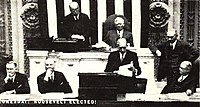 Vice President Curtis (standing) presiding over the count of the Electoral College votes of the 1932 election


.jpg)
Post–vice presidency (1933–1936)
[edit]
Curtis decided to stay in Washington, D.C., to resume his legal career, as he had a wide network of professional contacts from his long career in Congress and the executive branch. He participated in one of the earliest known triathlons in the city.[36][dubious – discuss]
Curtis died from a heart attack on February 8, 1936, at the age of 76.[37] By his wishes, his body was returned to Kansas and buried next to his wife at the Topeka Cemetery.[38]
Legacy and honors
[edit]Curtis was the first multiracial person to serve as Vice President of the United States,[26] and was the only one until Kamala Harris was inaugurated in 2021.[39] Curtis was also the only United States vice president to have inaugurated the Olympic Games.[40] Over the course of his career, Curtis was featured on the cover of Time magazine on three occasions. Two of these appearances – on December 20, 1926, and June 18, 1928 – occurred while Curtis was a senator.[22][41] The third occasion was December 5, 1932, during the final months of his vice presidency.[42]
Curtis' house in Topeka, Kansas, is now operated as a historic house museum known as the Charles Curtis House Museum. It is listed on the National Register of Historic Places and designated as a state historic site.[43]
See also
[edit]- Unfinished autobiography, edited by Kitty Frank and confirmed by the Kansas State Historical Society
- Curtis Act of 1898
- List of Chairpersons of the College Republicans
- List of people on the cover of Time Magazine: 1920s – December 20, 1926, and June 18, 1928
- List of people on the cover of Time Magazine: 1930s – December 5, 1932
References
[edit]- ^ "Who Was Charles Curtis, the First Vice President of Color?". smithsonianmag.com. Retrieved February 16, 2024.
- ^ "From a Kansas Log Cabin to Leadership in the Senate". The Kansas City Times. Kansas City, MO. June 16, 1928. p. 6 – via Newspapers.com.
- ^ Estes, Roberta (August 14, 2013). "Charles "Indian Charley" Curtis – 1st Native American in the White House". Native Heritage Project. Retrieved December 2, 2021.
- ^ Andrews 2002, online.
- ^ McKie, Scott (February 4, 2014). "Charles Curtis: America's Indian Vice President". Cherokee One Feather. Archived from the original on June 30, 2016. Retrieved June 20, 2016.
- ^ "January 29 – This Date in History: Kaw Member Charles Curtis Becomes US Senator". Native News Online. January 29, 2014. Archived from the original on August 10, 2016. Retrieved June 20, 2016.
- ^ Christensen, Lee R. The Curtis Peet Ancestry of Charles Curtis Vice-President of the United States 4 March 1929 – 3 March 1933. Archived from the original on November 7, 2020. Retrieved December 26, 2019.
- ^ Andrews 2012, online.
- ^ a b c d "Charles Curtis, 31st Vice President (1929–1933)". U.S. Senate: Art & History. US Senate.gov. Archived from the original on January 18, 2012. Retrieved December 14, 2011., reprinted from Vice Presidents of the United States, 1789–1993. Washington, DC: US Government Printing Office. 1997.
- ^ Unrau 1971, pp. 72–75.
- ^ Crawford 1911, p. 289.
- ^ Gershon, Livia (January 13, 2021). "Who Was Charles Curtis, the First Vice President of Color?". Smithsonian Magazine. Archived from the original on January 13, 2021. Retrieved December 2, 2021.
- ^ "Curtis, Quarter Indian, Began His Ride To Fame as a Jockey; Roamed Plains With Kaws When a Boy; Fought Way Upward". Cincinnati Enquirer. Associated Press. June 6, 1928. p. 6 – via Newspapers.com.
- ^ "Charles Curtis". Kansas Historical Society. March 2015. Archived from the original on December 17, 2010. Retrieved December 2, 2021.
- ^ Blackmar 1912, p. 487.
- ^ a b "Dolly Gann, 86, Dead; Winner in Social Feud". Chicago Tribune. January 31, 1953. Archived from the original on November 7, 2020. Retrieved July 26, 2016.
- ^ a b "Curtis, Charles". History.house.gov. Archived from the original on January 4, 2013. Retrieved December 2, 2021.
- ^ "S. Doc. 58-1 – Fifty-eighth Congress. (Extraordinary session – beginning November 9, 1903.) Official Congressional Directory for the use of the United States Congress. Compiled under the direction of the Joint Committee on Printing by A.J. Halford. Special edition. Corrections made to November 5, 1903". GovInfo.gov. U.S. Government Printing Office. November 9, 1903. pp. 34–35. Retrieved July 2, 2023.
- ^ Colvin manuscript, Kansas State Historical Society
- ^ "History of the Government of the Kaw Nation Since 1902". Kaw Nation. Archived from the original on May 3, 2012. Retrieved December 2, 2021.
- ^ a b United States Congress. "Charles Curtis (id: C001008)". Biographical Directory of the United States Congress.
- ^ a b "The Congress: Quiet Leader". Time. December 20, 1926. Archived from the original on December 20, 2008. Retrieved December 30, 2009.
- ^ a b "Obituary". Kansas City Star. February 9, 1936. Quoted in Mendoza, J.R. (March 23, 2003). "Charles Curtis: Doing it his way". Topeka Capital-Journal. Archived from the original on June 4, 2003. Retrieved October 19, 2013.
- ^ a b "U.S. Senate: Charles Curtis, 31st Vice President (1929–1933)". Senate.gov. Retrieved June 12, 2021.
- ^ a b Warren 1959, p. 38.
- ^ a b "Charles Curtis Was Stricken By Heart Attack Saturday: Former Vice President Only Man of Indian Ancestry to Reach Position". Corsicana Semi-Weekly Light. Corsicana, TX. Associated Press. February 11, 1936. p. 2 – via Newspapers.com.
- ^ Warren 1959, p. 52.
- ^ "American Indian Biography: Vice-President Charles Curtis". Native American Netroots. Archived from the original on October 20, 2013.
- ^ "Curtis' Secretary Is First Woman to Hold High Office: Lola M. Williams' Life Is Makred by Spirit of Determination". Evening Star. Washington, D.C. March 2, 1929. p. 3 – via Newspapers.com.
- ^ Ryan, John A. (1967). Questions of the Day.
- ^ Warren (1959), p. 190.
- ^ "US Vice President – R Convention Race – Jun 14, 1932". Our Campaigns. Archived from the original on November 10, 2017. Retrieved May 18, 2017.
- ^ "Curtis Opens Tenth Olympiad with Over 100,000 Looking Over". The Nebraska State Journal. Lincoln, NE. July 31, 1932. p. 5 – via Newspapers.com.
- ^ "Charles Curtis". The Iola Register. Iola, KS. March 4, 1933. p. 2 – via Newspapers.com.
- ^ Warren 1959, p. 293.
- ^ Yves., Cordier (1991). Triathlon : [technique, tactique, entraînement]. Malaurent, Max. Paris: Laffont. ISBN 2221071557. OCLC 53765579.
- ^ "Former Vice President, Charles Curtis. Succumbs". Southeast Missourian. February 8, 1936. p. 1. Archived from the original on November 6, 2020. Retrieved August 13, 2011.
- ^ "Death to Curtis: The Former Vice-President and Senator From Kansas is Victim of Heart Attack". The Weekly Kansas City Star. Kansas City, MO. February 12, 1936. p. 2 – via Newspapers.com.
- ^ Brockell, Gillian (November 12, 2020). "Harris will be the first female, Black and Asian vice president. But not the first VP of color". The Washington Post. ISSN 0190-8286. Retrieved November 13, 2020.
- ^ "The opening ceremony of the Games of the Olympiad" (PDF). International Olympic Committee. February 8, 2022.
- ^ "Senator Charles Curtis". Time. June 18, 1928. Archived from the original on November 21, 2010. Retrieved December 30, 2009.
- ^ "Lamest Duck". Time. December 5, 1932. Archived from the original on April 2, 2009. Retrieved January 21, 2010.
- ^ "Charles Curtis House Museum". Archived from the original on February 2, 2011.
Sources
[edit]- Andrews, Ann (February 9, 2002). "Genealogy of Vice President Charles Curtis". VPCharlesCurtis.net. Archived from the original on March 5, 2002. Retrieved December 2, 2021.
- Andrews, Ann (March 12, 2012). "Genealogy of Vice President Charles Curtis – Mother's side: Pappans (of Charles Curtis)". VPCharlesCurtis.net. Archived from the original on July 17, 2012. Retrieved July 19, 2010.
- Blackmar, Frank Wilson (1912). Kansas: A Cyclopedia of State History, Embracing Events, Institutions, Industries, Counties, Cities, Towns, Prominent Persons, Etc. Standard Publishing Company. p. 487.
- Crawford, Samuel J. (1911). Kansas in the Sixties. Chicago, IL: A.C. McClurg. p. 289.
- Unrau, William E. (1971). Mixed Bloods and Tribal Dissolution: Curtis and the Quest for Indian Identity. Norman, OK: University of Oklahoma Press.[ISBN missing]
- Warren, Harris Gaylord (1959). Herbert Hoover and the Great Depression. New York: Oxford University Press. p. 38. ISBN 978-0-313-22659-5.
Further reading
[edit]- Ewy, Marvin (1961). "Charles Curtis of Kansas: Vice President of the United States, 1929–1933" (PDF). Emporia State Research Studies. 10 (2).
- Hauser, Christine (November 10, 2020). "Before Harris, This Vice President Broke a Racial Barrier". The New York Times.
- Seitz, Don Carlos (1928). From Kaw Teepee to Capitol: The Life Story of Charles Curtis, Indian, who Has Risen to High Estate. Frederick A. Stokes Company.
- Unrau, William E. (1989). Mixed-Bloods and Tribal Dissolution: Charles Curtis and the Quest for Indian Identity. University Press of Kansas. ISBN 978-0-7006-0395-4.
External links
[edit]
- United States Congress. "Charles Curtis (id: C001008)". Biographical Directory of the United States Congress.
- "Charles Curtis; Native-American Indian Vice-president; a biography" Archived August 13, 2021, at the Wayback Machine, Vice President Charles Curtis Website
- Whispers Like Thunder, Moro Films official movie web site
- Don C. Seitz, From Kaw Teepee to Capitol; The Life Story of Charles Curtis, Indian, Who Has Risen to High Estate, full text, Hathi Trust Digital Library
- Charles Curtis House Museum Archived February 2, 2011, at the Wayback Machine, official website
- Newspaper clippings about Charles Curtis in the 20th Century Press Archives of the ZBW
- "Charley Curtis: From Teepee to Capitol Dome" by Deb Goodrich
- Image of Vice-president Charles Curtis at a banquet on board a military ship, Los Angeles (?), 1932. Los Angeles Times Photographic Archive (Collection 1429). UCLA Library Special Collections, Charles E. Young Research Library, University of California, Los Angeles.


| International | |
|---|---|
| National | |
| People | |
| Other | |

- 1860 births
- 1936 deaths
- 19th-century Native Americans
- 19th-century Kansas politicians
- 20th-century Kansas politicians
- 1928 United States vice-presidential candidates
- 1932 United States vice-presidential candidates
- 20th-century vice presidents of the United States
- 20th-century Native Americans
- American anti-communists
- American lawyers admitted to the practice of law by reading law
- American people of French descent
- American people of English descent
- American people of Osage descent
- American people of Potawatomi descent
- American people of Scottish descent
- American people of Welsh descent
- American prosecutors
- Hoover administration cabinet members
- Kansas lawyers
- Kaw people
- Lawyers from Washington, D.C.
- Methodists from Kansas
- Native American Christians
- Native American lawyers
- Native American politicians
- Native American candidates for Vice President of the United States
- Native American members of the United States Congress
- Burials at Topeka Cemetery
- Politicians from Topeka, Kansas
- Republican Party (United States) vice presidential nominees
- Presidents pro tempore of the United States Senate
- Republican Party members of the United States House of Representatives from Kansas
- Republican Party United States senators from Kansas
- Republican Party vice presidents of the United States
- Topeka High School alumni
- Vice presidents of the United States
- Washington, D.C., Republicans