


Communist Party of the Russian Federation
 |
Communist Party of the Russian Federation Коммунистическая Партия Российской Федерации | |
|---|---|
 | |
| Abbreviation | CPRF (English) КПРФ (Russian) KPRF (Romanized) |
| General Secretary | Gennady Zyuganov |
| First Deputy Chairmen | Ivan Melnikov Yury Afonin |
| Deputy Chairmen | Vladimir Kashin Dmitry Novikov Leonid Kalashnikov |
| Parliamentary Leader | Gennady Zyuganov |
| Founded | 14 February 1993 |
| Preceded by | CP RSFSR |
| Headquarters | 16th building, Ol'khovskaya Ulitsa Moscow, Russia 105066 |
| Newspaper | Pravda (81 regional editions) |
| Youth wing | Komsomol |
| Membership (2024 est.) | ~500,000[1][needs update] |
| Ideology | |
| Political position | Far-left[7][8][9] |
| National affiliation | National Patriotic Forces of Russia |
| Continental affiliation | UCP–CPSU |
| International affiliation | IMCWP |
| Colours | Red |
| Slogan |
|
| Anthem | |
| Seats in the State Duma | 57 / 450 |
| Seats in the Federation Council | 4 / 178 |
| Governors | 3 / 85 |
| Seats in the Regional Parliaments | 449 / 3,928 |
| Ministers | 0 / 31 |
| Party flag | |
 | |
| Website | |
| kprf cprf | |
The Communist Party of the Russian Federation (CPRF; Russian: Коммунистическая Партия Российской Федерации; КПРФ, tr. Kommunisticheskaya Partiya Rossiyskoy Federatsii; KPRF) is a communist political party in Russia that officially adheres to Marxist–Leninist philosophy.[3] It is the second-largest political party in Russia after United Russia. The youth organisation of the party is the Leninist Young Communist League.
The CPRF can trace its origin to the Russian Social Democratic Labour Party which was established in March 1898. The party split in 1903 into a Menshevik (minority) and Bolshevik (majority) faction; the latter, led by Vladimir Lenin, is the direct ancestor of the Communist Party of the Soviet Union (CPSU) and is the party that seized power in the October Revolution of 1917. After the CPSU was banned in 1991 by Russian President Boris Yeltsin in the aftermath of a failed coup attempt, the CPRF was founded at the Second Extraordinary Congress of Russian Communists on 14 February 1993 as the successor organisation of the Communist Party of the Russian Soviet Federative Socialist Republic (CPRSFSR). It was the ruling party in the State Duma, the lower house of the Russian Federal Assembly from 1998 to 1999.
The party's stated goal is to establish a new, modernized form of socialism in Russia through peaceful means.[10][11] Immediate goals of the party include the nationalisation of natural resources, agriculture, and large industries within the framework of a mixed economy, with socialist relations of production that allow for the growth of small and medium enterprises in the private/non-state sector.[12]
History[edit]
| Part of a series on |
| Communist parties |
|---|

The CPRF was founded on 14 February 1993 at the Second Extraordinary Congress of Russian Communists, where it declared itself to be the successor of the Communist Party of the Russian Soviet Federative Socialist Republic (CPRSFSR).[13] It formed through the merger of successor groups to the Communist Party of the Soviet Union (CPSU), including Roy Medvedev's Socialist Party of the Working People (of left-socialist orientation), Alexei Prigarin's Union of Communists; and much of the membership of the Stalinist Russian Communist Workers Party (although party leader Viktor Anpilov rejected the new party).[14] The CPRF quickly became the largest party in Russia, with 500,000 members soon after its founding, more than double all the other parties membership combined.[15]
Gennady Zyuganov, a co-founder of the party along with senior former Soviet politicians Yegor Ligachev, Anatoly Lukyanov, Andrew Konstant and others, was elected to be party leader at the Second Extraordinary Congress.[4] Zyuganov had been a harsh critic of Alexander Yakovlev, the so-called "godfather of glasnost", on the CPSU Central Committee. After the collapse of the Soviet Union in 1991, he became active in the Russian "national-patriotic" movement,[16][17] being the chairman of the National Salvation Front (some authors call him a nationalist).[18]
Following the CPRF's success in the 1995 legislative election, it emerged as the primary opposition to incumbent President Boris Yeltsin for the 1996 presidential election, whose approval rating was in single digits.[19] In order to oppose Yeltsin, Zyuganov organised a "popular-patriotic bloc" of nationalist organisations to support his candidacy.[19] After the election—which Yeltsin won with 54% of the vote—on 7 August 1996 the coalition supporting Zyuganov was transformed into an official organisation, the People's Patriotic Union of Russia (NPSR), consisting of more than 30 left-wing and nationalist organisations, including the Russian All-People's Union, led by Sergey Baburin. Zyuganov was its chairman. It went on to support Zyuganov in the 2000 presidential election. The NPSR was meant to form the basis of a two-party system, with the NPSR opposing the ruling "party of power".[19]
The party suffered a sharp decline in the 2003 legislative election, going from 113 seats to 52. Zyuganov called the 2003 elections a "revolting spectacle" and accused the Kremlin of setting up a "Potemkin party", Rodina, to steal its votes. The CPRF was endorsed by Sergey Baburin's People's Union for the 2007 Russian parliamentary elections.[20]
In the 2012 presidential election, Zyuganov denounced election irregularities in the 2011 legislative election, but he also expressed his opposition to the organisers of the mass demonstrations of December 2011, which he viewed as orchestrated by ultra-liberals exploiting unrest. The party played only a minor role as a catalyst in the protests. Party rallies on 18 December 2011 in protest of election irregularities in Moscow and Saint Petersburg were attended by only a few thousand, mostly elderly, party supporters.[21]
In 2014, the party called for Russia to formally recognise the separatist Donetsk People's Republic and the Luhansk People's Republic, something that would happen in 2022 preceding Russia's invasion of Ukraine.[22]
After Russia was sanctioned for systematic doping in the run-up to the 2018 Winter Olympics, Gennady Zyuganov, leader of the Communist Party of the Russian Federation, proposed sending Russian fans to the Games with a Soviet Victory Banner.[23]
In 2021, the party's headquarters were raided by Russian authorities and a party official was barred from entering his office in the State Duma after it refused to accept the results of an online parliamentary election vote and attempting to file a lawsuit against the results.[24]
Following the 2022 Russian invasion of Ukraine, the CPRF published a statement in support of the invasion and accused NATO of planning "to enslave Ukraine" and thus creating "critical threats to the security of Russia". It called for the "demilitarization and denazification" of Ukraine.[25] The party framed the conflict as that between the Ukrainian Banderites and fascists, who have been perpetrating genocide against Russian speakers, and liberating Russian forces.[26][27] The CPRF also accused the United States and NATO of deploying European fascist sympathizers and Middle Eastern terrorists to Ukraine to fight the Russian army.[28] Two members out of 57 of CPRF's Duma caucus, Vyacheslav Markhaev and Mikhail Matveev, have expressed opposition to the war, although they support the "protection of the people of Donbass".[29]
A few younger members of the CPRF spoke publicly against the war in Ukraine, although their criticisms only refer to Russia's military campaign outside of Donbass, while they fully support the narrative that Ukraine is governed by "neo-Nazis".[30]
As a result of the party's actions of endorsing the invasion of Ukraine, 55 of the 57 CPRF lawmakers, including Zyuganov, have been sanctioned by the United States Department of Treasury, HM Treasury of the United Kingdom, Global Affairs Canada, Japan, Australia and the European Commission.[31][32][33][34][35]
In July 2022, CPRF leader Gennady Zyuganov allowed the party to propose a merger with the left-conservative party A Just Russia — For Truth, but only if the new party adopted the communist program.[36] The day before, the leader of the A Just Russia Sergey Mironov said that he "does not see any obstacles to the creation in Russia of a large coalition of left-wing patriotic forces".[37]
Ideology[edit]

The party advocates for a socialist transformation of Russia through peaceful means within a pluralistic political framework. The CPRF considers the multi-sector socialist market system as developed in China to be a model which should be emulated within Russia. The party supports state ownership over major industries, the renationalization of businesses privatized after the collapse of the Soviet Union, giving out subsidies to currently existing state-owned firms and maintaining large welfare benefits. The CPRF has also maintained stable relationships with many businesses, including small and large private companies, worker cooperatives, and organizations which trace their lineage to the Soviet era.[11] In 2002, it was described as left-wing nationalist.[4]
The CPRF's current programme was adapted in 2008, where the CPRF declared that it is the only political organisation that consistently upholds the rights of the workers and national interests. According to the programme, the strategic goal of the party is to build in Russia a "renewed socialism, Socialism of the 21st century".[38] The program of the Communist Party declared that the party is guided by Marxism–Leninism, based on the experience and achievements of domestic and world science and culture. According to the party, there comes a "confrontation between the New World Order and the Russian people with its thousand-year history, and with its qualities", "communality and great power, deep faith, undying altruism and decisive rejection of lures mercantile bourgeois liberal-democratic paradise".[39]
According to its program,[40] the CPRF considers it necessary to reform the country in three phases. In the first phase, it is needed to achieve workers' power through representation by a coalition led by the CPRF. Achieving this goal will help eliminate the devastation from the standpoint of the party, the consequences conducted in the past decade of reforms, in particular by the nationalisation of property privatised in the 1990s. However, in this case small producers will remain and moreover will be organised to protect them from robbery by "big business, bureaucrats, and mafia groups". It is planned to reform the management of enterprises through the creation of councils at various levels. The party also plans to transform Russia into a Soviet republic.[citation needed] In the second stage, the role of councils and trade unions will increase even more. A gradual transition in the economy will be made to a socialist form of economic activity, but a small private equity is still retained. Finally, the third phase is to build socialism.
The First Secretary Gennady Zyuganov also expressed that they should learn from China's successful example and build Russian socialism. He also encouraged all party members to read "Selected works of Deng Xiaoping". He said during his visit to China in 2008: "Had we learned from the success of China earlier, the Soviet Union would not have dissolved".[41][42]
Party programme[edit]

Under the present conditions in the Russian Federation, the CPRF calls for the following proposals:[40]
- Stop the extinction of the country, restore benefits for large families, reconstruct the network of public kindergartens and provide housing for young families.
- Nationalise natural resources in Russia and the strategic sectors of the economy; revenues in these industries are to be used in the interests of all citizens.
- Return to Russia from foreign banks the state financial reserves and use them for economic and social development.
- Break the system of total fraud in the elections.[failed verification]
- Create a truly independent judiciary.[failed verification]
- Carry out an immediate package of measures to combat poverty and introduce price controls on essential goods.
- Not raise the retirement age.
- Restore government responsibility for housing and utilities, establish fees for municipal services in an amount not more than 10% of family income, stop the eviction of people to the streets and expand public housing.
- Increase funding for science and scientists to provide decent wages and all the necessary research.
- Restore the highest standards of universal and free secondary and higher education that existed during the Soviet era.
- Ensure the availability and quality of health care.
- Vigorously develop high-tech manufacturing.
- Ensure the food and environmental security of the country and support the large collective farms for the production and processing of agricultural products.
- Prioritise domestic debt over foreign debt
- Introduce progressive taxation; low-income citizens will be exempt from paying taxes.
- Create conditions for development of small and medium enterprises.
- Ensure the accessibility of cultural goods, stop the commercialisation of culture, defend Russian culture as the foundation of the spiritual unity of multinational Russia, the national culture of all citizens of the country.
- Stop the slandering of the Russian and Soviet history.
- Take drastic measures to suppress corruption and crime.
- Strengthen national defense and expand social guarantees to servicemen and law enforcement officials.
- Ensure the territorial integrity of Russia and the protection of compatriots abroad.
- Institute a foreign policy based on mutual respect of countries and peoples to facilitate the voluntary restoration of the Union of States.
The party is in favour of cooperation with the Russian Orthodox Church.[43] According to the words of Zyuganov, the CPRF is a party of scientific, but not militant atheism. Propaganda of any religion is banned inside the party.[44] The CPRF celebrates the rule of Joseph Stalin.[45] Zyuganov and the party support social conservatism and voted in favor of the ban on the "promotion of non-traditional sexual relations to minors", commonly known as the Russian gay propaganda law.[46][47][48] During the Russian invasion of Ukraine, the party has taken a pro-war stance.[citation needed] The party leader, Gennady Zyuganov, called in the Duma for a general mobilization.[49][50]
Internal factions[edit]
Since its founding the CPRF has had several distinct internal factions:[51]
- Left-wing nationalists. CPRF leader Gennady Zyuganov is from this tendency. The left-wing nationalists in the party identify socialism historically with Russia and Russia culturally with socialism. They are influenced by the writings of historian Lev Gumilyov and see class struggle as having evolved into struggle between civilisations.[4]
- Marxist–Leninists. The Marxist–Leninist faction of the party has a traditional Leninist understanding of class struggle and socialism. They are against both nationalism and social democracy. This tendency is heavily reflected in the party's rank-and-file membership. Richard Kosolapov was a prominent member of this group.[52]
- Reformers. The party's reformers are social democratic or reform-communists, who have a generally critical view of the Soviet Union. This faction had a majority at the Second Extraordinary Congress, but has declined since then.[4]
Party structure[edit]

The CPRF is legally registered in Russia.[53] In organisational terms, it largely mirrors the CPSU, with the party being led by a Central Committee with a commitment to democratic centralism.[54] It has regional offices in 81 federal subjects. Each regional office is controlled by the local (oblast, city, etc.) committee, headed by the First Secretary. The headquarters of the party is in Moscow. The Leninist Komsomol of the Russian Federation is the youth organisation of the party.
International cooperation[edit]
In 1993, the party founded the Union of Communist Parties – Communist Party of the Soviet Union. Since 2001, the organisation has been led by Gennady Zyuganov and it became part of the Central Committee.
The party has friendly relations with the Party of the European Left, but it is not a member of it.[55] The party also has friendly relations with the Chinese Communist Party.[56]
On 24 March 2017, the party sent a delegation to North Korea and signed a "protocol on cooperation" with the Workers' Party of Korea.[57] During the visit, a stone was placed in the Juche Tower.
In October 2017 the party hosted the 19th International Meeting of Communist and Workers Parties in the city of Saint Petersburg, marking the centenary of the October Revolution, with an attendance of over 100 parties from around the globe.[58]
Media[edit]
Pravda is the newspaper of the Communist Party;[59] it has 81 regional editions.
Left-wing nationalist newspaper Sovetskaya Rossiya has also friendly ties with the Communist Party, but is not officially affiliated with it.
Ultra-nationalist newspaper Zavtra used to support the Communist Party, but in 2005 it switched its support to Rodina.[60]
Finances[edit]
According to the financial report of the CPRF, in 2006 the party received ₽127,453,237 rubles (3,998,835 US$):
- 29% – membership fees
- 30% – the federal budget
- 6% – donations
- 35% – other incomes
In 2006, the party spent 116,823,489 rubles (3,665,328 US$):
- 5% – for the maintenance of regional offices
- 21% – on promotion (information, advertising, publishing and printing)
- 10% – the content of the governing bodies
- 7% – the preparation and conduct of elections and referendums
- 36% – content publishers, media and educational institutions
On 19 October 2008, the leader of the party Gennady Zyuganov appealed to the citizens of Russia to financially support the party to implement its policy goals.[61][62]
Popular support and electoral results[edit]
The CPRF is strong in large cities and major industrial and scientific centers ("naukograds") as well as in the small towns and cities around Moscow.[63] One of the few polling stations that gave a success to the CPRF during the 2007 Russian legislative election was at Moscow State University.[64] The CPRF is also strong in the far east of Russia, in Siberia, and the Ural.[65] Supporters of the CPRF include those who suffered economically and politically from the collapse of the Soviet Union. The party is considered to depend on the nostalgia for the Soviet Union, having the largest poll of voters among the elderly.[11]
Presidential elections[edit]
In all presidential elections that have been held in the Russian Federation, the CRPF's candidate has finished second. In 2012, several opposition politicians, including Boris Nemtsov, posited that Dmitry Medvedev admitted to them that Zyuganov would actually have won the 1996 Russian presidential election if not for fraud in favor of Boris Yeltsin.[66][67][68] According to the official results, Zyuganov received 17.18% of the votes in the 2012 Russian presidential election. According to independent observers, there was large-scale fraud in favor of Vladimir Putin.[69][70] Zyuganov called the election "one of thieves, and absolutely dishonest and unworthy".[71]
| Election | Candidate | First round | Second round | Result | ||
|---|---|---|---|---|---|---|
| Votes | % | Votes | % | |||
| 1996 | Gennady Zyuganov | 24,211,686 | 32.03 | 30,102,288 | 40.31 | Lost |
| 2000 | 21,928,468 | 29.21 | Lost | |||
| 2004 | Nikolay Kharitonov | 9,513,313 | 13.69 | Lost | ||
| 2008 | Gennady Zyuganov | 13,243,550 | 17.72 | Lost | ||
| 2012 | 12,318,353 | 17.18 | Lost | |||
| 2018 | Pavel Grudinin | 8,659,206 | 11.77 | Lost | ||
| 2024 | Nikolay Kharitonov | 3,768,470 | 4.37 | Lost | ||
Parliamentary elections[edit]
| Election | Leader | Votes | % | Seats | +/– | Rank | Government |
|---|---|---|---|---|---|---|---|
| 1993 | Gennady Zyuganov | 6,666,402 | 12.40 | 42 / 450
|
3rd | Opposition | |
| 1995 | 15,432,963 | 22.30 | 157 / 450
|
 115 115
|
1st
|
Opposition (1995–1998) | |
| Coalition (1998–1999) | |||||||
| Opposition (1999) | |||||||
| 1999 | 16,196,024 | 24.29 | 113 / 450
|
 44 44
|
 1st 1st
|
Opposition | |
| 2003 | 7,647,820 | 12.61 | 51 / 450
|
62
|
2nd
|
Opposition | |
| 2007 | 8,046,886 | 11.57 | 57 / 450
|
6
|
2nd
|
Opposition | |
| 2011 | 12,599,507 | 19.19 | 92 / 450
|
35
|
2nd
|
Opposition | |
| 2016 | 7,019,752 | 13.34 | 42 / 450
|
50
|
2nd
|
Opposition | |
| 2021 | 10,660,599 | 18.93 | 57 / 450
|
15
|
2nd
|
Opposition |
Regional elections[edit]
In February 2005, the CPRF defeated the ruling pro-Kremlin party United Russia in elections to the regional legislature of Nenets Autonomous Okrug, obtaining 27% of the popular vote.
In the Moscow Duma election held on 4 December 2005, the party won 16.75% and 4 seats, the best ever result for the CPRF in Moscow. In the opinion of some observers,[which?] the absence of the Rodina party contributed to the Communists' success.
On 11 March 2007, elections took place for 14 regional and local legislatures. The CPRF performed very well and increased its votes in most of the territories; it came second in Oryol Oblast (23.78%), Omsk Oblast (22.58%), Pskov Oblast (19.21%) and Samara Oblast (18.87%), Moscow Oblast (18.80%), Murmansk Oblast (17.51%) and Tomsk Oblast (13.37%).[72] These results testify that the CPRF is the most significant opposition party in Russia.
On 21 May 2007, the CPRF obtained an important success in the Volgograd's mayoral election. Communist candidate Roman Grebennikov won election as mayor with 32.47% of the vote and became the youngest mayor of a regional capital. In 2008, Roman Grebennikov switched his allegiance to United Russia, angering many Communists who accused him of using the CPRF as a tool to become elected.
On 7 April 2011, the CPRF candidate Ilya Potapov won the mayoral election in the town of Berdsk with a landslide victory over the United Russia candidates.
In 2015 gubernatorial elections, party's nominee Sergey Levchenko won the gubernatorial election in Irkutsk Oblast.[73]
In the 2018 gubernatorial elections, Communist Party candidates Andrey Klychkov and Valentin Konovalov won the gubernatorial elections in the Oryol Oblast and Khakassia, respectively.[74][75] In addition, in the election in Primorsky Krai, the party's candidate Andrey Ishchenko could pass in the second round of election in which lost, by official results. The result of those elections was declared invalid due to a large number of violations in connection with which recall election were scheduled for December 2018, but the Communist Party decided not to nominate its candidate for the new election.[76]
In the 2018 elections to the regional parliaments, the Communist Party took first place in the voting on party lists in three regions. However, in two regions, United Russia still managed to get a relative majority in regional parliaments at the expense of deputies-single-mandate holders. Nevertheless, in Irkutsk Oblast, the party received a relative majority and is the largest faction in the Legislative Assembly.[77]
Criticism[edit]
Marxist theoretician Boris Kagarlitsky wrote in 2001: "It is enough to recall that within the Communist movement itself, Zyuganov's party was at first neither the sole organisation, nor the largest. Bit by bit, however, all other Communist organisations were forced out of political life. This occurred not because the organisations in question were weak, but because it was the CPRF that had received the Kremlin's official approval as the sole recognised opposition".[78] Andrei Brezhnev, grandson of Soviet leader Leonid Brezhnev, has criticised the CPRF's Zyuganov's rapprochement with the Russian Orthodox Church.[79]
Gallery[edit]
-
 Zyuganov with members of the Leninist Komsomol of the Russian Federation
 -
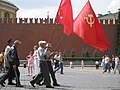 Demonstration of communists on the Red Square
 -
 Communists marching on International Workers' Day in 2009, Severodvinsk
 -
 The Communist Party holds a demonstration on Triumfalnaya Square in Moscow
 -
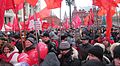 Demonstration of the party
 -
 Party members lay down flowers at the tomb of Joseph Stalin
 -
 Party membership card


See also[edit]


- CPRF faction in the State Duma
- History of the Communist Party of the Soviet Union
- List of communist parties
- MFK KPRF
- Politics of Russia
- Red Belt (Russia)
References[edit]
- ^ "Communist Party of the Russian Federation". 20 February 2024.
- ^ Bozóki, András; Ishiyama, John T. (2002). The Communist Successor Parties of Central and Eastern Europe. M.E. Sharpe. p. 241. ISBN 978-0-7656-1389-9. Retrieved 19 October 2022.
- ^ a b c Nordsieck, Wolfram (2016). "Russia". Parties and Elections in Europe. Retrieved 20 August 2018.
- ^ a b c d e f Bozóki, A and Ishiyama, J (2002). The Communist Successor Parties of Central and Eastern Europe. p. 245.
- ^ Bozóki, A and Ishiyama, J (2002). The Communist Successor Parties of Central and Eastern Europe. p. 241—245.
- ^ Vorobyov, Niko (25 January 2023). "Russian saboteurs seek to hamper Putin's war machine". Al Jazeera News. Archived from the original on 8 March 2023.
- ^ "Qui sont les ultranationalistes russes ?". Europe 1 (in French). 4 November 2013. Retrieved 24 December 2017.
- ^ Klußmann, Uwe (18 February 2008). "Far-Left Prepares for Russia's Election: Campaigning Communists Evoke Ghost of Stalin". Der Spiegel. Retrieved 28 February 2018.
- ^ Mccauley, Martin (2014). The Rise and Fall of the Soviet Union. Taylor & Francis. p. 513. ISBN 978-1-317-86782-1.
- ^ Rapoza, Kenneth (6 December 2011). "Can Russia's Communist Party Make A Comeback?". Forbes. Retrieved 11 August 2013.
- ^ a b c "Communist Party of the Russian Federation (KPRF)". Encyclopædia Britannica. Retrieved 21 June 2023.
- ^ "Socialism may be waning, but not for young Russians". The Washington Times. 22 November 2012. Retrieved 11 August 2013.
- ^ American University (Washington, D.C.), and Moskovskiĭ gosudarstvennyĭ universitet im. M. V. Lomonosova. Demokratizatsiya: The Journal of Post-Soviet Democratization, volume 4. Washington, D.C.: Quality Press of the Southern Tier, 1996. p. 174.
- ^ Richard Sakwa, Russian Politics and Society, Routledge, 1996, p. 85.
- ^ Bozóki & Ishiyama, p. 242.
- ^ "Research". The Heritage Foundation. Archived from the original on 23 December 2009. Retrieved 16 March 2009.
- ^ March, Luke (2002). The Communist Party in Post-Soviet Russia. Manchester University Press. ISBN 9780719060441. Retrieved 19 February 2011.
- ^ Sakwa, Richard (2002). Russian Politics and Society. Psychology Press. p. 179. ISBN 978-0-415-22753-7.
- ^ a b c Bozóki and Ishiyama, p. 249.
- ^ Andrey Shabaev. "Партинформ. Материал последнего номера". partinform.ru. Archived from the original on 9 March 2011. Retrieved 19 February 2011.
- ^ David M. Herszenhorn (20 December 2011). "Where Communists See an Opening, Many Russians See a Closed Door". The New York Times. Retrieved 22 December 2011.
He, [Gennadi A. Zyuganov], has joined in popular protests against Mr. Putin's government, while seeking to block the rise of the liberal reformers leading those rallies by denouncing them as a subversive threat to Russia's future.
- ^ "TASS: Russia – Communist Party urges Russian leadership to recognise Novorossiya". TASS.
- ^ "Зюганов предложил отправить на Олимпиаду болельщиков со знаменем Победы". mk.ru (in Russian). 30 January 2018. Retrieved 5 February 2018.
- ^ "Police Search Communist Party Offices as Online Voting Controversy Continues". The Moscow Times. 28 September 2021. Archived from the original on 28 September 2021. Retrieved 25 November 2021.
- ^ "The People of Ukraine Must Not Be a Victim of World Capital and Oligarchic Clans. Statement of the CPRF CC Presidium – Communist Party of the Russian Federation". Retrieved 28 February 2022.
- ^ "Новые акты нацистского террора на Украине". Kprf.ru. 6 March 2022. Retrieved 15 March 2022.
- ^ Зюганов Геннадий Андреевич (4 March 2022). "Г.А. Зюганов: Нет фашизму на нашей земле!". Kprf.ru. Retrieved 15 March 2022.
- ^ Зюганов Геннадий Андреевич (5 March 2022). "Фашисты из Европы и террористы с Ближнего Востока поддерживают нацистов-бандеровцев. Заявление Председателя ЦК КПРФ Г.А. Зюганова". Kprf.ru. Retrieved 15 March 2022.
- ^ "Third member of Derzhavna Duma condemns the war against Ukraine". Ukrayinska Pravda. 26 February 2022. Retrieved 2 March 2022.
- ^ "'Defending the Donbas is one thing. Bombing Kyiv is another'. Russia's Communist Party officially supports the war against Ukraine. But its younger members are speaking out". Meduza. 10 June 2022.
- ^ Flatley, Daniel; Follain, John; Morales, Alex (31 March 2022) [28 February 2022]. "The Sanctions Imposed So Far on Russia From the U.S., EU and U.K." Bloomberg. Retrieved 5 April 2022.
- ^ From: Global Affairs Canada (24 February 2022). "Canada imposes additional economic measures on Russia in response to Russia's attack on Ukraine". Canada.ca. Retrieved 5 April 2022.
- ^ "Autonomous Sanctions (Designated Persons and Entities and Declared Persons—Ukraine) Amendment (No. 4) Instrument 2022". Legislation.gov.au. 25 February 2022. Retrieved 5 April 2022.
- ^ "Gennady Zyuganov and Viktor Vekselberg are sanctioned by Japan". En.newizv.ru. 15 March 2022. Retrieved 5 April 2022.
- ^ Office of Foreign Assets Control. "Notice of OFAC Sanctions Actions" published 17 March 2022. 87 FR 15305
- ^ Жуковский, Иван (6 August 2022). "Зюганов согласился на объединение КПРФ и "Справедливой России". При одном условии". Gazeta.Ru. Retrieved 6 August 2022.
- ^ "Зюганов допустил объединение КПРФ и СРЗП". www.kommersant.ru (in Russian). 6 August 2022. Retrieved 2 August 2022.
- ^ "Official website of the Communist Party of the Russian Federation".
- ^ Зюганов Г. А. Кадры партии в действии. — М.: ИТРК, 2001. — с. 11. — ISBN 5-88010-083-9.
- ^ a b "Программа партии". Archived from the original on 2 January 2005. Retrieved 13 March 2015.
- ^ "久加诺夫:俄共党员应好好学习《邓小平文选》(图)_中国经济网——国家经济门户". ce.cn. Archived from the original on 23 September 2015. Retrieved 22 April 2014.
- ^ "俄共主席访华自称只求公平一战". sina.com.cn.
- ^ "Г.А. Зюганов о кончине Патриарха Алексия Второго: Он внес огромный вклад в дело возрождения церкви". kprf.ru.
- ^ Актуальные вопросы совершенствования идейно-теоретической работы партии (2012).
- ^ "Зюганов отреагировал на слова генсека НАТО о Сталине – РИА Новости, 03.03.2020". Ria.ru. 4 April 2019. Retrieved 2 March 2022.
- ^ "В КПРФ предложили арестовывать совершивших каминг-аут гомосексуалистов". 23 October 2015.
- ^ Antonova, Natalia (29 January 2014). "Russian State Duma: 'Possessed printer' or executor of the people's will?". themoscownews.com. Archived from the original on 1 March 2014.
- ^ "Russian MPs vote overwhelmingly to outlaw gay 'propaganda'". EuroNews. 11 June 2013. Archived from the original on 12 November 2020. Retrieved 19 December 2020.
- ^ Cuesta, Javier G. (15 September 2022). "Putin's entourage demands 'full mobilization' for the war in Ukraine". EL PAÍS English Edition. Retrieved 26 September 2022.
- ^ ""It's a war, not a special operation. We need mobilization," Russian Communist Party leader says". The Insider (in Russian). Retrieved 26 September 2022.
- ^ Bozóki & Ishiyama, p. 244.
- ^ Andrey Shabaev. "Российская многопартийность. Глава 5". www.partinform.ru. Retrieved 19 February 2011.
- ^ "Список зарегистрированных политических партий". minjust.ru. Archived from the original on 3 April 2018. Retrieved 12 August 2012.
- ^ Bozóki & Ishiyama, p. 243.
- ^ "И.И. Мельников встретился с делегацией Европарламента". kprf.ru.
- ^ "90 лет Коммунистической партии Китая. "Круглый стол" в редакции газеты "Правда"". kprf.ru.
- ^ "Russian dignitaries visit DPRK". Naenara.
- ^ "Partidos comunistas e operários assinalam centenário da Revolução de Outubro". pcp.pt. 9 November 2017.
- ^ "Г.А. Зюганов в "Интерфаксе": КПРФ – реальная политическая сила, способная вывести страну из тяжелого кризиса". kprf.ru.
- ^ "Party Number Four", Rodina: Whence and Why? Archived 2013-11-26 at the Wayback Machine, by Alexei Titkov, Panorama Centre, Moscow, 2006, ISBN 5-94420-021-9, p. 24-25.
- ^ "Коммунисты просят россиян материально поддержать партию". РИА Новости. 19 October 2008.
- ^ "Коммунисты просят россиян материально поддержать партию". Новости Mail. Ru. Archived from the original on 14 January 2012. Retrieved 12 August 2012.
- ^ Оренбургский Областной Комитет КПРФ (in Russian). Archived from the original on 28 August 2009. Retrieved 5 February 2009.
- ^ Агентство Политических Новостей. Agency of Political News (in Russian). Retrieved 14 December 2007.
- ^ Bozóki & Ishiyama, p. 253.
- ^ "Nieuws". PVDA. Archived from the original on 14 December 2013. Retrieved 6 August 2012.
- ^ "Russia: Did Yeltsin Steal the 1996 Presidential Vote?". Time. 24 February 2012. Archived from the original on 24 February 2012.
- ^ "How The West Helped Invent Russia's Election Fraud: OSCE Whistleblower Exposes 1996 Whitewash – By Alexander Zaitchik and Mark Ames – The eXiled". exiledonline.com.
- ^ "Fraude bij verkiezing Rusland". BNR Nieuwsradio. Archived from the original on 14 April 2012. Retrieved 6 August 2012.
- ^ "Fraudeberichten uit Rusland". nos.nl. 4 March 2012.
- ^ "Oppositie noemt stembusgang oneerlijk". De Standaard. 4 March 2012.
- ^ "Официальный сайт КПРФ". Cprf.ru. Archived from the original on 23 March 2007. Retrieved 19 February 2011.
- ^ "Иркутский проигрыш "Единой России"". Газета.Ru. 6 April 2024.
- ^ "Коновалов набирает 57,5% на выборах главы Хакасии". ТАСС. Retrieved 11 November 2018.
- ^ Новости, Р. И. А. (10 September 2018). "Клычков вступит в должность главы Орловской области 14 сентября". РИА Новости (in Russian). Retrieved 29 July 2022.
- ^ "Выборы губернатора Приморья пройдут без участия КПРФ". Коммерсантъ. 3 November 2018 – via Kommersant.
- ^ "КПРФ побеждает по партийным спискам на выборах в заксобрания трех регионов из 16". ТАСС.
- ^ Kagarlitsky, Boris (17 January 2001). "RUSSIA: Is there life for KPRF after Yeltsin?". Green Left Weekly. Retrieved 6 March 2022.
- ^ "The Saturday Profile; A Different Kind of Brezhnev in the Making". The New York Times. 10 August 2002. Retrieved 28 March 2010.
Further reading[edit]
- Syed Mohsin Hashim (March 1999). KPRF ideology and its implications for democratization in Russia. Communist and Post-Communist Studies. Vol. 32. Iss. 1. pp. 77–89.
- Lisa Horner (23 January 2009). "Communism and the CPRF in Modern Russia" • The School of Russian and Asian Studies.
- Miriam Elder (14 October 2009) (updated 30 May 2010). "Communism: a love affair? The tyranny of daily bribes has many Russians nostalgic for Soviet social services" • The Global Post.
- Bozóki, András; Ishiyama, John T. (2020). The Communist Successor Parties of Central and Eastern Europe. Taylor & Francis. ISBN 978-1-000-16140-3.
External links[edit]

| |||||||||||||||||||||||||||||||||||||||||||||||||||||||


| International | |
|---|---|
| National | |
| Other | |

- Communist Party of the Russian Federation
- 1993 establishments in Russia
- Communist parties in Russia
- Eurosceptic parties in Russia
- Neo-Sovietism
- Social conservative parties
- Neo-Stalinist parties
- Political parties established in 1993
- Organizations that oppose LGBT rights in Russia
- Registered political parties in Russia
- Far-left politics in Russia
- International Meeting of Communist and Workers Parties
- Political parties in Crimea