


Jajangmyeon
 | |
| Alternative names | Jjajangmyeon |
|---|---|
| Type | Korean Chinese cuisine, Myeon |
| Place of origin | China (original) Korea (introduced)[1] |
| Region or state | East Asia |
| Main ingredients | cumian, chunjang, meat, vegetables, sometimes seafood |
| Similar dishes | Zhajiangmian |

| Korean name | |
| Hangul | 자장면 |
|---|---|
| Hanja | 炸醬麵 |
| Revised Romanization | jajangmyeon |
| McCune–Reischauer | chajangmyŏn |
| IPA | [tɕa.dʑaŋ.mjʌn] |
| Hangul | 짜장면 |
| Hanja | 炸醬麵 |
| Revised Romanization | jjajangmyeon |
| McCune–Reischauer | tchajangmyŏn |
| IPA | [t͈ɕa.dʑaŋ.mjʌn] |
Jajangmyeon (Korean: 자장면) or jjajangmyeon (짜장면) is a Korean Chinese noodle dish topped with a thick sauce made of chunjang, diced pork, and vegetables.[2] It originated in Incheon, Korea where Chinese migrant workers brought over zhajiangmian from Shandong in the late 19th century. Modifications in Korea such as a darker and sweeter sauce differentiate the Korean version from the Chinese dish. Variants of the dish use seafood, or other meats.[3][4]
History[edit]
Jajangmyeon was brought to Incheon, Korea during the late nineteenth century by migrant workers from Shandong province, China.[5] At a time when both Qing and Japanese businesses were competing against each other, Jajangmyeon was offered in 1905 at Gonghwachun (공화춘; 共和春), a Chinese restaurant in Incheon Chinatown run by an immigrant from the Shandong region. The restaurant is now the Jajangmyeon Museum.[6]
Both the name and dish originate from the authentic Chinese dish, zhájiàngmiàn (炸醬麵). The common copied features of both are pork, long wheat noodles, and a sauce made from fermented soybean paste.[5] Originally the sauce that was introduced from China to make the noodle dish, had tasted saltier, richer, and was also of a deep brown color. The chefs at Incheon, Korea later added in caramel to sweeten it up as well as adding in grains, that darkened the sauce to copy the same jet black-brown color over time.[7]
In the mid-50s in South Korea, immediately after the Korean War, jajangmyeon was sold at low prices so that anyone could eat it without burden.[8] The new Korean-style jajangmyeon began to gain explosive popularity among the many merchants visiting the port of Incheon, which was the center of trade, and the many dock workers working in the fish market, and quickly spread throughout the country, being recognized as its "own dish" rather than a copied version of the traditional Chinese one.[8]
Name[edit]
Jajang (자장; alternatively spelled jjajang 짜장) is copied from the Chinese word zhájiàng (炸醬), which means "fried sauce". Myeon (면) means "noodles". The Chinese characters are pronounced jak (작; 炸) and jang (장; 醬) in Korean, but the noodle dish is called jajangmyeon, not *jakjangmyeon, because its origin is not the Sino-Korean word, but a transliteration of the Chinese pronunciation. As the Chinese pronunciation of zhá sounded like jja (rather than ja) to Korean ears, the dish is known in South Korea as jjajangmyeon, and the vast majority of Korean Chinese restaurants use this spelling.
For many years, until 22 August 2011, the National Institute of Korean Language did not recognize the word jjajangmyeon as an accepted idiomatic transliteration. The reason jjajangmyeon did not become the standard spelling was due to the transliteration rules for foreign words announced in 1986 by the Ministry of Education, which stated that the foreign obstruents should not be transliterated using doubled consonants except for some established usages.[9] The lack of acknowledgment faced tough criticism from the supporters of the spelling jjajangmyeon, such as Ahn Do-hyeon, a Sowol Poetry Prize winning poet.[10][11] Later, jjajangmyeon was accepted as an alternative standard spelling alongside jajangmyeon in the National Language Deliberation Council and, on 31 August, included as a standard spelling in the Standard Korean Language Dictionary.[12]
Preparation and serving[edit]

Jajangmyeon uses thick, hand-made or machine-pulled noodles made from wheat flour, salt, baking soda, and water.[13] The sauce, jajang, is made with fried chunjang with other ingredients, such as soy sauce (or oyster sauce), meat (usually pork, but sometimes beef), seafood (usually squid or shrimp), fragrants (scallions, ginger, and garlic), vegetables (usually onions, zucchini or Korean zucchini, or cabbage), stock, and starch slurry.[13]
When served, jajangmyeon may be topped with julienned cucumber, scallions, egg garnish, boiled or fried egg, blanched shrimp or stir-fried bamboo shoot slices.[13] The dish is usually served with danmuji (yellow pickled radish), sliced raw onions, and chunjang sauce for dipping the onions.[13]
Variations[edit]
Variations of the jajangmyeon dish include gan-jjajang, jaengban-jjajang, yuni-jjajang, and samseon-jjajang.[14]
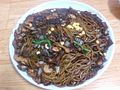
- Gan-jjajang (간짜장) – Jajangmyeon with a dry sauce, made without adding water (stock) and starch slurry. The letter gan comes from the Chinese pronunciation of the character 乾 (Korean hanja: 乾; reading: 건, geon; Chinese: 乾; reading: gān) meaning "dry".[14]
- Jaengban-jjajang (쟁반짜장) – Jajangmyeon made by stir-frying the parboiled noodles with the sauce in a wok, and served on a plate instead of in a bowl. Jaengban means "plate" in Korean.[14]
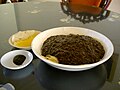
- Yuni-jjajang (유니짜장) – Jajangmyeon made with ground meat. The word yuni derived from the Korean reading of the Chinese word ròuní (肉泥; Korean reading: 육니, yungni) meaning "ground meat".[14] Although yungni is not a word in Korean, the loanword yuni, used only in the dish name yuni-jjajang, is likely to have been derived from Chinese immigrants' pronunciation of the Korean reading of the word, with the dropping of the coda k (or ng, due to the Korean phonotactics) which is difficult for native Mandarin speakers to pronounce.[15]
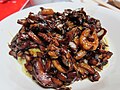
- Samseon-jjajang (삼선짜장) – Jajangmyeon which incorporates seafood such as squid and mussel. The word samseon derives from the Korean reading of the Chinese word sānxiān (三鮮) meaning "three fresh ingredients".[14]
There can be combinations. For example. samseon-gan-jjajang may refer to seafood jajangmyeon made without adding water.
Dishes such as jajang-bap and jajang-tteok-bokki also exist. Jajang-bap is essentially the same dish as jajangmyeon, but served with rice instead of noodles. Jajang-tteok-bokki is tteok-bokki served with jajang sauce instead of the usual spicy sauce. Bul jajangmyeon is a spicy variation of jajangmyeon.
Instant jajangmyeon products, such as Chapagetti, Chacharoni, and Zha Wang, are instant noodle versions of jajangmyeon consisting of dried noodles that are boiled in the same manner as ramyeon, using dried vegetable pieces that are drained and mixed with jajang powder or liquid jajang sauce, as well as a small amount of water and oil.
-
 Gan-jjajang
 -
 Jaengban-jjajang
 -
 Yuni-jjajang
 -
 Samseon-gan-jjajang
 -


See also[edit]

References[edit]
- ^ "Korea's 'Black Day' noodle dish and its Chinese roots". South China Morning Post. 2017-03-10. Retrieved 2021-08-10.
- ^ "Restaurant Prices of 8 Popular Meals All Surged in 2022". world.kbs.co.kr. Retrieved 2023-01-13.
- ^ "Korean jajangmyeong popular in China". The Korea Times. Retrieved 2023-01-23.
In 1905, these Chinese immigrants introduced a black-bean noodle to Koreans, and the salty food (zhajiangmian in Chinese) soon metamorphosed into a sweet one called 'jajangmyeon,' with the addition of caramel into it, putting Chinese cuisine on a new course in Korea.
- ^ "Jajangmyeon". www.gastrotoyrseoul.com. Retrieved 2023-01-23.
Most people describe the taste of Jajangmyeon as sweet and savory at the same time. The onions and black soybean paste have a slightly sweet flavor, but the soy sauce and stock make the dish deliciously savory at the same time. The noodles are thicker than usual and very soft and silky.
- ^ a b Mark Antonation (April 12, 2016). "Chinese, Korean and Japanese Versions of One Noodle Bowl and Where to Find Them". Westword.
- ^ Herald, Korea (2022-03-24). "[Visual History of Korea] Jjajangmyeon, Korean Chinese dish invented in Incheon by Chinese migrant workers". The Korea Herald. Retrieved 2023-01-22.
- ^ "[ICONIC FOOD] Jajangmyeon, a dish full of emotions: The famous black noodles have gone from copied special luxury to a cheap comfort". Korea JoongAng Daily. 2019-03-31. Retrieved 2023-01-22.
- ^ a b "장면". korean.visitkorea.or.kr (in Korean). Retrieved 2018-04-21.
- ^ Ministry of Education (1986). (in Korean) – via Wikisource.
- ^ 안, 도현 (5 October 2005). "그래도 짜장면 이다". The Hankyoreh (in Korean). Retrieved 5 July 2017.
- ^ 이, 준영 (12 October 2016). "[밀물썰물] 짜장면 시위". Busan Ilbo (in Korean). Retrieved 5 July 2017.
- ^ 김, 태식 (31 August 2011). "'짜장면', 표준어 됐다". Yonhap (in Korean). Retrieved 9 March 2017.
- ^ a b c d "Jjajangmyeon" 짜장면. Doopedia (in Korean). Doosan Corporation. Retrieved 22 July 2017.
- ^ a b c d e 원, 호성 (19 August 2015). "집밥 백선생' 백종원이 알려주는 짜장면의 종류, 간짜장·유니짜장·쟁반짜장의 차이는?". Sports Q (in Korean). Retrieved 22 July 2017.
- ^ Kim, Tae-kyung; Park, Cho-rong (2014). "Pronunciation Errors in Korean Syllable Coda by Native Chinese Speakers". Journal of Korean Language and Culture. 55: 5–34 – via DBpia.
External links[edit]

| Variants |
| ||||||||||||||||||||||||||||
|---|---|---|---|---|---|---|---|---|---|---|---|---|---|---|---|---|---|---|---|---|---|---|---|---|---|---|---|---|---|
| Dishes |
| ||||||||||||||||||||||||||||
| Instant noodle brands | |||||||||||||||||||||||||||||
| List articles | |||||||||||||||||||||||||||||
| See also | |||||||||||||||||||||||||||||
