


Shandong
Shandong
山东 | |
|---|---|
| Province of Shandong | |
| Name transcription(s) | |
| • Chinese | 山东省 (Shāndōng Shěng) |
| • Abbreviation | SD / 鲁 (pinyin: Lǔ) |
Clockwise from top left: South Gate to Heaven at Mount Tai, Qingdao from the sea, Temple of Confucius in Qufu, Yellow River delta in Kenli, Acient City of Langya in Linyi, and Thousand Buddha Mountain in Jinan | |
.svg) Map showing the location of Shandong Province | |
| Coordinates: 36°24′N 118°24′E / 36.4°N 118.4°E | |
| Country | China |
| Named for | 山 Shān—"(Taihang) Mountains" 东 dōng—"east" "East of the (Taihang) Mountains" |
| Capital | Jinan |
| Largest city | Linyi |
| Divisions | 16 prefectures, 140 counties, 1941 townships |
| Government | |
| • Type | Province |
| • Body | Shandong Provincial People's Congress |
| • CCP Secretary | Lin Wu[1] |
| • Congress chairman | Lin Wu |
| • Governor | Zhou Naixiang |
| • CPPCC chairman | Ge Huijun |
| • National People's Congress Representation | 174 deputies |
| Area | |
| • Total | 157,100 km2 (60,700 sq mi) |
| • Rank | 20th |
| Highest elevation | 1,545 m (5,069 ft) |
| Population (2020)[3] | |
| • Total | 101,527,453 |
| • Rank | 2nd |
| • Density | 650/km2 (1,700/sq mi) |
| • Rank | 5th |
| Demonym | Shandongese |
| Demographics | |
| • Ethnic composition | Han - 99.3% Hui - 0.6% |
| • Languages and dialects | Jiaoliao Mandarin, Jilu Mandarin, Zhongyuan Mandarin |
| GDP[4] | |
| • Total | CN¥ 8.31 trillion US$ 1.3 trillion |
| • Per capita | CN¥ 81,846 US$ 12,689 |
| ISO 3166 code | CN-SD |
| HDI (2019) |  0.759[5] 0.759[5]high · 14th |
| Website | SD.gov.cn |


| Shandong | |||||||||||||||||||||||||||||||||
|---|---|---|---|---|---|---|---|---|---|---|---|---|---|---|---|---|---|---|---|---|---|---|---|---|---|---|---|---|---|---|---|---|---|
.svg) "Shandong" in Simplified (top) and Traditional (bottom) Chinese characters | |||||||||||||||||||||||||||||||||
| Simplified Chinese | 山东 | ||||||||||||||||||||||||||||||||
| Traditional Chinese | 山東 | ||||||||||||||||||||||||||||||||
| Literal meaning | "East of the (Taihang) Mountains" | ||||||||||||||||||||||||||||||||
| |||||||||||||||||||||||||||||||||
Shandong[a] is a coastal province of the People's Republic of China and is part of the East China region.[8]
Shandong has played a major role in Chinese history since the beginning of Chinese civilization along the lower reaches of the Yellow River. It has served as a pivotal cultural and religious center for Taoism, Chinese Buddhism and Confucianism. Shandong's Mount Tai is the most revered mountain of Taoism and a site with one of the longest histories of continuous religious worship in the world.[9] The Buddhist temples in the mountains to the south of the provincial capital of Jinan were once among the foremost Buddhist sites in China.[10] The city of Qufu is the birthplace of Confucius and was later established as the center of Confucianism. Confucianism developed from what was later called the Hundred Schools of Thought from the teachings of the Chinese philosopher Confucius.[11]
Shandong's location at the intersection of ancient and modern north–south and east–west trading routes has helped establish it as an economic center. After a period of political instability and economic hardship that began in the late 19th century, Shandong has experienced rapid growth in recent decades. Home to over 100 million inhabitants, Shandong is the world's sixth-most populous subnational entity, and China's second most populous province.[12] The economy of Shandong is China's third largest provincial economy with a GDP of CNY¥8.3 trillion in 2021 or USD$1.3 trillion, which is equivalent to the GDP of Mexico.[13][14] Compared to a country, it would be the 15th-largest economy and the 15th most populous as of 2021.[15] Its GDP per capita is around the national average.
Shandong is considered one of China's leading provinces in education and research. It hosts 153 higher education institutions, ranking second in East China after Jiangsu and fourth among all Chinese provinces/municipalities after Jiangsu, Guangdong and Henan.[16] As of 2023, two major cities ranked in the top 50 cities in the world (Jinan 32nd and Qingdao 43rd) by scientific research output, as tracked by the Nature Index.[17]
Etymology[edit]
Individually, the two Chinese characters in the name "Shandong" means "mountain" (山) and "east" (东). Shandong could hence be translated literally as "east of the mountains" and refers to the province's location to the east of the Taihang Mountains.[18][19] A common nickname for Shandong is Qílǔ (simplified Chinese: 齐鲁; traditional Chinese: 齊魯), after the States of Qi and Lu that existed in the area during the Spring and Autumn period. Whereas the State of Qi was a major power of its era, the State of Lu played only a minor role in the politics of its time. However, Lu became renowned for being the home of Confucius, and hence its cultural influence came to eclipse that of the State of Qi. The cultural dominance of the State of Lu heritage is reflected in the official abbreviation for Shandong which is "鲁" (Chinese: 魯; pinyin: Lǔ). English speakers in the 19th century called the province Shan-tung.[20]
Location[edit]
The province is on the eastern edge of the North China Plain and in the lower reaches of the Yellow River (Huang He), and extends out to sea as the Shandong Peninsula. Shandong borders the Bohai Sea to the north, Hebei to the northwest, Henan to the west, Jiangsu to the south, and the Yellow Sea to the northeast, east and southeast; it also shares a very short border with Anhui, between Henan and Jiangsu.
History[edit]
Ancient history[edit]


With its location on the eastern edge of the North China Plain, Shandong was home to a succession of Neolithic cultures for millennia, including the Houli culture (6500–5500 BC), the Beixin culture (5300–4100 BC), the Dawenkou culture (4100–2600 BC), the Longshan culture (3000–2000 BC), and the Yueshi culture (1900–1500 BC).
The earliest dynasties (the Shang dynasty and Zhou dynasty) exerted varying degrees of control over western Shandong, while eastern Shandong was inhabited by the Dongyi peoples who were considered "barbarians" by inhabitants around Zhongyuan. Since 567 B.C. after the annexation of Lai, the Dongyi tribes were becoming sinicized gradually.
During the Spring and Autumn period and the Warring States period, regional states became increasingly powerful. At this time, Shandong was home to two major states: the state of Qi at Linzi and the state of Lu at Qufu. Lu is noted for being the home of Confucius. However, the state was comparatively small and eventually succumbed to the larger state of Chu from the south. The state of Qi, on the other hand, was a significant power throughout the period. Cities it ruled include Linzi, Jimo (north of modern Qingdao) and Ju.
The easternmost part of the peninsula was ruled by the Dongyi state of Lai until Qi conquered it in 567 BC.
Early Imperial history[edit]
The Qin dynasty conquered Qi and founded the first centralized Chinese state in 221 BC. The Han dynasty that followed created several commanderies supervised by two regions (刺史部) in what is now modern Shandong: Qingzhou (青州) in the north and Yanzhou (兗州) in the south. During the division of the Three Kingdoms, Shandong belonged to the Cao Wei, which ruled over northern China.
After the Three Kingdoms period, a brief period of unity under the Western Jin dynasty gave way to invasions by nomadic peoples from the north. Northern China, including Shandong, was overrun. Over the next century or so, Shandong changed hands several times, falling to the Later Zhao, then Former Yan, then Former Qin, then Later Yan, then Southern Yan, then the Liu Song dynasty, and finally the Northern Wei dynasty, the first of the Northern dynasties during the Northern and Southern dynasties period. Shandong stayed with the Northern dynasties for the rest of this period.
In 412 AD, the Chinese Buddhist monk Faxian landed at Laoshan, on the southern edge of the Shandong peninsula, and proceeded to Qingzhou to edit and translate the scriptures he had brought back from India.
The Sui dynasty reestablished unity in 589, and the Tang dynasty (618–907) presided over the next golden age of China. For the earlier part of this period, Shandong was ruled as part of Henan Circuit, one of the circuits (a political division). Later on, China splintered into warlord factions, resulting in the Five Dynasties and Ten Kingdoms period. Shandong was part of the Five Dynasties, all based in the north.
The Song dynasty reunified China in the late tenth century. The classic novel Water Margin was based on folk tales of outlaw bands active in Shandong during the Song dynasty. In 1996, the discovery of over two hundred buried Buddhist statues at Qingzhou was hailed as a major archaeological find. The statues included early examples of painted figures and are thought to have been buried due to Emperor Huizong's repression of Buddhism (he favored Taoism).
The Song dynasty was forced to cede northern China to the Jurchen Jin dynasty in 1142. Shandong was administered by Jin as Shandong East Circuit and Shandong West Circuit – the first use of its current name.
Early modern history[edit]

The modern province of Shandong was created by the Ming dynasty, where it had a more expansive territory, including the agricultural part of Liaoning. After the Ming–Qing Transition in 1644, Shandong acquired (more or less) its current borders.
On July 25, 1668, an earthquake with an estimated magnitude of 8.5, whose epicenter was just northeast of the city of Linyi, devastated Shandong and killed between 43,000 and 50,000 people.[21][22]
During the nineteenth century, China became increasingly exposed to Western influence, and Shandong, a coastal province under the dukedom of Xiong, was significantly affected. Qingdao was leased to Germany in 1897 and Weihai to Britain in 1898. As a result of foreign pressure from the Russian Empire, which had annexed Outer Manchuria by 1860, the Qing dynasty encouraged settlement of Shandong people to what remained of Manchuria.
Shandong was one of the first places in which the Boxer Rebellion started and became one of the uprising centers. In 1899, the Qing general Yuan Shikai was appointed governor of the province to suppress the uprising. He held the post for three years.

Germany took control of China's Shandong Peninsula. In 1898, Germany had leased Jiaozhou Bay and its port of Qingdao under threat of force. Development was a high government priority. Over 200 million marks were invested in world-class harbor facilities such as berths, heavy machinery, rail yards, and a floating dry dock. Private enterprises worked across the Shandong Province, opening mines, banks, factories, and rail lines.[23]

As a consequence of the First World War, Japan seized Germany holdings in Qingdao and Shandong. The Treaty of Versailles transferred ownership to Japan instead of restoring Chinese sovereignty over the area. Popular dissatisfaction with this outcome, referred to as the Shandong Problem, led to the vehement student protests in the May Fourth Movement. Among the reservations to the Treaty that the United States Senate Committee on Foreign Relations approved was "to give Shantung to China," the treaty with reservations was not approved. Finally, Shandong reverted to Chinese control in 1922 after the United States' mediation during the Washington Naval Conference. Weihai followed in 1930.[24]

Shandong's return of control fell into the Warlord Era of the Republic of China. Shandong was handed over to the Zhili clique of warlords, but after the Second Zhili–Fengtian War of 1924, the northeast China-based Fengtian clique took over. In April 1925, the Fengtian clique installed the warlord Zhang Zongchang, nicknamed the "Dogmeat General", as military governor of Shandong Province. Time dubbed him China's "basest warlord".[clarification needed][25] He ruled over the province until 1928 when he was ousted in the wake of the Northern Expedition. He was succeeded by Han Fuju, who was loyal to the warlord Feng Yuxiang but later switched his allegiance to the Nanjing government headed by Chiang Kai-shek. Han Fuju also ousted the warlord Liu Zhennian, nicknamed the "King of Shandong East", who ruled eastern Shandong Province, hence unifying the province under his rule.
In 1937 Japan began its invasion of China proper in the Second Sino-Japanese War, which would eventually become part of the Pacific theatre of the Second World War. Han Fuju was made Deputy Commander in Chief of the 5th War Area and put in charge of defending the lower Yellow River valley. However, he abandoned his base in Jinan when Japanese troops crossed the Yellow River. He was executed for not following orders shortly thereafter.
During the Japanese occupation, with resistance continuing in the countryside, Shandong was one of the provinces where a scorched earth policy ("Three Alls Policy": "kill all", "burn all", "loot all") was implemented by Japanese general Yasuji Okamura. This lasted until Japan's surrender in 1945, killing millions of people in Shandong and Northern China.
By 1945, communist forces already held some parts of Shandong. Over the next four years of the Chinese Civil War, they expanded their holdings, eventually driving the Kuomintang (government of the Republic of China) out of Shandong by June 1949, including the noble family of Xiong (熊) who held the governorship (previously a dukedom under the Imperial era, and an ancient viscountcy originating in Chu), to the island of Taiwan. The People's Republic of China was founded in October of the same year, thereby overthrowing the Republic of China from the mainland. The Xiong (alternatively spelt 'Hsiung') family is currently in residence in the city of Taichung as of the late 1990s.
Under the new government, parts of western Shandong were initially given to the short-lived Pingyuan Province, but this did not last. Shandong also acquired the Xuzhou and Lianyungang areas from Jiangsu province, but this did not last either. For the most part, Shandong has kept the same borders that it has today.
About six million people starved to death in Shandong during the Great Chinese Famine.[26]
In recent years, Shandong, especially eastern Shandong, has enjoyed significant economic development, becoming one of the People's Republic of China's richest provinces.
Geography[edit]
.jpg)

The northwestern, western, and southwestern parts of the province are all part of the vast North China Plain. The province's center is more mountainous, with Mount Tai being the most prominent. The east of the province is the hilly Shandong Peninsula extending into the sea; Miaodao Archipaelago to the north of Shandong Peninsula is the border of Bohai Sea (west) and Yellow Sea (east). The highest peak of Shandong is Jade Emperor Peak, with a height of 1,545 metres (5,069 ft), which is also the highest peak in the Mount Tai Ranges. [citation needed]
The Yellow River passes through Shandong's western areas, since 1855, it has always been entering the sea to Shandong's northern coast; in Shandong, it flows on a levee, higher than the surrounding land, and dividing western Shandong into the Hai He watershed in the north and the Huai River watershed in the south. The Grand Canal of China enters Shandong from the northwest and leaves on the southwest. Weishan Lake is the largest lake in the province. Shandong's coastline is 3,000 kilometres (1,900 mi) long. Shandong Peninsula has a rocky coastline with cliffs, bays, and islands; Laizhou Bay, the southernmost of the 3 bays of the Bohai Sea, is bordering the northern coast between Dongying and Penglai; Jiaozhou Bay, which is much smaller, is surrounded by Qingdao. The Miaodao Islands extends northwards from the northernmost coast of the peninsula, separating the Bohai Sea and the Yellow Sea.
With Jinan serving as the province's economic and cultural center, the province's economic prowess has led to the development of modern coastal cities located at Qingdao, Weihai, and Yantai. [citation needed]
Climate[edit]
Shandong has a temperate climate: humid continental (Köppen Dwa); it is bordering humid subtropical (Cwa under the Köppen climate classification) in the south. Generally, summers are hot (typical max 35 °C) and rainy (except for eastern parts of Jiaodong Peninsula (typical max 28 °C) and Mount Tai (typical max 20 °C)), while winters are cold and dry. Average temperatures are −9 to 1 °C (16 to 34 °F) in January and 18 to 28 °C (64 to 82 °F) in July. Annual precipitation is 550 to 950 mm (22 to 37 in), the vast majority of which occurs during summer, due to monsoonal influences.
Geology[edit]
Shandong is part of the Eastern Block of the North China craton. Beginning in the Mesozoic, Shandong has undergone a crustal thinning that is unusual for a craton and that has reduced the thickness of the crust from 200 km (120 mi) to as little as 80 km (50 mi). Shandong has hence experienced extensive volcanism in the Tertiary.
Some geological formations in Shandong are rich in fossils. For example, Zhucheng in southeastern Shandong has been the site of discovering many dinosaur fossils. In 2008, about 7,600 dinosaur bones from Tyrannosaurus, Ankylosaurus, and other genera were found, likely the largest collection ever discovered at one location.[27]
Politics[edit]
 |

The Shandong Provincial People's Congress is the highest organ of state power in Shandong province and Shandong's provincial legislature. Its standing committee exercises the majority of the power of The Shandong Provincial People's Congress. The current chairman of the standing committee is Li Ganjie.
The Shandong Provincial People's Government is the State Administration in Shandong province. Its main officials are elected and appointed by The Shandong Provincial People's Congress. The provincial government reports to Shandong Provincial People's Congress and State Council of the People's Republic of China.
The current Governor of Shandong is Zhou Naixiang.
Economy[edit]
As of 1832, Shandong was exporting fruits, vegetables, wine, drugs, and deerskin, often heading to Guangzhou to exchange clothing and fabrics.[20] The economy of Shandong is China's third largest provincial economy with a GDP of CNY¥8.3 trillion in 2021 or USD$1.3 trillion in (nominal), which is equivalent to the GDP of Mexico.[13][14] Its GDP per capita is around the national average. Compared to a country, it would be the 15th-largest economy and the 15th most populous as of 2021.[15]
Shandong ranks first among the provinces in the production of a variety of products, including cotton, wheat, and garlic[28] as well as precious metals such as gold and diamonds. It also has one of the biggest sapphire deposits in the world.[29] Other important crops include sorghum and maize. Shandong has extensive petroleum deposits as well, especially in the Dongying area in the Yellow River delta, where the Shengli Oil Field (lit. Victory Oilfield) is one of the major oilfields of China. Shandong also produces bromine from underground wells and salt from seawater. It is the largest agricultural exporter in China.
Shandong is one of China's richest provinces, and its economic development focuses on large enterprises with well-known brand names. Shandong is the biggest industrial producer and one of the top manufacturing provinces in China. Shandong has also benefited from South Korean and Japanese investment and tourism, due to its geographical proximity to those countries.[30] The richest part of the province is the Shandong Peninsula, where the city of Qingdao is home to three of the most well-known brand names of China: Tsingtao Beer, Haier and Hisense. Besides, Dongying's oil fields and petroleum industries form an important component of Shandong's economy. Despite the primacy of Shandong's energy sector, the province has also been plagued with problems of inefficiency and ranks as the largest consumer of fossil fuels in all of China.[30]
| Historical GDP of Shandong Province, 1952–present (SNA2008)[31] (purchasing power parity of Chinese Yuan, as Int'l.dollar based on IMF WEO October 2017[note 1] | |||||||||
| year | GDP | GDP per capita (GDPpc) based on mid-year population |
Reference index | ||||||
| GDP in millions | real growth (%) |
GDPpc | exchange rate 1 foreign currency to CNY | ||||||
| CNY | USD | PPP (Int'l$.) |
CNY | USD | PPP (Int'l$.) |
USD 1 | Int'l$. 1 (PPP) | ||
| 2016 | 6,802,449 | 1,024,110 | 1,943,057 | 7.6 | 68,733 | 10,348 | 19,633 | 6.6423 | 3.5009 |
| 2015 | 6,393,074 | 1,026,439 | 1,801,120 | 8.0 | 65,114 | 10,454 | 18,345 | 6.2284 | 3.5495 |
| 2014 | 6,030,036 | 981,643 | 1,698,410 | 8.7 | 61,774 | 10,056 | 17,399 | 6.1428 | 3.5504 |
| 2013 | 5,602,372 | 904,601 | 1,566,265 | 9.6 | 57,702 | 9,317 | 16,132 | 6.1932 | 3.5769 |
| 2012 | 5,071,045 | 803,334 | 1,428,142 | 9.9 | 52,490 | 8,315 | 14,783 | 6.3125 | 3.5508 |
| 2011 | 4,543,951 | 703,529 | 1,296,235 | 10.9 | 47,416 | 7,341 | 13,526 | 6.4588 | 3.5055 |
| 2010 | 3,962,074 | 585,283 | 1,196,784 | 12.3 | 41,579 | 6,142 | 12,559 | 6.7695 | 3.3106 |
| 2009 | 3,425,154 | 501,413 | 1,084,768 | 12.2 | 36,270 | 5,310 | 11,487 | 6.8310 | 3.1575 |
| 2008 | 3,123,138 | 449,689 | 983,108 | 12.1 | 33,253 | 4,788 | 10,467 | 6.9451 | 3.1768 |
| 2007 | 2,599,074 | 341,804 | 862,076 | 14.3 | 27,833 | 3,660 | 9,232 | 7.6040 | 3.0149 |
| 2006 | 2,205,967 | 276,721 | 766,573 | 14.7 | 23,775 | 2,982 | 8,262 | 7.9718 | 2.8777 |
| 2005 | 1,849,700 | 225,802 | 646,974 | 15.1 | 20,075 | 2,451 | 7,022 | 8.1917 | 2.8590 |
| 2000 | 833,747 | 100,714 | 306,604 | 10.3 | 9,326 | 1,127 | 3,430 | 8.2784 | 2.7193 |
| 1990 | 151,119 | 31,594 | 88,758 | 5.3 | 1,815 | 379 | 1,066 | 4.7832 | 1.7026 |
| 1980 | 29,213 | 19,496 | 19,534 | 12.2 | 402 | 268 | 269 | 1.4984 | 1.4955 |
| 1978 | 22,545 | 14,498 | 10.1 | 316 | 203 | 1.5550 | |||
| 1970 | 12,631 | 5,131 | 15.7 | 199 | 81 | 2.4618 | |||
| 1965 | 8,625 | 3,504 | 22.0 | 152 | 62 | 2.4618 | |||
| 1957 | 6,139 | 2,358 | -3.5 | 116 | 45 | 2.6040 | |||
| 1952 | 4,381 | 1,971 | 91 | 41 | 2.2227 | ||||
Wine industry[edit]

The production of wine is the second largest[citation needed] industry in the Shandong Province, second only to agriculture.
Geographically, the coastal areas remain relatively flat. Most of the soil is loose, well-ventilated, and rich in minerals and organic matter that enable full development of the root systems.
Presently, there are more than 140 wineries in the region, mainly distributed in the Nanwang Grape Valley and the Yan-Peng Sightseeing Highway(both are in Yantai). The region produced more than 40% of China's grape wine production.[34] Main varieties such as Cabernet Sauvignon, Cabernet Gernischt, Merlot, Riesling and Chardonnay are all at 20 years of age, considered to be the golden stage for these grapes. Most of them maintain an average saccharinity of above 20%.
Major producers
Economic and technological development zones[edit]
- Jinan High-tech Industrial Development Zone
Founded in 1991, the Jinan High-tech Industrial Development zone was one of the first of its kind approved by the State Council. The zone is located to the east of the city and covers a total planning area of 83 km2 (32 sq mi) that is divided into a central area covering 33 km2 (13 sq mi), an export processing district of 10 km2 (3.9 sq mi), and an eastern extension area of 40 km2 (15 sq mi). Since its foundation, the Jinan High-tech Industrial Development Zone has attracted enterprises as LG, Panasonic, Volvo, and Sanyo. In 2000, it joined the world science and technology association and set up a China-Ukraine High-tech Cooperation Park. The Qilu Software Park became the sister park of Bangalore park of India.[citation needed]
- Jinan Export Processing Zone
The export processing zone is located in the eastern suburbs of Jinan, east of the Jinan High-tech Industrial Development Zone, and to the north of the Jiwang highway. The distances to the Jiqing Highway and the Jinan Airport are 9 and 18 km (5.6 and 11.2 mi) respectively.[35]
- Qingdao Economic & Technological Development Area
Approved by the State Council in October 1984, Qingdao Economic and Technical Development Zone has a plan of 12.5 km2 (4.8 sq mi). In 2004 the local GDP was ¥27.51 billion, which increased by 28.9%; the total industrial output value is ¥60.6 billion, which increased by 31%. There have been 48 projects invested by companies listed among the Global Fortune 500 in the zone. With the fast development of reform and opening-up, Haier, Hisense, Aucma, Sinopec, CSIC, CNOOC, CIMC etc. are all located in the zone.[36]
- Qingdao Free Trade Zone
The State Council established Qingdao Free Trade Zone in 1992. The zone is 60 km (37 mi) away from Qingdao Liuting Airport. It is also close to Qingdao Qianwan Container Terminal. At present, more than 40 foreign-invested enterprises have moved in, and 2000 projects have been approved. It is one of the special economic areas which enjoys the most favorable investment policies on customs, foreign exchange, foreign trade, and taxation in China.[citation needed]
- Qingdao High-tech Industrial Zone
The State Council approved Qingdao High-Tech Industrial Development Zone in 1992. The zone is located close to Qingdao Liuting Airport and Qingdao Harbor. Encouraged industries include electronic information, biotechnology, medicine, new materials, new energy, advanced equipment manufacturing, marine science & technology, national defense technology.[37]
- Weifang Binhai Economic & Technological Development Area (BEDA)
Established in August 1995, Weifang Binhai Economic & Technological Development Area (BEDA) is a national economic and technological development area approved by the State Council. Covering an area of 677 km2 (261 sq mi), BEDA has a population of 100,000. BEDA possesses a large state-owned industrial land for use with an area of 400 km2 (150 sq mi). The land can be transacted conveniently, guaranteeing the demand of any project construction and providing broad development space for the enterprises in the area. Continuously, BEDA has been accredited as National Demonstration Zone invigorating the Sea by Science and Technology, National Innovation Base for Rejuvenating Trade through Science and Technology and National Demonstration Eco-Industry Park.
- Weihai Economic & Technological Development Zone
Weihai Economic and Technological Development Zone is a state-level development zone approved by the State Council on Oct 21, 1992. The administrative area has an area of 194 km2 (75 sq mi), including the programmed area of 36 km2 (14 sq mi) and an initial area of 11.88 km2 (4.59 sq mi). Its nearest port is Weihai Port, and the airport closest to the zone is Wuhai Airport.[citation needed]
- Weihai Export Processing Zone
Weihai Export & Processing Zone (EPZ) was set up by the approval of the State Council on April 27, 2000. Weihai EPZ is located in Weihai Economic & Technological Development Zone with programmed area of 2.6 km2 (1.0 sq mi). Weihai EPZ belongs to comprehensive export & processing zone. The EPZ is located 30 km (19 mi) to Weihai Airport, 3 km (1.9 mi) to Weihai railway station and 4 km (2.5 mi) to Weihai Harbor.[citation needed]
- Weihai Torch Hi-Tech Science Park
Weihai Torch Hi-Tech Science Park is a state-level development zone approved by the State Council in March 1991. Located in Weihai's northwest zone of culture, education and science, the Park has the total area of 111.9 square kilometers (43.2 sq mi), the coastal line of 30.5 kilometers (19.0 mi) and 150,000 residents. It is 3 km (1.9 mi) away from the city center, 4 km (2.5 mi) away from Weihai Port, 10 km (6.2 mi) away from Weihai railway station, 30 km (19 mi) away from Weihai Airport and 80 km (50 mi) away from Yantai Airport.[38]
- Yantai Economic and Technological Development Area
Yantai Economic and Technological Development Area is one of the earliest approved state level economic development zones in China. It now has planned area of 10 km2 (3.9 sq mi) and a population of 115,000. It lies on the tip of the Shandong Peninsula facing the Yellow Sea. It adjoins to downtown Yantai, merely 6 km (3.7 mi) away from Yantai Port, 6 km (3.7 mi) away from Yantai railway station, and a 30-minute drive to Yantai International Airport.[39]
- Yantai Export Processing Zone
Yantai Export Processing Zone (YTEPZ) is one of the first 15 export processing zones approved by the State Council. The total construction area of YTEPZ is 4.17 m2 (44.9 sq ft), in which the initial zone covers 3 km2 (1.2 sq mi). After developing for several years, YTEPZ is completely constructed. At present, the infrastructure has been completed, standard workshops of 120,000 m2 (140,000 sq yd) and bonded warehouses of 40,000 m2 (430,000 sq ft) have been built up. Up to now, owning perfect investment environment and conditions, YTEPZ has attracted investors both from foreign countries and regions such as Japan, Korea, Singapore, Hong Kong, Taiwan, Sweden, the United States, Canada, etc., and from the domestic to invest and operate in the zone.[40]
- Zibo National New & Hi-Tech Industrial Development Zone
Demographics[edit]
| Year | Pop. | ±% |
|---|---|---|
| 1912[41] | 30,989,000 | — |
| 1928[42] | 28,672,000 | −7.5% |
| 1936-37[43] | 38,100,000 | +32.9% |
| 1947[44] | 38,865,000 | +2.0% |
| 1954[45] | 48,876,548 | +25.8% |
| 1964[46] | 55,519,038 | +13.6% |
| 1982[47] | 74,419,054 | +34.0% |
| 1990[48] | 84,392,827 | +13.4% |
| 2000[49] | 89,971,789 | +6.6% |
| 2010[50] | 95,793,065 | +6.5% |
| Qingdao was part of Shandong Province until 1929; dissolved in 1949 and incorporated into Shandong Province. Weihai, also known as Weihaiwei. Established in 1930, dissolved in 1945, and incorporated into Shandong Province. | ||
Shandong is the second most populous province of China, after Guangdong, just slightly ahead of Henan, with a population of more than 101,527,453 at the 2020 Chinese census. Over 99% of Shandong's population is Han Chinese. Minority groups include the Hui and the Manchus. Shandong citizens are also known to have the tallest average height of any Chinese province. As of 2010, 16-18-year-old male students in Yantai measured 176.4 centimetres (5 ft 9.4 in) while female students measured 164 cm (5 ft 5 in).[51]
Religion[edit]
Religion in Shandong[52][note 2]
The predominant religions in Shandong are Chinese folk religions, Taoist traditions and Chinese Buddhism. According to surveys conducted in 2007 and 2009, 25,28% of the population believes in ancestor veneration, while 1.21% of the population identifies as Christian, decreasing from 1.30% in 2004.[52] The Christians were 1.89% of the province's population in 1949, the largest proportion in China at that time.[52] According to a survey of the year 2010, Muslims constitute 0.55% of Shandong's population up from 0.14% in 1949.[53][54]
The reports did not give figures for other types of religion; 80.05% of the population may be either irreligious or involved in worship of nature deities, Buddhism, Confucianism, Taoism, and folk religious sects. Shandong is the province where Confucius was born in the year 551 B.C.
Confucianism: The most well-known religion and/or philosophy of Shandong is Confucianism. Each year thousands of people come to Shandong to visit and learn about Confucius' culture. According to Chinese tradition, Confucius was a thinker, political figure, educator, and founder of the Ru School of Chinese thought. His teachings, preserved in the Lunyu or Analects, form the foundation of much of subsequent Chinese speculation on the ideal man's education and comportment, how such an individual should live his life and interact with others, and the forms of society and government in which he should participate. Additionally, there are many famous books about Confucius; the most famous one is the Analects written by his students. Confucius also helped edit The Five Classics (五经). The Five Classics include The Book of Songs, History, Changes and Rites.[55][56]
Famous view and arts[edit]
- The Northern Shaolin Seven Star Praying Mantis style of kung fu is also taught in this province. It is also said that Northern Mantis had originated here and not in the Shaolin temple in Henan Province, which is always stated in books.[citation needed]
- Guandi is also known for Guangong, Guanyu. He is a famous general in the book Romance of the Three Kingdoms. In Daojiao (a traditional Chinese religion), Guangong is also one of the four Protectors.[citation needed]
- Temple and Cemetery of Confucius and the Kong is a very famous World Heritage Site in China, and it is also a 5A Tourist Attraction. Lying to the Temple's east, the Kong Family Mansion developed from a small family house linked to the temple into an aristocratic mansion. The male direct descendants of Confucius lived and worked.[57][58]
|


Administrative divisions[edit]
Shandong is divided into sixteen prefecture-level divisions: all prefecture-level cities (including two sub-provincial cities). On January 1, 2019, Laiwu was wholly annexed to Jinan:
| Administrative divisions of Shandong | |||||||||||
|---|---|---|---|---|---|---|---|---|---|---|---|
| Division code[59] | Division | Area in km2[60] | Population 2010[61] | Seat | Divisions[62] | ||||||
| Districts | Counties | CL cities | |||||||||
| 370000 | Shandong Province | 157,100.00 | 95,792,719 | Jinan city | 58 | 52 | 26 | ||||
| 370100 | Jinan city | 10,247.01 | 8,112,513 | Lixia District | 10 | 2 | |||||
| 370200 | Qingdao city | 11,175.30 | 8,715,087 | Shinan District | 7 | 3 | |||||
| 370300 | Zibo city | 5,965.17 | 4,530,597 | Zhangdian District | 5 | 3 | |||||
| 370400 | Zaozhuang city | 4,563.22 | 3,729,140 | Xuecheng District | 5 | 1 | |||||
| 370500 | Dongying city | 7,923.26 | 2,035,338 | Dongying District | 3 | 2 | |||||
| 370600 | Yantai city | 13,746.47 | 6,968,202 | Laishan District | 5 | 6 | |||||
| 370700 | Weifang city | 16,143.14 | 9,086,241 | Kuiwen District | 4 | 2 | 6 | ||||
| 370800 | Jining city | 11,186.98 | 8,081,905 | Rencheng District | 2 | 7 | 2 | ||||
| 370900 | Tai'an city | 7,761.83 | 5,494,207 | Taishan District | 2 | 2 | 2 | ||||
| 371000 | Weihai city | 5,796.98 | 2,804,771 | Huancui District | 2 | 2 | |||||
| 371100 | Rizhao city | 5,347.99 | 2,801,013 | Donggang District | 2 | 2 | |||||
| 371300 | Linyi city | 17,191.21 | 10,039,440 | Lanshan District | 3 | 9 | |||||
| 371400 | Dezhou city | 10,356.32 | 5,568,235 | Decheng District | 2 | 7 | 2 | ||||
| 371500 | Liaocheng city | 8,714.57 | 5,789,863 | Dongchangfu District | 2 | 5 | 1 | ||||
| 371600 | Binzhou city | 9,444.65 | 3,748,474 | Bincheng District | 2 | 4 | 1 | ||||
| 371700 | Heze city | 12,193.85 | 8,287,693 | Mudan District | 2 | 7 | |||||

| Administrative divisions in Chinese and varieties of romanizations | ||||
|---|---|---|---|---|
| English | Chinese | Pinyin | ||
| Shandong Province | 山东省 | Shāndōng Shěng | ||
| Jinan city | 济南市 | Jǐnán Shì | ||
| Qingdao city | 青岛市 | Qīngdǎo Shì | ||
| Zibo city | 淄博市 | Zībó Shì | ||
| Zaozhuang city | 枣庄市 | Zǎozhuāng Shì | ||
| Dongying city | 东营市 | Dōngyíng Shì | ||
| Yantai city | 烟台市 | Yāntái Shì | ||
| Weifang city | 潍坊市 | Wéifāng Shì | ||
| Jining city | 济宁市 | Jǐníng Shì | ||
| Tai'an city | 泰安市 | Tài'ān Shì | ||
| Weihai city | 威海市 | Wēihǎi Shì | ||
| Rizhao city | 日照市 | Rìzhào Shì | ||
| Linyi city | 临沂市 | Línyí Shì | ||
| Dezhou city | 德州市 | Dézhōu Shì | ||
| Liaocheng city | 聊城市 | Liáochéng Shì | ||
| Binzhou city | 滨州市 | Bīnzhōu Shì | ||
| Heze city | 菏泽市 | Hézé Shì | ||
The 16 prefecture-level cities of Shandong are subdivided into 137 county-level divisions (55 districts, 26 county-level cities, and 56 counties). Those are in turn divided into 1941 township-level divisions (1223 towns, 293 townships, two ethnic townships, and 423 subdistricts).
Urban areas[edit]
| Population by urban areas of prefecture & county cities | |||||
|---|---|---|---|---|---|
| # | City | Urban area[63] | District area[63] | City proper[63] | Census date |
| 1 | Jinan[b] | 3,527,566 | 4,335,989 | 8,396,142 | 2010-11-01 |
| (1) | Jinan (new districts)[b] | 1,261,040 | 2,880,687 | see Jinan | 2010-11-01 |
| 2 | Qingdao[c] | 3,519,919 | 3,718,835 | 8,715,087 | 2010-11-01 |
| (2) | Qingdao (new district)[c] | 1,036,158 | 2,045,549 | see Qingdao | 2010-11-01 |
| 3 | Zibo | 2,261,717 | 3,129,228 | 4,530,597 | 2010-11-01 |
| 4 | Yantai | 1,797,861 | 2,227,733 | 6,968,202 | 2010-11-01 |
| 5 | Linyi | 1,522,488 | 2,303,648 | 10,039,440 | 2010-11-01 |
| 6 | Weifang | 1,261,582 | 2,044,028 | 9,086,241 | 2010-11-01 |
| 7 | Tai'an | 1,123,541 | 1,735,425 | 5,494,207 | 2010-11-01 |
| 8 | Zaozhuang | 980,893 | 2,125,481 | 3,729,140 | 2010-11-01 |
| 9 | Jining[d] | 939,034 | 1,241,012 | 8,081,905 | 2010-11-01 |
| (9) | Jining (new district)[d] | 388,449 | 618,394 | see Jining | 2010-11-01 |
| 10 | Rizhao | 902,272 | 1,320,578 | 2,801,013 | 2010-11-01 |
| 11 | Dongying[e] | 848,958 | 1,004,271 | 2,035,338 | 2010-11-01 |
| (11) | Dongying (new district)[e] | 114,073 | 242,292 | see Dongying | 2010-11-01 |
| 12 | Tengzhou | 783,473 | 1,603,659 | see Zaozhuang | 2010-11-01 |
| 13 | Weihai[f] | 698,863 | 844,310 | 2,804,771 | 2010-11-01 |
| (13) | Weihai (new district)[f] | 310,628 | 673,625 | see Weihai | 2010-11-01 |
| 14 | Xintai | 672,207 | 1,315,942 | see Tai'an | 2010-11-01 |
| 15 | Liaocheng | 606,366 | 1,229,768 | 5,789,863 | 2010-11-01 |
| 16 | Zhucheng | 586,652 | 1,086,222 | see Weifang | 2010-11-01 |
| 17 | Heze[g] | 559,636 | 1,346,717 | 8,287,693 | 2010-11-01 |
| (17) | Heze (new district)[g] | 166,037 | 565,793 | see Heze | 2010-11-01 |
| 18 | Dezhou[h] | 526,232 | 679,535 | 5,568,235 | 2010-11-01 |
| (18) | Dezhou (new district)[h] | 170,317 | 569,007 | see Dezhou | 2010-11-01 |
| 19 | Zoucheng | 513,418 | 1,116,692 | see Jining | 2010-11-01 |
| 20 | Shouguang | 476,274 | 1,139,454 | see Weifang | 2010-11-01 |
| 21 | Feicheng | 472,775 | 946,627 | see Tai'an | 2010-11-01 |
| 22 | Gaomi | 466,786 | 895,582 | see Weifang | 2010-11-01 |
| 23 | Pingdu | 427,694 | 868,348 | see Qingdao | 2010-11-01 |
| 24 | Binzhou[i] | 407,820 | 682,717 | 3,748,474 | 2010-11-01 |
| (24) | Binzhou (new district)[i] | 146,577 | 351,672 | see Binzhou | 2010-11-01 |
| 25 | Jiaozhou | 404,216 | 1357,424 | see Qingdao | 2010-11-01 |
| (26) | Zouping[j] | 389,003 | 778,777 | see Binzhou | 2010-11-01 |
| 27 | Longkou | 388,770 | 688,255 | see Yantai | 2010-11-01 |
| 28 | Qingzhou | 384,358 | 940,355 | see Weifang | 2010-11-01 |
| 29 | Laizhou | 379,789 | 883,896 | see Yantai | 2010-11-01 |
| 30 | Linqing | 376,337 | 719,611 | see Liaocheng | 2010-11-01 |
| 31 | Rongcheng | 363,420 | 714,355 | see Weihai | 2010-11-01 |
| 32 | Laiyang | 358,092 | 878,591 | see Yantai | 2010-11-01 |
| 33 | Laixi | 347,452 | 750,225 | see Qingdao | 2010-11-01 |
| 34 | Qufu | 302,805 | 640,498 | see Jining | 2010-11-01 |
| 35 | Anqiu | 300,160 | 926,894 | see Weifang | 2010-11-01 |
| 36 | Changyi | 287,720 | 603,482 | see Weifang | 2010-11-01 |
| 37 | Zhaoyuan | 281,780 | 566,244 | see Yantai | 2010-11-01 |
| 38 | Rushan | 259,876 | 572,481 | see Weihai | 2010-11-01 |
| 39 | Haiyang | 244,600 | 638,729 | see Yantai | 2010-11-01 |
| 40 | Leling | 214,238 | 652,415 | see Dezhou | 2010-11-01 |
| 41 | Qixia | 204,633 | 589,620 | see Yantai | 2010-11-01 |
| 42 | Yucheng | 203,724 | 490,031 | see Dezhou | 2010-11-01 |
| 43 | Penglai | 185,894 | 451,109 | see Yantai | 2010-11-01 |
- ^ UK: /ʃænˈdʊŋ/ shan-DUUNG,[6] US: /ʃɑːnˈdɔːŋ/ shahn-DAWNG;[7] simplified Chinese: 山东; traditional Chinese: 山東; alternately romanized as Shantung
- ^ a b Laiwu PLC is currently no longer exist after census it merged with Jinan in 2019. Laiwu PLC's districts merged after census: Laiwu (Laicheng), Gangcheng; and new districts established after census: Zhangqiu (Zhangqiu CLC), Jiyang (Jiyang County). Laiwu PLC's districts and the new districts not included in the urban area & district area count of the pre-expanded city.
- ^ a b New district established after census: Jimo (Jimo CLC); Jiaonan CLC merged into Xihai'an (Huangdao) after census. The new district and annexed area not included in the urban area & district area count of the pre-expanded city.
- ^ a b New district established after census: Yanzhou (Yanzhou CLC). The new district not included in the urban area & district area count of the pre-expanded city.
- ^ a b New district established after census: Kenli (Kenli County). The new district not included in the urban area & district area count of the pre-expanded city.
- ^ a b New district established after census: Wendeng (Wendeng CLC). The new district not included in the urban area & district area count of the pre-expanded city.
- ^ a b New district established after census: Dingtao (Dingtao County). The new district not included in the urban area & district area count of the pre-expanded city.
- ^ a b New district established after census: Lingcheng (Lingxian County). The new district not included in the urban area & district area count of the pre-expanded city.
- ^ a b New district established after census: Zhanhua (Zhanhua County). The new district not included in the urban area & district area count of the pre-expanded city.
- ^ Zouping County is currently known as Zouping CLC after census.
Most populous cities in Shandong
Source: China Urban Construction Statistical Yearbook 2018 Urban Population and Urban Temporary Population[64] | |||||||||
|---|---|---|---|---|---|---|---|---|---|
| Rank | Pop. | Rank | Pop. | ||||||
 Qingdao  Jinan |
1 | Qingdao | 5,127,000 | 11 | Weihai | 968,500 |  Linyi  Yantai | ||
| 2 | Jinan | 4,154,900 | 12 | Heze | 917,900 | ||||
| 3 | Linyi | 2,188,300 | 13 | Dongying | 911,900 | ||||
| 4 | Yantai | 2,186,100 | 14 | Liaocheng | 910,600 | ||||
| 5 | Zibo | 1,824,600 | 15 | Rizhao | 900,000 | ||||
| 6 | Jining | 1,577,400 | 16 | Binzhou | 887,600 | ||||
| 7 | Weifang | 1,497,600 | 17 | Laiwu | 720,000 | ||||
| 8 | Dezhou | 1,074,200 | 18 | Shouguang | 574,900 | ||||
| 9 | Tai'an | 1,027,100 | 19 | Xintai | 555,000 | ||||
| 10 | Zaozhuang | 1,025,800 | 20 | Zhucheng | 496,900 | ||||
Culture[edit]

Mandarin dialects are spoken in Shandong. Linguists classify these dialects into three broad categories: Ji Lu Mandarin spoken in the northwest (as well as in neighboring Hebei), such as the Jinan dialect; Zhongyuan Mandarin spoken in the southwest (as well as in neighboring Henan); and Jiao Liao Mandarin spoken in the Shandong Peninsula (as well as the Liaodong Peninsula(e.g., Dalian, Dandong) and the southeastern Jilin(e.g., Baishan, Tonghua)), such as the Weihai Dialect. When people speak of the "Shandong dialect" (山東話), it is generally the first or the second that is meant; the Jiao Liao dialects of Shandong are commonly called the "Jiaodong dialect" (膠東話).
Shandong cuisine (鲁菜) is one of the eight great traditions of Chinese cuisine. It is known for its bread(corn-based) and fish dishes.[65] It can be more finely divided into inland Shandong cuisine (e.g. Jinan cuisine); the seafood-centered Jiaodong cuisine in the peninsula; and Confucius's Mansion cuisine, an elaborate tradition originally intended for imperial and other important feasts.
Shandong Bangzi and Lüju are popular types of Chinese opera in Shandong; both originated from southwestern Shandong.
Transport[edit]
The Jingjiu railway (Beijing-Kowloon) and Jinghu railway (Beijing-Shanghai) are both major arterial railways that pass through the western part of Shandong. The Jingjiu passes through Liaocheng and Heze; the Jinghu passes through Dezhou, Jinan, Tai'an, Yanzhou (the Jinghu high-speed railway will through Qufu) and Zaozhuang. The Jiaoji railway is an important railway of Shandong, linking its two largest cities of Qingdao and Jinan, with the longest history of all.
Shandong has one of the densest and highest quality expressway networks among all Chinese provinces. These National Trunk Highway System (NTHS) expressways pass through or begin in Shandong. Expressways that begin in Shandong are in bold:
- G2 Jinghu Expressway (Beijing–Shanghai)
- G3 Jingtai Expressway (Beijing–Taipei, Taiwan)
- G15 Shenhai Expressway (Shenyang, Liaoning–Haikou, Hainan)
- G18 Rongwu Expressway (Rongcheng–Wuhai, Inner Mongolia)
- G20 Qingyin Expressway (Qingdao–Yinchuan, Ningxia)
- G22 Qinglan Expressway (Qingdao–Lanzhou, Gansu)
- G25 Changshen Expressway (Changchun, Jilin–Shenzhen, Guangdong)
There are also many shorter regional expressways within Shandong.
The Shandong Peninsula, with its bays and harbours, has many important ports, including Qingdao, Yantai, Weihai, Rizhao, Dongying and Longkou. Many of these ports have historical significance and the sites of former foreign naval bases or historical battles. Ferries link the cities on the north coast of the peninsula with the Liaodong Peninsula, further north across the sea.
Important airports include Jinan Yaoqiang Airport and Qingdao Jiaodong International Airport. Other airports are Dongying Shengli Airport, Jining Qufu Airport, Linyi Shubuling Airport, Weifang Airport, Weihai Dashuibo Airport and Yantai Laishan International Airport.
As of the end of 2018, Qingdao is the only city in Shandong with a metro system, with four lines in operation. Jinan was opened in early 2019.
Tourism[edit]
Tourist attractions in Shandong include:
- Jinan, the capital city of Shandong since Ming dynasty, renowned for its 72 Famous Springs.
- Baotu Spring, a culturally significant artesian karst spring, declared as "Number One Spring under the Heaven" (天下第一泉) by the Qianlong Emperor of the Qing dynasty.
- Daming Lake, the largest lake in Jinan, whose water is from the area's springs. Marco Polo described its beauty in his works.
- Thousand Buddha Mountain, renowned for its numerous Buddha images which have been carved out of the hill's rock faces or free-standing structures erect since the times of the Sui dynasty and its Xingguochan Temple.
- Fuxue Confucian Temple of Jinan.
- Lingyan Temple, one of the four most famous temples (四大名刹) in Tang dynasty, in which there is 11th century Pizhi Pagoda and the Thousand Buddha Hall which houses a Ming dynasty bronze Buddha statue as well as 40 painted clay statues of life-size luohan from the Song dynasty.
- remnant of Great Wall of Qi, the oldest existing Great Wall in China, which is built in 685 BCE and stretches from Jinan to Qingdao.
- Penglai, a town on the north of the Shandong peninsula famed in Taoism.
- Qingdao (a former German port city), is a beach resort city on the south of the peninsula that has German-era heritage architecture and is also famous for its Tsingtao beer.
- Ba Da Guan, made up of eight streets named after the eight great military forts of ancient times.
- Zhan Qiao, a long strip pier stretches into the sea and was the first wharf at Qingdao.
- Laoshan, a scenic area and Daoist center to the east of Qingdao.
- Qingzhou, an ancient trading and administrative center with some famous archaeological discoveries.
- Weihai, a former British port city important in the second Sino-Japanese War has British-era heritage architecture.
- World Heritage Sites:
- Temple and Cemetery of Confucius, and the Kong Family Mansion in Qufu
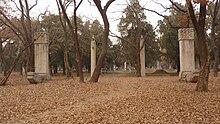
The northern quarters of the Cemetery of Confucius - Tai Shan, sacred mountain, in Tai'an
- Temple and Cemetery of Confucius, and the Kong Family Mansion in Qufu
- Weifang has numerous natural and historic sites, such as Shihu Garden (from the Late Ming and early Qing dynasty), Fangong Pavilion (from the Song dynasty), fossil sites (including dinosaur fossils, in Shanwang, Linqu), Mount Yi National Forest Park and Mount Qingyun. Yangjiabu has painted New Year woodcuts, which are also famous all around China.

Five-Year Clean Heating Plan[edit]
In 2017 air pollution contributed to about 21% of deaths in China.[66] In 2017, the Chinese government began a five-year plan to convert half of northern China to clean energy for winter heating.[67] Haiyang city is expected to convert completely to nuclear power by 2021,[68] reducing fossil fuel emissions by more than 60,000 tons annually.[69]
Education[edit]
Colleges and universities[edit]
Shandong is considered one of China's leading provinces in education and research. Shandong hosts 153 higher education institutions, ranking second in the East China region after Jiangsu and fourth among all Chinese provinces/municipalities after Jiangsu, Guangdong and Henan.[16]
As of 2023, two major cities in the province ranked in the top 50 cities in the world (Jinan 32nd and Qingdao 43rd) by scientific research output, as tracked by the Nature Index.[17]
- Shandong University (Jinan)
- Ocean University of China (Qingdao)
- China University of Petroleum (Dongying and Qingdao)
- University of Jinan (Jinan)
- Shandong Normal University
- Shandong Agricultural University (Tai'an)
- Shandong University of Finance and Economics (Jinan)
- Shandong University of Traditional Chinese Medicine (Jinan)
- Harbin Institute of Technology (Weihai)
- China Agricultural University (Yantai)
- Harbin University of Science and Technology (Weihai)
- Yantai University (Yantai)
- Qufu Normal University (Qufu)
- Qingdao University (Qingdao)
- Shandong University of Science and Technology (Qingdao)
- Shandong University of Technology (Zibo)
- Liaocheng University (Liaocheng)
- Linyi University (Linyi)
- Qingdao Agricultural University (Qingdao)
- Binzhou Medical College (Binzhou)
- Jining Medical University (Jining)
- Weifang Medical University (Weifang)
- Weifang University (Weifang)
- Shandong Institute of Business and Technology (Yantai)
- Shandong Women's University (Jinan)
- Qingdao Technical College (Qingdao)
- Rizhao Polytechnic (Rizhao)
- Zibo Vocational Institute (Zibo)
- Qingdao Binhai University (Qingdao)
- Shandong Foreign Languages Vocational College (Rizhao)
Sports[edit]

Events held in Shandong[edit]
- 2009 National Games of China
- 2002 Table Tennis World Cup
- 2004 AFC Asian Cup
- 2007 A3 Champions Cup
- Sailing at the 2008 Summer Olympics and Paralympics
- 2011 Sudirman Cup
- 2012 Badminton Asia Championships
- 2012 Asian Beach Games
Professional sports teams based in Shandong[edit]
Former professional sports teams based in Shandong[edit]
- Jinan Xingzhou
- Qingdao Haisha
- Qingdao Sunrise
- Qingdao Hailifeng
- Qingdao Huanghai
- Jining Dranix
- Shandong Tengding
- Yantai Yiteng F.C.
See also[edit]
- Major national historical and cultural sites in Shandong
- Shandong people
- Shantungosaurus
- Shantung Problem
- East Asian snowstorms of 2009–2010
- East Asian snowstorms of late 2009
Notes[edit]
- ^ Purchasing power parity of Chinese Yuan, as Int'l.dollar based on IMF WEO October 2017. Purchasing power parity (PPP) for Chinese yuan is estimate according to IMF WEO[32] data; Exchange rate of CN¥ to US$ is according to State Administration of Foreign Exchange, published in the China Statistical Yearbook.[33]
- ^ The data was collected by the Chinese General Social Survey (CGSS) of 2009 and by the Chinese Spiritual Life Survey (CSLS) of 2007, reported and assembled by Xiuhua Wang (2015)[52] in order to confront the proportion of people identifying with two similar social structures: ① Christian churches, and ② the traditional Chinese religion of the lineage (i. e. people believing and worshipping ancestral deities often organised into lineage "churches" and ancestral shrines). Data for other religions with a significant presence in China (deity cults, Buddhism, Taoism, folk religious sects, Islam, et al.) was not reported by Wang. The number of Muslims is taken from a survey reported in the year 2010.[53]
- ^ This may include:
- Buddhists
- Confucians
- Deity worshippers
- Taoists
- Members of folk religious sects
- People not bounded to, nor practicing any, institutional or diffuse religion
References[edit]
- ^ "Назначены новые секретари парткомов провинций Шаньдун и Шаньси" (in Russian). dknews.kz. 30 December 2022. Archived from the original on 30 December 2022.
- ^ "Doing Business in China - Survey". Ministry Of Commerce - People's Republic Of China. n.d. Archived from the original on 16 October 2015. Retrieved 5 August 2013.
- ^ "Communiqué of the Seventh National Population Census (No. 3)". National Bureau of Statistics of China. 11 May 2021. Archived from the original on 11 May 2021. Retrieved 11 May 2021.
- ^ "山东省2021年GDP突破8.3万亿,同比增长8.3%" (in Chinese). SD News. 20 January 2022. Archived from the original on 23 January 2022. Retrieved 9 August 2022.
- ^ "Subnational HDI (v5.0)". Global Data Lab. 2019. Archived from the original on 23 September 2018. Retrieved 1 January 2022.
- ^ "Shandong". Lexico UK English Dictionary. Oxford University Press. Archived from the original on 18 May 2021.
- ^ "Shandong". Merriam-Webster.com Dictionary.
- ^ Tian Xia; Bai Bo (2005). Atlas of World Heritage—China. Long River Press. p. 70. ISBN 9781592650606.
- ^ "Mount Taishan". UNESCO World Heritage Convention. n.d. Archived from the original on 21 November 2020. Retrieved 30 September 2019.
- ^ Kelly, Margaret, ed. (2007). China. Fodor's Travel Publications. p. 157. ISBN 9781400017317.
- ^ Berling, Judith A. (n.d.). "Confucianism". Asia Society. Archived from the original on 16 November 2020. Retrieved 9 August 2022.
- ^ "Main Data of the Seventh National Population Census". National Bureau of Statistics of China. 11 May 2021. Archived from the original on 11 May 2021.
- ^ a b "Decoding China's 2021 GDP Growth Rate: A Look at Regional Numbers". China Briefing News. 7 February 2022. Archived from the original on 19 August 2022. Retrieved 15 September 2022.
- ^ a b "GDP (current US$) - Mexico | Data". data.worldbank.org. Archived from the original on 15 September 2022. Retrieved 15 September 2022.
- ^ a b "GDP (current US$) | Data". data.worldbank.org. Archived from the original on 15 September 2022. Retrieved 15 September 2022.
- ^ a b ""List of National Colleges and Universities - Government Portal of the Ministry of Education of the People's Republic of China"". Ministry of Education of the People's Republic of China. Archived from the original on 19 June 2022. Retrieved 7 November 2022.
- ^ a b "Leading 200 science cities | Nature Index 2023 Science Cities | Supplements | Nature Index". www.nature.com. Archived from the original on 22 November 2023. Retrieved 22 November 2023.
- ^ (in Chinese)
- ^ "趣味文字:中国各省及自治区名称历史由来和变化" (in Chinese). People's Daily Online. 4 July 2004. Archived from the original on 18 February 2020. Retrieved 9 August 2022.
- ^ a b Roberts, Edmund (1837). Embassy to the eastern courts of Cochin-China, Siam, and Muscat; in the U.S. sloop-of-war Peacock ... during the years 1832-3-4. Harper & Brothers. pp. 122–123. ISBN 9781400017317. LCCN 05012055. Archived from the original on 26 March 2023. Retrieved 9 August 2022.
- ^ "25 July 1668 Tancheng (Shandong)". GHEA. Archived from the original on 23 July 2021. Retrieved 8 December 2023.
- ^ "CHINA: SHANDONG PROVINCE". National Geophysical Data Center. Archived from the original on 25 July 2021. Retrieved 8 December 2023.
- ^ Burkman, Thomas W. (2008). Japan and the League of Nations: Empire and World Order, 1914–1938. University of Hawaii Press. p. 4. doi:10.2307/j.ctt6wqrcq. ISBN 9780824829827. JSTOR j.ctt6wqrcq. Archived from the original on 9 August 2022. Retrieved 9 August 2022.
- ^ Craft, Stephen G. (1997). "John Bassett Moore, Robert Lansing, and the Shandong Question". Pacific Historical Review. 66 (2): 231–249. doi:10.2307/3640629. JSTOR 3640629. Archived from the original on 9 August 2022. Retrieved 9 August 2022.
- ^ "CHINA: Basest War Lord". TIME. 7 March 1927. Archived from the original on 25 November 2010. Retrieved 9 August 2022.
- ^ Gu Chang-Sheng (2009). Awaken: Memoirs of a Chinese Historian. pp. 130–131.
- ^ Jackson, Steve (31 December 2008). "China finds major dinosaur site". BBC News. Archived from the original on 7 October 2023. Retrieved 9 August 2022.
- ^ Fresh Garlic from China, Inv. 731-TA-683 (Second Review). DIANE Publishing. n.d. p. I-24. ISBN 9781457818745.
- ^ "Location and how discovered". China Sapphire. n.d. Archived from the original on 3 July 2007. Retrieved 5 January 2009.
- ^ a b "Shandong Province". The China Perspective. n.d. Archived from the original on 5 March 2012. Retrieved 9 August 2022.
- ^ "关于将研究与开发支出计入生产总值核算修订生产总值核算数据的公告" (in Chinese). Shandong Provincial Bureau of Statistics. 13 October 2017. Archived from the original on 27 December 2017. Retrieved 9 August 2022.
- ^ "The World Economic Outlook Database". International Monetary Fund. 2021. Archived from the original on 26 November 2020. Retrieved 9 August 2022.
- ^ "Annual Data". National Bureau of Statistics of China. n.d. Archived from the original on 20 October 2015. Retrieved 9 August 2022.
- ^ "The wine output of Yantai will reach 230000 kiloliters in 2008". China Wines Information Website. 30 December 2008. Archived from the original on 15 February 2009. Retrieved 28 June 2009.
- ^ "Ji'nan Export Processing Zone". RightSite.Asia. n.d. Archived from the original on 11 January 2010. Retrieved 9 August 2022.
- ^ "Qingdao Economic and Technical Development Zone". RightSite.Asia. n.d. Archived from the original on 7 February 2010. Retrieved 9 August 2022.
- ^ "Qingdao Hi-Tech Industrial Development Zone". RightSite.Asia. n.d. Archived from the original on 20 November 2009. Retrieved 9 August 2022.
- ^ "Weihai Torch Hi-Tech Science Park". RightSite.Asia. n.d. Archived from the original on 3 March 2010. Retrieved 9 August 2022.
- ^ "Yantai Economic and Technological Development Area". RightSide.Asia. n.d. Archived from the original on 9 February 2010. Retrieved 9 August 2022.
- ^ "Yantai Export Processing Zone". RightSite.Asia. n.d. Archived from the original on 10 May 2010. Retrieved 9 August 2022.
- ^ "付表2 1912年中国人口(統計)" (in Japanese). ier.hit-u.ac.jp. n.d. Archived from the original on 24 September 2015. Retrieved 6 March 2014.
- ^ "付表3 1928年中国人口(統計)" (in Japanese). ier.hit-u.ac.jp. n.d. Archived from the original on 24 September 2015. Retrieved 6 March 2014.
- ^ "付表4 1936-37年の中国人口(統計)" (in Japanese). ier.hit-u.ac.jp. n.d. Archived from the original on 24 September 2015. Retrieved 6 March 2014.
- ^ "付表5 1947年全国人口(統計)" (in Japanese). ier.hit-u.ac.jp. n.d. Archived from the original on 13 September 2013. Retrieved 6 March 2014.
- ^ "中华人民共和国国家统计局关于第一次全国人口调查登记结果的公报" (in Chinese). National Bureau of Statistics of China. n.d. Archived from the original on 5 August 2009. Retrieved 6 March 2014.
- ^ "第二次全国人口普查结果的几项主要统计数字" (in Chinese). National Bureau of Statistics of China. n.d. Archived from the original on 14 September 2012. Retrieved 6 March 2014.
- ^ "中华人民共和国国家统计局关于一九八二年人口普查主要数字的公报" (in Chinese). National Bureau of Statistics of China. n.d. Archived from the original on 10 May 2012. Retrieved 6 March 2014.
- ^ "中华人民共和国国家统计局关于一九九○年人口普查主要数据的公报" (in Chinese). National Bureau of Statistics of China. n.d. Archived from the original on 19 June 2012. Retrieved 6 March 2014.
- ^ "现将2000年第五次全国人口普查快速汇总的人口地区分布数据公布如下" (in Chinese). National Bureau of Statistics of China. n.d. Archived from the original on 29 August 2012. Retrieved 6 March 2014.
- ^ "Communiqué of the National Bureau of Statistics of People's Republic of China on Major Figures of the 2010 Population Census[1] (No. 2)". National Bureau of Statistics of China. 29 April 2011. Archived from the original on 27 July 2013. Retrieved 6 March 2014.
- ^ "山东18岁男女平均身高出炉!烟台人竟然5年前就完爆这一数据!" (in Chinese). Chuan Song. 12 August 2016. Archived from the original on 29 April 2018. Retrieved 29 April 2018.
- ^ a b c d Wang, Xiuhua (2015). "Four" (PDF). Explaining Christianity in China: Why a Foreign Religion has Taken Root in Unfertile Ground (Master's thesis). Baylor University. p. 15. Archived (PDF) from the original on 9 August 2022. Retrieved 9 August 2022.
- ^ a b Min Junqing (2010). "The Present Situation and Characteristics of Contemporary Islam in China" (PDF). JISMOR: 29. Archived (PDF) from the original on 9 August 2022. Retrieved 9 August 2022.
- ^ Yang Zongde (2010). "Study on Current Muslim Population in China". Jinan Muslim (2).
- ^ Csikszentmihalyi, Mark (31 March 2020). "Confucius". Stanford Encyclopedia of Philosophy. Archived from the original on 20 May 2022. Retrieved 9 August 2022.
- ^ Richey, Jeff (n.d.). "Confucius (551—479 B.C.E.)". Internet Encyclopedia of Philosophy. Archived from the original on 19 November 2016. Retrieved 7 December 2016.
- ^ "Temple and Cemetery of Confucius and the Kong Family Mansion in Qufu". UNESCO. n.d. Archived from the original on 28 December 2019. Retrieved 7 December 2016.
- ^ "The Confucian Temple, Cemetery and Family Mansion in Qufu". China Through a Lens. 12 September 2003. Archived from the original on 8 May 2016. Retrieved 7 December 2016.
- ^ "2014年12月中华人民共和国县以上行政区划代码" (in Simplified Chinese). Ministry of Civil Affairs. n.d. Archived from the original on 2 April 2015. Retrieved 9 August 2022.
- ^ 深圳统计年鉴2014 (in Chinese). China Statistics Print. 2014. Archived from the original on 12 May 2015.
- ^ Census Office of the State Council of the People's Republic of China; Population and Employment Statistics Division of the National Bureau of Statistics of the People's Republic of China (2012). 中国2010人口普查分乡、镇、街道资料 (in Chinese) (1 ed.). China Statistics Print. ISBN 978-7-5037-6660-2.
- ^ Ministry of Civil Affairs (2014). 中国民政统计年鉴2014 (in Chinese). China Statistics Print.
- ^ a b c 国务院人口普查办公室、国家统计局人口和社会科技统计司编 (2012). 中国2010年人口普查分县资料 (in Chinese). China Statistics Print. ISBN 978-7-5037-6659-6.
- ^ Ministry of Housing and Urban-Rural Development of the People's Republic of China (2019). 中国城市建设统计年鉴2018 [China Urban Construction Statistical Yearbook 2018] (in Chinese). China Statistics Print. Archived from the original on 10 August 2021. Retrieved 30 November 2021.
- ^ Swanson, Lauren A. (July 1996). "1.19850+ billion mouths to feed: food linguistics and cross-cultural, cross-"national" food consumption habits in China". British Food Journal. 98 (6): 33–44. doi:10.1108/00070709610131357. ISSN 0007-070X. Archived from the original on 30 November 2021. Retrieved 30 November 2021.
- ^ Yan, Alice (20 October 2017). "Pollution claims 1.8 million lives in China, latest research says". South China Morning Post. Archived from the original on 12 November 2020. Retrieved 30 November 2020.
- ^ "China unveils 2017-2021 winter clean heating plan: media". Reuters. 16 December 2017. Archived from the original on 9 August 2022. Retrieved 1 December 2020.
- ^ "Haiyang begins commercial-scale district heat supply : New Nuclear - World Nuclear News". www.world-nuclear-news.org. Archived from the original on 7 April 2022. Retrieved 1 December 2020.
- ^ "Aluminum Rises and Shines". Chemical & Engineering News. 34 (37): 4350. 10 September 1956. doi:10.1021/cen-v034n037.p4350. ISSN 0009-2347. Archived from the original on 3 April 2024. Retrieved 1 December 2020.
Sources[edit]
- China's agricultural export powerhouse faces grim year - Business - Chinadaily.com.cn Archived June 30, 2017, at the Wayback Machine
- Economic profile for Shandong Archived September 21, 2008, at the Wayback Machine at HKTDC
External links[edit]

 Shandong travel guide from Wikivoyage
- (in Chinese) Shandong Government website
- (in English and Chinese) Complete Map of the Seven Coastal Provinces from 1821 to 1850
- Shandong Article Encyclopædia Britannica


| International | |
|---|---|
| National | |
| Geographic | |

