Kabul, Israel
Kabul
| |
|---|---|
Local council (from 1974) | |
| Hebrew transcription(s) | |
| • ISO 259 | Kabbul |
| • Also spelled | al-Kabul (official) |
 | |
  Kabul  Kabul | |
| Coordinates: 32°52′11″N 35°12′8″E / 32.86972°N 35.20222°E | |
| Grid position | 170/252 PAL |
| Country |  Israel Israel |
| District | Northern |
| Founded | 1200 BCE (Biblical Cabul) |
| Government | |
| • Head of Municipality | Nader Taha |
| Area | |
| • Total | 7,149 dunams (7.149 km2 or 2.760 sq mi) |
| Population (2022)[1] | |
| • Total | 14,628 |
| • Density | 2,000/km2 (5,300/sq mi) |
| Name meaning | (1) from Kabul, a personal name;[2] (2) (Phoenician) = "what does not please"[3] |
Kabul (Arabic: كابول, Hebrew: כָּבּוּל) is an Arab town in the Northern District of Israel, located 14 kilometres (8.7 mi) southeast of Acre and north of Shefa-'Amr. In 2022 it had a population of 14,628.[1]
History[edit]
Classical era[edit]
Kabul is probably the Biblical Cabul mentioned in the Book of Joshua.[4]
Fragments of pottery from the Persian period have been found in Kabul,[5] as well as excavated burial chambers, used from the 1st to the 4th centuries.[6]
During the Second Temple there was a division of kohanim and the name of their head is Shecania. All divisions are described in Chronicles
In Roman times, Josephus calls the town "Chabolo" and camped there. He described it as a post from which incursions were made into the Galilee.[7]
Potsherds dating from the end of the Hellenistic–Early Roman period, Roman, and Byzantine periods have been found.[8][9][10] and bathhouse dating from the Byzantine era, and used well into the Umayyad era, have been excavated.[11]
Middle Ages[edit]
Al-Muqaddasi visited Kabul in 985 CE, while it was under Abbasid rule. He writes that "it is a town in the coastal district. It has fields of sugarcanes, and they make the best sugar—better than in all the rest of Syria."[12][13] Ali of Herat reports in 1173 that two sons of Jacob are buried in the town, namely Reuben and Simeon.[12] Kabul was one of the principal cities of Jund al-Urrdun.[14]
Its Crusader name was "Cabor".[15]
Remains of a building dating to the Mamluk period was excavated in 1999.[8]
Ottoman Empire[edit]
In 1517, Kabul was incorporated into the Ottoman Empire. In 1596, the village appeared in Ottoman tax registers as being in the Nahiya of Acre, part of Safad Sanjak, with a population of 40 Muslim households, 9 Muslim bachelors, 14 Jewish households and 1 Jewish bachelor. The villagers paid a fixed tax rate of 25% on wheat, barley, fruit trees, cotton, and bees, in addition to "occasional revenues"; a total of 7,926 akçe.[16][17]
In 1859, the population was estimated to be 400 people, with 30 feddans as tillage.[18]
The French explorer Victor Guérin visited in 1875, and noted "on the sides and top of the hill are found many rock-cut cisterns, a great many cut stones scattered here and there or built up in modern houses, fragments of columns, the vestiges of a surrounding wall, and remains of sarcophagi adorned with discs and garlands."[19]
In 1881, the Palestine Exploration Fund's Survey of Western Palestine described Kabul as a moderate sized village, with olives to the north and south.[18]
A population list from about 1887 showed that Kabul had about 415 inhabitants; all Muslims.[20]
British Mandate[edit]
In the 1922 census of Palestine conducted by the British Mandate authorities, Kabul had a population of 365 Muslims,[21] increasing at the time of the 1931 census to 457, still all Muslims, in 100 houses.[22]
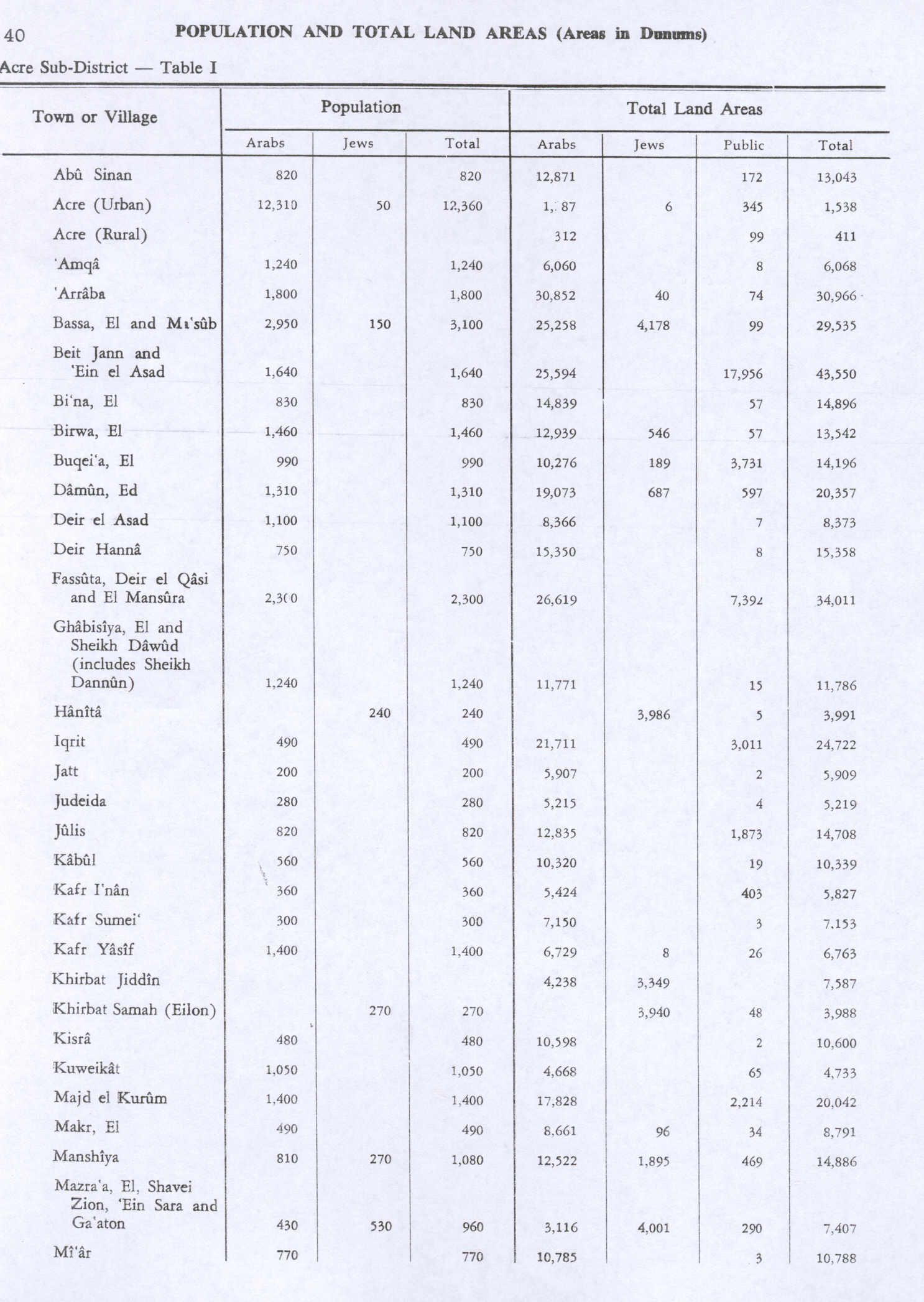
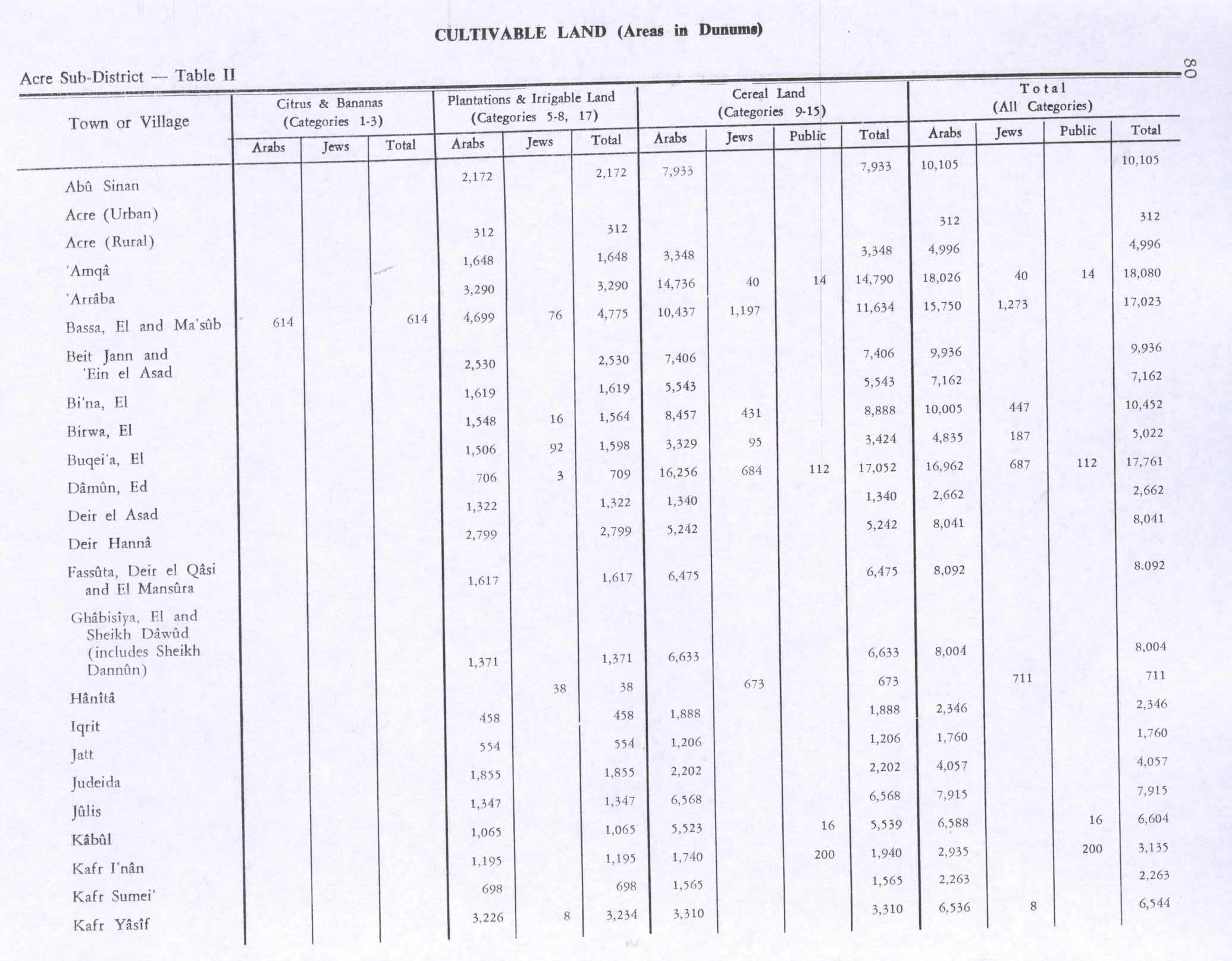
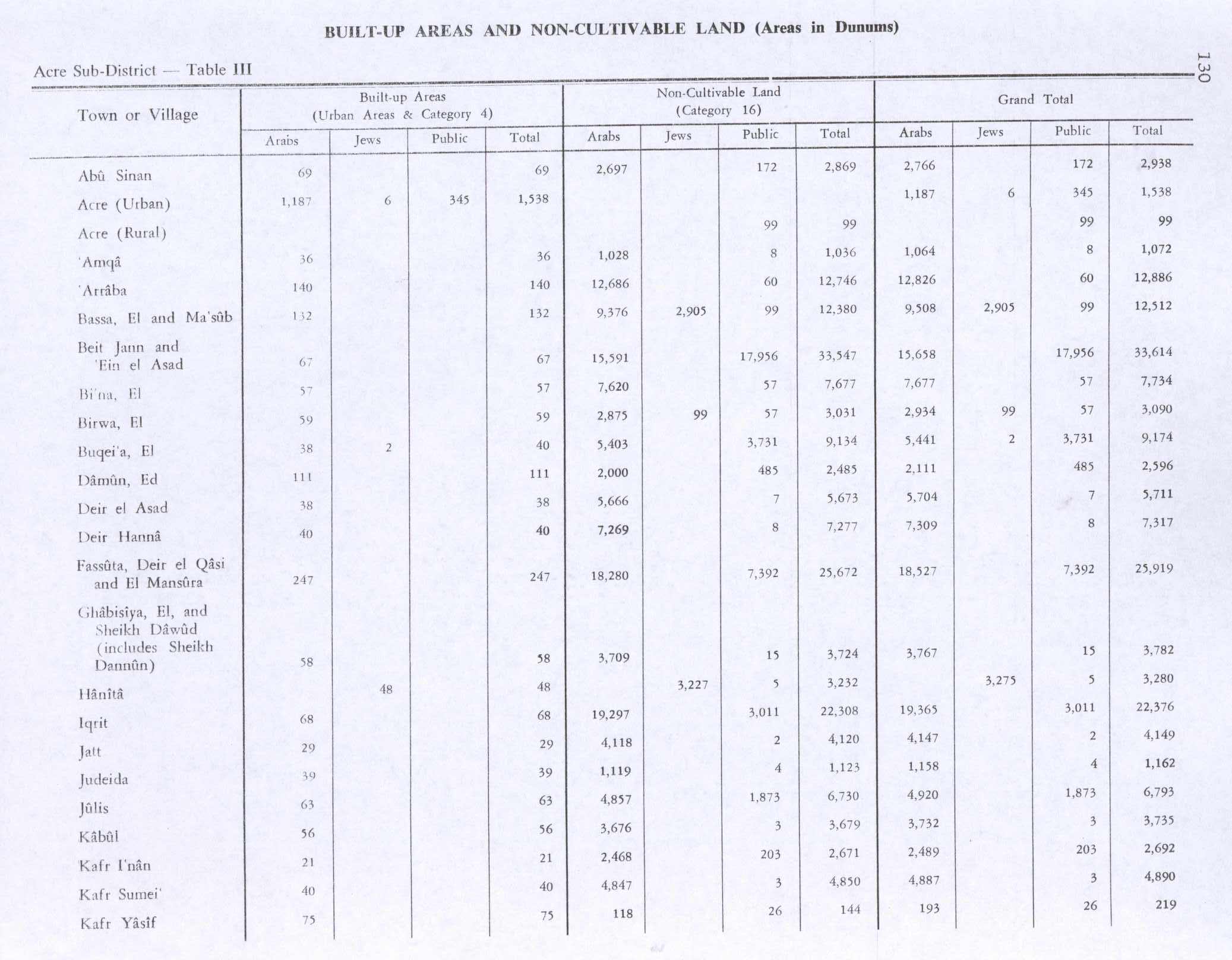
In the 1945 statistics the population was 560 Muslims,[23] while the total land area was 10,399 dunams, according to an official land and population survey.[24] Of this, 1,065 were allocated for plantations and irrigable land, 5,539 for cereals,[25] while 56 dunams were classified as built-up areas.[26]
Israel[edit]
The village was captured by Israel on 15 July 1948 during Operation Dekel by the Sheva Brigade. Israeli forces did not attack Kabul and very few of Kabul's residents fled the village. On 8 January 1949, villagers from Kabul with others from I'billin were amongst a group of Arabs, 97 men with 31 women and children, who were expelled to the West Bank at 'Ara.[27] All the Arab villages in the Galilee remained under Martial Law until 1966. Anyone not registered in the November 1948 census was "illegal" and could be deported. Kabul Was Also One Of 6 Towns in The Galilee to have a curfew imposed on it in the events of the 29th of March 1976 Land Day
Currently, there are five mosques in the town.[28] In 1974, it received the status of local council by the Israeli government.[29]
Demographics[edit]
In 1859 the population was estimated as being 400.[18] In a 1922 census by the British Mandate of Palestine, Kabul had 365 inhabitants, rising to 457 in 1931. According to the Israel Central Bureau of Statistics, the town of Kabul had a population of 7,134 in 1995, rising to 9,400 in 2005. Its inhabitants are mostly Muslims. Kabul's prominent families are Rayan, Hamoud, Taha, Morad, Hamdony, Ibrahim, Hebi, Uthman, Ashkar, Sharari, Akari, Badran and Bouqai. The town hosts a large number of Internally displaced Palestinians from the nearby destroyed villages of al-Birwa, al-Damun, Mi'ar and al-Ruways.[30] All of the inhabitants are Arab citizens of Israel, mostly adherents of Islam.[29]
_5_crop.jpg)
See also[edit]
References[edit]
- ^ a b "Regional Statistics". Israel Central Bureau of Statistics. Retrieved 21 March 2024.
- ^ Palmer, 1881, p. 110
- ^ Josephus, Antiquities 8.5.3. (8.141)
- ^ Tsafrir et al, TIR, 1994, pp. 102−103
- ^ Abu Raya, 2013, Kabul -final report
- ^ Dauphin, 1998, p. 663
- ^ Robinson, 1856, p. 88.
- ^ a b Abu-‘Uqsa, 2007, Kabul
- ^ Zidan and Alexandre, 2012, Kabul
- ^ In 2010, an archaeological survey of Kabul was conducted by Omar Zidan on behalf of the Israel Antiquities Authority (IAA), Excavators and Excavations Permit for Year 2010, Survey Permit # A-5956
- ^ Abu Raya, 2013, Kabul
- ^ a b Le Strange, 1890, p. 467
- ^ Al-Muqaddasi, 1886, p. 29
- ^ Le Strange, 1890, p. 39
- ^ Pringle, 1993, p. 283
- ^ Hütteroth and Abdulfattah, 1977, p. 193
- ^ Note that Rhode, 1979, p. 6 writes that the register that Hütteroth and Abdulfattah studied was not from 1595/6, but from 1548/9.
- ^ a b c Conder and Kitchener, 1881, SWP I, p. 271
- ^ Guérin, 1880, pp. 422-423; as translated by Conder and Kitchener, 1881, SWP I, p. 308
- ^ Schumacher, 1888, p. 176
- ^ Barron, 1923, Table XI, Sub-district of Acre, p. 37
- ^ Mills, 1932, p. 101
- ^ Department of Statistics, 1945, p. 4
- ^ Government of Palestine, Department of Statistics. Village Statistics, April, 1945. Quoted in Hadawi, 1970, p. 40
- ^ Government of Palestine, Department of Statistics. Village Statistics, April, 1945. Quoted in Hadawi, 1970, p. 80
- ^ Government of Palestine, Department of Statistics. Village Statistics, April, 1945. Quoted in Hadawi, 1970, p. 130
- ^ Morris, 1993, p. 145
- ^ Welcome to Kabul Palestine Remembered.
- ^ a b Gutterman, Dov. Kabul (Israel) CRW Flags.
- ^ Palestinian Internally Displaced Persons inside Israel: Challenging the Solid Structures BADIL, p.5. Archived December 14, 2004, at the Wayback Machine
Bibliography[edit]
- Abu Raya, Rafeh (2013-03-06). "Kabul" (125). Hadashot Arkheologiyot – Excavations and Surveys in Israel.
{{cite journal}}: Cite journal requires|journal=(help) - Abu Raya, Rafeh (2013-07-18). "Kabul -final report" (125). Hadashot Arkheologiyot – Excavations and Surveys in Israel.
{{cite journal}}: Cite journal requires|journal=(help) - Abu-‘Uqsa, Hanaa (2007-07-24). "Kabul" (119). Hadashot Arkheologiyot – Excavations and Surveys in Israel.
{{cite journal}}: Cite journal requires|journal=(help) - Barron, J. B., ed. (1923). Palestine: Report and General Abstracts of the Census of 1922. Government of Palestine.
- Conder, C.R.; Kitchener, H.H. (1881). The Survey of Western Palestine: Memoirs of the Topography, Orography, Hydrography, and Archaeology. Vol. 1. London: Committee of the Palestine Exploration Fund.
- Dauphin, C. (1998). La Palestine byzantine, Peuplement et Populations. BAR International Series 726 (in French). Vol. III : Catalogue. Oxford: Archeopress. ISBN 0-860549-05-4.
- Department of Statistics (1945). Village Statistics, April, 1945. Government of Palestine.
- Ellenblum, R. (2003). Frankish Rural Settlement in the Latin Kingdom of Jerusalem. Cambridge University Press. ISBN 9780521521871. (pp. 103(?), 129, 154, 194-197, 200, 202)
- Guérin, V. (1880). Description Géographique Historique et Archéologique de la Palestine (in French). Vol. 3: Galilee, pt. 1. Paris: L'Imprimerie Nationale.
- Hadawi, S. (1970). Village Statistics of 1945: A Classification of Land and Area ownership in Palestine. Palestine Liberation Organization Research Center.
- Hütteroth, Wolf-Dieter; Abdulfattah, Kamal (1977). Historical Geography of Palestine, Transjordan and Southern Syria in the Late 16th Century. Erlanger Geographische Arbeiten, Sonderband 5. Erlangen, Germany: Vorstand der Fränkischen Geographischen Gesellschaft. ISBN 3-920405-41-2.
- Le Strange, G. (1890). Palestine Under the Moslems: A Description of Syria and the Holy Land from A.D. 650 to 1500. Committee of the Palestine Exploration Fund.
- Mills, E., ed. (1932). Census of Palestine 1931. Population of Villages, Towns and Administrative Areas. Jerusalem: Government of Palestine.
- Morris, B. (1993). Israel's Border Wars, 1949 - 1956. Arab Infiltration, Israeli Retaliation, and the Countdown to the Suez War. Oxford University Press. ISBN 0-19-827850-0.
- Mukaddasi (1886). Description of Syria, including Palestine. London: Palestine Pilgrims' Text Society. ( pp. 11, 85)
- Palmer, E.H. (1881). The Survey of Western Palestine: Arabic and English Name Lists Collected During the Survey by Lieutenants Conder and Kitchener, R. E. Transliterated and Explained by E.H. Palmer. Committee of the Palestine Exploration Fund.
- Petersen, Andrew (2001). A Gazetteer of Buildings in Muslim Palestine (British Academy Monographs in Archaeology). Vol. 1. Oxford University Press. ISBN 978-0-19-727011-0. p. 192-3
- Pringle, D. (1993). The Churches of the Crusader Kingdom of Jerusalem: Volume I A-K (excluding Acre and Jerusalem). Cambridge University Press. ISBN 0-521-39036-2.
- Rhode, H. (1979). Administration and Population of the Sancak of Safed in the Sixteenth Century (PhD). Columbia University.
- Robinson, E.; Smith, E. (1856). Later Biblical Researches in Palestine and adjacent regions: A Journal of Travels in the year 1852. London: John Murray.
- Schumacher, G. (1888). "Population list of the Liwa of Akka". Quarterly Statement - Palestine Exploration Fund. 20: 169–191.
- Tsafrir, Y.; Leah Di Segni; Judith Green (1994). (TIR): Tabula Imperii Romani: Judaea, Palaestina. Jerusalem: Israel Academy of Sciences and Humanities. ISBN 965-208-107-8.
- Zidan, Omar; Alexandre, Yardenna (2012-12-31). "Kabul -final report" (124). Hadashot Arkheologiyot – Excavations and Surveys in Israel.
{{cite journal}}: Cite journal requires|journal=(help)
External links[edit]
- Welcome To Kabul
- Survey of Western Palestine, Map 5: IAA, Wikimedia commons


| Cities | .svg) | ||||
|---|---|---|---|---|---|
| Local councils |
| ||||
| Regional councils |
| ||||
| International | |
|---|---|
| National | |