


Kingdom of Georgia
Kingdom of Georgia საქართველოს სამეფო sakartvelos samepo | |
|---|---|
| 1008–1490 | |
  Flags of Georgia of the 14th–15th centuries according to Dulcert, the Pizzigano brothers and others[3]
![Coat of arms of "All-Georgian Kingdom" according to Prince Vakhushti's Atlas (c. 1745) Coat of arms of the "Kingdom of Georgia under Khan" according to Grünenberg Wappenbuch (1480)[1][2] of Kingdom of Georgia](/wiki/File:Kingdom_of_Georgia_coat_of_arms.svg) Coat of arms of "All-Georgian Kingdom" according to Prince Vakhushti's Atlas (c. 1745)
 | |
_Sphere_of_influence.png) Kingdom of Georgia in ~1220, at the peak of its territorial expansion. | |
 Administrative division of the Kingdom of Georgia in the 13th century | |
| Capital | |
| Common languages | Middle Georgian Greek[4] Laz Armenian[5] Arabic(lingua franca/numismatics/chancery)[6][7] Persian(numismatics)[8] |
| Religion | Eastern Orthodoxy (Georgian Patriarchate) |
| Government | Feudal monarchy |
| King | |
• 1008–1014 (first) | Bagrat III |
• 1446–1465 (last) | George VIII |
| Legislature | Council of State |
| Historical era | High Middle Ages to Late Middle Ages |
| c. 1008 | |
| 1122–1226 | |
| 1245–1247 | |
• East and West division | 1247–1329 |
• Reunification | 1329 |
1463 1490[a] | |
| Currency | Various Byzantine and Sassanian coins were minted until the 12th century. |
1the full title of the Georgian monarchs after 1124 was "King of Kings, Autocrat of all the East and the West, Sword of the Messiah, King of Abkhazia, King of Iberia, King of Kakheti and Hereti, King of Armenia, Possessor of Shirvan." | |

| Part of a series on the |
| History of Georgia |
|---|
.jpg) |
The Kingdom of Georgia (Georgian: საქართველოს სამეფო, romanized: sakartvelos samepo), also known as the Georgian Empire,[9] was a medieval Eurasian monarchy that was founded in c. 1008 AD. It reached its Golden Age of political and economic strength during the reign of King David IV and Queen Tamar the Great from the 11th to 13th centuries. Georgia became one of the pre-eminent nations of the Christian East and its pan-Caucasian empire[10] and network of tributaries stretching from Eastern Europe to Anatolia and northern frontiers of Iran, while also maintaining religious possessions abroad, such as the Monastery of the Cross in Jerusalem and the Monastery of Iviron in Greece. It is the principal historical precursor of present-day Georgia.
Lasting for several centuries, the kingdom fell to the Mongol invasions in the 13th century, but managed to re-assert sovereignty by the 1340s. The following decades were marked by the Black Death, as well as numerous invasions under the leadership of Timur, who devastated the country's economy, population, and urban centers. The Kingdom's geopolitical situation further worsened after the conquest of the Byzantine Empire and the Empire of Trebizond by the Ottoman Turks. As a result of these processes, by the end of the 15th century Georgia turned into a fractured entity. This whole series of events also led to the final collapse of the kingdom into anarchy by 1466 and the mutual recognition of its constituent kingdoms of Kartli, Kakheti, and Imereti as independent states between 1490 and 1493—each led by a rival branch of the Bagrationi dynasty, and into five semi-independent principalities—Odishi, Guria, Abkhazia, Svaneti, and Samtskhe.
Background[edit]
Early Georgian kingdoms were reduced to feudal regions over the course of the Roman–Persian wars. The area then fell under the control of the early Muslim conquests of the 7th century.
Iberian princes from the Bagrationi dynasty fought against the Arab occupation and came to rule the Tao-Klarjeti region. They established the Kouropalatate of Iberia as a nominal vassal of the Byzantine Empire. By 888, they had gained control of the central Georgian land, Kartli, and restored the Iberian kingship. The Bagrationi dynasty was unable to maintain their kingdom, and it was divided between the three branches of the family. The main branch controlled Tao, while another controlled Klarjeti.
In 736, Marwan ibn Muhammad's invasion of Georgia was repelled by Abkhazians, Lazic and Iberian allies. This successful defense along with increasing struggles against Byzantium helped lead to a process of unification of the Georgian states into a single feudal monarchy. The Georgian Church broke away from Constantinople in the 9th century, instead recognizing the authority of the Catholicate of Mtskheta. The church language was changed from Greek to Georgian.[11]
History[edit]
Unification of the Georgian State[edit]
.jpg)

During the 10th century, David III of Tao invaded the Duchy of Kartli, giving it to his adopted son, who would later be known as Bagrat III of Georgia, with his biological father, Gurgen of Iberia, as regent. In 994, Gurgen was crowned King of the Iberians. In 975, supported by the Duke of Kartli Ivane Marushisdze and David, Bagrat claimed the throne of Kartli,[12]: 108 becoming King of the Kartlians. During this time, the Kingdom of Abkhazia in what is today northeastern Georgia was under the rule of Theodosius the Blind, who did away with Abkhazian traditions. In 978, the Abkhazian aristocracy, dissatisfied with the rule of Theodosius, performed a coup d'état and invited Bagrat to claim the throne of Abkhazia.[13]: 67–68
Gurgen died in 1008, leaving his throne for Bagrat, allowing Bagrat to become the first king of a unified Abkhazia and Iberia. In his early reign, Bagrat pressed a claim to the kingdom of Khakheti-Hereti to the east, and annexed it in 1010. Bagrat also reduced the autonomy of dynastic princes to stabilize his realm, with his fears focusing on the Klarjeti line of the Bagrationi. In order to secure the throne for his son, George I of Georgia, Bagrat tricked his cousins into a meeting and imprisoned them, and his cousins' children fled to Constantinople, where they requested the aid of the Byzantine Empire to take back their patrimonial land.[14]
Bagrat's reign secured a victory for the Bagratids of Georgia, ending the power-struggles that had plagued the region for centuries. Bagrat had a peaceful foreign policy, successfully avoiding conflicts with the Byzantines and nearby Muslim realms, even though some of David's territory, such as Tao and Tbilisi, remained in Byzantine and Arab control, respectively.
War and peace with Byzantium[edit]

George I's reign was known primarily for its war against the Byzantines. This war had its roots in the 990s, when David III, after losing a rebellion against the Byzantine Emperor Basil II, agreed to cede his lands in Tao to the emperor upon his death. George I, in an attempt to take back the Kuropalates' land, occupied Tao starting from 1015 or 1016, during a Byzantine war with the Bulgarian Empire. When Bulgaria was dealt with in 1021, Basil II turned his attention to Georgia, leading to a two-year-long war and an eventual Byzantine victory. George, as a result, had to abandon his claims in Tao and surrender some of his southwestern lands, which were eventually made into the theme of Iberia. George's son, who would eventually become Bagrat IV, was also given to Basil as a hostage.
Bagrat IV spent the next three years in Constantinople, being released in 1025. George I's death in 1027 saw him succeeded by the 8-year-old Bagrat. By the time Bagrat ascended to the throne, the Bagratids' unification drive had gained much momentum. Many of the Georgian lands, such as Tao, Tbilisi, Kakheti and Hereti, were either under the rule of foreign empires or of independent kings. The loyalty of Georgian nobles was also questionable. Bagrat IV's childhood saw the regency increase the influence of the nobility, something which he tried to stop when he assumed his full powers.
Great Turkish Invasion[edit]
In the later half of the 11th century, the Seljuq Turks invaded nearby regions, prompting greater cooperation between the Georgian and Byzantine governments. In a political arrangement, Bagrat's daughter Maria married the Byzantine co-emperor Michael VII Ducas at some point between 1066 and 1071.
In 1065 the Seljuk sultan Alp Arslan attacked Kartli, taking Tbilisi and building a mosque.[15] During the internecine conflict between Seljuk heirs, George II of Georgia defeated a Seljuk governor, Sarang of Ganja, at the Battle of Partskhisi in 1074.[16] In 1076, the Seljuk sultan Malik Shah I attacked again. Georgia eventually submitted to Malik Shah, paying an annual tribute in order to have peace.
Georgian Reconquista[edit]
David IV[edit]


George II ceded the crown to his 16-year-old son David IV in 1089. Under the tutelage of his court minister, George of Chqondidi, David IV suppressed the feudal lords and centralized the power. In 1089–1100, he organized military action to destroy Seljuk troops, beginning the resettlement of occupied regions. In 1099, David IV refused to pay tribute to the Seljuqs.
By 1104, the local king of the eastern Georgia provide of Kakheti, Aghsartan II, was captured by David IV's supporters, reuniting the area. The following year, David IV defeated a Seljuk force in the Battle of Ertsukhi. Over the course of 1110 to 1118, David IV captured the fortresses of Samshvilde, Rustavi, Gishi, and Lori.
Starting in 1118 through 1120, David IV began major military reforms, including the resettlement of several thousand Kipchaks.[17] In exchange, each Kipchak family provided David IV with a soldier, allowing him to establish a standing army. This alliance was aided by David IV's earlier marriage to the Khan's daughter.
Entering 1120, David IV became more expansionist. He invaded the neighbouring Shirvan area and the town of Qabala. From there, he began to successfully attack the Seljuk in the eastern and southwestern areas of Transcaucasia. In 1121, Sultan Mahmud b. Muhammad declared a holy war on Georgia. but David IV defeated his army at the Didgori. Soon after, David IV secured Tbilisi, one of the last Muslim enclave remaining in Georgia, and the capital was moved there, beginning Georgia's Golden Age.[18]

In 1123, David IV liberated Dmanisi, the last Seljuk stronghold in southern Georgia. By 1124, Shirvan was captured along with the Armenian city of Ani. This expanded the kingdom's borders to the Araxes basin.
David IV founded the Gelati Academy, known at the time as "a new Hellas" and "a second Athos".[19] David also composed the Hymns of Repentance, eight free-verse psalms.[20]
Reign of Demetrius I and George III[edit]
.jpg)
The kingdom continued to flourish under Demetrius I, the son of David. Demetrius instituted religious tolerance throughout his kingdom, going as far as to give the Tbilisi Muslims tax exemptions and religious privileges.[21] Despite this, neighbouring Muslim rulers began attacking Georgia from all sides. The Seljuqid sultans fought to restore the rule of the Shirvanshahs. Shirvan's large Muslim population rose against Georgia. This probably happened in 1129 or 1130, when Demetrius restored the Shirvanshahs to power in Shirvan, installing on the throne Manuchihr II, the husband of his daughter Rusudan. The Shirvanshahs had to provide the Georgian king with troops whenever the latter demanded it. In 1130, Georgia was attacked by the Sultan of Ahlat, Shah-Armen Sökmen II (c. 1128–1183). This war was started by the passage of Ani into the hands of the Georgians; Demetrius I had to compromise and give up Ani to the Shaddadid emir Fadl ibn Mahmud on terms of vassalage and inviolability of the Christian churches. In 1139, Demetrius raided the city of Ganja in Arran. He brought the iron gate of the defeated city to Georgia and donated it to Gelati Monastery at Kutaisi. Despite this brilliant victory, Demetrius could hold Ganja only for a few years.[22][23] In reply to this, the sultan of the Eldiguzids attacked Ganja several times, and in 1143 the town again fell to the sultan. According to Mkhitar Gosh, Demetrius ultimately gained possession of Ganja, but, when he gave his daughter in marriage to the sultan, he presented the latter with the town as dowry, and the sultan appointed his own emir to rule it. Thus, Ganja once again fell into the hands of the Eldiguzids.
In 1130, Demetrius revealed a plot of nobles, probably involving the king's half-brother Vakhtang. The King arrested the conspirators and executed one of their leaders, Ioanne Abuletisdze, in 1138 (or 1145).
Fadl's successor, Fakr al-Din Shaddad, a Shaddadid emir of Ani asked for Saltuk's daughter's hand, however Saltuk refused him. This caused a deep hatred in Shaddad towards Saltuk. In 1154 he planned a plot and formed a secret alliance with the Demetrius I. While a Georgian army waited in ambush, he offered tribute to Saltukids, ruler of Erzerum and asked the latter to accept him as a vassal. In 1153–1154, Emir Saltuk II marched on Ani, but Shaddad informed his suzerain, the King of Georgia, of this. Demetrius marched to Ani, defeated and captured the emir. At the request of neighbouring Muslim rulers and released him for a ransom of 100,000 dinars, paid by Saltuk's sons in law and Saltuk swore not to fight against the Georgians he returned home.[24]
Although his reign saw a disruptive family conflict related to royal succession, Georgia remained a centralized power with a strong military.[22][25] A talented poet, Demetrius also continued his father's contributions to Georgia's religious polyphony. The most famous of his hymns is Thou Art a Vineyard.

Demetrius was succeeded by his son George III in 1156, beginning a stage of more offensive foreign policy. In the same year of his ascension to the throne, Giorgi launched a successful campaign against the Shah-Armens, raided their lands and turn back with prisoners and booty. In 1161, George III took over Ani and appointed his general Ivane Orbeli as its ruler. A coalition consisting of the ruler of Ahlat, Shah-Armen Sökmen II, the ruler of Diyarbekir, Kotb ad-Din il-Ghazi, Al-Malik of Erzerum, and others was formed as soon as the Georgians seized the town, but the latter defeated the allies. 1162 In the summer, the Georgian army, whose number reached 30,000, took Dvin.[26] In response to this, Eldiguz Soon he proceeded northward to recover the city of Dvin. A coalition of Muslim rulers - Shah-Armen Seyfettin Beytemür, Ahmadili Arslan-Aba, Arzen emir Fakhr ul-Din and Saltuk II, led by Eldiguz took the fortress of Gagi, laid waste as far as the region of Gagi and Gegharkunik, seized prisoners and booty, and then moved to Ani capturing and granting it to Shaddadid emir Shahanshah ibn Mahmud. The Muslim rulers were jubilant, and they prepared for a new campaign. However, this time they were forestalled by George III, who marched into Arran at the beginning of 1166, occupied a region extending to Ganja, devastated the land and turn back with prisoners and booty. The Shaddadids ruled Ani for about 10 years as vassals of Eldgiz, but in 1174 George III took the Shahanshah as a prisoner and occupied Ani once again, appointing Ivane Orbeli as governor.[27] After that, Eldiguz together with other Muslim rulers invaded Georgia twice, the first invasion was successfully repelled by the Georgians, but during the second invasion Georgians lost Ani and in 1175 it was recaptured by Shaddadids.[28]
Golden age[edit]

The unified monarchy maintained its precarious independence from the Byzantine and Seljuk empires throughout the 11th century, and flourished under David IV the Builder (c. 1089–1125), who repelled the Seljuk attacks and essentially completed the unification of Georgia with the re-conquest of Tbilisi in 1122.[29] In spite of repeated incidents of dynastic strife, the kingdom continued to prosper during the reigns of Demetrios I (c.1125–1156), George III (c.1156–1184), and especially, his daughter Tamar (c.1184–1213).

With the decline of Byzantine power and the dissolution of the Great Seljuk Empire, Georgia became one of the pre-eminent nations of the region, stretching, at its largest extent, from present-day Southern Russia to Northern Iran, and westwards into Anatolia. The Kingdom of Georgia brought about the Georgian Golden Age, which describes a historical period in the High Middle Ages, spanning from roughly the late 11th to 13th centuries, when the kingdom reached the zenith of its power and development. The period saw the flourishing of medieval Georgian architecture, painting and poetry, which was frequently expressed in the development of ecclesiastic art, as well as the creation of first major works of secular literature. It was a period of military, political, economical and cultural progress. It also included the so-called Georgian Renaissance (also called Eastern Renaissance[30]), during which various human activities, forms of craftsmanship and art, such as literature, philosophy and architecture thrived in the kingdom.[31]
King Tamar's reign[edit]


Tamar not only shielded much of her Empire from further Turkish invasions but successfully pacified internal tensions, including a coup organized by her Russian husband Yury Bogolyubsky, prince of Novgorod. In an attempt to reassure her Empire's neighbor, she issued a peace document in Arabic, believed to be addressed to Kilij Arslan II, stating, "in the name of the Father, Son and Holy Ghost to be friend of your friends, enemy of your enemies, as long as I am alive, to have the best intentions, never to attack your towns, states or fortresses".[6]


Early in the 1190s, the Georgian government began to interfere in the affairs of the Eldiguzids and of the Shirvanshahs, aiding rivaling local princes and reducing Shirvan to a tributary state. The Eldiguzid atabeg Abu Bakr attempted to stem the Georgian advance, but suffered a defeat at the hands of David Soslan at the Battle of Shamkor and lost his capital to a Georgian protégé in 1195. Although Abu Bakr was able to resume his reign a year later, the Eldiguzids were only barely able to contain further Georgian forays.[32][33]
The question of liberation of Armenia remained of prime importance in Georgia's foreign policy. Tamar's armies led by two Christianised Kurdish[34] generals, Zakare and Ivane Mkhargrdzeli (Zakarian) overran fortresses and cities towards the Ararat Plain, reclaiming one after another fortresses and districts from local Muslim rulers.
Alarmed by the Georgian successes, Süleymanshah II, the resurgent Seljuqid sultan of Rûm, rallied his vassal emirs and marched against Georgia, but his camp was attacked and destroyed by David Soslan at the Battle of Basian in 1203 or 1204. The chronicler of Tamar describes how the army was assembled at the rock-hewn town of Vardzia before marching on to Basian and how the queen addressed the troops from the balcony of the church.[35] Exploiting her success in this battle, between 1203 and 1205 Georgians seized the town of Dvin[36] and entered Ahlatshah possessions twice and subdued the emir of Kars (vassal of the Saltukids in Erzurum), the Ahlatshahs, and the emirs of Erzurum and Erzincan. In 1206, the Georgian army, under the command of David Soslan, captured Kars and other fortresses and strongholds along the Araxes. This campaign was evidently started because the ruler of Erzerum refused to submit to Georgia. The emir of Kars requested aid from the Ahlatshahs, but the latter was unable to respond, it was soon taken over by the Ayyubid Sultanate in 1207. By 1209 Georgia challenged Ayyubid rule in the Armenian highlands and led a liberation war for south Armenia. The Georgian army besieged Khlat. In response Ayyubid Sultan al-Adil I assembled and personally led a large Muslim army that included the emirs of Homs, Hama, and Baalbek as well as contingents from other Ayyubid principalities to support al-Awhad, emir of Jazira. During the siege, Georgian general Ivane Mkhargrdzeli accidentally fell into the hands of the al-Awhad on the outskirts of Ahlat. Using Ivane as a bargaining chip, al-Awhad agreed to release him in return for a thirty year truce with Georgia, thus ending the immediate Georgian threat to the Ayyubids.[37] This brought the struggle for the Armenian lands to a stall,[38] leaving the Lake Van region to the Ayyubids of Damascus.[39]
Among the remarkable events of Tamar's reign was the foundation of the Empire of Trebizond on the Black Sea in 1204. This state was established in the northeast of the crumbling Byzantine Empire with the help of the Georgian armies, which supported Alexios I of Trebizond and his brother, David Komnenos, both of whom were Tamar's relatives.[40] Alexios and David were fugitive Byzantine princes raised at the Georgian court. Tamar's Pontic endeavor can also be explained by her desire to take advantage of the Western European Fourth Crusade against Constantinople to set up a friendly state in Georgia's immediate southwestern neighborhood, as well as by the dynastic solidarity to the dispossessed Comnenoi.[41][42]


As a retribution for the attack on Georgian-controlled city of Ani, where 12,000 Christians were massacred in 1208, Georgia's Tamar the Great invaded and conquered the cities of Tabriz, Ardabil, Khoy, Qazvin[44] and others along the way to Gorgan[45][46] in northeast Persia.[47]
The country's power had grown to such extent that in the later years of Tamar's rule, the Kingdom was primarily concerned with the protection of the Georgian monastic centers in the Holy Land, eight of which were listed in Jerusalem.[48] Saladin's biographer Bahā' ad-Dīn ibn Šaddād reports that, after the Ayyubid conquest of Jerusalem in 1187, Tamar sent envoys to the sultan to request that the confiscated possessions of the Georgian monasteries in Jerusalem be returned. Saladin's response is not recorded, but the queen's efforts seem to have been successful.[49] Ibn Šaddād furthermore claims that Tamar outbid the Byzantine emperor in her efforts to obtain the relics of the True Cross, offering 200,000 gold pieces to Saladin who had taken the relics as booty at the battle of Hattin – to no avail, however.[50]
Jacques de Vitry, the Patriarch of Jerusalem at that time wrote:[51]
There is also in the East another Christian people, who are very warlike and valiant in battle, being strong in body and powerful in the countless numbers of their warriors...Being entirely surrounded by infidel nations...these men are called Georgians, because they especially revere and worship St. George...Whenever they come on pilgrimage to the Lord's Sepulchre, they march into the Holy City...without paying tribute to anyone, for the Saracens dare in no wise molest them...
Nomadic invasions[edit]
Reign of George IV and Rusudan[edit]

Mongol yoke[edit]

George V the Brilliant[edit]

In 1334, Shaykh Hasan of the Jalayir was appointed as governor of Georgia by Abu Sai'd.[52] The young and weak politician Abu Sa'id Khan could not stop the decline of the state. In 1335, after his death, complete chaos began in the country, and in fact, Ilkhanate was divided into several neighboring states. George V took good advantage of the created situation. He stopped paying tribute to the Mongols and expelled their army from the country, and successfully restored the country's previous strength and Christian culture.[53] During his reign, Armenian lands, including Ani, were part of the Kingdom of Georgia.[54] In the 1330s, George secured the southwestern province of Klarjeti against the advancing Ottoman tribesmen led by Orhan I. In 1341 he interfered in the power struggle in the neighbouring Empire of Trebizond and supported Anna Anachoutlou who ascended the throne with the help of the Laz, only to be put to death a year later. He also organized a successful campaign against Shirvan, a neighboring state of Georgia.[55] The restoration of the unity of Georgia, the liberation from the domination of the Mongols and the establishment of order in the country contributed to the revival of the country's economy. In the cities of Georgia, trade and craft production developed significantly; Trade and economic relations were restored not only with the cities of the Middle East and the North, but also with the city-states of Europe, particularly Northern Italy.[56] George V had friendly relations with King Philip VI of France, as evidenced by the correspondence between them. George V wrote to the King of France that he was ready to participate with him in the liberation of the "Holy Lands" of Syria-Palestine, and had 30,000 soldiers.[57] The widespread use of the Jerusalem cross in Medieval Georgia - an inspiration for the modern national flag of Georgia - is thought to date to the reign of George V.[58]
Black Death[edit]
One of the primary reasons of Georgian political and military decline was the bubonic plague. It was first introduced in 1346 by the soldiers of George the Brilliant returning from a military expedition in south-western Georgia against invading Osmanli tribesmen. It is said that the plague wiped out a large part, if not half of the Georgian populace.[59] This further weakened the integrity of the kingdom, as well as its military and logistic capabilities.
Timurid invasions[edit]

Turkmen invasions[edit]

After the devastating invasions by Timur and subsequent enfeeblement of the Kingdom of Georgia, it soon faced a new threat. Timur's death in 1405 marked the beginning of the end of his Empire, unified only by fear and blood of the subjected peoples. Turkomans, particularly the Kara Koyunlu clan, were among the first to rebel against Shah Rukh who ruled most of the Persia and Mawerannahr. Qara Yusuf, ruler of the Kara Koyunlu, defeated Shah Rukh, captured Baghdad, and repulsed Timurids from western Persia. After they established themselves as the new leading power in the middle east. They took advantage of the temporary weakness of Georgians and launched attacks against them, apparently in which, George VII of Georgia was killed. Constantine I of Georgia, fearing further encroachment, allied himself with the Shirvanshah Ibrahim I to counter Turkoman advance and engaged them in the Battle of Chalagan, in which he was defeated and taken captive. In captivity Constantine behaved very proudly, which infuriated Qara Yusuf to such an extent, that he ordered his, his half-brother David's and 300 Georgian nobles' execution. Kara Yusuf put Constantine to death by his own hand.[60]
Alexander I of Georgia who sought to strengthen and restore his declining Kingdom, faced constant invasions by the tribal Turkomans. Alexander re-conquered Lori from the Turkomans in 1431, which was of great importance in securing of the Georgian borders. Around 1434/5, Alexander encouraged the Armenian prince Beshken II Orbelian to attack the Kara Koyunlu clansmen in Siunia and, for his victory, granted him Lori under terms of vassalage. In 1440, Alexander refused to pay tribute to Jahan Shah of the Kara Koyunlu. In March, Jahan Shah surged into Georgia with 20,000 troops, destroyed the city of Samshvilde and sacked the capital city Tbilisi. He massacred thousands of Christians, put heavy indemnity on Georgia, and returned to Tabriz. He also mounted a second military expedition against Georgia in 1444. His forces met those of Alexander's successor, King Vakhtang IV at Akhaltsikhe, but the fighting was inconclusive and Jahan Shah returned to Tabriz once more.
As a result of foreign and internal struggles unified Kingdom of Georgia ceased to exist after 1466 and was subdivided into several political units. Kara Koyunlu tribal confederation was destroyed by Aq Qoyunlu, their kin tribesmen who formed another confederation, which was similar in many ways to its predecessor. Aq Qoyunlu Turkomans naturally took advantage of the Georgian fragmentation. Georgia was at least twice attacked by Uzun Hasan, the prince of the Aq Qoyunlu in 1466, 1472 and possibly 1476–7. Bagrat VI of Georgia, temporary ruler of most of Georgia at the time, had to make peace with the invaders, by abandoning Tbilisi to the enemy. It was only after Uzun Hasan's death (1478) when the Georgians were able to recover their capital. In the winter of 1488, the Ak Koyunlu Turkomans led by Halil Bey attacked Georgia's capital Tbilisi, and took the city after a long-lasted siege in February 1489. Alexander II of Imereti, another pretender to the throne, took advantage of the Aq Qoyunlu Turkoman invasion of Kartli, and seized control of Imereti. Occupation of the capital did not last long and Constantine II of Georgia was able to repel them, but it was still costly to Georgians. Ismail I, founder of the Safavid dynasty, formed an alliance with the Georgians in 1502 and decisively defeated Aq Qoyunlu in the same year, destroying their state and marking the end of their invasions.
Final disintegration[edit]


Government and society[edit]

Administration[edit]
 | This section may contain information not important or relevant to the article's subject. |
Numismatics[edit]
Bagrat IV's (r.1027 – 1072) coins featured Greek inscriptions alongside Georgian.[b][61] By the reigns of Demetrius I (r.1125-1154), Giorgi III (r.1156–1184), David IV (r.1089–1125), and T'amar (r.1184 – 1213), coins were minted bearing the titles "malik al-mulūk" and "malikat al-malikāt", respectively.[7] According to Brosset, Georgia used Arabic as a lingua franca because of the importance of trade relations with the Islamic world.[7] Karst supports this stating that the bilingual coins served as an official and visible symbol of the cordial relationship between Georgia and the Caliphate.[c][7]
Demetrius I's (r.1125-1154) reign exclusively struck copper coins.[63] There are several recognized patterns in his coinage, which eschewed Byzantine conventions in favor of a hybrid Georgian-Muslim style.[63] The reverse of one version includes the name of the Caliph of Baghdad due to political expediency, while the obverse features the king's initial "D" in Georgian ecclesiastical majuscule together with his title "Sword of the Messiah" in Arabic.[63] Copper coins belonging to George IV (r.1213-1223) carry the year 1210 (430 in the K'oronikon), indicating that during this time his mother gave George a significant amount of royal authority.[64] The reverse of the coin is similar to Tamar's irregular issue, but in the center is an inscription in ecclesiastical majuscules that reads "GI DZE T'MRSI," which is an acronym for "Giorgi, son of T'amar."[63] The Arabic inscription on the back illustrates George's name and titles.[63]
It is significant that only copper was minted in Georgia beginning under the rule of Demetrius I.[65] This was the outcome of the silver famine that was raging over the Near East during this time.[65] It was not until the thirteenth century that this famine was ended.[66] Large amounts of silver were brought to the Middle East after the Mongol invasion of China in 1213, where it was captured and circulated by the trading public.[66] When the silver supply in Georgia was restored, Queen Rusudan(r.1223–1245) was able to modify the coinage by issuing her renowned "Botinats" in 1230.[66] The Arabic legend of this series frequently transliterates the Queen's name as "Rusūdān", whereas her copper coins have "Rūsudān" on the description of Rusudan's silver coin from 1230.[67]
Georgian coins showed signs of foreign influence when the kingdom of Georgia came under the Mongol rule in the late 13th and early 14th centuries, combining inscriptions in Georgian, Arabic, and Persian.[8] During the regency of Töregene Khatun(r.1244-1245), silver dirhems minted at Tiblisi stated "The Great Mongol Alush (Ulush) Bek”, which has been intrepretated to "[Money issued by] the Great Mongol Viceroy (Supreme Commander)."[68] During this same time, the son of Rusudan, David VI (r.1245-1259), was minting copper coins at Dmanisi, with production moving to Tbilisi by 1247.[69] David VI's obverse consisted of, the king on a horse(left side); below are some bushes and dark objects that could be hounds, while the reverse has inscriptions in Persian.[70] David VI ruled with his cousin David VII (r.1248–1259) whose coins were minted in Tbilisi starting in 1252, which state, "David, son of Giorgi, Bagrationi, vassal of the Mongol Great Khan Mangu".[71] Both cousins issued a joint silver coin of Byzantine type in which the reverse features the Holy Virgin, while the obverse features the kings standing together.[71] These coins, which are quite rare, were most likely produced at Kutaisi in 1261-62, following David VII's rebellion, flight from the Mongol lords, and his subsequent shelter in Western Georgia with David VI.[71]
Religion and culture[edit]

Between the 11th and the early 13th centuries, Georgia experienced a political, economical and cultural golden age, as the Bagrationi dynasty managed to unite western and eastern halves of the country into a single kingdom. To accomplish that goal, kings relied much on the prestige of the Church, and enrolled its political support by giving it many economical advantages, immunity from taxes and large appanages. At the same time, the kings, most notably David the Builder (1089–1125), used state power to interfere in church affairs. Notably, he summoned the 1103 council of Ruisi-Urbnisi, which condemned Armenian Miaphysitism in stronger terms than ever before, and gave unprecedented power, second only to the Patriarch, to his friend and advisor George of Chqondidi. For the following centuries, the Church would remain a crucial feudal institution, whose economical and political power would always be at least equal to that of the main noble families.
During the Middle Ages, Christianity was the central element of Georgian culture. Specific forms of art were developed in Georgia for religious purposes. Among them, calligraphy, polyphonic church singing, cloisonné enamel icons, such as the Khakhuli triptych, and the "Georgian cross-dome style" of architecture, which characterizes most medieval Georgian churches. The most celebrated examples of Georgian religious architecture of the time include the Gelati Monastery and Bagrati Cathedral in Kutaisi, the Ikalto Monastery complex and Academy, and the Svetitskhoveli Cathedral in Mtskheta.
Outstanding Georgian representatives of Christian culture include Euthymius of Athos (Ekvtime Atoneli, 955–1028), George of Athos (Giorgi Atoneli, 1009–1065), Arsen Ikaltoeli (11th century), and Ephrem Mtsire, (11th century). Philosophy flourished between the 11th and 13th century, especially at the Academy of Gelati Monastery, where Ioane Petritsi attempted a synthesis of Christian, aristotelician and neoplatonic thought.
Tamar's reign also marked the continuation of artistic development in the country commenced by her predecessors. While her contemporary Georgian chronicles continued to enshrine Christian morality, the religious theme started to lose its earlier dominant position to the highly original secular literature. This trend culminated in an epic written by Georgia's national poet Rustaveli – The Knight in the Panther's Skin (Vepkhistq'aosani). Revered in Georgia as the greatest achievement of native literature, the poem celebrates the Medieval humanistic ideals of chivalry, friendship and courtly love.
Missionary activities[edit]
From the 10th century, Georgians had started to play a significant role in preaching Christianity in the mountains of the Caucasus. "Wherever the missions of the patriarchs of Constantinople, Rome, Alexandria, Antioch and Jerusalem failed, the Georgian Church succeeded in bringing Jesus's Cross and preaching His Gospels". This is corroborated not only by old written sources, but also by Christian architectural monuments bearing Georgian inscriptions, which are still to be seen throughout the North Caucasus in Chechnya, Ingushetia, Dagestan, North Ossetia, Kabardino-Balkaria. The golden age of Georgian monasticism lasted from the 9th to the 11th century. During that period, Georgian monasteries were founded outside the country, most notably on Mount Sinai, Mount Athos (the Iviron monastery, where the Theotokos Iverskaya icon is still located), and in Palestine.
Legacy[edit]
Artistic inheritance[edit]
-
 Golden Theotokos of Khobi Monastery, with some precious stones taken by the communists
 -

-
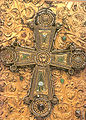 Detail of the Khakhuli Triptych
 -
 Atskuri Triptych
 -
 Georgian tondo commemorating Roman martyr Mammes of Caesarea
 -
 David IV's processional cross
 -
 Crucifixion from Mestia
 -
 Fresco from Ubisi, Georgia
 -
 The Last Supper of Ubisi
 -
 Annunciation of Ubisi
 -

-
 Walls of the Khobi Monastery showing strong Roman influence
 -
-

-

-
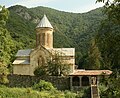
 Despite setbacks at the hands of Mongols, Georgia continued to produce cultural landmarks, such as these frescoes at Ubisi by Damiane - one of Georgia's distinctive medieval artists.
 -

-

-

-


.jpg)


See also[edit]
- List of the Kings of Georgia
- Monarchism in Georgia
- Style of the Georgian sovereign
- List of historical states of Georgia
Notes[edit]
- ^ "In 1490, Constantine II summoned a special royal council that recognized the fragmentation of the Kingdom of Georgia into separate kingdoms and principalities."
- ^ "...Islam was now only a relict on Georgian soil: Bagrat IV’s coins have the Virgin and a Greek inscription on the obverse, with Georgian initials on the reverse, but no Arabic..."[61]
- ^ "Sometimes the Caliph's name was included as a gesture of conciliation to Georgia's many Muslim subjects, as well as to the inhabitants of neighbouring states, among whom economic considerations made it desirable that Georgia's coinage should circulate as widely as possible.[62]
References[edit]
- ^ "Zwölf Königswappen, aus: Grünenberg, Konrad: Grünenberg, Konrad:Das Wappenbuch Conrads von Grünenberg, Ritters und Bürgers zu Constanz - BSB Cgm 145 ( um 1480) - Digitalisiertes Buch aus dem urheberrechtsfreien Bestand der Bayerischen Staatsbibliothek München [Deutschland] 2007-2021 Bildähnlichkeitssuche". bildsuche.digitale-sammlungen.de. Archived from the original on 2020-01-09. Retrieved 2019-09-11.
- ^ Oldest Georgian Arms Archived 2019-01-12 at the Wayback Machine Zachary Kiknadze, pp.6–7, State Council of Heraldry, 2014
- ^ "Heraldica - რუკები". heraldry.ge. Archived from the original on 2019-08-01. Retrieved 2019-12-05.
- ^ Graham Speake. Encyclopedia of Greece and the Hellenic Tradition, Taylor & Francis: 2021 "...Laz and Greeks appear to have survived in harmony both in Trebizond and in the multi-ethnic kingdom of the Bagrationis..." [1]
- ^ Stephen H. Rapp. "Languages and Cultures of Eastern Christianity", Taylor & Francis, 2018 "...Armenians partially belonged to the kingdom of Georgia..."[2]
- ^ a b Rayfield 2013, p. 111.
- ^ a b c d Vacca 2017, p. 148.
- ^ a b Mikaberidze 2007, p. 242.
- ^ Chufrin, Gennadiĭ Illarionovich (2001). The Security of the Caspian Sea Region. Stockholm, Sweden: Oxford University Press. p. 282. ISBN 0-19-925020-0. Archived from the original on 2020-01-05. Retrieved 2019-08-29.; Waters, Christopher P. M. (2013). Counsel in the Caucasus: Professionalization and Law in Georgia. New York City, USA: Springer. p. 24. ISBN 978-94-017-5620-4. Archived from the original on 2020-01-04. Retrieved 2019-08-29.; Suny, Ronald Grigor (1994). The Making of the Georgian Nation. Bloomington, IN, USA: Indiana University Press. p. 87. ISBN 0-253-20915-3. Archived from the original on 2020-09-13. Retrieved 2019-08-29.; Ronald G. Suny (1996) Armenia, Azerbaijan, and Georgia DIANE Publishing pp. 157-158-160-182
- ^ Rapp Jr., Stephen H. (2020). "Georgia, Georgians, until 1300". In Fleet, Kate; Krämer, Gudrun; Matringe, Denis; Nawas, John; Rowson, Everett (eds.). Encyclopaedia of Islam, THREE. Brill Online. ISSN 1873-9830. Archived from the original on 2021-02-04. Retrieved 2021-01-30.
(...) he courageously fought off countless enemies as he reinforced Georgian unity and assembled a pan-Caucasian empire, hence his sobriquet Aġmašenebeli (the builder) (...) The height of the pan-Caucasian rule of the Georgian Bagratids and of the transregional Georgian monastic network is habitually described as Georgia's Golden Age. (...) Internal and external tensions mounted, and the pan-Caucasian empire of the Georgian Bagratids shrank under T'amar's children Giorgi IV Laša (r. 1213–23 C.E.) and Rusudan (r. 1223–45 C.E.).
- ^ Rapp, Stephen H. Jr (2007). "Georgian Christianity". The Blackwell Companion to Eastern Christianity. John Wiley & Sons. p. 145. ISBN 978-1-4443-3361-9. Archived from the original on 12 November 2012. Retrieved 11 May 2012.
- ^ Lang, David Marshall. The Georgians, Ancient Peoples and Places.
- ^ Natho, Kadir I. Circassian History.
- ^ Toumanoff, Cyril (1967). Studies in Christian Caucasian History, p. 498. Georgetown University Press.
- ^ Minorsky 1953, p. 65.
- ^ Mikaberidze 2019, p. 468.
- ^ Norris 2009, p. 26.
- ^ (in Georgian) Javakhishvili, Ivane (1982), k'art'veli eris istoria (The History of the Georgian Nation), vol. 2, pp. 184–187. Tbilisi State University Press.
- ^ Chatzidakis, Nano. Byzantine Mosaics, Volume 7. Athens, Greece: Ekdotike Athenon, 1994, p.22
- ^ Donald Rayfield, "Davit II", in: Robert B. Pynsent, S. I. Kanikova (1993), Reader's Encyclopedia of Eastern European Literature, p. 82. HarperCollins, ISBN 0-06-270007-3.
- ^ Rayfield 2013, pp. 98–99.
- ^ a b Rayfield 2013, p. 100.
- ^ Mikaberidze, Alexander (2015). Historical Dictionary of Georgia (2 ed.). Rowman & Littlefield. p. 259. ISBN 978-1-4422-4146-6.
- ^ Prof. Yaşar Yüce-Prof. Ali Sevim: Türkiye tarihi Cilt I, AKDTYKTTK Yayınları, İstanbul, 1991, p. 149–150.
- ^ Mikaberidze, Alexander (2015). Historical Dictionary of Georgia (2 ed.). Rowman & Littlefield. p. 259. ISBN 978-1-4422-4146-6.
- ^ Gocha Japaridze, Georgia and the Islamic world of the Near East in the first third of the XII-XIII centuries, Tbilisi, 1995, p.102–105.
- ^ Bünyadov, Ziya, 1923-1997 (2007). Azərbaycan Atabəylər dövləti (1136-1225-ci illər) [Azerbaijan's Atabeg State (1136-1225)]. Güləliyev, Əziz., Ağayev, Rövşən., Səmədova, Pərinaz., Əliyeva, Nərgiz., Qəhrəmanov, Cahangir. Baku. p. 45. ISBN 978-9952-34-066-2. OCLC 1104451936.
{{cite book}}: CS1 maint: location missing publisher (link) CS1 maint: multiple names: authors list (link) CS1 maint: numeric names: authors list (link) - ^ საქართველოს ისტორიის ნარკვევები, ტ. 3, თბ., 1979, გვ. 270–274
- ^ Eastmond 1998, p. 71.
- ^ Brisku, Adrian (2013). Bittersweet Europe: Albanian and Georgian Discourses on Europe, 1878–2008. NY, USA: Berghahn Books. p. 134. ISBN 978-0-85745-985-5. Archived from the original on 2020-01-07. Retrieved 2019-08-29.
- ^ van der Zweerde, Evert (2013). Soviet Historiography of Philosophy: Istoriko-Filosofskaja Nauka. Berlin, Germany: Springer Science & Business Media. p. 140. ISBN 978-94-015-8943-7. Archived from the original on 2020-01-02. Retrieved 2019-08-29.
- ^ Luther, Kenneth Allin. "Atābākan-e Adārbāyĵān", in: Encyclopædia Iranica (Online edition). Retrieved on 2006-06-26.
- ^ Lordkipanidze & Hewitt 1987, p. 148.
- ^ Kuehn 2011, p. 28.
- ^ Eastmond 1998, p. 121; Lordkipanidze & Hewitt 1987, pp. 150–151.
- ^ Lordkipanidze & Hewitt 1987, p. 150.
- ^ Humphreys, 1977 p. 131.
- ^ Lordkipanidze & Hewitt 1987, p. 154.
- ^ Humphreys 1977, pp. 130–131.
- ^ Tamar's paternal aunt was the Comnenoi's grandmother on their father's side, as it has been conjectured by Cyril Toumanoff(1940).
- ^ Eastmond 1998, pp. 153–154.
- ^ *Vasiliev, A. A. (1935). Byzance et les Arabes, Tome I: La Dynastie d'Amorium (820–867) (in French). French ed.: Henri Grégoire, Marius Canard. Brussels, Belgium: Éditions de l'Institut de Philologie et d'Histoire Orientales. pp. 15–19. Archived from the original on 2016-06-24. Retrieved 2021-09-10.
- ^ Eastmond, Antony (2017). Tamta's World: The Life and Encounters of a Medieval Noblewoman from the Middle East to Mongolia. Cambridge University Press. doi:10.1017/9781316711774. ISBN 9781316711774.
- ^ Mikaberidze, Alexander (2011). Conflict and Conquest in the Islamic World: A Historical Encyclopedia, Volume 1. Santa Barbara, California, USA: ABC-CLIO. p. 196. ISBN 978-1-59884-336-1. Archived from the original on 2020-09-03. Retrieved 2019-08-29.
- ^ Yar-Shater, Ehsan (2010). Encyclopaedia Iranica, Volume 2, Parts 5-8. Abingdon, United Kingdom: Routledge & Kegan Paul. p. 892. ISBN 978-0-7100-9090-4. Archived from the original on 2019-12-21. Retrieved 2019-08-29.
- ^ Brosset, Marie-Felicite (1858). Histoire de la Géorgie depuis l'Antiquité jusqu'au XIXe siècle. France: imprimerie de l'Académie Impériale des sciences. pp. 468–472.
- ^ L. Baker, Patricia; Smith, Hilary; Oleynik, Maria (2014). Iran. London, United Kingdom: Bradt Travel Guides. p. 158. ISBN 978-1-84162-402-0. Archived from the original on 2020-09-03. Retrieved 2019-08-29.
- ^ Eastmond 1998, p. 122.
- ^ Pahlitzsch, Johannes, "Georgians and Greeks in Jerusalem (1099–1310)", in Ciggaar & Herman (1996), pp. 38–39.
- ^ Eastmond 1998, pp. 122–123.
- ^ David Marshall Land. The Lives and Legends of the Georgian Saints. London: Allen & Unwin, 1976, p. 11
- ^ Ta'rfkh-i Shaikh Uwais (History of Shaikh Uwais), trans. and ed. J. B. van Loon, The Hague, 1954, 56–58.
- ^ Ivane Javakhishvili, The History of the Georgian Nation, vol. 3, Tbilisi, 2012, p.79
- ^ W. Barthold, ' Die persische Inschrift an der Mauer der Manucehr-Moschee zu Ani ', trans. and edit. W. Hinz, ZDMG, Bd. 101, 1951, 246;
- ^ Vasil Kiknadze, Georgia in the XIV century, Tbilisi, 1989, p.105
- ^ Ivane Javakhishvili, The History of the Georgian Nation, vol. 3, Tbilisi, 2012, p.84
- ^ Vazha Kiknadze, European sources of Georgian history, Tbilisi, 1983, p.159
- ^ D. Kldiashvili, History of the Georgian Heraldry, Parlamentis utskebani, 1997, p. 35.
- ^ West, Barbara A. (2010). Encyclopedia of the Peoples of Asia and Oceania. New York City, NY, USA: Infobase Publishing. p. 229. ISBN 978-1-4381-1913-7. Archived from the original on 2017-03-24. Retrieved 2019-08-29.
- ^ Toumanoff, Cyril (1949–51). The Fifteenth-Century Bagratids and the Institution of Collegial Sovereignty in Georgia. Traditio 7: 174, 176–177.
- ^ a b Rayfield 2013, p. 78.
- ^ Lang 1955, p. 2.
- ^ a b c d e Lang 1955, p. 20.
- ^ Lang 1955, p. 27.
- ^ a b Lang 1955, p. 21.
- ^ a b c Lang 1955, p. 22.
- ^ Lang 1955, p. 33.
- ^ Lang 1955, p. 36.
- ^ Lang 1955, p. 36-37.
- ^ Lang 1955, p. 37-38.
- ^ a b c Lang 1955, p. 39.
Bibliography[edit]
- Eastmond, Antony (1998). Royal Imagery in Medieval Georgia. University Park, Pennsylvania, USA: The Pennsylvania State University Press. ISBN 0-271-01628-0.
- Lang, David M. (1955). Studies in the Numismatic History of Georgia in Transcaucasia. The American Numismatic Society.
- Mikaberidze, Alexander (2019). "Georgian-Seljuk Wars (11th-13th centuries)". In Tucker, Spencer C. (ed.). Middle East Conflicts from Ancient Egypt to the 21st Century. Vol. II:G-N. ABC-CLIO. pp. 467–468.
- Minorsky, V. (1953). Studies in Caucasian History I. New Light on the Shaddadids of Ganja II. The Shaddadids of Ani III. Prehistory of Saladin. Cambridge University Press.
- Lordkipanidze, Mariam Davydovna; Hewitt, George B. (1987). Georgia in the XI–XII Centuries. Tbilisi: Ganatleba Publishers.
- Kuehn, Sara (2011). The Dragon in Medieval East Christian and Islamic Art. Leiden: Koninklijke Brill NV. ISBN 978-90-04-18663-7.
- Humphreys, R. Stephen (1977). From Saladin to the Mongols: The Ayyubids of Damascus, 1193–1260. Albany, NY: State University of New York Press. ISBN 0-87395-263-4.
- Mikaberidze, Alexander, ed. (2007). "Currency". Historical Dictionary of Georgia. The Scarecrow Press.
- Norris, Harry (2009). Islam in the Baltic: Europe's Early Muslim Community. I.B. Tauris.
- Rayfield, Donald (2013). Edge of Empires: A History of Georgia. Reaktion Books. ISBN 978-1-78023-070-2.
- Vacca, Alison (2017). Non-Muslim Provinces under Early Islam: Islamic Rule and Iranian Legitimacy in Armenia and Caucasian Albania. Cambridge University Press.
External links[edit]
 Media related to Kingdom of Georgia at Wikimedia Commons

| Early Middle Ages |
|
|---|---|
| High Middle Ages |
|
| Late Middle Ages | |
| Culture | |
| Related | |


|  | |||||||||
Kingdom of Georgia articles | |||||
|---|---|---|---|---|---|
| History | | ||||
| Geography |
| ||||
| Politics |
| ||||
| Economy | |||||
| Culture |
| ||||
- Kingdom of Georgia
- Former kingdoms
- States and territories disestablished in 1466
- Former monarchies of Europe
- Former monarchies of Asia
- History of Transcaucasia
- Medieval Russia
- Medieval Iran
- States in medieval Anatolia
- Medieval Azerbaijan
- 1008 establishments in Europe
- 1008 establishments in Asia
- 1490 disestablishments in Europe
- 1490 disestablishments in Asia
- Former monarchies of West Asia
- Christian states
- Former empires
- States and territories established in 1008