


Olmsted County, Minnesota
Olmsted County | |
|---|---|
 Olmsted County Government Center (pre-expansion) | |
 Location within the U.S. state of Minnesota | |
 Minnesota's location within the U.S. | |
| Coordinates: 44°00′N 92°24′W / 44°N 92.4°W | |
| Country |  United States United States |
| State |  Minnesota Minnesota |
| Founded | February 20, 1855 |
| Named for | David Olmsted |
| Seat | Rochester |
| Largest city | Rochester |
| Area | |
| • Total | 655 sq mi (1,700 km2) |
| • Land | 653 sq mi (1,690 km2) |
| • Water | 1.5 sq mi (4 km2) 0.2% |
| Population (2020) | |
| • Total | 162,847 |
| • Estimate (2023) | 164,784  |
| • Density | 249/sq mi (96/km2) |
| Time zone | UTC−6 (Central) |
| • Summer (DST) | UTC−5 (CDT) |
| Congressional district | 1st |
| Website | www |
Olmsted County is a county in the U.S. state of Minnesota. As of the 2020 census, the population is 162,847.[1] Its county seat and most populous city is Rochester.[2]
Olmsted County is part of the Rochester Metropolitan Statistical Area.
History[edit]
The Wisconsin Territory was established by the federal government effective July 3, 1836, and existed until its eastern portion was granted statehood (as Wisconsin) in 1848. Therefore, the federal government set up the Minnesota Territory effective March 3, 1849. The newly organized territorial legislature created nine counties across the territory in October of that year. One of those original counties, Wabasha, had portions partitioned off in 1853 to create Fillmore and Rice counties. Then on February 20, 1855,[3] portions of Rice, Wabasha, and Fillmore counties were partitioned off to create the present county, with Rochester (which was also platted that year) as county seat. The county name recognized David Olmsted (1822-1861),[4] a member of the first territorial council and the fourth mayor of St. Paul.[5][6]
The county boundaries have remained unchanged since 1855.
Geography[edit]
Olmsted County is a fairly unusual mix of urban and rural areas in that there's no transition or buffer between the two environments. Rochester, Minnesota's third largest city of roughly 118,000 people, sits in the Zumbro River valley at the center of the county. Outside the valley however, with the exception of a small amount of urban growth in the last few years, remains farmland with small agricultural based communities and no directly adjacent suburbs. Stewartville, the county's second largest city, is slightly over 1/20th the size at roughly 6,000 people, an unusually large gap for a metropolitan area.
Olmsted County is drained by three rivers, all flowing to the Mississippi. The Zumbro River flows northward through the west central part of the county, into Wabasha County. The Whitewater flows northeast from the northeast part of the county into Winona County, and the Root flows east-southeastward through the lower part of the county into Fillmore County. The county terrain consists of low rolling hills, etched by drainage gullies and marked by occasional buttes. The available area is devoted to agriculture or is developed for other productive uses.[7] The county terrain slopes to the east and north,[8] and its highest point is a hill 7.5 miles (12.1 km) west of Stewartville, at 1,380 ft (420 m) ASL.[9] The county has a total area of 655 square miles (1,700 km2), of which 653 square miles (1,690 km2) is land and 1.5 square miles (3.9 km2) (0.2%) is water.[10]

It is one of four counties in Minnesota that does not have any natural lakes (the other three being Mower, Pipestone, and Rock).
Transit[edit]
Major highways[edit]


Airports[edit]
- Mid-Continent Airport[7]
- Rochester International Airport (RST)
Adjacent counties[edit]
- Wabasha County - north
- Winona County - east
- Fillmore County - south
- Mower County - southwest
- Dodge County - west
- Goodhue County - northwest
Protected areas[7][edit]
- Chester Woods Park
- High Forest Wildlife Management Area
- Keller Wildlife Management Area
- Marian Marshall Wildlife Management Area
- Nelson Fen Wildlife Management Area
- Oronoco Scientific and Natural Area
- Oxbow Park & Zollman Zoo
- Root River Park
- Schumann State Wildlife Management Area
- Suess State Wildlife Management Area
- Whitewater Wildlife Management Area (part)
Lakes[edit]
Though Olmsted County does not have any natural lakes, it does have six reservoirs created by dams:
- Chester Lake: Eyota Township
- Lake Florence: High Forest Township
- Lake George: Rochester Township
- Mayowood Lake: Rochester Township
- Silver Lake: Haverhill Township and Cascade Township
- Lake Zumbro (part): Oronoco Township
Demographics[edit]
| Census | Pop. | Note | %± |
|---|---|---|---|
| 1860 | 9,524 | — | |
| 1870 | 19,793 | 107.8% | |
| 1880 | 21,543 | 8.8% | |
| 1890 | 19,806 | −8.1% | |
| 1900 | 23,119 | 16.7% | |
| 1910 | 22,497 | −2.7% | |
| 1920 | 28,014 | 24.5% | |
| 1930 | 35,426 | 26.5% | |
| 1940 | 42,658 | 20.4% | |
| 1950 | 48,228 | 13.1% | |
| 1960 | 65,532 | 35.9% | |
| 1970 | 84,104 | 28.3% | |
| 1980 | 92,006 | 9.4% | |
| 1990 | 106,470 | 15.7% | |
| 2000 | 124,277 | 16.7% | |
| 2010 | 144,248 | 16.1% | |
| 2020 | 162,847 | 12.9% | |
| 2023 (est.) | 164,784 | [12] | 1.2% |
| U.S. Decennial Census[13] 1790-1960[14] 1900-1990[15] 1990-2000[16] 2010-2020[1] | |||
2020 census[edit]
As of the census of 2020,[17] the population was 162,847. The population density was 249.2 inhabitants per square mile (96.2/km2). There were 69,270 housing units at an average density of 106.0 per square mile (40.9/km2). The racial makeup of the county was 77.8% White, 6.8% Black or African American, 6.3% Asian, 0.4% Native American, 0.1% Pacific Islander, 2.5% from other races, and 6.1% from two or more races. Ethnically, the population was 5.6% Hispanic or Latino of any race.
2000 census[edit]

As of the 2000 United States census, there were 124,277 people, 47,807 households, and 32,317 families in the county. The population density was 190 per square mile (73/km2). There were 49,422 housing units at an average density of 75.7 per square mile (29.2/km2). The racial makeup of the county was 90.33% White, 2.68% Black or African American, 0.26% Native American, 4.27% Asian, 0.03% Pacific Islander, 0.92% from other races, and 1.51% from two or more races. 2.38% of the population were Hispanic or Latino of any race.
There were 47,807 households, out of which 35.20% had children under the age of 18 living with them, 56.70% were married couples living together, 8.00% had a female householder with no husband present, and 32.40% were non-families. 25.80% of all households were made up of individuals, and 7.60% had someone living alone who was 65 years of age or older. The average household size was 2.53 and the average family size was 3.09.
The county population contained 27.00% under the age of 18, 8.50% from 18 to 24, 32.20% from 25 to 44, 21.60% from 45 to 64, and 10.80% who were 65 years of age or older. The median age was 35 years. For every 100 females, there were 96.60 males. For every 100 females age 18 and over, there were 93.60 males.
The median income for a household in the county was $51,316, and the median income for a family was $61,610. Males had a median income of $40,196 versus $29,994 for females. The per capita income for the county was $24,939. About 3.80% of families and 6.40% of the population were below the poverty line, including 6.70% of those under age 18 and 9.50% of those age 65 or over.
Politics[edit]
Olmsted has historically been a Republican-leaning county. However, rapid population growth in Rochester has made it more competitive in recent years. In 2020, Joe Biden won it by nearly 11 points, the best performance of any Democrat since Lyndon Johnson in 1964. Since 2000, Olmsted County has voted for the winning presidential candidate in five of the six elections. The exception is 2016, where national electoral winner Donald Trump lost Olmsted County by only 0.75% and a slim margin of 600 votes.
Although it has trended Democratic at the presidential level, Olmsted County continues to lean Republican in state and local races, with split ticket voting becoming more common locally. Two of the county's three seats in the Minnesota Senate are held by Republicans, as well as two of the five seats in the Minnesota House of Representatives. Since 1970, Olmsted County has only voted for the DFL candidate for governor thrice: in 1974, 2018 and 2022. In 2018, then-Representative Tim Walz benefitted from high recognition in the district with a reputation at the time of being a moderate politician. Despite Walz winning a majority of the county's vote that election, Republican candidate Doug Wardlow concurrently won the greatest number of votes in Olmsted County in the 2018 Minnesota Attorney General election.
US House of Representatives[edit]
| Name | Congressional District | Assumed office | Party |
|---|---|---|---|
| Brad Finstad | 1st District | 2022 | Republican |
Minnesota Senate[edit]
| Name | District | Assumed office | Party |
|---|---|---|---|
| Steve Drazkowski | District 20 | 2023 | Republican |
| Carla Nelson | District 24 | 2011 | Republican |
| Liz Boldon | District 25 | 2023 | DFL |
Minnesota House of Representatives[edit]
| Name | District | Assumed office | Party |
|---|---|---|---|
| Steve Jacob | District 20A | 2023 | Republican |
| Duane Quam | District 24A | 2011 | Republican |
| Tina Liebling | District 24B | 2005 | DFL |
| Kim Hicks | District 25A | 2023 | DFL |
| Andy Smith | District 25B | 2023 | DFL |
| Year | Republican | Democratic | Third party | |||
|---|---|---|---|---|---|---|
| No. | % | No. | % | No. | % | |
| 2020 | 39,692 | 43.43% | 49,491 | 54.16% | 2,202 | 2.41% |
| 2016 | 35,668 | 44.51% | 36,268 | 45.26% | 8,193 | 10.22% |
| 2012 | 36,832 | 47.03% | 39,338 | 50.23% | 2,146 | 2.74% |
| 2008 | 36,202 | 47.34% | 38,711 | 50.62% | 1,557 | 2.04% |
| 2004 | 37,371 | 52.21% | 33,285 | 46.50% | 919 | 1.28% |
| 2000 | 30,641 | 51.59% | 25,822 | 43.48% | 2,929 | 4.93% |
| 1996 | 22,860 | 43.92% | 22,857 | 43.92% | 6,327 | 12.16% |
| 1992 | 23,404 | 41.30% | 19,039 | 33.60% | 14,219 | 25.09% |
| 1988 | 27,683 | 58.28% | 19,423 | 40.89% | 398 | 0.84% |
| 1984 | 28,129 | 62.76% | 16,335 | 36.44% | 359 | 0.80% |
| 1980 | 22,704 | 55.50% | 13,983 | 34.18% | 4,224 | 10.32% |
| 1976 | 24,030 | 60.66% | 14,676 | 37.04% | 911 | 2.30% |
| 1972 | 23,806 | 68.96% | 9,817 | 28.44% | 898 | 2.60% |
| 1968 | 17,292 | 54.31% | 13,417 | 42.14% | 1,131 | 3.55% |
| 1964 | 12,699 | 43.87% | 16,195 | 55.94% | 56 | 0.19% |
| 1960 | 16,080 | 59.41% | 10,918 | 40.34% | 67 | 0.25% |
| 1956 | 13,789 | 65.62% | 7,172 | 34.13% | 51 | 0.24% |
| 1952 | 14,566 | 67.92% | 6,792 | 31.67% | 89 | 0.41% |
| 1948 | 8,131 | 46.55% | 9,155 | 52.41% | 181 | 1.04% |
| 1944 | 8,355 | 54.70% | 6,873 | 45.00% | 46 | 0.30% |
| 1940 | 9,096 | 51.83% | 8,393 | 47.82% | 62 | 0.35% |
| 1936 | 5,316 | 35.63% | 8,958 | 60.04% | 645 | 4.32% |
| 1932 | 5,254 | 40.81% | 7,340 | 57.01% | 280 | 2.17% |
| 1928 | 8,334 | 63.63% | 4,720 | 36.04% | 44 | 0.34% |
| 1924 | 5,722 | 56.50% | 857 | 8.46% | 3,548 | 35.04% |
| 1920 | 7,130 | 77.12% | 1,756 | 18.99% | 359 | 3.88% |
| 1916 | 2,101 | 49.67% | 1,926 | 45.53% | 203 | 4.80% |
| 1912 | 720 | 18.21% | 1,542 | 39.01% | 1,691 | 42.78% |
| 1908 | 2,472 | 58.03% | 1,621 | 38.05% | 167 | 3.92% |
| 1904 | 2,745 | 68.54% | 1,140 | 28.46% | 120 | 3.00% |
| 1900 | 2,818 | 61.62% | 1,597 | 34.92% | 158 | 3.46% |
| 1896 | 3,201 | 62.83% | 1,741 | 34.17% | 153 | 3.00% |
| 1892 | 2,344 | 50.79% | 1,931 | 41.84% | 340 | 7.37% |
Communities[edit]

Cities[edit]
- Byron
- Chatfield (part)
- Dover
- Eyota
- Oronoco
- Pine Island (part)
- Rochester (county seat)
- Stewartville
Unincorporated communities[edit]
Townships[edit]
- Cascade Township
- Dover Township
- Elmira Township
- Eyota Township
- Farmington Township
- Haverhill Township
- High Forest Township
- Kalmar Township
- Marion Township
- New Haven Township
- Orion Township
- Oronoco Township
- Pleasant Grove Township
- Quincy Township
- Rochester Township
- Rock Dell Township
- Salem Township
- Viola Township
See also[edit]
- National Register of Historic Places listings in Olmsted County, Minnesota
- Musical Artist Yung Gravy is from Rochester
References[edit]
- ^ a b "State & County QuickFacts". United States Census Bureau. Retrieved April 8, 2023.
- ^ "Find a County". National Association of Counties. Retrieved June 7, 2011.
- ^ "Minnesota Place Names". Minnesota Historical Society. Archived from the original on June 20, 2012. Retrieved March 18, 2014.
- ^ Upham, Warren. Minnesota Geographic Names (1920), p. 385 (accessed April 26, 2019)
- ^ "History of Olmsted County". www.co.olmsted.mn.us. Retrieved October 10, 2018.
- ^ "Minnesota Government Series, State Counties". Minnesota House of Representatives. Archived from the original on September 20, 2012. Retrieved March 18, 2008.
- ^ a b c Olmsted County MN Google Maps (accessed April 26, 2019)
- ^ ""Find an Altitude/Olmsted County MN" Google Maps (accessed 26 April 2019)". Archived from the original on May 21, 2019. Retrieved April 26, 2019.
- ^ Olmsted County High Point - PeakBagger.com (accessed April 26, 2019)
- ^ "2010 Census Gazetteer Files". United States Census Bureau. August 22, 2012. Archived from the original on September 21, 2013. Retrieved October 24, 2014.
- ^ Nelson, Steven (2011). Savanna Soils of Minnesota. Minnesota: Self. pp. 43 - 48. ISBN 978-0-615-50320-2.
- ^ "Annual Estimates of the Resident Population for Counties: April 1, 2020 to July 1, 2023". Retrieved March 18, 2024.
- ^ "U.S. Decennial Census". United States Census Bureau. Retrieved October 24, 2014.
- ^ "Historical Census Browser". University of Virginia Library. Retrieved October 24, 2014.
- ^ "Population of Counties by Decennial Census: 1900 to 1990". United States Census Bureau. Retrieved October 24, 2014.
- ^ "Census 2000 PHC-T-4. Ranking Tables for Counties: 1990 and 2000" (PDF). United States Census Bureau. Archived (PDF) from the original on March 27, 2010. Retrieved October 24, 2014.
- ^ "2020 Decennial Census: Olmsted County, Minnesota". data.census.gov. U.S. Census Bureau. Retrieved July 13, 2022.
- ^ Leip, David. "Atlas of US Presidential Elections". uselectionatlas.org. Retrieved October 10, 2018.
- ^ The leading "other" candidate, Progressive Theodore Roosevelt, received 1,467 votes, while Socialist candidate Eugene Debs received 112 votes, Prohibition candidate Eugene Chafin received 93 votes, and Socialist Labor candidate Arthur Reimer received 19 votes.
External links[edit]

Places adjacent to Olmsted County, Minnesota | ||||||||||||||||
|---|---|---|---|---|---|---|---|---|---|---|---|---|---|---|---|---|
| ||||||||||||||||


Municipalities and communities of Olmsted County, Minnesota, United States | ||
|---|---|---|
| Cities | 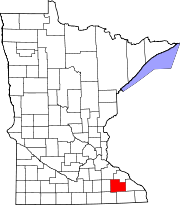 | |
| Townships | ||
| CDPs | ||
| Unincorporated communities | ||
| Footnotes | ‡This populated place also has portions in an adjacent county or counties | |

| International | |
|---|---|
| National | |
| Geographic | |
| Other | |
