


Manila Cathedral
| Manila Cathedral | |
|---|---|
| Minor Basilica and Metropolitan Cathedral of the Immaculate Conception | |
| The Mother Church of the Philippines[a] | |
 Main façade and bell tower in April 2024 | |
 | |
| 14°35′29″N 120°58′25″E / 14.59147°N 120.97356°E | |
| Location | Intramuros, Manila |
| Country | Philippines |
| Language(s) | Filipino, English |
| Denomination | Catholic |
| Sui iuris church | Latin Church |
| Tradition | Roman Rite |
| Website | manilacathedral |
| History | |
| Former name(s) | Church of Manila |
| Authorising papal bull | February 6, 1579 |
| Status | |
| Founded | 1571 |
| Founder(s) | Fray Juan de Vivero |
| Dedication | Immaculate Conception |
| Dedicated | December 10, 2018 |
| Earlier dedication | December 10, 1958 |
| Consecrated | December 7, 1958[2] |
| Relics held | |
| Events | List
|
| Past bishop(s) | |
| Associated people | Miguel López de Legazpi |
| Architecture | |
| Functional status | Active |
| Heritage designation | Important Cultural Property |
| Designated | 2018 |
| Previous cathedrals | 7 |
| Architect(s) | Fernando Ocampo |
| Architectural type | Cathedral |
| Style | Neo-Romanesque |
| Years built | |
| Groundbreaking | December 8, 1954 |
| Completed | December 8, 1958 |
| Construction cost | ₱120 million (renovation)[8] |
| Specifications | |
| Capacity | 2,000[9] |
| Length | 84.4 m (277 ft)[10] |
| Width | 31.4 m (103 ft)[10] |
| Nave width | 11.9 m (39 ft)[10] |
| Width across transepts | 48.9 m (160 ft)[10] |
| Other dimensions | Façade facing northwest |
| Number of floors | 2 |
| Floor area | 3,000 m2 (32,000 sq ft)[2] |
| Number of domes | 1 |
| Number of towers | 1 |
| Tower height | 55 meters (180 ft)[11] |
| Materials | Adobe and cement |
| Bells | 23[12] |
| Administration | |
| Province | Manila |
| Metropolis | Manila |
| Archdiocese | Manila |
| Deanery | Nuestra Señora de Guia[13] |
| Clergy | |
| Archbishop | Cardinal Jose Advincula |
| Rector | Rolando Ramos Dela Cruz |
| Vicar(s) | Vicente Gabriel San Jose Bautista |
| Chancellor | Isidro T. Marinay[14] |
| Laity | |
| Organist(s) | Alejandro D. Consolacion II |
| Organ scholar | Raphael Martin Yu Andaya |
 | |
The Minor Basilica and Metropolitan Cathedral of the Immaculate Conception,[b] commonly and popularly known as the Manila Cathedral,[c] is a Catholic minor basilica and the cathedral church of the Roman Catholic Archdiocese of Manila. It is located in Intramuros, the historic walled city in Manila, Philippines, and is dedicated to the Immaculate Conception of the Blessed Virgin Mary, the principal patroness of the country.
The cathedral was originally constructed in 1571 as a parish church under the Archdiocese of Mexico until it became a separate diocese on February 6, 1579, upon the issuance of the papal bull Illius Fulti Præsido by Pope Gregory XIII.[15] Since the original cathedral structure was built in 1581, the cathedral has been damaged and destroyed by several earthquakes and the Second World War; the eighth and current cathedral building was completed in 1958.[2]
The basilica has merited a papal endorsement from Pope Gregory XIII, and three apostolic visits from Popes Paul VI, John Paul II and Francis. On April 27, 1981, Pope John Paul II raised the shrine to the status of Minor Basilica through his motu proprio Quod Ipsum.[16]
Its current rector is the Reverend Monsignor Rolando Ramos Dela Cruz, who was appointed on October 13, 2022,[17] and installed on April 14, 2023.[18]
History[edit]
.jpg)
As a parish church (1571)[edit]
Fray Juan de Vivero, a Secular priest who had baptized Rajah Matanda and arrived in Manila Bay in 1566, established the "Church of Manila" established in 1571.[19] Archbishop of Mexico Alonso de Montúfar sent De Vivero, chaplain of the galleon San Gerónimo, to establish Christianity as the spiritual and religious administration in newly colonized Philippines. De Vivero later became vicar-general and the first ecclesiastical judge of Manila.[20]
The Spanish conquistador Miguel López de Legazpi chose the church's location and placed it under the patronage of Santa Potenciana. The church's first parish priest was Fray Juan de Villanueva.[20]
First cathedral (1581–1583)[edit]
The church was elevated to a cathedral in 1579, coinciding with the canonical erection of the Diocese of Manila. In 1581, Domingo de Salazar, the first-ever bishop of Manila, constructed a new building made from nipa, wood and bamboo that was consecrated on December 21, 1581, formally becoming a cathedral. The building was destroyed by a fire that started during the funeral of Governor-General Gonzalo Ronquillo de Peñalosa at San Agustin Church and razed much of the city.[15]
Second cathedral (1592–1600)[edit]
The second cathedral, which was made of stone, was built in 1592. This cathedral had a central nave and two collateral naves. The building was nearly completed when Bishop Salazar left for Spain. He died on December 4, 1594, and never returned to Manila to become its first archbishop.[21]
In 1595, the Holy See gave the cathedral sacred relics from 155 martyrs, 20 popes, Saint Polycarp and Saint Potenciana, and these were taken to Manila. A side structure was built beside the main cathedral to house the relics. Governor-General Juan Niño de Tabora and his wife Doña Magdalena Saldivar y Medoza built another collateral structure to shelter subsequent relics.[21]
By 1597, the cathedral buildings were unfinished; it lacked a chapter hall, baptistry, bell tower, and cloister. On December 31, 1600, the cathedral was destroyed by an earthquake.[21]
Third cathedral (1614–1645)[edit]
Archbishop Miguel de Benavides initiated the reconstruction of the cathedral. After his death in 1605, the project was passed on to his successor Diego Vázquez de Mercado. By 1607, the cathedral was in such a poor state it was abandoned.[22] The third cathedral structure, consisting of three naves and seven chapel, was built in 1614, largely using donated funds from the fourth dean Don Francisco Gomez de Arellano. The seven chapels were built from donations given by the cathedral's patrons.[22] On August 1, 1621, an earthquake caused serious damage to the cathedral's structure. Between 1641 and 1645, the cathedral was reconstructed but it was destroyed by a series of earthquakes in November and December, 1645.[22]
Fourth cathedral (1671–1751)[edit]
Reconstruction of the cathedral started after the arrival of Miguel de Poblete Casasola, the eighth Archbishop of Manila. The cornerstone of the fourth structure was laid on April 20, 1654. By 1659, the cathedral was nearly completed; the naves were enclosed and some halls were completed. In 1662, the main altar was built out of molave wood. The cathedral, which was made of quarried stone, lime and gravel, was blessed on June 7, 1662.[23] In 1750, the Florentine friar Juan de Uguccioni added a media naranja ("half orange") dome to the crossing and introduced a transept to the structure.[24] Following several earthquakes and typhoons, the fourth cathedral was demolished in 1751.[25]
Fifth cathedral (1760–1852)[edit]
_by_Brambila.jpg)
Work on the fifth cathedral building started after the demolition of its predecessor. Uguccioni's designs brought major changes; the three-nave design was retained but the chapels were reduced. The fifth cathedral, which closely resembled the Church of the Gesù in Rome, was inaugurated on December 8, 1760;[25] since then, there had been no modifications or alterations to the structure except for some minor repairs. The cathedral, particularly the dome structure, was repaired in 1839.[25] It survived the British occupation of Manila but underwent repairs. It was damaged by an earthquake on September 16, 1852.[25]
Sixth cathedral (1858–1863)[edit]
Bidding for the cathedral reconstruction was conducted in 1854 and the sixth structure was opened on March 31, 1858.[26] The building had a new Neoclassical façade, which was used for the seventh and eighth structures. The sixth cathedral replaced the Baroque façade of the fifth cathedral and the truncated or box-like cupola was replaced with a circular dome.[26]
On June 3, 1863, the sixth cathedral was damaged by a very strong earthquake that also damaged the palace of the Governor General of the Philippines. Many called for the building's demolition and clearing of the site. Architect Don Antonio Moraleda proposed to demolish and clear the ruins but the plan was put on hold in 1866. The plan was renewed in 1868, when architect Vicente Serrano y Salaverri was commissioned to inspect and undertake a study of the ruins. Serrano concluded the cathedral ruins must be demolished and this occurred in 1870.[26]
Seventh cathedral (1879–1945)[edit]

The seventh cathedral was constructed from 1873 to 1879, and was consecrated on December 7, 1879. The cross atop the central dome is a reference point of astronomical longitudes of the archipelago. In 1880, another earthquake toppled the building's bell tower, which had survived the 1863 earthquake, rendering the cathedral towerless until 1958.[27] During the Philippine Revolution of 1896, Archbishop Bernardino Nozaleda y Villa opened the cathedral to Spanish soldiers who sought refuge. During the Philippine–American War, American soldiers converted the cathedral into a hospital for their wounded soldiers.[27]

In 1937, the International Eucharistic Congress was held in the Philippines; Manila Cathedral played a role in promoting eucharistic beliefs. A cathedral stamp and medal were unveiled to commemorate the event; these were made by the official manufacturer of medals for the Congress of the Philippines sculptor Críspulo Zamora.[28] In 1945, during the Battle of Manila, Japanese forces destroyed the seventh cathedral in a scorched-earth defense.[29]
Eighth cathedral (1958–present)[edit]
_2024-04-07.jpg)
After the Second World War, archbishops Michael J. O'Doherty and Gabriel Reyes planned to transfer the seat of the Archdiocese of Manila to Mandaluyong. The plan was dropped when the cathedral was reconstructed under Cardinal Rufino Santos, under the supervision of Kapampangan architect Fernando Ocampo. The first cornerstone of the eighth cathedral was blessed and laid by Cardinal Fernando Quiroga Palacios, the Archbishop of Santiago de Compostela and papal legate of Pope Pius XII, on December 8, 1954. The building was consecrated on December 7, 1958, and the high altar was consecrated on December 10 that year.[2]

Pope Paul VI made an apostolic visit and celebrated Mass at the cathedral on November 27, 1970.[31] Pope John Paul II also celebrated Mass in the cathedral on February 17, 1981, during his first papal visit to the country,[32] and issued a papal bull Quod Ipsum elevating the cathedral to a minor basilica through his own motu proprio on April 27, 1981.[16] In the same papal bull, John Paul II restated Paul VI's papal decree of June 6, 1968, should be eternally preserved and enforced to the merits and titles of the cathedral as its own basilica.[33][34]
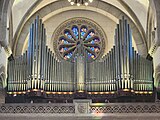
The golden jubilee of the Manila Cathedral's post-war restoration was celebrated in 2008 with the second Manila Cathedral Pipe Organ Festival from December 2 to 10, which was organized by the Catholic Bishops' Conference of the Philippines.[35] The cathedral's pipe organ was built by Dutch organ builder Pels & Zoon in 1958[36] and consists of 5,584 pipes,[37] is the largest church organ in Southeast Asia.[38]
In February 2011, the cathedral's bells were moved to the ground level to prevent the bell tower from collapsing as had earlier towers in past earthquakes. In January 2012, the bells were replaced with new ones that were cast by blacksmith Friedrich Wilhelm Schilling from Heidelberg, Germany, in 1958. According to the new marker installed by Cardinal Gaudencio Rosales, the newly installed bells are the largest bells that are in active use in the Philippines. Seven carillon bells weighing 17 metric tons (17 long tons) were permanently installed in the ground level of the belfry.[d]
In 2010, the cathedral failed the standards of the National Structural Code of the Philippines as cracks were detected in some critical sections. After Cardinal Luis Antonio Tagle assumed his post as Archbishop of Manila in December 2011, one of his first decisions was to close the cathedral.[8] Following the 2012 Negros earthquake and structural concerns, the cathedral temporarily closed on February 7 for repairs, earthquake retrofitting and subsidence prevention.[39] During this time, Paco Church was designated as the pro-cathedral of the Archdiocese of Manila.[40]
Restoration was expected to be completed in 2013 but the initial deadline was missed.[41] The cathedral's rector at the time, Monsignor Nestor Cerbo, stated that renovations would be finished by March 25, 2014. New features included closed-circuit television (CCTV) cameras, large, flat-screen television screens, improved audio-video systems, and improved interior and exterior LED lights.[42] Restoration finished on the planned date and the Manila Cathedral was reopened to the general public on April 9, 2014. Archbishop Cardinal Tagle presided a Holy Mass that was attended by President Benigno Aquino III.[43]
On January 16, 2015, Pope Francis celebrated his first Papal Mass in the Philippines at the cathedral as part of his apostolic visit to the country.[44] Due to safety considerations, the Mass was closed to the public, accommodating only 2,000 bishops, priests, and religious persons.[9]
The year-long celebrations commemorating the 60th anniversary of the Manila Cathedral's post-war restoration began with the opening of a historical exhibit on December 8, 2017.[45] On October 27, 2018,[46] Pope Francis appointed Cardinal Thomas Aquino Manyo Maeda, then-Archbishop of Osaka, as his papal legate for this occasion.[47] On December 1, Pope Francis wrote a letter to Cardinal Maeda, calling the cathedral as the "mother and head of the churches" in the Philippines. The pope further wrote in his letter:[48]
Indeed, this temple which has truly undergone great changes, destroyed seven times by earthquakes and other calamities through the centuries, was diligently rebuilt again and again by the faithful. Finally after being shattered by the Second World War, it was rebuilt from the ruins at the Lord's bidding.
Cardinal Maeda celebrated a fiesta Mass on December 8, 2018, concelebrated with Cardinal Tagle.[47] The pope, through Cardinal Maeda, imparted his apostolic blessing to the cathedral.[49] On December 10, Cardinal Tagle rededicated the altar in accordance with the rites prescribed by the Second Vatican Council;[47] the dedication Mass was concelebrated by several bishops comprising the Catholic Bishops' Conference of the Philippines (CBCP), including its president at the time and the Archbishop of Davao, Romulo Valles.[50]
Architecture and design[edit]

The Manila Cathedral was built in the Latin cross (cruciform) layout. Its northwest façade, which is built in the Neo-Romanesque architecture style, is a replica of the façade of the previous cathedral, along with statues of famous saints sculpted in Roman travertine stone. Several of the artworks inside the basilica were made by Italian artists. In the previous cathedral, the statues were originally made of molave wood. The statue of Rose of Lima was sculpted by Angelo Fattinanzi; Jacob, Andrew and Anthony the Abbot were sculpted by Livia Papini; and Francis Xavier and Polycarp were sculpted by Alcide Tico.[51]
Eight bronze panels sculpted by Alessandro Monteleone and Francesco Nagni dominate the central northwest doors of the cathedral. Each panel is 1.8 meters (5 ft 11 in) wide and 4.24 meters (13.9 ft) tall, depicting bas-reliefs of the important events in the cathedral's history.[52] The tympanum above the central doors bears the Latin inscription Tibi cordi tuo immaculato concredimus nos ac consecramus ("To thy Immaculate Heart, entrust us and consecrate us").[53] Two smaller doors on the left and right sides have also eight panels installed in each door, depicting invocations to the Blessed Virgin Mary.[52]


Since Pope John Paul II's apostolic visit to the basilica in 1981, a medallion bearing the papal arms has been placed beneath the cross of the façade and at the crossing above the high altar. The scarlet galeros of Cardinals Rufino Santos and Jaime Sin are also suspended from the dome's ceiling. A copy of the statue of St. Peter's Basilica titled Saint Peter Enthroned is placed across a polychrome, life-sized statue of the Immaculate Conception.
The bronze baptismal font and angel-shaped holy water fonts were made by Publio Morbiducci. The prominent mosaic of Jude Thaddeus was made by Marcello Mazzoli. In 1964, Filipino artist Galo Ocampo designed and made most of the cathedral's 134 modern stained glass windows.[54]
The marble floors on the center aisle near the altar bears the coats of arms of four cardinal archbishops of Manila: Rufino Santos, Jaime Sin, Gaudencio Rosales, and Luis Antonio Tagle.
-
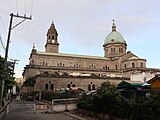 Right side view of the façade, showing the patinated dome surmounted by a four-armed cross
 -
 The central nave, looking towards the sanctuary
 -
 Rib vaults and clerestory
 -
-

-
 Iron reja
 -
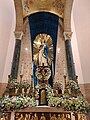 The older high altar and the image of the Immaculate Conception
 -

.jpg)


Cathedra[edit]
The cathedra or episcopal throne of the Archbishop of Manila was installed in 1958 during the postwar reconstruction. It is made of Mexican onyx and marble from Carrara, Italy, and was designed and made by the Istituto Internazionale d’Arte Liturgica in Rome.[55] The original cathedra bears the coat of arms of Rufino Santos before he was created a cardinal. His coat of arms and the Mexican onyx were covered by a stone until their restoration in 2021.[56]
The restored cathedra bears a carving of the coat of arms of Cardinal Jose Advincula, the present archbishop, imposed on top of white Indian marble.[55]
-
 With the coat of arms of Cardinal Luis Antonio Tagle before the 2021 restoration
 -
 Restored cathedra with the coat of arms of Cardinal Jose Advincula in April 2023


Patroness[edit]
Manila Cathedral is dedicated to the Blessed Virgin Mary under the title of the Immaculate Conception, who is honored as the Principal Patroness of the Philippines. The 9-foot (2.7 m) bronze statue, which was designed by Italian sculptor Vincenzo Assenza (1915–1981), is located above the high altar.[57]
Prior to 1988, the bronze statue was painted gold, though the twelve star halo-aureola is made of gold.[58][59] Inscribed on the baldachin above the statue of the Immaculate Conception is the Latin antiphon Tota pulchra es, Maria, et macula originalis non est in Te ("Thou art all-beautiful, Mary, and the original stain [spot] (of sin) is not in thee").
In 1581, Pope Gregory XIII in 1581 issued a papal bull consecrating the cathedral building to The Purest and Immaculate Conception of Mary.[15] Miguel López de Legazpi consecrated the City of Manila to Saint Potenciana. Pope Pius XII, on September 12, 1942, reiterated this patronage for the Filipino people to La Purísima Inmaculada Concepción through the papal bull Impositi Nobis, while Saint Rose of Lima and Saint Potenciana remained as the secondary patronesses of the Filipino people.[60] The same pope, through "Quidquid ad Dilatandum", reiterated this declaration of patronage on July 16, 1958, through the chancellor of apostolic briefs Gildo Brugnola, who signed and executed the decree.[61]
The cathedral celebrates its liturgical feast every December 8, the Feast of the Immaculate Conception.[62]
-
 A bronze life-sized polychromed statue of the Immaculate Conception located above the high altar.
 -


_2023-12-08.jpg)
Cathedral rectors[edit]
- Artemio Gabriel Casas (1956–1962)
- Jose C. Abriol (1962–1975)
- Augusto Pedrosa (1975–1985)
- Domingo A. Cirilos Jr. (1985–1996)
- Hernando M. Coronel (1996–2002)
- Nestor C. Cerbo (2002–2015)
- Reginald R. Malicdem (2015–2022)
- Rolando R. Dela Cruz (2022–present)
Burials and funerals[edit]

The cathedral crypt is the resting place for former Archbishops of Manila and other prelates, whose corpses are located underneath the church complex and accessible by a stairway to the right of the altar:[63]
- Michael J. O'Doherty,[63] the last foreign archbishop of Manila
- Gabriel M. Reyes,[63] the first Filipino archbishop of Manila
- Cardinal Rufino J. Santos,[63] the first Filipino cardinal
- Cardinal Jaime L. Sin, a prominent leader of the 1986 People Power Revolution[64]
- Dom Ambrose Agius, bishop and Apostolic Delegate to the Philippines (until 1945; remains transferred to the Abbey of Our Lady of Montserrat, Mendiola Street, Manila)
Three former Presidents were permitted to lie in state under the cathedral dome:
- Emilio Aguinaldo, 1st president of the Philippines (1899-1901) (d.1964)
- Carlos P. Garcia, 8th president of the Philippines (1957–1961) (d. 1971)
- Corazon C. Aquino, 11th president of the Philippines (1986–1992) (d. 2009)
President Aguinaldo was the first president to have a requiem mass said in the restored cathedral. Although he was a Freemason and was closely associated with the Aglipayan Church, his remains were taken to the cathedral and laid beneath the dome on February 14, 1964. Cardinal Rufino Santos officiated the Requiem Mass before the remains were taken to the Legislative Building for the state vigil.[65] President Garcia was the first layman to lie in state and have his Requiem Mass said at the cathedral; President Aquino was the third layperson and the first woman given this honor during her funeral. This broke with centuries of tradition that reserved the right of lying in state beneath the dome to Archbishops of Manila.[66]
See also[edit]


- Manila Cathedral-Basilica Re-Opening (April 9, 2014 Eucharist after Restoration and Retrofitting)
- Archdiocese of Manila
- Catholic Church in the Philippines
- Intramuros
- List of cathedrals in the Philippines
- List of Catholic basilicas
- San Agustin Church
Notes[edit]
- ^ It is one of two claimants of the title of mother church in the country, the other being the Basilica del Santo Niño in Cebu City which was canonically declared the title by Pope Paul VI in 1965.[1]
- ^ Filipino: Basilika Menor at Kalakhang Katedral ng Kalinis-linisang Paglilihi; Spanish: Basílica Menor y Catedral Metropolitana de la Inmaculada Concepción
- ^ Filipino: Katedral ng Maynila; Spanish: Catedral de Manila
- ^ Official Stone Marker at the Manila Cathedral. Publicly installed by Cardinal Gaudencio Rosales, former Archbishop of Manila (2011). Located on the left side of the front door of the Basilica.
References[edit]
- ^ "Ut clarificetur, Litterae Apostlicae, Titulus ac privilegia Basilicae Minoris ecclesiae Sanctissimo Nomini Iesu Caebuae dicatae conferuntur, d. 1 m. Aprilis a. 1965, Paulus PP. VI". Archived from the original on March 2, 2013. Retrieved June 27, 2023.
- ^ a b c d "The Eighth Cathedral 1958 - Present". Manila Cathedral. Retrieved February 20, 2023.
- ^ Leonen, Julius N. (June 27, 2018). "Relics of canonized popes to go on display at Manila Cathedral". Philippine Daily Inquirer. Retrieved March 15, 2023.
- ^ Santos, Tina G. (June 17, 2019). "Manila Cathedral to display St. Paul VI relic". Philippine Daily Inquirer. Retrieved March 15, 2023.
- ^ Patinio, Ferdinand (December 18, 2017). "Manila Cathedral receives vial of St. John Paul II's blood". Philippine News Agency. Retrieved March 15, 2023.
- ^ Patinio, Ferdinand (October 20, 2022). "Cathedral opens St. John Paul II's blood relic for veneration". Philippine News Agency. Retrieved March 15, 2023.
- ^ Aquino, Leslie Ann (September 13, 2022). "Relic of 'True Cross' to be exposed at Manila Cathedral". Manila Bulletin. Retrieved April 7, 2024.
- ^ a b Uy, Jocelyn R. (April 10, 2014). "Tagle: We are all home, in the house of our God". Philippine Daily Inquirer. Retrieved March 13, 2023.
- ^ a b Francisco, Katerina (December 2, 2014). "Only 2,000 attendees for Pope Francis' Manila Cathedral Mass". Rappler. Retrieved January 20, 2024.
- ^ a b c d Measured using Google Earth.
- ^ Reyes, Maria Bernardita M. (2017). "TECHNICAL ASPECT OF ADOBE STONE RESTORATION OF THE HISTORIC MANILA CATHEDRAL". Retrieved April 4, 2023.
- ^ "Simple Blessing of 23 Complete Carillon Bells". Manila Cathedral. Retrieved March 16, 2023.
- ^ "Vicariate of Nuestra Senora de Guia". Archdiocese of Manila. Retrieved February 27, 2021.
- ^ Aquino, Leslie Ann (November 5, 2021). "New chancellor and vice-chancellor for the Archdiocese of Manila named". Manila Bulletin. Retrieved June 7, 2023.
- ^ a b c "The First Cathedral 1581 - 1583". Manila Cathedral. Retrieved March 16, 2023.
- ^ a b "Quod Ipsum" (in Latin). April 27, 1981.
- ^ Patinio, Ferdinand (October 13, 2022). "Manila Cathedral gets new rector". Philippine News Agency. Retrieved April 15, 2024.
- ^ Calucin, Diann Ivy C. (April 14, 2023). "Manila Cathedral welcomes new rector". Manila Bulletin. Retrieved April 15, 2024.
- ^ "History of the City". City of Manila. Archived from the original on October 8, 2011. Retrieved November 24, 2011.
- ^ a b "The Church before it became a Cathedral : 1571". Manila Metropolitan Cathedral-Basilica. Archived from the original on October 21, 2011. Retrieved November 24, 2011.
{{cite web}}: CS1 maint: unfit URL (link) - ^ a b c "The Second Cathedral 1591 - 1600". Manila Cathedral. Retrieved March 14, 2023.
- ^ a b c "The Third Cathedral 1614–1645". Manila Cathedral. Retrieved March 14, 2023.
- ^ "The Fourth Cathedral 1681 - 1751". Manila Cathedral. Retrieved March 14, 2023.
- ^ "Dome". Manila Metropolitan Cathedral-Basilica. July 22, 2014. Archived from the original on February 4, 2015. Retrieved February 4, 2015.
- ^ a b c d "The Fifth Cathedral 1760 - 1852". Manila Cathedral. Retrieved March 14, 2023.
- ^ a b c "The Sixth Cathedral 1858–1863". Manila Cathedral. Retrieved March 14, 2023.
- ^ a b "The Seventh Cathedral 1879 - 1945". Manila Cathedral. Retrieved March 14, 2023.
- ^ "The Resilient Cathedral of Manila". The Philippines And Then Some. April 28, 2012. Archived from the original on May 21, 2013.
- ^ Scott, James M. (2018). Rampage MacArthur, Yamashita, and the Battle of Manila. New York: W.W.Norton and Company. p. 239. ISBN 978-0-393-24694-0.
- ^ "Exhibit marks Manila Cathedral's 41st anniversary as minor basilica". CBCP News. April 27, 2022. Retrieved April 19, 2023.
- ^ "Mass in the Cathedral of Manila - Homily of the Holy Father Paul VI". November 27, 1970. Retrieved March 14, 2023.
- ^ "Holy Mass in the Cathedral of Manila - Homily of His Holiness John Paul II". February 17, 1981. Retrieved March 14, 2023.
- ^ "Acta Apostolicae Sedis – Commentarium Oficiale" (PDF). The Vatican Archives. 1968. pp. 536–539. Retrieved February 3, 2012.
- ^ "Acta Apostolicae Sedis – Commentarium Oficiale – Ioannem Paulum Secundum, Papam. Decretum de Titulo Basilicae Minoris" (PDF). The Vatican Archives. 1990. pp. 436–440. Retrieved February 3, 2012.
- ^ "Activities lined up for Manila Cathedral's 50th restoration anniversary". GMA News. April 29, 2008.
- ^ "Pipe Organ". Manila Cathedral. Retrieved May 2, 2023.
- ^ "Manila Cathedral - Basilica". Organographia Philipiniana. Archived from the original on December 16, 2019.
- ^ "Manila Cathedral Restores Pipe Organ On Silver Jubilee As Basilica". Union of Catholic Asian News. December 3, 2006. Archived from the original on February 15, 2024. Retrieved February 15, 2024.
- ^ Uy, Jocelyn R. (February 14, 2012). "Manila Cathedral to be closed for one year". Philippine Daily Inquirer. Retrieved February 16, 2012.
- ^ Aning, Jerome (April 1, 2012). "Cathedral closed; Paco church site of main Lenten rites". Philippine Daily Inquirer. Retrieved March 8, 2024.
- ^ Saunar, Ivy (December 11, 2013). "Manila Cathedral still remains under repair". Solar News. Archived from the original on December 17, 2013. Retrieved December 17, 2013.
- ^ Aquino, Tricia (January 20, 2014). "Manila Cathedral to reopen in March". Interaksyon. Archived from the original on January 22, 2014. Retrieved February 3, 2014.
- ^ Takumi, Rie (April 9, 2014). "Manila Cathedral reopens after two years of reconstruction work". GMA News. Retrieved April 10, 2014.
- ^ "Pope Francis in the Philippines: Dancing inmates and a Jeepney 'popemobile'". BBC News. January 15, 2015. Retrieved February 15, 2024.
- ^ Patinio, Ferdinand (December 7, 2017). "Manila Cathedral marks 60th year of post-war construction Friday". Philippine News Agency. Retrieved March 8, 2024.
- ^ "Letter of the Holy Father to the special envoy to the celebration of the 60th anniversary of the reconstruction and consecration of the Cathedral of Manila, Philippines". Holy See. December 1, 2018. Retrieved April 7, 2024.
- ^ a b c Garcia, Patrick; Hermoso, Christina (December 6, 2018). "Rites set for Manila Cathedral's 60th anniversary". Manila Bulletin. Retrieved November 24, 2023.
- ^ Bajo, Anna Felicia (December 3, 2018). "Pope Francis calls PHL 'a great Catholic nation'". GMA News. Retrieved March 8, 2024.
- ^ Ciasico, Francine; Aquino, Leslie Ann; Hermoso, Christina (December 7, 2018). "Pope's Envoy celebrates mass at Manila Cathedral on Dec. 8". Manila Bulletin. Retrieved April 7, 2024.
- ^ Santos, Tina G. (December 13, 2018). "Bishops in show of force at cathedral rite". Philippine Daily Inquirer. Retrieved April 27, 2024.
- ^ "Statues". Manila Metropolitan Cathedral-Basilica. Archived from the original on January 6, 2009. Retrieved November 24, 2011.
- ^ a b "Portal". Manila Cathedral. Retrieved March 8, 2024.
- ^ Manila Cathedral's Portal. Retrieved March 8, 2024.
- ^ Ortiguero, Romsanne. "With more resilient foundation, Manila Cathedral is all set for Holy Week and Easter Masses". Interaksyon.com. Archived from the original on April 17, 2014. Retrieved May 3, 2014.
- ^ a b Patinio, Ferdinand (June 21, 2021). "Manila Cathedral all set to welcome new archbishop". Philippine News Agency. Retrieved February 9, 2022.
- ^ Sonnen, John Paul (April 8, 2021). "Cathedra of the Manila Cathedral Restored". Liturgical Arts Journal. Retrieved February 9, 2022.
- ^ Patinio, Ferdinand (April 29, 2021). "Immaculate Conception image at Manila Cathedral 'restored'". Philippine News Agency. Retrieved March 16, 2023.
- ^ Baldacchino Altar (1980s). Flickr. Retrieved February 3, 2012.
- ^ Manila Cathedral Ordination. Flickr. Retrieved February 3, 2012.
- ^ PP. Pius XII, Papam (September 12, 1942). "Acta Apostolicae Sedis, Impositi Nobis: Insularum Philippinarum Beatissima Virgo Maria Titulo Immaculata Conceptio Primaria Universalisque Patrona et Sanctae Virgines Pudentiana ac Rosa Limana Patronae Secundarias Declarantur" (PDF). The Vatican Archives (in Latin). pp. 336–337. Retrieved February 3, 2012.
- ^ "Beata Maria Virgo Immaculata Eligitur Praecipua Apud Deum Patrona Pro Universo Vicariatu Castrensi Insularum Philippinarum" (PDF). Acta Apostolicae Sedis: Commentarium Officiale. III (in Latin). Typis Polyglottis Vaticanis: 32. 1959. Archived from the original (PDF) on May 18, 2015. Retrieved February 20, 2024 – via The Holy See.
- ^ Aurelio, Julie M. (December 10, 2017). "Exhibit highlights Manila Cathedral through 60 years after World War II". Inquirer. Retrieved March 8, 2024.
- ^ a b c d "Crypt". The Manila Cathedral. Archived from the original on August 20, 2017. Retrieved February 15, 2024.
- ^ Frialde, Mike (June 29, 2005). "Thousands bid farewell to Cardinal Sin". The Philippine Star. Archived from the original on December 15, 2018. Retrieved February 15, 2024.
- ^ "In Memoriam Emilio Aguinaldo". Retrieved July 11, 2022.
- ^ Quezon, Manolo (August 13, 2009). "Notes on the Aquino funeral". Philippine Daily Inquirer. Archived from the original on August 14, 2009. Retrieved August 15, 2009.
External links[edit]
 Media related to Manila Cathedral at Wikimedia Commons
- Official website

Historic District of Manila | ||
| Buildings |  | |
| Fortifications | ||
| Parks, open spaces, and monuments | ||
| Museums | ||
| Education | ||
| Government | ||
| Destroyed | ||
| Administrators | ||

Archidioecesis Manilensis | |||||||||||||||||||||||||||
| Territories |  | ||||||||||||||||||||||||||
| Ordinaries |
| ||||||||||||||||||||||||||
| Cathedrals | |||||||||||||||||||||||||||
| Basilicas | |||||||||||||||||||||||||||
| Shrines |
| ||||||||||||||||||||||||||
| Parishes |
| ||||||||||||||||||||||||||
| Abbeys | |||||||||||||||||||||||||||
| Images |
| ||||||||||||||||||||||||||
| Properties | |||||||||||||||||||||||||||
| Suffragan dioceses | |||||||||||||||||||||||||||

| Historical sites | | |
|---|---|---|
| Religious buildings | ||
| Museums and galleries |
| |
| Integrated resorts | ||
| Amusement |
| |
| Parks and gardens | ||
| Shopping | ||
| Events and traditions | ||
| Event venues | ||
| By type | ||
| International | |
|---|---|
| National | |

- Roman Catholic churches in Manila
- Roman Catholic cathedrals in the Philippines
- Buildings and structures in Intramuros
- Cultural Properties of the Philippines in Metro Manila
- Tourist attractions in Manila
- Romanesque Revival church buildings in the Philippines
- Basilica churches in the Philippines
- Roman Catholic churches completed in 1958
- 20th-century Roman Catholic church buildings in the Philippines
- Churches in the Roman Catholic Archdiocese of Manila