


Momo (food)

 A typical serving of a plate of momos with sesame yellow sauce and red ginger chilli pickle | |
| Alternative names | མོག་མོག, मःमः |
|---|---|
| Place of origin | Tibet, Nepal |
| Associated cuisine | Tibetan cuisine, Nepali cuisine |
| Main ingredients | White-flour-and-water dough; meat, vegetable |
| Variations | Steam-momo, Kothey momo, Jhol momo, C-momo, Fry-momo, Open-momo, fried momo, chicken-momo, veg-momo, buff-momo, cheese-momo, khuwa-momo, chocolate-momo |
| 350 to 1000 (35 to 100 per piece) kcal | |
| Similar dishes | jiaozi, guotie, xiaolongbao, baozi, mantou, buuz, gyoza, mandu, manti |
Momos[a] are a type of steamed filled dumpling in Tibetan[1] and Nepali cuisine[2] that is also popular in neighbouring Bhutan, Bangladesh, and India.[3][4] The majority of Tibetan momos are half-moon in shape like jiaozi, while Nepali momos are normally round like baozi.[5][6] Momos are usually served with a sauce known as achar influenced by the spices and herbs used within many South Asian cuisines. It can also be used in soup, as in jhol momo and mokthuk.
Origin
"Momo", as written, is a phonetic transcription of the Tibetan word མོག་མོག (Wylie: mog mog, Tibetan pronunciation: [moʔ˩˨.ˈmoʔ]). It is possible that this Tibetan word is borrowed from the Chinese term momo (馍馍),[7] a name traditionally used in northwestern Chinese dialects for wheat steamed buns and bread. The word mo (馍) itself means wheat flour food products or mantou (馒头), steamed buns.[8] Historically, Chinese names for steamed buns did not distinguish between those with or without fillings until the term baozi (包子) emerged during the Song Dynasty between the tenth and thirteenth century.[9] However, in eastern regions of China such as Jiangsu and Shanghai, mantou continues to carry both meanings in modern day.[10] The history of dumplings in China shows that dumplings were popular during the Southern and Northern dynasties (420–589 AD). Dumplings dated between 499 AD and 640 AD were found in the Astana Cemetery in northwestern modern-day China.[11][12]
It is generally believed that the concept of dumplings was carried from China by the Mongols in the 13th century.[13][7][6] As for the Himalayan momo, similar to the history of Korean mandu, the history of momos in Nepal dates back to as early as the fourteenth century.[14][15] It is not quite known whether it spread from the Kathmandu valley of Nepal to Tibet or the other way around. Because this dish was initially popular among the Newar community of the Kathmandu Valley of Nepal, one prevalent belief is that traveling Nepali Newar merchants took the recipe from Tibet, where they traded, and brought it home to Nepal.[16] Some argue that momos were introduced in Tibet by a Nepalese Newari princess who was married to a Tibetan king in the late fifteenth century. since in the Newar language, mome (Newar: मम) means cooking by steaming.[15] In Tibet, the filling of the dish was typically meat, such as yak and occasionally potatoes and cheese. Traditional Tibetan momos are quite different from the Nepalese one as the former was made with a thicker dough and with little to no spices except salt.
After arriving in the Indo-Gangetic Plains, the meat was more often chicken, and mixed vegetable momos were introduced to feed the large population of vegetarian Hindus.[17] A large number of Tibetans emigrated to India following the 1959 Tibetan uprising, bringing their recipes for momos with them.[3] Unproven, but substantiated by the dates and references to momos in colloquial references, the civil war in Nepal pushed out the Nepali diaspora to seek a livelihood in India, which further increased the prevalence of Himalayan style momos in the southern half of India especially in the cities of Chennai and Bangalore.

Production


The earliest Tibetan dumplings were made of highland barley flour as the outer covering, and beef and mutton as the stuffing.[18] Nowadays, a simple white-flour-and-water dough is generally preferred to make the outer covering of momos. Sometimes, a little yeast or baking soda is added to give a more doughy texture to the finished product.
Traditionally, momos are prepared with ground/minced meat, potatoes, and leek filling. Nowadays, the fillings have become more elaborate and momos are prepared with virtually any combination of ground meat, vegetables, tofu, mushrooms, paneer cheese, soft chhurpi (local hard cheese) and vegetable and meat combinations.
- Meat: Different types of meat fillings are popular in different regions. In Nepal, Tibet, Sikkim, and Bhutan common meat fillings are pork, chicken, goat and water buffalo. In the Himalayan region of Nepal and India, lamb and yak meat are more common. Minced meat is combined with any or all of the following: onions/shallots, garlic, ginger and cilantro/coriander. Some people also add finely puréed tomatoes and soy sauce.[19]
- Vegetables: Finely chopped cabbage, carrot, soy granules, potato, flat bean (lilva kachori) or chayote (iskush) are used as fillings in Nepal.
- Cheese: Usually fresh cheese (paneer) or the traditional soft chhurpi is used. This variety is common in Eastern Nepal.
- Khoa: Momos filled with milk solids mixed with sugar are popular as a dessert in the Kathmandu Valley.
The dough is rolled into small circular flat pieces. The filling is enclosed in the circular dough cover either in a round pocket or a half-moon or crescent shape. People prefer meat with a lot of fat because it produces flavourful, juicy momos. A little oil is sometimes added to the lean ground/minced meat to keep the filling moist and juicy. The dumplings are then cooked by steaming over a soup (either a stock based on bones or vegetables) in a momo-making utensil called mucktoo. Momos may also be pan-fried or deep-fried after being steamed.
Variations
Momos are traditionally steamed but can also be deep-fried or pan-fried and cooked in soup. It is usually served with chilli garlic sauce and pickled daikon in Tibet. In Nepal, popular dipping sauces include tomato-based chutneys or sesame or peanut or soybean-based sauces called achar. Sauces can be thick or thin in consistency depending on the eatery.[20]

Momos may be used in soups. Jhol momo (Nepali: झोल मोमो) is a Nepali soup consisting of momos in a spicy vegetable broth called jhol achar, which contains tomatoes, sesame seeds, chillies, cumin, and coriander. It is commonly eaten in Kathmandu in the winter.[21][22][23] Mokthuk, from Tibet, is a variation of the thukpa soup using small momos.[24]
Other variations of momos include:
- C-momo, steamed or fried then served in chili sauce.[25][26]
- Dhapu momo, from Chinese da bao (大包), or "big bun", also known as "Tibetan momo", a Nepali dumpling that is typically larger and flatter than other versions of momos.[27] This was possibly introduced to Nepal through two routes. One was through Myanmar along the eastern Himalayas, and the other was by the Chinese who immigrated to Kolkata, India one or two hundred years ago.[28]
- Gonga momo (Tibetan: སྒོ་ང་མོག་མོག, Wylie: sgo nga mog mog), a wheat and egg fried dough dumpling filled with meat paste.[29]
- Green momo, a steamed vegetarian dumpling stuffed with vegetables, cabbage and green beans.[25]
- Hoentay, a Bhutanese dumpling made from buckwheat dough wrapper mixed with spinach and cheese.[30]
- Kothey momo, from Chinese guotie (锅贴), a pan-fried version of the momo. The dumpling is first filled with meat as well as vegetables and spices. It is first steamed then fried and then served in dipping sauce.
- Open momo, another Nepali addition to the variant in that it has a distinct shape which has open holes on the top that can be used to add various sauces and spices.[31]
- Sadheko momo, a momo salad with onions and tomatoes, herbs, and spices.[32][33][34]
- Shoko momo (Tibetan: ཞོག་ཁོག་མོག་མོག, Wylie: zhog khog mog mog), a Tibetan variant that is prepared using mashed potato with dough, shaped into balls, with a minced meat filling, served with bread crumbs.[35]
- Tingmo (Tibetan: ཀྲིན་མོག, Wylie: krin mog), a type of steamed bread made from flour, yeast and water. Tingmo is a soft and fluffy bread served with savoury dishes such as stews or curries. Unlike other versions of momos, tingmo does not contain any type of filling.[36]
- Shamo (Tibetan: ཤ་མོག, Wylie: sha mog), a Tibetan dumpling stuffed with beef or mutton.[29]
Gallery
-
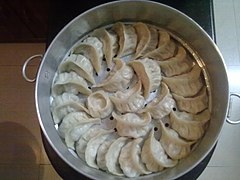 Momos in a mucktoo in Kathmandu, Nepal
 -
 Kothey, a pan-fried momo variety from "The Bakery Cafe" in Nepal


See also
.svg)

- List of dumplings
- Tibetan diaspora
- Wow! Momo, an Indian chain of momo restaurants
Notes
- ^ Some speakers of South Asian English use "momo" as the plural form.
References


- ^ Kleeman, Julie; Jampa, Yeshi (2022). Taste Tibet: Family recipes from the Himalayas. Murdoch Books. ISBN 9781911668428. Archived from the original on 2023-05-05. Retrieved 2023-05-05.
- ^ Shah, Santosh (26 April 2022). Ayla: A Feast of Nepali Dishes from Terai, Hills and the Himalayas. DK. ISBN 9780241535776. Archived from the original on 2023-05-05. Retrieved 2023-05-05.
- ^ a b Pushkarna, Kritika (2021-11-23). "The Interesting Story Of How Momos Came To India". TIMESOFINDIA.COM. Archived from the original on 24 April 2024. Retrieved 12 May 2023.
- ^ "How Momos are becoming a street food staple in Dhaka". Dhaka Tribune. 2023-11-02. Retrieved 2024-09-27.
- ^ Sang, Kham (2023-06-10). "Tibetan Momo, A Kind of Exotic Dumpling in Tibet". Tibet Travel.[unreliable source?]
- ^ a b "Momos! The Tibetan dumplings that the world is besotted with". gulfnews.com. 2021-12-07. Retrieved 2024-08-13.
- ^ a b "The Origins of the "Barbarian Head" | EATEN". Eileen Guo. Retrieved 2024-08-13.
- ^ ""馍"字的解释 | 汉典". www.zdic.net (in Chinese (China)). Retrieved 2024-08-13.
- ^ "燕翼诒谋录 - 维基文库,自由的图书馆". zh.wikisource.org (in Simplified Chinese). Retrieved 2024-08-13.
- ^ "菜包占比超过肉馒头 苏州人吃包子口味紧跟时尚_我苏网". www.ourjiangsu.com. Archived from the original on 2023-06-17. Retrieved 2023-06-17.
- ^ Chen, T.; Wu, Y.; Zhang, Y.; Wang, B.; Hu, Y.; Wang, C.; Jiang, H. (2012). "Archaeobotanical Study of Ancient Food and Cereal Remains at the Astana Cemeteries, Xinjiang, China". PLOS ONE. 7 (9): e45137. Bibcode:2012PLoSO...745137C. doi:10.1371/journal.pone.0045137. PMC 3447823. PMID 23028807.
- ^ "新疆出土现时我国最早的饺子_藏趣逸闻_新浪收藏_新浪网".
- ^ "Georgians have the Mongols to thank for their favourite dumpling". South China Morning Post. 2016-10-13. Retrieved 2024-08-13.
- ^ "WORLDFOOD - Momo: Nepal's Most Popular Food". Slow Food. Retrieved 2024-08-13.
- ^ a b "The history of MOMO (The king of fast food-Dumpling)". Archived from the original on 2023-01-21. Retrieved 2023-01-16.[better source needed]
- ^ Sijapati, Alisha (September 17, 2016). "A Juicy Love Affair". The Kathmandu Post. Archived from the original on September 23, 2016. Retrieved September 22, 2016.
- ^ Seow, Lynelle (15 January 2017). CultureShock! India. Marshall Cavendish International Asia Pte Ltd. pp. 202–. ISBN 978-981-4771-98-6.
- ^ "山南礼物丨"包"你好吃!". lyfzj.shannan.gov.cn. Retrieved 2024-08-13.
- ^ "Momo recipe". Himalayanlearning.org. Archived from the original on December 1, 2008. Retrieved April 6, 2011.
- ^ Williams, James. "Momos Chutney Recipe". Recipickr.com. Archived from the original on 2016-11-08. Retrieved 2014-12-12.
- ^ "Anup's Kitchen | Traditional recipes, without shortcuts". July 8, 2016. Archived from the original on April 25, 2023. Retrieved April 25, 2023.
- ^ HoneyGuide (9 July 2015). "12 Varieties of Momo – Have You Tried Them All?". Honeyguide to the mountains!. Archived from the original on 24 April 2023. Retrieved 24 April 2023.
- ^ Info Nepal. "Momos". Info Nepal. Archived from the original on 28 April 2023. Retrieved 24 April 2023.
- ^ Lama, Tsering Ngodup. "An essential guide to thukpas". The Kathmandu Post. Archived from the original on 25 April 2023. Retrieved 25 April 2023.
- ^ a b HoneyGuide Staff (9 July 2015). "12 Varieties of Momo - Have you tried them all?". HoneyGuide. Archived from the original on 2023-04-24. Retrieved 2023-05-02.
- ^ Bishal (2019-05-22). "How to cook Nepali Style C-Momo (Chilli Momo) in 10 Minutes? C-MOMO Recipe". ReaderSpice. Archived from the original on 2023-05-07. Retrieved 2023-07-22.
- ^ "Top 15 momos that will surely tempt your taste buds!". BuddyMantra. Archived from the original on 2023-05-02. Retrieved 2023-05-02.
- ^ "尼泊尔小吃"馍馍"神似小笼包,历史上也是从中国传过去的,两国交往源远流长". wenhui.whb.cn. Retrieved 2024-08-13.
- ^ a b Li, Tao, Jiang (2003). Tibetan Customs. 五洲传播出版社. p. 37. ISBN 978-7-5085-0254-0. Retrieved 5 August 2011.
- ^ Migrationology (2 April 2017). "Bhutanese Food: 25 Best Dishes To Eat When You're In Bhutan!". Migrationology. Archived from the original on 2023-05-26. Retrieved 2023-05-15.
- ^ "How To Make Authentic Open Momo Recipe In 20 Min". Bakaasur. Archived from the original on 2023-05-02. Retrieved 2023-05-02.
- ^ "Sandheko Momo". momo king. Archived from the original on 2023-05-02. Retrieved 2023-05-02.
- ^ Jeena (2023-06-08). "Sadeko Momo Recipe (Spicy Momo Salad Nepali Style)". Archived from the original on 2023-07-22. Retrieved 2023-07-22.
- ^ "Momos: Scrumptious Delights". nepaltraveller.com. Archived from the original on 2023-05-08. Retrieved 2023-07-22.
- ^ Himalayan Dumplings. "Tibetan Shogo Momo (Fluffy Potato Dumplings)". feedfeed. Archived from the original on 2023-05-02. Retrieved 2023-05-02.
- ^ Singh, Sarina (2010). Lonely Planet India. Lonely Planet Publications. p. 377. ISBN 9781742203478.