


Mandu (food)
.jpg) Jjin-mandu (steamed dumplings) | |
| Alternative names | Dumplings |
|---|---|
| Type | Fillled dumpling |
| Place of origin | Korea |
| Associated cuisine | Korean cuisine Korean royal court cuisine |
| Similar dishes | |

| Korean name | |
| Hangul | 만두 |
|---|---|
| Hanja | 饅頭 |
| Revised Romanization | mandu |
| McCune–Reischauer | mandu |
| IPA | [man.du] |
.jpg) |
| This article is part of a series on |
| Korean cuisine 한국 요리 조선 료리 |
|---|
Mandu (Korean: 만두; Hanja: 饅頭), or mandoo, are dumplings in Korean cuisine.[1][2] Mandu can be steamed, boiled, pan-fried, or deep-fried. The styles also vary across regions in the Korean Peninsula.[3] Mandu were long part of Korean royal court cuisine, but are now found in supermarkets, restaurants, and snack places such as pojangmacha and bunsikjip throughout South Korea.[4]
Names and etymology[edit]
The name is cognate with the names of similar types of meat-filled dumplings along the Silk Road in Central Asia, such as Uyghur manta (مانتا), Turkish mantı, Kazakh mänti (мәнті), Uzbek manti, Afghan mantu and Armenian mantʿi (մանթի).[5][6] Chinese mántou (馒头; 饅頭) is also considered a cognate, which used to mean meat-filled dumplings, but now refers to steamed buns without any filling.[5][6][7][8][9][10]
Mandu can be divided into gyoja (교자; 餃子) type and poja (포자; 包子) type.[11] In Chinese, the categories of dumplings are called jiǎozi (饺子; 餃子) and bāozi (包子) respectively, which are cognates with the Korean words. In Japanese, the former-type dumplings are called gyōza (餃子), which is also a cognate. In Mongolian, the latter-type dumplings are called buuz (бууз) and in Nepalese and Tibetan, they are called momo (मम, མོག་མོག) all of which is also cognates with the former.
History[edit]
Mandu are believed to have been first brought to Korea by Yuan Mongolians in the 14th century during the reign of the Goryeo dynasty.[12][13] The state religion of Goryeo was Buddhism, which discouraged consumption of meat. The Mongolian incursion into Goryeo relaxed the religious prohibition against consuming meat, and mandu was among the newly imported dishes that included meat.
Another possibility is mandu came to Korea at a much earlier period from the Middle East through the Silk Road. Historians point out many cuisines based on wheat, such as dumplings and noodles which originated from Mesopotamia and gradually spread from there. It also spread east along the Silk Road, leaving many versions of mandu throughout Central and East Asia.[14]
A Goryeo-era folk song, "Ssanghwajeom", tells a story of a mandu shop (ssanghwa meaning 'dumplings', and jeom meaning 'shop') run by a foreigner, probably of Central Asian origin.[12][15]
Varieties[edit]
If the dumplings are grilled or pan-fried, they are called gun-mandu (군만두); when steamed, jjin-mandu (찐만두); and when boiled, mul-mandu (물만두).[16] In North Korea, mandu styles vary in different regions of the country. In particular, Pulmuone is releasing cheese dumplings, sweet seed dumplings with sugar and spicy dumplings.[17]
- Mul-mandu (물만두) means "boiled mandu".[18]
- Gun-mandu (군만두) is pan-fried mandu. It is derived from guun-mandu 구운만두=>군만두 to mean "panned" dumplings.'.[19][20]
- Jjin-mandu (찐만두) is steamed, either in a traditional bamboo steamer or modern versions.[13]
- Gullin-mandu (굴린만두), also called gulmandu, is a variety of mandu in a ball shape without a covering. It is mainly eaten in summer.[21]
- Wang mandu (왕만두) is a bun stuffed with pork and vegetables, similar to the Chinese baozi.
- Pyeonsu (편수), mandu stuffed with vegetables in a rectangular shape. It is mainly eaten in summer and a local specialty of Kaesong, North Korea.[22]
- Eo-mandu (어만두), mandu wrapped with sliced fish fillet. It was originally eaten in Korean royal court and yangban (noble class) families.[23]
- Saengchi-mandu (생치만두), mandu stuffed with pheasant meat, beef, and tofu, that was eaten in Korean royal court and in the Seoul area during winter.[24]
- Seongnyu-mandu (석류만두), literally "pomegranate dumpling" because of the shape.[25]
- So-mandu (소만두), mandu stuffed with only vegetables, which were originally eaten in Buddhist temples.[26]
- Gyuasang (규아상), mandu stuffed with shredded cucumber and minced beef in the shape of a sea cucumber. It is mainly eaten in the summer.[27][28]
- Kimchi-mandu (김치만두), mandu with stuffing which contains kimchi. The addition of kimchi gives it a spicier taste compared to other mandu.[29]
- Napjak-mandu (납작만두), a Daegu specialty. As the name suggests (napjak in Korean means 'flat'), the mandu is not as plump as the other types. A small amount of chopped glass noodles and chopped vegetables go inside the mandu. The mandu is then boiled once and pan-fried once, finished off with a dipping sauce made with soy sauce and red pepper powder, and garnished on top with vegetables.[30]
-
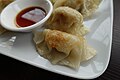 Gun-mandu (pan-fried dumplings)
 -
 Jjin-mandu (steamed dumplings)
 -
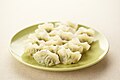 Mul-mandu (boiled dumplings)
 -
 Wang-mandu (steamed bun dumplings)
 -
 Daegu napjak-mandu (flat dumplings)
 -
 Common dumplings sold in Korean street restaurants


.jpg)


Dishes made with mandu[edit]

Manduguk is a variety of Korean soup (guk) made with mandu in beef broth. In the Korean royal court, the dish was called byeongsi (餠匙) while in the Eumsik dimibang, a 17th-century cookbook, it was called "seokryutang" (석류탕).[31]
Similar food[edit]
In Korean cuisine, mandu generally denotes a type of filled dumpling similar to the Mongolian buuz, a Tibetan-Nepalese momo and Turkic mantı, and some variations are similar to the Chinese jiaozi and the Japanese gyoza.
They are similar to pelmeni and pierogi in some Slavic cultures.
In popular culture[edit]
- In the 2003 South Korean film Oldboy, the protagonist Oh Dae-Su is fed a steady diet of fried mandu, the food that he detests the most, while he is imprisoned. After he is released, he visits various restaurants serving the dish to get clues and determine where he was held captive.[32]
- Wonder Girls member Ahn Sohee is often referred to as Mandu due to her cheeks resembling the shape of mandu.[33]
- In the 2020 DreamWorks animated series Kipo and the Age of Wonderbeasts, Kipo finds a mutated pig and names it Mandu because it resembles the dumpling.
See also[edit]
References[edit]
- ^ National Institute of Korean Language (30 July 2014). 주요 한식명(200개) 로마자 표기 및 번역(영, 중, 일) 표준안 (PDF) (in Korean). Retrieved 15 February 2017.
- 주요 한식명 로마자 표기 및 표준 번역 확정안 공지. National Institute of Korean Language (Press release) (in Korean). 2014-05-02.
- ^ "Mandu" [Dumplings]. Korean Food Foundation. Retrieved 24 June 2017.
- ^ Gentile, Dan (28 February 2014). "Korean food: The 12 essential dishes you need to know from the North and the South". Thrillist. Retrieved 19 May 2017.
- ^ Goldberg, Lina (23 March 2012). "Asia's 10 greatest street food cities". CNN. Retrieved 11 April 2012.
- ^ a b Anderson, E. N. (2005). Everyone Eats: Understanding Food and Culture. New York: New York University Press. pp. 183. ISBN 0-8147-0495-6.
- ^ a b Millward, James A. (2013). The Silk Road : A Very Short Introduction. London: Routledge. p. 62. ISBN 978-0-19-978286-4.
- ^ James A. Millward (15 March 2013). The Silk Road: A Very Short Introduction. Oxford University Press. pp. 62–. ISBN 978-0-19-979079-1.
- ^ Andrew Coe (16 July 2009). Chop Suey: A Cultural History of Chinese Food in the United States. Oxford University Press. pp. 89–. ISBN 978-0-19-975851-7.
- ^ PPC. Prospect Books. 1983. p. 30.
- ^ "Dumpling heaven in Adelaide | Fuchsia Dunlop". www.fuchsiadunlop.com. Archived from the original on 2016-05-31.
- ^ "Mandu" 만두. Standard Korean Language Dictionary (in Korean). National Institute of Korean Language. Retrieved 24 June 2017.
- ^ a b Pettid, Michael J. (2008). Korean Cuisine: An Illustrated History. Reaktion Books. p. 235. ISBN 978-1-86189-348-2. Retrieved 10 October 2018.
- ^ a b (in Korean) Mandu at Doosan Encyclopedia
- ^ (in Korean) Mandu Archived 2012-07-12 at archive.today, Hankook Ilbo, 2009-01-21
- ^ Mandu, Great Food, Great Stories From Korea
- ^ Favorite foods, Korean Tourism Organization
- ^ "[Weekend 맛대맛] 조리법따라 맛이 바뀌다니.. 깜짝 놀랄 '만두'하지". www.fnnews.com. 2018-10-18. Retrieved 2019-05-23.
- ^ (in Korean) Mulmandu recipe, Naver kitchen
- ^ (in Korean) Gunmandu, Naver dictionary
- ^ (in Korean) Yakimandu, Naver dictionary
- ^ (in Korean) Gullin mandu Archived 2011-06-10 at the Wayback Machine at Encyclopedia of Korean Culture
- ^ (in Korean) Pyeonsu Archived 2011-06-10 at the Wayback Machine at Encyclopedia of Korean Culture
- ^ (in Korean) Eomandu at Encyclopedia of Korean Culture
- ^ (in Korean) Saengchi mandu Archived 2011-06-10 at the Wayback Machine at Encyclopedia of Korean Culture
- ^ (in Korean) The three aesthetics of mandu Archived 2011-07-08 at the Wayback Machine, Lee Mi-jong (이미종), Yeoseong Chosun, 2008-02-14.
- ^ (in Korean) Somandu Archived 2011-06-10 at the Wayback Machine at Encyclopedia of Korean Culture
- ^ (in Korean) Gyuasang Archived 2011-06-10 at the Wayback Machine at Encyclopedia of Korean Culture
- ^ (in Korean) Gyuasang[permanent dead link] at Doosan Encyclopedia
- ^ (in Korean) Kimchi mandu at Doosan Encyclopedia
- ^ ""최원준의 음식 사람 <10> 납작만두"". Kookje News (in Korean). 2020-05-26. Retrieved 2021-01-25.
- ^ (in Korean) Manduguk Archived 2011-06-10 at the Wayback Machine at Encyclopedia of Korean Culture
- ^ (in Korean) Old Boy mandu, Yonhap News, 2005-03-21
- ^ (in Korean) Sohee hates nickname Mandu, Joy News 24, 2008-01-14
External links[edit]
- Golden Mandu (Korean Dumplings) (Kate's Global Kitchen, by Kate Heyhoe)
- Traditional Mandu Recipe, Korean-Cooking.com