


Serbian dances
| Part of a series on the |
| Culture of Serbia |
|---|
 |
| People |
| Mythology and Folklore |
| Cuisine |
| Festivals |
| Sport |

Dancing tradition in Serbia is represented by various styles of dances in the country and it is called Kolo. The word Kolo originated from the Slavic word meaning a ‘wheel,’ circle, or circuit. As with other aspects of Serbian culture, different forms of dances originated in different parts of Serbia, developed according to the local traditions and also acquired elements from other parts of the country. Kolo used to be performed near churches, at war fronts, weddings, and other occasions; the Serbian community described it as a circle dance around the church. At these celebrations, the Serbians start a circle dance, then, people hold each other’s hands, making a chain or a union, following the same rhythm; their hands are either in a V or W formation.[1]
Serbian folk dancing, kolo ("circle [dance]"), includes many varieties. The most popular dances are Užičko kolo,[2] and Moravac,[3] while other popular dances include Kokonješte, Žikino kolo and Vranjanka.[3]
Dances[edit]
 |
- Bojerka (Serbian noble dance), “Biserka-Bojerka" are two different melodies, to which the same dance was done in an urban circle. “Biserka” is derived from the word “biser,” meaning “pearl” or “jewel." "Bojerka" is derived from the Romanian "Boiereasca" which means "Noble Woman". This was danced in elegent balls.[4]
- Čačak Kolo
- Čoček
- Kokonješte, translates from the Romanian word "coconeşte, which means in the style of a young nobleman." Kokonjeste is danced to many different tunes, although the music that became the most popular, "Arapsko Kokonješte" (meaning Arabian, as in the horse), was brought to the United States of America by Serbs who lived in the Austro-Hungarian Empire.[5]
- Malo Kolo or Malo Banatsko Kolo is a kolo from northern Serbian region of Banat. It is one of the most popular kolos danced at social events. It is in 2/4 measure with 8 beats. It starts slow, speeding up with the footwork becoming more intricate and the dance more dynamic.[6]
- Moravac (from Great Morava), derived from Sumadija, which is a Region in Central Serbia. The dance structure is performed to a 2/4 beat in an open circle of dancers where the dance moves counterclockwise.[1]
- Niski Sa, Sa is also known as Sa, Sa, sa or Op sa. The name is derived from "opsa", a spontaneous exclamation. It usually refers to a three measure dance pattern with simple steps of 2 right, 2 backwards and two forward. There is a 5 measure dance version.[7]
- Oro (Serbian eagle dance from Montenegro and Herzegovina)
- Šetnja is a dance from Šumadija. It translates to "stroll" or "walk". It is usually danced to the lyrics “Dodji, Mile, u naš kraj” (Come, Mile, to our region) or “Prodji, Mile, kroz naš kraj” (Pass by, Mile, through our region).[8]
- Trojanac is a very quick, 2/4 rhythm, 5 measure dance with five “upbeat“ trembling steps.[9]
- Užičko kolo (from Užice), is one of the most widespread songs for dancing as it was composed by Milija Spasojevic, an accordionist from former Yugoslavia.[1]
- Vranjanka is a 5 measure, 7/8 rhythm kolo from Vranje, usually danced to songs “Šano Dušo” or “Otvori mi Lepo Lence”.[10][1]
- Žikino kolo, translates to Zika's circle dance, it is performed to a 7/8 beat (in some places, it's noted as 3/4).
-

-
 Dance from Gnjilane, Ensemble Kolo
 -
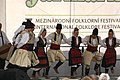 Dance from Pirot
 -
 Dance from the Timok Valley
 -
 Dance from Vranje
 -
 Dance from Leskovac


See also[edit]

References[edit]
- ^ a b c d "Kolo Dance | General Knowledge | Simply Knowledge". simplyknowledge.com. Retrieved 2022-12-04.
- ^ Ursula Hemetek; Adelaida Reyes; Institut für Volksmusikforschung und Ethnomusikologie--Wien (2007). Cultural diversity in the urban area: explorations in urban ethnomusicology. Institut für Volksmusikforschung und Ethnomusikologie. ISBN 978-3-902153-03-6.
They played newly composed folk music as well as kolos such as Uzicko kolo, a very popular dance melody from Serbia. The dance, one of the musical ethnic symbols of Serbia; might allude to Serbian ethnicity; otherwise we did not find any ...
- ^ a b Savez udruženja folklorista Jugoslavije. Kongres (1965). Rad ... Kongresa Saveza folklorista Jugoslavije. Savez folklorista Jugoslavie.
Za poslednjih dvadesetak godina Moravac je potisnuo svoje prethodnike Kokonjeste, 2ikino kolo i Vranjanku (brzu), naravno, ne potpuno, ali ipak toliko efikasno da je zauzeo mesto pored njih, pa i ispred njih.
- ^ Rakočević, Selena. "ETHNOCHOREOLOGICAL RESEARCH and TRADITIONAL DANCE PRACTICE IN SERBIA" (PDF). Balkanfolkfest.com.
- ^ https://socalfolkdance.org/dances/K/Kokonjeste_B_Serbian.pdf [bare URL PDF]
- ^ "Malo kolo Serbia". folkdancefootnotes.org. 30 January 2020.
- ^ "Sa (L*), Sa Sa, Op Sa, Niški sa,sa – Serbia". folkdancefootnotes.org. 27 January 2021.
- ^ "Šetnja, (Dodji, Mile or Prodje Mile) – Serbian Children's Dance". folkdancefootnotes.org.
- ^ "Trojanac (Serbia)". folkdancemusings.blogspot.com.
- ^ "Vranjanka, Teško (Šano dušo, Belo Lenče) – Serbia, Kosovo, N Macedonia". folkdancefootnotes.org. 26 November 2020.
Sources[edit]
- Vladimir Mutavdžić (2005). Narodni plesovi Srbije: praktikum pedagoške prakse. Studentski kulturni centar. ISBN 978-86-7757-115-3.
- Desa Đorđević (1988). Narodne igre Šumadije i Pomoravlja. Kulturno-prosvjetni sabor. ISBN 978-86-80825-62-5.
- Ljubica S. Janković; Danica S. Janković (1951). Narodne igre. Štamparija D. Gregorića.
- Tihomir R. Đorđević (1907). Srpske narodne igre. Vol. 9–10. Srpska kraljevska akademija.
- Bogdanka Đurić; Radomir Janković; Vasilije Pavlović (1991). Srpske narodne igre. Prosveta-Koprodukcija.
- Dragoslav Džadžević (2006). Narodne igre severoistočne Srbije. Kulturno-prosvetna zajednica. ISBN 9788684107079.
- Margarita Debeljak; Milica Ilijin (1953). Mađarske narodne igre iz Vojvodine. Bratstvo Jedinstvo.
- Branka Koturović; Aleksandar Marinković (1973). Narodne igre Jugoslavije: metodika, tehnika, ritam. Interplas.
- Vladimir Kirin (1965) [1954]. Narodni plesovi Jugoslavije. Naklada Color.
- "Kolo-Dance".
 | This article needs additional citations for verification. (December 2022) |