


Singkawang
Singkawang | |
|---|---|
| Other transcription(s) | |
| • Hanzi | 山口洋 |
| • Pinyin | shān kǒu yáng |
| • Hakka | san khew jong |
| • Dayak Salako | Sakawokng |
| • Jawi | كوتا سيڠ كوانڠ |
 Singkawang City Centre | |
 Coat of arms | |
| Nickname: Hong Kong van Borneo. | |
| Motto(s): Bersatu Untuk Maju, Singkawang Berkualitas | |
 Location within West Kalimantan | |
  Singkawang Location in Kalimantan and Indonesia  Singkawang Singkawang (Indonesia) | |
| Coordinates: 0°54′N 108°59′E / 0.900°N 108.983°E | |
| Country |  Indonesia Indonesia |
| Province |  West Kalimantan West Kalimantan |
| Established | 12 December 1981 (as administrative city) 21 June 2001 |
| Districts | |
| Government | |
| • Mayor | Tjhai Chui-Mie |
| • Vice Mayor | Irwan Zaini |
| Area | |
| • Total | 504.0 km2 (194.6 sq mi) |
| Population (mid 2023 estimate) | |
| • Total | 246,112 |
| • Density | 490/km2 (1,300/sq mi) |
| • Demonym | People of Singkawang 山口洋人 (San Khew Jong-Nyin) |
| [1] | |
| Time zone | UTC+7 (Indonesia Western Time) |
| Area code | (+62) 562 |
| Website | singkawangkota |
Singkawang or Sakawokng in Dayak Salako or San-Khew-Jong (Hakka: 山口洋), is a coastal city and port located in the province of West Kalimantan, on the island of Borneo in Indonesia. It is located at about 145 km north of Pontianak, the provincial capital, and is surrounded by the Pasi, Poteng, and Sakkok mountains. Singkawang is derived from the Salako language,[2] which refers to a very wide area of swamps (all swamps). In addition, the ancestors of the Hakka Chinese community in Sakawokng also named this area in Hakka as "San-Khew-Jong" (Mount-Mouth-Sea), which means "A city located at the foot of a mountain near the sea and has a river that flows up to the mouth of the river (estuary)."
The city was created on 21 June 2001 by separation from Bengkayang Regency. It is bordered to the east and south by Bengkayang Regency, to the west by the South China Sea, and to the north by Sambas Regency. It covers an area of 504 km2 and had a population of 186,462 at the 2010 Census[3] and 235,064 at the 2020 Census;[4] the official estimate as at mid 2023 was 246,112 (comprising 125,788 males and 120,324 females).[1]
History[edit]
Originally Singkawang was a village in that part of the Sultanate of Sambas, named as Singkawang Village (Kampong Singkawang) as a haven for traders and gold miners from Monterado. The miners and traders who came mostly from China, before they headed towards Monterado, first rested in Singkawang, while gold miners from Monterado often rested in Singkawang to remove their tiredness, while Singkawang also served as the transit point for the transportation of gold dust. At that time, they called Singkawang with the word Sakawokng (Salakko Dayak language), which means a very wide swampy swamp area located on the beach. Dayak Salako are part of the soldiers and intelligence of the Sultanate of Sambas which was given territorial territory in Binua Sarauntung Sakawokng.
Basically the Salako Dayak tribe has long inhabited the Sakawokng area before it became a bustling trading area. The Hakka Chinese who came from South China, who were mostly farmers, traders, and gold miners at that time entered the Sakawokng area through small rivers in the Sado (Sedau) area. At first, the Singkawang area was still a vast wilderness filled with swamps. Due to its geographical location, the Hakka Chinese immigrants named this area in Hakka as "San Khew Jong" (山口洋).
The word "San" (山) which means Mountain and Forest, the word "Khew" (口) which means the mouth of the river, and the word "Jong" (洋) which means the sea. These three syllables really describe the geographical location of Singkawang which is surrounded by mountains and adjacent to the sea and has a river that flows from upstream to downstream and empties into the mouth of the river (estuary). Coincidentally or not, the name San Khew Jong given by the Hakka Chinese immigrants has the same sound and meaning as the name Sakawokng, which was first named by the Salako Dayak ancestors. This shows that there has been a well-established interaction since time immemorial between the Chinese Hakka community and the indigenous Dayak Salako Sakawokng, especially in terms of language and culture.
Administrative districts[edit]
The city is divided into five administrative districts (kecamatan), listed below with their areas and their populations at the 2010 Census[3] and the 2020 Census,[4] together with the official estimates as at mid 2023.[1] The table also includes the number of urban villages (kelurahan) in each district, and its post codes.
| Kode Wilayah |
Name of District (kecamatan) |
Area in km2 |
Pop'n Census 2010 |
Pop'n Census 2020 |
Pop'n Estimate mid 2023 |
No. of villages |
Post code |
|---|---|---|---|---|---|---|---|
| 61.72.05 | Singkawang Selatan (a) (South Singkawang) |
224.48 | 41,432 | 54,910 | 58,294 | 4 | 79163 |
| 61.72.03 | Singkawang Timur (East Singkawang) |
166.26 | 19,263 | 23,366 | 24,177 | 5 | 79251 |
| 61.72.04 | Singkawang Utara (North Singkawang) |
66.45 | 21,977 | 30,994 | 33,503 | 7 | 79151 |
| 61.72.02 | Singkawang Barat (West Singkawang) |
15.04 | 46,890 | 55,477 | 56,987 | 5 | 79121 - 79124 |
| 61.72.01 | Singkawang Tengah (Central Singkawang) |
31.57 | 56,900 | 70,317 | 73,151 | 6 | 79111 - 79116 |
| Totals | 504.00 | 186,462 | 235,064 | 246,112 | 26 |
Note: (a) including offshore island of Pulau Simping.
Climate[edit]
Singkawang has a tropical rainforest climate (Af) with heavy to very heavy rainfall year-round.
| Climate data for Singkawang | |||||||||||||
|---|---|---|---|---|---|---|---|---|---|---|---|---|---|
| Month | Jan | Feb | Mar | Apr | May | Jun | Jul | Aug | Sep | Oct | Nov | Dec | Year |
| Mean daily maximum °C (°F) | 29.6 (85.3) |
30.1 (86.2) |
30.9 (87.6) |
31.2 (88.2) |
31.8 (89.2) |
31.5 (88.7) |
31.2 (88.2) |
31.3 (88.3) |
31.2 (88.2) |
31.1 (88.0) |
30.6 (87.1) |
30.1 (86.2) |
30.9 (87.6) |
| Daily mean °C (°F) | 26.0 (78.8) |
26.5 (79.7) |
26.9 (80.4) |
27.0 (80.6) |
27.5 (81.5) |
27.3 (81.1) |
26.9 (80.4) |
27.0 (80.6) |
27.1 (80.8) |
27.1 (80.8) |
26.7 (80.1) |
26.5 (79.7) |
26.9 (80.4) |
| Mean daily minimum °C (°F) | 22.5 (72.5) |
23.0 (73.4) |
22.9 (73.2) |
22.9 (73.2) |
23.2 (73.8) |
23.1 (73.6) |
22.7 (72.9) |
22.8 (73.0) |
23.0 (73.4) |
23.1 (73.6) |
22.9 (73.2) |
22.9 (73.2) |
22.9 (73.3) |
| Average rainfall mm (inches) | 309 (12.2) |
215 (8.5) |
198 (7.8) |
198 (7.8) |
200 (7.9) |
191 (7.5) |
165 (6.5) |
186 (7.3) |
227 (8.9) |
322 (12.7) |
358 (14.1) |
387 (15.2) |
2,956 (116.4) |
| Source: Climate-Data.org[5] | |||||||||||||
Demographics[edit]
Most of the population are of Chinese descent (around 42% of whole population). The largest group of Chinese descent is Hakka people (locally called as "Hakka-nyin" who speak Guangdong-Hakka dialect). The other major group of Chinese descent is Chaozhou People which is better known as Teochew. The rest are Malay, Dayak, Javanese, and other ethnicities. The total population was 235,064 at the 2020 Census.[4]
Religion in Singkawang (2022)[7]
The distribution of the religion practically follows the distribution of the ethnic groups; the largest groups are Islam followed by Buddhism, Catholic, Protestant and Confucianism.[7][8]
Food[edit]
Chinese food especially Hakka style dominates the food stalls or small restaurants, but Teochew style is also available. Minang style food can also be found here. Unique food like Rujak Ju Hie (鱿鱼炒; rojak with dried squid) is one of delicacies in Singkawang. Tofu (bean curd) Singkawang is famous in West Kalimantan, also Kembang Tahu (腐皮; silky smooth tofu with sugar gravy) is very popular in this city. Singkawang is also famous for its cakes. The variety of cakes is surprising and available from early morning till midnight. Choi Pan (菜粄:Steamed vegetable dumplings) is one of the many special traditional Chinese delicacies. Believed to be of Hakka origin, it consists mainly of fragrantly stir-fried yam bean wrapped in a slightly chewy translucent skin and is steamed to perfection.[9] There are also have several Malay food such as Bubur Paddas (Malay's spicy porridge), Pedak (fermented shrimp paste) and Nasi Lemak. Kopi tiam (咖啡店; local coffee shop) with strong bitter robusta coffee can be found every where. Peaceful and safe feeling for everyone makes Singkawang to be one of the cities with lively night. One may enjoy various food in Pasar Hongkong from porridge, kwetiau, fried rice, nasi lemak, rujak (fruit & vegetables salad), cakes coffee stall. And the prices of the food are surprisingly cheap. Local people enjoy the night with their friends discussing the local hottest issues, singing, or playing cards.
Chinatown[edit]
Besides being well known as the City of Thousands Temples, as there are many small and large temples in any part of the Singkawang region, Singkawang is also known as one of the Indonesian Chinatowns since the majority of the population is of Chinese descent, consisting of mostly Hakka and some other sub-group of Han Chinese. Theye reside in all areas in the city. They still practice their culture in any ceremony or official events, from weddings to funeral ceremonies. The culture is seen as the closest to the original tradition of Chinese people (mostly refers to Hakka), making Singkawang known as the Indonesian Chinatown.
Languages[edit]
Singkawang people use Indonesian as the primary language not only in conversation or trading, but they also use their own mother tongue. As Singkawang consists of three major ethnic groups, Chinese, Malays and Dayak, Hakka people, almost all of the Singkawang people use either Indonesian or Hakka Chinese for conversation; even some members of other ethnic groups use it, too. The Indonesian used in Singkawang commonly for daily conversation is not standard Indonesian, but has some Malay influence on vocabulary as Malay is the closest language to Indonesian and the Singkawang people have for years been accustomed to Malay.
Transportation[edit]
At present there is no airport at Singkawang, and served by Supadio International Airport. It is connected by road, can be reached by bus or taxi from Pontianak covering a distance of 150 km. It is also connected by road to Kuching in Malaysia via the Aruk/Biawak border and Sambas. A toll road to Pontianak is under consideration.[10]
A new international airport, which will serve Singkawang and become an alternative for Pontianak airport, is under construction. It will be built in two phases, out of which the first phase is expected to be completed by the end of 2024.[11][12]
Festivals[edit]

- Cap Go Meh (正月半 Jang Ngiet Ban in Hakka) is celebrated on the 15th and last day of Chinese New Year, the main spotlight of the day is Tatung (大同) festival, a mixed Chinese and Dayak people rituals;
- Qingming Festival or locally known as Cheng Beng, celebrated on 4–5 April in a given year;
- May: Gawai Dayak Naik Dango is celebrated by the Dayak in the opening of the rice harvest to thank the Gods;
- June 1: Ngabayotn is celebrated by the Dayak people to celebrate the closing form of rice harvest and beginning of the cultivation season;
- August: Wayang Gantung;
- August 17: The Celebration of Indonesian Independence day;
- October: Singkawang 10 km running contest is held on Singkawang's anniversary;
- October: Dragon Cup soccer championship gathers the clubs from the surrounding districts to celebrate Singkawang's anniversary;
- October: Pawai Takbir;
- Festival Bedug on Idul Adha day;
- Karnaval Muharram celebrates Islamic new year
Around Singkawang[edit]
Places of interest around the city are:
- Villa Bukit Mas, a resort;
- Simping Island, the smallest island in the world with an area of less than 0.5 hectares.
- Seran Tangan Lake, surrounded by shady trees give a fantastic impression and are very refreshing to the eye.
- Bukit Bougenville, a botanical garden about 6 km south of Singkawang;
- Chidayu Indah, is a similar garden to that of Bougenville, and lies right next to it;
- Pasir Panjang (长沙海滩) beach resort about 17 km south of Singkawang;
- Sungai Hangmoy (坑門), a river used for bathing mainly by the Hakka population;
- Kawasan Wisata, a white sanded beach 8 km south of Singkawang;
- Teratai Indah, an artificial lake used for recreation by the locals; lies only 2 km south of Singkawang;
- Thai Pak Kung Temple (大伯公廟)
- Vihara Chikung (济公庙), the largest Taoist temple in the area, funded by Singaporeans, located 3 km south of the city;
- Gunung Roban, a mount with a tiled path up the mountain used by the locals for easy hiking; located 4 km to the east.
- Batu Belimbing, or Starfruit Rock, a rock that resembles a starfruit. lies 8 km east of the city;
- Gunung Poteng is one of the main water resources for the city, and lies 7 km east. The mountain is a Natural Reserve where unique flora such as the Rafflesia Tuan Mudae grows;
- Sinka Island Park location at south of Singkawang in Teluk Karang has access to small Simping Island, recreational park, swimming pool and mini zoo around a hill.[13]
-
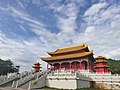 Thai Pak Kung Temple, the newly and largest temple in Singkawang
 -
 Pasir Panjang Beach
 -
 Singkawang Grand Mosque
 -
 Tjhia ancestral house


Mail order bride scandal[edit]
There have been allegations of human trafficking in Singkawang, based upon the town's mail order bride illegal business.[14] Most of the men who travel to Singkawang looking for young women to marry are from Taiwan, Mainland China, or Singapore. These men arrive and get in touch with brokers, these brokers then approach families with suitably aged daughters and generally offers these parents about 6 million rupiahs (about US$450) for each girl.
It is most normal for a majority of these foreign clients to pay an amount exceedingly more than what is requested by the brokers and most payments are at an average of 30 million rupiahs (about US$2,250). Contracts are often drawn between the brokers and the clients. It is a fact that each contract includes a time period clause and most of these marriages are contractually bound for 2 to 4 years, some for even shorter periods of time. It is also common for these relationships to not be legally bound marriages.
Indonesian police actively arrest the offender of mail order bride.[15]
Sister cities[edit]
 Bintulu, Sarawak, Malaysia
- Kuching, Sarawak, Malaysia[16]
- Miri, Sarawak, Malaysia
- Sibu, Sarawak, Malaysia
- Kangar, Perlis, Malaysia
 Singapore, Singapore
 Fuzhou, PRC
- Gutian County, PRC
- Minjiang, PRC
 Matsu, Taiwan
- Yangmei District, Taiwan
 Newcastle upon Tyne, England
 Yamaguchi, Japan
 Pamplona, Spain


Notable people[edit]
- Morgan Oey, actor and singer, former member of Indonesian idol group SMASH
- Christiandy Sanjaya (黃漢山), Deputy Governor of West Kalimantan
References[edit]
- ^ a b c Badan Pusat Statistik, Jakarta, 28 February 2024, Kota Singkawang Dalam Angka 2024 (Katalog-BPS 1102001.6172)
- ^ Cite journal |title= |url=https://jurnal.untan.ac.id/index.php/jpdpb/article/view/2038 |journal=Kata Ulang Bahasa Dayak Salako
- ^ a b Biro Pusat Statistik, Jakarta, 2011.
- ^ a b c Badan Pusat Statistik, Jakarta, 2021.
- ^ "Climate: Singkawang". Climate-Data.org. Retrieved 24 November 2020.
- ^ Indonesia's Population: Ethnicity and Religion in a Changing Political Landscape. Institute of Southeast Asian Studies. 2003. ISBN 9812302123
- ^ a b "Penduduk Menurut Wilayah dan Agama yang Dianut di Kota Singkawang". www.sp2010.bps.go.id. Retrieved 16 April 2021.
- ^ "ArcGIS Web Application".
- ^ "Chai Kuih Recipe 菜粿 (Steamed Vegetable Dumplings)". 23 July 2016.
- ^ Media, Kompas Cyber (2019-05-08). "Tol Pontianak-Singkawang Layak Dibangun". KOMPAS.com (in Indonesian). Retrieved 2022-12-09.
- ^ "Singkawang Airport New Airport Profile | CAPA". centreforaviation.com. Retrieved 2022-12-09.
- ^ Siregar, Syahriani (2022-06-03). "Bandara Singkawang Beroperasi Tahun 2024". Pontianak Post (in Indonesian). Retrieved 2022-12-09.
- ^ "Jika ke Singkawang, Ayo Mampir ke Sinka Island Park". February 3, 2012.
- ^ Indonesia, Etc.: Exploring the Improbable Nation, Elizabeth Pisani, p. 286
- ^ "Polres Singkawang gagalkan pengiriman warga yang diduga korban TPPO". 28 June 2019.
- ^ Rendra Oxtora; Aria Cindyara; Fardah Assegaf (9 July 2019). "Sarawak Chambers explore cooperation with Singkawang". Antara. Archived from the original on 26 September 2019. Retrieved 26 September 2019.
External links[edit]

- (in Indonesian) Official Singkawang Website

Regencies and cities of West Kalimantan | ||
|---|---|---|
Capital: Pontianak | ||
| Regencies |  | |
| Cities | ||
| 2,000,000 and more | |
|---|---|
| 1,000,000–1,999,999 | |
| 500,000–999,999 | |
| 300,000–499,999 | |
| 200,000–299,999 | |
| |
| International | |
|---|---|
| National | |
| Geographic | |
| Other | |
