


Portal:Czech Republic


Welcome to the Czech Portal!
Vítejte na Českém portálu!

|

|

| |
The Czech Republic, also known as Czechia, is a landlocked country in Central Europe. Historically known as Bohemia, it is bordered by Austria to the south, Germany to the west, Poland to the northeast, and Slovakia to the southeast. The Czech Republic has a hilly landscape that covers an area of 78,871 square kilometers (30,452 sq mi) with a mostly temperate continental and oceanic climate. The capital and largest city is Prague; other major cities and urban areas include Brno, Ostrava, Plzeň and Liberec.
The Duchy of Bohemia was founded in the late 9th century under Great Moravia. It was formally recognized as an Imperial State of the Holy Roman Empire in 1002 and became a kingdom in 1198. Following the Battle of Mohács in 1526, all of the Crown lands of Bohemia were gradually integrated into the Habsburg monarchy. Nearly a hundred years later, the Protestant Bohemian Revolt led to the Thirty Years' War. After the Battle of White Mountain, the Habsburgs consolidated their rule. With the dissolution of the Holy Roman Empire in 1806, the Crown lands became part of the Austrian Empire.
In the 19th century, the Czech lands became more industrialized, and in 1918 most of it became part of the First Czechoslovak Republic following the collapse of Austria-Hungary after World War I. Czechoslovakia was the only country in Central and Eastern Europe to remain a parliamentary democracy during the entirety of the interwar period. After the Munich Agreement in 1938, Nazi Germany systematically took control over the Czech lands. Czechoslovakia was restored in 1945 and three years later became an Eastern Bloc communist state following a coup d'état in 1948. Attempts to liberalize the government and economy were suppressed by a Soviet-led invasion of the country during the Prague Spring in 1968. In November 1989, the Velvet Revolution ended communist rule in the country and restored democracy. On 31 December 1992, Czechoslovakia was peacefully dissolved, with its constituent states becoming the independent states of the Czech Republic and Slovakia.
The Czech Republic is a unitary parliamentary republic and developed country with an advanced, high-income social market economy. It is a welfare state with a European social model, universal health care and free-tuition university education. It ranks 32nd in the Human Development Index. The Czech Republic is a member of the United Nations, NATO, the European Union, the OECD, the OSCE, the Council of Europe and the Visegrád Group. (Full article...)
Selected article -
Czechoslovakia (/ˌtʃɛkoʊsloʊˈvæki.ə, ˈtʃɛkə-, -slə-, -ˈvɑː-/ CHEK-oh-sloh-VAK-ee-ə, CHEK-ə-, -slə-, -VAH-; Czech and Slovak: Československo, Česko-Slovensko) was a landlocked state in Central Europe, created in 1918, when it declared its independence from Austria-Hungary. In 1938, after the Munich Agreement, the Sudetenland became part of Nazi Germany, while the country lost further territories to Hungary and Poland (the territories of southern Slovakia with a predominantly Hungarian population to Hungary and Zaolzie with a predominantly Polish population to Poland). Between 1939 and 1945, the state ceased to exist, as Slovakia proclaimed its independence and Carpathian Ruthenia became part of Hungary, while the German Protectorate of Bohemia and Moravia was proclaimed in the remainder of the Czech Lands. In 1939, after the outbreak of World War II, former Czechoslovak President Edvard Beneš formed a government-in-exile and sought recognition from the Allies.
After World War II, Czechoslovakia was reestablished under its pre-1938 borders, with the exception of Carpathian Ruthenia, which became part of the Ukrainian SSR (a republic of the Soviet Union). The Communist Party seized power in a coup in 1948. From 1948 to 1989, Czechoslovakia was part of the Eastern Bloc with a planned economy. Its economic status was formalized in membership of Comecon from 1949 and its defense status in the Warsaw Pact of 1955. A period of political liberalization in 1968, the Prague Spring, ended when the Soviet Union, assisted by other Warsaw Pact countries, invaded Czechoslovakia. In 1989, as Marxist–Leninist governments and communism were ending all over Central and Eastern Europe, Czechoslovaks peacefully deposed their communist government during the Velvet Revolution, which began on 17 November 1989 and ended 11 days later on 28 November when all of the top Communist leaders and Communist party itself resigned. On 31 December 1992, Czechoslovakia peacefully split into the two sovereign states of the Czech Republic and Slovakia. (Full article...)Selected picture

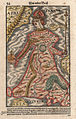
Source: Národní Galerie v Praze, PD
In this month

- 14 August 2002 – Water in the Vltava reaches peak level during the 2002 European floods, in which 17 people in the country die and around 200,000 are evacuated from their homes
- 15 August 1744 – Frederick the Great leads a Prussian invasion of Bohemia as part of the War of the Austrian Succession
- 20 August 1968 – The Warsaw Pact invasion of Czechoslovakia takes place in response to the Prague Spring reform movement
- 26 August 1992 – Václav Klaus and Vladimír Mečiar meet at Villa Tugendhat and agree to the Dissolution of Czechoslovakia
- 28 August 1867 – The Bohemian Crown Jewels (replica of the Crown of Saint Wenceslas pictured) are returned to Prague from Vienna
Categories

Selected biography -

Leoš Janáček (Czech pronunciation: [ˈlɛoʃ ˈjanaːtʃɛk] , 3 July 1854 – 12 August 1928) was a Czech composer, music theorist, folklorist, publicist, and teacher. He was inspired by Moravian and other Slavic music, including Eastern European folk music, to create an original, modern musical style.
Born in Hukvaldy, Janáček demonstrated musical talent at an early age and was educated in Brno, Prague, Leipzig, and Vienna. He then returned to live in Brno, where he married his pupil Zdenka Schulzová and devoted himself mainly to folkloristic research. His earlier musical output was influenced by contemporaries such as Antonín Dvořák, but around the turn of the century he began to incorporate his earlier studies of national folk music, as well as his transcriptions of "speech melodies" of spoken language, to create a modern, highly original synthesis. The death of his daughter Olga in 1903 had a profound effect on his musical output; these notable transformations were first evident in the opera Jenůfa (often called the "Moravian national opera"), which premiered in 1904 in Brno. (Full article...)Did you know?

- ...that, although Mozart never visited Kroměříž, much of the Academy Award-winning film Amadeus was filmed at the local episcopal residence?
- ... that the report Public Finance Balance of Smoking in the Czech Republic found that the "effect of smoking on the public finance balance in the Czech Republic in 1999 was positive"?
- ... that Czech international footballer Patrik Gedeon went to play club football in Liechtenstein in the middle of his career?
- ... that Czech Karel Robětín was not only an Olympian and national tennis champion but also an international paper industry tycoon?
General images
-
 Great Moravia during the reign of Svatopluk I (from History of the Czech lands)
 -
 A "traditional Bohemian platter" at a restaurant in central Prague, consisting of roast duck, roast pork, beer sausage, smoked meat, red and white cabbage, bread, bacon and potato dumplings. (from Czech cuisine)
 -
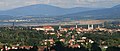
-
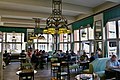 Grand Café Orient in Prague (from Czech architecture)
 -
 Map of protected areas of the Czech Republic: national parks (grey) and protected landscape areas (green) (from Protected areas of the Czech Republic)
 -
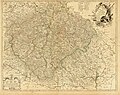 Detailed map of Bohemia, 1742 (from Bohemia)
 -

-
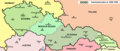 Bohemia (westernmost area) in Czechoslovakia 1918–1938 (from Bohemia)
 -
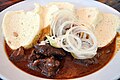 Prague-style beef goulash (from Czech cuisine)
 -
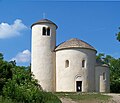 Rotunda of St. George from the beginning of the 12th century on Mount Říp (from History of the Czech lands)
 -
 Lands of the Bohemian Crown (until 1635), map by Josef Pekař, 1921 (from Bohemia)
 -
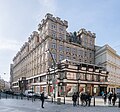 Adria Palace (Prague) (from Czech architecture)
 -
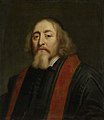 John Amos Comenius (1592-1670), Czech philosopher and school reformer (from History of the Czech lands)
 -
 Copper engraving of the Second Defenestration of Prague from Theatrum Europaeum by Matthäus Merian. (from History of the Czech lands)
 -
 Bohemian city Karlovy Vary (from Bohemia)
 -
 Linguistic map of interwar Czechoslovakia (c. 1930) (from Bohemia)
 -
 Václav Havel, playwright, dissident and president from 1989 to 2003 (from History of the Czech lands)
 -
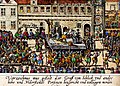 Beheading of 27 Bohemian nobles at the Old Town Square in Prague, 1621 (contemporary illustration) (from History of the Czech lands)
 -
 The National Theater from 1881 (from History of the Czech lands)
 -
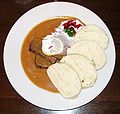 Svíčková na smetaně (Marinated tenderloin), served here with dumplings and cream (from Czech cuisine)
 -
 Monument to the village of Lidice murdered by the Nazis (from History of the Czech lands)
 -
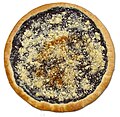 Frgál, a type of koláč baked in Moravian Wallachia (from Czech cuisine)
 -
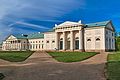 Kačina Castle in Chotkov (from Czech architecture)
 -
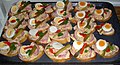 Obložené chlebíčky, a type of snack or appetizer (from Czech cuisine)
 -
 Bronze sword, Urnfield culture, c. 1200 BC (from History of the Czech lands)
 -
The First Czechoslovak Republic (1918-1938) (from History of the Czech lands)
-
 Church of Saint Agnes of Bohemia (Spořilov) (from Czech architecture)
 -
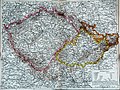 An 1892 map showing Bohemia proper outlined in pink, Moravia in yellow, and Austrian Silesia in orange (from Bohemia)
 -
 Territory under the control of the Přemyslids, c. 1301 (from History of the Czech lands)
 -
 Europe after the Congress of Vienna in 1815 (from History of the Czech lands)
 -
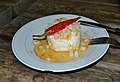 Nakládaný hermelín (marinated cheese) (from Czech cuisine)
 -
 Cubist architecture in Prague (from Czech architecture)
 -
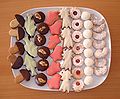 Christmas cookies (vánoční cukroví) (from Czech cuisine)
 -
 Hroby Nature Monument in Radenín (from Protected areas of the Czech Republic)
 -
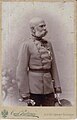 Emperor Francis Joseph I. (reigned 1848–1916) (from History of the Czech lands)
 -
 Entrance to Moravian Karst PLA (from Protected areas of the Czech Republic)
 -
 King George of Podebrady, one of the first promoters of united Europe (from History of the Czech lands)
 -
 St. Vitus Cathedral in Prague Castle, John of Luxembourg laid the foundation stone in 1344 (from History of the Czech lands)
 -
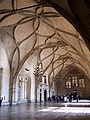 Vladislaus Hall at the Prague Castle, built from 1490 to 1502 by Benedikt Rejt (from History of the Czech lands)
 -
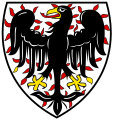 The coat of arms of the Přemyslid dynasty (until 1253–1262) (from Bohemia)
 -
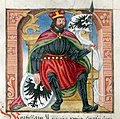 Saint Wenceslas, Czech prince (from History of the Czech lands)
 -
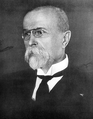 Tomas Garrigue Masaryk, philosopher, Czechoslovak president in the years 1918-1935 (from History of the Czech lands)
 -
 Iconic brutalist Transgas building, demolished in 2019 (from Czech architecture)
 -
 The extent of the Protestant Reformation (1545–1620) (from History of the Czech lands)
 -

-
 Monument to Master Jan Hus, a religious reformer and philosopher in Prague (from History of the Czech lands)
 -
 Řežabinec a Řežabinecké tůně National Nature Reserve (from Protected areas of the Czech Republic)
 -

-
 The coat of arms of the Kingdom of Bohemia (from Bohemia)
 -
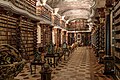 Library of Clementinum, a former Jesuit College, built in 1722 (from History of the Czech lands)
 -
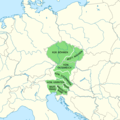 Territories ruled by Ottokar II of Bohemia in 1273 (from History of the Czech lands)
 -
 Emperor and King Charles IV. Luxembourg (from History of the Czech lands)
 -
 Venus of Dolní Věstonice, the oldest ceramic article in the world (from History of the Czech lands)
 -
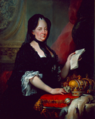 Empress Maria Theresa (reignet 1740–1780) (from History of the Czech lands)
 -
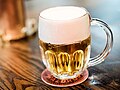 Pilsner Urquell in a branded mug (from Czech cuisine)
 -

-
 Zelňačka (from Czech cuisine)
 -
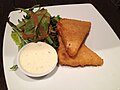 Fried cheese, served with tartar sauce and side salad (from Czech cuisine)
 -
 Czech kings Ottokar II, Wenceslas II and Wenceslas III from the Přemyslid dynasty (from History of the Czech lands)
 -
 Duchy of Bohemia, around 1029 (from History of the Czech lands)
 -
-
 Buděticko Nature Park with Rabí Castle (from Protected areas of the Czech Republic)
 -
 Russian occupation in 1968 (from History of the Czech lands)
 -
 Dacian Influence over Bohemia (from History of the Czech lands)
 -
 Korozluky Castle (from Czech architecture)
 -
 Apple strudel with raisins (from Czech cuisine)
 -
 Semi-detached villa in Brno by Otto Eisler, according to MoMA's Henry-Russell Hitchcock and Philip Johnson, is a defining building of the International style. (from Czech architecture)
 -
 A panorama of Kłodzko, the capital city of Kłodzko Land, which is referred to as "Little Prague" (from Bohemia)
 -
 Writer Božena Němcová (from History of the Czech lands)
 -
 Baroque St. Nicholas Church in Malá Strana, built between 1704 and 1755 (from History of the Czech lands)
 -
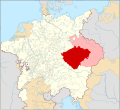 The Kingdom of Bohemia in 1618 with other Bohemian Crown lands within the Holy Roman Empire (1618). (from Bohemia)
 -
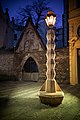 Cubist lamp by Emil Králíček, Jungmannovo náměstí, next to the Gothic Church of Our Lady of the Snows (Prague) (from Czech architecture)
 -

-
 Fried bramboráky (potato pancakes) (from Czech cuisine)


_(1592-1670)._Tsjechisch_humanist_en_pedagoog._Als_voorganger_van_de_Moravische_of_Boheemse_Broedergemeente_verdreven_en_sedert_1656_gevestigd_te_Amsterdam_Rijksmuseum_SK-A-2161.jpeg)


.jpg)


.jpg)
.jpg)

.JPG)
_-_Emperor_Franz_Josef_I_-_ca_1885.jpg)
.JPG)


.jpg)
.JPG)


.svg)

.JPG)


.svg)


Related portals


Topics

Czech lands: Bohemia • Moravia • Czech Silesia
History: Únětice culture • Boii • Marcomanni • Samo • Great Moravia • Přemyslid dynasty • Lands of the Bohemian Crown • Czech lands (1526–1648) • 1648–1867 • 1867–1918) • Czechoslovakia • Czech Republic
Geography: Lakes • Protected areas • Regions • Rivers
Law: Judiciary • Law enforcement • Supreme Court of the Czech Republic
Politics: Administrative divisions • Government • Constitution • Elections • Foreign relations • Army • Parliament • Political parties • President • Prime Minister
Economy: Banks • Czech koruna • Energy • Oil and gas deposits • Stock Exchange • Tourism • Transport
Culture: Architecture • Art • Cinema • Cuisine • Demographics • Education • Language • Literature • Media • Music • Philosophy • Prostitution • Public holidays • Religion • Sport • Television • Video games
Symbols: Flag • Coat of arms • National anthem (Kde domov můj)
Lists: Outline of the Czech Republic • List of Czech Republic–related topics
WikiProjects


Featured and good content


Things to do

Wikimedia
The following Wikimedia Foundation sister projects provide more on this subject:
-
 Commons
Free media repository -
 Wikibooks
Free textbooks and manuals -
 Wikidata
Free knowledge base -
 Wikinews
Free-content news -
 Wikiquote
Collection of quotations -
 Wikisource
Free-content library -
 Wikiversity
Free learning tools -
 Wikivoyage
Free travel guide -
 Wiktionary
Dictionary and thesaurus


