


Bossier City, Louisiana
Bossier City | |
|---|---|
| City of Bossier City | |
Downtown First Baptist Church | |
 Flag | |
| Motto(s): "Union, Justice, Confidence" | |
 Location of Bossier City in Bossier Parish, Louisiana | |
  Bossier City Location of Bossier City in Bossier Parish, Louisiana  Bossier City Bossier City (the United States) | |
| Coordinates: 32°31′04″N 93°41′29″W / 32.51778°N 93.69139°W | |
| Country |  United States United States |
| State |  Louisiana Louisiana |
| Parishes | Bossier |
| Founded | 1907 |
| Named for | Pierre Bossier |
| Government | |
| • Mayor | Tommy Chandler[1] (R) |
| • City council | Members list |
| Area | |
| • City | 45.02 sq mi (116.60 km2) |
| • Land | 43.85 sq mi (113.57 km2) |
| • Water | 1.17 sq mi (3.03 km2) 1.89% |
| • Metro | 2,698 sq mi (6,987.8 km2) |
| Elevation | 174 ft (53 m) |
| Population (2020) | |
| • City | 62,701 |
| • Rank | BO: 1st LA: 7th |
| • Density | 1,429.90/sq mi (552.08/km2) |
| • Metro | 393,406 (US: 140th) |
| Time zone | UTC−6 (CST) |
| • Summer (DST) | UTC−5 (CDT) |
| ZIP codes | 71111-71113, 71171-71172 |
| Area code | 318 |
| FIPS code | 22-08920 |
| Primary airport | Shreveport Regional Airport |
| Interstates |   |
| Website | BossierCity.org |

.jpg)
.jpg)
.jpg)


Bossier City (/ˈboʊʒər/ BOH-zhər) is a city in Bossier Parish in the northwestern region of the state of Louisiana in the United States.[3] It is the second-most populous city in the Shreveport–Bossier City metropolitan statistical area. In 2020, it had a total population of 62,701, up from 61,315 in 2010.[4]
Located on the eastern bank of the Red River, Bossier City is closely tied economically and socially to its larger sister city Shreveport on the western bank. The parish operates its own community college, Bossier Parish Community College.
History[edit]
19th century[edit]
In the 1830s, the area of Bossier City was the plantation Elysian Grove, which was purchased by James Cane and his second wife Mary Doal Cilley Bennett Cane.[5]
Cane had come to the area with his first wife Rebecca Bennett, and her brother, William Bennett, and his wife Mary Doal (née Cille)y Bennett. They ran a trading post across the river on what was then Caddo Indian territory, a portion called "Bennett's Bluff". The trading post partners became a one-seventh partner in the new Shreve Town, which eventually developed as Shreveport.
Like most plantations, Elysian Grove had frontage on the Red River for access to transportation for shipping cotton and other commodities. The Texas Trail crossed the Red River at this point. The trading post on the west side operated a ferry between what would become Shreveport and Bossier City. The plantation loading and unloading dock was later recorded as "Cane's Landing" in the old ferry log books.[6] For a very short time, Cane's Landing was known as Cane City.[7]
The Canes and Bennetts were among the earliest European-American ettlers in the area. Mary D. C. Bennett gave birth to the first white baby of the area, William Smith Bennett Jr. He died at an early age.[8][9]
In 1843, a section of land east of the Red River was divided from the Great Natchitoches District and Claiborne Parish areas and was called Bossier Parish. It was named in honor of Pierre Evariste John Baptiste Bossier, a former Creole general, who became a cotton planter in Bossier Parish.[10] Of ethnic French descent, he was one of the first European settlers in the area after most of the Native Americans had been forcibly removed by the federal government.
In the 1840s, the Great Western Migration of Americans and immigrants from the East and Upper South began. The parish grew in population. Many early settlers passed through the region on their way to the Western U.S. By 1850, more than 200 wagons a week passed through Bossier City, with many travelers from the Upper South intending to settle in Texas.[7] Some of these settlers stayed in Louisiana, attracted by the fertile soil and river valley. In 1850, the U.S. census listed the population of Bossier City (?) at 6,962.
American Civil War[edit]
During the American Civil War, companies of Confederate soldiers shipped out of Cane's Landing aboard steamboats for distant battlefields.[7] Mrs. Cane hosted hundreds of Confederate officers and troops who were heading off to war. Mrs. Cane's plantation was fortified to protect Shreveport by three batteries, with Fort Kirby Smith in the center. The others were Batteries Price, and Walker and Ewell.
Fort Smith protected the area from an eastern invasion.[7] The American Civil War reached Bossier Parish in 1861, and ended in Shreveport four years later, when the Trans-Mississippi Department surrendered. In the 20th century, Bossier High School was constructed near the former site of the fort.
Shed Road[edit]
Shed Road, the first all-weather turnpike in the American South, was constructed in the 1870s and operated from 1874 to 1886. It extended for 9 miles (14 km) from Red Chute to the Red River. The elevated and covered roadway led to a plantation that was accessible by a ferry. The covered road made the transportation of goods easier before the arrival of the railroads.[5]
Classification as a city[edit]
Anna B., granddaughter of James and Mary Cane, felt the area would prosper and began promoting the idea of a riverfront city. Anna B. and J. J. Stockwell sold lots in 1883. The area grew quickly, as did transportation through it. At the time, the unincorporated settlement was often called Cane City.
Around 1907, Cane City was incorporated by Louisiana Governor Newton C. Blanchard; the village was renamed as Bossier City. Blanchard appointed Ewald Max Hoyer, a Shreveport businessman, as the first Bossier City mayor. By that time, Bossier City had grown from an area around a square mile to a city containing more than 35 sq mi (91 km2). Continued growth led to Bossier City's being reclassified from village to town by Governor John M. Parker. Later, Governor Earl Kemp Long issued a proclamation classifying Bossier City as a city.[7]
The "golden spike" commemorated the completion of the east–west Vicksburg, Shreveport and Pacific Railroad. It was driven at Bossier City on July 12, 1884, by Julia "Pansy" Rule. It was the first such spike to be driven by a woman. The north–south Shreveport and Arkansas Railroad was completed on April 6, 1888. The Louisiana–Arkansas Railroad was completed on November 2, 1909.[11] The Dixie Overland Highway from the East to the West Coast was built in 1918. These railroads and highways combined to make Bossier City a hub for future activity.
The discovery of crude oil, to the south, in 1908, thrust Bossier City into the nationwide oil boom. Bossier's central location to the rural oil fields made it a major player in the oil patch. Several international oil companies were located in the area. The advantages brought by black gold fueled many civic, social and economic improvements.
A fire on June 23, 1925, consumed one-half of downtown Bossier City.[5] Local citizens were unable to battle the blaze. The loss spurred civic improvements, including a modern water system capable of fighting such fires, a new city hall, a modern fire alarm system, modern sidewalks, and the first city park.
In the 1930s, construction began on Barksdale Airfield (now Barksdale Air Force Base). In 1929 the land on which the base is built was unincorporated property south of Bossier City. The city of Shreveport annexed the land and donated it to the federal government. Through the years, Bossier City expanded, eventually encompassing the area surrounding the base. The first unit assigned to Barksdale was the 20th Pursuit Group. Before World War II, Barksdale was a training school for the Army Air Corps.
During World War II, Barksdale trained pilots, navigators, and bombardiers. Later, the base became one of the key bases of the Strategic Air Command in the new Air Force. Today Barksdale is the headquarters for the 8th Air Force.[12]
In the 1890s, Cane City had a population of about 600. Bossier City in 2012 had an estimated population of over 64,000. First a cotton-exporting river landing, next a railroad town, then an airbase and oil-boom town, Bossier City has become known for its tourism and casino gambling.[13]
Three casinos in the city have financed a number of municipal projects, many completed during the administration of the late Mayor George Dement. Recent improvements include the CenturyLink Center, Louisiana Boardwalk, Benton Road Overpass, and the Arthur Ray Teague Parkway, located along the eastern side of the Red River. Dement also procured Amtrak service between Bossier City and Dallas, Texas.[14]
In 2005 Dement was succeeded as mayor by Lo Walker, his former administrative assistant and mayoral opponent from 1989, the first Republican politician to hold the city's top executive position.[15]
Growth and redevelopment[edit]
On April 20, 2017, in their joint "State of Bossier" address, hosted by the Bossier Chamber of Commerce, Mayor Lo Walker, and Bossier Parish Police Jury President Bob Brotherton described the growth of the city and parish as "outstanding." With a population of 69,000 in a 2015 study by Louisiana State University, Bossier City had become the sixth-largest city in the state and the fastest-growing one.
Walker said that the city and the parish "work extremely close together, and our business and civic leaders and military make us an outstanding parish." The parish grew at 19%; the city grew at 10%. According to the Bossier Economic Development Foundation, the city could have reached 80,000 by 2019. Ongoing projects contributing to growth include the Walter O. Bigby Carriageway (the north parkway extension named for former state representative and judge Walter O. Bigby), Shed Road construction, and the South Bossier redevelopment districts.[16]
Geography[edit]
Bossier City is located at 32°31′4″N 93°41′29″W / 32.51778°N 93.69139°W (32.517651, −93.691397) within the Ark-La-Tex[17] and has an elevation of 174 feet (53.0 m) above sea level.[18] The city lies primarily on the banks of the Red River, and has a largely flat topography in contrast with Shreveport's terrain. The northern city limits are noticeably more hilly than the rest of the city. Many small waterways flow through the city, such as Flat River and Red Chute Bayou, which provide drainage for many areas of the city.[19]
The city has a total area of 43.90 square miles (113.69 km2), of which 0.99 square miles (2.56 km2) are covered by water.[20]
Climate[edit]
Bossier shares most aspects of its climate with its sister city of Shreveport. The city has a humid subtropical climate (Köppen climate classification Cfa) with hot, humid summers and mild winters.
During the warmer months, the city is prone to severe thunderstorms that feature heavy rain, high winds, hail, and occasional tornadoes. The city has a slightly above-average rate of tornadoes when compared to the U.S. average. Due to the flat topography of the city and the prominence of smaller waterways that are prone to backwater flooding from the Red River, the city occasionally experiences severe flooding events. A notable occurrence of severe flooding occurred in March 2016 after torrential rains caused a rapid rise of many local waterways, displacing upwards of 3,500 people from their homes across the area.[21][22] Freezes and ice storms regularly occur during the winters.
| Climate data for Bossier City, Louisiana (Shreveport Regional Airport), 1981–2010 normals,[23] extremes 1871–present | |||||||||||||
|---|---|---|---|---|---|---|---|---|---|---|---|---|---|
| Month | Jan | Feb | Mar | Apr | May | Jun | Jul | Aug | Sep | Oct | Nov | Dec | Year |
| Record high °F (°C) | 85 (29) |
89 (32) |
92 (33) |
96 (36) |
102 (39) |
104 (40) |
108 (42) |
110 (43) |
109 (43) |
99 (37) |
88 (31) |
84 (29) |
110 (43) |
| Mean maximum °F (°C) | 76.1 (24.5) |
79.4 (26.3) |
84.4 (29.1) |
87.5 (30.8) |
92.2 (33.4) |
95.5 (35.3) |
99.4 (37.4) |
100.9 (38.3) |
97.2 (36.2) |
91.1 (32.8) |
82.6 (28.1) |
76.6 (24.8) |
101.8 (38.8) |
| Mean daily maximum °F (°C) | 57.3 (14.1) |
61.5 (16.4) |
69.5 (20.8) |
76.9 (24.9) |
83.8 (28.8) |
90.1 (32.3) |
93.4 (34.1) |
94.1 (34.5) |
88.2 (31.2) |
78.2 (25.7) |
67.5 (19.7) |
58.5 (14.7) |
76.6 (24.8) |
| Mean daily minimum °F (°C) | 36.2 (2.3) |
39.7 (4.3) |
46.3 (7.9) |
53.6 (12.0) |
62.7 (17.1) |
69.5 (20.8) |
72.7 (22.6) |
72.1 (22.3) |
65.6 (18.7) |
54.6 (12.6) |
45.2 (7.3) |
37.7 (3.2) |
54.7 (12.6) |
| Mean minimum °F (°C) | 20.3 (−6.5) |
24.6 (−4.1) |
29.6 (−1.3) |
37.4 (3.0) |
49.3 (9.6) |
60.7 (15.9) |
67.2 (19.6) |
64.8 (18.2) |
51.3 (10.7) |
38.3 (3.5) |
29.1 (−1.6) |
21.7 (−5.7) |
17.3 (−8.2) |
| Record low °F (°C) | −2 (−19) |
−5 (−21) |
15 (−9) |
31 (−1) |
39 (4) |
52 (11) |
58 (14) |
53 (12) |
42 (6) |
28 (−2) |
16 (−9) |
5 (−15) |
−5 (−21) |
| Average precipitation inches (mm) | 4.20 (107) |
4.75 (121) |
4.14 (105) |
4.19 (106) |
4.93 (125) |
5.40 (137) |
3.65 (93) |
2.73 (69) |
3.16 (80) |
4.96 (126) |
4.53 (115) |
4.77 (121) |
51.41 (1,305) |
| Average snowfall inches (cm) | 0.6 (1.5) |
0.5 (1.3) |
— | 0 (0) |
0 (0) |
0 (0) |
0 (0) |
0 (0) |
0 (0) |
0 (0) |
0 (0) |
0.3 (0.76) |
1.4 (3.6) |
| Average precipitation days (≥ 0.01 in) | 9.0 | 9.1 | 9.2 | 7.6 | 9.5 | 9.2 | 8.1 | 6.4 | 6.9 | 8.0 | 8.7 | 9.6 | 101.2 |
| Average snowy days (≥ 0.1 in) | 0.3 | 0.3 | 0.1 | 0 | 0 | 0 | 0 | 0 | 0 | 0 | 0 | 0.1 | 0.8 |
| Average relative humidity (%) | 72.6 | 69.7 | 67.7 | 69.6 | 73.2 | 73.3 | 72.4 | 71.7 | 73.6 | 71.7 | 73.7 | 74.4 | 72.0 |
| Mean monthly sunshine hours | 158.3 | 172.8 | 213.1 | 231.2 | 267.1 | 297.9 | 317.9 | 300.7 | 249.8 | 235.8 | 176.8 | 158.4 | 2,779.8 |
| Percent possible sunshine | 50 | 56 | 57 | 59 | 62 | 70 | 73 | 73 | 67 | 67 | 56 | 51 | 63 |
| Source: NOAA (sun and relative humidity 1961–1990)[24][25] | |||||||||||||
Demographics[edit]
| Census | Pop. | Note | %± |
|---|---|---|---|
| 1890 | 202 | — | |
| 1910 | 775 | — | |
| 1920 | 1,094 | 41.2% | |
| 1930 | 4,003 | 265.9% | |
| 1940 | 5,786 | 44.5% | |
| 1950 | 15,470 | 167.4% | |
| 1960 | 32,776 | 111.9% | |
| 1970 | 43,769 | 33.5% | |
| 1980 | 50,817 | 16.1% | |
| 1990 | 52,721 | 3.7% | |
| 2000 | 56,461 | 7.1% | |
| 2010 | 61,315 | 8.6% | |
| 2020 | 62,701 | 2.3% | |
| U.S. Decennial Census[26] 2018 Estimate[27] | |||
| Race | Number | Percentage |
|---|---|---|
| White (non-Hispanic) | 31,843 | 50.79% |
| Black or African American (non-Hispanic) | 19,092 | 30.45% |
| Native American | 240 | 0.38% |
| Asian | 1,482 | 2.36% |
| Pacific Islander | 76 | 0.12% |
| Other/mixed | 3,273 | 5.22% |
| Hispanic or Latino | 6,695 | 10.68% |
Per the 2020 United States census, 62,701 people, 26,677 households, and 17,524 families resided in the city.[28] According to 2019 census estimates per the American Community Survey, 24.2% of the population were 18 and older, and 13.8% were 65 and older; the 26,927 households from 2015 to 2019 had an average of 2.44 people per household. In 1890, Bossier City initially had a population of 202, which has steadily increased since.
In 2019, the racial and ethnic makeup of the city was 58.5% non-Hispanic or Latino white, 27.9% Black or African American, 0.4% Native American, 2.4% Asian, 0.1% Native Hawaiian and other Pacific Islander, 2.5% two or more races, and 8.6% Hispanic and Latino American of any race.[29] At the 2020 census, the racial and ethnic makeup of the city was 50.79% non-Hispanic white, 30.45% Black or African American, 0.38% Native American, 2.36% Asian, 0.12% Pacific Islander, 5.22% two or more races, and 10.68% Hispanic and Latino American of any race; the 2020 census reflected nationwide trends of greater diversification and the growth of traditional minority populations in areas once predominantly non-Hispanic white.[30][31]
Of the 26,927 households estimated at 2019's American Community Survey, the owner-occupied housing rate was 52.8% and the median value of an owner-occupied housing unit was $163,500. The median cost with a mortgage was $1,182 versus $363 without a mortgage, and the median gross rent was $955. The median income for a household in the city was $50,340, and the per capita income was $26,755; an estimated 19.7% of the population lived at or below the poverty line. By 2020, its median household income was $48,385 with a mean income of $63,114.[32]
Religion[edit]
The majority of Bossier City's population is Christian.[33] Neighboring Shreveport is more religiously diverse than Bossier. Of its population, 37.9% identified as Baptists, primarily affiliated with the Southern Baptist Convention and National Baptist Convention, USA, Inc. Within the city, 6.7% were Methodists, primarily served by the United Methodist Church, 5.2% were Catholics in the Shreveport Diocese, 2.2% Pentecostals, 0.9% Latter Day Saints, 0.4% Presbyterian, 0.4% Lutheran, and 0.2% Episcopalian or Anglican. Within the Christian population of Bossier City, 7.7% claimed to be from another Christian group. Outside of Christendom, 0.3% of the city's residents were adherents to Islam.[33] Less than 0.1% of Bossier's residents identified with Judaism, or eastern religions such as Hinduism or Buddhism.[33]
Education[edit]


Primary and secondary schools[edit]
Bossier City residents are zoned to Bossier Parish Schools, as are all residents of the parish.[34]
Elementary schools in Bossier City:
- Apollo Elementary School
- Bellaire Elementary School
- Bossier Elementary School
- Central Park Elementary School
- Curtis Elementary School
- R.V. Kerr Elementary School
- Meadowview Elementary School
- Plantation Park Elementary School
- Stockwell Place Elementary School
- Sun City Elementary School
- Waller Elementary School
W.T. Lewis Elementary School, outside the city limits, serves dsome portions of Bossier City.[35] A portion of Bossier City is in the collective boundary of T. L. Rhodes Elementary School (Eastwood CDP, PreKindergarten-Grade 1), Platt Elementary School (Eastwood, grades 2-3), and Princeton Elementary School (grades 4-5).[36] Additionally, a small area of the city limits is in the zone for Elm Grove Elementary School, also outside of the city limits.[37]
Middle schools in Bossier City include:
- Cope Middle School
- Elm Grove Middle School
- Greenacres Middle School
- T.O. Rusheon Middle School
Additionally, Haughton Middle School in Haughton has a boundary including a portion of Bossier City.[38]
High schools in Bossier City include:
Parkway High School, just outside the city limits, has a boundary including parts of Bossier City.[39] Additionally, Haughton High School in Haughton has a boundary including a portion of Bossier City.[40]
Tertiary education[edit]
Bossier Parish is in the areas of Bossier Parish Community College and Northwest Louisiana Technical Community College.[41]
Four year institutions:
- Louisiana Tech University at Shreveport-Bossier City[42]
Media[edit]
As a sister city to Shreveport, the city of Bossier City is served by the Bossier Press-Tribune and Shreveport Times.[43] In addition, The Forum, City Lights, and SB Magazine are news magazines in the Shreveport–Bossier City area. The city shares the same television and radio markets with Shreveport and the Texarkana metropolitan area as part of the Ark-La-Tex.
In mainstream media, "Bossier City" is a song by David Allan Coe, in which he sings, "And it sure smells like snow in Bossier City..." Johnny Rodriguez recorded a song called "Achin' Bossier City Backyard Blues" in 1972. Turnpike Troubadours 2007 freshman album is entitled Bossier City, and includes the title track "Bossier City".
Radio[edit]
Bossier City is the secondary principal city of the Shreveport radio market.
Television[edit]
Bossier City is the second most populous city in the Shreveport media market for television.[44]
Sports and entertainment[edit]


From the 1930s to the 1970s, Bossier was regionally and even nationally known for its entertainment district known as The Bossier Strip, which followed U.S. Highway 80 through the city. Nightclubs proliferated from the Texas Avenue Bridge to the Bossier-Webster parish line. Prior to the 1940s, The Strip was as well known for such entertainment as Las Vegas, Nevada.[45][46]
Bossier City and Shreveport share an all-women's flat track roller derby team named the Twin City Knockers. The team is the newest competing sport in the area, founded in January 2010. Bouts are hosted at Hot Wheels skating rink in south Bossier.
The Brookshires Grocery Arena (formerly CenturyTel Center) in Bossier City was the home of the Bossier–Shreveport Battle Wings of the AF2, as well as the Bossier-Shreveport Mudbugs of the Central Hockey League. The arena has hosted top performers, including Britney Spears and Aerosmith, as well as rodeos, ice shows, and children's entertainment.
The 2005 Red River Classic PRCA Rodeo to be hosted at the CenturyTel Center was cancelled due to the arena's use as a shelter for Hurricane Katrina evacuees.[47]
The city hosts three riverboat casino gambling resorts along the east bank of the Red River: Margaritaville, Horseshoe, and Boomtown. Diamond Jacks previously operated in the area before closing, but Foundation Gaming has plans for reopening in 2024.[48][49] Horse racing and gambling on slot machines is also available at Louisiana Downs, which opened in 1974.
Notable people[edit]
- Jimmy Boyd, state representative for Bossier Parish from 1944 to 1952
- Henry Newton Brown Jr., judge of the Louisiana Second Circuit Court of Appeals (1992–2012) and district attorney of Bossier and Webster parishes (1976–1991), is a long-term resident of Bossier City.
- Jeff Cox, judge of Division C of the 26th Judicial District in Bossier and Webster parishes since 2005[50]
- Raymond Crews, Republican state representative for District 8
- Tim Dement, amateur boxer who competed in the 1972 Summer Olympics, former Bossier City police detective, and son of former Mayor George Dement
- Ryan Gatti, state senator for District 36, 2016–2020; Bossier City lawyer[51]
- Eurlyne Howell, Miss Louisiana USA 1958, Miss USA 1958
- Mike Johnson, Speaker of the United States House of Representatives, U.S. Representative since 2017 for (R-Louisiana's 4th congressional district); former state representative
- Keith Lehr, two-time World Series of Poker bracelet winner, born and resides in Bossier City
- Jared Leto, actor and musician, was born in Bossier City on December 26, 1971.
- Shannon Leto, drummer of 30 Seconds to Mars and older brother of Jared Leto, was born in Bossier City on March 9, 1970.
- Judi Ann Mason, born and reared in Shreveport-Bossier, Hollywood screenwriter and producer, wrote Sister Act 2: Back in the Habit
- John McConathy (1930–2016), professional basketball player, former superintendent for the Bossier Parish School Board
- Mike McConathy (born 1955), basketball coach since 1999 at Northwestern State University in Natchitoches; former basketball coach at Bossier Parish Community College; son of John McConathy
- Alex Pourteau, professional wrestler who worked for both WWE and WCWR, was born in Bossier City in 1969.
- Buddy Roemer, former United States Representative (R-Louisiana's 4th Congressional District (1980–87) and Governor of Louisiana (1988–92)
- Charles E. Roemer II, farmer, businessman, and politician
- B. J. Ryan was a closer in Major League Baseball for the Toronto Blue Jays of the American League. Previously, Ryan played for the Cincinnati Reds (1999) and Baltimore Orioles (1999–2005).
- Jeffrey D. Sadow, political scientist, columnist, professor at Louisiana State University in Shreveport
- Jeff R. Thompson, state representative; successor to Jane Smith
- David Toms, a professional golfer, graduated from Airline High School.
- Randy Walker, a professional American football player who played for the Green Bay Packers in 1974, graduated from Bossier High School and later Northwestern State University. Walker still holds many punting/kicking records at both schools.
- Todd Walker, a professional baseball player, graduated from Airline High School.
- Jesse Winchester, musician and songwriter, was born May 17, 1944, at Barksdale Air Force Base.
References[edit]
- ^ Tommy Chandler takes oath of office as Bossier City's new mayor
- ^ "2020 U.S. Gazetteer Files". United States Census Bureau. Retrieved March 20, 2022.
- ^ Office, US Census Bureau Public Information. "Census 2000 data for Louisiana". census.gov. Retrieved December 28, 2016.
- ^ "QuickFacts: Bossier City, Louisiana". U.S. Census Bureau. Retrieved August 12, 2021.
- ^ a b c "On the road: History of Bossier City". KSLA. Archived from the original on July 15, 2012. Retrieved August 19, 2021.
- ^ LSUS Special Archives. Ferry Log Book.
- ^ a b c d e "City History | Bossier City, LA". www.bossiercity.org. Retrieved August 19, 2021.
- ^ "Shreveport, LA – Official Website – History of Shreveport". ShreveportLa.gov. Retrieved December 28, 2016.
- ^ "History". BossierCity.org. Archived from the original on February 6, 2015. Retrieved December 28, 2016.
- ^ Carr, Jessica (April 27, 2018). "5 Fascinating Facts about the History of Bossier Parish". Be Bossier. Retrieved August 19, 2021.
- ^ Smith, Chuck (October 8, 2018). "Do You Know the History of Bossier Railroads?". Be Bossier. Retrieved August 19, 2021.
- ^ "8th Air Force".
- ^ "Bossier City History". Archived from the original on September 5, 2008. Retrieved July 12, 2008.
- ^ "Amanda Crane, "'Mr. Bossier' turns 91"". bossierpress.com. Retrieved February 6, 2013.
- ^ "Lo Walker to seek third term as Bossier City mayor, April 12, 2012". KTBS-TV. Archived from the original on April 11, 2013. Retrieved February 3, 2013.
- ^ Sarah Crawford (April 22, 2017). "Mayor: Bossier 6th largest city in state". The Shreveport Times. Retrieved April 24, 2017.
- ^ "US Gazetteer files: 2010, 2000, and 1990". United States Census Bureau. February 12, 2011. Retrieved April 23, 2011.
- ^ "US Board on Geographic Names". United States Geological Survey. October 25, 2007. Retrieved January 31, 2008.
- ^ Bossier City (Louisiana). Bossier City Comprehensive Plan. Retrieved on 13 June 2016.
- ^ "U.S. Census website". United States Census Bureau. Retrieved August 28, 2014.
- ^ Vagell, Quincy; Dolce, Chris; Erdman, Jon. "Over 23 Inches of Rain Triggers Historic Flash Flooding, River Flooding In Parts of the South". Retrieved March 11, 2016.[permanent dead link]
- ^ "Flooding, evacuations continue in Caddo and Bossier parishes". shreveporttimes.com. Retrieved June 13, 2016.
- ^ Mean monthly maxima and minima (i.e. the expected highest and lowest temperature readings at any point during the year or given month) calculated based on data at said location from 1981 to 2010.
- ^ "NowData – NOAA Online Weather Data". National Oceanic and Atmospheric Administration. Retrieved August 22, 2019.
- ^ "WMO Climate Normals for Shreveport/WSO AP, LA 1961–1990". National Oceanic and Atmospheric Administration. Retrieved February 12, 2017.
- ^ United States Census Bureau. "Census of Population and Housing". Retrieved August 28, 2014.
- ^ "Population Estimates". United States Census Bureau. Retrieved June 8, 2018.
- ^ a b "Explore Census Data". data.census.gov. Retrieved December 29, 2021.
- ^ "U.S. Census Bureau QuickFacts: Bossier City city, Louisiana". www.census.gov. Retrieved August 19, 2021.
- ^ Frey, William H. (July 1, 2020). "The nation is diversifying even faster than predicted, according to new census data". Brookings. Retrieved May 27, 2022.
- ^ "Census shows US is diversifying, white population shrinking". AP NEWS. August 12, 2021. Retrieved May 27, 2022.
- ^ "Explore Census Data". data.census.gov. Retrieved May 27, 2022.
- ^ a b c "Bossier City, Louisiana Religion". www.bestplaces.net. Retrieved October 1, 2018.
- ^ "2020 CENSUS - SCHOOL DISTRICT REFERENCE MAP: Bossier Parish, LA" (PDF). U.S. Census Bureau. Retrieved March 9, 2024. - Text list
- ^ "W. T. Lewis Elementary Attendance Zone Map" (PDF). Bossier Parish School Board. Retrieved March 9, 2024. - The boundaries of Bossier City are directly indicated on this map.
- ^ "T. L. Rodes, Platt, Princeton Elementary Attendance Zone Map" (PDF). Bossier Parish School Board. Retrieved March 9, 2024. - The boundaries of Bossier City and other places are directly indicated on this map.
- ^ "Elm Grove Elementary Attendance Zone Map" (PDF). Bossier Parish School Board. Retrieved March 9, 2024. - The boundaries of Bossier City are directly indicated on this map.
- ^ "Haughton Middle School Attendance Zone Map" (PDF). Bossier Parish School Board. Retrieved March 9, 2024. - The boundaries of Haughton, Bossier City, and Plain Dealing are directly indicated on this map.
- ^ "Parkway High School Attendance Zone Map" (PDF). Bossier Parish School Board. Retrieved March 9, 2024. - The boundaries of Bossier City are directly indicated on this map.
- ^ "Haughton High School Attendance Zone Map" (PDF). Bossier Parish School Board. Retrieved March 9, 2024. - Compare to the CDP maps. The boundaries of Haughton, Bossier City, and Plain Dealing are directly indicated on this map.
- ^ "Our Colleges". Louisiana's Technical and Community Colleges. Retrieved March 9, 2024. shows Bossier Parish in the service areas of BPCC and NLTCC.
- ^ "Home – Louisiana Tech University @ Shreveport – Bossier City". Archived from the original on May 28, 2013.
- ^ Bossier Press-Tribune
- ^ "Market Search: Shreveport DMA Overview". Katz Radio Group. Retrieved January 22, 2024.
- ^ Kip Lornell and Tracey E. W. Laird, ed. (2008). Shreveport Sounds in Black and White. p. 151. ISBN 9781934110416. Retrieved January 20, 2015.
- ^ "Las vegas casinos and past mob Ties". Archived from the original on June 13, 2010. Retrieved January 21, 2015.
- ^ "2005 Red River Classic PRCA Rodeo Cancelled" (PDF). CenturyTel Center, 2005. Retrieved April 22, 2010.
- ^ "DiamondJacks Casino & Hotel in Bossier City closes its doors, cites impact of COVID-19". KYTX. Retrieved May 16, 2020.
- ^ "What's the latest on the Diamond Jacks Casino project in Bossier City?". The Times. Retrieved November 23, 2022.
- ^ "Judge Jeff Cox". 26jdc.com. Archived from the original on May 17, 2014. Retrieved April 26, 2014.
- ^ "About Ryan". rayangatti.com. Archived from the original on May 7, 2016. Retrieved March 30, 2016.
External links[edit]


Municipalities and communities of Bossier Parish, Louisiana, United States | ||
|---|---|---|
| Cities | 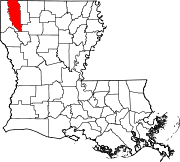 | |
| Towns | ||
| CDPs | ||
| Other communities |
| |
| Footnotes | ‡This populated place also has portions in an adjacent parish or parishes | |
City of Shreveport, Louisiana | |||||||
|---|---|---|---|---|---|---|---|
| Topics |  | ||||||
| Shreveport neighborhoods |
| ||||||
| Education |
| ||||||
| Transportation | |||||||
| Media |
| ||||||
| Landmarks | |||||||
| Culture | |||||||

| International | |
|---|---|
| National | |
| Geographic | |
