


Fula people

Fulɓe 𞤊𞤵𞤤𞤩𞤫 | |
|---|---|
.jpg) Fulani men during Guérewol, Niger | |
| Total population | |
| est. 38.6 million[citation needed] | |
| Regions with significant populations | |
| West Africa, North Africa and Central Africa | |
 Nigeria Nigeria | 15,300,000 (6.6%)[1] |
 Senegal Senegal | 5,055,782 (27.5%)[2] |
 Guinea Guinea | 4,544,000 (33.4%)[3] |
 Cameroon Cameroon | 3,000,000 (13.4%)[4][5] |
 Mali Mali | 2,840,850 (13.3%)[6] |
 Burkina Faso Burkina Faso | 1,800,000 (8.4%)[7] |
 Niger Niger | 1,650,000 (6.5%)[8] |
 Benin Benin | 1,182,900 (8.6%)[9] |
 Mauritania Mauritania | 900,000 (18.3%)[10] |
 Guinea-Bissau Guinea-Bissau | 623,646 (30%)[11] |
 Gambia Gambia | 449,280 (18.2%)[12] |
 Chad Chad | 334,000 (1.8%)[13] |
 Sierra Leone Sierra Leone | 310,000 (5%)[14] |
 CAR CAR | 250,000 (4.5%)[15] |
 Sudan Sudan | 204,000 (0.4%)[16] |
 Togo Togo | 110,000 (1.2%)[17] |
 Ghana Ghana | 4,240 (0.01%)[18] |
 South Sudan South Sudan | 4,000 (0.02%)[19] |
 Algeria Algeria | 4,000 (0.01%)[citation needed] |
 Ivory Coast Ivory Coast | 3,800 (0.02%)[15] |
| Languages | |
| Fula • French • Portuguese • English • Arabic • Hausa | |
| Religion | |
| Primarily Islam[20] | |
| Related ethnic groups | |
| Toucouleur, Tuareg, Hausa, Tebu, Serer, Songhay, Berber Tribes[21] | |
| Person | Pullo 𞤆𞤵𞤤𞥆𞤮 |
|---|---|
| People | Fulɓe 𞤊𞤵𞤤𞤩𞤫 |
| Language | Pulaar (𞤆𞤵𞤤𞤢𞥄𞤪, West), Fulfulde (𞤊𞤵𞤤𞤬𞤵𞤤𞤣𞤫, East) |
The Fula, Fulani, or Fulɓe people[a] is an ethnic group in Sahara, Sahel and West Africa, widely dispersed across the region.[22] Inhabiting many countries, they live mainly in West Africa and northern parts of Central Africa, South Sudan, Darfur, and regions near the Red Sea coast in Sudan. The approximate number of Fula people is unknown, due to clashing definitions regarding Fula ethnicity. Various estimates put the figure between 25[23][24] and 40 million people worldwide.[25]
A significant proportion of the Fula – a third, or an estimated 7 to 10 million[26] – are pastoralists, and their ethnic group has the largest nomadic pastoral community in the world.[27][28] The majority of the Fula ethnic group consisted of semi-sedentary people,[28] as well as sedentary settled farmers, scholars, artisans, merchants, and nobility.[29][30] As an ethnic group, they are bound together by the Fula language, their history[31][32][33] and their culture. The Fula are almost completely Muslims.[34][35]
Many West African leaders are of Fulani descent, including the former President of Nigeria, Muhammadu Buhari; the first president of Cameroon Ahmadou Ahidjo; the former President of Senegal, Macky Sall; the President of Gambia, Adama Barrow; the President of Guinea-Bissau, Umaro Sissoco Embaló; the Vice President of Sierra Leone, Mohamed Juldeh Jalloh; the Prime Minister of Mali, Boubou Cisse and the Wife of Vice President of Ghana Samira Bawumia. They also occupy positions in major international institutions, such as the Deputy Secretary-General of the United Nations, Amina J. Mohammed; the 74th President of the United Nations General Assembly, Tijjani Muhammad-Bande; and the Secretary-General of OPEC, Mohammed Sanusi Barkindo.
Names
Ethnonyms
There are many names (and spellings of the names) used in other languages to refer to the Fulɓe. Fulani in English is borrowed from the Hausa term.[36] Fula, from Manding languages, is also used in English, and sometimes spelled Fulah or Fullah. Fula and Fulani are commonly used in English, including within Africa. The French borrowed the Wolof term Pël, which is variously spelled: Peul, Peulh, and even Peuhl. More recently the Fulfulde / Pulaar term Fulɓe, which is a plural noun (singular, Pullo) has been Anglicised as Fulbe,[37] which is gaining popularity in use. In Portuguese, the terms Fula or Futafula are used. The terms Fallata, Fallatah, or Fellata are of Arabic origins, and are often the ethnonyms by which Fulani people are identified by in parts of Chad and Sudan.
The Toucouleur people of the central Senegal River valley speak Fulfulde / Pulaar and refer to themselves as Haalpulaaren, or those who speak Pulaar. The supposed distinction between them was invented by French ethnographers in the 19th century who differentiated between supposedly sedentary, agricultural, fanatical, and anti-European Toucouleurs on one hand and nomadic, pastoralist, docile and cooperative Peulhs on the other, but the dichotomy is false.[38]
Surnames
Common Fulani family names in Guinea, Sierra Leone, Guinea Bissau and Southern Senegal are: Diallo (French regions), Jallow or Jalloh (Gambia, Sierra Leone and Liberia), Djalo (Cap Verde and Guinea Bissau), Sow, Barry, Bah or Ba, Baldé, and Diouldé.[39] Other Fulani (Toucouleur) family names in Guinea and northern Senegal are: Tall, Sall, Diengue, Sy, Anne, Ly, Wann, Dia and others.
Although most Fulbe of Nigeria, Niger and Cameroon mostly use their father's family name, there are some common Fulani last names such as Bello (likely from the Fulfulde word Ballo meaning “helper of religion”),[40] Tukur (from Takrur), Gidado, Barkindo, Jallo, Ahidjo and Dikko.
In Mali, the most common Fulani family names are Diallo, Diakité, Dia, Sow, Sidibé, Sangaré, Ba, Dicko, Bocoum, Tall, Kah, etc. These names can be found among the Fulani populations of the following Malian regions and areas of Mopti, Macina, Nioro, Kidal, Tomboctou, Gao, Sikasso, and others.[41][42]
In the Wasulu (Wassoulou) region of Mali, the most common family names among the Fula are Diallo, Diakité, Sidibé and Sangaré. These names are also found among the Fula population of Burkina Faso,[43] along with other names like Barry, Dicko and Sankara (derived from Sangaré). Many of the Fula people from the Wasulu region have lost their ability to speak their native tongue due to multiple generations of intermingling and intermarriage with the Mandé (primarily the Bambara) tribes of the region. Though many of them no longer speak the Fula language, they have still managed to retain various aspects of their Fula cultural identities.[44]
One of the most famous people of Wasulu Fula origin is Oumou Sangaré, a popular singer from Mali who is nicknamed the “Songbird of Wasulu”[45] due to her powerful voice accompanied by her melodiously unique way of singing. Most of Sangaré’s songs pertain to women’s rights in Africa and the union of different tribes within Mali. She has traveled to many parts of West Africa, including Cameroon, to work with various Fula artists and to promote the Fulani cultural heritage of Wasulu.
Bocoum, Dia (in English as "Jah"), Kah, and Kane are some common family names among the Diawambe/Jawambe (Singular: Dianwando/Jawando and Diokoramé/Jokoromeh in Bambara) of Mali. The Jawambe are a small sub-group of Fulanis from Mali and they are primarily known for trading.[46] Some famous Jawando Fula singers are Afel Bocoum and Inna Modja.
In Mopti, apart from the common Fula surnames like those previously mentioned, you will find surnames like Cissé and Touré. Though these names are commonly associated with the Manding tribes, some in Mopti have adopted the Fula culture and language through centuries of coexistence, and thus now consider themselves as part of the Fula tribe. A notable example of this is Amadou Toumani Touré, the former president of Mali.
Geographic distribution

The Fula people are widely distributed, across the Sahel from the Atlantic coast to the Red Sea, particularly in West Africa. In addition, many also speak other languages of the countries they inhabit, making many Fulani bilingual or even trilingual. Such languages include French, Hausa, Bambara, Wolof, Soninke, and Arabic.
Major concentrations of Fulani people exist in the Fouta Djallon highlands of central Guinea and south into the northernmost reaches of Sierra Leone; the Futa Tooro savannah grasslands of Senegal and southern Mauritania; the Macina inland Niger river delta system around Central Mali; and especially in the regions around Mopti and the Nioro Du Sahel in the Kayes region; the Borgu settlements of Benin, Togo, and west-central Nigeria; the northern parts of Burkina Faso in the Sahel region's provinces of Seno, Wadalan, and Soum; and the areas occupied by the Sokoto Caliphate, which includes what is now southern Niger and northern Nigeria (such as Adamawa, Tahoua, Katsina, Sokoto, Kebbi, Zinder, Bauchi, Diffa, Yobe, Gombe, and further east, into the Benue River valley systems of north eastern Nigeria and northern Cameroon).
This is the area known as the Fombina/Hombina, literally meaning 'the south' in Adamawa Fulfulde, because it represented the most southern and eastern reaches of Fulɓe hegemonic dominance in West Africa. In this area, Fulfulde is the local lingua franca, and language of cross cultural communication. Further east of this area, Fulani communities become predominantly nomadic, and exist at less organized social systems. These are the areas of the Chari-Baguirmi Region and its river systems, in Chad and the Central African Republic, the Ouaddaï highlands of Eastern Chad, the areas around Kordofan, Darfur and the Blue Nile, Sennar, Kassala regions of Sudan,[48] as well as the Red Sea coastal city of Port Sudan. The Fulani on their way to or back from the pilgrimage to Mecca, Saudi Arabia, settled in many parts of eastern Sudan, today representing a distinct community of over two million people referred to as the Fellata.[49][50][51]

While their early settlements in West Africa were in the vicinity of the tri-border point of present-day Mali, Senegal, and Mauritania, they are now, after centuries of gradual migrations and conquests, spread throughout a wide band of West and Central Africa. The Fulani People occupy a vast geographical expanse located roughly in a longitudinal east–west band immediately south of the Sahara, and just north of the coastal rain forest and swamps. There are estimates of more than 25 million Fulani people.[24]
There are generally three different types of Fulani based on settlement patterns, viz: the nomadic-pastoral or Mbororo, the semi-nomadic, and the settled or "town" Fulani. The pastoral Fulani move around with their cattle throughout the year. Typically, they do not stay around for long stretches (not more than 2–4 months at a time). The semi-nomadic Fulani can either be Fulɓe families who happen to settle down temporarily at particular times of the year or Fulɓe families who do not "browse" around past their immediate surroundings, and even though they possess livestock, they do not wander away from a fixed or settled homestead not too far away, they are basically "in-betweeners".[52]
Settled Fulani live in villages, towns, and cities permanently and have given up nomadic life completely, in favor of an urban one. These processes of settlement, concentration, and military conquest led to the existence of organized and long-established communities of Fulani, varying in size from small villages to towns. Today, some major Fulani towns include: Labé, Pita, Mamou, and Dalaba in Guinea; Kaedi, Matam and Podor, Kolda in Senegal and Mauritania; Bandiagara, Mopti, Dori, Gorom-Gorom, and Djibo in Mali and Burkina Faso, on the bend of the Niger; and Birnin Kebbi, Katsina, Gombe, Yola, Digil, Jalingo, Bauchi, Misau, Jama'are, Mayo Belwa, Mubi, Maroua, Ngaoundere, Azare ,Dukku, Kumo, Girei, Damaturu, Bertoua, and Garoua in the countries of Cameroon and Nigeria. In most of these communities, the Fulani are usually perceived as a ruling class.
Fulani communities are sometimes grouped and named based on the areas they occupy. Although within each region, there are even further divisions and sub-groupings as well. Below is a list of the main Fulɓe groups.
| Main Fulani sub-groups, national and subnational locations, cluster group and dialectal variety | |||||||||||
| Fulbe Adamawa 𞤊𞤵𞤤𞤩𞤫 𞤀𞤣𞤢𞤥𞤢𞤱𞤢 |
Fulfulde Adamawa (Fombinaare) | Eastern | |||||||||
| Fulbe Bagirmi 𞤊𞤵𞤤𞤩𞤫 𞤄𞤢𞤺𞤭𞤪𞤥𞤭 |
|||||||||||
| Fulbe Sokoto 𞤊𞤵𞤤𞤩𞤫 𞤅𞤮𞤳𞤮𞤼𞤮 |
Fulfulde Sokoto (Woylaare) | ||||||||||
| Fulbe Gombe 𞤊𞤵𞤤𞤩𞤫 𞤘𞤮𞤲'𞤦𞤫 |
Nigeria: Gombe State, Bauchi State, Yobe State, Borno State, Plateau State
|
Fulfulde Woylaare-Fombinaare transitional | |||||||||
| Fulbe Mbororo 𞤊𞤵𞤤𞤩𞤫 𞤐'𞤄𞤮𞤪𞤮𞤪𞤮 |
|
Fulfulde Sokoto (Woylaare) & Adamawa (Fombinaare) | |||||||||
| Fulbe Borgu 𞤊𞤵𞤤𞤩𞤫 𞤄𞤮𞤪𞤺𞤵 |
Fulfulde Borgu & Jelgoore | Central | |||||||||
| Fulbe Jelgooji 𞤊𞤵𞤤𞤩𞤫 𞤔𞤫𞤤𞤺𞤮𞥅𞤶𞤭 |
|
Fulfulde Jelgoore & (Massinakoore) | |||||||||
| Fulbe Massina 𞤊𞤵𞤤𞤩𞤫 𞤃𞤢𞤧𞥆𞤭𞤲𞤢 |
|
Fulfulde Massinakoore | |||||||||
| Fulbe Nioro 𞤊𞤵𞤤𞤩𞤫 𞤻𞤮𞥅𞤪𞤮 |
Pulaar – Fulfulde
Fuua Tooro -Massinakoore transitional |
Western | |||||||||
| Fulbe Futa Jallon 𞤊𞤵𞤤𞤩𞤫 𞤊𞤵𞥅𞤼𞤢 𞤔𞤢𞤤𞤮𞥅 |
|
Pular Fuuta Jallon | |||||||||
| Fulbe Futa Tooro 𞤊𞤵𞤤𞤩𞤫 𞤊𞤵𞥅𞤼𞤢 𞤚𞤮𞥅𞤪𞤮 |
|
Pulaar Fuuta Tooro | |||||||||
| Fulbe Fuladu 𞤊𞤵𞤤𞤩𞤫 𞤊𞤵𞤤𞤢𞤣𞤵 |
|
Pulaar – Pular
Fuuta Tooro – Fuuta Jallon transitional | |||||||||
Typically, Fulɓe belonging to the same affinity bloc tend to cluster together in culture, customs, and dialectal variety with the Eastern Fulɓe sub-groups tending to be more similar to each other than to other sub-groups, and the same applies to most western groups. Culturally speaking, the central Fulɓe sub-groups are roughly in between the western and eastern Fulani cultural niches.[citation needed]
For example, the Massina Fulɓe share similarities both dialectally and culturally to Nigerian or Cameroonian (Eastern) (both of which end interrogative questions with "na?"), as well as Senegalese and Guinean (western) Fulɓe cultures (who do not end interrogative questions with such mannerism). Accordingly, the western groups are the most divergent from the eastern groups and vice versa. Overall, however, all share most cultural practices to a large extent.
In Ghana, the exact number of Fulani is unknown due to systematic oppression that includes not counting the Fulani in the Ghanaian census. This reflects widespread discrimination and negative stereotypes about the Fulani.[53]
History
Historiography
The origins of the Fulani people are unclear and various theories have been postulated. As a nomadic herding people, they have moved through and among many cultures, making it difficult to trace their relationships and history with other peoples. Speculations about their origins started in the era of European conquest and colonization because of their oftentimes fair skin, wavy long hair and facial features.[54]: 25
Fulani oral histories suggest that their origins lie in North Africa. Their ethnogenesis likely arose as a result of interactions between an ancient West African population and North African populations such as Berbers or Egyptians.[32][55][22][56]
The earliest mention of the Fula in history may go back to the Bible. Maurice Delafosse speculated that they may correspond to the descendants of Put, son of Ham. Josephus wrote of the Phutites, ancient inhabitants of what is now Libya.[54]: 87
Early Kingdoms

The precursors of the Fulani likely migrated out of the Sahara desert, at the time much wetter than today, as it progressively dried beginning in the 7th century BC.[54]: 56 They migrated into the Senegal river valley from the east, pushed by Berber raids and desertification.[57][58] The kingdom of Tekrur in what is now Futa Toro was formed through the interaction of the Fula (and perhaps Berber) migrants with the native "Negro agricultural peoples" of the valley who were "essentially Serer",[59][54]: 56 Dominated first by Wagadu and later by the Lamtuna, the Mali Empire and the Jolof Empire, in the early 16th century the area was conquered by Koli Tenguella, who founded the Empire of Great Fulo.[60][61]
Migration
 |
The Fulani were cattle-keeping farmers who shared their lands with other nearby groups, like the Soninke, who contributed to the rise of ancient Ghana, with eastward and westward expansion being led by nomadic groups of cattle breeders or the Fulɓe ladde. While the initial expansionist groups were small, they soon increased in size due to the availability of grazing lands in the Sahel and the lands that bordered it to the immediate south.

Agricultural expansions led to a division among the Fulani, where individuals were classified as belonging either to the group of expansionist nomadic agriculturalists or the group of Fulani who found it more comfortable to abandon traditional nomadic ways and settle in towns or the Fulɓe Wuro. Fulani towns were a direct result of nomadic heritage and were often founded by individuals who had simply chosen to settle in a given area instead of continuing on their way.
Evidence of Fulani migration as a whole, from the Western to Eastern Sudan is very fragmentary. Delafosse, one of the earliest enquirers into Fulani history and customs, principally relying on oral tradition, estimated that Fulani migrants left Fuuta-Tooro heading east between the eleventh and the fourteenth centuries. By the 15th century, there was a steady flow of Fulɓe immigrants into Hausaland and, later on, Bornu. Their presence in Baghirmi was recorded early in the 16th century. By the end of the 18th century, Fulani settlements were dotted all along the Benue River valley and its tributaries. They spread eastwards towards Garoua and Rey Bouba, and southwards towards the Faro River, to the foot of the Mambilla Plateau, which they would later ascend in subsequent years. The heaviest concentrations of their settlements were at Gurin, Chamba territory, Cheboa, Turua and Bundang.
Today, Fula oral historians recognize three different Fuuta, or Fula lands: Fuuta Kingi, meaning 'Old Fuuta', encompassing the Tagant Plateau, the Assaba Region, the Hodh, Futa Toro and the area around Nioro du Sahel; Fuuta Keyri, 'New Fuuta', includes Futa Djallon, Massina, Sokoto, and the Adamawa Region; Fuuta Jula is the diaspora of Fula traders and emigrants in other regions.[54]: 26
Islam and the Fula Jihads


The Fula, living on the edge of the Sahara, were among the first sub-Saharan groups to adopt Islam. According to David Levison, adopting Islam made the Fulani feel a "cultural and religious superiority to surrounding peoples, and that adoption became a major ethnic boundary marker" between them and other African ethnic groups in the Sahel and West Africa.[62]
Armed with horses and weapons from the north and inspired by Fula, Berber and Arab clerics, Fulani political units would play a central role in promoting Islam in West Africa through peaceful and violent means. These jihads targeted other ethnic groups but also other Fulani who had not yet adopted Islam or who follows it too loosely.[60][63] These wars helped the Fula dominate much of the Sahel region of West Africa during the medieval and pre-colonial era, establishing them not only as a religious group but also as a political and economic force.[64][65] From the 18th century onwards, the frequency of jihads increased and the Fulani became politically dominant in many areas.[60]
While establishing their hegemony, the Fulbe defined a strict social hierarchy and imposed limitations on economic and trading activities, the purpose of which was to ensure a constant flow of tax revenue and commodities to the state apparatus and the standing army, especially for the cavalry. The freedom for pastoralists to move around was curtailed to ensure the smooth functioning of other production activities, such as cereal cultivation and, in the case of Maasina, of fishing activities.There was considerable resistance to the forced acceptance of Islam. Conversion to Islam meant not only changing one's religion but also submitting to rules dealing with every aspect of social, political and cultural life, intrusions with which many nomadic Fulbe were not comfortable.[66]: 53
Bundu
In 1690, Torodbe cleric Malick Sy[67] came to Bundu, in what is now eastern Senegal, from his home near Podor. Sy settled the lands with relatives from his native Futa Toro and Muslim immigrants from as far west as the Djolof Empire and as far east as Nioro du Sahel.[68]
Under Sy, Bundu became a refuge for Muslims and Islamic scholars persecuted by traditional rulers in other kingdoms.[69] Sy was killed in 1699 caught in an ambush by the army of Gajaaga.[70]: 192 Still, Bundu's growth that would set a precedent for later, larger, and more disruptive Fula jihads.[70]: 192
Imamate of Futa Jallon

The Emirate / Imamate of Timbo in the Fuuta Jallon developed from a revolt by Islamic Fulɓe against their oppression by the pagan Pulli (فُلِی or 𞤆𞤵𞤤𞥆𞤭, non-Islamic Fulɓe), and the Jallonke (the original Mande inhabitants of the Fuuta-Jallon), during the first half of the 18th century. The first ruler took the title of Almaami and resided in Timbo, near the modern-day town of Mamou.[66]: 53 The town became the political capital of the newly formed Imamate, with the religious capital was located in Fugumba. The Council of Elders of the Futa Jallon state were also based in Fugumba, acting as a brake on the Almami's powers.[citation needed]
The newly formed imamate was mostly located mainly in present-day Guinea, but also spanned parts of modern-day Guinea Bissau, Senegal, and Sierra Leone. This emirate was, in fact, a federal state of nine provinces: Timbo, Fugumbaa, Ɓuuriya, Koyin, Kollaaɗe, Keebaali, Labe, Fode-Hajji, and Timbi. After the Muslim Fulɓe victory, other ethnic groups who had resisted the jihad were deprived of their rights to land except for a small piece for their subsistence and were reduced to servitude. The nomad Pulli Fulɓe lost all freedom of movement, and thus, began to settle en-masse. The Jalonke lost their noble status and became slaves (maccuɓe).[66]: 53
Later, due to strife between two branches of the Seediayanke royal lineage, (the Soriya and the Alphaya),[71] a system for the rotation of office between these branches was set up. This led to an almost permanent state of civil strife since none of the parties was inclined to respect the system, which considerably weakened the power of the political centre.[66]: 54
Imamate of Futa Toro
A jihad in Futa Toro between 1769 and 1776 led by Sulayman Bal threw out the ruling Denianke Dynasty.[72]: 541–2 Sulayman died in 1776 and was succeeded by Abdul Kader ('Abd al-Qadir), a learned teacher and judge who had studied in Cayor.[73]: 419
Abdul Kader became the first Almamy of the theocratic Almamyate of Futa Toro.[72]: 541–2 He encouraged construction of mosques, and pursued an aggressive policy towards his neighbors.[73]: 419 The Torodbe prohibited the trade in slaves on the river. In 1785 they obtained an agreement from the French to stop trading in Muslim slaves and to pay customs duties to the state. Abdul Kader defeated the emirates of Trarza and Brakna to the north, but was defeated and captured when he attacked the Wolof states of Cayor and Waalo around 1797. After his release the jihad impetus had been lost. By the time of Abdul Kader's death in 1806 the state was dominated by a few elite Torodbe families.[72]: 541–2
The Sokoto Caliphate and its various emirates
The Sokoto Caliphate was by far the largest and most successful legacy of Fulani power in Western Africa. It was the largest, as well as the most well-organized, of the Fulani Jihad states. Throughout the 19th century, Sokoto was one of the largest and most powerful empires in West Africa until 1903, when defeated by European colonial forces. The Sokoto Caliphate included several emirates, the largest of which was Adamawa, although the Kano Emirate was the most populated. Others included, but are not limited to: Gombe Emirate, Gwandu Emirate, Bauchi Emirate, Katsina Emirate, Zazzau Emirate, Hadejia Emirate, and Muri Emirate.[74]

The Empire of Massina

The Maasina Emirate was established by the Fulbe jihad led by Seku Amadu in 1818, rebelling against the Bamana Empire, a political power that controlled the region from Segou. This jihad was inspired by Usman Dan Fodio and his jihad in Sokoto.[66]: 56 This state appears to have had tight control over its core area, as evidenced by the fact that its political and economic organization is still manifested today in the organization of agricultural production in the Inland Delta. Despite its power and omnipresence, the hegemony of the emirate was constantly threatened. During the reign of Aamadu Aamadu, the grandson of Sheeku Aamadu, internal contradictions weakened the emirate until it fell to the Toucouleur in 1862.[66]: 56
The Toucouleur Empire
The founder of the Toucouleur Empire, El Hadj Umar Tall, was an Islamic reformer originating from Fuuta Tooro. Beginning in Futa Jallon, he led an army that conquered Massina, Segou, and Kaarta, but he died fighting against rebels in 1864. At that point the emirate was divided into three states, each ruled by one of his sons. These three states had their capitals respectively in the towns of Nioro, Segou and Bandiagara. Within 30 years, all three had been conquered and colonized by the French.[66]: 63
Timeline of Fulani history
|
| Time | Events |
|---|---|
| 4th century | The Ghana Empire emerges in modern-day southeastern Mauritania and western Mali, as the first large-scale Sudano-Sahelian empire |
| 5th century | The Ghana Empire becomes the most important power in West Africa |
| 5th century (?) | The Fulbe migrate southwards and Eastwards from present-day Morocco and Mauritania[dubious ] |
| 9th century | Takrur founded on the lower Senegal River (present-day Senegal) upon the influx of Fulani from the east and north settling in the Senegal River valley |
| 11th century | Kingdoms of Tekruur and the Gao Empire flourish in West Africa due to gold trade |
| 1042 | Almoravids, Berber Muslims from southern Morocco and Mauritania, attack Takrur, after defeating the Sanhaja in 1039 |
| 1050s | Islam gains a strong foothold in West Africa |
| 1050–1146 | Almoravids take over Morocco, Algeria, and part of al-Andalus; they invade Ghana in 1076 and establish power there. |
| 1062 | Almoravids found capital at Marrakesh |
| 1100 | The Empire of Ghana starts to decline in influence and importance |
| 1147 | The Almohad Caliphate, ruled by Berber Muslims opposed to the Almoravids, seize Marrakesh and go on to conquer Almoravid Spain, Algeria, and Tripoli |
| 1150 | An unprecedented resurgence of the Ghana Empire sees it reach its height, controlling vast areas of western Africa as well as Saharan trade routes in gold and salt |
| 1200 | Empire and themselves set out on a road of conquest, they take its capital Koumbi Saleh in 1203 |
| 1235 | Great warrior leader Sundiata Keita of the Mandinka people founds the Mali Empire in present-day Mali, West Africa; it expands under his rule |
| 1240–1250 | Mali absorbs Ghana, Tekruur |
| 1324 | 10th Emperor of Mali, Musa I of Mali regarded as the richest individual in recorded history, goes on his famous pilgrimage to Mecca, Saudi Arabia. his procession reported to include 18,000 workers who each carried 4 pounds (1.8 kg) gold bars, heralds dressed in silks who bore gold staffs, organized horses and handled bags. Musa provided all necessities for the procession, feeding the entire company of men and animals. Also in the train were 80 camels, which varying reports claim carried between 50 and 300 pounds (23 and 136 kg) of gold dust each |
| 1325 | The Empire of Mali reaches its height of power, covering much of Northern West Africa. |
| 1352 | Ibn Battuta, Berber scholar, travels across Africa and writes an account of all he sees |
| 1462 | Sonni Ali becomes ruler of the Songhai people and goes on to build the Songhai Empire |
| 1490 | The Mali empire is overshadowed by the Songhai Empire |
| 16th century | Songhai Empire enters a period of massive expansion and power under Askia Mohammad I. Askia Mohammad strengthened his country and made it the largest contiguous territory ever in West African history. At its peak, the Empire encompassed the Hausa states as far as Kano (in present-day Nigeria) and much of the territory that had belonged to the Songhai empire in the west neighbouring Bornu Empire of the Kanuri |
| 1515 | The Songhai Empire reaches its zenith and pinnacle of power |
| 1590 | Songhai Empire is defeated by invading Moroccans from further North |
| 1650 | Another wave of Fulbe migrations sees them penetrate even further in the Southern Senegal and Fouta Jallon highlands of middle Guinea |
| 1670 | Fulani people gain control of Bhundu in Senegal with Malick Sy, and the Sissibhe |
| 1673 | First unsuccessful Fulani jihad in the Fuuta Tooro |
| 1808 | Bornu successfully repel Fulani forces |
| 1893 | The French conquer the Fouta-Toro |
| 1903 | The British conquer the Sokoto Caliphate[75] |
Society
.jpg)

The Fulani, migrant Arabs and Hausa people have taken some influences from each other's cultures. Upon the success recorded in the 1804 Fulani War of Usman dan Fodio, many formerly nomadic Fulɓe subsequently joined the ruling classes of the many emirates of the Sokoto Caliphate. The Fulɓe of Hausaland dress in the clothing and speak the language of their Hausa neighbours (see Hausa–Fulani). Because they became the dominant ethnic group in these lands, the Fulɓe in the emirates outside Hausaland, like parts of Kanem-Bornu, Adamawa and Gombe, still retain much of their Fulani culture even still speaking Fulfulde as their first language. The Fulɓe who didn't settle during this period and their descendants, however, still keep an obvious distinct identity from that of the Hausa and other surrounding groups of the region. This Hausa–Fulani interaction is uncommon outside the eastern subregion of West Africa.[76][74]
In Mali, Burkina Faso and Senegal for instance, those within the Fulɓe cultural sphere, but who are not ethnically Fula, are referred to as yimɓe pulaaku (𞤴𞤭𞤥𞤩𞤫 𞤆𞤵𞤤𞤢𞥄𞤳𞤵, "people of the Fula culture"). As such, Fulani culture includes people who may or may not be ethnic Fulani.[77] Although slavery is now illegal, memories of the past relationship between Fulɓbe and Rimayɓe are still very much alive in both groups. Paul Riesman, an American ethnographer who resided among the Jelgooji Fulɓbe of Burkina Faso in the 1980s, states that the Fulɓe are tall, slim, and light-skinned; they have thin straight noses, and their hair tends to be long and curly. In contrast, the Rimayɓe are stocky, tending towards corpulence, dark-skinned with flat 'squashed' noses, and short kinky hair.[78][79][80]
Slavery and caste system
The first Fulani people who were forcibly expatriated to America during the Atlantic slave trade came from several parts of West and Central Africa. Many Fulani slaves came from places such as Guinea, Senegal, Guinea-Bissau, Sierra Leone, Nigeria and Cameroon. Most of the slaves who came from Senegal belonged to Fula and Mandinga peoples.[81][82] Some of the most common names found on the Registry of Liberated Africans were Fulani in origin.[83][84] Many of the captors and perpetrators of raids providing sources for the European slave merchants were also Fulani.[85]
Fula society features the caste divisions typical of the West African region.[86][87] The fairly rigid caste system of the Fula people has medieval roots,[86] had become well established by the 15th-century, and has survived into modern age.[22] The four major castes, states Martin Kich, in their order of status are "nobility, traders, tradesmen (such as blacksmith) and descendants of slaves".[22] According to the African Commission on Human and Peoples' Rights, the Fulani people have held on to "a strict caste system".[88]
There are the Fulani proper, also referred to as the Fulɓe, including the Pullo (also called the Rimɓe (singular)) and the Dimo, meaning "noble". There is the artisan caste,[87] including blacksmiths, potters, griots,[89] genealogists, woodworkers, and dressmakers. They belong to castes but are considered free people. Then there are those castes of captive, slave or serf ancestry: the Maccuɗo, Rimmayɓe, Dimaajo, and less often Ɓaleeɓe, the Fulani equivalent of the Tuareg Ikelan known as Bouzou (Buzu) or Bella in the Hausa and Songhay languages respectively.[90][91][92] The Fulani rulers and merchants were, like many other ruling ethnic groups of Africa, also involved in the trans-Atlantic slave trade, sourcing the enslaved people through raids and from captives they took by waging war.[29][60][93] Many Fulani were enslaved and raided by ethnic groups who adhered to traditional African religions.[94]
The Fulani castes are endogamous in nature, meaning individuals marry only within their caste. This caste system, however, wasn't as elaborate in places like northern Nigeria, Eastern Niger or Cameroon. According to some estimates, by the late 19th century, slaves constituted about 50% of the population of the Fulɓe-ruled Adamawa Emirate, where they were referred to as jeyaɓe (singular jeyado). Though very high, these figures are representative of many other emirates of the Sokoto Caliphate, of which Adamawa formed a part.[95] The castes-based social stratification among the Fula people was widespread and seen across the Sahel, such as Burkina Faso,[96] Niger,[97] Senegal,[98] Guinea,[87] Mali,[97][99] Nigeria,[56] Sudan,[100] and others.[101]
Culture
Traditional livelihood
The Fulani are traditionally a nomadic, pastoralist trading people. They herd cattle, goats and sheep across the vast dry hinterlands of their domain, keeping somewhat separate from the local agricultural populations. They are the largest nomadic ethnic group in the world and inhabit several territories over an area larger in size than the continental United States. The pastoral lifestyle of the herders' tribe makes it complicated for a non-member to date or marry a Fulani woman.[102]
The Fulani follow a code of behaviour known as pulaaku, which consists of the qualities of patience, self-control, discipline, prudence, modesty, respect for others (including foes), wisdom, forethought, personal responsibility, hospitality, courage, and hard work. Among the nomadic Fulani, women in their spare time make handicrafts including engraved gourds, weavings, knitting, beautifully made covers for calabashes known as mbeedu, and baskets. The Fulani men are less involved in the production of crafts such as pottery, iron-working, and dyeing, unlike males from neighbouring ethnic groups around them.
.jpg)
In virtually every area of West Africa, where the nomadic Fulɓe reside, there has been an increasing trend of conflicts between farmers (sedentary) and grazier (pastoral nomadic). There have been numerous such cases on the Jos Plateau, the Western High Plateau, the Central/Middle Belt regions of Nigeria,[103] Northern Burkina Faso, and Southern Chad. The rearing of cattle is a principal activity in four of Cameroon's ten administrative regions as well as three other provinces with herding on a lesser scale, throughout the North and Central regions of Nigeria, as well as the entire Sahel and Sudan region.[104]
For decades there have been intermittent skirmishes between the Woɗaaɓe Bororo (graziers) and sedentary farmers such as the Jukun, Tiv, Chamba, Bamileke, Wurkum, Bachama, Jenjo, Mbula, Berom, Mumuye, Kare Kare, and sometimes even the Hausa. Such conflicts usually begin when cattle have strayed into farmlands and destroyed crops. Thousands of Fulani have been forced to migrate from their traditional homelands in the Sahel, to areas further south, because of increasing encroachment of Saharan desertification. Nigeria alone loses 2,168 square kilometres (837 sq mi) of cattle rangeland and cropland every year to desertification, posing serious threats to the livelihoods of about 20 million people.[104]
Recurrent droughts have meant that a lot of traditional herding families have been forced to give up their nomadic way of life, losing a sense of their identity in the process.[105] Increasing urbanization has also meant that a lot of traditional Fulani grazing lands have been taken for developmental purposes, or forcefully converted into farmlands.[106] These actions often result in violent attacks and reprisal counterattacks being exchanged between the Fulani, who feel their way of life and survival are being threatened, and other populations who often feel aggrieved from loss of farm produce even if the lands they farm on were initially barren and uncultivated.[103]

Fulani in Nigeria have often requested for the development of exclusive grazing reserves, to curb conflicts.[107] All the leading presidential aspirants of previous elections seeking Fulɓe votes have made several of such failed promises in their campaigns. Discussions among government officials, traditional rulers, and Fulani leaders on the welfare of the pastoralists have always centred on requests and pledges for protecting grazing spaces and cattle passages. The growing pressure from Ardo'en (the Fulani community leaders) for the salvation of what is left of the customary grazing land has caused some state governments with large populations of herders (such as Gombe, Bauchi, Adamawa, Taraba, Plateau, and Kaduna) to include in their development plans the reactivation and preservation of grazing reserves. Quick to grasp the desperation of cattle-keepers for land, the administrators have instituted a Grazing Reserve Committee to find a lasting solution to the rapid depletion of grazing land resources in Nigeria.[108]

The Fulani believe that the expansion of the grazing reserves will boost livestock population, lessen the difficulty of herding, reduce seasonal migration, and enhance the interaction among farmers, pastoralists, and rural dwellers. Despite these expectations, grazing reserves are not within the reach of about three-quarters of the nomadic Fulani in Nigeria, who number in the millions, and about sixty per cent of migrant pastoralists who use the existing grazing reserves keep to the same reserves every year. The number and the distribution of the grazing reserves in Nigeria range from insufficient to severely insufficient for Fulani livestock. In countries like Nigeria, Cameroon, and Burkina Faso where meat supplies are entirely dependent on the Fulani, such conflicts lead to scarcity and hikes in animal protein prices. In recent times, the Nigerian senate and other lawmakers have been bitterly divided in attempts to pass bills on grazing lands and migration "corridors" for Fulani herdsmen. This was mainly due to Southern and Central Nigerian lawmakers opposing the proposal, and Northern Lawmakers being in support.[108] Fulani extremists are involved in herder-farmer conflicts in Nigeria.[109][103][110][111][112][113] According to the Global Terrorism Index, a continuous sequence of Fulani attacks across West Africa have occurred in Mali,[114][115][116] Central African Republic,[110] Democratic Republic of Congo,[117] and Cameroon.[118] The cumulative fatalities in these attacks is in the thousands.[110]
-
-
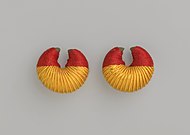
 Bracelet; made before 1985; red copper; 5.3 x 10.6 x 10.6 cm (11⁄16 x 43⁄16 x 43⁄16 in.); Nationaal Museum van Wereldculturen (the Netherlands)


Language
The language of the Fulani is "Pulaar" 𞤆𞤵𞤤𞤢𞥄𞤪, which is also the language of the Toucouleurs. All Senegalese and Mauritanians who speak the language natively are known as the Halpulaar (𞤖𞤢𞤤𞤨𞤵𞤤𞤢𞥄𞤪) or Haalpulaar'en (𞤖𞤢𞥄𞤤𞤵𞤤𞤢𞥄𞤪𞥇𞤫𞤲), which means "speakers of Pulaar" ("hal" is the root of the Pulaar verb haalugol 𞤖𞤢𞥄𞤤𞤵𞤺𞤮𞤤, meaning "to speak"). In some areas, e.g. in northern Cameroon, Fulfulde is a local lingua franca.
There are three writing systems used to write this language: an Arabic derived one called Ajami, a Latin derived system with 6 sets, and a native phonetic-faithful system called Adlam recently invented in 1989; the third one is the most increasingly popular not only learnt by hundreds of thousands of people among the diaspora worldwide but has also apps and computer programs created to assist in the script's adoption.[119]
Moral code
Central to the Fulani people's lifestyle is a code of behavior known as pulaaku (Fulfulde: 𞤆𞤵𞤤𞤢𞥄𞤳𞤵) or laawol Fulɓe (𞤂𞤢𞥄𞤱𞤮𞤤 𞤆𞤵𞤤𞤩𞤫) literally meaning the "Fulani pathways" which are passed on by each generation as high moral values of the Fulbe, which enable them to maintain their identity across boundaries and changes of lifestyle. Essentially viewed as what makes a person Fulani, or "Fulaniness", pulaaku includes:
- Munyal: Patience, self-control, discipline, prudence
- Gacce / Semteende: Modesty, respect for others (including foes)
- Hakkille: Wisdom, forethought, personal responsibility, hospitality
- Sagata / Tiinaade: Courage, hard work
Dress

There are no particular outfits for all Fulani sub-groups; dressing and clothing accessories such as ornaments mostly depend on the particular region. The traditional dress of the Fulbe Wodaabe consists of long colourful flowing robes, modestly embroidered or otherwise decorated. In the Futa Jallon highlands of central Guinea, it is common to see men wearing a distinctive hat with colorful embroidery. In Nigeria, Cameroon and Niger, men wear a hat that tapers off at three angular tips, known as a noppiire. Both men and women wear a characteristic white or black cotton fabric gown, adorned with intricate blue, red and green thread embroidery work, with styles differing according to region and sex.

It is not uncommon to see the women decorate their hair with bead hair accessories as well as cowrie shells. Fula women often use henna for hand, arm and feet decorations. Their long hair is put into five long braids that either hang or are sometimes looped on the sides. It is common for women and girls to have silver coins and amber attached to their braids. Some of these coins are very old and have been passed down in the family. The women often wear many bracelets on their wrists. The women can also be seen wearing a colorful cloth (modjaare) around, the waist, head or over one shoulder.[120]
Like the men, the women have markings on their faces around their eyes and mouths that they were given as children. The Western Fulbe in countries like Mali, Senegal and Mauritania use indigo inks around the mouth, resulting in a blackening around the lips and gums.
Fulani men are often seen wearing solid-colored shirt and pants which go down to their lower calves, made from locally grown cotton, a long cloth wrapped around their faces, and a conical hat made from straw and leather on their turbans, and carrying their walking sticks across their shoulders with their arms resting on top of it. Often the men have markings on either side of their faces and/or on their foreheads. They received these markings as children. Fula ethics are strictly governed by the notion of pulaaku. Women wear long robes with flowery shawls. They decorate themselves with necklaces, earrings, nose rings and anklets.[121]
Herding
Fula are primarily known to be pastoralists, but are also traders in some areas. Most Fula in the countryside spend long times alone on foot, and can be seen frequently parading with their cattle throughout the west African hinterland, moving their herds in search of water and better pasture. They were, and still are, the only major migratory people group of West Africa, although the Tuareg people, another nomadic tribe of North African origin, live just immediately north of Fula territory, and sometimes live alongside the Fulani in countries such as Mali, Niger and Burkina Faso. The Fulani, as a result of their constant wandering of the past, can be seen in every climatic zone and habitat of West Africa, from the deserts of the north, to the derived savannah and forests of the south.
From the 16th to 20th centuries many Fulani communities settled in the highlands of the Jos Plateau, the Western High Plateau of Bamenda, and Adamawa Plateau of Nigeria and the Cameroons. These are the highest elevated places in West Africa, and their altitude can reach up to 8,700 feet above sea level. The highland plateaus have a more temperate climate conducive for cattle herding activities, which allowed Fulbe populations to settle there in waves of migrations from further west. Though most Fula now live in towns or villages, a large proportion of the population is still either fully nomadic, or semi-nomadic in nature.
Wealth is counted by how large the herd of cattle is. Long ago Fulani tribes and clans used to fight over cattle and grazing rights. Being the most treasured animal that the Fulanis herd, the cows are very special. Many people say that a person cannot speak Fulfulde if he does not own a cow. The Fulani have a tradition of giving a habbanaya – a cow which is loaned to another until she calves. Once the calf is weaned it is retained and the cow is returned to its owner. This habbanaya is a highly prized animal. Upon receipt of this gift, there is a special ceremony in honor of the gift. The recipient buys special treats and invites his neighbors for this event in which the habbanaya is given a name. The habbanaya is never to be struck under any circumstance.

Fulani nomads keep various species of cattle, but the zebu is the most common in the West African hinterland, due to its drought resistant traits. In the wetter areas of Fouta Djallon and Casamance, the dwarf N'Dama is more common, as they are highly resistant to trypanosomiasis and other conditions directly associated with high humidity. Subspecies of zebu include the White Fulani cattle, locally known as the Aku, Akuji, Bororoji, White Kano, Yakanaji or Bunaji, which are an important beef breed of cattle found throughout the area owned by both Fulani and Hausa people and beyond in the Sahel zone of Africa.[122]
The Red Fulani cattle, which are called the Jafun French: Djafoun in Nigeria and Cameroon, and Fellata in Chad, as well as other names such as the M'Bororo, Red Bororo, or Bodaadi, another subspecies is the Sokoto Gudali and the Adamawa Gudali or simply Gudali, which means "horned and short legged" in the Hausa language. The widely accepted theory for the origin of present-day zebu cattle in West Africa is that they came from the westward spread of the early zebu populations in East Africa through the Sudan. Other breeds of zebu are found mainly in the drier regions. Their body conformation resembles the zebu cattle of eastern Africa. The zebu did not appear in West Africa until about 1800.[122] The increasing aridity of the climate and the deterioration of the environment in the Sahel appear to have favoured the introduction and spread of the zebu, as they are superior to longhorn and shorthorn cattle in withstanding drought conditions.
The origins and classification of the Fulani remains controversial; one school of thought is of the opinion that the Fulani cattle are truly long-horned zebus that first arrived in Africa from Asia on the east coast; these are believed to have been introduced into West Africa by Arab invaders during the seventh century, roughly about the same time that the short-horned zebus arrived into East Africa. This theory is supported by the appearance of the skull as well as the thoracic hump of the Fulani cattle.[122]
Another school of thought contends that these cattle originated from the Horn of Africa, present-day Ethiopia and Somalia, and that interbreeding between the short-horned zebu (which arrived in the Horn around the first millennium BC) and the ancient Hamitic Longhorn and/or B. taurus brachyceros shorthorn (which had arrived much earlier) occurred in the Horn about 2000–1500 BCE. The subsequent successive introductions of the short-horned zebu are believed to have displaced most sanga cattle into southern Africa.[122]

During this period of constant movement of people and animals within Africa, some of these sanga cattle probably intermixed with the short-horned, thoracic-humped cattle to produce the thoracic-humped sanga. The latter may have migrated, most probably along with the spread of Islam, westerly to constitute what are today the lyre-horned cattle of West and Central Africa, including the Fulani cattle. Originally the White Fulani were indigenous to north Nigeria, southeast Niger and northeast Cameroon, owned by both Fulani and Hausa people. They then spread to southern Chad and western Sudan.[122]
Every year, in the Malian town of Diafarabé, Fulani men cross the Niger River with their cattle, in an annual cycle of transhumance. This annual festival is known in the local Fulfulde as the Dewgal. Since the founding of the village in 1818, it has always been the most important Fulani festival. It takes place on a Saturday in November or December; the day is carefully chosen based on the state of pastures and the water levels in the river Niger. During the rainy season, the river swells, and the areas around the village are inundated in water, as the level of the river Niger rises, and turns Diafarabe into an island. The cattle are kept on the lush fields up north or south, but when the West African Monsoon subsides and the drier season returns, the water level drops and the cattle can return home again.[123][124][125]
The crossing is more than a search for pastures; it is also a competition to show craftsmanship as a herdsmen. The cattle are driven into the river, and each herder, with no help from others, loudly encourages the animals to move forward as he stands or swims between them, holding on to the horns of the bulls. The smaller animals don't have to swim, but are lifted into pirogues. When all the cattle are back, they are judged by a panel, which decides whose animals are the "fattest". That herder is awarded "best caretaker", and he is awarded by the community.[123][124][125] The worst caretaker ends up with a shameful "prize" – a peanut.
Besides being a competition of herdsmanship, it is also a social event; the herdsmen return after having been away for the most part of the year and they meet their family and friends again. It is a time for celebration. The women decorate their house with woven mats and paint the floor with white and black clay, braid their hair with very intricate patterns, and dress up for their husbands and loved ones. Impressed by the cultural significance attached to the annual event, UNESCO included it on its list of world cultural heritage events.[123][124][125]
Music

The Fula have a rich musical culture and play a variety of traditional instruments including drums, hoddu (a plucked skin-covered lute similar to a banjo), and riti or riiti (a one-string bowed instrument similar to a violin), in addition to vocal music. The well-known Senegalese Fula musician Baaba Maal sings in Pulaar on his recordings. Zaghareet or ululation is a popular form of vocal music formed by rapidly moving the tongue sideways and making a sharp, high sound.
Fulani music is as varied as its people. The numerous sub-groups all maintain unique repertoires of music and dance. Songs and dances reflect traditional life and are specifically designed for each individual occasion. Music is played at any occasion: when herding cattle, working in the fields, preparing food, or at the temple. Music is extremely important to the village life cycle, with field cultivation, harvest and winnowing of millet performed to the rhythm of the songs and drums.
Fulani herders have a special affinity for the flute and violin nianioru. The young Fulani shepherd like to whistle and sing softly as they wander the silent savannah with cattle and goats. The truly Fulani instruments are the one-string viola of the Fulani (nianioru), the flute, the two to five string lute hoddu or molo, and the buuba and bawdi set of drums. But they are also influenced by the other instruments of the region such as the beautiful West African harp, the kora, and the balafon. Entertainment is the role of certain casts. The performance of music is the realm of specialized casts. The Griots or Awlube recite the history of the people, places and events of the community.
Food

Kossam can be the general term for both fresh milk miradam and yoghurt known as pendidan in Fulfulde. It is central to Fulbe identity and revered as a drink or in one of its various processed forms, such as yoghurt and cheese. Kettugol and lébol are derived from milk fat, are used in light cooking and hair weaving. It is common to see Fulani women hawking milk products in characteristic beautifully decorated calabashes balanced on their heads. Other meals include a heavy porridge (nyiiri) made of flour from such grains as millet, sorghum, or corn which is eaten in combination with soup (takai, haako) made from tomatoes, onions, spices, peppers, and other vegetables.[126]
Another popular meal eaten by almost all Fulani communities is made from fermenting milk into yoghurt and eaten with corn couscous known as latchiiri or dakkere, either in the same bowl or separately, also a fluid or porridge called gāri made of flour cereals such as millet, sorghum or corn and milk. The Wodaabe traditionally eat millet, milk and meat as staples. Millet is eaten in the morning, noon and night as a grease with a sauce or stew which usually contains tomatoes, peppers, bone, meat, onion, and other vegetables. On special occasions they eat meat such as goat or beef. A thick beverage similar to the Tuareg eghajira is made by pounding goat cheese, milk, dates and millet.[citation needed]
Houses

Traditionally, nomadic Fula live in domed houses known as a bukkaru or suudu hudo, literally "grass house". During the dry season, the characteristically hemisphere-shaped domed houses are supported by compact millet stalk pillars, and by reed mats held together and tied against wood poles, in the wet or rainy season. These mobile houses are very easy to set up, and dismantle, as typical of houses from nomadic societies. When it is time to move, the houses are easily disassembled and loaded onto donkeys, horses or camels for transport. With recent trends however, many Fula now live in mud or concrete block houses.[citation needed]
Once they are set up, the room is divided into a sleeping compartment, and another compartment where calabashes and guards of all sizes are intricately arranged in a stack according to their sizes and functions. Spoons made from gourda are hung from the rooftop, with others meant for grain storage.[citation needed]
Religion
The Fula were one of the first African tribes to convert to Islam, maintaining it as an intrinsic part of their cultural identity, although in some cases elements of traditional African faiths are mixed in a predominantly Muslim religious syncretism.[127] More than 98% of the Fula are Muslims, with some religious minorities such as Fula Christians.[128][129] They are particularly present in the Plateau State of northern Nigeria. Virtually all of them come from a Muslim background. Fulani Christians have faced severe persecutions from both Fulani Muslims, because of their rejection of Islam, and Nigerian Christians from other tribes.[130]
Genetics
The Fulani people are genetically an admixture of West and East African ancestries, specifically Niger-Congo and Nilo-Saharan components, but also display varying degrees of West Eurasian admixture through contact with groups from North Africa.[131] The Fulani are the most wide-spread pastoralist group in the Sahel/Savannah belt.[132]
Paternal lineages (Y-DNA)
The paternal lineages of the Fula/Fulɓe/Fulani tend to vary depending on geographic location. According to a study by Cruciani et al. (2002), around 90% of Fulani individuals from Burkina Faso carried haplotype 24, which corresponds with the E-M2 (E1b1a) that is common in West Africa. The remainder belonged to haplotype 42/haplogroup E-M132. Both of these clades are today most frequent among Niger–Congo-speaking populations, particularly those inhabiting Senegal. Similarly, 53% of the Fulani in northern Cameroon bore haplogroup E-M132, with the rest mainly carrying other African clades (12% haplogroup A and 6% haplogroup E1b1a). A significant minority carried the West Eurasian haplogroups T (18%) and R1 (12%), making up together around ~30% of the total haplogroup variation.[133] Mulcare et al. (2004) observed a similar frequency of haplogroup R1 subclades in their Fulani samples from Cameroon (18%).[134]
A study by Hassan et al. (2008) on a Fulani subgroup in Sudan observed a significantly higher occurrence of the West-Eurasian haplogroup R1 (53.8%). The remainder belonged to E-M215 subclades, including 34.62% E-M78 and 27.2% E-V22.[135] Bučková et al. (2013) analyzed various Fulani subgroups, and observed R1b among the Fulani Zinder grouping with a frequency of ~31%. This was in sharp contrast to most of the other Fulani pastoralist groups elsewhere, including those from Burkina Faso, Cameroon, Mali and Chad, which instead had nearly exclusive West African paternal haplogroups.[136]
Maternal lineages (mtDNA)
In contrast to their more heterogeneous paternal lineages, the Fulani have rather homogenous maternal lineages, with close affinity to other Niger-Congo populations. Only 8.1% of their mtDNA clades were associated with West Eurasian or Afro-Asiatic groups (J1b, U5, H, and V).[137]
A study of four Fulani nomad populations (n = 186) in three Sahelian countries (Chad, Cameroon, and Burkina Faso), found that the only group of nomadic Fulani that manifests some similarities with geographically related agricultural populations (from Guinea-Bissau and Nigeria) comes from Tcheboua in northern Cameroon.[138][139]
Autosomal DNA (overall)
According to Tishkoff et al. (2009), the Fulani's genomic ancestry clusters near that of Chadic and Central Sudanic speaking populations, with genetic affinities observed to the Hausa people. Based on this, the researchers suggest that the Fulani may have adopted a Niger-Congo language at some point in their history, while intermarrying with local populations. Additionally, moderate levels of West Eurasian admixture was also observed among the Fulani samples, which the authors propose may have been introduced via the Iberian Peninsula and Northern Africa.[140] Dobon et al. (2015), found that the Sudanese Fulani have largely ancestry from Niger-Kordofanian and Nilo-Saharan (Sudanic) speaking groups, with lower amounts of West-Eurasian ancestry.[141]

Triska, Petr et al. (2015) showed that there is extensive admixture across the Sahel Belt, with the Fula carrying West African and East African components, as well as a Mozabite/North African component. These results support the hypothesis of a North African origin and a Western to Central Africa past migration for Fulani.[142]
A full genome analysis was conducted by Vicente et al. in 2019, analyzing several different Fulani subgroups from various geographic regions. They found that the Fulani people are characterized by the admixture of local West African and East African components, but also display West-Eurasian admixture, mediated through historical North African groups. The West-Eurasian ancestry among Fulani was estimated to a mean average of 21,4% among the 53 samples from Ziniaré in Burkina Faso. According to the authors, there were two admixture events, the first being about 2000 years ago, with the second being more recent at around 300 years ago. This Eurasian ancestry was observed in the ancestry components of Mozabite people. They found that: "Our findings suggest that Eurasian admixture and the European LP allele was introduced into the Fulani through contact with a North African population/s. We furthermore confirm the link between the lactose digestion phenotype in the Fulani to the MCM6/LCT locus by reporting the first GWAS of the lactase persistence trait. e observed a T-13910 allele frequency of 48.0%, while the genome-wide European admixture fraction in the Fulani is 21.4% at K = 3. The notable European admixture fraction in the Fulani coupled with the high frequencies of the LP T-13910 allele suggests the possibility of adaptive gene flow into the Fulani gene pool".[132] Another study in 2020 by Priehodová et al., suggest an older date for the introduction of one variant of the LP allele in the Sahel, about ~8.5 ka.[143]
A study in 2019 by Fan et al., found that the Fulani sampled from Cameroon, clustered with Afro-Asiatic speakers from East Africa in the phylogenetic analysis, which the authors said indicates a potential shift in language to Niger-Congo. The analysis on autosomal markers found traces of West Eurasian-related ancestry in this population, which suggests a North African or East African origin (as North and East Africans also have such ancestry likely related to expansions of farmers and herders from the Near East) and is consistent with the presence at moderate frequency of the −13,910T variant associated with lactose tolerance in European populations.[144]
In 2020, a study inferred that the Fulani of western Cameroon have 48% Mende-related, 23% East African-related, and 29% non-African-related ancestry.[145]
In 2023, whole genomes of Fulani individuals from various Sahelian samples were analyzed, and the researches said the non-Sub-Saharan genetic ancestry within the Fulani cannot be solely explained by recent admixture events. Fulani may be descendants of Saharan cattle herders during the last Green Sahara, who had some genomic similarities to Late Neolithic Moroccans based on ancient samples.[146]
Another 2023 study inferred that "The Fulani derived 50% of their ancestry from a population related to the Amhara and 50% from a population related to the Tikari (consistent with TreeMix results with 3 migration events)."[147]
Notable Fulanis
See also
Notes
References
- ^ Wealth, household heterogeneity and livelihood diversification of Fulani pastoralists in the Kachia Grazing Reserve, northern Nigeria, during a period of social transition on PubMed Central, access-date=2023-10-14
- ^ "Africa: Senegal The World Factbook – Central Intelligence Agency". www.cia.gov. 2019. Retrieved 22 December 2019.
- ^ "Africa: Guinea The World Factbook – Central Intelligence Agency". www.cia.gov. 2023. Retrieved 2 August 2023.
- ^ "L'ethnie peul au Cameroun Cameroon". 15 October 2023. Retrieved 13 August 2019.
- ^ "Mbororo/Fulani/Peul". 15 October 2023. Retrieved 13 August 2019.
- ^ "Africa: Mali – The World Factbook – Central Intelligence Agency". www.cia.gov. 27 April 2021. Retrieved 1 May 2021.
- ^ "Africa: Burkina Faso The World Factbook – Central Intelligence Agency". www.cia.gov. 2019. Retrieved 22 December 2019.
- ^ "Africa: Niger – The World Factbook – Central Intelligence Agency". www.cia.gov. 27 April 2021. Retrieved 1 May 2021.
- ^ "PRINCIPAUX INDICATEURS SOCIO DEMOGRAPHIQUES ET ECONOMIQUES" (PDF). 2013. Retrieved 22 December 2019.
- ^ "What Is The Ethnic Composition Of Mauritania?". www.worldatlas.com. 27 April 2021. Retrieved 1 May 2021.
- ^ "Africa: Guinea-Bissau – The World Factbook – Central Intelligence Agency". www.cia.gov. 27 April 2021. Retrieved 1 May 2021.
- ^ "Distribution of the Gambian population by ethnicity 1973, 1983, 1993, 2003 and 2013 Censuses – GBoS". www.gbosdata.org. Archived from the original on 2021-11-19. Retrieved 2021-06-17.
- ^ "Africa: Chad – The World Factbook – Central Intelligence Agency". www.cia.gov. 27 April 2021. Retrieved 1 May 2021.
- ^ "Sierra Leone 2015 Population and Housing Census National Analytical Report" (PDF). Statistics Sierra Leone. Retrieved 28 March 2020.
- ^ a b "Fulani people and Jihadism in Sahel and West African countries :: Observatoire of Arab-Muslim World and Sahel :: Foundation for Strategic Research :: FRS". www.frstrategie.org. Retrieved 2021-06-21.
- ^ "Adamawa Fulfulde". Ethnologue. Retrieved 18 October 2023.
- ^ "Borgu Fulfude". Ethnologue. Retrieved 18 October 2023.
- ^ "Maasina Fulfulde". Ethnologue. Retrieved 18 October 2023.
- ^ "No South Sudan Passports for Fulani, Officials Say | Voice of America – English". www.voanews.com. Retrieved 2021-09-05.
- ^ "Fulani | People, Religion, & Nigeria | Britannica". 25 August 2023.
- ^ Francis Rodd (1926) – Origins of Tuareg people; H.R. Palmer (1914) – M. Delafosse's Account of the Fulani, Taylor White (1921)
- ^ a b c d e Richard M. Juang (2008). Africa and the Americas: Culture, Politics, and History. ABC-CLIO. p. 492. ISBN 978-1-85109-441-7.
- ^ Felicity Crowe (2010). Modern Muslim Societies. Marshall Cavendish. p. 262. ISBN 978-0-7614-7927-7.
- ^ a b Steven L. Danver (2015). Native Peoples of the World: An Encyclopedia of Groups, Cultures and Contemporary Issues. Routledge. pp. 31–32. ISBN 978-1-317-46400-6.
- ^ "Fulbe". homepage.univie.ac.at (in German). Archived from the original on 24 November 2021. Retrieved 30 August 2020.
- ^ David Levinson (1996). "Fulani". Encyclopedia of World Cultures: Africa and the Middle East, Volume 9. Gale Group. ISBN 978-0-8161-1808-3.
- ^ Anthony Appiah; Henry Louis Gates (2010). Encyclopedia of Africa. Oxford University Press. p. 495. ISBN 978-0-19-533770-9.
- ^ a b David Levinson (1996). "Fulani". Encyclopedia of World Cultures: Africa and the Middle East, Volume 9. Gale Group. ISBN 978-0-8161-1808-3., Quote: The Fulani form the largest pastoral nomadic group in the world. The Bororo'en are noted for the size of their cattle herds. In addition to fully nomadic groups, however, there are also semisedentary Fulani —Fulbe Laddi— who also farm, although they argue that they do so out of necessity, not choice.
- ^ a b Christopher R. DeCorse (2001). West Africa During the Atlantic Slave Trade: Archaeological Perspectives. Bloomsburg Academic. pp. 172–174. ISBN 978-0-7185-0247-8.
- ^ Anthony Appiah; Henry Louis Gates (2010). Encyclopedia of Africa. Oxford University Press. pp. 495–496. ISBN 978-0-19-533770-9.
- ^ Richard M. Juang (2008). Africa and the Americas: Culture, Politics, and History. ABC-CLIO. p. 492. ISBN 978-1-85109-441-7.
- ^ a b Pat Ikechukwu Ndukwe (1996). Fulani. The Rosen Publishing Group. pp. 9–17. ISBN 978-0-8239-1982-6.
- ^ D Group (2013). Encyclopedia of African Peoples. Routledge. pp. 85–88. ISBN 978-1-135-96334-7.
- ^ "Religion and expressive culture – Fulani". www.everyculture.com. Retrieved 30 August 2020.
- ^ "Fulani | people". Encyclopedia Britannica. Retrieved 2020-10-27.
- ^ The homonym Fulani is also used by the Manding peoples, being the diminutive form of the word Fula in their language (with suffix -ni), essentially meaning 'little Fula'.
- ^ The letter ɓ is an implosive b sound, which does not exist in English, so is replaced by b. In the orthography for languages of Guinea (pre-1985), this sound was represented by bh, so one would have written Fulbhe instead of Fulɓe.
- ^ Clark, Andrew F. “The Fulbe of Bundu (Senegambia): From Theocracy to Secularization.” The International Journal of African Historical Studies, vol. 29, no. 1, 1996, p. 4. JSTOR, https://doi.org/10.2307/221416. Accessed 1 July 2023.
- ^ "Fulani: A brief walk into the origin and lifestyle of this beautiful people". Pulse Nigeria. 2022-07-06. Retrieved 2023-09-18.
- ^ Saeed, Asma’u G. (2017). "The Mahdiyya in Adamawa Emirate : the poem on the battle of Danki (1892) by Shaykh Hayāt b. Sa'īd". Journal for Islamic Studies. 36 (1): 61. ISSN 2957-9163.
- ^ Hampaté Bah, Ahmadou (1996). "Des Foulbé du Mali et de leur Culture" (PDF). Abbia: Revue culturelle Camerounaise: 23–54.
- ^ "Les communautés peules au Mali" (PDF). African Security Network. Analyse sociétale africaine/African societal Analysis (ASA).
- ^ Diallo, Youssouf (1994). "Barani: une chefferie satellite des grands États du XIXe siècle (Barani, a Chiefdom in the Orbit of Major 19th-Century State Formations)". Cahiers d'Études Africaines. 34 (133/135): 359–384. doi:10.3406/cea.1994.2056. ISSN 0008-0055. JSTOR 4392526.
- ^ Durán, Lucy (1995). "Birds of Wasulu: Freedom of Expression and Expressions of Freedom in the Popular Music of Southern Mali". British Journal of Ethnomusicology. 4: 101–134. doi:10.1080/09681229508567240. ISSN 0968-1221. JSTOR 3060685.
- ^ Desmond, Vincent. "Interview: Oumou Sangaré Proves Why She's the Songbird of Wassoulou". www.okayafrica.com.
- ^ Pageard, Robert (1959). "Note sur les Diawambé ou Diokoramé". Journal des Africanistes. 29 (2): 239–260. doi:10.3406/jafr.1959.1907.
- ^ Mali: People & Society, Burkina Faso: People & Society, Guinea: People & Society, Senegal: People & Society, Niger: People & Society, CIA Factbook (2015)
- ^ Schlee, Gunther; Watson, Elizabeth, eds. (2013-10-15). Changing Identifications and Alliances in North-east Africa: Volume II: Sudan, Uganda, and the Ethiopia-Sudan Borderlands. Berghahn Books. ISBN 9781845459635.
- ^ Al-Amin Abu-Manga; Nuhu Auwalu Wakili (1986). Fulfulde in the Sudan: process of adaptation to Arabic. D. Reimer. p. 7. ISBN 9783496008859.
The Fulani in the Sudan are known by the loose generic term 'Fellata'
- ^ "The World Factbook". CIA. Retrieved 2013-12-28.
- ^ "Association of Concerned Africa Scholars » Citizenship and Identity in Post-Secession Northern Sudan". Association of Concerned Africa Scholars. Retrieved 2013-12-28.
- ^ "Chad Ethnic Groups". Study.com. Retrieved 2020-05-25.
- ^ Bukari, Kaderi Noagah; Schareika, Nicholaus (2015-11-04). "Stereotypes, prejudices and exclusion of Fulani pastoralists in Ghana". Pastoralism. 5 (1): 20. doi:10.1186/s13570-015-0043-8. ISSN 2041-7136.
- ^ a b c d e Kane, Oumar (2004). La première hégémonie peule. Le Fuuta Tooro de Koli Teηella à Almaami Abdul. Paris: Karthala. Retrieved 12 July 2023.
- ^ Carl Skutsch (2005). Encyclopedia of the World's Minorities. Routledge. p. 474. ISBN 978-1-135-19388-1., Quote: "Fulani oral traditions suggest an origin in Egypt or the Middle East, a common theme in West African Muslim traditions.
- ^ a b Webster, G. W. (1931). "242. Customs and Beliefs of the Fulani: Notes Collected During 24 Years Residence in Northern Nigeria". Man. 31: 238–244. doi:10.2307/2790939. JSTOR 2790939.
- ^ Unesco General History of Africa (1992). Africa from the Seventh to the Eleventh Century v. 3. James Currey Publishers. p. 204. ISBN 978-0852550939.
- ^ Creevey, Lucy (August 1996). "Islam, Women and the Role of the State in Senegal". Journal of Religion in Africa. 26 (3): 268–307. doi:10.1163/157006696X00299. JSTOR 1581646.
- ^ Fage, John Donnelly (1997). "Upper and Lower Guinea". In Roland Oliver (ed.). The Cambridge History of Africa, Volume 3. Cambridge University Press. ISBN 978-0521209816.
- ^ a b c d Andrea L. Stanton (2012). Cultural Sociology of the Middle East, Asia, and Africa: An Encyclopedia. SAGE Publications. pp. 147–148. ISBN 978-1-4129-8176-7.
- ^ John Thornton (28 April 1998). Africa and Africans in the Making of the Atlantic World, 1400–1800. Cambridge University Press. pp. 91–92, xvii–xix. ISBN 978-0-521-62724-5.
- ^ David Levinson (1996). "Fulani". Encyclopedia of World Cultures: Africa and the Middle East, Volume 9. Gale Group. ISBN 978-0-8161-1808-3., Quote: "Their adoption of Islam increased the Fulanis' feeling of cultural and religious superiority to surrounding peoples, and that adoption became a major ethnic boundary marker."
- ^ Knut Vikor (2013). Leif Manger (ed.). Muslim Diversity: Local Islam in Global Contexts. Routledge. pp. 92–93. ISBN 978-1-136-81857-8.
- ^ a b Johnson, Marion (1976). "The Economic Foundations of an Islamic Theocracy – The Case of Masina". The Journal of African History. 17 (4). Cambridge University Press: 481–495. doi:10.1017/s0021853700015024. S2CID 162679554.
- ^ a b Walter van Beek (1988). "Purity and statecraft: The Fulani Jihad". The Quest for Purity: Dynamics of Puritan Movements. Walter de Gruyter. pp. 149–177. ISBN 978-3-11-011382-2.
- ^ a b c d e f g de Bruijn, Mirjam; van Dijk, Han (2003). "Resistance to Fulbe Hegemony in nineteenth-century West Africa". In Abbink, Jon; van Walraven, Klaas; de Bruijn, Mirjam (eds.). Rethinking resistance : revolt and violence in African history. Brill. pp. 43–68. Retrieved 9 January 2024.
- ^ Not to be confused with Malick Sy, founder of the Tijanniyah Sufi order.
- ^ "The Islamic revolution in the western Sudan: The First Fulani Jihad." (p. 10) Encyclopædia Britannica. 2013. (accessed 6 March 2013)
- ^ Brooks, George E. (August 1985). "WESTERN AFRICA TO c1860 A.D. A PROVISIONAL HISTORICAL SCHEMA BASED ON CLIMATE PERIODS" (PDF). Indiana University African Studies Program: 209. Retrieved 30 May 2023.
- ^ a b Curtin, Philip D. (1975). "The uses of oral tradition in Senegambia : Maalik Sii and the foundation of Bundu". Cahiers d'études africaines. 15 (58): 189–202. doi:10.3406/cea.1975.2592.
- ^ J. D. Fage; Roland Anthony Oliver (1975). The Cambridge History of Africa, Volume 4. Cambridge University Press. p. 208. ISBN 9780521204132. Retrieved 2014-02-27.
- ^ a b c Klein, Martin A. (2005). "Futa-Tooro: Early Nineteenth Century". Encyclopedia of African History. Vol. 1. Fitzroy Dearborn. p. 541. ISBN 978-1-57958-245-6. Retrieved 13 February 2013.
- ^ a b Lapidus, Ira M. (2002-08-22). A History of Islamic Societies. Cambridge University Press. ISBN 978-0-521-77933-3. Retrieved 2013-02-13.
- ^ a b Last, Murray (1967). The Sokoto Caliphate. Internet Archive. [New York] Humanities Press.
- ^ "Time line". Jamtan. Archived from the original on 2012-11-22. Retrieved 2013-12-28.
- ^ Boyle, C. Vicars (1910). "Historical Notes on the Yola Fulanis". Journal of the Royal African Society. 10 (37): 73–92. ISSN 0368-4016. JSTOR 715032.
- ^ "Materials and Methods" (PDF). Archived from the original (PDF) on 2014-02-20. Retrieved 2014-02-03.
- ^ Paul Riesman; David L. Szanton (1992). "Global Fulani Society". First Find Your Child a Good Mother: The Construction of Self in Two African Communities. Rutgers University Press. p. 15. ISBN 9780813517681. Retrieved 2014-02-27.
- ^ "The Cast System". Jamtan. Archived from the original on 2014-02-20. Retrieved 2014-02-27.
- ^ David J. Phillips (2001). Peoples on the Move: Introducing the Nomads of the World. William Carey Library. ISBN 9780878083527. Retrieved 2014-02-27.
- ^ "Portrait of Yarrow Mamout: An Early American Muslim". www.religioninamerica.org.
- ^ Omar ibn Said (1831). "Autobiography of Omar ibn Said, Slave in North Carolina, 1831". University of North Carolina at Chapel Hill.
- ^ Anderson, R. (2020). Liberated African Origins and the Nineteenth-Century Slave Trade. In Abolition in Sierra Leone: Re-Building Lives and Identities in Nineteenth-Century West Africa (African Identities: Past and Present, pp. 30–65). Cambridge: Cambridge University Press. doi:10.1017/9781108562423.002
- ^ Misevich, “The Mende and Sherbro Diaspora,” 254.
- ^ Curtin, P., & Vansina, J. (1964). Sources of the Nineteenth Century Atlantic Slave Trade. The Journal of African History, 5(2), 185–208. doi:10.1017/S0021853700004801
- ^ a b Tamari, Tal (1991). "The Development of Caste Systems in West Africa". The Journal of African History. 32 (2): 221–250. doi:10.1017/s0021853700025718. S2CID 162509491., Quote: "Endogamous artisan and musician groups are characteristic of over fifteen West African peoples, including the Manding, Soninke, Wolof, Serer, Fulani, Tukulor, Songhay, Dogon, Senufo, Minianka, Moors, and Tuareg. Castes appeared among the Malinke no later than 1300, and were present among the Wolof and Soninke, as well as some Songhay and Fulani populations, no later than 1500."
- ^ a b c Dupire, Marguerite (1985). "A Nomadic Caste: The Fulani Woodcarvers Historical Background and Evolution". Anthropos. 80 (1/3): 85–100. JSTOR 40460882.
The woodcarvers associated with the Fulani and neighboring societies in West Africa were nomads. All criteria retained by specialists to defìne a caste group (Berreman, Pitt-Rivers, Vaughan), may be applied to them. This is true even today in spite of their sedentarization and the conversion of certain of them to sculpture. The second part of this study raises the question of the conditions underlying the creation of artisan castes, drawing upon examples taken from agricultural societies, certain of which are state-based (Fulani, Serer of Sine), others of which are more or less acephalous (Marghi, Senufo, Cangin Serer).
- ^ African Commission on Human and Peoples' Rights (2009). Rapport Du Groupe de Travail de la Commission Africaine Sur Les Populations/communautes Autochtones : Mission en Republique de Niger 14–24 Février 2006. IWGIA. p. 41 note 74. ISBN 978-87-91563-48-5.
- ^ Sow, Abdoul Aziz; Angell, John (1993). "Fulani Poetic Genres". Research in African Literatures. 24 (2): 61–77. JSTOR 3819886.
At the top of the hierarchy are cattle-owning Fulani, Toorobbe (literate marabouts who hold spiritual power), Seebe (members of a warrior caste...) The middle of the hierarchy is comprisedof the five castes that...
- ^ Paul Riesman; David L. Szanton (1992). First Find Your Child a Good Mother: The Construction of Self in Two African Communities. Rutgers University Press. p. 14. ISBN 9780813517681. Retrieved 2014-02-27.
- ^ Hill, Allan G (2012-07-26). Population, Health and Nutrition in the Sahel. Routledge. p. 9. ISBN 9781136882845. Retrieved 2014-02-27.
- ^ "The Unreached Peoples Prayer Profiles". Kcm.co.kr. Retrieved 2014-02-27.
- ^ Frank Salamone (1997). Junius P. Rodriguez (ed.). The Historical Encyclopedia of World Slavery. ABC-CLIO. pp. 333–334. ISBN 978-0-87436-885-7.
- ^ Fisher, Humphrey J., Slavery in the History of Muslim Black Africa, C. Hurst & Co. Publishers (2001), p. 26, ISBN 9781850655244
- ^ Vereecke, Catherine (1994). "The Slave Experience in Adamawa: Past and Present Perspectives from Yola (Nigeria) (Une approche historique de l'esclavage dans l'Adamawa du XIXe siècle à nos jours)". Cahiers d'Études Africaines. 34 (133/135): 23–53. doi:10.3406/cea.1994.2039. JSTOR 4392512.
- ^ Hampshire, Kate (2006). "Flexibility in Domestic Organization and Seasonal Migration Among the Fulani of Northern Burkina Faso". Africa. 76 (3): 402–426. doi:10.3366/afr.2006.0044. S2CID 73652678.
- ^ a b Tor Arve Benjaminsen; Christian Lund (2001). Politics, Property and Production in the West African Sahel: Understanding Natural Resources Management. Nordic Africa Institute. pp. 118–119, 122, 127–128, 130–131. ISBN 978-91-7106-476-9.
- ^ Marguerite Dupire (1963), Matériau pour l'étude de l'endogamie des Peul du cercle de Kedougou (Sénégal oriental), Cahiers du Centre de recherches anthropologiques, Volume 5, Numéro 3, pages 235–236, 251, 223–297 (in French)
- ^ Gallais, Jean (1962). "Signification du groupe ethnique au Mali". L'Homme. 2 (2): 106–129. doi:10.3406/hom.1962.366487. JSTOR 25131051.
- ^ JH Vaughn (1970). "Caste System in the Western Sudan". In Arthur Tuden and Leonard Plotnicov (ed.). Social Stratification in Africa. Free Press. ISBN 978-0029327807.
- ^ Chodak, Szymon (1973). "Social Stratification in Sub-Saharan Africa". Canadian Journal of African Studies. 7 (3): 401–417. doi:10.2307/484167. JSTOR 484167.
- ^ "4 Things To Know Before Dating Fulani Girls". Dating Reporter's Blog. Archived from the original on 2021-03-01. Retrieved 2021-02-27.
- ^ a b c Martin Patience (2016-08-10). "Nigeria's deadly battle for land: Herdsmen v farmers". BBC News. Retrieved 2016-08-10.
- ^ a b "Nigeria: Going Beyond the Green Wall Ritual". allAfrica.com. 2013-07-04. Retrieved 2014-02-27.
- ^ "An Introduction To The Gambia's Fulani People". Culture Trip. 2019-11-30. Retrieved 2019-10-27.
- ^ "Ivory Coast – ETHNIC GROUPS AND LANGUAGES". countrystudies.us. Retrieved 2020-05-25.
- ^ "Grazing Reserve Development and Constraints". Gamji.com. Retrieved 2014-02-27.
- ^ a b "Senators fight over grazing land for Fulani herdsmen". Punchng.com. 2012-07-21. Archived from the original on 2014-02-01. Retrieved 2014-02-27.
- ^ Premier (2019-02-07). "Nigerian government failing to stop Fulani militants killing Christians, charity says". Premier. Retrieved 2019-04-24.
- ^ a b c "GTD Search Results". www.start.umd.edu. Retrieved 2019-04-11.
- ^ Amnesty International (2018). Harvest of Death Three Years Of Bloody Clashes Between Farmers and Herders in Nigeria (PDF). Maitama, Abuja-FCT, Nigeria: Amnesty International.
- ^ Nwangwu, Chikodiri; Enyiazu, Chukwuemeka (2019). "Nomadic Pastoralism and Human Security: Towards a Collective Action against Herders-Farmers Crisis in Nigeria" (PDF). Nomadic Pastorialism and Human Security: Towards a Collective Action Against Herders-Farmers Crisis in Nigeria | AfriHeritage Working Paper 2019 010. Archived from the original (PDF) on 2020-07-15. Retrieved 2022-12-24.
- ^ "Fulani Extremists Kill 3, Burn Church Site in Latest Attack on Christians in Nigeria – Villagers Say Gov't Doing Nothing". CBN News. 2022-04-07. Retrieved 2022-08-15.
- ^ "The Sahel in flames". The New Humanitarian. 2019-05-31. Retrieved 2019-06-23.
- ^ "GTD Search Results". www.start.umd.edu. Retrieved 2019-04-11.
- ^ Tobie, Aurélien (December 2017). Central Mali: Violence, Local Perspectives and Diverging Narratives (PDF) (Report). Stockholm International Peace Research Institute. Archived from the original (PDF) on 28 July 2022. Retrieved 12 September 2023.
- ^ "Incident Summary for GTDID: 201603260030". www.start.umd.edu. Retrieved 2019-04-11.
- ^ Cameroon: Civilians Massacred in Separatist Area, Human Rights Watch, Feb 25, 2020. Accessed Feb 26, 2020.
- ^ Bach, Deborah; Lerner, Sara. "ADLaM comes online". Microsoft Story Labs. Retrieved 4 September 2019.
- ^ Marianne Gullestad (2007). Picturing Pity: Pitfalls and pleasures in cross-cultural communication – image and word in a North Cameroon mission. Berghahn Books. p. 130. ISBN 9781845453435.
- ^ "Pulaaku Ethics". 2007-12-27. Archived from the original on 2007-12-27. Retrieved 2013-12-28.
- ^ a b c d e "DAGRIS". Dagris.ilri.cgiar.org. 2009-10-20. Archived from the original on 2015-06-10. Retrieved 2014-02-27.
- ^ a b c "Courtship by the river as cows return home – Arts and Culture". africareview.com. Archived from the original on 2014-02-22. Retrieved 2014-02-27.
- ^ a b c Chris Caldicott (1996-11-02). "Take me to the river – Travel". The Independent. Retrieved 2014-02-27.
- ^ a b c "Dewgal (Crossing of the Cattle): a celebration of greener pastures". Lonely Planet. 2012-11-15. Archived from the original on 22 February 2014. Retrieved 2014-02-27.
- ^ "Fulani – Introduction, Location, Language, Folklore, Religion, Major holidays, Rites of passage, Relationships, Living conditions". Everyculture.com. Retrieved 2013-12-28.
- ^ Department of the Arts of Africa, Oceania, and the Americas (October 2022). "The Fulani/Fulbe People". The Metropolitan Museum of Art. Retrieved 3 December 2023.
- ^ "Nigeria's Fulani conflict: A 'clash over land ownership' or a sectarian massacre?". Nigeria Report. Retrieved 2023-12-04.
- ^ "Nigeria's Fulani Christians are Attacked from Every Side". Perseution.org. International Christian Concern. 8 July 2023. Retrieved 3 December 2023.
- ^ Kim, Masara (2021-11-11). Nigeria's Little Known Fulani Christians Worship In Secret. The Nigerian Voice. Available at: https://www.thenigerianvoice.com/news/303573/nigerias-little-known-fulani-christians-worship-in-secret.html (retrieved: 2023-06-17).
- ^ Černý, Viktor; Fortes-Lima, Cesar; Tříska, Petr (2021-04-26). "Demographic history and admixture dynamics in African Sahelian populations". Human Molecular Genetics. 30 (R1): R29–R36. doi:10.1093/hmg/ddaa239. ISSN 1460-2083. PMID 33105478.
- ^ a b Vicente, Mário; Priehodová, Edita; Diallo, Issa; Podgorná, Eliška; Poloni, Estella S.; Černý, Viktor; Schlebusch, Carina M. (2019-12-02). "Population history and genetic adaptation of the Fulani nomads: inferences from genome-wide data and the lactase persistence trait". BMC Genomics. 20 (1): 915. doi:10.1186/s12864-019-6296-7. ISSN 1471-2164. PMC 6888939. PMID 31791255.
- ^ Cruciani, Fulvio; Santolamazza, Piero; Shen, Peidong; et al. (May 2002). "A Back Migration from Asia to Africa Is Supported by High-Resolution Analysis of Human Y-Chromosome Haplotypes". American Journal of Human Genetics. 70 (5): 1197–1214. doi:10.1086/340257. PMC 447595. PMID 11910562.
- ^ Mulcare, Charlotte A.; Weale, Michael E.; Jones, Abigail L.; Connell, Bruce; Zeitlyn, David; Tarekegn, Ayele; Swallow, Dallas M.; Bradman, Neil; Thomas, Mark G. (2004). "The T Allele of a Single-Nucleotide Polymorphism 13.9 kb Upstream of the Lactase Gene (LCT) (C−13.9kbT) Does Not Predict or Cause the Lactase-Persistence Phenotype in Africans". The American Journal of Human Genetics. 74 (6): 1102–1110. doi:10.1086/421050. PMC 1182074. PMID 15106124.
- ^ Hassan, Hisham Y.; Underhill, Peter A.; Cavalli-Sforza, Luca L.; Ibrahim, Muntaser E. (2008). "Y-chromosome variation among Sudanese: Restricted gene flow, concordance with language, geography, and history". American Journal of Physical Anthropology. 137 (3): 316–23. doi:10.1002/ajpa.20876. PMID 18618658.
- ^ Bučková, Jana; Cerný, Viktor; Novelletto, Andrea (2013). "Multiple and differentiated contributions to the male gene pool of pastoral and farmer populations of the African Sahel". American Journal of Physical Anthropology. 151 (1): 10–21. doi:10.1002/ajpa.22236. PMID 23460272.
- ^ Miller, MS (1990). "Differential effects of N-methyl-N'-nitro-N-nitrosoguanidine on constitutive and hormone-inducible gene expression in rat hepatoma cells". Chemico-Biological Interactions. 73 (2–3): 207–19. doi:10.1016/0009-2797(90)90004-7. PMID 1690087.
- ^ Cerný, V.; Hájek, M.; Bromová, M.; Cmejla, R.; Diallo, I.; Brdicka, R. (2006). "MtDNA of Fulani nomads and their genetic relationships to neighboring sedentary populations". Human Biology. 78 (1): 9–27. doi:10.1353/hub.2006.0024. ISSN 0018-7143. PMID 16900879. S2CID 7045459.
- ^ ČERNÝ, V.; HÁJEK, M.; BROMOVÁ, M.; ČMEJLA, R.; DIALLO, I.; BRDIČKA, R. (2006). "mtDNA of Fulani Nomads and Their Genetic Relationships to Neighboring Sedentary Populations". Human Biology. 78 (1): 9–27. doi:10.1353/hub.2006.0024. ISSN 0018-7143. JSTOR 41466384. PMID 16900879. S2CID 7045459.
- ^ Tishkoff, S. A.; Reed, F. A.; Friedlaender, F. R.; Ehret, C.; Ranciaro, A.; Froment, A.; Hirbo, J. B.; Awomoyi, A. A.; Bodo, J.-M.; Doumbo, O.; Ibrahim, M.; Juma, A. T.; Kotze, M. J.; Lema, G.; Moore, J. H.; Mortensen, H.; Nyambo, T. B.; Omar, S. A.; Powell, K.; Pretorius, G. S.; Smith, M. W.; Thera, M. A.; Wambebe, C.; Weber, J. L.; Williams, S. M. (2009). "The Genetic Structure and History of Africans and African Americans". Science. 324 (5930): 1035–44. Bibcode:2009Sci...324.1035T. doi:10.1126/science.1172257. PMC 2947357. PMID 19407144.
- ^ Dobon, Begoña; Hassan, Hisham Y.; Laayouni, Hafid; Luisi, Pierre; Ricaño-Ponce, Isis; Zhernakova, Alexandra; Wijmenga, Cisca; Tahir, Hanan; Comas, David; Netea, Mihai G.; Bertranpetit, Jaume (2015-05-28). "The genetics of East African populations: a Nilo-Saharan component in the African genetic landscape". Scientific Reports. 5 (1): 9996. Bibcode:2015NatSR...5E9996D. doi:10.1038/srep09996. ISSN 2045-2322. PMC 4446898. PMID 26017457.
- ^ Triska, Petr; Soares, Pedro; Patin, Etienne; Fernandes, Veronica; Cerny, Viktor; Pereira, Luisa (2015-11-26). "Extensive Admixture and Selective Pressure Across the Sahel Belt". Genome Biology and Evolution. 7 (12): 3484–3495. doi:10.1093/gbe/evv236. ISSN 1759-6653. PMC 4700964. PMID 26614524.
- ^ Priehodová, Edita; Austerlitz, Frédéric; Čížková, Martina; Nováčková, Jana; Ricaut, François-Xavier; Hofmanová, Zuzana; Schlebusch, Carina M.; Černý, Viktor (November 2020). "Sahelian pastoralism from the perspective of variants associated with lactase persistence". American Journal of Physical Anthropology. 173 (3): 423–436. doi:10.1002/ajpa.24116. ISSN 1096-8644. PMID 32812238. S2CID 221179656.
- ^ Fan, Shaohua; Kelly, Derek E.; Beltrame, Marcia H.; Hansen, Matthew E. B.; Mallick, Swapan; Ranciaro, Alessia; Hirbo, Jibril; Thompson, Simon; Beggs, William; Nyambo, Thomas; Omar, Sabah A. (2019-04-26). "African evolutionary history inferred from whole genome sequence data of 44 indigenous African populations". Genome Biology. 20 (1): 82. doi:10.1186/s13059-019-1679-2. ISSN 1474-760X. PMC 6485071. PMID 31023338.
- ^ Lipson, Mark; Ribot, Isabelle; Mallick, Swapan; Rohland, Nadin; Olalde, Iñigo; Adamski, Nicole; Broomandkhoshbacht, Nasreen; Lawson, Ann Marie; López, Saioa; Oppenheimer, Jonas; Stewardson, Kristin; Asombang, Raymond Neba’ane; Bocherens, Hervé; Bradman, Neil; Culleton, Brendan J. (2020-01-22). "Ancient West African foragers in the context of African population history" (PDF). Nature. 577 (7792): 665–670. Bibcode:2020Natur.577..665L. doi:10.1038/s41586-020-1929-1. ISSN 0028-0836. PMC 8386425. PMID 31969706.
- ^ D’Atanasio, Eugenia (April 6, 2023). "Echoes from the last Green Sahara: whole genome analysis of Fulani, a key population to unveil the genetic evolutionary history of Africa". bioRxiv. doi:10.1101/2023.04.06.535569. S2CID 258041998.
- ^ Fan, Shaohua; Spence, Jeffrey P.; Feng, Yuanqing; Hansen, Matthew E. B.; Terhorst, Jonathan; Beltrame, Marcia H.; Ranciaro, Alessia; Hirbo, Jibril; Beggs, William; Thomas, Neil; Nyambo, Thomas; Mpoloka, Sununguko Wata; Mokone, Gaonyadiwe George; Njamnshi, Alfred; Folkunang, Charles (2023-03-02). "Whole-genome sequencing reveals a complex African population demographic history and signatures of local adaptation". Cell. 186 (5): 923–939.e14. doi:10.1016/j.cell.2023.01.042. ISSN 1097-4172. PMC 10568978. PMID 36868214.
General references
- Almanach de Bruxelles (now a paying site)
- Gordon, Raymond G., Jr. (ed.) (2005): "Adamawa Fulfulde". Ethnologue: Languages of the World, 15th ed. Dallas: SIL International. Accessed 25 June 2006.
- Ndukwe, Pat I., Ph.D. (1996). Fulani. New York: The Rosen Publishing Group, Inc.
- Christiane Seydou, (ed.) (1976). Bibliographie générale du monde peul. Niamey, Institut de Recherche en Sciences Humaines du Niger
Further reading
- Prof. Mark D. DeLancey's Fulbe studies bibliography, accessed 25 March 2008.
- Morel, E.D. (1902). Affairs of West Africa. London: William Heinemann., chapter XVI – The Fulani in West African History, pp. 130–135; chapter XVII – Origins of the Fulani, pp. 136–152.
- Can an Alphabet Save a Future? – Story of the Barry brother's 30-year commitment to developing a native script and font, giving the Fulani people a digital footprint for a global community – published on Microsoft Unlocked
- Monembo, Tierno. (2004). Peuls. Editions Seuil.
- Lam, Aboubacry-Moussa. (1993). De l'origine égyptienne des Peuls. Présence Africaine.
External links


- fulfulde social learning network fulfulde Nigeria Archived 2020-11-25 at the Wayback Machine
- missionafrica.org.uk
- Portal of Fulɓe history and culture
- Online magazine published/edited in Fulfulde
- Online magazine published/edited in Fulfulde
- Online magazine in Fulfulde
- Online fulfulde Dictionary Archived 2017-09-09 at the Wayback Machine
- Fulfulde online news site Archived 2021-01-27 at the Wayback Machinel
- Portal of Fulɓe Fuuta Jaloo history and culture
- Geerewol, by Sandrine Loncke (Website about Woɗaaɓe ritual celebrations, with annotated music recordings and short videos featuring dance and ritual sequences. Supplement to the book of the same author)
- Online musical archives dedicated to Fulɓe Jelgooɓe (Burkina Faso) and Fulɓe Woɗaaɓe (Niger) musics and singings (Telemeta, CREM-CNRS)

| National | |
|---|---|
| Other | |

- Fula people
- Fula
- Ethnic groups in Burkina Faso
- Ethnic groups in Cameroon
- Ethnic groups in the Central African Republic
- Ethnic groups in Chad
- Ethnic groups in Ivory Coast
- Ethnic groups in the Gambia
- Ethnic groups in Guinea
- Ethnic groups in Mali
- Ethnic groups in Mauritania
- Ethnic groups in Niger
- Ethnic groups in Nigeria
- Ethnic groups in Senegal
- Ethnic groups in Sierra Leone
- Ethnic groups in Sudan
- Ethnic groups in Togo
- Muslim communities in Africa
- Muslim ethnoreligious groups in Africa
- Afroasiatic peoples
- West African people
- Ethnic groups in Adamawa State