


Hualien City
 | You can help expand this article with text translated from the corresponding article in Chinese. Click [show] for important translation instructions.
|
Hualien
花蓮市 Karenkō | |
|---|---|
| Hualien City | |
 Hualien City | |
| Nickname: Huashi (花市) | |
 | |
 Hualien City | |
  Hualien Location in Taiwan | |
| Coordinates: 23°58′20″N 121°36′23″E / 23.97222°N 121.60639°E | |
| Country | Taiwan |
| Province | Taiwan Province (nominal) |
| County | Hualien County |
| Government | |
| • Type | County-administered city |
| • Mayor | Wei Chia-hsien (KMT)[1] |
| Area | |
| • Total | 29.41 km2 (11.36 sq mi) |
| Population (March 2023) | |
| • Total | 99,458 |
| • Density | 3,400/km2 (8,800/sq mi) |
| Time zone | UTC+8 (CST) |
| Post code | 970 |
| Subdivision | 45 boroughs[2] |
| Website | www.hualien.gov.tw |
Hualien City (pinyin: Huālián Shì; Wade-Giles: Hua¹-lien² Shih⁴; Hokkien POJ: Hoa-lian-chhī or Hoa-liân-chhī) is a county-administered city and the county seat of Hualien County, Taiwan. It is located on the east coast of Taiwan on the Pacific Ocean, and has a population of 99,458 inhabitants.[3]
Name[edit]
Hualien County annals (花蓮縣志) record that the city was called "Kilai" (Chinese: 奇萊; Pe̍h-ōe-jī: Kî-lâi) until the early twentieth century. This name refers to the Sakiraya Taiwanese aborigines and their settlement.[4]
After Taiwan came under Japanese rule in 1895 its governors sought to change the name because "Kilai" is pronounced the same as the Japanese word for "dislike" (嫌い, kirai). The name was eventually changed to Karen Harbour (Japanese: 花蓮港, Hepburn: Karenkō). After World War II the incoming Kuomintang-led Republic of China retained the Kanji spelling but shortened the name to just Karen (花蓮), or Hualien via Chinese romanization.
History[edit]
The Spaniards built mines for gold in Hualien in 1622. Permanent settlements began in 1851, when 2,200 Han Chinese farmers led by Huang A-fong (黃阿鳳) from Taipei arrived at Fengchuan (now the area near Hualien Rear Station). In 1875, more farmers, led by Lin Cang-an (林蒼安) from Yilan, settled at Fengchuan.[citation needed]
Settlements in the area remained small by the start of Japanese rule. The city was expanded circa 1912 by its Japanese governor to incorporate Guohua (國華) and Guoan (國安) Villages, a region later known as Old New Port (舊新港街). In 1920, Karenkō Town (花蓮港街) was established, and around 1923 it was extended to Riran Port (鯉浪港), today known as "New Port" (新港),[5] including the Guowei and Guoji Villages. In 1940, the town was upgraded to Karenkō City, Karenkō Prefecture.
On 25 October 1945, Taiwan was handed over from Japan to the Republic of China under Kuomintang government. In January 1946, the incoming Kuomintang designated Hualien City a county-administered city of Hualien County and to be the county seat.
On 3 April 2024, a major earthquake struck near Hualien.[6]
Subdivisions[edit]
The 45 villages (里) of the city are divided into six village unions (聯合里): (in Hanyu Pinyin)
- The first union: Minyun (民運), Minle (民樂), Minxiang (民享), Minyi (民意), Minxin (民心), Minli (民立), Minde (民德), Minzheng (民政), Minqin (民勤), Minxiao (民孝)
- The second union: Minsheng (民生), Minquan (民權), Minzu (民族), Minyou (民有), Minzhu (民主), Minzhi (民治)
- The third union: Zhuji (主計), Zhuyi (主義), Zhuxin (主信), Zhuqin (主勤), Zhushang (主商), Zhugong (主工)
- The fourth union: Zhuxue (主學), Zhuquan (主權), Zhunong (主農), Zhuhe (主和), Zhuli (主力), Zhu'an (主安), Zhumu (主睦)
- The fifth union: Guofeng (國風), Guofang (國防), Guozhi (國治), Guoguang (國光), Guohun (國魂), Guo'an (國安), Guowei (國威), Guohua (國華), Guolian (國聯), Guosheng (國盛)
- The sixth union: Guofu (國富), Guoyu (國裕), Guoqing (國慶), Guoqiang (國強), Guofu (國福), Guoxing (國興)
The newest villages from 2002 are Guosheng, Guoxing, Minxiao, and Minzhu.
Government institutions[edit]
Demographics[edit]
Hualien City has 9,000 aboriginal people, making it the city with the largest aboriginal population in Taiwan. The majority of the aborigines that reside in Hualien include the Amis, Atayal, Truku and Bunun.[7] Hualien City is also the most densely populated area in Hualien county.[3]
Climate[edit]
Hualien experiences a tropical monsoon climate (Am) with frequent cyclones, as it borders the Pacific Ocean. It closely borders on a humid subtropical climate (Cfa) with the average temperature of the coldest month being just above 18 °C, as well as a tropical rainforest climate (Af) with the driest month's precipitation narrowly missing the 60 mm mark. The city experiences significant rainfall year-round and the temperature there averages 23.4 °C (74.1 °F). Precipitation in the city averages 2,177 mm (85.7 in). January is the city's driest month, while September tends to be the wettest.
| Hualien City | |||||||||||||||||||||||||||||||
|---|---|---|---|---|---|---|---|---|---|---|---|---|---|---|---|---|---|---|---|---|---|---|---|---|---|---|---|---|---|---|---|
| Traditional Chinese | 花蓮市 | ||||||||||||||||||||||||||||||
| |||||||||||||||||||||||||||||||
| Climate data for Hualien (1991–2020 normals, extremes 1910–present) | |||||||||||||
|---|---|---|---|---|---|---|---|---|---|---|---|---|---|
| Month | Jan | Feb | Mar | Apr | May | Jun | Jul | Aug | Sep | Oct | Nov | Dec | Year |
| Record high °C (°F) | 29.6 (85.3) |
30.6 (87.1) |
31.2 (88.2) |
33.6 (92.5) |
34.3 (93.7) |
34.7 (94.5) |
36.3 (97.3) |
37.4 (99.3) |
35.2 (95.4) |
37.0 (98.6) |
32.3 (90.1) |
29.6 (85.3) |
37.4 (99.3) |
| Mean daily maximum °C (°F) | 21.4 (70.5) |
21.9 (71.4) |
23.6 (74.5) |
26.2 (79.2) |
28.7 (83.7) |
30.9 (87.6) |
32.4 (90.3) |
32.2 (90.0) |
30.7 (87.3) |
28.3 (82.9) |
25.8 (78.4) |
22.8 (73.0) |
27.1 (80.7) |
| Daily mean °C (°F) | 18.3 (64.9) |
18.6 (65.5) |
20.3 (68.5) |
22.8 (73.0) |
25.3 (77.5) |
27.3 (81.1) |
28.7 (83.7) |
28.4 (83.1) |
27.0 (80.6) |
24.9 (76.8) |
22.5 (72.5) |
19.7 (67.5) |
23.7 (74.6) |
| Mean daily minimum °C (°F) | 15.8 (60.4) |
16.2 (61.2) |
17.6 (63.7) |
20.1 (68.2) |
22.5 (72.5) |
24.7 (76.5) |
25.6 (78.1) |
25.4 (77.7) |
24.2 (75.6) |
22.2 (72.0) |
19.9 (67.8) |
17.2 (63.0) |
21.0 (69.7) |
| Record low °C (°F) | 4.6 (40.3) |
4.4 (39.9) |
8.7 (47.7) |
9.6 (49.3) |
14.6 (58.3) |
16.8 (62.2) |
20.1 (68.2) |
19.8 (67.6) |
16.9 (62.4) |
12.5 (54.5) |
8.1 (46.6) |
6.5 (43.7) |
4.4 (39.9) |
| Average precipitation mm (inches) | 54.6 (2.15) |
74.7 (2.94) |
76.7 (3.02) |
76.6 (3.02) |
186.9 (7.36) |
165.5 (6.52) |
198.5 (7.81) |
258.8 (10.19) |
329.9 (12.99) |
350.6 (13.80) |
175.1 (6.89) |
83.6 (3.29) |
2,031.5 (79.98) |
| Average rainy days | 13.4 | 14.2 | 14.2 | 14.1 | 15.8 | 11.6 | 8.2 | 10.4 | 13.2 | 12.5 | 12.4 | 11.2 | 151.2 |
| Average relative humidity (%) | 75.6 | 76.9 | 77.4 | 78.9 | 80.2 | 80.4 | 77.1 | 78.0 | 77.8 | 75.2 | 75.7 | 74.0 | 77.3 |
| Mean monthly sunshine hours | 68.7 | 67.8 | 85.7 | 98.1 | 124.3 | 180.9 | 255.6 | 228.0 | 163.1 | 124.3 | 93.2 | 74.2 | 1,563.9 |
| Source: Central Weather Bureau[8][9][10][11][12] | |||||||||||||

Education[edit]
There are 3 universities, 12 senior high schools, 4 junior high schools, 16 elementary schools.


Universities[edit]
- National Dong Hwa University, Meilun campus
- Tzu Chi University
- Tzu Chi University of Science and Technology
High schools[edit]
Industries[edit]
Hualien City is the center of politics, economy and transportation of Hualien County.
Medical care[edit]
- Hualien Tzu Chi Medical Center (First Medical Center in Eastern Taiwan)
- Mennonite Christian Hospital
- Hualien Hospital, Department of Health, Execusive Yuan

Tourist attractions[edit]
Hualien is most famous as the jumping off point for Taroko Gorge National Park. Taroko Gorge is billed as the largest marble canyon in the world. Tours from Hualien City are available in large bus tours or smaller group or private tours. Taroko Gorge features suspension bridges, trails, rivers, waterfalls and more.
- Dongdamen Night Market
- Hualien Al-Falah Mosque
- Hualien Baseball Stadium
- Hualien County Stone Sculptural Museum
- Hualien Cultural and Creative Industries Park
- Hualien Martyrs' Shrine
- Hualien Railway Culture Park
- Pine Garden
- North Beach Park (Beibin Park)
- South Beach Park and Night Market (Nanbin Park)
- Meilun Mountain Park
- Hualien Fish Market
- Old Railroad Cultural Shopping Street
- Rock Street
- Whale Watching
- Jing Si Hall (Meditation Hall) of the Tzu Chi Foundation
- Gong Tian Temple
Transportation[edit]

.jpg)
Air[edit]
Hualien City is served by Hualien Airport located at the neighboring Xincheng Township of Hualien County. The airport is about 10 minutes drive to the city.
Rail[edit]
Sea[edit]
The Port of Hualien is an international port in the city with liners sailing to Japan, Middle East, South East Asia and South Korea.
Road[edit]
- Provincial Highway No. 9
- Provincial Highway No. 11
- County Road No.193
Notable natives[edit]
- Hsieh Chia-hsien, baseball player
- Huang Teng-hui, artist and entrepreneur
- Lin Man-ting, football and futsal player
- Yeh Kuang-shih, Deputy Mayor of Kaohsiung (2018–2020)
- Yang Mu, poet, writer
Gallery[edit]
-
 Martyrs' shrine in Hualien
 -
 Formosa Express tourist train
 -
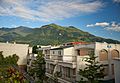 Residential community
 -
 Yuan Yeh Resort
 -
 Roadside cemetery


Twin towns – sister cities[edit]
Hualien City is twinned with:[13]
 Ulsan, South Korea (1982)
 Yonaguni, Japan (1982)
 Albuquerque, United States (1983)
- Bellevue, United States (1984)
 Oudtshoorn, South Africa (1985)


Friendly cities[edit]
Hualien City has friendly relations with:[13]

See also[edit]

References[edit]
- ^ "KMT's Wei wins Hualien by-election – Taipei Times". 28 August 2016.
- ^ 花蓮市公所-英文版-. Archived from the original on 2014-02-22. Retrieved 2014-02-17.
- ^ a b 花蓮市公所-英文版-. Archived from the original on 2013-11-14. Retrieved 2014-02-17.
- ^ 撒奇萊雅族_認識本族. TAIWAN INDIGENOUS PEOPLES CULTURE PARK (in Chinese). Archived from the original on 11 May 2015. Retrieved 3 December 2014.
- ^ 台灣旅遊景點地圖 – 花蓮縣花蓮市旅遊景點介紹. 旅遊資訊王TravelKing. Retrieved 17 June 2016.
- ^ "Taiwan's strongest earthquake in nearly 25 years damages buildings, leaving 4 dead". NPR.
- ^ Stanisław Kałużyński, ed. (1996). Przegląd Orientalistyczny. 177–184. Warszawa: Polskie Towarzystwo Oreintalistyczne: 202. ISSN 0033-2283.
{{cite journal}}: Missing or empty|title=(help) - ^ "Monthly Mean". Central Weather Bureau. Retrieved 29 November 2022.
- ^ "氣象站各月份最高氣溫統計" (PDF) (in Chinese). Central Weather Bureau. Retrieved 29 November 2022.
- ^ "氣象站各月份最高氣溫統計(續)" (PDF) (in Chinese). Central Weather Bureau. Retrieved 29 November 2022.
- ^ "氣象站各月份最低氣溫統計" (PDF) (in Chinese). Central Weather Bureau. Retrieved 29 November 2022.
- ^ "氣象站各月份最低氣溫統計(續)" (PDF) (in Chinese). Central Weather Bureau. Retrieved 29 November 2022.
- ^ a b "Sister Cities". hualien.gov.tw. Hualien City. 30 August 2017. Retrieved 2020-12-17.
External links[edit]


 Hualien travel guide from Wikivoyage
 Geographic data related to Hualien City at OpenStreetMap


Cities and townships of Hualien County | ||
|---|---|---|
| Cities |  | |
| Urban townships | ||
| Rural townships | ||
| Mountain indigenous townships | ||
| Highland indigenous Townships and Districts |
|  | ||||||||||||||||||||||||
|---|---|---|---|---|---|---|---|---|---|---|---|---|---|---|---|---|---|---|---|---|---|---|---|---|---|---|
| Plains indigenous Townships and County-Administered Cities |
| |||||||||||||||||||||||||
Note: On the map, "Mountain Indigenous Areas" are in dark green and "Plains Indigenous Areas" are in light green. | ||||||||||||||||||||||||||
| International | |
|---|---|
| National | |
| Geographic | |
