


Olav V
| Olav V | ||||||||||||||||||||||||
|---|---|---|---|---|---|---|---|---|---|---|---|---|---|---|---|---|---|---|---|---|---|---|---|---|
 Olav V, c. 1957–70 | ||||||||||||||||||||||||
| King of Norway | ||||||||||||||||||||||||
| Reign | 21 September 1957 – 17 January 1991 | |||||||||||||||||||||||
| Benediction[a] | 22 June 1958 | |||||||||||||||||||||||
| Predecessor | Haakon VII | |||||||||||||||||||||||
| Successor | Harald V | |||||||||||||||||||||||
| Prime ministers | ||||||||||||||||||||||||
| Born | Prince Alexander of Denmark 2 July 1903 Appleton House, Sandringham, Norfolk, England | |||||||||||||||||||||||
| Died | 17 January 1991 (aged 87) The Royal Lodge, Holmenkollen, Oslo, Norway | |||||||||||||||||||||||
| Burial | 30 January 1991 Akershus Castle, Oslo | |||||||||||||||||||||||
| Spouse | ||||||||||||||||||||||||
| Issue | ||||||||||||||||||||||||
| ||||||||||||||||||||||||
| House | Glücksburg | |||||||||||||||||||||||
| Father | Haakon VII of Norway | |||||||||||||||||||||||
| Mother | Maud of Wales | |||||||||||||||||||||||
| Signature |  | |||||||||||||||||||||||
| Sports career | ||||||||||||||||||||||||
Medal record
| ||||||||||||||||||||||||


Olav V (Norwegian pronunciation: [ˈûːlɑːv dɛn ˈfɛ̂mtə];[1] born Prince Alexander of Denmark; 2 July 1903 – 17 January 1991) was King of Norway from 1957 until his death in 1991.
Olav was the only child of King Haakon VII of Norway and Maud of Wales. He became heir apparent to the Norwegian throne when his father was elected King of Norway in 1905. He was the first heir to the Norwegian throne to be brought up in Norway since Olav IV in the fourteenth century, and his parents made sure he was given as Norwegian an upbringing as possible. In preparation for his future role, he attended both civilian and military schools. In 1929, he married his first cousin Princess Märtha of Sweden. During World War II his leadership was much appreciated and he was appointed Norwegian Chief of Defence in 1944. Olav became king following the death of his father in 1957.
Owing to his considerate, down-to-earth style, King Olav was immensely popular, resulting in the nickname Folkekongen ('The People's King'). In a 2005 poll by the Norwegian Broadcasting Corporation, Olav was voted "Norwegian of the Century".[2]
Birth and early life
[edit].jpg)
Olav was born as Prince Alexander Edward Christian Frederik in Appleton House on the royal Sandringham Estate, Flitcham, United Kingdom.[3] His parents were Prince Carl, second son of Crown Prince Frederick of Denmark (later King Frederick VIII), and Princess Maud, youngest daughter of King Edward VII of the United Kingdom, who was the eldest son of Britain's Queen Victoria. In 1905, Carl was elected King of Norway and took the name Haakon VII. The king gave his two-year-old son the Norwegian name Olav after Olav Haakonsson, king of Norway and Denmark.[4]
Olav was thus the first heir to the throne since the Middle Ages to have been raised in Norway. Unlike his father, who was a naval officer, Olav chose to complete his main military education in the army. He graduated from the three-year Norwegian Military Academy in 1924, with the fourth best score in his class. Olav then went on to study jurisprudence and economics for two years at Balliol College, Oxford.[5]
During the 1930s, Crown Prince Olav was a naval cadet serving on the minelayer/cadet training ship Olav Tryggvason.[6] Olav moved up the ranks of the Norwegian armed forces, rising in the army from an initial rank of first lieutenant to captain in 1931 and colonel in 1936.[7]
He was an accomplished athlete. Olav jumped from the Holmenkollen ski jump in Oslo and competed in sailing regattas. He won a gold medal in sailing at the 1928 Summer Olympics[8] in Amsterdam and remained an active sailor into old age.
On 21 March 1929 in Oslo, he married his first cousin Princess Märtha of Sweden with whom he had two daughters, Ragnhild and Astrid and one son, Harald. As exiles during World War II, Crown Princess Märtha and the royal children lived in Washington, D.C., where she struck up a close friendship with Franklin D. Roosevelt. She died in 1954, before her husband ascended the throne.
The British Film Institute houses an early film, made in 1913, in which a miniature car (a "baby Cadillac") commissioned by Queen Alexandra for Crown Prince Olav tows a procession of Londoners through the streets of the capital, before being delivered to a pair of "royal testers" of roughly Olav's age.[9] The car is a battery-powered, one-third size replica on a four-foot wheelbase, and is on permanent loan to the Norsk Teknisk Museum in Oslo.[10]
World War II
[edit]
As Crown Prince, Olav had received extensive military training and had participated in most major Norwegian military exercises. Because of this he was perhaps one of the most knowledgeable Norwegian military leaders [citation needed] and was respected by other Allied leaders for his knowledge and leadership skills. During a visit to the United States before the war, he and his wife had established a close relationship with President Roosevelt. These factors would prove to be important for the Norwegian fight against the attacking German forces. In 1939, Crown Prince Olav was appointed an admiral of the Royal Norwegian Navy and a general of the Norwegian Army.[7]
During World War II, Olav stood by his father's side in resisting the German occupation of Norway. During the campaign he was a valuable advisor both to civilian and military leaders. When the Norwegian government decided to go into exile, he offered to stay behind with the Norwegian people, but this was declined. He reluctantly followed his father to the United Kingdom, where he and his staff and servants and aides continued to be a key advisor to the government-in-exile and his father. One source states that Olav helped "to build and lead a free fighting force" and made radio broadcasts" while in England.[11] Olav made several visits to Norwegian and Allied troops in the United Kingdom, Canada and the United States. In 1944, he was appointed to the post of Norwegian Chief of Defence and after the war he led the Norwegian disarmament of the German occupying forces. On 13 May 1945 Crown Prince Olav and five government ministers returned to a liberated Norway. The arrival was documented in a newsreel by British Pathé News.[12]
His war decorations from other nations, including the War Crosses of Norway, France, Greece and the Netherlands, the US Legion of Merit and the French Médaille Militaire, are testament to the international recognition of his contribution to the war against Hitler.

| Norwegian Royalty House of Oldenburg (Glücksburg branch) |
|---|
 |
| Haakon VII |
|
| Olav V |
| Harald V |
|
Reign
[edit]
Haakon was injured in an accident in 1955; his son Olav served as regent until his death.[13] Haakon died at the Royal Palace in Oslo on 21 September 1957. He was 85 years old. After his death, Olav succeeded him as Olav V.
Olav reigned as a "People's King," and became extremely popular, despite the fact that he had no queen consort (he was a widower throughout his reign). He liked to drive his own cars, and would drive in the public lanes, even though as a monarch he was allowed to drive in bus lanes. When driving was restricted during the 1973 energy crisis, King Olav – who could have driven legally – wanted to lead by example; while preparing for a skiing trip, he dressed up in his skiing outfit and boarded the Holmenkollbanen suburban railway carrying his skis on his shoulder.[14] When later asked how he dared to go out in public without bodyguards, he replied that "he had 4 million bodyguards" – the population of Norway was at the time 4 million.
For his athletic ability and role as King, Olav earned the Holmenkollen medal in 1968, the Medal for Outstanding Civic Achievement in 1970 and was made Name of the Year in 1975. He had a strong interest in military matters and took his role as titular Commander-in-Chief very seriously. As well as his ceremonial roles in the Norwegian Army, he also served as Colonel-in-Chief of the Green Howards (Alexandra, Princess of Wales's Yorkshire Regiment), the British regiment named for his grandmother Queen Alexandra.
The King represented Norway extensively abroad during his reign, conducting state visits to both neighbouring countries and more distant destinations such as Ethiopia and Iran. King Olav V opened the 14th World Scout Jamboree in July 1975 in the presence of 17,259 Scouts from 94 countries.
Although the constitution nominally vested Olav with executive power, he was not responsible for exercising it. One source states that his "duties were largely ceremonial".[13] His acts were not valid without the countersignature of a minister–usually the Prime Minister–who then became politically responsible for the act in question. He had the right to appoint the government, but in practice it was not possible for him to keep a government in office against the will of the Storting. Thus, in practice, his role was mostly representative in nature. Nonetheless, like his father before him, he commanded great moral authority as a symbol of the nation's unity.
Illness and death
[edit]During the summer of 1990, the King suffered from health problems, but recovered somewhat during Christmas the same year. At the age of 87, on 17 January 1991, while residing in the Royal Lodge Kongsseteren in Oslo, he became ill and died in the evening of a heart attack. An interview given by King Harald V and hints in a biography by Jo Benkow, who was the President of the Storting at that time, mention the possibility that King Olav suffered great trauma upon learning of the outbreak of the first Gulf War,[citation needed] which began on the day he died. Olav's son succeeded him as King Harald V.
On the night of his death and for several days up until the state funeral, Norwegians mourned publicly, lighting hundreds of thousands of candles in the courtyard outside the Royal Palace in Oslo, with letters and cards placed amongst them.[15] The National Archives have preserved all these cards.
Funeral
[edit]The state funeral of King Olav V was held on 30 January 1991. During the funeral procession from the Royal Palace to Oslo Cathedral, over 100,000 people lined up along Karl Johans gate to pay their respects.[16] Prime Minister Gro Harlem Brundtland gave the eulogy at the funeral, before the casket was moved to Akershus Fortress where a private service was held.[17]
Olav was finally laid to rest next to his wife Märtha in the green sarcophagus of the Royal Mausoleum.[18]
Legacy
[edit]King Olav's leadership during the Second World War made him a symbol of Norwegian independence and national unity. As King Olav's wife, Princess Märtha, died of cancer, the King Olav V's Prize for Cancer Research was established in 1992.
A 2005 poll by the Norwegian Broadcasting Corporation named King Olav "Norwegian of the Century".[2]
In popular culture
[edit]Viktor Andersen portrayed the two-year-old Prince Alexander (Olav) in the 2009 NRK drama series Harry & Charles. Actor Anders Baasmo Christiansen was chosen to portray Crown Prince Olav in the 2016 drama The King's Choice while Tobias Santelmann portrayed Olav in the 2021 NRK drama Atlantic Crossing.
Honours
[edit]National honours and medals
[edit] Norway:
 Recipient of the War Cross
 Recipient of the Medal for Outstanding Civic Achievement in gold
 Grand Cross with Collar of the Royal Norwegian Order of St Olav (18 November 1905);[19] Grand Master (21 September 1957)
 Founder of the Royal Norwegian Order of Merit (1985)
 Recipient of the St Olav's medal
 Recipient of the Haakon VII Coronation Medal
 Recipient of the War Medal
 Recipient of the Haakon VII 70th Anniversary Medal
 Recipient of the King Haakon VII 1905–1955 Jubilee Medal


Foreign honours
[edit] Argentina: Grand Cross with Collar of the Order of the Liberator General San Martin
 Austria: Grand Star of the Decoration of Honour for Services to the Republic of Austria
 Belgium: Grand Cordon of the Order of Leopold
 Brazil: Grand Cross with Collar of the Order of the Rose
 Chile: Grand Cross with Collar of the Order of the Merit of Chile
 Denmark:
- Knight of the Elephant (13 August 1921)[20]
- Cross of Honour of the Order of the Dannebrog (13 August 1921)[20]
- Grand Commander of the Order of the Dannebrog (11 September 1958)[20]
- Recipient of the King Christian X's Liberty Medal[20]
- Recipient of the Commemorative Medal for King Christian IX's 100th birthday[20]
- Recipient of the Commemorative Medal for King Frederik VIII's 100th birthday[20]
 Ethiopia: Grand Cross of the Order of Solomon
 Finland: Grand Cross of the Order of the White Rose
 France:
- Grand Cross of the Order of Legion of Honour
- Recipient of the Croix de guerre
- Recipient of the Médaille militaire
 Germany: Grand Cross Special Class of the Order of Merit of the Federal Republic of Germany
 Greece:
- Grand Cross of the Order of the Redeemer
- Grand Cross of the Order of St. George and St. Constantine
- Recipient of the War Cross
- Recipient of the Commemorative Badge of the Centenary of the Royal House of Greece
 Iceland:
- Grand Cross with Collar of the Order of the Falcon (1961)
- Grand Cross of the Order of the Falcon (1955)
 Iran:
Iran:
- Grand Cordon of the Order of Pahlavi
- Commemorative Medal of the 2500th Anniversary of the founding of the Persian Empire (14/10/1971).[21]
 Italy: Knight Grand cross with Collar of the Order of Merit of the Italian Republic (1965)
 Japan: Collar of the Order of the Chrysanthemum
 Luxembourg: Knight of the Order of the Gold Lion of the House of Nassau
 Mexico: Grand Cross of the Order of the Aztec Eagle
 Netherlands:
- Grand Cross of the Order of the Netherlands Lion
- Grand Cross of the Order of the House of Orange
- Recipient of the War Cross
- Recipient of the Queen Juliana Juliana Inauguration Medal (1948)
 Peru: Grand Cross of the Order of the Sun
 Portugal:
- Grand Cross of the Military Order of Aviz
- Grand Collar of the Order of Saint James of the Sword
 Romania: Knight Grand Cross of the Order of the Star
 Saxony: Grand Cross of the Ernestine Order (Saxony, Germany)
 Spain:
- Knight of the Order of the Golden Fleece
- Collar of the Order of Charles III
 Sweden:
- Knight of the Royal Order of the Seraphim (1 November 1926)[22]
- Recipient of the 70th Birthday Medal of King Gustaf V (1928)
- Recipient of the 90th Birthday Medal of King Gustaf V (1948) King Gustaf V's 90th Anniversary Medal
 Thailand:
- Knight of the Most Illustrious Order of the Royal House of Chakri (19 September 1960)[23]
- Knight Grand Cordon (Special Class) of the Most Illustrious Order of Chula Chom Klao
 Tunisia: Grand Cross of the Order of Independence
 Vatican City: Collar of the Order of Pope Pius IX (1967)
 United Kingdom:
- Stranger Knight Companion of the Most Noble Order of the Garter (29 May 1959)[24]
- Extra Knight of the Most Ancient and Most Noble Order of the Thistle[25]
- Honorary Knight Grand Cross of the Most Honourable Order of the Bath
- Recipient of the Royal Victorian Chain
- Honorary Knight Grand Cross of the Royal Victorian Order
- Recipient of the King George V Silver Jubilee Medal
- Recipient of the King George VI Coronation Medal
- Recipient of the Queen Elizabeth II Coronation Medal
 United States:
- Chief Commander of the Legion of Merit
- Recipient of Honorary Degree of Doctor of Laws, University of North Dakota[26]
 Yugoslavia: Great Star of the Order of the Yugoslav Star[27]


Other honours
[edit]- Norway – A 180 000 km2 area (Prince Olav Coast) and the Prince Olav Mountains in Antarctica are named in his honour.
- Norway – Olav V Land on Svalbard is named in his honour.
- Norway – In 1961 the King was a laureate of the Nansen Refugee Award.
- Norway – In 1968 he was awarded the Holmenkollen medal.
- Norway – In 2005, Olav was proclaimed the Norwegian of the Century, with 41 percent of the tele-votes in a popular competition held by NRK.
 United Kingdom – In 1959, Olav was granted the honorary rank of Air Chief Marshal in the Royal Air Force.[28]
 United Kingdom – In 1958, Olav was granted the honorary rank of Admiral in the Royal Navy,[29] and in 1988, he was granted the honorary rank of Admiral of the Fleet.[30]
- United Kingdom – Honorary Freeman of Richmond
- United Kingdom – Honorary Freedom of Newcastle upon Tyne[31]
 South Georgia and the South Sandwich Islands – Prince Olav Harbour on South Georgia is also named in his honour.


- Norway – Member of the Independent Order of Odd Fellows.[32]
 Skopje, SR Macedonia - In 1966, Olav became an honorary citizen.[33]

Issue
[edit]| Children | Birth | Death | Married | Grandchildren | Great-Grandchildren | Great-Great-Grandchildren |
|---|---|---|---|---|---|---|
| Princess Ragnhild of Norway | 9 June 1930 | 16 September 2012 | married 1953, Erling Lorentzen | Haakon Lorentzen (b. 23 August 1954)
Ingeborg Lorentzen Ribeiro (b. 27 February 1957) Ragnhild Lorentzen Long (b. 8 May 1968) |
Olav Lorentzen (b. 11 July 1985)
Christian Lorentzen (b. 23 May 1988) Sophia Lorentzen (b. 28 Jun 1994) Victoria Ribeiro Falcao (b. 19 December 1988) Alexandra Long (b. 14 December 2007) Elizabeth Long (b. 2011) |
Frederik Falcao (b. 28 September 2016)
Alice Falcao (b. 21 October 2022) Thomas Lorentzen (b. 2022) Salvador Lorentzen (b. 1 April 2023) |
| Princess Astrid of Norway | 12 February 1932 | married 1961, Johan Ferner | Cathrine Ferner Johansen (b. 22 July 1962)
Benedikte Ferner Stange (b. 27 September 1963) Alexander Ferner (b. 15 March 1965) Elisabeth Ferner Beckmann (b. 30 March 1969) Carl-Christian Ferner (b. 22 October 1972, Oslo) |
Sebastian Johansen (b. 9 March 1990)
Madeleine Johansen (b. 7 March 1993) Edward Ferner (b. 28 March 1996) Stella Ferner (b. 23 April 1998) Benjamin Beckmann (b. 25 April 1999) Fay Ferner (b. 10 July 2018) Fam Ferner (b. 28 January 2021) |
Nicoline Johansen (b. 2019)
Ferdinand Johansen (b. 2021) | |
| Harald V of Norway | 21 February 1937 | married 1968, Sonja Haraldsen | Princess Märtha Louise of Norway (b. 22 September 1971)
Crown Prince Haakon Magnus (b. 20 July 1973) |
Maud Behn (b. 29 April 2003)
Leah Behn (b. 8 April 2005) Emma Behn (b. 2008) Princess Ingrid Alexandra (b. 21 January 2004) Prince Sverre Magnus (b. 3 December 2005) |
Gallery
[edit]-
 Crown Prince Olav arrives in Norway in 1905 on his father's arm and is greeted by Prime Minister Christian Michelsen
 -
 Drawing, 1906, by Andreas Bloch
 -
 Märtha and Olav on the cover of Time on the occasion of their wedding
 -
 Crown Prince Olav and his father King Haakon VII take shelter under birch trees as the German Luftwaffe bombs Molde
 -
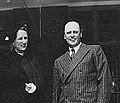 Märtha and Olav in 1950.
 -
 Olav in 1921 as Crown Prince.
 -
 Haakon VII of Norway, Maud of Wales and Crown Prince Olav on 17 July 1913 in Norway


See also
[edit]- Descendants of Christian IX of Denmark - Lists members of European royalty who share a common ancestor with Olav V
Notes
[edit]- ^ Coronation discarded by constitutional amendment in 1908. Olav V instead received benediction in Nidaros Cathedral.
References
[edit]- ^ Berulfsen, Bjarne (1969). Norsk Uttaleordbok (in Norwegian). Oslo: H. Aschehoug & Co (W Nygaard). pp. 64, 91, 232.
- ^ a b "Folkekongen ble århundrets nordmann". Aftenposten (in Norwegian). 17 December 2005. Retrieved 14 July 2011.
- ^ Sandelson, Michael (28 October 2011). "Norway's Queen Maud in euthanasia speculations". The Foreigner. Retrieved 9 July 2013.
- ^ "Olav to Martha". Time Magazine. 21 January 1929. Archived from the original on 10 February 2009. Retrieved 17 January 2009.
- ^ Benkow 1991, pp. 97–108.
- ^ Bratli & Schau 1995, p. 93.
- ^ a b Dahl 1982, p. 48.
- ^ Flint 1991.
- ^ F.S. Bennett (Director) (1913). The Smallest Car in the Largest City in the World (motion picture). London, England: British Film Institute. Archived from the original on 7 November 2021. Retrieved 15 May 2017 – via YouTube.
- ^ Morton, Ian (30 August 2003). "Right Royal Fun in a Baby Cadillac". The Daily Telegraph. Archived from the original on 12 January 2022. Retrieved 15 May 2017.
- ^ "The Real Historical People of the New Drama 'Atlantic Crossing'". WTTW, PBS. 6 April 2021. Retrieved 13 April 2021.
- ^ "Olav V Arrives In Norway 1945". British Pathé. Retrieved 12 April 2021.
- ^ a b "Olav V king of Norway". Britannica. Retrieved 13 April 2021.
- ^ Sleire Øyen, Ragnhild (30 December 2004). "Kong Olav 5". NRK (in Norwegian). Retrieved 24 November 2006.
- ^ "Tronskiftet 1991". www.kongehuset.no (in Norwegian). Retrieved 13 April 2018.
- ^ AS, TV 2. "I dag er det 25 år siden kong Olav døde". TV 2 (in Norwegian). Retrieved 13 April 2018.
{{cite news}}: CS1 maint: numeric names: authors list (link) - ^ Berge, Jørgen. "Gro: - Jeg hadde et nært forhold til kong Olav". Nettavisen (in Norwegian). Retrieved 13 April 2018.
- ^ Dahlmann, L. A. "The secret journey of Queen Maud's coffin | norwegianhistory.no". Archived from the original on 9 February 2019. Retrieved 7 February 2019.
- ^ "Den kongelige norske Sanct Olavs Orden", Norges Statskalender (in Norwegian), 1922, p. 1171-1172, retrieved 19 September 2021 – via hathitrust.org
- ^ a b c d e f Bille-Hansen, A. C.; Holck, Harald, eds. (1963) [1st pub.:1801]. Statshaandbog for Kongeriget Danmark for Aaret 1963 [State Manual of the Kingdom of Denmark for the Year 1963] (PDF). Kongelig Dansk Hof- og Statskalender (in Danish). Copenhagen: J.H. Schultz A.-S. Universitetsbogtrykkeri. pp. 18, 20. Retrieved 7 July 2020 – via da:DIS Danmark.
- ^ Badraie Archived 5 March 2016 at the Wayback Machine
- ^ Sveriges Statskalender (in Swedish), vol. 2, 1931, p. 7, retrieved 6 January 2018 – via runeberg.org
- ^ Royal Thai Government Gazette (28 December 1964). "แจ้งความสำนักนายกรัฐมนตรี เรื่อง ถวายเครื่องขัตติยราชอิสริยาภรณ์มหาจักรีบรมราชวงศ์ แด่พระมหากษัตริย์แห่งประเทศนอรเว" (PDF) (in Thai). Archived from the original (PDF) on 8 May 2019. Retrieved 8 May 2019.
{{cite journal}}: Cite journal requires|journal=(help) - ^ List of Knights of the Garter – 1348 to present – via heraldica.org.
- ^ "People". Time Magazine. 26 October 1962. p. 1. Archived from the original on 10 February 2009. Retrieved 17 January 2009.
- ^ https://commons.und.edu/cgi/viewcontent.cgi?article=1091&context=und-commencement-programs [bare URL]
- ^ Royal House of Norway web page on King Olav V's decorations (Norwegian) Retrieved 5 October 2007
- ^ "No. 41815". The London Gazette (Supplement). 11 September 1959. p. 5791.
- ^ "No. 41435". The London Gazette (Supplement). 1 July 1958. p. 4199.
- ^ "No. 51344". The London Gazette (Supplement). 23 May 1988. p. 6093.
- ^ Solholm, Rolleiv (14 November 2008). "King Harald receives honorary title". Norwegian Broadcasting Corporation. Norway Post. Retrieved 4 May 2013.
- ^ Suits 2011, p. 53.
- ^ "Official portal of City of Skopje - Honorary citizens". 15 April 2017. Archived from the original on 15 April 2017. Retrieved 1 July 2021.
Bibliography
[edit]- Benkow, Jo (1991). Olav – menneske og monark (in Norwegian) (3rd ed.). Oslo: Gyldendal Norsk Forlag. ISBN 82-05-20192-7.
- Bramsen, Bo (1992). Huset Glücksborg. Europas svigerfader og hans efterslægt [The House of Glücksburg. The Father-in-law of Europe and his descendants] (in Danish) (2nd ed.). Copenhagen: Forlaget Forum. ISBN 87-553-1843-6.
- Bratli, Kjell Arne; Schau, Øyvind (1995). Sjøoffiser og samfunnsbygger : Vernepliktige sjøoffiserers forening : 100-års jubileumsbok : 1895–1995 (in Norwegian). Hundvåg: Sjømilitære Samfund ved Norsk Tidsskrift for Sjøvesen. ISBN 82-91008-09-4.
- Dahl, Hans Fredrik (1982). Norge under Olav V (in Norwegian). Oslo: Cappelen. ISBN 8202090520.
- Flint, Peter B. (18 January 1991). "Olav V, Norway's King 33 Years And Resistance Hero, Dies at 87". New York Times.
- Lerche, Anna; Mandal, Marcus (2003). A royal family : the story of Christian IX and his European descendants. Copenhagen: Aschehoug. ISBN 9788715109577.
- Suits, Julia (2011). The Extraordinary Catalog of Peculiar Inventions: The Curious World of the Demoulin Brothers and Their Fraternal Lodge Prank Machi nes - from Human Centipedes and Revolving Goats to ElectricCarpets and SmokingC. Penguin Publishing Group. p. 53. ISBN 978-1-101-54576-8.
External links
[edit]
- Official Website of the Royal House of Norway
- King Olav – biography (Official Website of the Royal House of Norway)
- The Royal Norwegian Order of St Olav – H.M. King Olav V the former Grand Master of the Order
- Holmenkollen medalists – click Holmenkollmedaljen for downloadable pdf file (in Norwegian)
- Newspaper clippings about Olav V in the 20th Century Press Archives of the ZBW
The generations are numbered from the ascension of Haakon VII as King of Norway in 1905. | ||
| 1st generation | | |
| 2nd generation | ||
| 3rd generation | ||
| 4th generation | ||
*Prince of Denmark by birth, but created prince of Norway | ||
The generations are numbered from the implementation of hereditary monarchy by Frederick III in 1660. | ||
| 1st generation |  | |
| 2nd generation | ||
| 3rd generation | ||
| 4th generation | ||
| 5th generation | ||
| 6th generation | ||
| 7th generation | ||
| 8th generation | ||
| 9th generation | ||
| 10th generation | ||
| 11th generation | ||
| 12th generation | ||
| 13th generation | ||
1 Also prince of Norway 2 Also prince of Greece 3 Also prince of Iceland 4 Also prince of the United Kingdom 5 Not Danish prince by birth, but created prince of Denmark Princes that lost their title are shown in italics | ||
|


- 1903 births
- 1991 deaths
- 20th-century Norwegian monarchs
- 20th-century regents
- House of Glücksburg (Norway)
- Norwegian people of World War II
- Princes of Denmark
- Norwegian princes
- Norwegian male ski jumpers
- Norwegian male sailors (sport)
- Olympic sailors for Norway
- Sailors at the 1928 Summer Olympics – 6 Metre
- Olympic gold medalists for Norway
- Norwegian Military Academy alumni
- Alumni of Balliol College, Oxford
- Norwegian Army generals
- Royal Norwegian Navy admirals
- Crown princes of Norway
- Royal Olympic medalists
- Royal Air Force officers holding honorary commissions
- Holmenkollen medalists
- Knights Grand Cross of the Order of Orange-Nassau
- Knights of the Golden Fleece of Spain
- Chief Commanders of the Legion of Merit
- Recipients of the Croix de Guerre (France)
- Grand Cross of the Legion of Honour
- Collars of the Order of the Liberator General San Martin
- Recipients of the Grand Star of the Decoration for Services to the Republic of Austria
- Recipients of the War Cross (Greece)
- Grand Crosses of the Order of the House of Orange
- Grand Crosses of the Order of the Sun of Peru
- Grand Crosses of the Order of Aviz
- Grand Collars of the Order of Saint James of the Sword
- Grand Crosses of the Order of the Star of Romania
- Honorary Knights of the Thistle
- Honorary Knights Grand Cross of the Order of the Bath
- Honorary Knights Grand Cross of the Royal Victorian Order
- Extra Knights Companion of the Garter
- Grand Commanders of the Order of the Dannebrog
- Recipients of the Cross of Honour of the Order of the Dannebrog
- Knights Grand Cross of the Order of Chula Chom Klao
- Recipients of the St. Olav's Medal
- Recipients of the War Cross (Norway)
- Norwegian people of German descent
- Norwegian people of English descent
- Burials at the Royal Mausoleum (Norway)
- Royal Navy admirals of the fleet
- Olympic medalists in sailing
- Norwegian Army World War II generals
- Royal Norwegian Navy World War II admirals
- Medalists at the 1928 Summer Olympics
- Grand Crosses Special Class of the Order of Merit of the Federal Republic of Germany
- Sons of kings
- Nansen Refugee Award laureates
- Recipients of orders, decorations, and medals of Ethiopia