


Portal:Linux

The Linux Portal

Linux (/ˈlɪnʊks/ LIN-uuks) is a family of open-source Unix-like operating systems based on the Linux kernel, an operating system kernel first released on September 17, 1991, by Linus Torvalds. Linux is typically packaged as a Linux distribution (distro), which includes the kernel and supporting system software and libraries, many of which are provided by the GNU Project. Many Linux distributions use the word "Linux" in their name, but the Free Software Foundation uses and recommends the name "GNU/Linux" to emphasize the use and importance of GNU software in many distributions, causing some controversy.
Linux was originally developed for personal computers based on the Intel x86 architecture, but has since been ported to more platforms than any other operating system. Because of the dominance of Linux-based Android on smartphones, Linux, including Android, has the largest installed base of all general-purpose operating systems . Linux is, , used by around 4 percent of desktop computers, the Chromebook, which runs the Linux kernel-based ChromeOS, dominates the US K–12 education market and represents nearly 20 percent of sub-$300 notebook sales in the US. Linux is the leading operating system on servers (over 96.4% of the top one million web servers' operating systems are Linux), leads other big iron systems such as mainframe computers, and is used on all of the world's 500 fastest supercomputers (, having gradually displaced all competitors).
Linux also runs on embedded systems, i.e., devices whose operating system is typically built into the firmware and is highly tailored to the system. This includes routers, automation controls, smart home devices, video game consoles, televisions (Samsung and LG Smart TVs), automobiles (Tesla, Audi, Mercedes-Benz, Hyundai, and Toyota), and spacecraft (Falcon 9 rocket, Dragon crew capsule, and the Perseverance rover). (Full article...)
Selected articles -
-

Puppy Linux is a family of light-weight Linux distributions that focus on ease of use and minimal memory footprint. The entire system can be run from random-access memory (RAM) with current versions generally taking up about 600 MB (64-bit), 300 MB (32-bit), allowing the boot medium to be removed after the operating system has started. Applications such as AbiWord, Gnumeric and MPlayer are included, along with a choice of lightweight web browsers and a utility for downloading other packages. The distribution was originally developed by Barry Kauler and other members of the community, until Kauler retired in 2013. The tool Woof can build a Puppy Linux distribution from the binary packages of other Linux distributions. (Full article...) -
Linux adoption is the adoption of Linux computer operating systems (OS) by households, nonprofit organizations, businesses, and governments.
Many factors have resulted in the expanded use of Linux systems by traditional desktop users as well as operators of server systems, including the desire to minimize software costs, increase network security and support for open-source philosophical principles.[better source needed] In recent years several governments, at various levels, have enacted policies shifting state-owned computers to Linux from proprietary software regimes. (Full article...) -

Arch Linux (/ɑːrtʃ/) is an independently developed x86-64 general-purpose Linux distribution that strives to provide the latest stable versions of most software by following a rolling-release model. The default installation is intentionally minimal so that users can add only the packages they require.
pacman, a package manager written specifically for Arch Linux, is used to install, remove and update software packages. (Full article...) -
Linux malware includes viruses, Trojans, worms and other types of malware that affect the Linux family of operating systems. Linux, Unix and other Unix-like computer operating systems are generally regarded as very well-protected against, but not immune to, computer viruses. (Full article...)
-

Ubuntu, one of the most popular desktop Linux distributions
A Linux distribution (often abbreviated as distro) is an operating system made from a software collection that includes the Linux kernel and often a package management system. Linux users usually obtain their operating system by downloading one of the Linux distributions, which are available for a wide variety of systems ranging from embedded devices (for example, OpenWrt) and personal computers (for example, Linux Mint) to powerful supercomputers (for example, Rocks Cluster Distribution).
A typical Linux distribution comprises a Linux kernel, an init system (such as systemd, OpenRC, or runit), GNU tools and libraries, documentation, and many other types of software (such as IP network configuration utilities and the getty TTY setup program, among others). Optionally, to provide a desktop experience (most commonly the Mesa userspace graphics drivers) a display server (the most common being the X.org Server, or, more recently, a Wayland compositor such as Sway, KDE's KWin, or GNOME's Mutter), a desktop environment, a sound server (usually either PulseAudio or more recently PipeWire), and other related programs may be included with the distribution or are installable by the user. (Full article...) -
Smack (full name: Simplified Mandatory Access Control Kernel) is a Linux kernel security module that protects data and process interaction from malicious manipulation using a set of custom mandatory access control (MAC) rules, with simplicity as its main design goal. It has been officially merged since the Linux 2.6.25 release, it was the main access control mechanism for the MeeGo mobile Operating System. It is also used to sandbox HTML5 web applications in the Tizen architecture, in the commercial Wind River Linux solutions for embedded device development, in Philips Digital TV products., and in Intel's Ostro OS for IoT devices.
Since 2016, Smack is required in all Automotive Grade Linux (AGL) implementations where it provides in association with other Linux facilities the base for the AGL security framework. (Full article...) -
ext4 (fourth extended filesystem) is a journaling file system for Linux, developed as the successor to ext3.
ext4 was initially a series of backward-compatible extensions to ext3, many of them originally developed by Cluster File Systems for the Lustre file system between 2003 and 2006, meant to extend storage limits and add other performance improvements. However, other Linux kernel developers opposed accepting extensions to ext3 for stability reasons, and proposed to fork the source code of ext3, rename it as ext4, and perform all the development there, without affecting existing ext3 users. This proposal was accepted, and on 28 June 2006, Theodore Ts'o, the ext3 maintainer, announced the new plan of development for ext4. (Full article...) -
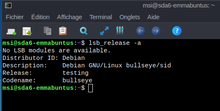
An example of LSB output in a terminal (Debian version 11)
The Linux Standard Base (LSB) was a joint project by several Linux distributions under the organizational structure of the Linux Foundation to standardize the software system structure, including the Filesystem Hierarchy Standard. LSB was based on the POSIX specification, the Single UNIX Specification (SUS), and several other open standards, but extended them in certain areas.
According to LSB:
(Full article...)
The goal of the LSB is to develop and promote a set of open standards that will increase compatibility among Linux distributions and enable software applications to run on any compliant system even in binary form. In addition, the LSB will help coordinate efforts to recruit software vendors to port and write products for Linux Operating Systems. -
GoboLinux is a Linux distribution whose most prominent feature is a reorganization of the traditional Linux file system. Rather than following the Filesystem Hierarchy Standard like most Unix-like systems, each program in a GoboLinux system has its own subdirectory tree, where all of its files (including settings specific for that program) may be found. Thus, a program "Foo" has all of its specific files and libraries in
/Programs/Foo, under the corresponding version of this program at hand. For example, the commonly known GCC compiler suite version 8.1.0, would reside under the directory/Programs/GCC/8.1.0.
According to the GoboLinux developers, this results in a cleaner system. (Full article...) -
Debian (/ˈdɛbiən/), also known as Debian GNU/Linux, is a Linux distribution composed of free and open-source software and optionally non-free firmware or software developed by the community-supported Debian Project, which was established by Ian Murdock on August 16, 1993. The first version of Debian (0.01) was released on September 15, 1993, and its first stable version (1.1) was released on June 17, 1996. The Debian Stable branch is the most popular edition for personal computers and servers.
Debian is also the basis for many other distributions that have different purposes, like Proxmox for servers, Ubuntu or Linux Mint for desktops, Kali for penetration testing, and Pardus and Astra for government use.
Debian is one of the oldest operating systems based on the Linux kernel and, as of September 2023, the second oldest Linux distribution still in active development, only behind Slackware. The project is coordinated over the Internet by a team of volunteers guided by the Debian Project Leader and three foundational documents: the Debian Social Contract, the Debian Constitution, and the Debian Free Software Guidelines. New distributions are updated continually, and the next candidate is released after a time-based freeze. (Full article...) -
Android is a mobile operating system based on a modified version of the Linux kernel and other open-source software, designed primarily for touchscreen mobile devices such as smartphones and tablets. Android is developed by a consortium of developers known as the Open Handset Alliance, though its most widely used version is primarily developed by Google. It was unveiled in November 2007, with the first commercial Android device, the HTC Dream, being launched in September 2008.
At its core, the operating system is known as the Android Open Source Project (AOSP) and is free and open-source software (FOSS) primarily licensed under the Apache License. However, most devices run on the proprietary Android version developed by Google, which ships with additional proprietary closed-source software pre-installed, most notably Google Mobile Services (GMS) which includes core apps such as Google Chrome, the digital distribution platform Google Play, and the associated Google Play Services development platform. Firebase Cloud Messaging is used for push notifications. While AOSP is free, the "Android" name and logo are trademarks of Google, which imposes standards to restrict the use of Android branding by "uncertified" devices outside their ecosystem. (Full article...) -
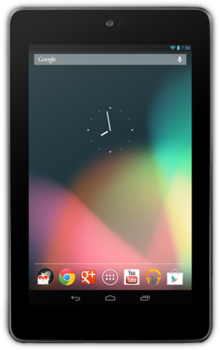
The first-generation Nexus 7 tablet running Android, an operating system using the Linux kernel. While Linux-based operating systems are in common use in tablet computers, they are less frequently adopted as desktop computers.
The criticism of Linux focuses on issues concerning use of operating systems which use the Linux kernel.
While the Linux-based Android operating system dominates the smartphone market in many countries, and Linux is used on the New York Stock Exchange and most supercomputers, it is used in few desktop and laptop computers. Much of the criticism of Linux is related to the lack of desktop and laptop adoption, although there has been growing unease with the project's perspective on security and its adoption of systemd has been controversial. (Full article...) -
The Linux kernel is a free and open-source, monolithic, modular, multitasking, Unix-like operating system kernel. It was originally written in 1991 by Linus Torvalds for his i386-based PC, and it was soon adopted as the kernel for the GNU operating system, which was written to be a free (libre) replacement for Unix.
Linux is provided under the GNU General Public License version 2 only, but it contains files under other compatible licenses. (Full article...) -

GNOME (/ɡəˈnoʊm, ˈnoʊm/), originally an acronym for GNU Network Object Model Environment, is a free and open-source desktop environment for Linux and other Unix-like operating systems.
Many major Linux distributions, including Debian, Fedora Linux, Ubuntu, Red Hat Enterprise Linux, and SUSE Linux Enterprise distribute GNOME as their default desktop environment; it is also the default in Oracle Solaris, a Unix operating system. (Full article...) -
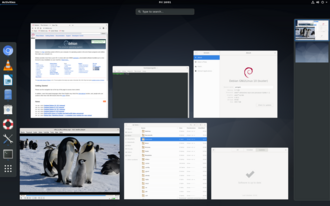
A screenshot of Debian 10 (Buster) with the GNOME desktop environment
Debian releases do not follow a fixed schedule. Recent releases have been made around every two years by the Debian Project. The most recent version of Debian is Debian version 12, codename "Bookworm". The next up and coming release of Debian is Debian 13, codename "Trixie".
Debian always has at least three active branches at any time: "stable", "testing" and "unstable". The stable branch is considered the primary release and what most people refer to when talking about Debian. The testing branch contains packages that have been imported from unstable. Testing has significantly more up-to-date packages than stable and is frozen some time before a release to become the next version of Debian. The unstable release (also known as Sid) is the branch where active development takes place. It is the most volatile version of Debian. (Full article...)


_GNOME_43.9%E2%80%94English.png)

.png)


Release news
- 2024-05-12 Linux kernel 6.9 released.
- 2024-04-25 Ubuntu 24.04 LTS "Noble Numbat" released.
- 2024-04-23 Fedora 40 released.
- 2024-03-20 GNOME 46 released. (announcement)
- 2024-03-10 Linux kernel 6.8 released.
- 2024-01-07 Linux kernel 6.7 released.
- 2023-11-20 Rocky Linux 9.3 released
- 2023-11-07 Fedora 39 released.
- 2023-10-30 Linux kernel 6.6 released.
- 2023-10-12 Ubuntu 23.10 "Mantic Minotaur" released.
- 2023-09-20 GNOME 45 released.
- 2023-08-27 Linux kernel 6.5 released.
- 2023-06-26 Linux kernel 6.4 released.
- 2023-06-10 Debian 12 "bookworm" released.
- 2023-05-16 Rocky Linux 9.2 released.
- 2023-05-10 AlmaLinux 9.2 "Turquoise Kodkod" released.
- 2023-04-23 Linux kernel 6.3 released.
- 2023-04-20 Ubuntu 23.04 "Lunar Lobster" released.
- 2023-03-22 GNOME 44 released.
- 2023-02-19 Linux kernel 6.2 released.
- 2022-12-11 Linux kernel 6.1 released.
- 2022-11-16 Red Hat Enterprise Linux 9.1 and AlmaLinux 9.1 released.
- 2022-11-15 Fedora 37 released.
- 2022-10-20 Ubuntu 22.10 "Kinetic Kudu" released.
- 2022-10-02 Linux kernel 6.0 released.
- 2022-09-21 GNOME 43 released-
- 2022-07-31 Linux kernel 5.19 released.
- 2022-05-26 AlmaLinux 9 released.
- 2022-05-22 Linux kernel 5.18 released.
- 2022-05-18 Red Hat Enterprise Linux 9 released.
- 2022-05-10 Fedora 36 released.
- 2022-04-21 Ubuntu 22.04 LTS "Jammy Jellyfish" released.
- 2022-03-23 GNOME 42 released.
- 2022-03-20 Linux kernel 5.17 released.
- 2022-02-02 Slackware 15.0 released.
- 2022-01-09 Linux kernel 5.16 released.
- 2021-11-02 Fedora 35 released.
Selected image

The Linux kernel System Call Interface and the GNU C Library.
Related portals


Selected biographies -
-
Sage Sharp (formerly Sarah Sharp) is an American software engineer who has worked on the Linux kernel, including serving on the Linux Foundation's Technical Advisory Board for two years. Sharp is non-binary and uses the pronouns "they" and "them".
Sharp began working on the kernel in 2006 as an undergraduate at Portland State University, and later through an Intel undergraduate research grant. Sharp's contributions to the kernel include writing and acting as a maintainer for its USB 3.0 driver. In 2015, Sharp recommended that the Linux project adopt a code of conduct for Linux developers; Linus Torvalds adopted a "code of conflict" instead. Sharp stepped down from direct work on the kernel on 5 October 2015, citing the abrasive communication style and "abusive commentary [on submitted patches]" of the maintainer community. (Full article...) -

Matthew Garrett is an Irish technologist, programmer, and free software activist who is a major contributor to a series of free software projects including Linux, GNOME, Debian, Ubuntu, and Red Hat. He has received the Free Software Award from the Free Software Foundation (FSF) for his work on Secure Boot, UEFI, and the Linux kernel. (Full article...) -
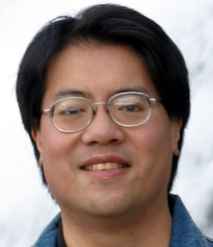
Theodore Yue Tak Ts'o (Chinese: 曹子德; born 1968) is an American software engineer mainly known for his contributions to the Linux kernel, in particular his contributions to file systems. He is the secondary developer and maintainer of e2fsprogs, the userspace utilities for the ext2, ext3, and ext4 filesystems, and is a maintainer for the ext4 file system. (Full article...) -

Federico Heinz at Wikimania 2009
Federico Heinz is an Argentinian programmer and Free Software advocate living in London. He is a co-founder and former president of Fundación Vía Libre, a non-profit organization that promotes the free flow of knowledge as a motor for social progress, and the use and development of Free Software. He has helped legislators such an Argentina's Ing. Dragan, Dr. Conde, and Peru's Dr. Villanueva draft and defend legislation demanding the use of Free Software in all areas of public administration.
He works at Google in their UK office. (Full article...) -
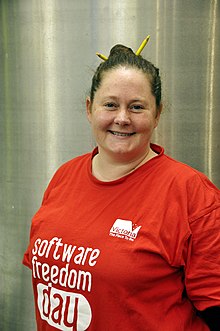
Benjamin at Software Freedom Day, 2010
Donna Benjamin is an Australian open source community contributor, commentator and advocate. She has served in board positions with community organisations including Open Source Industry Australia, Drupal Association and the Ada Initiative, and was the lead organiser of the 2008 linux.conf.au conference in Melbourne. She regularly runs the Community Leadership Summit X at LCA (clsXlca), a workshop focussing on community development in open source projects. In 2011 she organised a crowdfunding campaign called Digitise The Dawn, which successfully raised funds to digitise The Dawn, an early feminist journal published in Australia between 1888 and 1905.
In 2012 she received the Rusty Wrench Award from Linux Australia in recognition of her contributions. She runs a micro-business called Creative Contingencies, which specialises in the Drupal content management platform. (Full article...) -
Greg Kroah-Hartman is a major Linux kernel developer. , he is the Linux kernel maintainer for the -stable branch, the staging subsystem, USB, driver core, debugfs, kref, kobject, and the sysfs kernel subsystems, Userspace I/O (with Hans J. Koch), and TTY layer. He also created linux-hotplug, the udev project, and the Linux Driver Project. He worked for Novell in the SUSE Labs division and, , works at the Linux Foundation. (Full article...) -
Bruce Perens (born around 1958) is an American computer programmer and advocate in the free software movement. He created The Open Source Definition and published the first formal announcement and manifesto of open source. He co-founded the Open Source Initiative (OSI) with Eric S. Raymond.
In 2005, Perens represented Open Source at the United Nations World Summit on the Information Society, at the invitation of the United Nations Development Programme. He has appeared before national legislatures and is often quoted in the press, advocating for open source and the reform of national and international technology policy. (Full article...) -
Peter MacDonald is a Canadian software engineer, best known as the creator of Softlanding Linux System (SLS), widely regarded as the first complete Linux distribution. Some of his work served as a foundation of Wine. He also created the Tcl web browser BrowseX, and the PDQI suite of Tcl utilities.
Current projects include Jsish, an embeddable javascript interpreter with builtin type-checking. (Full article...) -
Andries Evert Brouwer (born 1951) is a Dutch mathematician and computer programmer, Professor Emeritus at Eindhoven University of Technology (TU/e). He is known as the creator of the greatly expanded 1984 to 1985 versions of the roguelike computer game Hack that formed the basis for NetHack. He is also a Linux kernel hacker. He is sometimes referred to by the handle aeb. (Full article...)
-
Bradley M. Kuhn (born 1973) is a free software activist from the United States.
Kuhn is currently Policy Fellow and Hacker-in-Residence of the Software Freedom Conservancy, having previously been executive director. Until 2010 he was the FLOSS Community Liaison and Technology Director of the Software Freedom Law Center (SFLC). He previously served as the Executive Director of Free Software Foundation (FSF) from 2001 until March 2005. He served on the FSF's board of directors from March 2010 until October 2019. (Full article...) -
Benjamin Mako Hill is a free software activist, hacker, author, and professor. He is a contributor and free software developer as part of the Debian and Ubuntu projects as well as the co-author of three technical manuals on the subject, Debian GNU/Linux 3.1 Bible, The Official Ubuntu Server Book, and The Official Ubuntu Book.
Hill is an associate professor in Communication at the University of Washington. (Full article...) -
Patrick Volkerding (born October 20, 1966) is the founder and maintainer of the Slackware Linux distribution. Volkerding is Slackware's "Benevolent Dictator for Life" (BDFL), and is also known informally as "The Man". (Full article...) -
Alan or Allan Cox may refer to:
- Alan Cox (computer programmer) (born 1968), British computer programmer and Linux developer
- Alan Cox (actor) (born 1970), English actor
- Alan Cox (footballer) (1920–1993), footballer for Tranmere Rovers
- Alan Cox (radio personality) (born 1971), radio host
- Allan Cox (author) (1937–2016), American consultant and author
- Allan Cox (cricketer) (1873–1896), Barbadian cricketer
- Allan Leslie Cox (1927–1996), Canadian politician in the Legislative Assembly of British Columbia
- Allan V. Cox (1926–1987), American geophysicist
-
Rémy Card is a French software developer who is credited as one of the primary developers of the Extended file system (ext) and Second Extended file system (ext2) for Linux. (Full article...)
-
Robert M. Love (born c. 1981) is an American author, speaker, Google engineer, and open source software developer.
Love is best known for his contributions to the Linux kernel, with notable work including the preemptive kernel, process scheduler, kernel event layer, virtual memory subsystem, and inotify. At Google, he was a member of the Android team and helped launch the first version of the platform. Love is also active in the GNOME community, working on NetworkManager, GNOME Volume Manager, Project Utopia and Beagle. (Full article...)
.jpg)


.jpg)


General images -
-
 Screenshot of GDebi Package installer (from Debian)
 -

-
 Fedora Workstation 35 installation summary (from Fedora Linux)
 -
 The official logo (also known as open use logo) that contains the well-known Debian swirl (from Debian)
 -
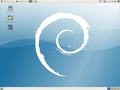 Debian 4 (Etch), 2007 (from Debian)
 -
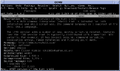
 Text version of the Debian Installer (from Debian)
 -
-
![Image 8Ubuntu family tree[dubious – discuss] (from Ubuntu)](//upload.wikimedia.org/wikipedia/commons/thumb/7/79/UbuntuFamilyTree1210.svg/108px-UbuntuFamilyTree1210.svg.png)
-
 Debian 6 (Squeeze), 2011 (from Debian)
 -
 Fedora 21, a version that brought experimental Wayland and HiDPI support (2014-12) (from Fedora Linux)
 -
 Redevelopment costs of Linux kernel (from Linux kernel)
 -
 Deepin logo (from Ubuntu)
 -
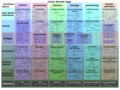 Map of the Linux kernel (from Linux kernel)
 -

-
 An example of Linux kernel panic (from Linux kernel)
 -

-
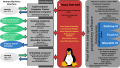 The Linux kernel supports various hardware architectures, providing a common platform for software, including proprietary software. (from Linux kernel)
 -
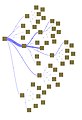 Sankey diagram of Linux Kernel Source Lines of Code (from Linux kernel)
 -
 Xfce is default on CD images and non-Linux ports. (from Debian)
 -
 Debian 10 installation menu (BIOS Mode) (from Debian)
 -

-
 Graphical version of the Debian Installer (from Debian)
 -
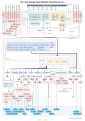 The Linux Storage Stack Diagram (from Linux kernel)
 -
 Cloud Ubuntu Orange Box
 -
 The core values of the Fedora community (from Fedora Linux)
 -
 Package installed with Aptitude (from Debian)
 -

-
-
 Four interfaces are distinguished: two internal to the kernel, and two between the kernel and userspace. (from Linux kernel)
 -
 A Debian 10.0 Buster box cover (from Debian)
 -
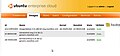 Eucalyptus interface (from Ubuntu)
 -
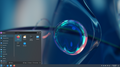 Fedora KDE Plasma Desktop, one of the several official Fedora Spins (from Fedora Linux)
 -
 Logo of GNU Hurd (from Debian)
 -
 Logo of Debian GNU/kFreeBSD (from Debian)
 -
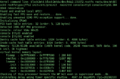 Boot messages of a Linux kernel 2.6.25.17 (from Linux kernel)
 -
 At XDC2014, Alex Deucher from AMD announced the unified kernel-mode driver. The proprietary Linux graphic driver, libGL-fglrx-glx, will share the same DRM infrastructure with Mesa 3D. As there is no stable in-kernel ABI, AMD had to constantly adapt the former binary blob used by Catalyst. (from Linux kernel)
 -
 Debian 10 console login and welcome message (from Debian)
 -
 Fedora Core 1.0, a continuation of Red Hat Enterprise Linux with GNOME 2.4 (2003-11) (from Fedora Linux)
 -

-
 Ubuntu - Version History - Visual Timeline - 20231019 (from Ubuntu)


![Image 8Ubuntu family tree[dubious – discuss] (from Ubuntu)](/wiki/File:UbuntuFamilyTree1210.svg)


.jpg)


Did you know?

WikiProjects

Topics
| Linux kernel | |
|---|---|
| Controversies | |
| Distributions | |
| Organizations | |
| Adoption | |
| Media | |


Subcategories

Associated Wikimedia
The following Wikimedia Foundation sister projects provide more on this subject:
-
 Commons
Free media repository -
 Wikibooks
Free textbooks and manuals -
 Wikidata
Free knowledge base -
 Wikinews
Free-content news -
 Wikiquote
Collection of quotations -
 Wikisource
Free-content library -
 Wikiversity
Free learning tools -
 Wiktionary
Dictionary and thesaurus


