


Allium ursinum
| Allium ursinum | |
|---|---|

| |
Scientific classification 
| |
| Kingdom: | Plantae |
| Clade: | Tracheophytes |
| Clade: | Angiosperms |
| Clade: | Monocots |
| Order: | Asparagales |
| Family: | Amaryllidaceae |
| Subfamily: | Allioideae |
| Genus: | Allium |
| Subgenus: | A. subg. Amerallium |
| Species: | A. ursinum
|
| Binomial name | |
| Allium ursinum | |
| Synonyms[1] | |
|
Species synonymy
| |

Allium ursinum, known as wild garlic, ramsons, cowleekes, cows's leek, cowleek, buckrams, broad-leaved garlic, wood garlic, bear leek, Eurasian wild garlic or bear's garlic, is a bulbous perennial flowering plant in the amaryllis family Amaryllidaceae. It is native to Europe and Asia, where it grows in moist woodland.[2] It is a wild relative of onion and garlic, all belonging to the same genus, Allium. There are two recognized subspecies: A. ursinum subsp. ursinum and A. ursinum subsp. ucrainicum.[3]
Etymology[edit]
The Latin specific name ursinum translates to 'bear' and refers to the supposed fondness of the brown bear for the bulbs; folk tales describe the bears consuming them after awakening from hibernation.[3] Another theory is that the "ursinum" may refer to Ursa Major, as A. ursinum was perhaps one of the most northerly distributed Allium species known to the ancient Greeks,[3] though this hypothesis is disputed.[4] Common names for the plant in many languages also make reference to bears.[5]
Cows love to eat them, hence the modern vernacular name of cows's leek.[6] In Devon, dairy farmers have occasionally had the milk of their herds rejected because of the garlic flavour imparted to it by the cows having grazed upon the plant.[6]
Ramsons is from the Saxon word hramsa, meaning "garlic". There is evidence it has been used in English cuisine since Celtic Britons over 1,500 years ago.[7]
Early healers among the Celts, Gaels, Teutonic tribes and ancient Romans were familiar with the wild herb and called it herba salutaris, meaning 'healing herb'.[7]
Description[edit]

Allium ursinum is a bulbous, perennial herbaceous monocot, that reproduces primarily by seed. The narrow bulbs are formed from a single leaf base[8] and produce bright green entire, elliptical leaves up to 25 cm (9.8 in) long x 7 cm (2.8 in) wide with a petiole up to 20 cm (7.9 in) long.[8] The inflorescence is an umbel of six to 20 white flowers, lacking the bulbils produced by some other Allium species such as Allium vineale (crow garlic) and Allium oleraceum (field garlic).[9][8]: 394 [10]: 902 The flowers are star-like with six white tepals, about 16–20 mm (0.63–0.79 in) in diameter, with stamens shorter than the perianth.[8]
It flowers in the British Isles from April to June,[8]: 394 starting before deciduous trees leaf in the spring. The flower stem is triangular in cross-section and the leaves are broadly lanceolate, similar to those of the toxic lily of the valley (Convallaria majalis).[3]
Distribution[edit]
It is native to temperate regions of Europe, from Ireland east to the Caucasus.[citation needed] It is common in much of the lowlands of the British Isles with the exception of the far north of Scotland, Orkney and Shetland.[11] The ursinum subspecies is found in western and central Europe, while the ucrainicum subspecies is found in the east and southeast.[3]
Herbal remedy[edit]
Allium ursinum has been credited with many medicinal qualities and is a popular homeopathic ingredient. It is often used for treating cardiovascular, respiratory, and digestive problems, as well as for the sterilisation of wounds.[12]
Various minerals are found in much higher amounts in Allium ursinum than in clove garlic. It is sometimes called the "magnesium king" of plants because of the high levels of this mineral found in the leaves.[citation needed]
Habitat[edit]
_05.JPG)
It grows in deciduous woodlands with moist soils, preferring slightly acidic conditions. In the British Isles, colonies are frequently associated with bluebells (Hyacinthoides non-scripta), especially in ancient woodland. It is considered to be an ancient woodland indicator species.[13]
Allium ursinum in cooking[edit]
All parts of the Allium ursinum plant are edible and have culinary uses, including the flower, which can be used to garnish salads.
The leaves of the Allium ursinum are the most popular part to be used in food. Leaves can be used in raw salads and carry a very subtle garlicky flavour similar to that of garlic chives. When picked the leaves bruise, making them smell even stronger. When cooked the flavour of the leaves becomes softer and sweeter.[citation needed]
The leaf is often chopped and used to replace garlic and other herbs in many recipes. The bulb can be used in a similar way to clove garlic.
Popular dishes using the plant include pesto, soups, pasta, cheese, scones and Devonnaise.[citation needed]
Edibility[edit]
All parts of A. ursinum are edible. The leaves can be used as salad, herb,[14] boiled as a vegetable,[15] in soup, or as an ingredient for a sauce that may be a substitute for pesto in lieu of basil. Leaves are also often used to make garlic butter.[16] In Russia the stems are preserved by salting and eaten as a salad. A variety of Cornish Yarg cheese has a rind coated in wild garlic leaves.[17] The leaves can be pickled in the same way as Allium ochotense known as mountain garlic in Korea.[18] The bulbs can be used similarly to garlic cloves, and the flowers are also edible. Parts of the plant can be used for preparing Van herbed cheese, a speciality of the Van province in Turkey.[citation needed]
The leaves are also used as fodder. Cows that have fed on ramsons give milk that tastes slightly of garlic, and butter made from this milk used to be very popular in 19th-century Switzerland.[citation needed]
The first evidence of the human use of A. ursinum comes from the Mesolithic settlement of Barkær (Denmark), where an impression of a leaf has been found. In the Swiss Neolithic settlement of Thayngen-Weier (Cortaillod culture), a high concentration of pollen from A. ursinum was found in the settlement layer, interpreted by some as evidence for use of the plant as fodder.[19]
Similarity to poisonous plants[edit]

Plants that may be mistaken for A. ursinum include lily of the valley, Colchicum autumnale, Arum maculatum, and Veratrum viride or Veratrum album,[20] all of which are poisonous. In Europe, where ramsons are popularly harvested from the wild, people are regularly poisoned after mistakenly picking lily of the valley or Colchicum autumnale.[21]
Grinding the leaves between the fingers and checking for a garlic-like smell can be helpful, but if the smell remains on the hands, one can mistake a subsequent poisonous plant for a safe one.[21] When the leaves of A. ursinum and Arum maculatum first sprout, they look similar, but unfolded Arum maculatum leaves have irregular edges and many deep veins, while ramsons leaves are convex with a single main vein. The leaves of lily of the valley are in pairs, dull green, and come from a single reddish-purple stem, while the leaves of A. ursinum each have their own stem, are shiny when new, and are bright green.[22]: 320
Ecology[edit]
As its name suggests, A. ursinum is an important food for brown bears.[23] The plant is also a favourite of wild boar.[citation needed]
A. ursinum is the primary larval host plant for a specialised hoverfly, ramsons hoverfly (Portevinia maculata).[24]
The flowers are pollinated by bees.[25]
Gallery[edit]
-
 Allium ursinum ramsons. The small flower buds are entwined in the cracked flower bud.
 -
 Allium ursinum ramsons. Small delicate flowers and flower buds on a slender stem.
 -

-

-

-
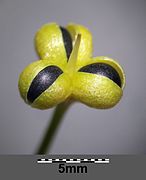 Fruit with seeds.
 -
 Ramsons in a forest.
_d.j.b_07.jpg)
_d.j.b_02.jpg)
_d.j.b_05.jpg)
_-_Bl%C3%BCte.jpg)


See also[edit]
- Allioideae
- Allium tricoccum - North American wild leek (or "ramps", a cognate of "ramsons")
- Allium ampeloprasum - Eurasian broadleaf wild leek
- Allium ochotense
- Allium victorialis
- List of Allium species
References[edit]
- ^ Kew World Checklist of Selected Plant Families
- ^ GRIN-CA Archived 2019-01-12 at the Wayback Machine, Agriculture and Agri-Food Canada
- ^ a b c d e Sobolewska, Danuta; Podolak, Irma; Makowska-Wąs, Justyna (2015). "Allium ursinum: botanical, phytochemical and pharmacological overview". Phytochemistry Reviews. 14 (1): 81–97. Bibcode:2015PChRv..14...81S. doi:10.1007/s11101-013-9334-0. ISSN 1568-7767. PMC 4352197. PMID 25774103.
- ^ Kolosova, Valeria; Svanberg, Ingvar; Kalle, Raivo; Strecker, Lisa; Özkan, Ayşe Mine Gençler; Pieroni, Andrea; Cianfaglione, Kevin; Molnár, Zsolt; Papp, Nora; Łuczaj, Łukasz; Dimitrova, Dessislava (2017-02-21). "The bear in Eurasian plant names: motivations and models". Journal of Ethnobiology and Ethnomedicine. 13 (1): 14. doi:10.1186/s13002-016-0132-9. ISSN 1746-4269. PMC 5320662. PMID 28222790.
- ^ "Ramsons names - Encyclopedia of Life". eol.org. Retrieved 2021-02-17.
- ^ a b "Home". Forager's Calendar. Retrieved 2022-07-28.
- ^ a b Company, The Foraging Course (2022-03-28). "Foraging focus: wild garlic". Foraging Course Site. Retrieved 2022-07-28.
- ^ a b c d e Clapham, A.R.; Tutin, T.G.; Warburg, E.F. (1981). Excursion Flora of the British Isles (Third ed.). Cambridge University Press. ISBN 0-521-23290-2.
- ^ Reader's Digest Field Guide to the Wild Flowers of Britain. Reader's Digest. 1981. p. 383. ISBN 978-0-276-00217-5.
- ^ Stace, C. A. (2010). New Flora of the British Isles (Third ed.). Cambridge, U.K.: Cambridge University Press. ISBN 978-0-521-70772-5.
- ^ "BSBI map Allium ursinum". Botanical Society of Britain and Ireland.
- ^ Sobolewska, Danuta; Podolak, Irma; Makowska-Wąs, Justyna (December 25, 2013). "Allium ursinum: botanical, phytochemical and pharmacological overview". Phytochemistry Reviews. 14 (1): 81–97. Bibcode:2015PChRv..14...81S. doi:10.1007/s11101-013-9334-0. PMC 4352197. PMID 25774103.
- ^ British Wildlife - April 1999 - Francis Rose, Indicators of ancient woodland: The use of vascular plants in evaluating ancient woods for nature conservation, p. 246 Archived 2011-10-05 at the Wayback Machine
- ^ Johannes Seidemann (2005). World spice plants. Springer. p. 27. ISBN 978-3-540-22279-8. Retrieved 13 April 2011.
- ^ Institut Fur Pflanzengenetik Und Kulturpflanzenforschung Gatersleben (COR) (11 May 2001). Mansfeld's Encyclopedia of Agricultural and Horticultural Crops: (Except Ornamentals). Springer. pp. 2251–. ISBN 978-3-540-41017-1. Retrieved 13 April 2011.
- ^ "Wild Garlic – What You Need to Know – Obey Your Hunger".
- ^ "British Cheese Board - Lynher Farms & Dairies: Cornish Yarg". Archived from the original on 2019-04-22. Retrieved 2013-05-06.
- ^ Koch, Ryusei Hosono, Matthias. "Pickled Mountain Garlic Korean Vegetarian Sidedish Recipe ✪ Japanese & Korean Recipes". Asiatischer Foodblog RyuKoch.com. Retrieved 2020-12-29.
{{cite web}}: CS1 maint: multiple names: authors list (link) - ^ Kühn, Marlu; Maier, Ursula; Herbig, Christoph; Ismail-Meyer, Kristin; Bailly, Matthieu Le; Wick, Lucia (2013-02-01). "Methods for the examination of cattle, sheep and goat dung in prehistoric wetland settlements with examples of the sites Alleshausen-Täschenwiesen and Alleshausen-Grundwiesen (around cal 2900 BC) at Lake Federsee, south-west Germany". Environmental Archaeology. 18 (1): 43–57. Bibcode:2013EnvAr..18...43K. doi:10.1179/1461410313Z.00000000017. ISSN 1461-4103. S2CID 140699993.
- ^ Gilotta, Irene; Brvar, Miran (2010). "Accidental poisoning with Veratrum album mistaken for wild garlic (Allium ursinum)". Clinical Toxicology. 48 (9): 949–952. doi:10.3109/15563650.2010.533675. ISSN 1556-3650. PMID 21171854. S2CID 207657813.
- ^ a b Risk of mix-up with bear's garlic - BfR warns pickers about fatal consequences of mistaking free-growing poisonous plants for bear's garlic, German Federal Institute for Risk Assessment; 2005
- ^ Blamey, M.; Fitter, R.; Fitter, A (2003). Wild flowers of Britain and Ireland: The Complete Guide to the British and Irish Flora. London: A & C Black. ISBN 978-1-4081-7950-5.
- ^ Kusak, Josip; Huber, Djuro (1998). "Brown Bear Habitat Quality in Gorski Kotar, Croatia". Ursus. 10: 281–291. ISSN 1537-6176. JSTOR 3873137.
- ^ Nature Spot - Portevinia maculata
- ^ Woodland Trust - Ramsons
External links[edit]

- Tutin, T.G. 1957. Biological flora of the British Isles: Allium ursinum. Journal of Ecology 45(3) pp.1003-1010.
- Ramsons at Gernot Katzer's Spice Pages
 Data related to Allium ursinum at Wikispecies
- "Allium ursinum". Plants for a Future.

| Onion cultivars | |||
|---|---|---|---|
| Onion species | |||
| Onion food | |||
| Garlic cultivars | |||
| Garlic species |
| ||
| Garlic food | |||
| Garlic and onion constituents | |||
| Related |
| ||


| Authority control databases: National |
|---|
