


Songkran (Thailand)
| Songkran | |
|---|---|
 New Year celebration, Rot Nam Dam Hua, a traditional celebration of elders | |
| Official name | Songkran Festival |
| Observed by | Thailand |
| Begins | 13 April |
| Ends | 15 April |
| Date | April 13 |
| Frequency | Annual |
| Related to | South and Southeast Asian solar New Year |
| Songkran in Thailand, traditional Thai New Year festival | |
|---|---|
.jpg) | |
| Country | Thailand |
| Domains | Social practices |
| Reference | 01719 |
| Region | Asia and the Pacific |
| Inscription history | |
| Inscription | 2023 (18th session) |
| List | Representative |

.jpg)


Thai New Year[1]: 802 [2]: 127 or Songkran[1]: 802 (Thai: เทศกาลสงกรานต์, pronounced [tʰêːt.sā.kāːn sǒŋ.krāːn]), also known as Songkran Festival,[3] Songkran Splendours,[2]: 127 is the Thai New Year's national holiday. Songkran is on 13 April every year, but the holiday period extends from 14 to 15 April. In 2018 the Thai cabinet extended the festival nationwide to seven days, 9–16 April, to enable citizens to travel home for the holiday.[4] In 2019, the holiday was observed 9–16 April as 13 April fell on a Saturday.[5] In 2024, Songkran was extended to almost the entire month, starting on the first of April, and ending on the twenty-first, departing from the traditional 3-day format. And with the New Year of many calendars of Southeast and South Asia, in keeping with the Buddhist calendar and also coincides with New Year in Hindu calendar such as Vishu, Bihu, Pohela Boishakh, Pana Sankranti, Vaisakhi. The New Year takes place at around the same time as the new year celebrations of many regions of South Asia like China (Dai people of Yunnan Province), India, Laos, Cambodia, Myanmar, Nepal, and Sri Lanka.
In Siam, New Year is now officially celebrated 1 January. Songkran was the official New Year until 1888, when it was switched to a fixed date of 1 April. Then in 1940, this date was shifted to 1 January. The traditional Thai New Year Songkran was transformed into a national holiday.[6] Celebrations are famous for the public water fights framed as ritual cleansing. This had become quite popular among Thai and foreigners.
Meaning
[edit]Songkran is a Thai word,[7] derived from Sanskrit[8] संक्रान्ति saṅkrānti meaning 'to move', 'movement',[9]: 4 'the passing of'[10] or 'astrological passage'.[11]: 70 It derives from the movement of the sun from one position to another in the zodiac. According to its literal meaning in Sanskrit, a Songkran occurs every month. However, the period that Thai people refer to as Songkran happens when the sun moves from Pisces to Aries in the zodiac.[12] The correct name for this period should actually be Maha Songkran ('great Songkran)[13]: 4 because it coincides with the arrival of a New Year. The Songkran festival is, therefore, a celebration of the New Year in accordance with the solar calendar. The celebration covers a period of three days: 13 April is regarded as Maha Songkran, the day that the sun moves into Aries on the zodiac or the last day of the old year. The next day, 14 April is called Wan Nao, the transitional day between the old and the new years, and 15 April is called Wan Thaloeng Sok (Thai: วันเถลิงศก 'to begin a new era or year'), New Year's day itself.[14]
Computation
[edit]In 1989, the Thai cabinet fixed Songkran at 12–14 April, despite the correct starting date (13 April at 20:57).[15][n 1] Songkran, however, was traditionally computed according to the method described in Suriyayart (Thai: สุริยยาตร์), the Thai version of Surya Siddhanta. The celebration starts when the sun enters Aries according to the sidereal zodiac system. This is called Maha Songkran day[16]: 26 [17]: 236 [9]: 4 (Thai: วันมหาสงกรานต์). The final day marks the new solar year and is called Wan Thaloengsok (Thai: วันเถลิงศก). The astrologers, local or royal, then make predictions about the economy, agriculture, rainfall, and political affairs according to observations between both days.[18] The king, or Chief Royal Astrologer on the monarch's behalf, issued an official notification on the new year to the public. The announcement, called Prakat Songkran (Thai: ประกาศสงกรานต์, Songkran notification), contained the information on Maha Songkran, Thaloengsok, the lunisolar calendar, and religious and royal ceremonies.[19] The government strictly adhered to the announcement and arranged some ceremonies according to the computation made by the royal astrologer.[20][21][n 2]
According to the scripture, 800 years equal 292,207 days.[22][23][n 3] In other words, each solar year lasts 292,207 kammaja (Thai: กัมมัช, lit. one produced by karma), where 1 kammaja equals 108 seconds and 800 kammaja corresponds to 1 solar day. Timekeeping began as Kali Yuga started in 3102 BCE (−3101 CE). At the start of each year, it is possible to compute the number of days since Kali Yuga commenced using the following formula:[24][25]

where , , denote Kali Era, Common Era, and Buddhist Era respectively. is the Suriyayart day number, which can vary according to the calendar era being used. The integer result is the count of days at New Year's Day, while the remainder indicates the time at which the new year begins (in kammaja), measured from the previous midnight.


Owing to a huge day number in the calculation, new calendar eras were devised to solve this problem, including the Minor Era (ME). 0 ME corresponds to 1181 BE, 638 CE or 3739 KE. Following the above equation, it follows that there were 1,365,702 days since the start of Kali Yuga. The remainder of the division suggests that the new year started at 373 kammaja after the previous midnight. This corresponds to 373/800 of a day or 11 hours, 11 minutes, and 24 seconds. In other words, 0 ME started at 11:11:24 on Sunday, 25 March 638 CE in the proleptic Gregorian calendar. The Julian day at the new year is computed according to the following formula:

The number can then be converted back into a date using an algorithm (see Julian day). Maha Songkran day is computed either by a lengthy process or by subtracting by 2.165 days (2 days 3 hours 57 minutes 36 seconds). This can be rewritten as


A solar year lasts 292,207 kammaja or 365.25875 days every year. However, a Gregorian year lasts, on average, 292194 kammaja.[n 4] The difference of 13 kammaja (23 minutes, 24 seconds) accumulates every year, causing the shift of Songkran towards the end of the calendar year.[26] In 1600, 1700, 1800, 1900 and 2000, Maha Songkran was on 7 April 9 April, 10 April 12 and 13 April respectively.
Nowadays the royal palace has ceased to issue the Prakat Songkran, replacing it with a small calendar booklet given to the public on New Year's Day. Government Savings Bank still prints a one-page lunisolar calendar, which is different from the multiple-page solar calendar commonly seen. The calendar features the image of Nang Songkran with her vehicle and subordinates, led by a Chinese zodiac animal holding a flag with Thai script for that zodiac. It also contains a piece of comprehensive information on the correct Songkran day and religious days.[27] Some astrologers, especially in northern Thailand, still issue their own Songkran notification containing predictions and other information.[28] In 2013, the Chiang Mai Provincial Council decided to defy the government-set holiday by rescheduling the ceremony according to the correct calculation.[29]
The following table lists the start and end dates of Songkran festival obtained from the formulae discussed above. The Chinese zodiac for each year is also given since it is also used in Thai astrology. However, the Chinese zodiac in Chinese astrology changes on Lichun, just before the Chinese New Year, in February, while Thai astrology uses the first day of fifth lunar month (roughly the new moon in late–March to early–April).[30][31] Before the cut off date, astrologer uses the zodiac of the last year.
| Year | Chinese zodiac | Maha Songkran Songkran starts |
Thaloengsok Songkran ends |
|---|---|---|---|
| 2019 | Pig | 14 April 2019 15:14:24 |
16 April 2019 19:12:00 |
| 2020 | Rat | 13 April 2020 21:27:00 |
16 April 2020 01:24:36 |
| 2021 | Ox | 14 April 2021 03:39:36 |
16 April 2021 07:37:12 |
| 2022 | Tiger | 14 April 2022 09:52:12 |
16 April 2022 13:49:48 |
| 2023 | Rabbit | 14 April 2023 16:04:48 |
16 April 2023 20:02:24 |
| 2024 | Dragon | 13 April 2024 22:17:24 |
16 April 2024 02:15:00 |
| 2025 | Snake | 14 April 2025 04:30:00 |
16 April 2025 08:27:36 |
| 2026 | Horse | 14 April 2026 10:42:36 |
16 April 2026 14:40:12 |
| 2027 | Goat | 14 April 2027 16:55:12 |
16 April 2027 20:52:48 |
| 2028 | Monkey | 13 April 2028 23:07:48 |
16 April 2028 03:05:24 |
| 2029 | Rooster | 14 April 2029 05:20:24 |
16 April 2029 09:18:00 |
Origin and myths
[edit]The origin of songkran festival lies in a Buddhist folk myth or non canonical jataka related to harvest and spring. In prosperous city of Sukhavati in suvannabhumi, Bodistva was born in the household of a poor farmer. Once upon a time, Indra the king of Devas, looked at the city from heaven, and felt sad seeing the high level of corruption. He found that people did not respect their elders, behaved rudely, and didn't serve them proper food and medicines. They had no compassion to the needy and helpless. No faith in Sila and Uposath but fun in sins, no faith in donation but greedy for wealth, no faith in Dhamma but made business of Dhamma. By seeing decline of Dhamma, he said, "Glory/Siri of humans lies in their faith in Dhamma. There is no Glory without Dhamma." With affirmation of this truth, people in the city immediately lost their glory, no proper rains, water and food scarcity prevailed, extreme drought with skin-burning hot sun waves and dirty bad smelling garbage filled their homes.
To get saved from this suffering, In leadership of bodistva, people prayed to mother earth or Siri. They asked Siri the causes and solutions of their misfortune. Out of compassion and sympathy to her children, she told them the causes and solutions to their sufferings. She told them restoration of their faith in Dhamma will end their suffering. She gave them a divine piece of fertile land, divine seeds, mysterious song for rain and pots divine thanaka powder of several colours to apply on their skin to cool body from hot sun waves. Now, people pleaged to observe sila and upasotha under guidance of bodistva.
Bodistva and his companions started cultivating the divine land, sowing divine seeds. They used to apply several colours of thanaka powder and water is poured to cool their body from heavy sun waves. In few days their crops were grown that was the day when the sun entered aries constellation. They produced adequate grains. At the day of harvest, they washed feets of their elders, saluted them and served delicious food and proper cloths. Donations were made to needy and helpless. Hence, Dhamma was restored by the people.
Same day when Indra the king of devas again looked at the city of SuvannaBhumi. He praised them and said, "Glory of humans lies in their faith in Dhamma, there is no Glory without Dhamma." By affirmation of this truth immediately their lost glory was restored back and the people elected bodistva as their leader and celebrated the harvest day with throwing water on each other and started playing with several colours of thanaka powder by applying it on each other's body.
Thus, in Buddhist community in South East Asia, to remember and celebrate this day, people clean their houses, salute and show respect to their elders by washing their feets, serving delicious food and proper clothing to them. Donations are made to monastery and needy. People play with water and different colours of thanaka powder is applied to each other's body.
According to the Buddhist scripture of Wat Pho, Songkran originated from the death of Kapila Brahma (Thai: กบิลพรหม, romanized: Kabilaphrom, lit. 'reddish Brahma').[32] In the olden days, there was a wealthy man and his neighbor, a drunkard. The drunkard, who had two sons, belittled the rich man for being childless. The rich man was humiliated and beseeched the Sun and the Moon gods to grant him a son. His attempts failed until he offered cooked rice to the tree god living in a banyan tree, who asked Indra to grant the man's wish. The child, named Thammabal (Thai: ธรรมบาล, also Dhammapala, lit. 'one who protects righteousness'), was born.
Thammabal was a clever child who learned three vedas, bird language and also taught people to avoid sin. Kapila Brahma learned of the child and wanted to test the child's cleverness. The god asked, "Where is the glory of men (sri) located in the morning, during the day, and in the evening?". The loser would have his head chopped off. The boy thought in vain for six days, but could not find a solution to the riddles. He lay beneath a sugar palm tree and overheard a conversation between a pair of eagles who planned to eat his corpse when he lost the bet. The female eagle asked her mate whether he knew the answer. He answered, "In the morning, the sri appears on the face, so people wash their faces every morning. At noon, the sri is at the chest where people spray perfume every noon. In the evening, the sri goes to the feet, so people wash their feet every evening." Thmmabal memorized the answer and gave it to Kapila Brahma the next day. Having lost, Kapila Brahma summoned his seven daughters and told them that he must cut his head off. However, if his head fell to earth, it would create an inferno that would engulf the world. If his head was thrown into the air, the rains would stop. And if his head was dropped into the ocean, all seawater would dry up. To prevent these calamities, he told his daughters to place his head on an elevated phan. Thungsa, his eldest child, stored her father's head in the cave in Mount Kailash.[14]
Every year when the Sun enters Aries, one of Kapila Brahma's children, called the Nang Songkran (Thai: นางสงกรานต์, lit. 'Lady Songkran') for that year, and other angels form a procession. One of them takes the phan with Kapila Brahma's head. The lady stands, sits, reclines or sleeps on the back of the animal depending on the time. From the dawn to midday, the lady will stand on the back of her conveyance. After midday until the sunset, she will sit down. Between the sunset and midnight, the lady lies down on her vehicle but leaves her eyes open. After midnight, she sleeps.[25] These postures and other details were previously drawn as part of the Prakat Songkran and now as part of the lunisolar calendar. The procession lasts for 60 minutes around Mount Meru. This is subsequently called Maha Songkran to distinguish from other Songkran that occur when the Sun moves from one to another zodiac. For simplicity, the name was later shortened as Songkran.[33][34]
The following table lists the names and characteristics of Nang Songkran, which vary according to which day of the week Maha Songkran falls on in each year.
| Day of Week and corresponding colour | Name | Flower | Jewellery stone | Food | Right hand | Left hand | Conveyance |
|---|---|---|---|---|---|---|---|
| Sunday | Dungsha Devi/Thungsa Thewi | Pomegranate flowers | Ruby | Fig | Discus | Conch | Garuda |
| Monday | Gōrāgha Devi/Khorakha Thewi | Cork tree flowers | Moonstone | Oil | Sword | Staff | Tiger |
| Tuesday | Rākshasa Devi/Raksot Thewi | Lotus flower | Agate | Blood | Trident | Bow | Pig |
| Wednesday | Maṇdā Devi/Mantha Thewi | Champak flowers | Cat's eye | Butter | Stylus | Staff | Donkey |
| Thursday | Kiriṇī Devi/Kirini Thewi | Magnolia | Emerald | Nuts and sesame seeds | Hook | Bow | Elephant |
| Friday | Kimidā Devi/Kimitha Thewi | Water lilies | Topaz | Banana | Sword | Lute | Buffalo |
| Saturday | Mahodharā Devi/Mahothon Thewi | Water hyacinth flowers | Blue sapphire | Hog deer meat | Discus | Trident | Peacock |
New year traditions
[edit]In De Beschryving van Japan (The History of Japan) handwrote in 1690 by Engelbert Kaempfer in reign of King Phetracha of Ayutthaya Kingdom said of Songkran in old-17th century Dutch :-
De Siamiten vieren den ecrſtcn en vyſtienden dag der maand, zynde de dagen der nieuwe en volle maan. Sommige gaan ook op den cerſtcn dag van de kwartier maanen na de Pagoden, 't welk eeniger maaten overeenkomt met onzen Zondag. Behalven deze hebben zy fommige jaarlykſche plechtige Feeſtdagen, by voorbeeld een in ’t begin van 't jaar, genaamt Sonkraen, ..."[35]
(Translation): "Every first day and 15th day of month, Siamese people had celebration as the first day of new moon and the 15th day of full moon. Some Siamese people went to temple at the first day of the week which was similar to our Sunday—Holy Communion. There were also many annual ceremonies, such as Siamese New Year celebration called Songkran (Sonkraen), ..."
— Engelbert Kaempfer (Handwrote in 1690), De beschryving van Japan. (Translated in 1727 by John Gaspar Scheuchzer).
In the reign of King Borommakot (1733–58), there was recorded of ancient royal ceremonies of Siamese New Year observance called Maha Songkran Day, the tradition-inherited from past generations of King of Ayutthaya Kingdom such ceremonies as, royal forming of sand stupa with royal ornaments, sprinkling the water onto the statues of Buddha and graven images, offering food to monks, procession of sand stupas parade to temples, royal musical fanfares, and also establishing the almshouse assignment subsequently, said in the Concise Royal Chronicle of Ayutthaya Kingdom of royal forming the sand stupa in the reign of King Borommakot:-
อนึ่งเมื่อครั้ง (แผ่นดิน) สมเด็จพระพุทธเจ้าหลวงในพระบรมโกศนั้น ครั้นวันขึ้นปีใหม่โหรถวายฤกษ์เป็นวันมหาสงกรานต์ เจ้าพนักงานได้ก่อพระทรายหน้าพระวิหารหลวงวัดพระศรีสรรเพ็ชญ์...และเครื่องราชวัติฉัตรธงเครื่องประดับพระทรายนั้น เจ้าพนักงานได้เบิกสิ่งของให้แก่ช่างเขียนทำ และพระทรายนั้นช่างเขียนได้ตัด [เขียนตัดเส้นระบายสี หรือตัดพระทรายให้เป็นรูปทรง] ครั้นรุ่งขึ้นเพลาเช้าวันมหาสงกรานต์ ล้นเกล้าล้นกระหม่อมเสด็จไป ณ พระวิหารใหญ่ด้วย [พระวิหารหลวงวัดพระศรีสรรเพ็ชญ์ หลังกลาง] นิมนต์พระสงฆ์ราชาคณะอธิการวัด ได้ฉัน ณ พระวิหารใหญ่ฉลองพระทราย และที่พระ(ทราย)มหาธาตุและพระทรายบริวารนั้น วิเศษแต่งเทียนและบายศรี (มี) เทียนทองคำขวัญบูชาพระทรายองค์ละสำรับ ครั้นเสร็จ (งาน) พระทรายที่วัดพระศรีสรรเพ็ชญ์แล้วรุ่งขึ้นเป็นวันเนา เจ้าพนักงานจึงเอาทรายและเตียงเข้าไปให้ล้นเกล้าล้นกระหม่อมทรงก่อพระทราย ณ พระที่นั่งทรงปืน...ทรงก่อแล้วพนักงานยกพระทรายออกให้ช่างเขียนตัด และเครื่องประดับพระพรายนั้นให้เจ้าพนักงานปิดทองอังกฤษประดับ และช่าง [ช่างเขียน] เขียนทำประดับประดาพระทราย แล้วยกเข้าไปตั้งไว้ ณ พระที่นั่งทรงปืน ครั้นรุ่งขึ้นเพลาเช้าวันเถลิงศกเสด็จ ฯ ออกฉลองพระเจดีย์ทราย เตียงยกพระที่นั่งทรงปืน พระสงฑ์ฉันเสร็จแล้ว เจ้าพนักงานยกพระทรายออกมาตั้งไว้ ณ ศาลาลูกขุนท้ายสระ พันพุฒ พันเทพราช พันจันท์ เกณฑ์เครื่องเล่นและคู่แห่เดินเท้าและม้า ปี่กลองชนะ ธงสามชาย ปีกลองมลายู ปี่กลองจีนแห่พระทรายไปไว้ ฯ วัดวรโพธิ์ วัดพระราม วัดมงคลบพิตร (เป็น) อย่างธรรมเนียมสืบมาแต่ก่อน (ดังนี้)[36]
(Translation): After the royal ceremony of Phra Sai at Wat Phra Si Sanphet, the next day was Wan Nao. The royal officials offered the sands and a big tray to the Majesty King to form the sand in the shape of stupa (Phra Sai) with five hollow spears of the sky at the Song Peun Throne Hall. The royal officials moved King’s sand stupa (Phra Sai) to the painter for decorating the British gold on it and the royal officials then moved it to place at the Song Peun Throne Hall. After the Buddhist monks had already eaten their morning meals, the royal officials moved to move (Phra Sai) King’s sand stupa (Phra Sai) to place in the pavilion “Lukkhun Thai Sara”. The three colonels named Put, Thep Rat and Chan marched the parade with the pairs of flocks by walking and riding the horses. The royal officials produced melodies with the flutes and victory drums, Malaya drum and Chinese drums and took three jagged-edge flags in the parade to move King’s sand stupa (Phra Sai) to Wat Worapho, Wat Pra Ram and Wat Mongkol Bophit as the inherited tradition.[37]
— The Concise Chronicle Chapter 69 of Krung Sri Ayutthaya Part I, recorded in 1783 Year of Rabbit, the 2nd year in the reign of King Rama I, Rattanakosin era.
There was a contemporary archive mentioned Songkran festival of Siam in reign of King Mongkut. The archive written in 1854 by Jean-Baptiste Pallegoix, a priest of the Société des Missions Etrangères who was assigned as Coadjutor Vicar Apostolic and lived in Siam. Said in French:-
Ils ont en outre, durant le cours de l’année, plusieurs jours de fêtes civiles ou religieuses, qu’ils célèbrent avec grande pompe : 1°Songkran; c’est leur nouvel an, qui tombe ordinairement dans leur cinquième mois; on le célèbre pendant trois jours; ce n’est qu’à cette époque que le peuple apprend des astro-logues, si l’ange de l’année monte un tigre, un bœuf, un ours, un cheval; une chèvre, un dragon ou quelque autre animal.[38]
(Translation): "During the year, Siamese also have several days of civil or religious festivals, which they celebrate with great splendor: 1°Songkran; it is Siamese New Year, which usually falls in April (fifth month in brahman calendar); it held an observance for three days; Siamese people's able to acknowledge horoscope from astrologers whether the angel of the year to ride a tiger, an ox, a bear, a horse, a goat, a dragon or other animals during the this festival only."
— Jean-Baptiste Pallegoix, Description du Royaume Thai ou Siam. (1854).
The Songkran celebration is rich with symbolic traditions. Mornings begin with merit-making. Visiting local temples and offering food to the Buddhist monks is commonly practiced. On this specific occasion, performing water pouring on Buddha statues and the young and elderly is a traditional ritual, representing purification and the washing away of one's sins and bad luck.[12] As a festival of unity, people who have moved away usually return home to their loved ones and elders. Paying reverence to ancestors is an important part of Songkran tradition.
The holiday is known for its Water Festival. Major streets are closed to traffic, and are used as arenas for water fights. Celebrants, young and old, participate in this tradition by splashing water on each other. Traditional parades are held and in some venues "Lady Songkran" or "Miss Songkran" is crowned,[39] where contestants are clothed in traditional Thai dress. For the general public, floral shirt or Hawaiian shirt is a popular clothing item worn during this festival.[40]
-
 Water fights along the west moat, Chiang Mai, Thailand
 -
 Songkran at Wat Thai, Los Angeles
 -
 Songkran symbolic sand pagodas in temple, Wat Phu Khao Thong, Ban Maenam, Koh Samui
 -
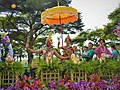 Group of Thai traditional dancer in Songkran festival, Bangkok
 -
 Lady Songkran parade at Songkran festival, Bangkok
 -
 Lady Songkran parade at Songkran festival, Bangkok


.jpg)
.jpg)
.jpg)
In Thailand
[edit]

.jpg)

Central Region: people in this region clean their houses when Songkran approaches. All dress up in colorful clothing or Thai dress. After offering food to the monks, people will offer a requiem to their ancestors. People make merit offerings such as giving sand to the temple for construction or repair. Other forms of merit include releasing birds and fish. Nowadays, people also release other kinds of animals such as buffaloes and cows. Phra Pradaeng hosts traditional ceremonies of Mon people such as parades in the colourful traditional outfits and folklore performances.[41]
South: southerners have three Songkran rules: Work as little as possible and avoid spending money; do not hurt other persons or animals; do not tell lies.
North: on 7 April, Baan Had Siew in Si Satchanalai District hosts the'Elephant Procession Ordination' event with a colourful parade where men dressed in the traditional clothes are taken to the temples on elephants.[42] In northern Thailand 13 April is celebrated with gunfire or firecrackers to repel bad luck. On the next day, people prepare food and useful things to offer to the monks at the temple. People have to go to temple to make merit and bathe Buddha's statue and after that they pour water on the hands of elders and ask for their blessings.
East: the eastern region has activities similar to the other part of Thailand, but people in the east always make merit at the temple throughout all the days of the Songkran Festival and create sand pagodas. Some people, after making merit at the temple, prepare food to be given to the elderly members of their family.
The Capital (Bangkok): the Khao San Road and Silom Road with Siam Square[43] are the hubs for modern celebration of Songkran. The roads are closed for traffic, and posts equipped with water guns and buckets full of water. The party runs day and night.[44]
At the festival of Songkran, which marks the beginning of the old Siamese solar year, it is the custom to bathe the images of the Buddha and also the monks and old people. The young folk make this an occasion for throwing water over each other amidst much fun and laughter.[45]: 125 [46]: 133
— Peter Anthony Thompson B.A., A.M., I.C.E., Late of The Royal Survey Department, Siam., Lotus Land: Being an Account of the Country and the People of Southern Siam, July 1906.
Elsewhere
[edit] | This section needs additional citations for verification. (April 2022) |
Songkran is celebrated by the Malaysian Siamese community, particularly in the states of Kedah, Kelantan, Penang, Perak, Perlis and Terengganu where most Siamese are located.[47][48]
Pana Sankranti (Odia: ପଣା ସଂକ୍ରାନ୍ତି), also known as Maha bisuba Sankranti, is the traditional new year day festival of Buddhists and Hindus in Odisha, India.
The festival is celebrated as Sangken in northeastern areas of India and as Bizu, Boisuk, Shangrai, and Boisabi in the Chittagong Hill Tracts of Bangladesh, which is the traditional New Year's Day by the indigenous Hindu people and Buddhist community. The Sangken festival is celebrated by the Tai people — Khamti people Khamyang, Phake and Turung people. The festival is also celebrated by Singpho, Tikhak (Tangsa) and Duoniya people. Sangken generally falls in the month of 'Naun Ha', the fifth month of the year of the Tai Lunar calendar coinciding with the month of April. It is celebrated in the last days of the old year and the lunar new year begins on the day just after the end of the festival.
Vishu, a Hindu religious festival, celebrated mainly in the South Indian State of Kerala (and some parts of Tamil Nadu), also falls during the same timeframe. It is predominantly a harvest festival.
In some villages in south India, especially Karnataka, a festival called "Okhali" or "Okhli" is celebrated in which every household keeps a barrel of water mixed with chalk and turmeric to throw on passers-by. The date of Okhali coincides with that of Songkran in Thailand and Thingyan in Myanmar, not with the dates of Holi, which is a north Indian festival.
In Japan, Songkran festival observance held along with the Hot Spring festival, Beppu Hatto Onsen Matsuri, in Beppu city, Ōita Prefecture, called Beppu Songkran Festival,[49] not only water-splashing observance but also Thai cultural fanfares occurred, and also held at the world's wettest music festival, S2O Japan Songkran Music Festival.[50] It's combination of Thai-Japan culture and depiction of long time relation of each other.
Songkran is celebrated annually on the U.S. territory of Wake Island by Air Force members and American and Thai contractors,[51] including New York State for commemorating the Asian American community's celebration of Songkran on April as an important cultural event on the state according to Assembly Resolution No. 1059.[52]
In other calendars
[edit]Songkran occurs at the same time as that given by Bede for festivals of Ēostre—and Easter weekend occasionally coincides with Songkran (most recently 1979, 1990, and 2001, but not again until 2063[53]).
Controversies
[edit]Roadway fatalities
[edit]Police statistics show that the death toll from road accidents doubles during the annual Songkran holiday. Between 2009 and 2013 there were about 27 road deaths per day during non-holiday periods and an average of 52 road deaths per day during Songkran. Thailand has among the highest traffic fatality rates in the world, along with Liberia, Congo, and Tanzania. Approximately 70–80 percent of the accidents that occur during the long holiday period are motorcycle accidents.[54] About 10,000 people per year die in motorcycle accidents.[55]
The National Council for Peace and Order (NCPO) says a total of 110,909 people were arrested and 5,772 vehicles impounded at road safety checkpoints across the country between 9–16 April 2016.[56] In 2018 the number of offenders arrested at 2,029 checkpoints had risen to 146,589. Of these, 39,572 had failed to wear crash helmets and 37,779 carried no driving licence.[54] Reacting to the numbers, the prime minister "ordered stricter enforcement of the law"; the interior minister said he would "propose greater efforts in raising awareness as an additional measure, insisting that traffic laws were [already] strictly enforced"; and deputy prime minister Prawit Wongsuwan said he would "work harder to ensure motorcyclists wore helmets".[57]
This period is known locally as "7 dangerous days".[58]
| Date | Accidents | Deaths | Injuries | Source |
|---|---|---|---|---|
| 11–17 Apr 2018 | 3,724 | 418 | 3,987 | [54] |
| 2017 | 3,690 | 335 | 3,506 | [59] |
| 11–17 Apr 2016 | 3,447 | 442 | 3,656 | [60][61] |
| 2015 | 3,373 | 364 | 3,559 | [61] |
| 11–17 Apr 2014 | 2,992 | 322 | 3,225 | [61] |
Arrests
[edit]- Police arrested a British tourist in Chiang Mai on the first day of the 2016 Songkran holiday, 13 April, for violating the junta's ban on indecent dress. In a water fight the culprit was topless, wearing only short pants, but no shirt. He was taken into custody, fined 100 baht, then released. Temperatures in Chiang Mai reached 41 °C that day.[62]
- A man was arrested during Songkran 2016 for posting a video of a topless woman dancing during the 2015 Songkran festival. Police said Jakkrapatsorn Akkarapokanan, 29, was charged under the Computer Crime Act for posting the year-old video of a woman rolling up her wet shirt to let revelers touch her breasts. Jakkrapatsorn was released on a 100,000 baht bond. Police said they attempted to find the topless woman in the video to fine her 500 baht for indecency, but the one year statute of limitations had expired.[63]
Intellectual property
[edit]Celebrate Singapore
[edit]In 2014, "Celebrate Singapore," a large two-day Songkran-style water festival,[64] was planned for Singapore and the event was promoted as the "largest water festival party in Singapore." However, controversy emerged when the Tourism Authority of Thailand (TAT) Deputy Governor for Tourism Products, Vilaiwan Twichasri, claimed that Thailand holds exclusive rights to celebrate Songkran and planned to consult with officials at the Department of Intellectual Property, Ministry of Commerce and Ministry of Culture to discuss a potential lawsuit. The Deputy Governor's view was supported by numerous Thai citizens on social media websites.[65] Chai Nakhonchai, Cultural Promotion Department chief, pointed out that Songkran is a traditional festival shared by many countries throughout Southeast Asia, while historian Charnvit Kasetsiri stated that no single nation can claim ownership of a tradition.[66] On 25 March 2014, the Bangkok Post reported that the Singaporean government had intervened in the festival's content and there would be no water-throwing, no water pistols and no public drinking. The festival was also reduced to a one-day event.[67]
See also
[edit]- Holi – an Indian holiday famous for its ritualized street celebrations with colored powder
Notes
[edit]- ^ The cabinet later fixed this issue by shifting the holiday by one day to 13–15 April, which is still in use today.
- ^ In 1896, for example, the ceremony started on 12 April. According to Suriyayart, the sun entered Aries at 19:30 on 12 April. The main ceremony started one day later, possibly due to difficulties organizing the ceremony at the exact time. In 1949, Maha Songkran was on 13 April at 12:35 and the ceremony started that day.
- ^ According to Deva Sastri, Bapu (1861). "Translation of the Surya Siddhanta" (PDF). C B Lewis and the Baptist Mission Press, Calcutta. Sloka 37, there are 1,577,917,828 solar (or terrestrial, as the translator chose) day within one great Yuga, or eon. There are four yugas, or periods, within the aeon. All of them spans 4,320,000 solar years (Sloka 15–16). It follows that 800 solar years correspond to 292,207 days.
- ^ Julian year lasts 292,200 kammajas on average
References
[edit]- ^ a b Ach Vidyagama (George Bradley McFarland), Phra. (1944). "สงกรานต์", Thai-English Dictionary. CA, United States: Stanford University Press. 1,058 pp. ISBN 978-080-4-70383-3
- ^ a b Glen Lewis. (2007). "Thai tourism take 1: a land of diversity and refinement", Virtual Thailand The Media and Cultural Politics in Thailand, Malaysia and Singapore (Rethinking Southeast Asia). NY, United States: Routledge, Taylor & Francis Group (T&F Informa plc.). 241 pp. ISBN 978-0-415-36499-7. "April 'Songkran Splendours' (Thai New Year, nationalwide)"
- ^ Anuman Rajadhon (Yong Sathirakoses), Phraya. (1956). Loy Krathong and Songkran Festival. Bangkok: National Culture Institute Thailand. p. 13. "SONGKRAN FESTIVAL Of all the feasts and festivals in Thailand which are many..."
- Ministry of Education Thailand, Office of the National Culture Commission. (1989). Thai Culture: Songkran Festival. Bangkok: Ministry of Education Thailand. 33 pp.ISBN 978-974-7-90326-3, 974-790-326-1. "Songkran Festival " issued by the Office of the National Culture Commission is the third of its series . The aim of this cultural kit is to present Thai culture to the general public and thereby to create mutual understanding"
- ^ "'Songkran Festival' extended to five-day holiday". The Nation. 27 February 2018. Archived from the original on 14 April 2018. Retrieved 15 April 2018.
- ^ "Thai Government Approves Extra Day for Songkran 2019". Chiang Rai Times. 13 February 2019. Archived from the original on 26 March 2019. Retrieved 15 February 2019.
- ^ Melton, J. Gordon (2011). Religious Celebrations: An Encyclopedia of Holidays, Festivals, Solemn Observances, and Spiritual Commemorations. ABC-CLIO. p. 825. ISBN 978-1-59884-205-0.
- ^ V. S. Bhaskar, Government of Assam, India. (2009). "Festivals: Songkran", Faith & Philosophy of Buddhism. New Delhi, India: Kalpaz Publications. 312 pp. pp. 261-262. ISBN 978-817-8-35722-5. "Songkran is a Thai word which means 'move'..."
- Taipei City Government, Taiwan (ROC). (2008). Teipei: 2008 Yearbook. [臺北市年鑑2008-英文版 (In Chinese)]. Taipei: Taipei City Government Editorial Group. 386 pp. ISBN 978-986-0-14421-5. p. 269. "(Songkran) is in April, and Thai people celebrate their new year by splashing water at each other, hence the Thai name Songkran, i.e., "Water Splashing Festival."
- Rooney, Dawn F. (2008). Ancient Sukhothai: Thailand's Cultural Heritage. Bangkok: River Books Press. 247 pp. ISBN 978-974-9-86342-8. p. 36. "'Songkran' is a Thai name that derives from a Sanskrit word meaning 'to move to', a reference to the sun's movements.
- Komlosy, A. (2002). Images Of The Dai : The Aesthetics Of Gender And Identity In Xishuangbanna. [Doctoral Dissertation, University of St. Andrews]. University of St. Andrews Research Repository. 'https://hdl.handle.net/10023/7293'. p. 334. "The term Songkran is a Thai word meaning to move, here it refers to the Sun which moves into the sign of Aries at this time of the year". pp. 334–335. "The Thai term Songkran is now used by many Southeast Asia specialists to refer to the New Year festival held in many countries, including Myanmar, Laos and China."
- "Songkran" (noun) in Oxford English Dictionary (Online). Retrieved on 17 April 2024.
- Anouska Komlosy. "Procession and Water Splashing: Expressions of Locality and Nationality during Dai New Year in Xishuangbanna: Songkran", The Journal of the Royal Anthropological Institute, 10(2). (2004, June). London: Royal Anthropological Institute of Great Britain and Ireland. JSTOR #i370994. p. 357. "The term Songkran is a Thai word meaning ' to move ' , and it refers here to the Sun, which moves into the sign of Aries at this time of the year."
- Prakong Nimmanahaeminda, Academy of Arts, Royal Society of Thailand. "Myth and Ritual : A Study of the Songkran Festival", The Journal of The Royal Society of Thailand, 29(1–2), (2004, January–March). pp. 345–350. "Songkran is a Thai word which means of movement."
- Malaysia, Jabatan Perpaduan Negara Dan Integrasi Nasional (JPNIN). (1985). Festivals and religious occasions in Malaysia. (First series). Kuala Lumpur: The National Unity Department of Malaysia, Prime Minister's Dept. 36 pp. p. 26. "‘SONGKRAN’ is a Traditional New Year of the Thai people and this day normally fulls in the month of April. 'SONGKRAN' is a Thai word meaning change of exchange."
- Sir. Philip John Newling Ward, Maj. Gen. (1974). "THE SONGKRAN FESTIVAL", Bangkok: Portrait of a City. Cambridge, United Kingdom: The Oleander Press. 136 pp. p. 111. ISBN 978-090-2-67544-5. "Thai word ' Songkran ' literally means a move or change".
- James Hastings, John Alexander Selbie, Louis Herbert Gray. (1912). "FESTIVALS AND FACTS (Siamese)", Encyclopaedia of Religion and Ethics Vol. 5. New York: Charles Scribner's Sons. p. 886.
- ^ Oxford Business Group (OBG). (2011). "Water wars: The traditional Thai New Year includes some playful activities", The Report: Thailand 2012. (n.p.): Oxford Business Group. 268 pp. p. 260.ISBN 978-190-7-06563-7
- Monier-Williams, Monier (1899). "Saṃkrānti". A Sanskrit-English Dictionary: Etymologically and Philologically Arranged with Special Reference to Cognate Indo-European Languages. Oxford: Clarendon Press. OCLC 685239912.
- ^ a b Office of the National Culture Commission. (1989). Thai Culture: Songkran Festival Cultural Kit No. 3. Bangkok: Ministry of Education Thailand. 33 pp. ISBN 978-974-7-90326-3
- ^ Epstein, N., and Arvigo, R. (2021). Spiritual Bathing: Healing Rituals and Traditions from Around the World (eBook). (n.p.): Echo Point Books & Media, LLC. 192 pp.
- ^ Bartlett, S. (2015). Spellcraft for a Magical Year: Rituals and Enchantments for Prosperity, Power, and Fortune. United States: Quarto Publishing Group USA. 224 pp. ISBN 978-162-7-88297-2
- ^ a b "The magic and traditions of Thai New Year (Songkran)". Tourism Authority of Thailand Newsroom. Archived from the original on 5 April 2014. Retrieved 12 December 2015.
- ^ Corness, I. (2015). "Songkran", Farang: Thailand through the eyes of an ex-pat (eBook). Dublin, Ireland: Maverick House. 240 pp. ISBN 978-190-5-37977-4
- ^ a b Nimmanahaeminda, Prakong (April–June 2004). "Myth and Ritual : A Study of the Songkran Festival" (PDF). The Journal of the Royal Institute of Thailand. 29 (2): 345–350. Retrieved 5 August 2018.
- ^ ราชกิจจานุเบกษา, ประกาศสำนักนายกรัฐมนตรี เรื่อง กำหนดเวลาทำงานและวันหยุดราชการ (ฉบับที่ ๑๙) พ.ศ. ๒๕๔๐, เล่ม ๑๑๔, ตอนที่ ๒๖ ง, ๑ เมษายน ๒๕๔๐ (Cabinet notification on workdays and holidays, 1997)
- ^ Yavaprapas, S., Ministry of Culture (Thailand). (2004). Songkran Festival. (2nd Ed.). Bangkok: Prachoomthong Printing Group Co., Ltd. ISBN 978-974-7-10351-9
- ^ Crump, William D. (2016). "Thailand", Encyclopedia of New Year's Holidays Worldwide. NC, United States: McFarland & Company, Inc., Publishers. 319 pp. ISBN 978-147-6-60748-1
- ^ เสมเสริมสุข, บาง (1961). ตำราพรหมชาติ ฉบับหลวง. สำนักงานลูก ส. ธรรมภักดี.
- ^ For example, ราชกิจจานุเบกษา, ประกาศสงกรานต์ ร.ศ. ๑๑๐ พ.ศ.๒๔๓๔, เล่ม ๘, ๑๒ เมษายน ๒๔๓๔ (1891 Notification on Songkran)
- ^ ราชกิจจานุเบกษา, พระราชพิธีเผด็จศกสงกรานต์, เล่มที่ ๑๖, ๑๖ เมษายน ๒๔๔๒, หน้า ๓๕ (Songkran and cutting off the year ceremony in 1899)
- ^ ราชกิจจานุเบกษา, กำหนดการพระราชพิธีสงกรานต์ พ.ศ.๒๔๙๒, ตอนที่ ๒๒, เล่ม ๖๖, ๑๒ เมษายน ๒๔๙๒ (Songkran royal ceremony schedule, 1949)
- ^ Burgess, James (1893). "ART.XVIII. Notes on Hindu Astronomy and the History of our Knowledge of it". Journal of the Royal Asiatic Society. 25 (4). Cambridge University: 717–761. doi:10.1017/S0035869X00022553. S2CID 163252270.
- ^ Deva Sastri, Bapu (1861). "Translation of the Surya Siddhanta" (PDF). C B Lewis and the Baptist Mission Press, Calcutta.
- ^ มนเทียรทอง, เอื้อน; ทองเนียม, บุนนาค. พระคัมภีร์สุริยยาตร์ศิวาคม. สำนักโหรหอคำ. (Aeur Montianthong and Bunnak Thongniam's Suriyayat Sivakom for Computer Users, in Thai)
- ^ a b สุริยาอารักษ์, สิงห์โต. เรื่องฤกษ์และการให้ฤกษ์ ดวงพิชัยสงคราม. เขษมบรรณกิจ. (Singto Suriya-arak's How to and how not to set the ceremonial time and how to compute a detailed Suriyayart natal chart, in Thai)
- ^ Chunpongtong, Loy (October 2012). "Discrepancies in Songkran Days: A Mathematical Research (ความคลาดเคลื่อนของวันสงกรานต์: ผลวิจัยเชิงคณิตศาสตร์)". 37 (4).
{{cite journal}}: Cite journal requires|journal=(help) - ^ "ปฏิทินสงกรานต์". Kom Chad Luek. 10 April 2014. Retrieved 30 December 2017.
- ^ "สกู๊ปหน้า 1… หนังสือปีใหม่เมืองล้านนา". Chiang Mai News.
- ^ บัวคลี่, บัณรส (8 April 2013). "เลื่อนวันดำหัวผู้ว่าเชียงใหม่ : ท้องถิ่นนิยมใต้อำนาจรวมศูนย์". Archived from the original on 30 December 2017. Retrieved 30 December 2017.
- ^ การผูกดวงวางลัคนา. ชมรมพยากรณ์ศาสตร์. 2004. (On the Formation of Thai Natal Chart)
- ^ "การเปลี่ยนปีนักษัตร". 7 February 2012. Retrieved 30 December 2017.
- ^ วิริยบูรณะ, อุระคินทร์ (1 April 1960). พรหมชาติ ฉบับหลวง. สำนักงาน ลูก ส. ธรรมภักดี. pp. 512–513
- ^ Suksawat, Saranya (n.d.). "Happy New Year Songkran Festival". Thaiways. Archived from the original on 9 February 2018. Retrieved 14 April 2018.
- ^ "Legendary of Songkran lady (Nang Songkran)". Songkran Festival. Retrieved 14 April 2018.
- ^ Engelbert Kaempfer, John Gaspar Scheuchzer and Sir Hans Sloane. (1727). De beschryving van Japan. Door ENGELBERT KÆMPFER, M.D. Geneesheer van bet Hollandſche... (Translated by John Gaspar Scheuchzer). Netherlands: Gosse en J. Neaulme. 550 pp. p. 29. "Behalven deze hebben zy fommige jaarlykſche plechtige Feeſtdagen, by voorbeeld een in ’t begin van 't jaar, genaamt Sonkraen, een ander Kitimbac genoemt, ook wel ..."
- ^ The Fine Arts Department of Thailand. (1969). "เริ่มก่อพระทรายครั้งรัชกาลสมเด็จพระเจ้าบรมโกศตอนปลายกรุงศรีอยุธยาตามที่บันทึกไว้เมื่อปีเถาะ พ.ศ. ๒๓๒๖ ปีที่ ๒ ในรัชกาลที่ ๑ กรุงรัตนโกสินทร์". The Concise Chronicle Vol. 43. (The Concise Chronicle Chapter 69-70) of Krung Sri Ayutthaya Part I, Nakhon Champassak, and story of Khun Borom. [ประชุมพงศาวดาร เล่มที่ ๔๓ (ประชุมพงศาวดารภาคที่ ๖๙-๗๐) เรื่องเกี่ยวกับกรุงเก่าตอนที่ ๑ เรื่องเมืองนครจำปาศักดิ์ และเรื่องขุนบรมราชา (in Thai)]. Bangkok: Kuru Sa Pha. pp. 3–6.
- Office of Literature and History. (1999). The Concise of The Royal Chronicle of Thailand Celebrating Golden Jubilee Vol. 5 [ประชุมพงศาวดารฉบับกาญจนาภิเษก เล่ม ๕ (in Thai)]. Bangkok: Kuru Sa Pha Lat Phrao. pp. 138–142.
- The Concise Chronicle Vol. 69 of Krung Sri Ayutthaya Part I. Re distributed in royal cremation of Col. Phraya Phiriyawichai (Pheap Suwannin) on 22 June 1938 at Makut Kasattriyaram Ratchaworawihan temple. Bangkok: Phra Chan. pp. 2–5.
- ^ Ministry of Culture Thailand, Department of Cultural Promotion. (2021). Songkran Tradition. Bangkok: The Agricultural Co-operative Federation of Thailand Ltd. p. 82. ISBN 978-616-543-698-4
- ^ Jean-Baptiste Pallegoix. (1854). Description du Royaume Thai ou Siam. Lagny, France: Vialat et Cie. p. 249. "Ils ont en outre, durant le cours de l’année, plusieurs jours de fêtes civiles ou religieuses, qu’ils célèbrent avec grande pompe : 1°Songkran; c’est leur nouvel an, qui tombe ordinairement dans leur cinquième mois; on le célèbre pendant trois jours; ce n’est qu’à cette époque que le peuple apprend des astro-logues, si l’ange de l’année monte un tigre, un bœuf, un ours, un cheval; une chèvre, un dragon ou quelque autre animal."
- ^ Chadchaidee, Thanapol (1994). Essays on Thailand. D.K. Today Co., Ltd. ISBN 974-834-824-5.
- ^ Jaikusol, Warapun (18 April 2023). "Floral shirts hot again for Songkran festival week". Pattaya Mail. Retrieved 15 April 2024.
- ^ "Songkran". rove.me. 2 November 2022.
- ^ "Thailand Grand Songkran Celebrations". Tourism Authority of Thailand. 4 April 2018.
- ^ "SONGKRAN IN SIAM SQUARE". Novotel. 15 April 2015.
- ^ "Songkran, everything you need to know about Thailand's famous new year water fight". South China Morning Post.
- ^ Thompson, Peter A. (1906). Lotus Land: Being an Account of the Country and the People of Southern Siam. London: T. Werner Laurie. 312 pp.
- ^ Thompson, Peter A. (1910). "The Brotherhood of the Yellow Robe", Siam: An Account of the Country and the People, Vol 16. Boston, MA: J. B. Millet Company. 330 pp.
- ^ Lee, Edmund (13 April 2017). "Five million Malaysians celebrate Songkran and Good Friday". The Sun Daily. Retrieved 14 April 2018.
- ^ Nor Ain Mohd Radhi (12 April 2018). "Najib wishes Happy Songkran to Malaysian Siamese". New Straits Times. Retrieved 14 April 2018.
- ^ Public relations news of Beppu Songkran Festival (PR No. 23/2566). Royal Thai Consulate General Fukuoka. (29 March 2023). Retrieved on 20 April 2024.
- ^ Shobunsha Publications. (2019). Mappuru shutoken-hatsu 《まっぷる 首都圏発》 [Mapple from the metropolitan area]. Tokyo: Shobunsha. p 121. ISBN 978-439-8-28865-3
- ^ Captain Anastasia Schmidt (19 April 2017). "Air Force members celebrate Thai New Year and Water Festival at Wake Island". Joint Base Elmendorf-Richardson. 11th Air Force Public Affairs. Retrieved 20 April 2017.
- ^ "Commemorating the Asian American community's celebration of Songkran on April". Assembly Resolution No. 1059. (2023-K1059). The New York State Senate. Retrieved on 19 April 2024.
- New York officially recognises Songkran as an important cultural event. ThaiPBS Worlds. (April 19, 2024). Retrieved on 19 April 2024.
- Abhasakun, T. (2023, 16 April). New York State celebrates Songkran. TheThaiger. 16 April 2023. Retrieved on 20 April 2024. "The state of New York in the US officially celebrated Songkran this year. New York State Representative Steven Raga proposed a bill to celebrate the Thai Songkran festival, the Thai Post reported."
- ^ Ronald M. Mallen (April 2002). "Easter Dating Method". Astronomical Society of South Australia. Archived from the original on 25 February 2012. Retrieved 20 March 2012.
List of Easter Sunday Dates 2000–2099
- ^ a b c "Songkran road death toll up again". Bangkok Post. 18 April 2018. Retrieved 18 April 2018.
- ^ "Lawless culture takes its toll". Bangkok Post. 11 April 2014. Retrieved 11 April 2014.
- ^ "Songkran death toll rises to 397". Bangkok Post. 17 April 2016. Retrieved 17 April 2016.
- ^ Sattaburuth, Aekarach; Nanuam, Wassana (18 April 2018). "Prayut vows to overcome traffic accident scourge". Bangkok Post. Retrieved 18 April 2018.
- ^ "25 deaths in 234 road accidents recorded on 1st of Songkran's '7 dangerous days'". The Nation. 12 April 2024. Retrieved 15 April 2024.
- ^ "Songkran 2017 road crashes took 335 lives alongside thousands of non-fatal accidents". Coconuts Bangkok. 18 April 2017. Retrieved 18 April 2018.
- ^ "Road toll soars to record 442 killed over Songkran". Bangkok Post. 18 April 2016. Retrieved 18 April 2016.
- ^ a b c Barrow, Richard (18 April 2016). "Full Road Accident Statistics for Songkran 2016". Richard Barrow in Thailand. Retrieved 18 April 2018.
- ^ Pravit Rojanaphruk (13 April 2016). "Topless Farang Fined 100 Baht in Chiang Mai". Khaosod English. Retrieved 13 April 2016.
- ^ Mokkhasen, Sasiwan (16 April 2016). "Man Arrested for Posting Topless Songkran Clip From 2015". Khaosod English. Archived from the original on 24 April 2017. Retrieved 16 April 2016.
- ^ "Tết té nước tại thái lan". Archived from the original on 13 October 2016.
- ^ Lamphai Intathep (18 March 2014). "Suit eyed for Singapore Songkran". Bangkok Post. Retrieved 16 April 2014.
- ^ "Songkran in Singapore". Bangkok Post. 19 March 2014. Retrieved 16 April 2014.
- ^ "Only in Singapore: No Songkran". Bangkok Post. 25 March 2014. Retrieved 16 April 2014.
Further reading
[edit]- E-books
- Phraya Anuman Ratchathon (Yong Sathiankoset). (1954). "Amusements During Songkran Festival". Archived 29 March 2017 at the Wayback Machine Journal of the Siam Society (volume 42, part 1). pp. 39–43.
- Ministry of Culture (Thailand). (2021). Songkran Tradition. Bangkok: Department of Cultural Promotion, Ministry of Culture. 262 pp. ISBN 978-616-543-698-4
External links
[edit] Media related to Songkran in Thailand at Wikimedia Commons


