


Turks in Kosovo
 | |
| Total population | |
| Regions with significant populations | |
| Languages | |
| Religion | |
| Related ethnic groups | |
| Balkan Turks, Gagauz people, Turkish people and other Turkic peoples |
Turks in Kosovo (Albanian: Turqit në Kosovë), also known as Kosovo Turks or Kosovan Turks (Turkish: Kosova Türkleri, Albanian: Turqit Kosovar), are the ethnic Turks who constitute a minority group in Kosovo.
History[edit]
Turkish settlement into Kosovo began in the late 14th century after the medieval Serbian state lost the Battle of Kosovo and the territory came under Ottoman rule. Although Turkish colonists began arriving in 1389-1455 when, during the Ottoman conquest, numbers of soldiers, officials, and merchants began to make their appearance in the major towns of Kosovo, the overwhelming majority of modern Turks in Kosovo are of Albanian origin.[5][6]
During Ottoman rule, the cities of Prizren, Mitrovica, Vushtrri, Gjilan and Pristina experienced a widespread phenomenon where villagers settling in the cities would, upon arrival, begin adopting Turkish customs and the Turkish language. Those who settled in these urban environments, where Turkish was the language of communication with the government and the language of social prestige, opted to refer to themselves as Turks, in order to distinguish themselves from those who had not migrated to the cities and as a marker of socioeconomic status. A large number of these Turkified inhabitants still retain names alluding to their ethnic Albanian origin, usually consisting of tribal names such as Berisha, Bytyçi, Gashi, Hoti, Kastrati, Krasniqi, Kryeziu, Luma and others.[7]
In 1912 the Ottoman Turks lost control over Kosovo and the region became a part of the Kingdoms of Serbia and Montenegro. From this point, Kosovo as a political entity was discontinued as the region was divided among new administrative units. Following the Austrian and Bulgarian occupation during World War I, Serbia and Montenegro became part of the newly created Kingdom of Serbs, Croats and Slovenes in 1918. When the Axis powers occupied Yugoslavia in 1941, the former territory of Kosovo became part of Albania, which was itself controlled by Italy. With the defeat of the Axis powers, Yugoslavia, then ruled by Communists led by Josip Broz Tito, regained control over the region. In 1946, Kosovo returned to maps when a region bearing the name Kosovo and Metohija was granted autonomous status within FPR Yugoslavia.
During the Kosovo War, a variety of non-Albanian communities, including Serbs, Roma, Bosnians, Montenegrins, and even Turks, were persecuted by the Kosovo Liberation Army (KLA). This persecution took various forms, including killings, burning of houses, destruction of churches and monasteries, as well as threats against monks and nuns.[8]Additionally, many Turks were forcibly displaced, and in the early stages of the conflict, the KLA specifically targeted and killed Turks.[9]
As a result of the Turkification policies enacted by the Yugoslavian government between 1948-1956, the number of registered Turks in Kosovo jumped from a mere 1,313 (or 0.2% of the population) in 1948 to 34,343 (4.3% of Kosovo's population) in the 1953 census. This was partly the result of the historical connotations of the word Turk, which had been synonymous with Muslim during the Ottoman era. These self declared Turks, almost exclusively consisting of ethnic Albanians, then began to emigrate to Turkey until 1958 on the basis of a bilateral agreement between Yugoslavia and Turkey.[10][11]
| Turks in Kosovo according to official censuses[12] | |||||||
| Year of census | Turks | % of total population | |||||
|---|---|---|---|---|---|---|---|
| 1921 | 27,920 | 6.3% | |||||
| 1931 | 23,698 | 4.3% | |||||
| 1939 | 24,946 | 3.8% | |||||
| 1948 | 1,315 | 0.2% | |||||
| 1953 | 34,583 | 4.3% | |||||
| 1961 | 25,784 | 2.7% | |||||
| 1971 | 12,224 | 1.0% | |||||
| 1981 | 12,513 | 0.8% | |||||
| 2011 | 18,738 | 1.1% | |||||
Demographics[edit]
Population[edit]
In 1993, the Human Rights Watch stated that there was approximately 20,000 Kosovan Turks, constituting about 1% of Kosovo's population.[13] More recent estimates suggest that there are now about 29,000 to 30,000 Turks living in Kosovo, forming between 1-2% of Kosovo's total population.[4][3] According to the 2011 census 18,738 citizens declared themselves as Turks, constituting 1.1% of Kosovo's total population. The European Centre for minority Issues Kosovo has stated that:
The total census number for Turks (18,738) is somewhat lower than that of previous estimates. To give an example, in Lipjan/Lipljan, the figure of Turks decreases from 400-500 to 128. However, in the 2010 general elections, the Turkish political parties KDTP and KTB received together a total of 207 votes. Although members from other communities sometimes vote for Turkish parties and other issues need to be taken into account, this figure suggests that for this municipality the census figure may not be representative and that further analysis is needed.[14]
Areas of settlement[edit]
The Turkish minority of Kosovo have a majority population in Mamusha. However, the largest Turkish population in Kosovo live in Prizren.[15] They constitute roughly 5% of Prizren's population, and the town remains the historical, cultural and political centre of the Kosovan Turkish community.[2] In the Gjilan municipality, the Turkish community resides mostly in the town of Gjilane and in the villages of Livoç i Epërm/Gornji Livoč and Dobërçan/Dobrčane, constituting between 0.9-1.1% of the total population of the municipality.[2] Kosovan Turks living in Mitrovica amount to roughly 1.5% of its total population; in the southern part of the town, Kosovan Turks live scattered in the city, while those who live in northern region reside in the "Bosniak Mahalla" neighbourhood.[2] In Vushtrri Turks constitute about 0.9% of the total population, and live scattered throughout the urban areas. In the Pristina region together with Turkish speaking Muslim Roma the Divanjoldjije Group, they are concentrated in the urban areas of the city, and constitute roughly 0.4% of the total municipal population, and in the rural settlements of Janjevo and Banullë/Bandulić in the Lipjan municipality, where they amount to 0.5% of the population.[2]
Turkish population in Kosovo according to the 2011 census (Turkish majority in bold):
| Municipality | Turks (2011 Census)[16] |
% Turkish |
|---|---|---|
| Prizren | 9,091 | 5.11% |
| Mamusha | 5,128 | 93.11% |
| Pristina | 2,156 | 1.08% |
| Gjilan | 978 | 1.08% |
| Mitrovicë | 518 | 0.72% |
| Vushtrri | 278 | 0.39% |
| Dragash | 202 | 0.59% |
| Lipjan | 128 | 0.22% |
| Fushë Kosovë | 62 | % |
| Pejë | 59 | % |
| Ferizaj | 55 | % |
| Gjakovë | 16 | % |
| Gračanica | 15 | % |
| Istog | 10 | % |
| Novo Brdo | 7 | % |
| Drenas | 5 | % |
| Kamenicë | 5 | % |
| Podujevë | 5 | % |
| Suharekë | 4 | % |
| Viti | 4 | % |
| Klinë | 3 | % |
| Kaçanik | 2 | % |
| Obiliq | 2 | % |
| Rahovec | 2 | % |
| Klokot | 1 | % |
| Skenderaj | 1 | % |
| Shtime | 1 | % |
| Kosovo total | 18,738 | 1.1% |
Politics[edit]
There are three Turkish political parties in Kosovo:
- Turkish Public Front- under the leadership of Sezai Saipi
- Turkish Democratic Union- under the leadership of Erhan Köroğlu, centred in Pristina
- Turkish Democratic Party of Kosovo (KTDP)- under the leadership of Mahir Yağcılar, centred in Prizren (the only registered Turkish party of Kosovo)
Notable Kosovo Turks[edit]
- Emin Açar, politician
- Gülsha Adilji, Swiss TV presenter (Turkish-Kosovar mother)[17]
- Mazhar Apa, businessman
- Cemil Arıcan, politician
- Tevfik Nazif Arıcan, politician
- Necmi Rıza Ayça, cartoonist
- Enver Baki, writer
- Mehmet Faik Baysal, politician
- Zeynel Beksaç, writer, poet and short story writer
- Süleyman Brina, community leader
- Aşık Çelebi, biographer, poet, and translator
- Prizrenli Suzi Çelebi, poet and historiographer
- Hacı Ömer Lütfü Efendi, poet and writer
- Cafer Tayyar Eğilmez, officer of the Ottoman Army and a general of the Turkish Army
- Melih Gökçek, mayor of Ankara (1994-2017)
- Nimetullah Hafız, literary scholar and Turcologist
- Adem Huduti, military general
- Adnan Januzaj, Belgian football player[18][19][20]
- Suzan Kardeş, singer and actress
- Hikmet Kıvılcımlı, communist leader, theoretician, writer, publicist, and translator
- Abdülhadi Krasniç, mayor of Mamuša
- Edvin Kurtulus, Swedish football player
- Abdurrahman Şeref Laç, politician
- Hasan Mercan, poet and writer
- Gani Müjde, writer, cartoonist, screenwriter, director and presenter
- Ahmet Samim, journalist and liberal politician; founding member of the Liberty Party
- Ali Haydar Şen, businessman
- Naci Şensoy, football manager and former player
- Yahya Kemal Beyatlı, Turkish poet and author, as well as a politician and diplomat
- İsmet Tavgaç, politician
- Ekrem Behçet Tezel, politician
- Razi Trak, former president of Fenerbahçe S.K.
- Güner Ureya, first Ambassador of the Republic of Kosovo to the People's Republic of Bangladesh
- Nusret Dişo Ülkü, writer, poet and short story writer
- Vehbi Varlık, businessman
- Mahir Yağcılar, President of the Turkish Democratic Party of Kosovo
Ottoman architecture[edit]
-
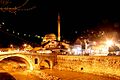 Ottoman mosque, Prizren.
 -
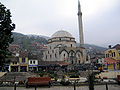 An Ottoman mosque in Prizren.
 -
 Prizren.
 -
 League of Prizren building in Prizren.


See also the Mosque of Muderis Ali Efendi
See also[edit]
- Turkish minorities in the former Ottoman Empire
- Mamuša
- Turkish Democratic Party of Kosovo
- Kosovo–Turkey relations
- Turkification
References[edit]
- ^ http://esk.rks-gov.net/rekos2011/repository/flipbook/1/Te%20dhenat%20kryesore_ALB/#/0 [dead link]
- ^ a b c d e OSCE 2010, 3.
- ^ a b Cole 2011, 368.
- ^ a b Today's Zaman. "Kosovo Turks' fear of Albanianization". Retrieved 2012-02-24.
- ^ Elsie 2010, 276.
- ^ Gashi, Skënder (2015). ONOMASTIC-HISTORICAL RESEARCH ON EXTINCT AND ACTUAL MINORITIES OF KOSOVA. ASHAK. p. 724.
- ^ Gashi, Skënder (2015). ONOMASTIC-HISTORICAL RESEARCH ON EXTINCT AND ACTUAL MINORITIES OF KOSOVA. ASHAK. p. 724.
- ^ Jacobs, Steven L. (2009). Confronting Genocide: Judaism, Christianity, Islam. Lexington Books. ISBN 978-0-7391-3589-1.
The KLA and other Albanian extremists sought to expel almost all non-Albanians (Serbs, Roma, Bosnians, Montenegrins, and even Turks). Some were killed, houses were burned, churches and monasteries destroyed.
- ^ Kovachevich, Sophia Z. (2012-02-09). Betrayal: A Political documentary of out times. Xlibris Corporation. ISBN 978-1-4653-0574-9.
- ^ Baltic 2007, 29.
- ^ Gashi, Skënder (2015). ONOMASTIC-HISTORICAL RESEARCH ON EXTINCT AND ACTUAL MINORITIES OF KOSOVA. ASHAK. p. 245-246.
- ^ Mertus 1999, 316-317.
- ^ Human Rights Watch 1993, 54.
- ^ European Centre for minority Issues Kosovo 2012, 6.
- ^ O'Neill 2002, 56.
- ^ Kosovo Agency of Statistics. "Population by gender, ethnicity at settlement level". p. 12. Archived from the original on 2016-05-08. Retrieved 2016-04-29.
- ^ Jikhareva, Anna (2015), Sind Sie eine Mustermigrantin von Zwinglis Gnaden?, WOZ Die Wochenzeitung, retrieved 6 May 2021,
Frau Adilji, Ihre Mutter stammt aus Pristina, ist aber ursprünglich Türkin. Ihr Vater wuchs als Albaner in einem serbischen Dorf nahe der kosovarischen Grenze auf.
- ^ Which countries can Adnan Januzaj play for?, ITV News, 2013, retrieved 25 April 2021,
The teenager was born in Brussels... He qualifies to play for Albania through his Kosovan-Albanian parents... He qualifies to play for Turkey through his grandparents.
- ^ Adnan Januzaj invited to play for Kosovo in friendly match, BBC News, 2014, retrieved 25 April 2021,
Januzaj, who signed a new five-year-deal with Manchester United last October, was born in Belgium and has Kosovan-Albanian parents. He could also represent Serbia after Kosovo declared independence from the country in 2008, while his grandparents are Turkish.
- ^ Januzaj could play for Kosovo – but it won't end England hopes, The Week, 2014, retrieved 25 April 2021,
The 19-year-old... was born in Belgium to Kosovan-Albanian parents... In addition the teenager has Turkish grandparents
Bibliography[edit]
- Baltic, Nina (2007), Theory and Practice of Human and Minority Rights under the Yugoslav Communist System (PDF), MIRICO: Human and Minority Rights in the Life Cycle of Ethnic Conflicts.
- Cole, Jeffrey (2011), Ethnic Groups of Europe: An Encyclopedia, ABC-CLIO, ISBN 978-1-59884-302-6.
- Elsie, Robert (2010), Historical Dictionary of Kosovo, Scarecrow Press, ISBN 978-0-8108-7231-8.
- European Centre for minority Issues Kosovo (2012), Minority Communities in the 2011 Kosovo Census Results: Analysis and Recommendations (PDF), European Centre for minority Issues Kosovo, archived from the original (PDF) on 2014-01-03.
- Human Rights Watch (1993), Open Wounds: Human Rights Abuses in Kosovo, Human Rights Watch, ISBN 1-56432-131-2.
- Mertus, Julie (1999), Kosovo: How Myths and Truths Started a War, University of California Press, ISBN 0-520-21865-5.
- O'Neill, William G. (2002), Kosovo: An Unfinished Peace, Lynne Rienner Publishers, ISBN 1-58826-021-6.
- OSCE (2010), "Community Profile: Kosovo Turks", Kosovo Communities Profile, Organization for Security and Co-operation in Europe.

