Chang'e 3
  Top: Chang'e 3 lander on the Moon Bottom: Yutu rover on lunar surface | |
| Mission type | Lander and rover |
|---|---|
| Operator | CNSA |
| COSPAR ID | 2013-070A |
| SATCAT no. | 39458 |
| Mission duration | Lander: 1 year (planned) Current: 10 years, 4 months, 12 days Rover: 3 months (planned)[1] Final: 2 years, 229 days |
| Spacecraft properties | |
| Manufacturer | China Academy of Space Technology (CAST) |
| BOL mass | 3,780 kg (8,330 lb)[2] |
| Landing mass | 1,200 kg (2,600 lb) Rover: 140 kg (310 lb)[3] |
| Dimensions | Rover: 1.5 m (4.9 ft) long, 1.0 m high |
| Start of mission | |
| Launch date | 17:30, 1 December 2013 (UTC) UTC[4] |
| Rocket | Long March 3B Y-23 |
| Launch site | Xichang LC-2 |
| Contractor | |
| Lunar lander | |
| Landing date | 13:11, 14 December 2013 (UTC) UTC |
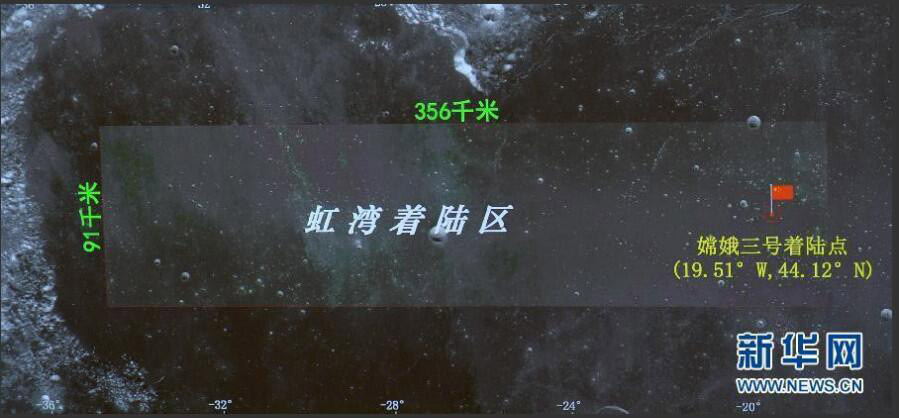
| Landing site | Mare Imbrium 44°07′17″N 19°30′42″W / 44.1214°N 19.5116°W |
Chang'e probes | |

| History of the People's Republic of China |
|---|
.svg) |
| History of |
 China portal China portal |
Chang'e 3 ( /tʃæŋˈʌ/; Chinese: 嫦娥三号; pinyin: Cháng'é Sānhào; lit. 'Chang'e No. 3') is a robotic lunar exploration mission operated by the China National Space Administration (CNSA), incorporating a robotic lander and China's first lunar rover. It was launched in December 2013 as part of the second phase of the Chinese Lunar Exploration Program.[4][5] The mission's chief commander was Ma Xingrui.[6]
The spacecraft was named after Chang'e, the goddess of the Moon in Chinese mythology, and is a follow-up to the Chang'e 1 and Chang'e 2 lunar orbiters. The rover was named Yutu (Chinese: 玉兔; lit. 'Jade Rabbit') following an online poll, after the mythological rabbit that lives on the Moon as a pet of the Moon goddess.[7]
Chang'e 3 achieved lunar orbit on 6 December 2013[8] and landed on 14 December 2013,[9] becoming the first spacecraft to soft-land on the Moon since the Soviet Union's Luna 24 in 1976[10] and the third country to successfully achieve the feat.[11] On 28 December 2015, Chang'e 3 discovered a new type of basaltic rock, rich in ilmenite, a black mineral.[12]
Overview[edit]


The Chinese Lunar Exploration Program is designed to be conducted in four [13] phases of incremental technological advancement: The first is simply reaching lunar orbit, a task completed by Chang'e 1 in 2007 and Chang'e 2 in 2010. The second is landing and roving on the Moon, as Chang'e 3 did in 2013 and Chang'e 4 did in 2019. The third is collecting lunar samples from the near-side and sending them to Earth, a task done by Chang'e 5 and will be done by Chang'e 6 missions. The fourth phase consists of development of a robotic research station near the Moon's south pole.[13][14][15] The program aims to facilitate a crewed lunar landing in the 2030s and possibly build an outpost near the south pole.[16]
History[edit]
In January 2004, China's lunar orbiter project was formally established.[17] The first Chinese lunar orbiter, Chang'e 1, was launched from Xichang Satellite Launch Center on 24 October 2007[18] and entered lunar orbit on 5 November.[19] The spacecraft operated until 1 March 2009, when it was intentionally crashed into the surface of the Moon.[20] Data gathered by Chang'e 1 were used to create an accurate and high-resolution 3D map of the entire lunar surface, assisting site selection for the Chang'e 3 lander.[21][22]
Chang'e 1's successor, Chang'e 2, was approved in October 2008[17] and was launched on 1 October 2010 to conduct research from a 100-km-high lunar orbit, in preparation for Chang'e 3's 2013 soft landing.[23] Chang'e 2, though similar in design to Chang'e 1, was equipped with improved instruments and provided higher-resolution imagery of the lunar surface to assist in the planning of the Chang'e 3 mission. In 2012, Chang'e 2 was dispatched on an extended mission to the asteroid 4179 Toutatis.[24]
Objectives[edit]
The official mission objective is to achieve China's first soft-landing and roving exploration on the Moon, as well as to demonstrate and develop key technologies for future missions.[25][26][27] The scientific objectives of Chang'e 3 include lunar surface topography and geology survey, lunar surface material composition and resource survey, Sun-Earth-Moon space environment detection, and lunar-based astronomical observation.[25] Chang'e 3 will attempt to perform the first direct measurement of the structure and depth of the lunar soil down to a depth of 30 m (98 ft), and investigate the lunar crust structure down to several hundred meters deep.[28]
The Chinese Lunar Exploration Program has been divided into three main operational phases, which are:[25]
- Orbiting (Chang'e 1 and Chang'e 2)
- Landing (Chang'e 3 and Chang'e 4)
- Sample return (Chang'e 5 and Chang'e 6)
Mission profile[edit]
Launch[edit]
Chang'e 3 was launched at 17:30 UTC on 1 December 2013 (01:30 local time on 2 December) atop a Long March 3B rocket flying from Launch Complex 2 at the Xichang Satellite Launch Centre in the southwestern province of Sichuan.[29]
Homes downrange of the Launch Centre were damaged during liftoff when spent hardware wreckage from the rocket, including one piece the size of a desk, fell on a village in Suining County in neighbouring Hunan province. The county authorities had moved 160,000 people to safety before the liftoff, while more than 20,000 people near the launch site in Sichuan had been moved to a primary school auditorium. The expected wreckage zone for Long March rockets is 50 to 70 kilometres (31 to 43 mi) long and 30 km (19 mi) wide.[29]
Landing[edit]
Chang'e 3 entered a 100 km (62 mi)-high circular lunar orbit on 6 December 2013, 9:53 UTC. The orbit was obtained after 361 seconds (6 minutes) of variable thrust engine braking from its single main engine.[30] Later, the spacecraft adopted a 15 km (9.3 mi) × 100 km (62 mi) elliptic orbit. The landing took place one week later, on 14 December. At periapsis, its variable thrusters were again fired in order to reduce its velocity, descending to 100 m (330 ft) above the Moon's surface. It hovered at this altitude, moving horizontally under its own guidance to avoid obstacles, before slowly descending to 4 m (13 ft) above the ground, at which point its engine was shut down for a free-fall onto the lunar surface. The landing sequence took about 12 minutes to complete.
Topographic data from the Chang'e 1 and 2 orbiters were used to select a landing site for Chang'e 3. The planned landing site was Sinus Iridum,[31] but the lander actually descended on Mare Imbrium, about 40 km (24.9 mi) south of the 6 km (3.7 mi) diameter crater Laplace F,[32][33] at 44.1214°N, 19.5116°W (2640 m elevation) (1.6 mi),[34] on 14 December 2013, 13:11 UTC.[9][26][35]
Lander[edit]
With a landing mass of 1,200 kg (2,600 lb), it also carried and deployed the 140 kg (310 lb) rover.[3] It serves double-duty as a technology demonstrator to be further refined for the planned 2019 Chang'e 5 sample-return mission.[36][37]
The stationary lander is equipped with a radioisotope heater unit (RHU) in order to heat its subsystems and power its operations, along with its solar panels, during its planned one-year mission. It has a scientific payload of seven instruments and cameras. In addition to their lunar scientific roles, the cameras will also acquire images of the Earth and other celestial bodies.[1] During the 14-day lunar nights, the lander and the rover go into 'sleep mode'.[25]
Lunar-based ultraviolet telescope (LUT)[edit]
The lander is equipped with a 50 mm (2.0 in) Ritchey–Chrétien telescope that is being used to observe galaxies, active galactic nuclei, variable stars, binaries, novae, quasars and blazars in the near-UV band (245–340 nm), and is capable of detecting objects at a brightness as low as magnitude 13. The thin exosphere and slow rotation of the Moon allow extremely long, uninterrupted observations of a target. The LUT is the first long term lunar-based astronomical observatory, making continuous observations of important celestial bodies to study their light variation and better improve current models.[38][39][40]
Extreme ultraviolet (EUV) camera[edit]
The lander also carries an extreme ultraviolet (30.4 nm) camera,[41] which will be used to observe the Earth's plasmasphere in order to examine its structure and dynamics and to investigate how it is affected by solar activity.[28]
Lander cameras[edit]
Three panoramic cameras are installed on the lander, facing different directions. The lander is equipped with a single descent camera that was tested on the Chang'e 2 spacecraft.[38]
Soil probe[edit]
The Chang'e 3 lander also carries an extensible soil probe.[38][42]
Rover[edit]

The development of the six-wheeled rover began in 2002 at the Shanghai Aerospace System Engineering Institute and was completed in May 2010.[43][44] The rover has a total mass of approximately 140 kg (310 lb), with a payload capacity of approximately 20 kg (44 lb).[1][45] The rover may transmit video in real time, and can perform simple analysis of soil samples. It can navigate inclines and has automatic sensors to prevent it from colliding with other objects.
Energy was provided by 2 solar panels, allowing the rover to operate through lunar days, as well as charging its batteries. At night the rover was powered down to a large extent, and kept from getting too cold by the use of several radioisotope heater units (RHUs) using plutonium-238.[46] The RHUs provide only thermal energy and no electricity.
The rover was deployed from the lander, and made contact with the lunar surface on 14 December, 20:35 UTC.[47] On 17 December it was announced that all of the scientific tools apart from the spectrometers had been activated, and that both the lander and rover were "functioning as hoped, despite the unexpectedly rigorous conditions of the lunar environment".[3] However, from 16 to 20 December the rover did not move, having shut down its subsystems. Direct solar radiation had raised the temperature on the sunlit side of the rover to over 100 °C (212 °F), while the shaded side simultaneously fell below zero. Since then, the lander and rover finished taking pictures of each other and commenced their respective science missions.[48]
The rover was designed to explore an area of 3 square kilometres (1.2 sq mi) during its 3-month mission, with a maximum travelling distance of 10 km (6.2 mi).
The rover demonstrated its ability to endure its first lunar night when it was commanded out of sleep mode on 11 January 2014.[49] On 25 January 2014, China's state media announced the rover had undergone a "mechanical control abnormality" caused by the "complicated lunar surface environment".[50]
The rover established contact with mission control on 13 February 2014, but it was still suffering from a "mechanical abnormality".[51] The rover was still intermittently transmitting as late as 6 September 2014[52] It ceased to transmit data in March 2015.[53]
Ground-penetrating radar (GPR)[edit]
The rover carries a ground-penetrating radar (GPR) on its underside, allowing for the first direct measurement of the structure and depth of the lunar soil down to a depth of 30 m (98 ft), and investigation of the lunar crust structure down to several hundred meters deep.[28]
Spectrometers[edit]
The rover carries an alpha particle X-ray spectrometer[54] and an infrared spectrometer, intended to analyze the chemical element composition of lunar samples.
Stereo cameras[edit]
There are two panoramic cameras and two navigation cameras on the rover's mast, which stands ~1.5 m (4.9 ft) above the lunar surface, as well as two hazard avoidance cameras installed on the lower front portion of the rover.[38] Each camera pair may be used to capture stereoscopic images,[55] or for range imaging by triangulation.
Monitoring by other lunar missions[edit]
The descent of the Chang'e 3 spacecraft was expected to increase the content of lunar dust in the tenuous lunar exosphere, as well as introduce gases from engine firings during landing. Although there is no formal cooperation between NASA and the China National Space Administration, the landing provided an opportunity for NASA's Lunar Atmosphere and Dust Environment Explorer (LADEE) mission to examine possible changes to the baseline readings of the Moon's exosphere, and will allow it to study how dust and spent propellant gases settle around the Moon after a landing.[56][57] For example, one of the lander's combustion byproducts is water vapor, and LADEE may be able to observe how lunar water is deposited in cold traps near the poles.[56] NASA's Lunar Reconnaissance Orbiter (LRO) took a photograph of the landing site on 25 December 2013 in which the lander and the rover can be seen.[58] LRO also attempted to photograph the lander and rover on 22 January 2014, and on 18 February 2014.[56]
Status[edit]
The rover was still intermittently transmitting as late as 6 September 2014.[52] As of March 2015, the rover remained immobile and its instruments continued degrading,[59][60][61] but was still able to communicate with Earth radio stations.[62][63][64][65] While amateur observers were unable to detect transmissions from the lander, Chinese officials reported that the craft was still operating its UV Camera and Telescope as it entered its 14th lunar night on 14 January 2015.[52][66]
The Yutu rover ceased to transmit data in March 2015.[53] The lander and its Lunar-based Ultraviolet Telescope (LUT) are still operational as of September 2020, seven years after landing on the Moon.[67][68] The power source for the lander, which consists of a radioisotope heater unit (RHU) and solar panels, could last for 30 years.[69]
Chang'e 3 landing site named 'Guang Han Gong'[edit]
The landing site of China's first Moon lander Chang'e 3 has been named "Guang Han Gong(广寒宫) (Guang: widely, extensively; Han: cold, freezing;Gong: Palace) " or "Moon Palace" by the International Astronomical Union (IAU), China's State Administration of Science, Technology and Industry for National Defense (SASTIND). Three nearby impact craters were given the names Zi Wei, Tian Shi and Tai Wei, three constellations in traditional Chinese astrology.[70]
See also[edit]

- Chinese space program
- Chinese Lunar Exploration Program (CLEP)
- Chang'e 4
- Chang'e 5
- Changesite-(Y)
- List of missions to the Moon
- List of artificial objects on the Moon
References[edit]
- ^ a b c Laxman, Srinivas (7 March 2012). "Chang'e-3: China To Launch First Moon Rover In 2013". Asian Scientist. Archived from the original on 2 November 2013. Retrieved 5 April 2012.
- ^ "Chang'e-3 Coming Into Focus". Lunar Enterprise Daily. 23 April 2013. Archived from the original on 13 April 2019. Retrieved 26 December 2013.
- ^ a b c "Most Chang'e-3 science tools activated". Archived from the original on 18 December 2013. Retrieved 19 December 2013.
- ^ a b "China Starts Manufacturing Third Lunar Probe". English.cri.cn. Archived from the original on 21 October 2013. Retrieved 2 December 2013.
- ^ "China Readying 1st Moon Rover for Launch This Year". Space.com. 19 June 2013. Archived from the original on 22 August 2017. Retrieved 23 July 2013.
- ^ He Huifeng (26 March 2015). "China's moon mission chief Ma Xingrui named party chief of high-tech hub Shenzhen". South China Morning Post. Archived from the original on 2 December 2017. Retrieved 4 April 2015.
- ^ Ramzy, Austin (26 November 2013). "China to Send 'Jade Rabbit' Rover to the Moon". The New York Times. Archived from the original on 27 June 2018. Retrieved 2 December 2013.
- ^ "China moon rover enters lunar orbit: Xinhua". www.spacedaily.com. Archived from the original on 7 May 2016. Retrieved 8 December 2013.
- ^ a b "China lands Jade Rabbit robot rover on Moon". BBC. 14 December 2013. Archived from the original on 12 January 2020. Retrieved 20 June 2018.
- ^ Barbosa, Rui C. (14 December 2013). "China's Chang'e-3 and Jade Rabbit duo land on the Moon". NASAspaceflight.com. Archived from the original on 31 December 2017. Retrieved 14 December 2013.
- ^ "China Becomes Third Country to Ever 'Soft-Land' on the Moon". The Atlantic. 14 December 2013. Archived from the original on 29 May 2019. Retrieved 26 April 2019.
- ^ Bhanoo, Sindya N. (28 December 2015). "New Type of Rock Is Discovered on Moon". The New York Times. Archived from the original on 19 September 2018. Retrieved 29 December 2015.
- ^ a b Chang'e 4 press conference Archived 15 December 2020 at the Wayback Machine. CNSA, broadcast on 14 January 2019.
- ^ China's Planning for Deep Space Exploration and Lunar Exploration before 2030 Archived 3 March 2021 at the Wayback Machine. (PDF) XU Lin, ZOU Yongliao, JIA Yingzhuo. Space Sci., 2018, 38(5): 591-592. doi:10.11728/cjss2018.05.591
- ^ A Tentative Plan of China to Establish a Lunar Research Station in the Next Ten Years Archived 15 December 2020 at the Wayback Machine. Zou, Yongliao; Xu, Lin; Jia, Yingzhuo. 42nd COSPAR Scientific Assembly. Held 14–22 July 2018, in Pasadena, California, USA, Abstract id. B3.1-34-18.
- ^ China lays out its ambitions to colonize the moon and build a "lunar palace" Archived 29 November 2018 at the Wayback Machine. Echo Huang, Quartz. 26 April 2018.
- ^ a b "Backgrounder: Timeline of China's lunar program". Xinhua. CCTV – English. 26 November 2013. Archived from the original on 13 December 2013. Retrieved 9 December 2013.
- ^ "China's 1st Moon orbiter enters Earth orbit". Xinhua News Agency. 24 October 2007. Archived from the original on 25 October 2007. Retrieved 24 October 2007.
- ^ "Missions to the Moon | The Planetary Society". Planetary.org. Archived from the original on 21 April 2012. Retrieved 2 December 2013.
- ^ Guodong, Du (1 March 2009). "China's lunar probe Chang'e-1 impacts Moon". Xinhua. Archived from the original on 2 March 2009. Retrieved 1 March 2009.
- ^ "Asia Times Online :: China News, China Business News, Taiwan and Hong Kong News and Business". Atimes.com. 16 April 2010. Archived from the original on 18 April 2010. Retrieved 2 December 2013.
{{cite web}}: CS1 maint: unfit URL (link) - ^ "China publishes first map of whole lunar surface". 12 November 2008. Archived from the original on 16 November 2017. Retrieved 12 November 2008.
- ^ Stephen Clark (1 October 2010). "China's second Moon probe dispatched from Earth". Spaceflight Now. Archived from the original on 18 July 2018. Retrieved 1 October 2010.
- ^ Lakdawalla, Emily (15 June 2012). "Update on yesterday's post about Chang'E 2 going to Toutatis". Planetary Society. Archived from the original on 8 January 2018. Retrieved 16 June 2012.
- ^ a b c d SUN ZeZhou; JIA Yang; ZHANG He (November 2013). "Technological advancements and promotion roles of Chang'e-3 lunar probe mission". Science China. 56 (11): 2702–2708. Bibcode:2013ScChE..56.2702S. doi:10.1007/s11431-013-5377-0. S2CID 111801601.
- ^ a b O'Neil, Ian (14 December 2013). "China's Rover Rolls! Yutu Begins Moon Mission". Discovery News. CCTV. Archived from the original on 3 March 2016. Retrieved 15 December 2013.
- ^ Shukman, David (29 November 2013). "Why China is fixated on the Moon". BBC News. Archived from the original on 14 December 2013. Retrieved 15 December 2013.
- ^ a b c "欧阳自远:嫦娥三号明年发射将实现着陆器与月球车联合探测". Xinhua. 14 June 2012. Archived from the original on 17 June 2012. Retrieved 23 July 2013.
- ^ a b Rocket debris hits Chinese village Archived 25 October 2016 at the Wayback Machine The Guardian, 4 December 2013.
- ^ "Chang'e-3 enters lunar orbit". Xinhuanet. 6 December 2013. Archived from the original on 7 December 2013. Retrieved 6 December 2013.
- ^ "Chang'e 3 Diary". Zarya.info. 6 December 2013. Archived from the original on 29 November 2014. Retrieved 9 December 2013.
- ^ "Chang'e 3 landing coordinates". China News (CN). 14 December 2013. Archived from the original on 2 February 2021. Retrieved 15 December 2013.
- ^ Lakdawalla, Emily; Stooke, Phil (December 2013). "Chang'e 3 has successfully landed on the Moon!". The Planetary Society. Archived from the original on 22 June 2020. Retrieved 15 December 2013.
- ^ "NASA Images of Chang'e 3 Landing Site". 30 December 2013. Archived from the original on 2 January 2014. Retrieved 1 January 2014.
- ^ David, Leonard. "China Lands On The Moon: Historic Robotic Lunar Landing Includes 1st Chinese Rover". Space.com. Archived from the original on 20 December 2013. Retrieved 17 December 2013.
- ^ Molnár, László (24 May 2013). "Chang'e-3 revealed – and its massive!". Pull Space Technologies. Archived from the original on 6 June 2017. Retrieved 9 December 2013.
- ^ Wiener-Bronner, Danielle (2 December 2013). "China Shoots for the Moon with Its First Lunar Lander". The Wire. Archived from the original on 5 December 2013. Retrieved 9 December 2013.
- ^ a b c d "Chang'e 3". SPACEFLIGHT101. Archived from the original on 3 December 2013. Retrieved 2 December 2013.
- ^ "China's Lunar Telescope: Alive and Well". CNSA. SpaceRef. 12 October 2015. Retrieved 13 October 2015.[permanent dead link]
- ^ Wang, J.; et al. (6 October 2015). "18-Months Operation of Lunar-based Ultraviolet Telescope: A Highly Stable Photometric Performance". Astrophysics and Space Science. 360: 10. arXiv:1510.01435. Bibcode:2015Ap&SS.360...10W. doi:10.1007/s10509-015-2521-2. S2CID 119221340.
- ^ 2013 – Launches to Orbit and Beyond Archived 22 October 2013 at the Wayback Machine. Zarya. 1 December 2013.
- ^ Nerlich, Steve (4 May 2013). "Chang'e 3: The Chinese Rover Mission". AmericaSpace. Archived from the original on 20 October 2016. Retrieved 5 December 2013.
- ^ "登月车构造原理". 新华网. 24 April 2008. Archived from the original on 27 February 2009. Retrieved 24 April 2008.
- ^ "中国首辆登月车工程样机". 新华网. 24 April 2008. Archived from the original on 27 February 2009. Retrieved 24 April 2008.
- ^ "China considering manned lunar landing in 2025–2030". Xinhua. 24 May 2009. Archived from the original on 31 May 2009. Retrieved 1 October 2010.
- ^ "Radioisotope Power Systems: Pu-238 and ASRG status and the way forward" Archived 28 March 2014 at the Wayback Machine by Ralph L. McNutt, Jr., Space Department, Johns Hopkins University, Applied Physics Laboratory, Laurel, MD 20723 USA.
- ^ "Live* Yutu Rover "Jade Rabbit" separates from lander on the Moon". YouTube. 14 December 2013. Archived from the original on 15 December 2021. Retrieved 26 December 2013.
- ^ "China's Yutu "naps", awakens and explores". Archived from the original on 24 December 2013. Retrieved 21 December 2013.
- ^ "Chang'e 3 – Change". www.spaceflight101.com. Archived from the original on 29 November 2014. Retrieved 20 January 2014.
- ^ China's first moon rover has experienced a "mechanical control abnormality" Archived 9 September 2019 at the Wayback Machine – Australian Broadcasting Corporation – Retrieved 25 January 2014.
- ^ McKirdy, Euan (13 February 2014). "Down but not out: Jade Rabbit comes back from the dead". CNN. Archived from the original on 22 October 2017. Retrieved 13 February 2014.
- ^ a b c Howell, Elizabeth (9 September 2014). "China's Yutu rover is still alive, reports say, as lunar panorama released". Universe Today. PhysOrg. Archived from the original on 1 October 2014. Retrieved 2 October 2014.
- ^ a b Wall, Mike (12 March 2015). "The Moon's History Is Surprisingly Complex, Chinese Rover Finds". Space.com. Archived from the original on 4 August 2017. Retrieved 13 March 2015.
- ^ ""嫦娥三号"发射成功 将于5天后到达月球". Netease. 2 December 2013. paragraph "月兔"将巡天观地测月. Archived from the original on 13 December 2013. Retrieved 8 December 2013.
- ^ Lakdawalla, Emily. "Chang'e 3 update with lots of pictures: Yutu begins lunar journey". Archived from the original on 26 December 2013. Retrieved 24 December 2013.
- ^ a b c Lakdawalla, Emily (5 December 2013). "Chang'e 3 and LADEE updates – and Lunar Reconnaissance Orbiter, too, for good measure". The Planetary Society. Archived from the original on 7 December 2013. Retrieved 6 December 2013.
- ^ David, Leonard (21 November 2013). "China's 1st Moon Lander May Cause Trouble for NASA Lunar Dust Mission". Space.com. Archived from the original on 25 November 2013. Retrieved 25 November 2013.
- ^ "NASA Images of Chang'e 3 Landing Site". 30 December 2013. Archived from the original on 2 January 2014. Retrieved 1 January 2014.
- ^ "Chinese lunar rover alive but weak". icrosschina.com. Archived from the original on 29 April 2015. Retrieved 4 March 2015.
- ^ "China's ailing moon rover weakening: designer". October 2014. Archived from the original on 16 March 2015. Retrieved 4 March 2015.
- ^ "China's moon rover Yutu functioning but stationary". Space Daily. 4 March 2015. Archived from the original on 18 March 2015. Retrieved 4 March 2015.
- ^ "Chang'e 3 Third Lunar Day, Day 3. Is the rover alive?". unmannedspaceflight.com. Archived from the original on 14 July 2014. Retrieved 4 March 2015.
- ^ "Ello Yutu! It is back". Twitter. Archived from the original on 29 January 2015. Retrieved 4 March 2015.
- ^ "月球车"玉兔"号已被唤醒 部分设备状态退化". politics.people.com.cn. Archived from the original on 23 July 2014. Retrieved 4 March 2015.
- ^ "Ninth day for Yutu just ended". unmannedspaceflight.com. Archived from the original on 6 October 2014. Retrieved 4 March 2015.
- ^ China's Chang'e 3 Lander in good Shape as 14th Lunar Night sets in Archived 29 November 2014 at the Wayback Machine spaceflight101.com
- ^ Andrew Jones (23 September 2020). "China's Chang'e 3 lunar lander still going strong after 7 years on the moon". Space.com. Archived from the original on 25 November 2020. Retrieved 16 November 2020.
- ^ "The Chang'e-3 lunar lander is still waking up after nearly five years on the Moon". GB Times. 25 June 2018. Archived from the original on 30 November 2018. Retrieved 25 June 2018.
- ^ Andrew Jones. "China's telescope on the Moon is still working, and could do for 30 years". GBTimes. Archived from the original on 17 May 2019. Retrieved 15 August 2018.
- ^ "Chang'e-3 landing site named 'Guang Han Gong'". www.ecns.cn. Archived from the original on 7 January 2016. Retrieved 7 January 2016.
External links[edit]

- Official coverage on China Central Television (English)
- Snapshots from Space at The Planetary Society website
- Chang'e 3 diary Archived 29 November 2014 at the Wayback Machine from zarya.info
- Chang'e 3 – Mission Overview at Spaceflight101
- Chang'e 3 may be still functioning at Spaceflight101
- Panorama from Chang'e 3 terrain camera (TCAM) (in Chinese)
- Raw data from National Astronomical Observatories of China
| Missions | |
|---|---|
| Launch vehicles | |
| Facilities | |
| People | |


2013 in space | ||||||
|---|---|---|---|---|---|---|
Space probe launches  |
|    | ||||
| Impact events | ||||||
| Selected NEOs | ||||||
| Exoplanets |
| |||||
| Discoveries |
| |||||
| Novae | ||||||
| Comets | ||||||
| Space exploration |
| |||||