


Cupping therapy

| Cupping therapy | |
|---|---|
 Cupping and bloodletting set, from London, England, dating from 1860–1875 | |
| Alternative therapy |
| This article is part of a series on |
| Alternative medicine |
|---|
 |
| Cupping therapy | |||||||||||||||||||||||||||||||
|---|---|---|---|---|---|---|---|---|---|---|---|---|---|---|---|---|---|---|---|---|---|---|---|---|---|---|---|---|---|---|---|
| Chinese name | |||||||||||||||||||||||||||||||
| Traditional Chinese | 拔罐 | ||||||||||||||||||||||||||||||
| Simplified Chinese | 拔罐 | ||||||||||||||||||||||||||||||
| |||||||||||||||||||||||||||||||
| Vietnamese name | |||||||||||||||||||||||||||||||
| Vietnamese alphabet | Giác hơi | ||||||||||||||||||||||||||||||
| Chữ Hán | 覺有 | ||||||||||||||||||||||||||||||
| Korean name | |||||||||||||||||||||||||||||||
| Hangul | 부항 | ||||||||||||||||||||||||||||||
| Hanja | 附缸 | ||||||||||||||||||||||||||||||
| |||||||||||||||||||||||||||||||
Cupping therapy is a form of pseudoscience in which a local suction is created on the skin with the application of heated cups. As alternative medicine it is practiced primarily in Asia but also in Eastern Europe, the Middle East, and Latin America.[1][2] Cupping has been characterized as a pseudoscience and its practice as quackery.[3][4]
Cupping practitioners attempt to use cupping therapy for a wide array of medical conditions including fevers, chronic low back pain, poor appetite, indigestion, high blood pressure, acne, atopic dermatitis, psoriasis, anemia, stroke rehabilitation, nasal congestion, infertility, and menstrual period cramping.[1][2]
Despite the numerous ailments for which practitioners claim cupping therapy is useful, there is insufficient evidence it has any health benefits, and there are some risks of harm, especially from wet cupping and fire cupping.[1] Bruising and skin discoloration are among the adverse effects of cupping and are sometimes mistaken for child abuse.[2] In rare instances, the presence of these marks on children has led to legal action against parents who had their children receive cupping therapy.[2]
Scientific evaluation
The American Cancer Society notes that "available scientific evidence does not support claims that cupping has any health benefits" and also that the treatment carries a small risk of burns.[5] A review of literature in 2011 determined that "the effectiveness of cupping is currently not well-documented for most conditions", and that systematic reviews showing efficacy for the treatment of pain "were based mostly on poor quality primary studies."[6] This was further supported by a review in 2014 which demonstrated that previous evidence supporting cupping has resulted from "unreasonable design and poor research quality".[7] There is a lack of evidence to support the use of cupping therapy for acne.[8] Additionally, cupping is often practiced along with other acupuncture therapies[2][9] and therefore cannot exclusively account for resultant positive benefits. Many reviews suggest that there is insufficient scientific evidence to support the use of cupping techniques to combat relevant diseases and chronic pain.[10] Cupping has been characterized as quackery.[4]
The lack of apparent benefits of cupping treatments are discussed by Simon Singh and Edzard Ernst in their 2008 book Trick or Treatment.[11]
As a pseudoscientific detoxification ritual, proponents of cupping falsely claim that it can remove unspecified toxins from the body.[12][13] Proponents also falsely claim that cupping "improves blood flow" to help sore muscles.[14] James Hamblin notes that a bruise caused by cupping "is a blood clot, though, and clotted blood is definitionally not flowing."[15]
Critics of alternative medicine have spoken out against cupping therapy. Harriet Hall and Mark Crislip have characterized cupping as "pseudoscience nonsense", "a celebrity fad", and "gibberish", and observed that there is no evidence that cupping works any better than a placebo.[16][17] Pharmacologist David Colquhoun writes that cupping is "laughable... and utterly implausible."[18] Practicing surgeon David Gorski observes that "it's all risk for no benefit. It has no place in modern medicine, or at least shouldn't."[19]
Safety
In 2016, the Cambodian Ministry of Health warned that cupping could be a health risk and particularly dangerous for people with high blood pressure or heart problems.[20] According to the NCCIH "Cupping can cause side effects such as persistent skin discoloration, scars, burns, and infections, and may worsen eczema or psoriasis".[21]
Cupping may cause breaks in the capillaries (small blood vessels) in the papillary dermis layer of the skin, resulting in the appearance of petechiae and purpura.[1] These marks are sometimes mistaken for signs of child abuse when cupping is performed on children.[1]
Cupping therapy adverse events can be divided into local and systemic adverse events. The local adverse events may include scar formation, burns, linear bruising or streaks (wet cupping), skin ulcers, undesired darkening of the skin, panniculitis, erythema ab igne, induction of the Koebner phenomenon in susceptible individuals with psoriasis, and pain at the cupping site.[1][2] A theoretical risk of infection exists but there are no reports of this as of 2012.[2]
Claimed uses
Cupping practitioners use cupping therapy for a wide array of medical conditions including fevers, pain, poor appetite, indigestion, high blood pressure, acne, atopic dermatitis, psoriasis, anemia, stroke rehabilitation, nasal congestion, infertility, and dysmenorrhea.[1]
There is low to moderate evidence that cupping can reduce pain associated with musculoskeletal pain and myofascial pain syndrome,[22][23][24] although the benefits may be indistinguishable from those of a placebo.[24]
Claimed mechanism of action
Proponents claim cupping has a therapeutic effect and removes unspecified "toxins", stagnant blood, or "vital energy" when used over acupuncture points with the goal of improving blood circulation.[1][2]
Methods
Modern suction devices are sometimes used instead of the traditional cups.[2]
While details vary between practitioners, societies, and cultures, the practice consists of drawing tissue into a cup placed on the targeted area by creating a partial vacuum – either by the heating and subsequent cooling of the air in the cup, or via a mechanical pump.[25] The cup is usually left in place for somewhere between five and fifteen minutes.
Cupping therapy types can be classified using four distinct methods of categorization. The first system of categorization relates to "technical types" including: dry, wet, massage, and flash cupping therapy. The second categorization relates to "the power of suction related types" including: light, medium, and strong cupping therapy. The third categorization relates to "the method of suction related types" including: fire, manual suction, and electrical suction cupping therapy. The fourth categorization relates to "materials inside cups" including: herbal products, water, ozone, moxa, needle, and magnetic cupping therapy.[26]
Further categories of cupping were developed later. The fifth relates to area treated including: facial, abdominal, female, male, and orthopedic cupping therapy. The sixth relates to "other cupping types" that include sports and aquatic cupping.[citation needed]
-
 Glass
Glass -
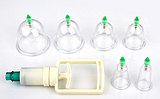 Plastic
 -
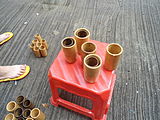 Bamboo
 -
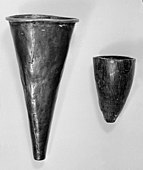 Horn/copper
 -
 Bronze


Dry cupping
Dry cupping involves the application of a heated cup on the skin of the back, chest, abdomen, or buttocks.[1] The cooling of the air is then thought to create a suction effect. Bamboo and other materials are sometimes used as alternatives to glass cups.[1]
Fire cupping

Fire cupping involves soaking a cotton ball in almost pure alcohol. The cotton is clamped by a pair of forceps and lit via match or lighter, and, in one motion, placed into the cup and quickly removed, while the cup is placed on the skin. The fire heats up the air in the cup which, after cooling reduces in volume creating a negative pressure inside the cup. The cup is then quickly placed onto the body and the negative pressure "sucks" the skin up. Massage oil may be applied to create a better seal as well as allow the cups to glide over muscle groups (e.g. trapezius, erectors, latissimus dorsi, etc.) in an act called "gliding cupping" or "sliding cupping". Dark circles may appear where the cups were placed because of capillary rupture just under the skin. There are documented cases of burns caused by fire cupping.[27][28]
Wet cupping
Wet cupping is also known as Hijama (Arabic: حجامة lit. "sucking") or medicinal bleeding, where blood is drawn by local suction from a small skin incision.[29]
The first reported usages are found in the Islamic hadith, sayings attributed to or describing the actions of the Islamic prophet Muhammad.[30][31] Hadith from Muhammad al-Bukhari, Muslim ibn al-Hajjaj Nishapuri and Ahmad ibn Hanbal support its recommendation and use by Muhammad.[32] As a result, wet cupping has remained a popular remedy practiced in many parts of the Muslim world.[33]
In Finland, wet cupping has been done at least since the 15th century, and it is done traditionally in saunas. The cupping cups were made of cattle horns with a valve mechanism in it to create a partial vacuum by sucking the air out.[34] Cupping is still practiced in Finland as part of relaxing and/or health regimens.[35]
The points used in wet and dry cupping are varied and intended to correspond to areas of pain and blockage. Over the years treatment plans have been created but, due to its holistic nature, points used may vary depending on the individual.[36][37]
-
 A person receiving wet cupping
 -
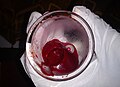 Blood drawn by wet cupping


Traditional Chinese medicine

In Chinese, cupping is known as "pulling-up jars" (Chinese: 拔罐; pinyin: báguàn). According to traditional Chinese medicine (TCM), cupping is done to dispel stagnation (stagnant blood and lymph), thereby improving qi flow,[38] in order to treat respiratory diseases such as the common cold, pneumonia and bronchitis. Cupping also is used on back, neck, shoulder and other musculoskeletal conditions. Its advocates claim it has other applications as well.[38] Cupping is not advised, in TCM, over skin ulcers or to the abdominal or sacral regions of pregnant women.[39]
Society and culture
Cupping has gained publicity in modern times due to its use by American sport celebrities including National Football League player DeMarcus Ware and Olympians Alexander Naddour, Natalie Coughlin, and Michael Phelps.[40] Medical doctor Brad McKay wrote that Team USA was doing a great disservice to their fans who might "follow their lead", calling cupping an "ancient (but useless) traditional therapy."[41] Steven Novella noted "It is unfortunate that elite athletics, including the Olympics, is such a hot bed for pseudoscience."[42]
There is a description of cupping in George Orwell's essay "How the Poor Die", where he was surprised to find the antiquated practice applied to him in a Paris hospital.[43] In the 1964 Hollywood film, Zorba the Greek cupping is depicted with the character Zorba, played by Anthony Quinn, performing it on the character played by Lila Kedrova.[citation needed]
Perceived benefits of cupping have often been perpetuated by celebrities and athletes who use these therapeutic interventions in their daily lives. Professional swimmer Michael Phelps received publicity during the 2016 Olympics for the purple bruises evident on his back resulting from cupping. He has been known to "do it before every meet he goes to" in order to "speed up recovery".[44] Celebrity endorsements such as these may bias individuals to feel benefits from the practice.
History

The origin of cupping is unclear. Iranian traditional medicine uses wet-cupping practices, with the belief that cupping with scarification may eliminate scar tissue, and cupping without scarification would cleanse the body through the organs.[45]
In ancient Greece, Hippocrates (c. 460 – c. 370 BC) used cupping for internal disease and structural problems, and Roman surgeons used it for bloodletting.[46][47] The method was highly recommended by Islamic Prophet Muhammad[31] and hence well-practiced by Muslim scientists who elaborated and developed the method further. Consequently, this method in its multiple forms spread into medicine throughout Asian and European civilizations. In China, the earliest use of cupping that is recorded is from the Taoist alchemist and herbalist Ge Hong (281–341 AD).[48] Cupping was also mentioned in Maimonides' book on health and was used within the Eastern European Jewish community.[49] William Osler recommended its use for pneumonia and acute myelitis in the early twentieth century.[2]
The practice has been used in hospitals in China since the 1950s as a traditional Chinese medicine modality.[50]
See also
References
- ^ a b c d e f g h i j Vashi, NA; Patzelt, N; Wirya, S; Maymone, MBC; Zancanaro, P; Kundu, RV (July 2018). "Dermatoses caused by cultural practices: Therapeutic cultural practices". Journal of the American Academy of Dermatology. 79 (1): 1–16. doi:10.1016/j.jaad.2017.06.159. PMID 29908818. S2CID 49268995.
- ^ a b c d e f g h i j Lilly, E; Kundu, RV (April 2012). "Dermatoses secondary to Asian cultural practices". International Journal of Dermatology. 51 (4): 372–379. doi:10.1111/j.1365-4632.2011.05170.x. PMID 22435423. S2CID 32407869.
- ^ Crislip, Mark (24 December 2014). "Acupuncture Odds and Ends". Science-Based Medicine. Retrieved 8 August 2016.
- ^ a b Hall, Harriet (21 August 2012). "Quackery and Mumbo-Jumbo in the U.S. Military". Slate.
- ^ Russell J; Rovere A, eds. (2009). "Cupping". American Cancer Society Complete Guide to Complementary and Alternative Cancer Therapies (2nd ed.). American Cancer Society. pp. 189–191. ISBN 9780944235713.
- ^ Lee, MS; Kim, JI; Ernst, E (March 2011). "Is cupping an effective treatment? An overview of systematic reviews". Journal of Acupuncture and Meridian Studies. 4 (1): 1–4. doi:10.1016/s2005-2901(11)60001-0. PMID 21440874.
- ^ Chen, B; Li, MY; Liu, PD; Guo, Y; Chen, ZL (July 2015). "Alternative medicine: an update on cupping therapy". QJM: Monthly Journal of the Association of Physicians. 108 (7): 523–525. doi:10.1093/qjmed/hcu227. PMID 25399022.
- ^ Cao H, Yang G, Wang Y, Liu JP, Smith CA, Luo H, Liu Y (January 2015). "Complementary therapies for acne vulgaris". The Cochrane Database of Systematic Reviews (Systematic Review & Meta-Analysis). 1 (1): CD009436. doi:10.1002/14651858.CD009436.pub2. PMC 4486007. PMID 25597924.
- ^ Kim, J. I., Lee, M. S., Lee, D. H., Boddy, K., & Ernst, E. (2011). Cupping for treating pain: a systematic review. Evidence-Based Complementary and Alternative Medicine, 2011.
- ^ Cao, H., Li, X., & Liu, J. (2012). An updated review of the efficacy of cupping therapy. PLOS ONE, 7(2).
- ^ Singh, Simon; Ernst, Edzard (2008). Trick or Treatment. Transworld Publishers. p. 368. ISBN 978-0-552-15762-9.
- ^ Gorski, David (23 May 2011). "Fashionably toxic". Science-Based Medicine. Retrieved 12 May 2020.
- ^ Colquhoun, David (10 August 2016). "Cupping: bruises for the gullible, and other myths in sport". DC's Improbable Science. Retrieved 12 May 2020.
- ^ Salzberg, Steven (13 May 2019). "The Ridiculous And Possibly Harmful Practice Of Cupping". Forbes. Retrieved 12 May 2020.
- ^ Hamblin, James (9 August 2016). "Please, Michael Phelps, Stop Cupping". The Atlantic. Retrieved 12 May 2020.
- ^ Crislip, Mark (24 December 2014). "Acupuncture Odds and Ends". Science-Based Medicine. Retrieved 8 August 2016.
- ^ Hall, Harriet (31 July 2012). "Therapy or Injury? Your Tax Dollars at Work". Science-Based Medicine. Retrieved 8 August 2016.
- ^ "Revealed – Why some Olympic athletes have those little red marks on them". Irish Independent. 8 August 2016.
- ^ Gorski, David (July 1, 2016). "What's the harm? Cupping edition". Respectful Insolence. Science-Based Medicine. Retrieved 8 August 2016.
- ^ Cheang, Sopheng (2016-08-10). "Cupping and coining: I did it long before Phelps". AP News. Retrieved 2023-08-19.
The Cambodian Health Ministry does not advocate cupping, and warns that it could be a health risk. Health Ministry spokesman Ly Sovann told me that the practice is not known to cure any illnesses, and in fact can be dangerous for people with high blood pressure or heart problems. Still, the practice is not banned in the country because it is almost a way of life for Cambodians, he said.
- ^ "Cupping". NCCIH. 8 November 2018.
- ^ Mohamed, Ayman A.; Zhang, Xueyan; Jan, Yih-Kuen (2023). "Evidence-based and adverse-effects analyses of cupping therapy in musculoskeletal and sports rehabilitation: A systematic and evidence-based review". J Back Musculoskelet Rehabil. 36 (1): 3–19. doi:10.3233/BMR-210242. PMID 35848010. S2CID 250511730.
- ^ Wood, Sarah; Fryer, Gary; Tan, Liana Lei Fon; Cleary, Caroline (October 2020). "Dry cupping for musculoskeletal pain and range of motion: A systematic review and meta-analysis". J Bodyw Mov Ther. 24 (4): 503–18. doi:10.1016/j.jbmt.2020.06.024. PMID 33218554. S2CID 225353128.
- ^ a b Charles, Derek; Hudgins, Trey; MacNaughton, Josh; Newman, Eric; Tan, Joanne; Wigger, Michael (July 2019). "A systematic review of manual therapy techniques, dry cupping and dry needling in the reduction of myofascial pain and myofascial trigger points". J Bodyw Mov Ther. 23 (3): 539–46. doi:10.1016/j.jbmt.2019.04.001. PMID 31563367. S2CID 132721136.
- ^ "What is cupping therapy". WebMD. Retrieved 15 August 2016.
- ^ Shaban, Tamer (2013). Cupping Therapy Encyclopedia. CreateSpace. p. 29. ISBN 978-1494780517.
- ^ Iblher, N.; Stark, B. (2007). "Cupping treatment and associated burn risk: a plastic surgeon's perspective". J Burn Care Res. 28 (2): 355–358. doi:10.1097/BCR.0B013E318031A267. PMID 17351459.
- ^ Sagi, A.; Ben-Meir, P.; Bibi, C. (Aug 1988). "Burn hazard from cupping--an ancient universal medication still in practice". Burns Incl Therm Inj. 14 (4): 323–325. doi:10.1016/0305-4179(88)90075-7. PMID 3224303.
- ^ Albinali, Hajar (June 2004). "Traditional Medicine Among Gulf Arabs Part II – Blood Letting". Heart Views. 5 (2): 74–85. Archived from the original on 11 September 2007.
- ^ Rippin, Andrew; Knappert, Jan (1986). Textual Sources for the Study of Islam. Manchester University Press. p. 78. ISBN 978-0-7190-1884-8.
- ^ a b Qayyim Al-Jauziyah (2003). Abdullah, Abdul Rahman (formerly Raymond J. Manderola) (ed.). Healing with the Medicine of the Prophet. Darussalam. ISBN 978-9960892917.
Indeed, the best of remedies you have is hijama, and if there was something excellent to be used as a remedy then it is hijama.
- ^ Sunan Abu Dawood, 11:2097, 28:3848, Sahih Muslim, 26:5467, 10:3830, Sahih al-Bukhari, 7:71:584, 7:71:602
- ^ El-Wakil, Ahmed (9 December 2011). "Observations of the popularity and religious significance of blood-cupping (al-ḥijāma) as an Islamic medicine". Contemporary Islamic Studies. 2. Hamad bin Khalifa University Press. doi:10.5339/cis.2011.2.
- ^ Kaups, Matti (1976). "A Finish Savusauna in Minnesota" (PDF). Minnesota History (Spring). Minnesota Historical Society: 11–20. Archived from the original (PDF) on 2016-07-05. Retrieved 2018-09-19.
- ^ Burns, Monique (30 January 2012). "Finland's Magnificent Obsession". Travel Squire. Retrieved 12 June 2023.
...a cupping session – a recently revived, if archaic procedure, during which a therapist uses a cupping hatchet to make small cuts in your back and places glass cups fitted with bulb syringes over the cuts to draw out 'bad blood' and release 'feel-good' endorphins. Cupping is considered perfectly safe and aficionados say the procedure energizes them, but it's definitely not for germophobes or the squeamish.
- ^ Points, Hijama (11 July 2023). "Hijama Points by Ailment". Hijama Points. Retrieved 11 July 2023.
- ^ Osman-Latib, Feroz (2019). Clinical Manual of Hijama Therapy. EDI Publishers. ISBN 978-0991145560.
- ^ a b State Administration of Traditional Chinese Medicine and Pharmacy, Advanced Textbook on Traditional Chinese Medicine and Pharmacology, Volume IV, 1997 New World Press, Beijing
- ^ Chinese Acupuncture and Moxibustion (Revised Edition), Xingnong, Foreign Languages Press, Beijing, China, 1987, p. 370.
- ^ Reynolds, Gretchen; Crouse, Karen (August 8, 2016). "What Are the Purple Dots on Michael Phelps? Cupping Has an Olympic Moment". Well. The New York Times. Retrieved 8 August 2016.
- ^ McKay, Brad (August 9, 2016). "Why Team USA's use of cupping therapy really sucks". News.com.au. Retrieved 9 August 2016.
- ^ Novella, Steven (August 10, 2016). "Cupping – Olympic Pseudoscience". Science Based Medicine.
- ^ Orwell, George (November 1946). "How the Poor Die". Now. Retrieved 10 August 2016.
As I lay down I saw on a bed nearly opposite me a small, round-shouldered, sandy-haired man sitting half naked while a doctor and a student performed some strange operation on him. First the doctor produced from his black bag a dozen small glasses like wine glasses, then the student burned a match inside each glass to exhaust the air, then the glass was popped on to the man's back or chest and the vacuum drew up a huge yellow blister. Only after some moments did I realize what they were doing to him. It was something called cupping, a treatment which you can read about in old medical text-books but which till then I had vaguely thought of as one of those things they do to horses.
- ^ Reynolds, Gretchen; Crouse, Karen (8 August 2016). "What Are the Purple Dots on Michael Phelps? Cupping Has an Olympic Moment". The New York Times. New York Times. Retrieved 22 March 2020.
- ^ Nimrouzi M; Mahbodi A; Jaladat AM; Sadeghfard A; Zarshenas MM (2014). "Hijama in traditional Persian medicine: risks and benefits". J Evid Based Complementary Altern Med. 19 (2): 128–136. doi:10.1177/2156587214524578. PMID 24647093. S2CID 7387100.
- ^ Chirali, Ilkay Z. (2014-06-27). Traditional Chinese Medicine Cupping Therapy - E-Book. Elsevier Health Sciences. p. 18. ISBN 978-0-7020-5834-9.
- ^ Baker, Patricia A. (2013-09-30). The Archaeology of Medicine in the Greco-Roman World. Cambridge University Press. p. 74. ISBN 978-1-107-29213-0.
- ^ Dharmananda, Subhuti. "Cupping". itmonline.org. Institute for Traditional Medicine. Retrieved 2016-08-10.
- ^ Ingall, Marjorie (2016-08-11). "Everything You Ever Wanted to Know About Cupping – and Some Stuff You Probably Didn't". Tablet Magazine. Retrieved 2016-08-14.
- ^ Cao, H; Li, X; Liu, J (2012). "An updated review of the efficacy of cupping therapy". PLOS ONE. 7 (2): e31793. Bibcode:2012PLoSO...731793C. doi:10.1371/journal.pone.0031793. PMC 3289625. PMID 22389674.
External links
- Dunning, Brian (April 23, 2013). "Skeptoid #359: Cupping for the Cure". Skeptoid.


