


Portal:Victoria

| Portal page | WikiProject Victoria | WikiProject Melbourne | WikiProject Geelong |
The Victoria Portal

.svg)
Victoria (commonly abbreviated as Vic) is a state in southeastern Australia. It is the second-smallest state, with a land area of 227,444 km2 (87,817 sq mi); the second-most-populated state (after New South Wales), with a population of over 6.7 million; and the most densely populated state in Australia (29.5 per km2). Victoria is bordered by New South Wales to the north and South Australia to the west and is bounded by the Bass Strait to the south (with the exception of a small land border with Tasmania located along Boundary Islet), the Great Australian Bight portion of the Southern Ocean to the southwest, and the Tasman Sea (a marginal sea of the South Pacific Ocean) to the southeast. The state encompasses a range of climates and geographical features from its temperate coastal and central regions to the Victorian Alps in the northeast and the semi-arid northwest.
The majority of the Victorian population is concentrated in the central-south area surrounding Port Phillip, and in particular within the metropolitan area of Greater Melbourne, Victoria's state capital and largest city and also Australia's second-largest city, where over three-quarters of the Victorian population live. The state is home to four of Australia's 20 largest cities: Melbourne, Geelong, Ballarat and Bendigo. The population is culturally diverse, with 35.1% of inhabitants being immigrants.
Victoria's economy is the second-largest among Australian states and is highly diversified, with service sectors predominating. Melbourne hosts a number of museums, art galleries, and theatres, and in 2016 a sport's marketing company named it the world's sporting capital. (Full article...)
 Recognised content -


-

Julia Eileen Gillard AC (born 29 September 1961) is an Australian former politician who served as the 27th prime minister of Australia from 2010 to 2013. She held office as leader of the Australian Labor Party (ALP), having previously served as the 13th deputy prime minister of Australia from 2007 to 2010, under Prime Minister Kevin Rudd. She is the first and only woman to hold either office in Australian history.
Born in Barry, Wales, Gillard migrated with her family to Adelaide in South Australia in 1966. She attended Mitcham Demonstration School and Unley High School. Gillard went on to study at the University of Adelaide, but switched to the University of Melbourne in 1982, where she graduated with a Bachelor of Laws in 1986 and a Bachelor of Arts in 1989. During this time, she was president of the Australian Union of Students from 1983 to 1984. In 1987, Gillard joined the law firm Slater & Gordon, eventually becoming a partner in 1990, specialising in industrial law. In 1996, she became chief of staff to John Brumby, the Leader of the Opposition in Victoria. (Full article...) -
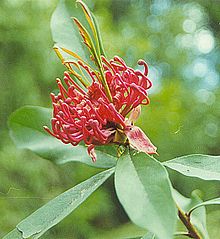
Telopea oreades, commonly known as the Gippsland-, mountain- or Victorian waratah, is a large shrub or small tree in the family Proteaceae. Native to southeastern Australia, it is found in wet sclerophyll forest and rainforest on rich acidic soils high in organic matter. No subspecies are recognised, though a northern isolated population hybridises extensively with the Braidwood waratah (T. mongaensis). Reaching a height of up to 19 metres (62 feet), T. oreades grows with a single trunk and erect habit. It has dark green leaves with prominent veins that are 11–28 centimetres (4.3–11 in) long and 1.5–6 cm (0.6–2.4 in) wide. The red flower heads, known as inflorescences, appear in late spring. Each is composed of up to 60 individual flowers.
In the garden, T. oreades grows in soils with good drainage and ample moisture in part-shaded or sunny positions. Several commercially available cultivars that are hybrid forms with T. speciosissima have been developed, such as the 'Shady Lady' series. The timber is hard and has been used for making furniture and tool handles. (Full article...) -
Banksia integrifolia, commonly known as the coast banksia, is a species of tree that grows along the east coast of Australia. One of the most widely distributed Banksia species, it occurs between Victoria and Central Queensland in a broad range of habitats, from coastal dunes to mountains. It is highly variable in form, but is most often encountered as a tree up to 25 metres (82 ft) in height. Its leaves have dark green upper surfaces and white undersides, a contrast that can be striking on windy days.
It is one of the four original Banksia species collected by Sir Joseph Banks in 1770, and one of four species published in 1782 as part of Carolus Linnaeus the Younger's original description of the genus. It has had a complicated taxonomic history, with numerous species and varieties ascribed to it, only to be rejected or promoted to separate species. Modern taxonomy recognises three subspecies: B. integrifolia subsp. integrifolia, B. integrifolia subsp. compar and B. integrifolia subsp. monticola. (Full article...) -
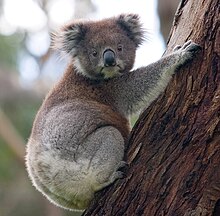
The koala (Phascolarctos cinereus), sometimes called the koala bear, is an arboreal herbivorous marsupial native to Australia. It is the only extant representative of the family Phascolarctidae and its closest living relatives are the wombats. The koala is found in coastal areas of the mainland's eastern and southern regions, inhabiting Queensland, New South Wales, Victoria, and South Australia. It is easily recognisable by its stout, tailless body and large head with round, fluffy ears and large, dark nose. The koala has a body length of 60–85 cm (24–33 in) and weighs 4–15 kg (9–33 lb). Fur colour ranges from silver grey to chocolate brown. Koalas from the northern populations are typically smaller and lighter in colour than their counterparts further south. These populations possibly are separate subspecies, but this is disputed.
Koalas typically inhabit open Eucalyptus woodland, as the leaves of these trees make up most of their diet. This eucalypt diet has low nutritional and caloric content and contains toxic compounds that deter most other mammals from feeding on it. Koalas are largely sedentary and sleep up to twenty hours a day. They are asocial animals, and bonding exists only between mothers and dependent offspring. Adult males communicate with loud bellows that intimidate rivals and attract mates. Males mark their presence with secretions from scent glands located on their chests. Being marsupials, koalas give birth to underdeveloped young that crawl into their mothers' pouches, where they stay for the first six to seven months of their lives. These young koalas, known as joeys, are fully weaned around a year old. Koalas have few natural predators and parasites, but are threatened by various pathogens, such as Chlamydiaceae bacteria and koala retrovirus. (Full article...) -

The smooth toadfish (Tetractenos glaber) is a species of fish in the pufferfish family Tetraodontidae. It is native to shallow coastal and estuarine waters of southeastern Australia, where it is widespread and abundant. French naturalist Christophe-Paulin de La Poix de Fréminville described the species in 1813, though early records confused it with its close relative, the common toadfish (T. hamiltonii). The two are the only members of the genus Tetractenos after going through several taxonomic changes since discovery.
Up to 16 cm (6+1⁄4 in) long with distinctive leopard-like dark markings on its dorsal side, the smooth toadfish has a rounded front and tapers to a narrow tail at the back. Unlike most of its relatives, it does not have prominent spines on its body. Like other pufferfish, it can inflate itself with water or air. It forages for its preferred foods—molluscs and crustaceans—in sand and mud of the bottom sediment. Often an unwanted catch by anglers, the smooth toadfish is highly poisonous because of the tetrodotoxin present in its body, and eating it may result in death. (Full article...) -
Catherine Elise Blanchett AC (/ˈblæntʃɪt/ BLAN-chit; born 14 May 1969) is an Australian actor and producer. Often regarded as one of the best performers of her generation, she is recognised for her versatile work across independent films, blockbusters and the stage. Blanchett has received numerous accolades, including two Academy Awards, four British Academy Film Awards and four Golden Globe Awards, in addition to nominations for two Primetime Emmy Awards and a Tony Award.
A graduate of the National Institute of Dramatic Art, Blanchett began her career on the Australian stage. Making her feature film debut in 1997, she came to international prominence for her portrayal of Queen Elizabeth I in the period drama Elizabeth (1998), for which she received her first Academy Award nomination. Her portrayal of Katharine Hepburn in the biopic The Aviator (2004) won her the Academy Award for Best Supporting Actress. She later won the Academy Award for Best Actress for playing a neurotic former socialite in the comedy-drama Blue Jasmine (2013). Blanchett's other Oscar-nominated roles were in Notes on a Scandal (2006), I'm Not There (2007), Elizabeth: The Golden Age (2007), Carol (2015), and Tár (2022), making her the most-nominated Australian. Her biggest commercial successes include The Lord of the Rings trilogy (2001–2003), Indiana Jones and the Kingdom of the Crystal Skull (2008), The Curious Case of Benjamin Button (2008), Cinderella (2015), Thor: Ragnarok (2017), Ocean's 8 (2018), and Don't Look Up (2021). (Full article...) -
Monaro Highway is a 285-kilometre-long (177 mi) highway in Victoria, New South Wales, and the Australian Capital Territory, in Australia, linking Cann River in Victoria to Canberra in the Australian Capital Territory (ACT) via the Monaro region. From its southern terminus, it follows the nearby Cann River upstream towards the New South Wales border through heavily forested terrain. Within New South Wales (NSW), it makes its way through further forest before reaching the pastures typical of the Monaro. There are multiple towns and villages along the highway, including Bombala, Nimmitabel, and Cooma. The terrain within the Monaro is largely hilly, and there are numerous crossings. The road also parallels the former Bombala railway line in several locations. Within the ACT, the road becomes a high volume roadway and serves the southern suburbs of Canberra. The highway has more recently had a grade-separated dual carriageway extension constructed within Canberra, as part of the Eastern Parkway construction project. It is designated part of route M23, and route A23 within Canberra, and route B23 within Victoria and New South Wales, with a concurrency where it also carries route B72 between the two sections of Snowy Mountains Highway. (Full article...) -
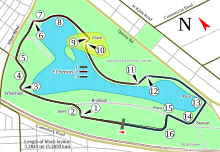
The 2002 Australian Grand Prix (formally the 2002 Foster's Australian Grand Prix) was a Formula One motor race contested on 3 March 2002 at the Albert Park Circuit, Albert Park, Melbourne, Victoria, Australia. The race, which drew 127,000 spectators, was the first of the 2002 Formula One World Championship and the 18th Formula One Australian Grand Prix. Ferrari's Michael Schumacher won the 58-lap race after starting second. Williams' Juan Pablo Montoya finished second, and McLaren's Kimi Räikkönen took third, his maiden podium finish.
Ferrari's Rubens Barrichello took pole position after setting the best qualifying lap. He retired at the start of the race after braking too early for the first corner, catching Williams driver Ralf Schumacher, who collided with the rear of Barrichello's car. Six drivers were involved in a separate incident. The safety car was deployed for four laps to clear the track. McLaren's David Coulthard led the first ten laps before a mistake on lap eleven allowed Michael Schumacher to pass him. Montoya then passed Schumacher for first place on lap twelve. He maintained the lead until he ran wide and Michael Schumacher passed him to retake it. He led the rest of the race to claim his 54th career victory. (Full article...) -
William Johnson (born 27 February 1959) is a former English cricketer. Johnson was a right-handed batsman who bowled right-arm off break. He was born in Sunderland, County Durham.
Johnson made his debut for Durham against Bedfordshire in 1986 Minor Counties Championship. He played Minor counties cricket for Durham from 1986 to 1988, making 7 Minor Counties Championship appearances and 4 MCCA Knockout Trophy appearances. He made his only List A appearance against Somerset in the 1988 NatWest Trophy. He scored 16 runs in this match, before being dismissed by Gary Palmer. (Full article...) -
Neighbours is an Australian television soap opera, which has aired since 18 March 1985. It was created by television executive Reg Watson. The Seven Network commissioned the show following the success of Watson's earlier soap Sons and Daughters. Although successful in Melbourne, Neighbours underperformed in the Sydney market and was cancelled by Seven four months after it began airing. It was immediately commissioned by rival Network Ten for a second production season, which began screening on 20 January 1986. Neighbours became the longest-running drama series in Australian television history. In 2005, it was inducted into the Logie Hall of Fame.
The storylines concern the lives of the people who live and work in Erinsborough, a fictional suburb of Melbourne, Victoria. The series centres on the residents of Ramsay Street, a cul-de-sac, and its neighbouring area, the Lassiters complex, which includes a bar, hotel, café, police station, lawyers' office and park. Neighbours began with a focus on three households created by Watson – including the Ramsay and Robinson families, who have a long history and an ongoing rivalry. Over the serial's early years, three additional houses on the street were introduced as regular settings. Pin Oak Court, in Vermont South, is the real cul-de-sac that has doubled for Ramsay Street. The houses featured are real and the residents allow the production to shoot external scenes in their yards. The interior scenes are filmed at the FremantleMedia studios in Forest Hill. (Full article...) -
The St Kilda Football Club, nicknamed the Saints, is a professional Australian rules football club based in Melbourne, Victoria. The club plays in the Australian Football League (AFL), the sport's premier league.
The club's name originates from its original home base in the bayside Melbourne suburb of St Kilda in which the club was established in 1873. The club also has strong links to the south-eastern suburb of Moorabbin due to it being the long-standing location of their training ground. (Full article...) -
Kew Lunatic Asylum is a decommissioned psychiatric hospital located between Princess Street and Yarra Boulevard in Kew, a suburb of Melbourne, Australia. Operational from 1871 to 1988, Kew was one of the largest asylums ever built in Australia. Later known as Willsmere, the complex of buildings were constructed between 1864 and 1872 to the design of architects G.W. Vivian and Frederick Kawerau of the Victorian Public Works Office to house the growing number of "lunatics", "inebriates", and "idiots" in the Colony of Victoria.
The first purpose-built asylum in the Colony of Victoria, Kew was also larger and more expensive than its sister asylums at Ararat and Beechworth. The asylum's buildings are typical examples of the Italianate architecture style which was popular in Victorian Melbourne. Designed to be elegant, beautiful, yet substantial, and to be viewed as "a magnificent asylum for the insane" with the aim of portraying Melbourne as a civilised and benevolent city whilst avoiding the jail-like appearance of other asylums. These aims were furthered by the use of low ha-ha walls and extensively landscaped grounds. Long considered of cultural and historic significance to Melbourne, Kew Asylum and its complex of buildings were registered on the Register of the National Estate in March 1978. (Full article...) -
Sir Thomas Walter White, KBE, DFC, VD (26 April 1888 – 13 October 1957) was an Australian politician and pilot in the First World War. In 1914 he became one of the first airmen trained for the Australian Flying Corps (AFC), and the following year he was among the first AFC members to see action when he was deployed to the Middle East with the Mesopotamian Half Flight. After carrying out several missions behind Turkish lines, he was captured in November 1915 but escaped in July 1918. White was awarded the Distinguished Flying Cross and twice mentioned in despatches for his war service. He married Vera Deakin, a Red Cross worker and daughter of former Australian prime minister Alfred Deakin, in 1920.
White began his parliamentary career in 1929 when he was elected to the House of Representatives as the Member for Balaclava in Victoria. He served as Minister for Trade and Customs in Joseph Lyons's United Australia Party government from 1933 to 1938, but resigned when he was excluded from Lyons's inner cabinet. He joined the Royal Australian Air Force (RAAF) shortly after the outbreak of the Second World War and saw service in Australia and the United Kingdom. Returning to parliament as a member of the newly formed Liberal Party in 1945, he served as Minister for Air and Minister for Civil Aviation in Robert Menzies's government from 1949 to 1951. His term coincided with the commitment of RAAF squadrons to the Korean War and the Malayan Emergency. Australia's high commissioner to the United Kingdom from 1951 to 1956, White was knighted in 1952 and died in 1957. (Full article...) -
Amanda Carter (born 16 July 1964) is an Australian Paralympic wheelchair basketball player. Diagnosed with transverse myelitis at the age of 24, she began playing wheelchair basketball in 1991 and participated in the Australia women's national wheelchair basketball team, the Gliders, at three Paralympics from 1992 to 2000. An injury in 2000 forced her to withdraw from the sport, but she came back to the national team in 2009, and was a member of the team that represented Australia and won silver at the 2012 London Paralympics.
Due to her 2000 injury, Carter lost considerable mobility in her right arm, and required an elbow reconstruction. She spent 11 weeks on a continuous passive motion machine, and nine operations were required to treat the elbow. After her comeback in 2008, she played for the Dandenong Rangers in the Australian Women's National Wheelchair Basketball League (WNWBL), the team she had played for before her injury. That year she received a player award from the Dandenong Rangers and was named the Most Valuable Player (MVP) in her 1-point disability classification in the WNWBL and was named to the league's All Star Five. The Rangers won back-to-back WNWBL titles in 2011 and 2012, and she was again named the WNWBL MVP 1 Pointer and to the league's All Star Five in 2012. (Full article...) -

Melbourne Airport (IATA: MEL, ICAO: YMML), known locally as Tullamarine Airport, is the main international airport serving the city of Melbourne, the capital of the Australian state of Victoria. It is the second busiest airport in Australia. The airport operates 24/7 and has on-site parking, world-class shopping and dining. The airport opened in 1970 and replaced Essendon Airport. Melbourne Airport is the main international airport of the four airports serving the Melbourne metropolitan area, the other international airport being Avalon Airport.
The airport comprises four terminals: one international terminal, two domestic terminals and one budget domestic terminal. It is 18 kilometres (11 miles) northwest of the city centre, adjacent to the suburb of Tullamarine. The airport has its own suburb with its own postcode—Melbourne Airport, Victoria, 3045 respectively. The facility presently covers 2,741 hectares (6,773 acres) of airport property, making MEL among the largest airports in Australia in terms of land area. (Full article...) -
Jessica Gallagher (born 14 March 1986) is an Australian Paralympic alpine skier, track and field athlete, tandem cyclist and rower. She was Australia's second female Winter Paralympian, and the first Australian woman to win a medal at the Winter Paralympics at the 2010 Vancouver Games. She competed at the 2014 Winter Paralympics in Sochi, where she won a bronze medal in the women's giant slalom visually impaired.
She is legally blind, and represents Australia internationally in three sports: skiing, athletics and cycling. Besides her skiing achievements, she has represented Australia in athletics at the 2012 Summer Paralympics in London, and won a silver and a bronze medal at the 2011 Christchurch IPC Athletics World Championships in long jump and javelin, respectively. She has also represented the state of Victoria as a junior in netball and basketball. Gallagher was selected in the Australian cycling team with her pilot Madison Janssen for the 2016 Rio Paralympics. Her "long term goal is to be the first Australian to medal at a summer and winter Paralympics or Olympics". This was achieved when she won a bronze medal in the women's B/VI 1000m time trial in Rio. (Full article...) -

Persoonia linearis, commonly known as the narrow-leaved geebung, is a shrub native to New South Wales and Victoria in eastern Australia. It reaches 3 m (9.8 ft), or occasionally 5 m (16 ft), in height and has thick, dark grey papery bark. The leaves are, as the species name suggests, more or less linear in shape, and are up to 9 cm (3.5 in) long, and 0.1 to 0.7 cm (0.039 to 0.276 in) wide. The small yellow flowers appear in summer, autumn and early winter (December to July), followed by small green fleshy fruit known as drupes. Within the genus Persoonia, it is a member of the Lanceolata group of 58 closely related species. P. linearis interbreeds with several other species where they grow together.
Found in dry sclerophyll forest on sandstone-based nutrient-deficient soils, P. linearis is adapted to a fire-prone environment; the plants resprout epicormic buds from beneath their thick bark after bushfires. The fruit are consumed by vertebrates such as kangaroo, possums and currawongs. As with other members of the genus, P. linearis is rare in cultivation as it is very hard to propagate by seed or by cuttings, but once propagated, it adapts readily, preferring acidic soils with good drainage and at least a partly sunny aspect. (Full article...) -
Reginald Walter Saunders, MBE (7 August 1920 – 2 March 1990) was the first Aboriginal Australian to be commissioned as an officer in the Australian Army. He came from a military family, his forebears having served in the Boer War and the First World War. Enlisting as a soldier in 1940, he saw action during the Second World War in North Africa, Greece and Crete, before being commissioned as a lieutenant and serving as a platoon commander in New Guinea during 1944–1945. His younger brother Harry also joined the Army, and was killed in 1942 during the Kokoda Track campaign.
After the war, Saunders was demobilised and returned to civilian life. He later served as a company commander with the 3rd Battalion, Royal Australian Regiment (3 RAR) during the Korean War, where he fought at the Battle of Kapyong. Saunders left the Army in 1954 and worked in the logging and metal industries, before joining the Office of Aboriginal Affairs (later the Department of Aboriginal Affairs) as a liaison officer in 1969. In 1971, he was appointed a Member of the Order of the British Empire (MBE) for his community service. He died in 1990, aged 69. (Full article...) -
The 2018 season was the Geelong Football Club's 119th in the Australian Football League (AFL). It was the club's eighth season under senior coach Chris Scott, with Joel Selwood appointed as club captain for a seventh successive year. Geelong (known as the Cats) participated in both the inaugural AFLX competition and the 2018 JLT Community Series as part of their pre-season schedule, and the club's regular season began on 25 March against Melbourne at the Melbourne Cricket Ground (MCG). The Cats finished the home-and-away season with a 13–9 win–loss record and placed eighth on the league's ladder, qualifying for the 2018 finals series as a result. Geelong were defeated in an elimination final against Melbourne by 29 points, and therefore did not progress past the first finals week.
Mark Blicavs was named Geelong's best and fairest player, polling 234 votes for the Carji Greeves Medal ahead of joint runners-ups Patrick Dangerfield and Tim Kelly on 233.5 votes each. It was Blicavs' second Carji Greeves Medal, having previously won the award for the 2015 season. Tom Hawkins was the club's leading goalkicker for the seventh successive season, scoring 60 goals. Dangerfield and Tom Stewart were selected in the 2018 All-Australian team, with Stewart also receiving the AFL Coaches Association's Best Young Player award. The Cats also fielded a reserves team in the Victorian Football League (VFL) and a women's team in the VFL Women's (VFLW) competition. The women's team finished runners-up after they were defeated in the VFLW Grand Final by Hawthorn. (Full article...) -

The Old Melbourne Gaol is a former jail and current museum on Russell Street, in Melbourne, Victoria, Australia. It consists of a bluestone building and courtyard, and is located next to the old City Police Watch House and City Courts buildings, and opposite the Russell Street Police Headquarters. It was first constructed starting in 1839, and during its operation as a prison between 1845 and 1924, it held and executed some of Australia's most notorious criminals, including bushranger Ned Kelly and serial killer Frederick Bailey Deeming. In total, 133 people were executed by hanging. Though it was used briefly during World War II, it formally ceased operating as a prison in 1924; with parts of the jail being incorporated into the RMIT University, and the rest becoming a museum.
The three-storey museum displays information and memorabilia of the prisoners and staff, including death masks of the executed criminals. At one time the museum displayed what was believed at the time to be Ned Kelly's skull, before it was stolen in 1978; as well as the pencil used by wrongly convicted Colin Campbell Ross to protest his innocence in writing, before being executed. (Full article...) -
Ian William Geddes Johnson, CBE (8 December 1917 – 9 October 1998) was an Australian cricketer who played 45 Test matches as a slow off-break bowler between 1946 and 1956. Johnson captured 109 Test wickets at an average of 29.19 runs per wicket and as a capable lower order batsman made 1,000 runs at an average of 18.51 runs per dismissal. He captained the Australian team in 17 Tests, winning seven and losing five, with a further five drawn. Despite this record, he is better known as the captain who lost consecutive Ashes series against England. Urbane, well-spoken and popular with his opponents and the public, he was seen by his teammates as a disciplinarian and his natural optimism was often seen as naive.
Aged 17, Johnson made his first-class cricket debut for Victoria in the 1935–36 season but did not establish a permanent place in the team until 1939–40. His career was interrupted by the Second World War; he served with the Royal Australian Air Force as a pilot and later as a flight instructor. He returned to cricket after his discharge and was selected to tour New Zealand with the Australian team, making his Test debut. Johnson was part of Don Bradman's Invincibles team; undefeated on tour in England in 1948. He was a regular member of the national side until poor form saw him left out of the Australian squad for the 1953 tour of England. (Full article...) -
William Harold Ponsford MBE (19 October 1900 – 6 April 1991) was an Australian cricketer. Usually playing as an opening batsman, he formed a successful and long-lived partnership opening the batting for Victoria and Australia with Bill Woodfull, his friend and state and national captain. Ponsford is the only player to twice break the world record for the highest individual score in first-class cricket; Ponsford and Brian Lara are the only cricketers to twice score 400 runs in an innings. Ponsford holds the Australian record for a partnership in Test cricket, set in 1934 in combination with Don Bradman (451 for 2nd wicket)—the man who broke many of Ponsford's other individual records. In fact, he along with Bradman set the record for the highest partnership ever for any wicket in Test cricket history when playing on away soil (451 runs for the second wicket)
Despite being heavily built, Ponsford was quick on his feet and renowned as one of the finest ever players of spin bowling. His bat, much heavier than the norm and nicknamed "Big Bertha", allowed him to drive powerfully and he possessed a strong cut shot. However, critics questioned his ability against fast bowling, and the hostile short-pitched English bowling in the Bodyline series of 1932–33 was a contributing factor in his early retirement from cricket a year and a half later. Ponsford also represented his state and country in baseball, and credited the sport with improving his cricketing skills. (Full article...) -
Sir Wilfrid Selwyn "Bill" Kent Hughes, KBE, MVO, MC (12 June 1895 – 31 July 1970) was an Australian army officer and politician who had a long career in both state and federal politics, most notably as a minister in the Menzies government. He also had a longstanding involvement with the Olympic movement, as both an athlete and organiser.
Kent Hughes was born in Melbourne to an upper middle-class family. He won a Rhodes Scholarship in 1914, but postponed his studies to join the Australian Imperial Force. He entered Christ Church, Oxford, in 1919, and combined his studies with his sporting career, representing Australia in hurdling at the 1920 Summer Olympics. Kent Hughes returned home in 1923 and began working at his father's publishing company. He was elected to the Victorian Legislative Assembly in 1927, representing the Nationalist Party. He joined the new United Australia Party in 1931, and the following year was made a minister in the government of Stanley Argyle. He served as the party's deputy leader from 1935 to 1939. (Full article...) -
The Australian Academy of Cinema and Television Arts (AACTA) is a professional organisation of film and television practitioners in Australia. The Academy's aim is "to identify, award, promote, and celebrate Australia's greatest achievements in film and television".
It was established in August 2011 with the backing of the Australian Film Institute (AFI) to act as its industry engagement arm and to administer the AACTA Awards (formerly the Australian Film Institute Awards, also known as the AFI Awards) which rewards achievements in Australian feature film, television, documentary and short films. (Full article...) -

Catherine Baker OBE (1861–1953) was an Irish-born Australian teacher best known for championing the work of her friend Joseph Furphy, whose novel Such Is Life had received an indifferent reception upon its initial publication in 1909 but was later embraced by critics and the public. Miles Franklin incorporated Baker's recollections into the essay "Who Was Joseph Furphy?", which won the S. H. Prior Memorial Prize in 1939. Baker was appointed an OBE in 1937 for her efforts in promoting Furphy's work and to broader Australian literature. She was an influential part of the Australian literary scene, supporting, writing to and encouraging writers such as Ada Cambridge, Victor Kennedy, Edith Coleman, the poet Marie E. J. Pitt, journalist Alice Henry and the poet John Shaw Neilson. She was made a life member of the Henry Lawson Society, and honored with a bronze plaque by the society in 1936. Shortly before her death in 1953 she was made vice-president of the Australian Council for Civil Liberties. (Full article...)


.jpg)


.jpg)


.jpg)

.jpg)


Selected image
.jpeg)
The Geelong Waterfront is a tourist and recreation area on the north facing shores of Corio Bay in Geelong, Australia. The area was once part of the Port of Geelong, falling into disuse before being redeveloped during the 1990s.
Related portals

(Northern
Territory) |
WikiProjects


Selected articles -
-
The North Melbourne Football Club, nicknamed the Kangaroos, is a professional Australian rules football club. The men's team competes in the Australian Football League (AFL), and the women's team in the AFL Women's (AFLW). The Kangaroos also field a reserves men's team in the Victorian Football League (VFL) and women's team in the VFLW.
Founded in the suburb of North Melbourne in 1869 and based at the Arden Street Oval, it is the 4th oldest club in the competition and one of the oldest surviving clubs in the world. Its original home at Arden Street continues to serve as its headquarters, training facilities and home ground for its women's side. The club's senior men's team plays its home matches at Marvel Stadium in the Docklands area of Melbourne, Victoria, as well as Blundstone Arena in Hobart, Tasmania which is also used by the women's team as a secondary home ground. (Full article...) -
Coburg is a suburb in Melbourne, Victoria, Australia, 8 km (5.0 mi) north of Melbourne's Central Business District, located within the Cities of Darebin and Merri-bek local government areas. Coburg recorded a population of 26,574 at the 2021 census.
Although most of Coburg is within the City of Merri-bek, a handful of properties on Elizabeth Street, Coburg's eastern boundary, are located in the City of Darebin. (Full article...) -

Geelong Waterfront
The Geelong Waterfront is a tourist and recreation area on the north facing shores of Corio Bay in Geelong, Australia. The area was once part of the Port of Geelong, falling into disuse before being redeveloped during the 1990s. (Full article...) -
The Twelve Apostles are a collection of limestone stacks off the shore of Port Campbell National Park, by the Great Ocean Road in Victoria, Australia. The Twelve Apostles are located on the traditional lands of the Eastern Maar peoples.
Their proximity to one another has made the site a popular tourist attraction. Eight of the original nine stacks remain standing at the Twelve Apostles' viewpoint, after one collapsed in July 2005. Though the view from the promontory by the Twelve Apostles never included twelve stacks, additional stacks—not considered part of the Apostles group—are located to the west within the national park. (Full article...) -

Warragul is a town in Victoria, Australia, 102 kilometres (63 miles) south-east of Melbourne. Warragul lies between the Strzelecki Ranges to the south and the Mount Baw Baw Plateau of the Great Dividing Range to the north. As of the 2021 census, the town had a population of 19,856 people. Warragul forms part of a larger urban area that includes nearby Drouin that had an estimated total population of 42,827 as of the 2021 census.
Warragul is the main population and service centre of the West Gippsland region and the Shire of Baw Baw. The surrounding area is noted for dairy farming and other niche agriculture and has long been producing gourmet foods. (Full article...) -
The Old Melbourne Gaol is a former jail and current museum on Russell Street, in Melbourne, Victoria, Australia. It consists of a bluestone building and courtyard, and is located next to the old City Police Watch House and City Courts buildings, and opposite the Russell Street Police Headquarters. It was first constructed starting in 1839, and during its operation as a prison between 1845 and 1924, it held and executed some of Australia's most notorious criminals, including bushranger Ned Kelly and serial killer Frederick Bailey Deeming. In total, 133 people were executed by hanging. Though it was used briefly during World War II, it formally ceased operating as a prison in 1924; with parts of the jail being incorporated into the RMIT University, and the rest becoming a museum.
The three-storey museum displays information and memorabilia of the prisoners and staff, including death masks of the executed criminals. At one time the museum displayed what was believed at the time to be Ned Kelly's skull, before it was stolen in 1978; as well as the pencil used by wrongly convicted Colin Campbell Ross to protest his innocence in writing, before being executed. (Full article...) -
Melbourne Vixens is an Australian professional netball team based in Melbourne, Victoria. Since 2017 they have represented Netball Victoria in Suncorp Super Netball. Between 2008 and 2016, they played in the ANZ Championship. The team was formed in 2007 when Netball Victoria merged its two former Commonwealth Bank Trophy league teams, Melbourne Phoenix and Melbourne Kestrels. Vixens have won three premierships, in 2009, 2014 and 2020. (Full article...)
-
Geelong (/dʒɪˈlɒŋ/ jih-LONG) (Wathawurrung: Djilang/Djalang) is a port city in Victoria, Australia, located at the eastern end of Corio Bay (the smaller western portion of Port Phillip Bay) and the left bank of Barwon River, about 65 km (40 mi) southwest of Melbourne.
Geelong is the second largest Victorian city behind Melbourne with an estimated urban population of 268,277 as of June 2018, and is also Australia's second fastest-growing city. Geelong is also known as the "Gateway City" due to its critical location to surrounding western Victorian regional centres including Ballarat in the northwest, Torquay, Great Ocean Road and Warrnambool in the southwest, Hamilton, Colac and Winchelsea to the west, providing a transport corridor past the Central Highlands for these regions to the state capital Melbourne in its northeast. The City of Greater Geelong is also a member of the Gateway Cities Alliance in partnership with Councils from Newcastle and Wollongong. (Full article...) -
The Hawthorn Football Club, nicknamed the Hawks, is a professional Australian rules football club based in Mulgrave, Victoria, that competes in the Australian Football League (AFL). The club was founded in 1902 in the inner-east suburb of Hawthorn, making it the youngest Victorian-based team in the AFL.
Hawthorn is the only club to have won premierships in each decade of the 1960s, 1970s, 1980s, 1990s, 2000s, and 2010s. In total, it has won 13 senior VFL/AFL premierships. The team play in brown-and-gold vertically striped guernseys. The club's Latin motto is spectemur agendo, the English translation being "Let us be judged by our acts." (Full article...) -
Flinders Street railway station is a train station located on the corner of Flinders and Swanston streets in Melbourne, Victoria, Australia. It is the busiest train station in Australia, serving the entire metropolitan rail network, 15 tram routes travelling to and from the city, as well as some country and regional V/Line services to eastern Victoria. Opened in 1854, the station is the oldest in Australia, backing onto the Yarra River in the central business district, the complex includes 13 platforms and structures that stretch over more than two city blocks, from east of Swanston Street to nearly at Market Street.
Flinders Street is served by Metro Trains services and V/Line regional services to Gippsland. It is the busiest station on Melbourne's metropolitan network, with an average of 77,153 daily entries recorded in the 2017/18 fiscal year. It was the terminus of the first railway in Australia (the Port Melbourne line) and was reputedly the world's busiest passenger station in the 1920s, owing to the concentration of services there that was only rectified with the construction of the City Loop in the 1970s. Its main platform (operationally divided into platforms 1 and 14) is Australia's 2nd longest, and the eighteenth longest railway platform in the world. Flinders Street connects with several tram services and is responsible for two of Melbourne's busiest pedestrian crossings, both across Flinders Street, including one of Melbourne's few pedestrian scrambles. (Full article...) -
The Dandenong Ranges (commonly just The Dandenongs) are a set of low mountain ranges in Victoria, Australia, approximately 35 km (22 mi) east of the state capital Melbourne. A minor branch of the Great Dividing Range, the Dandenongs consist mostly of rolling hills, rising to 633 m (2,077 ft) at Mount Dandenong, as well as steeply weathered valleys and gullies covered in thick temperate rainforest, predominantly of tall mountain ash trees and dense ferny undergrowth. The namesaked Dandenong Creek and most of its left-bank tributaries (particularly the Eumemmerring Creek) originate from headwaters in these mountain ranges. Two of Melbourne's most important storage reservoirs, the Cardinia and Silvan Reservoir, are also located within the Dandenongs.
After European settlement in the Port Phillip Bay region, the range was used as a major local source of timber for Melbourne. The ranges were popular with day-trippers from the 1870s onwards. Much of the Dandenongs were protected by parklands as early as 1882 and by 1987 these parklands were amalgamated to form the Dandenong Ranges National Park, which was subsequently expanded in 1997. The range receives light to moderate snowfalls a few times in most years, frequently between late winter and late spring. (Full article...) -

Docklands Stadium, known by naming rights sponsorship as Marvel Stadium, is a multi-purpose sports and entertainment stadium in the suburb of Docklands in Melbourne, Victoria, Australia. Construction started in October 1997 and was completed in 2000 at a cost of A$460 million ($930 million in 2023 terms). The stadium features a retractable roof and the ground level seating can be converted from oval to rectangular configuration.
The stadium is primarily used for Australian rules football and was originally built as a replacement for Waverley Park. Offices at the precinct serve as the headquarters of the Australian Football League (AFL) which, since October 2016, has had exclusive ownership of the venue. With a capacity for over 53,000 spectators for sports, it is the second-largest stadium in Melbourne after the Melbourne Cricket Ground. It has hosted a number of other sporting events—including domestic Twenty20 cricket matches, Melbourne Victory soccer home matches, rugby league and rugby union matches, as well as special events and concerts. The precinct is headquarters for the Seven Network's digital broadcast centre and an NAB branch. (Full article...) -
Collingwood is an inner-city suburb in Melbourne, Victoria, Australia, 3km north-east of the Melbourne central business district, located within the City of Yarra local government area. Collingwood recorded a population of 9,179 at the 2021 census.
The area now known as Collingwood is thought to have been named Yálla-birr-ang by the Wurundjeri people, the original Indigenous inhabitants of the area. Following colonisation, the suburb was named in 1842 after Baron Collingwood or an early hotel which bore his name. Collingwood is one of the oldest suburbs in Melbourne and is bordered by Smith Street, Alexandra Parade, Hoddle Street and Victoria Parade. (Full article...) -
Luna Park Melbourne is a historic amusement park located on the foreshore of Port Phillip Bay in St Kilda, Melbourne, Victoria. It opened on 13 December 1912, with a formal opening a week later, and has been operating almost continuously ever since. (Full article...) -
Hawthorn is an inner suburb of Melbourne, Victoria, Australia, 6 kilometres (3.7 mi) east of Melbourne's central business district, located within the City of Boroondara local government area. Hawthorn recorded a population of 22,322 at the 2021 census. (Full article...)


Did you know (auto-generated)

- ... that the government of Victoria, Australia, has a program to remove 110 level crossings by 2030, the fastest rate in the state's history?
- ... that the Victoria State Government has ordered 100 G-class trams, which is the largest domestic order in Australian history?
- ... that Genevieve Beacom became the first woman to pitch in the Australian Baseball League when she made her debut for the Melbourne Aces in 2022?
- ... that Cheok Hong Cheong sold bananas for a decade, after which he became superintendent of the Church of England of Melbourne?
Subcategories

In the News (for Australia)
No recent news
Topics
| Topics | | ||||||||||||||||
|---|---|---|---|---|---|---|---|---|---|---|---|---|---|---|---|---|---|
| Regions and sub-regions / districts |
| ||||||||||||||||
| Cities and towns | |||||||||||||||||


To-do list
Here are some tasks you can do to help at WikiProject Victoria:
-
Requests: - Missing topics
- Byrne, Victoria - request from pre 2016
- Local Government Association of Victoria - request from pre 2016
- Maroon, Victoria - request from pre 2016
- University of Western Victoria - request from pre 2016
- Lincoln Square (Melbourne)
- Awakenings Festival - Horsham
- Central Goulburn Irrigation Area
- Rochester Irrigation Area
- Wimmera Mallee Pipeline Project
- Heytesbury fires - (1886)
- Victoria bushfire season 1969 - Lara (1969)
- Barwon (region) - sub region of Barwon South West (region)
- Great South Coast (region) - sub region of Barwon South West (region)
- Loddon Campaspe (region) - sub region of Loddon Mallee
- Redlinks in navbox (Protected areas in Victoria)
- Aura Vale Lake Park (part of Cardinia Reservoir Parks)
- Barwon Bluff Marine Sanctuary
- Beechworth Historic Park
- Beware Reef Marine Sanctuary
- Birrarrung Park (part of Yarra Valley Parklands)
- Candlebark Park (part of Yarra Valley Parklands)
- Cape Liptrap Coastal Park
- Cardinia Creek Parklands
- Cardinia Reservoir Parks
- Corner Inlet Marine and Coastal Park
- Eagle Rock Marine Sanctuary
- Jawbone Marine Sanctuary
- Lake Tyers State Park
- Longridge Park Camp (part of Yarra Valley Parklands)
- Marengo Reefs Marine Sanctuary
- Maribyrnong Valley Parklands
- Maroondah Reservoir Park
- Merri Marine Sanctuary
- Mushroom Reef Marine Sanctuary
- Nooramunga Marine and Coastal Park
- Nortons Park (part of Dandenong Valley Parklands)
- Point Cooke Marine Sanctuary - part covered in Point Cook Coastal Park#Marine
- Point Danger Marine Sanctuary
- Point Gellibrand Heritage Park
- Ricketts Point Marine Sanctuary
- Shallow Inlet Marine and Coastal Park
- Shepherds Bush (Victoria) (part of Dandenong Valley Parklands)
- Silvan Reservoir Park
- Steiglitz Historic Park
- Sugarloaf Reservoir Parks
- The Arches Marine Sanctuary
- Tirhatuan Park (part of Dandenong Valley Parklands)
- Wabba Wilderness Park
- Wilsons Promontory Marine Park
- Wimmera River Heritage Area Park
- Woodlands Historic Park
- Yarra Flats Park (part of Yarra Valley Parklands)
- Yarra Valley Parklands
-
Expand: - stubs: 5,072
- List of schools in Victoria
- Mount Rothwell Biodiversity Interpretation Centre
- Melbourne Workers Theatre
- City West Water
- Belgrave Lantern Festival
- Red Tuesday bushfires - (1898)
- 1925–26 Victorian bushfire season - Black Sunday (1926)
- Linton Bushfire - (1998)
- 2003 Eastern Victorian alpine bushfires
- Mount Lubra bushfire - (2006)
- 2006–07 Eastern Victoria Great Divide bushfires
- Goulburn (region) - sub region of Hume (region)
- Ovens Murray (region) - sub region of Hume (region)
- Images: - requested images: 260

A list of articles needing cleanup associated with this project is available. See also the tool's wiki page and the index of WikiProjects.
Geelong To-do
|
|---|
|
Here are some tasks you can do to help at WikiProject Geelong:
A list of articles needing cleanup associated with this project is available. See also the tool's wiki page and the index of WikiProjects. |

In other projects
The following Wikimedia Foundation sister projects provide more on this subject:
-
 Commons
Free media repository -
 Wikibooks
Free textbooks and manuals -
 Wikidata
Free knowledge base -
 Wikinews
Free-content news -
 Wikiquote
Collection of quotations -
 Wikisource
Free-content library -
 Wikispecies
Directory of species -
 Wikiversity
Free learning tools -
 Wikivoyage
Free travel guide -
 Wiktionary
Dictionary and thesaurus


