


Religion in Romania
Religious affiliation in Romania according to the partial 2021 census results, given as percentages of the total stable population.[1]

Christianity is the main religion in Romania, with Romanian Orthodoxy being its largest denomination.
Romania is a secular state and freedom of religion is enshrined in the nation's constitution.
Overview[edit]
Romania is one of the most religious of European countries[2] and the majority of the country's citizens are Orthodox Christians. Romania is a secular state, and it has no state religion.
The Romanian state officially recognizes 18 religions and denominations.[3] 86.53% of the country's stable population identified as part of the Eastern Orthodox Church in the 2011 census (see also: History of Christianity in Romania). Other major Christian denominations include the Catholic Church (both Latin Catholicism (4.62%) and Greek Catholicism (0.8%–3.3%)), Calvinism (3.19%), and Pentecostal denominations (1.92%). This amounts to approximately 99% of the population identifying as Christian.[4] Romania also has a small but historically significant Muslim minority of around 44,000 people, concentrated in Northern Dobruja, who are mostly of Crimean Tatar and Turkish ethnicity. According to the 2011 census data, there are also approximately 3,500 Jews, around 21,000 atheists and about 19,000 people not identifying with any religion. The 2011 census numbers are based on a stable population of 20,121,641 people and exclude a portion of about 6% due to unavailable data.[5]
According to the 2022 census, 76,215 people, approximately 0.4% of the total population, indicated that their religion was Islam.[6]
Religious denominations[edit]
Eastern Orthodoxy[edit]

.jpg)
The Eastern Orthodox Church is the largest religious denomination in Romania, numbering 16,307,004 according to the 2011 census, or 81.04% of the population. The rate of church attendance is, however, significantly lower. According to a poll conducted by INSCOP in July 2015, 37.8% of Romanians who declare themselves to be religious go to church only on major holidays, 25.4% once a week (especially on Sunday), 18.9% once a month, 10.2% once a year or less, 3.4% say they do not go to church, 2.7% a few times a week, and only 0.9% say they go to church daily.[7]
Latin Church of the Catholic Church[edit]
According to the 2011 census, there are 870,774 Catholics belonging to the Latin Church in Romania, making up 4.33% of the population. The largest ethnic groups are Hungarians (500,444, including Székelys; 41% of the Hungarians), Romanians (297,246 or 1.8%), Germans (21,324 or 59%), and Roma (20,821 or 3.3%), as well as a majority of the country's Slovaks, Bulgarians, Croats, Italians, Czechs, Poles, and Csangos (27,296 in all).
Romanian Greek Catholic Church[edit]
According to the 2011 census, there are 150,593 Romanian Greek Catholics in Romania, making up 0.75% of the population. The majority of Greek Catholics live in the northern part of Transylvania. Most are Romanians (124,563), with the remainder mostly Hungarians or Roma.
On the other hand, according to data published in the 2016 Annuario Pontificio, the Romanian Greek-Catholic Church had 504,280 members, 8 bishops, 1,225 parishes, some 835 diocesan priests and 235 seminarians of its own rite at the end of 2012.[8][9] However, according to the 2011 Romanian government census, the number of its followers living in Romania was as low as 150,593, of which 124,563 are ethnic Romanians.[10] In 2022, the church estimated their numbers at 488,000, noting that many citizens whose ancestors were forced to covert during the Communist regime had rediscovered their roots and joined the Greek Catholic Church.[11]
The Romanian Orthodox Church continues to claim many of the Romanian Greek Catholic Church's properties.[12] The law provides for the restitution of religious properties confiscated between 1940 and 1989, if they are still owned by the state; however restitution is moving slowly.[11]
Protestantism[edit]
Protestant traditions in Romania in 2022
According to the 2021 census, Protestants make up about 6% of the total population. They have been historically been made up of Lutherans, Calvinists and Unitarians, although in recent years Evangelical Protestants, Pentecostals and newer Protestant groups spread and are holding a greater share. In 1930, prior to World War II, they constituted approximately 8.8% of the Romanian population. The largest denominations are the Reformed Church in Romania and the Pentecostal Union of Romania. Of these various Protestant groups, Hungarians account for most of the Reformed, Unitarians, and Evangelical Lutherans; Romanians are the majority of the Pentecostals, Baptists, Seventh-day Adventists and Evangelical Christians; while Germans account for most of the Augustan Confession Evangelicals (i.e. Lutherans historically subscribing to the Augsburg Confession). The majority of Calvinist (Reformed Church) and Unitarians have their services in Hungarian.
Lutheranism[edit]

Before the Partition of Hungary, the Evangelical Lutheran Church of Romania and the Evangelical Church of the Augsburg Confession in Romania were one denomination. In 1920 the german and hungarian speaking congregations officially separated into 2 distinct bodies.
Currently there are three Lutheran denominations in Romania: The larges one, the Evangelical Lutheran Church of Romania, has some Slovak and Romanian speaking congregations, but is mostly a Hungarian speaking denomination. The Evangelical Church of Augustan Confession in Romania is a strict German speaking denomination with some congregations holding bilingual services. The smallest one is the newly founded Confessional Lutheran Church in Romania, which is a Lutheran Church–Missouri Synod foreign mission with 3 congregations in Brașov, Bucharest and Suceava.[13]
Calvinism[edit]
The Reformed Church in Romania is an exclusive Hungarian speaking denomination with some 495.000 members, making it the largest protestant denomination in the country. Other calvinist denominations with presence in the country include a missionary congregation of the URCNA in Bucharest[14] and the Reformed Presbyterian Church of Central and Eastern Europe which has 13 congregations in Romania.[15]
Evangelicals[edit]
Evangelicals (or sometimes called "neo-protestants" in Romania) are mostly identified with Baptists, Plymouth Brethren, Pentecostals (both Apostolic and Assemblies) or members of various other independent churches.
Other[edit]
Not to be confused with any of the above, the Evangelical Church of Romania (0.08%), is an indigenous Eastern Protestant denomination unrelated with the other protestant traditions.
Jehovah's Witnesses[edit]
Jehovah's Witnesses were banned and persecuted in some occasions in Romania from 1948 to 1989.[16][17] In 1989, after the Romanian ban was lifted, members and representatives of the Governing Body of Jehovah's Witnesses were able to gather thousands of Romanian Jehovah's Witnesses that had been separated for a long time,[18] but some of them still rejected certain doctrinal changes and preferred their autonomy, forming The True Faith Association of Jehovah's Witnesses in 1992.[19][20]
Nowadays, Romania is the only country in the world to have 2 different Jehovah's Witnesses organizations.[19][20]
As for the main group, in 2020, the number of Jehovah's Witnesses was 39,328 active publishers, united in 535 congregations; 74,363 people attended annual celebration of Lord's Evening Meal in 2020.[21]
The Church of Jesus Christ of Latter-day Saints[edit]
The Church of Jesus Christ of Latter-day Saints (LDS Church) had some presence in the country from 1899–1913. Most of these early members emigrated to the west. The LDS Church was reintroduced in 1990 and a small branch was formed in Bucharest in 1991. In 2019, the LDS Church claimed 3,064 members in 15 congregations in Romania.[22][23]
Hinduism[edit]
 |
Since the end of World War II, thousands of Nepali, Bangladeshi and Indian immigrants have brought Hinduism with them. The International Society of Krishna Consciousness operates nearly a dozen temples throughout the nation's largest cities, such as Bucharest, Brasov, Timisaora, Oradea, and others. These temples organize large festivals with Hindu significance such as Ratha Yatra, Diwali and Durga Puja, and see thousands of attendees each year from various religions and people.
Islam[edit]

Although the number of adherents of Islam is relatively small, Islam enjoys a 700-year tradition in Romania particularly in Northern Dobruja,[24] a region on the Black Sea coast which was part of the Ottoman Empire for almost five centuries (ca. 1420–1878).[25] According to the 2011 census, 64,337 people, approx. 0.3% of the total population, indicated that their religion was Islam. The majority of the Romanian Muslims belong to the Sunni Islam.
According to the 2022 census, 76,215 people, approximately 0.4% of the total population, indicated that their religion was Islam.[6]
97% of the Romanian Muslims are residents of the two counties forming Northern Dobruja: eighty-five percent live in Constanța County, and twelve percent in Tulcea County.[24] The remaining Muslims live in cities like Bucharest, Brăila, Călărași, Galați, Giurgiu, Drobeta-Turnu Severin.[24] Ethnically, most of them are Tatars, followed by Turks, Albanians, Muslim Roma, and immigrants from the Middle East and Africa,[24][26] although there are a few ethnic Romanian converts to Islam who even established a mosque in 2014.[27][28] Since 2007, there are Indonesian, Bangladeshi and Pakistani workers coming to Romania, who are mostly Muslims.
In Romania there are about 80 mosques.[29] One of the largest is the Grand Mosque of Constanța, originally known as the Carol I Mosque. It was built between 1910 and 1913, on the order of Carol I, in appreciation for the Muslim community in Constanța. According to the legal status of the Muslim denomination, the Romanian Muslim community is officially represented by a mufti, while the Muftiat is the denominational and cultural representative institution of the Muslim community,[30] with a status similar with that of the other denominations officially recognized by the Romanian state.[31] Likewise, Muslims in Constanța, which comprise approx. 6% of the population of this county, are represented in the Parliament by the Democratic Union of Turkish-Muslim Tatars of Romania, founded on 29 December 1989.[32]
Judaism[edit]

In 1930, more than 700,000 people in the Kingdom of Romania (including Bessarabia) practiced Judaism. By 2011, that number had dropped to 3,271. A legacy of the country's once numerous Jewish congregations is the large number of synagogues throughout Romania. Today, between 200,000 and 400,000 descendants of Romanian Jews are living in Israel.
Other religions[edit]
Other denominations not listed above but recognised as official religions by the Romanian state are listed here. The Jehovah's Witnesses number around 50,000 adherents (0.25% of the stable population). Old Believers make up about 0.16% of the population with 30,000 adherents, who are mainly ethnic Russians living in the Danube Delta region. Serbian Orthodox believers are present in the areas which border Serbia and number about 14,000 people. Once fairly well represented in Romania, Judaism has fallen to around 3,500 adherents in 2011, which is about 0.02% of the population. Less still is the Armenian Christian minority, numbering about 400 people in total. The Association of Religion Data Archives reports roughly 1,900 followers of the Baháʼí Faith in the country as of 2010.[33] Lastly, the number of people who have identified with other religions than the ones explicitly mentioned in the 2011 census comes to a total of about 30,000 people.[34]
Paganism[edit]

Neopagan groups have emerged in Romania over the latest decade, virtually all of them being ethno-pagan as in the other countries of European Union,[35] although still small in comparison to other movements such as Ősmagyar Vallás in Hungary.
The revived ethnic religion of the Romanians is called Zalmoxianism and is based on Thracian mythological sources, with prominence given to the figure of god Zalmoxis.[36] One of the most prominent Zalmoxian groups is the Gebeleizis Association (Romanian: Societatea Gebeleizis).[36]
In the same time, in Romania there is a recognized pagan organization: THE NEW PAGAN DAWN Association,[37][38][39][40] which attempts to defend the rights of the pagan community in Romania and to represent its voice.
Irreligion[edit]
Approximately 40,000 people have identified as nonreligious in Romania in the 2011 census, of which 21,000 declared atheists and 19,000 agnostics. Most of them are concentrated in major cities such as Bucharest or Cluj-Napoca.[41] Irreligion is much lower in Romania than in most other European countries; one of the lowest in Europe.[42]
Other and unknown[edit]
In the 2021 Romanian census, 13.94% of respondents refused to state a religious affiliation.[1]
Attitudes towards religion[edit]
 | This section needs to be updated. The reason given is: This section needs to be updated with data and information from the 2021 census. (March 2024) |
Religious affiliation in Romania according to the 2011 census, given as percentages of the total stable population.[4]
In 2008, 19% of Romanians placed "Faith" among maximum four answers to the question "Among the following values, which one is most important in relation to your idea of happiness?". It is the third highest number, after Armenia (27%), and Georgia (26%), at equality with Turkey (19%) and Cyprus (19%). The mean in EU-27 was 9%.[43] According to a study by the Soros Foundation, over three quarters of Romanians consider themselves religious people, in a greater amount from rural areas, from women, from elders and from those with low income.[44]
In 2011, 49% of Bucharesters declared that they only go to church on social occasions (weddings, Easter, etc.) or not at all. Only 26% told the same in the other parts of the country.[45] According to preliminary data from the national 2011 census, 98.4% of the population declared themselves adherents of a religious denomination. This figure was contested,[46] suggesting that the number of believers in disproportionately large. The final data for the 2011 national census shows a reduction of this figure to about 93.5% but includes a much larger portion of the population where religion-related data is missing (6.26%).
According to a survey conducted in July 2015, 96.5% of Romanians believe in God, 84.4% believe in saints, 69.6% believe in the existence of heaven, 57.5% in that of hell, and 54.4% in afterlife.[47] 83% of Romanians say they observe Sundays and religious holidays, 74.6% worship when they pass by a church, 65.6% say they pray regularly, 60.2% state they sanctify their belongings, house, car, and 53.6% of Romanians donate regularly to the church.[47]
Religious freedom[edit]
The laws of Romania establish the freedom of religion as well as outlawing religious discrimination, and provide a registration framework for religious organizations to receive government recognition and funding (this is not a prerequisite for being able to practice in the country). The government also has programs for compensating religious organizations for property confiscated during World War II and during the rule of the Socialist Republic of Romania. Representatives of minority groups have complained that the government favors the Romanian Orthodox Church over other religious groups, and there have been several incidences of local government and police failing to enforce anti-discrimination laws reliably.[48]
In 2023, the country was scored 3 out of 4 for religious freedom.[49]
History[edit]
During the existence of the Kingdom of Romania in the 19th and early 20th centuries, the government of Romania systematically favored the Orthodox and Romanian Greek Catholic Churches.[50] Non-Christians were denied citizenship until the late 19th century, and even then faced obstacles and limited rights.[51] Antisemitism was a prominent feature of Liberal political currents in the 19th century, before being abandoned by Liberal parties and adopted by left-wing peasant and later fascist groups in the early 20th century.[52][53] During World War II, several hundred thousand Jews were killed by Romanian or German forces in Romania.[54] Although Jews living in territories belonging to Romania prior to the beginning of the war largely avoided this fate, they nevertheless faced harsh antisemitic laws passed by the Antonescu government.[54] During the Socialist era following World War II, the Romanian government exerted significant control over the Orthodox Church and closely monitored religious activity, as well as promoting atheism among the population.[55] Dissident priests were censured, arrested, deported, and/or defrocked, but the Orthodox Church as a whole acquiesced to the government's demands and received support from it.[56]
Historical evolution[edit]
Post 1989[edit]
| Denominations and religious organizations | 1992 census[57] | 2002 census[57] | 2011 census[57][58][59] | 2022 census[1] | Trend | |
|---|---|---|---|---|---|---|
| Traditional Christian denominations | Romanian Orthodox | 19,802,389 | 18,817,975 | 16,367,267 | 13,989,584 | 
|
| Roman Catholic | 1,161,942 | 1,026,429 | 869,246 | 741,276 |
| |
| Greek Catholic | 223,327 | 191,556 | 160,275 | 115,364 |
| |
| Serbian Orthodox | – | – | 14,385 | 55,206 | 
| |
| Old Believers | 28,141 | 38,147 | 32,558 | 28,280 | 
| |
| Old Calendarists | 32,228 | – | – | – | unknown | |
| Armenian Apostolic | 2,023 | 775 | 393 | 804 |
| |
| Protestant Christian denominations | Reformed | 802,454 | 701,077 | 600,970 | 495,380 |
|
| Pentecostal | 220,824 | 324,462 | 367,938 | 404,307 |
| |
| Baptist | 109,462 | 126,639 | 118,003 | 103,157 |
| |
| Seventh-day Adventist | 77,546 | 93,670 | 85,902 | 65,812 |
| |
| Unitarian | 76,708 | 66,944 | 57,686 | 47,991 |
| |
| Evangelicals | 49,963 | 44,476 | 42,495 | 36,339 |
| |
| Evangelical Lutheran (Synod-Presbyterian) | 21,221 | 27,112 | 20,168 | 20,023 |
| |
| Romanian Evangelical | – | 18,178 | 15,514 | 7,680 |
| |
| Evangelical Augustan | 39,119 | 8,716 | 5,399 | 3,737 |
| |
| Restorationist Movements | Jehovah's Witnesses | – | – | 49,820 | 43,324 |
|
| Mormons | 99 | 1,545 | 2,800 | 3,064 (2019)[60] |
| |
| Others | Islam | 55,928 | 67,257 | 64,337 | 76,215 |
|
| Judaism | 9,670 | 6,057 | 3,519 | 2,707 |
| |
| Other religion | 56,129 | 89,196 | 30,557 | 23,925 | unknown | |
| Without religion | 26,314 | 12,825 | 23,918 | 71,417 | unknown | |
| Atheism | 10,331 | 8,524 | 21,196 | 57,205 |
| |
| Undeclared | 8,139 | 11,734 | 84,753 | 2,656,477 | ||
| Unavailable | – | – | 1,259,739 |
Notes:
1 Census results were contested by the Romanian Greek Catholic Church[57] which has a very different self-declared membership of: 2,011,635 (1995), 1,390,610 (2000), 707,452 (2010) and 504,280 (2016)[61]
Historic Romania[edit]
| Denominations and religious organizations | 1859–1860 census[57] | 1899 census[57] | 1912 census[57] | 1930 census[57] | |
|---|---|---|---|---|---|
| Traditional Christian denominations | Orthodox | 4,198,862 | 5,451,787 | 6,735,444 | 13,108,227 |
| Roman Catholic | 45,154 | 149,667 | 157,938 | 1,234,151 | |
| Armenian Catholic | 1,440 | ||||
| Old Believers | 8,375 | 15,094 | 21,628 | 57,288 | |
| Armenian Apostolic | 8,178 | 5,787 | 6,985 | 10,005 | |
| Protestant Christian denominations | Baptist | 28,903 | 22,749 | 24,727 | 60,562 |
| Evangelical Augustan | 398,759 | ||||
| Christian denominations after unification | Evangelical Lutheran (Synod-Presbyterian) | – | – | – | |
| Greek Catholic | – | – | – | 1,427,391 | |
| Reformed | – | – | – | 710,706 | |
| Unitarian | – | – | – | 69,257 | |
| Seventh-day Adventist | – | – | – | 16,102 | |
| Other | Islam | 1,323 | 44,732 | 46,406 | 185,486 |
| Judaism | 134,168 | 266,652 | 241,088 | 756,930 | |
| Other religion | – | 222 | 1,104 | 7,434 | |
| Without religion | – | – | – | 6,604 | |
| Undeclared | – | – | – | 6,686 |
Charts[edit]
-
 Geographical distribution of denominations
 -
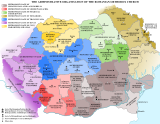 Romanian Orthodox Church organization
 -
 Eastern Orthodoxy in Romania (2002 census)
 -
 Catholicism in Romania (2002 census)
 -
 Protestantism in Romania (2002 census)


.png)
.png)
.png)
See also[edit]


Notes[edit]
- ^ a b c "Rezultatele parțiale ale recensământului din 2022 privind situația religiei în România". 30 December 2022.
- ^ How do European countries differ in religious commitment? Use our interactive map to find out. Pew Research.
- ^ "Culte recunoscute oficial în România" (in Romanian). Secretariatul de Stat pentru Culte. Archived from the original on 14 August 2016.
- ^ a b "Afiliere Religioasa - Secretariatul Cultelor".
- ^ "Populația stabilă după religie – județe, municipii, orașe, comune" (in Romanian). Institutul Național de Statistică.
- ^ a b "Rezultatele parțiale ale recensământului din 2022 privind situația religiei în România". 30 December 2022.
- ^ Sorin Peneș (28 July 2015). "Sondaj INSCOP: 96,5% dintre români cred în Dumnezeu". Agerpres (in Romanian).
- ^ Ronald Roberson. "The Eastern Catholic Churches 2016" (PDF). Catholic Near East Welfare Association. Retrieved 29 November 2016. Information sourced from Annuario Pontificio 2012 edition
- ^ "The Eastern Catholic Churches 2012" (PDF). Annuario Pontificio. CNEWA.
- ^ 2011 Romanian census official data.
- ^ a b US State Dept 2022 report
- ^ George Rădulescu (6 May 2010). "Au trădat greco‑catolicii ortodoxia?". Historia.ro (in Romanian).
- ^ "Biserica Luterana Confesionala".
- ^ "Biserica Evanghelica Reformata".
- ^ "RPCCEE Congregations".
- ^ 2006 Yearbook of Jehovah's Witnesses, page 112-116.
- ^ "Martorii lui Iehova aşteaptă cu răbdare bătălia Armaghedonului". adevarul.ro. Archived from the original on 7 November 2012.
- ^ "Losing a Father—Finding a Father". The Watchtower. Watch Tower Society. 15 July 2014. p. 21.
- ^ a b "The Association The True Faith Jehovah's Witnesses". Archived from the original on 15 January 2013. Retrieved 3 September 2011. archive.org
- ^ a b "The True Faith Jehovah's Witnesses". Retrieved 29 September 2020.
- ^ "Jehovah's Witnesses—2020 Country and Territory Reports".
- ^ "Facts and Statistics: Statistics by Country: Romania", Newsroom, LDS Church, retrieved 15 October 2021
- ^ "Church Almanac: Country information: Romania", Church News, Deseret News, 1 February 2009, retrieved 15 October 2021
- ^ a b c d "România musulmană. Ce știm despre musulmanii din România ? VIDEO" (in Romanian). 2 July 2016.
- ^ Mehmet Ali Ekrem (1994). Din istoria turcilor dobrogeni (in Romanian). Bucharest: Editura Kriterion. ISBN 978-9732603840.
- ^ George Grigore (1999). "Muslims in Romania" (PDF). ISIM Newsletter. 3 (99): 34.
- ^ "Moschee la Rediu, pentru românii convertiți la Islam". Ziarul de Roman (in Romanian). 28 June 2014.
- ^ Ionescu, Sinziana (15 January 2015). "Un român convertit la Islam a ridicat o moschee peste drum de casă. "Este pentru toți musulmanii"". Adevărul (in Romanian).
- ^ Maria Oprea (June 2016). "Unde se roagă albanezii musulmani? Geamiile din România". Prietenul Albanezului (in Romanian) (176).
- ^ "Despre noi". Muftiatul Cultului Musulman din România (in Romanian).
- ^ Katarzyna Górak-Sosnowska, ed. (2011). "Muslim institutions and organizations in Romania". Muslims in Poland and Eastern Europe: Widening the European Discourse on Islam. University of Warsaw. p. 268. ISBN 978-83-903229-5-7.
- ^ "Despre noi". Uniunea Democrată a Tătarilor Turco-Musulmani din România (in Romanian).
- ^ "QuickLists: Most Baha'i (sic) Nations (2010)". Association of Religion Data Archives. 2010. Retrieved 14 October 2020.
- ^ "Ce ne spune recensământul din anul 2011 despre religie?" (PDF) (in Romanian). Institutul Național de Statistică. October 2013.
- ^ Hubbes László-Attila, Rozália Klára Bakó (2011). "Romanian and Hungarian Ethno-Pagan Organizations on the Net". Reconect Working Paper No. 1/2011. Sapientia – Hungarian University of Transylvania. doi:10.2139/ssrn.1863263. SSRN 1863263.
- ^ a b "Zalmoxianism". Federația Păgână Internațională – România.
- ^ "THE NEW PAGAN DAWN – Tradition and continuity in the work of the Gods in Romania". Archived from the original on 5 November 2021. Retrieved 16 December 2021.
- ^ Olteanu, Cosmin (2 January 2018). "Interview with founder of first pagan association from Romania". BlastingNews. Retrieved 15 July 2019.
- ^ Teodora, Munteanu (25 January 2017). "Am vorbit cu românul care conduce un cult satanist și a fost și-n Consiliul Județean al Elevilor". Vice. Retrieved 15 July 2019.
- ^ Cosmin, Olteanu (6 November 2019). "Schimbarea denumirii ROPAGANISM in The New Pagan Dawn Motivele schimbării". Canal Youtube Asociatia THE NEW PAGAN DAWN. Archived from the original on 13 December 2021. Retrieved 21 February 2020.
- ^ "Religiile României. Orașul cu cel mai mare procent de atei din țară". inCont.ro (in Romanian).
- ^ Tomka, Miklós (2011). Expanding Religion: Religious Revival in Post-communist Central and Eastern Europe. Walter de Gruyter. p. 75. ISBN 9783110228151.
- ^ "Eurobarometer 69" (PDF). European Commission. November 2008.
- ^ Raluca Popescu. "Atitudini religioase la români: religia și biserica sunt în continuare foarte importante; cu toate acestea, românii au un model religios valoric mai critic și mai tolerant" (PDF) (in Romanian). Fundația Soros.
- ^ "Cartografierea socială a Bucureștiului" (PDF) (in Romanian). Școala Națională de Studii Politice și Administrative.
- ^ "Asociația Secular-Umanistă din România contestă datele privind religia din rezultatele preliminare ale Recensământului anunțate de INS". HotNews.ro (in Romanian). 30 August 2012.
- ^ a b "Sondaj: 96,5% dintre români cred în Dumnezeu". Digi24 (in Romanian). 28 July 2015.
- ^ International Religious Freedom Report 2017 Romania, US Department of State, Bureau of Democracy, Human Rights, and Labor.
 This article incorporates text from this source, which is in the public domain.
- ^ Freedom House website, Romania page, retrieved 2023-08-08
- ^ Statul si cultele religioase
- ^ David Aberbach (2012). The European Jews, Patriotism and the Liberal State 1789–1939: A Study of Literature and Social Psychology. Routledge. pp. 107–9. ISBN 9781136158957.
- ^ Ornea, Zigu Anii treizeci. Extrema dreaptă românească ("The 1930s: The Romanian Far Right"), Editura Fundației Culturale Române, Bucharest, 1995. p. 395
- ^ The Jewish-Romanian Marxist Constantin Dobrogeanu-Gherea criticised Poporanist claims in his work on the 1907 revolt, Neoiobăgia ("Neo-Serfdom"), arguing that, as favorite victims of prejudice (and most likely to be retaliated against), Jews were least likely to exploit: "[The Jewish tenant's] position is inferior to that of the exploited, for he is not a boyar, a gentleman, but a Yid, as well as to the administration, whose subordinate bodies he may well be able to satisfy, but whose upper bodies remain hostile towards him. His position is also rendered difficult by the antisemitic trend, strong as it gets, and by the hostile public opinion, and by the press, overwhelmingly antisemitic, but mostly by the régime itself – which, while awarding him all the advantages of neo-serfdom on one hand, uses, on the other, his position as a Yid to make of him a distraction and a scapegoat for the régime's sins."
- ^ a b International Commission on the Holocaust in Romania (28 January 2012). "Executive Summary: Historical Findings and Recommendations" (PDF). Final Report of the International Commission on the Holocaust in Romania. Yad Vashem (The Holocaust Martyrs' and Heroes' Remembrance Authority). Archived (PDF) from the original on 12 January 2012. Retrieved 28 January 2012.
- ^ Lavinia Stan and Lucian Turcescu. The Romanian Orthodox Church and Post-Communist Democratisation. Europe-Asia Studies, Vol. 52, No. 8 (Dec., 2000), pp. 1467–1488
- ^ Lucian N. Leustean. Between Moscow and London: Romanian Orthodoxy and National Communism, 1960–1965. The Slavonic and East European Review, Vol. 85, No. 3 (Jul., 2007), pp. 491–521
- ^ a b c d e f g h Sorin Negruți (2014). "The evolution of the religious structure in Romania since 1859 to the present day" (PDF). Revista Română de Statistică (6): 46.
- ^ (in Romanian) Comunicat de presă privind rezultatele preliminare ale Recensământului Populaţiei şi Locuinţelor – 2011, at the 2011 census official site; accessed October 28, 2012.
- ^ "Ce ne spune recensământul din 2011 despre religie?" (PDF) (in Romanian).
- ^ "Facts and Statistics: Statistics by Country: Romania", Newsroom, LDS Church, retrieved 11 October 2021
- ^ The Eastern Catholic Churches 2017. cnewa.org

Bibliography[edit]
- Lavinia Stan and Lucian Turcescu, Religion and Politics in Post-communist Romania, Oxford University Press, 2007. ISBN 0-19-530853-0
- Lavinia Stan and Lucian Turcescu, "Religion and Politics in Post-Communist Romania," in Quo Vadis Eastern Europe? Religion, State, Society and Inter-religious Dialogue after Communism, ed. by Ines A. Murzaku (Bologna, Italy: University of Bologna Press, 2009), pp. 221–235.
- Lavinia Stan and Lucian Turcescu, "Politics, National Symbols and the Romanian Orthodox Cathedral," Europe-Asia Studies, vol. 58, no. 7 (November 2006), pp. 1119–1139.
- Lavinia Stan and Lucian Turcescu, "Pulpits, Ballots and Party Cards: Religion and Elections in Romania," Religion, State and Society, vol. 33, no 4 (December 2005), pp. 347–366.
- Lavinia Stan and Lucian Turcescu, "The Devil's Confessors: Priests, Communists, Spies and Informers," East European Politics and Societies, vol. 19, no. 4 (November 2005), pp. 655–685.
- Lavinia Stan and Lucian Turcescu, "Religious Education in Romania," Communist and Post-Communist Studies, vol. 38, no. 3 (September 2005), pp. 381–401.
- Lavinia Stan and Lucian Turcescu, "Religion, Politics and Sexuality in Romania," Europe-Asia Studies, vol. 57, no. 2 (March 2005), pp. 291–310.
- Lavinia Stan and Lucian Turcescu, "The Romanian Orthodox Church and Post-Communist Democratization", Europe-Asia Studies, vol. 52, no. 8 (December 2000), pp. 1467–1488, republished in East European Perspectives, vol. 3, no. 4 (22 February 2001), available online at http://www.rferl.org/content/article/1342524.html, and vol. 3, no. 5 (7 March 2001), available online at http://www.rferl.org/content/article/1342525.html.
- Flora, Gavril; and Georgina Szilagyi; Victor Roudometof (April 2005). "Religion and national identity in post-communist Romania". Journal of Southern Europe and the Balkans. 7 (1): 35–55. doi:10.1080/14613190500036917. S2CID 155517149.

| State-recognised |
|  |
|---|---|---|
| Semi-recognised (as a religious association, but not a denomination) | ||
| Not state-recognised | ||
| Others | ||