


N700 Series Shinkansen
| N700 series | |
|---|---|
 N700 series set F20 on the Tōkaidō Shinkansen, September 2021 | |
| In service | 1 July 2007 – present |
| Manufacturer | Hitachi, Kawasaki Heavy Industries, Kinki Sharyo, Nippon Sharyo |
| Replaced | 300 series, 500 series,[1] 700 series |
| Constructed | 2005–2020 |
| Scrapped | 2019– |
| Number in service | 2,624 vehicles (179 sets) (as of 1 April 2022[update]) |
| Number preserved | 3 vehicles (N700-9000 series) |
| Number scrapped | 13 vehicles (N700-9000 series); 352 vehicles (22 sets. of which, 1 due to fire damage) |
| Successor | N700S Series Shinkansen |
| Formation | 16 cars per trainset (8 cars per trainset for N700-7000/8000) |
| Capacity | Tokaido/Sanyo 16-car sets (F, G, K/N, X/Z): 1,323 (200 Green + 1,123 ordinary) Sanyo/Kyushu 8-car sets (R, S): 546 (24 Green + 522 ordinary) |
| Operators |
|
| Depots | Tokyo (for ■ JR Central), Hakata (■ JR-West), Osaka (■ JR Central), Kumamoto (for ■ JR Kyushu) |
| Lines served | Kyushu Shinkansen, Tōkaidō Shinkansen, San'yō Shinkansen, Hakata-Minami Line |
| Specifications | |
| Car body construction | Aluminium |
| Car length | 25 m (82 ft 0 in) (intermediate cars) 27.35 m (89 ft 9 in) (end cars) |
| Width | 3.36 m (11 ft 0 in) |
| Height | 3.6 m (11 ft 10 in), (middle cars and connectors of end cars) (without rooftop equipment) 3.5 m (11 ft 6 in) (end cars excluding connector with middle cars) |
| Maximum speed | 285 km/h (177 mph) (Tokaido) 300 km/h (186 mph) (Sanyo) 260 km/h (162 mph) (Kyushu) |
| Weight | 715 t (16-car set)[2] |
| Traction motors | 56 x 305 kW (409 hp) |
| Power output | 17.08 MW (22,905 hp) |
| Acceleration | 2.6 km/(h⋅s) (1.6 mph/s) |
| Electric system(s) | 25 kV 60 Hz AC catenary |
| Current collector(s) | Pantograph |
| UIC classification | 2'2'+14*Bo'Bo'+2'2' (N, Z and G sets) 8*Bo'Bo' (R and S sets) |
| Braking system(s) | Pneumatic, regenerative |
| Safety system(s) | ATC-NS, KS-ATC (R and S sets only) |
| Track gauge | 1,435 mm (4 ft 8+1⁄2 in) standard gauge |
| Notes/references | |
 | |
The N700 series (N700系, Enu nana-hyaku-kei) is a Japanese Shinkansen high-speed train with tilting capability developed jointly by JR Central and JR West for use on the Tōkaidō and San'yō Shinkansen lines since 2007, and is operated by JR Kyushu on the Kyushu Shinkansen line.
N700 series trains have a maximum speed of 300 km/h (186 mph), and tilting of up to one degree allows the trains to maintain 270 km/h (168 mph), even on 2,500 m (8,202 ft) radius curves that previously had a maximum speed of 255 km/h (158 mph). Another feature of the N700 is that it accelerates more quickly than the older 700 series Shinkansen trains, with a maximum acceleration rate of 2.6 km/h/s (0.72 m/s2). This enables it to reach 270 km/h (170 mph) in only three minutes. Further advancements led to the development of the N700A, an incremental evolution of the N700. N700A trains can reach 285 km/h (177 mph) on 3,000 m (9,843 ft) curves, allowing the maximum operating speed on the Tōkaidō Shinkansen to be raised to 285 km/h (177 mph). All N700 series sets have been retrofitted with most of the improvements added to the N700A series, and are now classified as "N700A".
Because of these improvements, trains can travel between Tokyo and Osaka on a Nozomi run in as little as 2 hours and 22 minutes on the fastest service (8 minutes faster than before).
A new train, the N700S, entered service in 2020 with plans to eventually replace all N700-series trains. The first four sets began operation on 1 July 2020.
Operations
[edit]N700 series trains gradually replaced 300, 500 and 700 series sets on Nozomi services, and by the end of February 2009, the N700 series were responsible for 74 Nozomi services per day.[3] All Nozomi through runs (over the full route between Tokyo and Hakata) were scheduled to use the N700 series exclusively by 2009. From the start of the revised timetable on 17 March 2012, all regularly scheduled Nozomi services, including runs limited only to the Tokaido Shinkansen, were operated by N700 series sets.[4]
Since 4 March 2017, the N700 is also used on regularly scheduled Hikari services during the day, as well as all Kodama trains on the Tokaido Shinkansen, since March 2020.
Since March 2009, the N700 series trains have been equipped with wireless internet available for use between Tokyo and Shin-Osaka.[5]
Future plans
[edit]In an announcement by JR Central, JR West, and JR Kyushu made on 17 October 2023, the companies stated that all onboard smoking rooms on the Tokaido, San'yo, and Kyushu Shinkansen trains would be abolished by Q2 2024.[6]
In another announcement made on 14 February 2024, JR West revealed plans to convert four existing 16-car N700 series sets into 8-car formations.[7] This move is to be made in a bid to retire four of the remaining 500 series sets on the San'yo Shinkansen.[7] The conversions of the first four sets are set to take place between 2024 and the end of 2026.[7] JR West later announced on 24 July 2024 that ten more 16-car N700 series sets are also scheduled to be converted to 8-car sets from 2026 to 2029.[8]
-
 N700-3000 LED display
 -
 N700-8000 LED display


Variants
[edit]- N700-0 series: 80 x 16-car "Z" sets owned by JR Central, introduced from 1 July 2007 and all converted to N700-2000 series "N700A" by August 2015
- N700-1000 series "N700A": 51 x 16-car "G" sets owned by JR Central, introduced from 8 February 2013
- N700-2000 series "N700A": 80 x 16-car "X" sets owned by JR Central, modified from original "Z" sets between 2013 and 2015
- N700-3000 series: 16 x 16-car "N" sets owned by JR-West, introduced from 1 July 2007 and all converted to N700-5000 series "N700A" by March 2016
- N700-4000 series "N700A": 24 x 16-car "F" sets owned by JR-West, introduced from December 2013
- N700-5000 series "N700A": 16 x 16-car "K" sets owned by JR-West, modified from original "N" sets from October 2013
- N700-7000 series: 19 x 8-car "S" sets owned by JR-West, introduced from 12 March 2011
- N700-8000 series: 11 x 8-car "R" sets owned by JR Kyushu, introduced from 12 March 2011
- N700-9000 series: Prototype 16-car set Z0 owned by JR Central, later redesignated X0 and retired in 2019
16-car G sets (N700-1000 series "N700A")
[edit]
The N700-1000 series, or "N700A" (with "A" standing for "Advanced"), is a new version of the N700 series design delivered from August 2012, and entering revenue service from 8 February 2013.[9]
The new version is externally identical to the existing N700 series sets, with the addition of new "N700A" logos on each odd-numbered car.[10] The new trains include modified brake discs, bogie vibration detection, and ATC improvements.[11]
Six "G" sets were scheduled to be introduced during fiscal 2012, replacing older 700 series sets, with seven more sets introduced during fiscal 2013.[12] A further 18 sets are on order by JR Central, to be delivered six sets per year between fiscal 2014 and 2016 at a cost of 88 billion yen.[13] In October 2015, JR Central announced that it had ordered a further 20 N700A series sets to be delivered between fiscal 2016 and 2019, replacing all of the remaining 700 series trains sets on Tokaido Shinkansen services.[14]
The first set, G1, was delivered to Hamamatsu in August 2012, with test running commencing on the Tokaido Shinkansen the following month.[15]
-
 Logo on the side of car 9, February 2013

Formation
[edit]The 16-car G sets are formed as follows, with car 1 at the Shin-Osaka (western) end and car 16 at the Tokyo (eastern) end.[16]
| Car No. | 1 | 2 | 3 | 4 | 5 | 6 | 7 | 8 | 9 | 10 | 11 | 12 | 13 | 14 | 15 | 16 |
|---|---|---|---|---|---|---|---|---|---|---|---|---|---|---|---|---|
| Designation | Tc | M2 | M'w | M1 | M1w | M' | M2k | M1s | M1sw | M2s | M'h | M1 | M1w | M' | M2w | T'c |
| Numbering | 783-1000 | 787-1000 | 786-1500 | 785-1000 | 785-1300 | 786-1000 | 787-1400 | 775-1000 | 776-1000 | 777-1000 | 786-1700 | 785-1600 | 785-1500 | 786-1200 | 787-1500 | 784-1000 |
| Seating capacity | 65 | 100 | 85 | 100 | 90 | 100 | 75 | 68 | 64 | 68 | 63 | 100 | 90 | 100 | 80 | 75 |
| Facilities | Toilets | Toilets / smoking room | Telephone | Toilets | Toilets / smoking room | Conductor's compartment / AED | Toilets / telephone | Smoking room | Toilets / multi-purpose compartment | Telephone | Toilets | Toilets / smoking room / telephone |
Cars 5 and 12 each have one single-arm pantograph.[9]


Interior
[edit]Internally, seats have new moquette seat covers, and LED lighting is used in toilets and washing areas.[12]
-
 Green car seating (car 10), February 2012

Fleet list
[edit]As of 1 April 2020[update], the N700A series G set fleet is as follows.[16]
| Set No. | Manufacturer | Date delivered | Remarks |
|---|---|---|---|
| G1 | Nippon Sharyo | 25 August 2012 | Fiscal 2012 batch |
| G2 | Hitachi | 7 November 2012 | |
| G3 | Nippon Sharyo | 16 November 2012 | |
| G4 | 22 January 2013 | ||
| G5 | Hitachi | 30 January 2013 | |
| G6 | Nippon Sharyo | 22 February 2013 | |
| G7 | Hitachi | 17 April 2013 | Fiscal 2013 batch |
| G8 | Nippon Sharyo | 11 July 2013 | |
| G9 | 20 September 2013 | ||
| G10 | 29 October 2013 | ||
| G11 | 11 December 2013 | ||
| G12 | 21 January 2014 | ||
| G13 | 21 February 2014 | ||
| G14 | 4 July 2014 | Fiscal 2014 batch | |
| G15 | Hitachi | 31 July 2014 | |
| G16 | Nippon Sharyo | 22 August 2014 | |
| G17 | 21 October 2014 | ||
| G18 | Hitachi | 3 December 2014 | |
| G19 | Nippon Sharyo | 17 February 2015 | |
| G20 | 14 April 2015 | Fiscal 2015 batch | |
| G21 | Hitachi | 11 June 2015 | |
| G22 | Nippon Sharyo | 28 August 2015 | |
| G23 | 20 October 2015 | ||
| G24 | Hitachi | 16 December 2015 | |
| G25 | Nippon Sharyo | 16 February 2016 | |
| G26 | Hitachi | 6 April 2016 | Fiscal 2016 batch |
| G27 | Nippon Sharyo | 10 June 2016 | |
| G28 | 30 August 2016 | ||
| G29 | Hitachi | 19 October 2016 | |
| G30 | Nippon Sharyo | 1 November 2016 | |
| G31 | 13 December 2016 | ||
| G32 | 7 March 2017 | ||
| G33 | 21 April 2017 | Fiscal 2017 batch | |
| G34 | 13 June 2017 | ||
| G35 | 19 July 2017 | ||
| G36 | Hitachi | 5 September 2017 | |
| G37 | Nippon Sharyo | 17 October 2017 | |
| G38 | 5 December 2017 | ||
| G39 | 16 January 2018 | ||
| G40 | 8 June 2018 | Fiscal 2018 batch | |
| G41 | 13 October 2018 | ||
| G42 | Hitachi | 20 July 2018 | |
| G43 | 18 September 2018 | ||
| G44 | Nippon Sharyo | 8 January 2019 | |
| G45 | 15 February 2019 | ||
| G46 | 23 March 2019 | ||
| G47 | Hitachi | 19 April 2019 | Fiscal 2019 batch |
| G48 | Nippon Sharyo | 7 June 2019 | |
| G49 | Hitachi | 16 July 2019 | |
| G50 | Nippon Sharyo | 17 September 2019 | |
| G51 | Hitachi | 21 February 2020 |
16-car X sets (N700-2000 series "N700A")
[edit]
- 81 x 16-car sets, X0–X80 (converted from N700-0 series)
These are former N700 series Z sets modified between 2013 and August 2015 to incorporate some of the design improvements featured in the later N700A series sets. Cars are renumbered in the -2000 subseries, with the exception of set X0, which is still numbered in the -9000 subseries. The sets are also identified by the addition of a small "A" added to the right of the bodyside "N700" logos.[17] The prototype 16-car train (Z0) was delivered in March 2005 for extensive testing and endurance running. Cars 1 to 4 were built by Hitachi, cars 5 to 14 were built by Nippon Sharyo, and cars 15 and 16 were built by Kawasaki Heavy Industries.[18] It was initially fitted with two auxiliary headlights located below the nose.[19]
The first full-production Z set (Z1) was delivered to JR Central in April 2007, and trains entered revenue service on 1 July 2007, with eight daily Nozomi service runs. The final Z set, Z80, was delivered from Kawasaki Heavy Industries in February 2012.[20]
From fiscal 2013, the fleet of Z sets underwent modifications to incorporate some of the improvements featured in the later N700A series sets. Modified sets were re-designated "X" sets, with cars renumbered in the -2000 subseries. The modified sets are also identified by the addition of a small "A" added to the right of the bodyside "N700" logos.[17] The first original "Z" set, set Z65, was modified to become set X65 in May 2013, with the last original "Z" set, set Z4, modified to become set X4 in August 2015.[16]
The prototype set Z0 was used as a JR Central test train with cars numbered in the -9000 series, and was not used in revenue service. It was renumbered set X0 in 2014, but the car numbers remained in the -9000 subseries.[9] The set was officially withdrawn from service in February 2019.[citation needed]
Withdrawals of N700 series X sets commenced in July 2020, beginning with set X12.[citation needed]
-
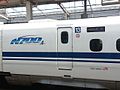 The modified logo on the side of set X6, August 2013

Former Z sets
[edit]
-
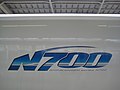 The original "N700" logo, February 2011
 -
 N700 series prototype set Z0 on a test run at Hamamatsu, January 2006
 -
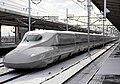 Set Z0, January 2011


Formation
[edit]The 16-car X sets are formed as follows.[9]
| Car No. | 1 | 2 | 3 | 4 | 5 | 6 | 7 | 8 | 9 | 10 | 11 | 12 | 13 | 14 | 15 | 16 |
|---|---|---|---|---|---|---|---|---|---|---|---|---|---|---|---|---|
| Designation | Tc | M2 | M'w | M1 | M1w | M' | M2k | M1s | M's | M2s | M'h | M1 | M1w | M' | M2w | T'c |
| Numbering | 783-2000 | 787-2000 | 786-2500 | 785-2000 | 785-2300 | 786-2000 | 787-2400 | 775-2000 | 776-2000 | 777-2000 | 786-2700 | 785-2600 | 785-2500 | 786-2200 | 787-2500 | 784-2000 |
| Seating capacity | 65 | 100 | 85 | 100 | 90 | 100 | 75 | 68 | 64 | 68 | 63 | 100 | 90 | 100 | 80 | 75 |
| Facilities | Toilets | Toilets / smoking room | Telephone | Toilets | Toilets / smoking room | Conductor's compartment / AED | Toilets / telephone | Smoking room | Toilets / multi-purpose compartment | Telephone | Toilets | Toilets / smoking room / telephone |
Former Z set formation
[edit]| Car No. | 1 | 2 | 3 | 4 | 5 | 6 | 7 | 8 | 9 | 10 | 11 | 12 | 13 | 14 | 15 | 16 |
|---|---|---|---|---|---|---|---|---|---|---|---|---|---|---|---|---|
| Designation | Tc | M2 | M'w | M1 | M1w | M' | M2k | M1s | M's | M2s | M'h | M1 | M1w | M' | M2w | T'c |
| Numbering | 783 | 787 | 786-500 | 785 | 785-300 | 786 | 787-400 | 775 | 776 | 777 | 786-700 | 785-600 | 785-500 | 786-200 | 787-500 | 784 |
| Seating capacity | 65 | 100 | 85 | 100 | 90 | 100 | 75 | 68 | 64 | 68 | 63 | 100 | 90 | 100 | 80 | 75 |
| Facilities | Toilets | Toilets / smoking room | Telephone | Toilets | Toilets / smoking room | Conductor's compartment / AED | Toilets / telephone | Smoking room | Toilets / multi-purpose compartment | Telephone | Toilets | Toilets / smoking room / telephone |
Cars 5 and 12 each have one single-arm pantograph.[9]
Interior
[edit]-
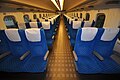 Standard-class car seating
 -
 Z set standard-class car interior
 -
 Z set Green car (first class) seating
 -
 Interior of a smoking room


Fleet list
[edit]As of 28 January 2023[update], the JR Central N700A series fleet is as follows.[21]
| Set No. | Manufacturer | Date delivered | Date converted to N700A | Date withdrawn | Remarks |
|---|---|---|---|---|---|
| X0 | Hitachi/Kawasaki HI/Nippon Sharyo | 12 March 2005 | 12 May 2014 | 25 February 2019 | Pre-series set |
| X1 | Nippon Sharyo | 17 April 2007 | 18 May 2015 | 4 October 2021 | Full-production sets |
| X2 | Hitachi | 9 May 2007 | 9 June 2015 | 2 November 2021 | |
| X3 | Nippon Sharyo | 21 May 2007 | 15 June 2015 | 2 December 2021 | |
| X4 | Hitachi | 16 June 2007 | 5 August 2015 | 4 January 2022 | |
| X5 | Nippon Sharyo | 23 June 2007 | 7 July 2015 | 7 February 2022 | |
| X6 | Hitachi | 5 September 2007 | 16 July 2013 | 2 March 2022 | |
| X7 | Nippon Sharyo | 12 September 2007 | 12 August 2013 | 19 April 2022 | |
| X8 | Hitachi | 31 October 2007 | 28 August 2013 | 13 May 2022 | |
| X9 | Nippon Sharyo | 22 October 2007 | 21 October 2013 | 13 July 2022 | |
| X10 | Hitachi | 6 December 2007 | 25 October 2013 | 16 August 2022 | |
| X11 | Nippon Sharyo | 29 November 2007 | 11 December 2013 | 12 September 2022 | |
| X12 | Kawasaki HI | 9 January 2008 | 21 January 2014 | 2 July 2020 | |
| X13 | Nippon Sharyo | 16 January 2008 | 31 January 2014 | 1 September 2020 | |
| X14 | Hitachi | 6 February 2008 | 27 February 2014 | 26 September 2020 | |
| X15 | Nippon Sharyo | 21 February 2008 | 16 May 2014 | 21 October 2020 | |
| X16 | Hitachi | 5 March 2008 | 22 May 2014 | 18 November 2020 | |
| X17 | Nippon Sharyo | 8 May 2008 | 3 June 2014 | 14 December 2020 | |
| X18 | Hitachi | 15 May 2008 | 19 June 2014 | ||
| X19 | Nippon Sharyo | 12 June 2008 | 1 July 2014 | 14 January 2021 | |
| X20 | Hitachi | 2 July 2008 | 7 July 2014 | ||
| X21 | Nippon Sharyo | 17 July 2008 | 24 July 2014 | ||
| X22 | Hitachi | 6 August 2008 | 7 August 2014 | 12 February 2021 | |
| X23 | Nippon Sharyo | 27 August 2008 | 8 September 2014 | 16 March 2021 | |
| X24 | Hitachi | 17 September 2008 | 12 September 2014 | 16 April 2021 | |
| X25 | Nippon Sharyo | 3 October 2008 | 21 October 2014 | 7 June 2021 | |
| X26 | Kawasaki HI | 16 November 2008 | 29 November 2014 | 5 August 2021 | |
| X27 | Nippon Sharyo | 9 November 2008 | 27 October 2014 | 14 May 2021 | |
| X28 | Hitachi | 21 December 2008 | 4 December 2014 | 8 July 2021 | |
| X29 | Nippon Sharyo | 14 December 2008 | 28 January 2015 | 7 September 2021 | |
| X30 | Kawasaki HI | 11 February 2009 | 22 December 2014 | ||
| X31 | Nippon Sharyo | 24 January 2009 | 16 December 2014 | ||
| X32 | 1 March 2009 | 9 February 2015 | |||
| X33 | Hitachi | 15 April 2009 | 22 May 2015 | ||
| X34 | Nippon Sharyo | 3 April 2009 | 3 February 2015 | ||
| X35 | 13 May 2009 | 3 June 2015 | |||
| X36 | Kawasaki HI | 26 August 2009 | 22 July 2013 | ||
| X37 | Nippon Sharyo | 18 June 2009 | 19 June 2015 | ||
| X38 | 24 July 2009 | 9 July 2013 | |||
| X39 | 3 September 2009 | 27 July 2013 | 30 March 2022 | ||
| X40 | Hitachi | 8 July 2009 | 19 June 2013 | ||
| X41 | Nippon Sharyo | 11 October 2009 | 27 September 2013 | 3 June 2022 | |
| X42 | 14 November 2009 | 13 November 2013 | |||
| X43 | Hitachi | 1 December 2009 | 21 December 2013 | 11 October 2022 | |
| X44 | Nippon Sharyo | 17 December 2009 | 27 January 2014 | 11 November 2022 | |
| X45 | Hitachi | 13 January 2010 | 5 March 2014 | 13 December 2022 | |
| X46 | Nippon Sharyo | 27 January 2010 | 15 March 2014 | ||
| X47 | Hitachi | 17 February 2010 | 20 March 2014 | 12 January 2023 | |
| X48 | Nippon Sharyo | 1 March 2010 | 9 April 2014 | ||
| X49 | 2 April 2010 | 28 May 2014 | |||
| X50 | 9 May 2010 | 25 June 2014 | |||
| X51 | 9 June 2010 | 18 July 2014 | |||
| X52 | 10 July 2010 | 31 July 2014 | |||
| X53 | Hitachi | 21 July 2010 | 22 August 2014 | ||
| X54 | Nippon Sharyo | 18 August 2010 | 27 September 2014 | ||
| X55 | 18 September 2010 | 19 September 2014 | |||
| X56 | Hitachi | 1 October 2010 | 15 October 2014 | ||
| X57 | Nippon Sharyo | 21 October 2010 | 31 October 2014 | ||
| X58 | Hitachi | 10 November 2010 | 18 November 2014 | ||
| X59 | Nippon Sharyo | 21 November 2010 | 12 December 2014 | ||
| X60 | 22 December 2010 | 25 November 2014 | |||
| X61 | Hitachi | 19 January 2011 | 22 January 2015 | ||
| X62 | Nippon Sharyo | 28 January 2011 | 19 March 2015 | ||
| X63 | Hitachi | 23 February 2011 | 25 March 2015 | ||
| X64 | Nippon Sharyo | 3 March 2011 | 25 April 2015 | ||
| X65 | 6 April 2011 | 7 May 2013 | |||
| X66 | Hitachi | 20 April 2011 | 14 July 2015 | ||
| X67 | Nippon Sharyo | 13 May 2011 | 1 July 2015 | ||
| X68 | 15 June 2011 | 27 June 2013 | |||
| X69 | 16 July 2011 | 23 August 2013 | |||
| X70 | Hitachi | 3 August 2011 | 12 September 2013 | ||
| X71 | Nippon Sharyo | 20 August 2011 | 19 September 2013 | ||
| X72 | Hitachi | 7 September 2011 | 15 October 2013 | ||
| X73 | Nippon Sharyo | 22 September 2011 | 29 November 2013 | ||
| X74 | 24 October 2011 | 5 December 2013 | |||
| X75 | Hitachi | 3 November 2011 | 17 December 2013 | ||
| X76 | Nippon Sharyo | 23 November 2011 | 27 December 2013 | ||
| X77 | 22 December 2011 | 21 February 2014 | |||
| X78 | 29 January 2012 | 11 March 2014 | |||
| X79 | Hitachi | 22 February 2012 | 15 April 2014 | ||
| X80 | Nippon Sharyo | 1 March 2012 | 21 April 2014 |
16-car F sets (N700-4000 series "N700A")
[edit] | This section needs to be updated. (April 2020) |
These are N700A series sets owned by JR-West and classified N700-4000 series, with one set (set F1) delivered in November 2013 and entering revenue service from 8 February 2014.[9] A further four sets were delivered each in fiscal 2015 (sets F2 to F5) and fiscal 2016 (sets F6 to F9),[22] followed by three in fiscal 2017 (sets F10 to F12), five in fiscal 2018 (sets F13 to F17), and seven in fiscal 2019 (sets F18 to F24).[23]
Formation
[edit]The 16-car F sets are formed as follows.
| Car No. | 1 | 2 | 3 | 4 | 5 | 6 | 7 | 8 | 9 | 10 | 11 | 12 | 13 | 14 | 15 | 16 |
|---|---|---|---|---|---|---|---|---|---|---|---|---|---|---|---|---|
| Designation | Tc | M2 | M'w | M1 | M1w | M' | M2k | M1s | M's | M2s | M'h | M1 | M1w | M' | M2w | T'c |
| Numbering | 783-4000 | 787-4000 | 786-4500 | 785-4000 | 785-4300 | 786-4000 | 787-4400 | 775-4000 | 776-4000 | 777-4000 | 786-4700 | 785-4600 | 785-4500 | 786-4200 | 787-4500 | 784-4000 |
| Seating capacity | 65 | 100 | 85 | 100 | 90 | 100 | 75 | 68 | 64 | 68 | 63 | 100 | 90 | 100 | 80 | 75 |
| Facilities | Toilets | Toilets / smoking room | Telephone | Toilets | Toilets / smoking room | Conductor's compartment / AED | Toilets / telephone | Smoking room | Toilets / multi-purpose compartment | Telephone | Toilets | Toilets / smoking room / telephone |
Fleet list
[edit]As of 1 April 2020[update], the JR-West N700A series fleet is as follows.[16]
| Set No. | Manufacturer | Date delivered | Remarks |
|---|---|---|---|
| F1 | Hitachi | 27 November 2013 | Fiscal 2013 batch |
| F2 | Nippon Sharyo | 1 August 2015 | Fiscal 2015 batch |
| F3 | Hitachi | 3 September 2015 | |
| F4 | 3 November 2015 | ||
| F5 | Nippon Sharyo | 17 February 2016 | |
| F6 | 15 April 2016[24] | Fiscal 2016 batch | |
| F7 | Hitachi | 29 May 2016[24] | |
| F8 | 7 September 2016 | ||
| F9 | Nippon Sharyo | 11 October 2016 | |
| F10 | 22 August 2017 | Fiscal 2017 batch | |
| F11 | 3 October 2017 | ||
| F12 | Hitachi | 16 January 2018 | |
| F13 | 17 April 2018 | Fiscal 2018 batch | |
| F14 | 15 October 2018 | ||
| F15 | Nippon Sharyo | 21 August 2018 | |
| F16 | Hitachi | 21 February 2019 | |
| F17 | Nippon Sharyo | 26 November 2018 | |
| F18 | Hitachi | 19 June 2019 | Fiscal 2019 batch |
| F19 | Nippon Sharyo | 12 July 2019 | |
| F20 | Hitachi | 16 October 2019 | |
| F21 | Nippon Sharyo | 13 November 2019 | |
| F22 | Hitachi | 11 December 2019 | |
| F23 | 18 March 2020 | ||
| F24 | Nippon Sharyo | 19 February 2020 |
16-car K sets (N700-5000 series "N700A")
[edit]- 16 x 16-car sets, K1–K16 (Converted from N700-3000 series)

These are JR-West trainsets modified from October 2013 from former N700 series N sets to incorporate some of the design improvements featured in the later N700A series sets.[25]
Former N sets
[edit]The 16-car N sets were operated by JR-West on Tokaido and Sanyo Shinkansen services. The first set, N1, was delivered in June 2007, entering service on 1 July 2007.[9] 16 sets were in service by April 2014.[9]
The fleet of 16 "N" sets subsequently underwent modifications at Hakata Depot between fiscal 2013 and fiscal 2015 to add improved braking systems and other features incorporated in the later N700A series sets.[25] Modified sets were re-designated "K" sets, with cars renumbered in the -5000 subseries.[25]

-
 The logo on the side of car 13 of N700-3000 series set N7 (now K7), May 2009

Formation
[edit]The 16-car K sets are formed as follows.[9]
| Car No. | 1 | 2 | 3 | 4 | 5 | 6 | 7 | 8 | 9 | 10 | 11 | 12 | 13 | 14 | 15 | 16 |
|---|---|---|---|---|---|---|---|---|---|---|---|---|---|---|---|---|
| Designation | Tc | M2 | M'w | M1 | M1w | M' | M2k | M1s | M's | M2s | M'h | M1 | M1w | M' | M2w | T'c |
| Numbering | 783-5000 | 787-5000 | 786-5500 | 785-5000 | 785-5300 | 786-5000 | 787-5400 | 775-5000 | 776-5000 | 777-5000 | 786-5700 | 785-5600 | 785-5500 | 786-5200 | 787-5500 | 784-5000 |
| Seating capacity | 65 | 100 | 85 | 100 | 90 | 100 | 75 | 68 | 64 | 68 | 63 | 100 | 90 | 100 | 80 | 75 |
| Facilities | Toilets | Toilets / smoking room | Telephone | Toilets | Toilets / smoking room | Conductor's compartment / AED | Toilets / telephone | Smoking room | Toilets / multi-purpose compartment | Telephone | Toilets | Toilets / smoking room / telephone |
Former N set formation
[edit]The 16-car N sets were formed as follows.[9]
| Car No. | 1 | 2 | 3 | 4 | 5 | 6 | 7 | 8 | 9 | 10 | 11 | 12 | 13 | 14 | 15 | 16 |
|---|---|---|---|---|---|---|---|---|---|---|---|---|---|---|---|---|
| Designation | Tc | M2 | M'w | M1 | M1w | M' | M2k | M1s | M's | M2s | M'h | M1 | M1w | M' | M2w | T'c |
| Numbering | 783-3000 | 787-3000 | 786-3500 | 785-3000 | 785-3300 | 786-3000 | 787-3400 | 775-3000 | 776-3000 | 777-3000 | 786-3700 | 785-3600 | 785-3500 | 786-3200 | 787-3500 | 784-3000 |
| Seating capacity | 65 | 100 | 85 | 100 | 90 | 100 | 75 | 68 | 64 | 68 | 63 | 100 | 90 | 100 | 80 | 75 |
| Facilities | Toilets | Toilets / smoking room | Telephone | Toilets | Toilets / smoking room | Conductor's compartment / AED | Toilets / telephone | Smoking room | Toilets / multi-purpose compartment | Telephone | Toilets | Toilets / smoking room / telephone |
Cars 5 and 12 each have one single-arm pantograph.[9]
Fleet list
[edit]As of 1 April 2016[update], the JR-West N700A series fleet is as follows.[16]
| Set No. | Manufacturer | Date delivered | Date converted to N700A |
|---|---|---|---|
| K1 | Kawasaki Heavy Industries | 1 June 2007 | 19 December 2014 |
| K2 | 10 July 2007 | 18 February 2015 | |
| K3 | Nippon Sharyo | 6 August 2007 | 13 March 2015 |
| K4 | 9 October 2007 | 25 October 2013 | |
| K5 | Kawasaki Heavy Industries | 10 November 2007 | 18 December 2013 |
| K6 | 13 September 2007 | 22 June 2015 | |
| K7 | 12 September 2007 | 4 September 2015 | |
| K8 | Kinki Sharyo | 31 January 2008 | 7 August 2014 |
| K9 | Kawasaki Heavy Industries | 20 May 2008 | 7 March 2016 |
| K10 | 17 November 2009 | 24 April 2014 | |
| K11 | 18 December 2009 | 11 December 2015 | |
| K12 | Kinki Sharyo | 28 January 2010 | 6 October 2014 |
| K13 | Kawasaki Heavy Industries | 15 October 2009 | 12 March 2014 |
| K14 | 28 February 2010 | 21 October 2014 | |
| K15 | Hitachi | 23 May 2010 | 19 November 2014 |
| K16 | 14 December 2010 | 9 April 2015 |
8-car S sets (N700-7000 series)
[edit]
- 19 x 8-car sets, S1–S19
The N700-7000 series variant are 8-car sets operated by JR-West on through-running Sakura and Mizuho services between Shin-Ōsaka and Kagoshima-Chūō on the Kyushu Shinkansen since 12 March 2011.[26] The pre-series set (S1) was delivered to Hakata Depot in October 2008. These trains do not feature the tilting mechanism of the earlier N700 trains, as they do not run on the Tokaido Shinkansen.[27]
External livery is shiraai (白藍) pale blue intended to evoke the colour of traditional porcelain with indigo and gold bodyside lining.[26]
Full-production JR-West sets were delivered to Hakata Depot from early April 2010.[28] The final S set, S19, was delivered to Hakata Depot in February 2012.[20]
Formation
[edit]The 8-car S sets, S1–S19, are formed as follows.[9]
| Car No. | 1 | 2 | 3 | 4 | 5 | 6 | 7 | 8 |
|---|---|---|---|---|---|---|---|---|
| Designation | Mc | M1 | M' | M2 | M2w | M's | M1h | M'c |
| Numbering | 781-7000 | 788-7000 | 786-7000 | 787-7000 | 787-7500 | 766-7000 | 788-7700 | 782-7000 |
| Seating capacity | 60 | 100 | 80 | 72 | 36+24 | 38 | 56 | |
Cars 2 and 7 each have one single-arm pantograph.[9]
-
 781-7000 (Car 1)
 -
 788-7000 (Car 2)
 -
 786-7000 (Car 3)
 -
 787-7000 (Car 4)
 -
 787-7500 (Car 5)
 -
 766-7000 (Car 6)
 -
 788-7700 (Car 7)
 -
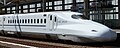 782-7000 (Car 8)


Interior
[edit]These sets feature a Green car saloon in half of one car (car 6) consisting of 24 seats (6 rows) arranged in 2+2 abreast configuration with 480 mm (19 in) wide seats and a seat pitch of 1,160 mm (46 in). Cars 4 to 8 (including half of car 6) are designated as "reserved seating" cars with 2+2 abreast configuration, 465 mm wide seats and a seat pitch of 1,040 mm. Cars 1 to 3 are "non-reserved seating" cars with 2+3 abreast configuration, 440 mm wide seats (460 mm in middle of 3-seat row) and a seat pitch of 1,040 mm.[26]
-
 N700-7000 series standard-class non-reserved car seating, April 2011
 -
 N700-7000 series standard-class reserved car seating, August 2011
 -
 A smoking room


Fleet list
[edit]As of 1 April 2016[update], the fleet consists of 19 sets, all based at Hakata Shinkansen Depot.[16]
| Set No. | Manufacturer | Date delivered |
|---|---|---|
| S1 | Kawasaki/Kinki Sharyo/Nippon Sharyo | 24 October 2008 |
| S2 | Kawasaki Heavy Industries | 20 April 2010 |
| S3 | Nippon Sharyo | 12 July 2010 |
| S4 | Kawasaki Heavy Industries | 22 June 2010 |
| S5 | 4 August 2010 | |
| S6 | 14 September 2010 | |
| S7 | Kinki Sharyo | 17 November 2010 |
| S8 | 14 January 2011 | |
| S9 | Nippon Sharyo | 16 February 2011 |
| S10 | 12 April 2011 | |
| S11 | Kawasaki Heavy Industries | 30 May 2011 |
| S12 | 24 June 2011 | |
| S13 | 11 July 2011 | |
| S14 | 1 August 2011 | |
| S15 | 3 October 2011 | |
| S16 | 23 October 2011 | |
| S17 | Nippon Sharyo | 15 November 2011 |
| S18 | Kawasaki Heavy Industries | 23 January 2012 |
| S19 | Hitachi | 27 February 2012 |
8-car R sets (N700-8000 series)
[edit]
- 11 x 8-car sets, R1–R11
These are eleven 8-car N700 series sets operated by JR Kyushu alongside JR-West N700-7000 series "S" sets on through-running Sakura and Mizuho services between Shin-Osaka and Kagoshima-Chūō on the Kyushu Shinkansen since 12 March 2011.[9] External livery is identical to the N700-7000 series "S" sets.
The first set, R1, was delivered to Kumamoto Depot in July 2010.[29] Test running on the unopened section of the Kyushu Shinkansen began on 31 August 2010.[30]
Formation
[edit]The 8-car R sets are formed as follows.[9]
| Car No. | 1 | 2 | 3 | 4 | 5 | 6 | 7 | 8 |
|---|---|---|---|---|---|---|---|---|
| Designation | Mc | M1 | M' | M2 | M2w | M's | M1h | M'c |
| Numbering | 781-8000 | 788-8000 | 786-8000 | 787-8000 | 787-8500 | 766-8000 | 788-8700 | 782-8000 |
| Seating capacity | 60 | 100 | 80 | 72 | 36+24 | 38 | 56 | |
Cars 2 and 7 each have one single-arm pantograph.[9]
Interior
[edit]As with the JR-West N700-7000 series sets, the R sets feature a Green car saloon in half of one car (car 6) consisting of 24 seats (6 rows) arranged in 2+2 abreast configuration. Cars 4 to 8 (including half of car 6) are designated as "reserved seating" cars with 2+2 abreast configuration. Cars 1 to 3 are "non-reserved seating" cars with 2+3 abreast configuration.[31]
-
 Green class seating saloon, September 2011
 -
 Reserved car with 2+2 abreast seating, September 2011
 -
 Interior of a smoking room


Fleet list
[edit]As of 1 April 2016[update], the fleet consists of 11 sets, all based at Kumamoto Shinkansen Depot.[16]
| Set No. | Manufacturer | Date delivered |
|---|---|---|
| R1 | Hitachi | 11 December 2010 |
| R2 | 23 November 2010 | |
| R3 | 6 December 2010 | |
| R4 | Kawasaki Heavy Industries | 27 November 2010 |
| R5 | 18 December 2010 | |
| R6 | Hitachi | 31 January 2011 |
| R7 | Kawasaki Heavy Industries | 12 January 2011 |
| R8 | 4 February 2011 | |
| R9 | 18 February 2011 | |
| R10 | Kinki Sharyo | 11 February 2011 |
| R11 | 6 July 2012 |
N700-I Bullet
[edit]This was a proposed export version of the N700 series design announced by JR Central Chairman Yoshiyuki Kasai at an international high-speed railway symposium held in Nagoya on 16 November 2009.[32] Nominally specified as an 8-car set with a maximum operating speed of 330 km/h (205 mph), the train can be configured in lengths from 6 to 16 cars to suit customer requirements.[33][34]
The same model was being considered in the developing Houston–Dallas Texas Central Railway, before focus shifted to the N700S due to its inherently modular construction, and higher top speed.[35]
High-speed trials
[edit]On 16 November 2009, JR Central conducted a late-night high-speed demonstration run using N700 series trainset Z0, recording a maximum speed of 332 km/h (206 mph) on the Tokaido Shinkansen between Maibara and Kyōto. The high-speed run was conducted as a demonstration for approximately 160 international guests attending a high-speed railway symposium in Nagoya.[36][37]
Incidents
[edit]Fire damage and replacement
[edit]Car 783-2059 (car 1) of JR Central set X59 was scrapped due to fire damage sustained in an arson attack occurring on 30 June 2015. A replacement car with the same running number was built by Nippon Sharyo in 2016.[38]
Discovery of cracked bogie
[edit]On 11 December 2017, Car 785-5505 (car 13) of JR West set K5 (a 16-car N700A built by Kawasaki Heavy Industries) was taken out of service at Nagoya Station after engineers confirmed an unusual burning smell.[39] The smell was detected at Kokura Station, but was ordered by the operational centre to continue service until Nagoya which JR West later admitted was a "big danger".[40][41] An on-site inspection revealed that the outer frame of the carriage had cracked and its underfloor carriage was leaking oil.[41] It was the first "serious incident" involving any Shinkansen, and Ministry of Land, Infrastructure, Transport and Tourism reported that the train could have derailed had it continued on service and the carriage frame broke.[39] An investigation by JR West implicated companies involved in the construction of the trainset, which included Kawasaki Heavy Industries, Nippon Steel and Mitsubishi Electric.[40] The investigation revealed that at least 100 out of the 303 Kawasaki-made bogies were substandard due to improper welding preparations, which caused the base material of the bogies to become 4.7 mm (0.19 in) in thickness, instead of the required 7 mm (0.28 in) or more. Following the events JR West is planning to gradually replace all the bogies that were provided by Kawasaki.[42]
Overall fleet history
[edit]The annual totals for the fleet sizes (number of vehicles as of 1 April each year) owned by JR Central, JR West, and JR Kyushu are as follows.[19]
| Year | ■ JR Central | ■ JR West | ■ JR Kyushu | Total |
|---|---|---|---|---|
| 2005 | 16 | 0 | 0 | 16 |
| 2006 | 16 | 0 | 0 | 16 |
| 2007 | 16 | 0 | 0 | 16 |
| 2008 | 272 | 128 | 0 | 400 |
| 2009 | 528 | 152 | 0 | 680 |
| 2010 | 1,040 | 232 | 0 | 1,272 |
| 2011 | 1,040 | 328 | 80 | 1,448 |
| 2012 | 1,296 | 368 | 80 | 1,744 |
| 2013 | 1,392 | 408 | 88 | 1,888 |
| 2014 | 1,504 | 424 | 88 | 2,016 |
| 2015 | 1,600 | 424 | 88 | 2,112 |
| 2016 | 1,696 | 488 | 88 | 2,272 |
| 2017 | 1,808 | 552 | 88 | 2,448 |
| 2018 | 1,920 | 616 | 88 | 2,624 |
| 2019 | 2,016 | 680 | 88 | 2,784 |
| 2020 | 2,096 | 792 | 88 | 2,976 |
| 2021 | 1,952 | 792 | 88 | 2,832 |
| 2022 | 1,744 | 792 | 88 | 2,624 |
 | Graphs are unavailable due to technical issues. Updates on reimplementing the Graph extension, which will be known as the Chart extension, can be found on Phabricator and on MediaWiki.org. |
Preserved examples
[edit]
On display at the SCMaglev and Railway Park, Nagoya, from 17 July 2019:[43]
- 783-9001 (ex-prototype set X0, built 2005 by Hitachi)
- 775-9001 (ex-prototype set X0, built 2005 by Nippon Sharyo)
- 786-9201 (ex-prototype set X0, built 2005 by Nippon Sharyo)
See also
[edit]References
[edit]- ^ Nakajima, Yoshikatsu (13 June 2018). "Epic journey of 500 Series, bullet train with a nose for adventure". asahi.com. The Asahi Shimbun. Archived from the original on 10 September 2019. Retrieved 4 January 2019.
- ^ "N700系量産車" [N700 series production trains]. Japan Railfan Magazine (in Japanese). No. 556. Japan: Koyusha Co., Ltd. August 2007. pp. 13–20.
- ^ "Winter 2008/2009 Train Schedule Update (JR Central)" (PDF). 17 October 2008. Archived from the original (PDF) on 20 December 2008. Retrieved 20 October 2008.
- ^ "N700 Series Delivery Schedule" (PDF). 26 September 2007. Retrieved 1 October 2007. [dead link]
- ^ Serkan Toto (9 March 2009). "Shinkansen bullet trains get wireless LAN with 2Mbps". Archived from the original on 10 May 2010. Retrieved 13 April 2010.
- ^ Kinoshita, Kenji (17 October 2023). "東海道・山陽・九州新幹線の車内喫煙ルーム、2024年春にすべて廃止" [All smoking rooms on Tokaido, Sanyo, and Kyushu Shinkansen trains will be abolished in spring 2024.]. MyNavi Corporation. Archived from the original on 18 October 2023. Retrieved 19 October 2023.
- ^ a b c "JR西日本、N700系16両編成を8両編成化 - 500系は4編成を用途廃止に". MyNavi Corporation (in Japanese). 14 February 2024. Retrieved 14 February 2024.
- ^ "JR西日本のN700Sも個室を導入、2026年度から - N700系8両化も実施" [JR West's N700S to also introduce private compartments from 2026 - N700 series to be shortened to 8 cars]. Mynavi News (in Japanese). 24 July 2024. Retrieved 24 July 2024.
- ^ a b c d e f g h i j k l m n o p JR電車編成表 2015夏 [JR EMU Formations - Summer 2015] (in Japanese). Japan: Kotsu Shimbunsha. 20 May 2015. pp. 110–112, 128–129, 418–421. ISBN 978-4-330-56915-4.
- ^ N700Aのデザインについて [Details of N700A design] (PDF). News release (in Japanese). Japan: Central Japan Railway Company. 25 July 2012. Retrieved 25 July 2012.
- ^ 東海道・山陽新幹線車両 N700Aの概要及び投入計画について [Outline of N700A Tokaido/Sanyo Shinkansen trains] (PDF). News release (in Japanese). Japan: Central Japan Railway Company. 30 May 2011. Retrieved 30 May 2011.
- ^ a b "新形新幹線「N700A」" [New "N700A" Shinkansen]. Japan Railfan Magazine. Vol. 52, no. 619. Japan: Koyusha Co., Ltd. November 2012. pp. 42–46.
- ^ "JR東海 N700Aを追加投入" [JR Central to introduce additional N700As]. Tetsudo Hobidas (in Japanese). Japan: Neko Publishing. 21 February 2013. Archived from the original on 24 February 2013. Retrieved 21 February 2013.
- ^ N700Aの追加投入について 全ての東海道新幹線が「N700Aタイプ」になります [Details of additional N700A introductions - All Tokaido Shinkansen services to become N700A type] (PDF). News release (in Japanese). Japan: Central Japan Railway Company. 22 October 2015. Retrieved 22 October 2015.
- ^ "N700Aが試運転で東京へ" [N700A test run to Tokyo]. Japan Railfan Magazine Online (in Japanese). Japan: Koyusha Co., Ltd. 16 September 2012. Retrieved 16 September 2012.
- ^ a b c d e f g JR電車編成表 2016夏 [JR EMU Formations - Summer 2016] (in Japanese). Japan: Kotsu Shimbunsha. 20 May 2016. pp. 110–111, 128–129, 209. ISBN 978-4-330-68216-7.
- ^ a b 東海道・山陽新幹線のラインアップ [Tokaido & Sanyo Shinkansen Lineup]. Japan Railfan Magazine (in Japanese). Vol. 53, no. 632. Japan: Koyusha Co., Ltd. December 2013. pp. 12–13.
- ^ JR電車編成表 2009夏 [JR EMU Formations - Summer 2009]. Japan: JRR. June 2009. ISBN 978-4-330-06909-8.
- ^ a b Ikeguchi, Eiji (December 2016). 700系新幹線の軌跡 [The 700 series trajectory]. Japan Railfan Magazine (in Japanese). Vol. 56, no. 668. Japan: Koyusha Co., Ltd. pp. 19, 26.
- ^ a b N700系Z80編成が搬入される [N700 series set Z80 delivered]. Japan Railfan Magazine Online (in Japanese). Japan: Koyusha Co., Ltd. 9 February 2012. Retrieved 10 February 2012.
- ^ 『JR電車編成表』2023冬 [JR EMU Formations - Winter 2023] (in Japanese). Japan: Kotsu Shimbunsha. 2023. ISBN 9784330067223.
- ^ "東海道・山陽新幹線車両 N700Aの追加投入" [Additional N700A series trains to be introduced on Tokaido & Sanyo Shinkansen]. News release (in Japanese). Japan: West Japan Railway Company. 19 November 2014. Retrieved 19 November 2014.
- ^ JR西日本,N700Aを15編成導入へ [JR West to introduce 15 more N700A sets]. Japan Railfan Magazine Online (in Japanese). Japan: Koyusha Co., Ltd. 22 December 2016. Archived from the original on 23 December 2016. Retrieved 24 December 2016.
- ^ a b JR車両のうごき [JR rolling stock changes]. Tetsudō Daiya Jōhō Magazine (in Japanese). Vol. 45, no. 389. Japan: Kōtsū Shimbun. September 2016. p. 80.
- ^ a b c N700系0・3000番台を「N700A」タイプに改造 [N700-0 and N700-3000 series to be modified as "N700A" type]. Japan Railfan Magazine (in Japanese). Vol. 54, no. 633. Japan: Koyusha Co., Ltd. January 2014. pp. 64–65.
- ^ a b c JR Kyushu: "新幹線の列車名決定!!" Archived 19 September 2009 at the Wayback Machine Retrieved on 26 February 2009. (in Japanese)
- ^ Japan Railfan Magazine, December 2008 issue: "山陽・九州新幹線直通用車両 量産先行車", p. 64-67
- ^ JR-West press release: "山陽・九州新幹線直通用車両の量産車について" (23 March 2010) Archived 24 March 2010 at the Wayback Machine. Retrieved 24 March 2010. (in Japanese)
- ^ "N700系8000番台が熊本総合車両基地に搬入される" [N700-8000 series set delivered to Kumamoto Depot]. Japan Railfan Magazine Online (in Japanese). Koyusha Co., Ltd. 5 July 2010. Retrieved 14 July 2010.
- ^ 九州新幹線,熊本—筑後船小屋間で試運転 [Test-running on Kyushu Shinkansen Between Kumamoto and Chikugo-Funagoya]. Japan Railfan Magazine Online (in Japanese). Koyusha Co., Ltd. 1 September 2010. Retrieved 1 September 2010.
- ^ "N700系8000番台" [N700-8000 series]. Japan Railfan Magazine. Vol. 50, no. 595. Japan: Koyusha Co., Ltd. November 2010. pp. 58–59.
- ^ Kobayashi, Seiichi (8 December 2009), "Bullet train export a JR Tokai priority", Asahi Shimbun, retrieved 15 December 2009[dead link]
- ^ "About the N700-I Bullet Train". USJHSR. Archived from the original on 6 October 2016. Retrieved 9 July 2013.
- ^ Morimura, Tsutomu (13 January 2012). "Introduction of the N700-I Bullet Train, The World's Safest and Most Efficient High Speed Rail System" (PDF). jterc.or.jp. Japan Transport Research Institute. Archived from the original (PDF) on 8 March 2016.
- ^ "The Project - Texas Central".
- ^ 東海道新幹線、332キロで試験運転 各国関係者にPR. Asahi Shimbun (in Japanese). Japan. 17 November 2009. Archived from the original on 19 November 2009. Retrieved 18 November 2009.
- ^ "Foreign rail interests given high-speed run". The Japan Times. Japan. 18 November 2009. Retrieved 18 November 2009.
- ^ N700系X59編成 試運転 [N700 series set X59 test run] (in Japanese). Japan. 26 July 2016. Archived from the original on 19 September 2016. Retrieved 19 September 2016.
- ^ a b "Shinkansen halted in Nagoya after oil leak and cracked frame found". Japan Times. 13 December 2017. Retrieved 30 December 2017.
- ^ a b Peter Wells and Leo Lewis. "Japan bullet train safety scare embroils manufacturers". 20 December 2017. Archived from the original on 30 December 2017. Retrieved 30 December 2017.
{{cite news}}: CS1 maint: bot: original URL status unknown (link) - ^ a b "Outer frame under running bullet train was close to breaking". Asahi Shimbun. 20 December 2017. Archived from the original on 30 December 2017. Retrieved 30 December 2017.
- ^ 品質不良で台車亀裂=鋼材削り、厚さ足りず-川重製、100台で基準未満・JR西. Jiji Press (in Japanese). 28 February 2018. Archived from the original on 28 February 2018. Retrieved 28 February 2018.
- ^ リニア・鉄道館 N700系車両の展示について [N700 series shinkansen exhibit at SCMaglev and Railway Park] (PDF). News release (in Japanese). Japan: Central Japan Railway Company. 17 May 2019. Retrieved 14 July 2019.
External links
[edit]
- JR Central N700 series (in Japanese)
- JR-West N700 series Nozomi Archived 22 February 2009 at the Wayback Machine (in Japanese)
| Lines |
|     | ||||||||||||||||||
|---|---|---|---|---|---|---|---|---|---|---|---|---|---|---|---|---|---|---|---|---|
| Service names |
| |||||||||||||||||||
| Train types |
| |||||||||||||||||||
| Operators |
| |||||||||||||||||||
| Builders and owners |
| |||||||||||||||||||
| People | ||||||||||||||||||||


.svg)
.svg)
.svg)
.svg)
.svg)


 Multiple units of Central Japan Railway Company Multiple units of Central Japan Railway Company | ||||||||||||||||||||||||||
|---|---|---|---|---|---|---|---|---|---|---|---|---|---|---|---|---|---|---|---|---|---|---|---|---|---|---|
| Current / active |
|  | ||||||||||||||||||||||||
| Future |
| |||||||||||||||||||||||||
| Retired / withdrawn |
| |||||||||||||||||||||||||
 Multiple units of West Japan Railway Company Multiple units of West Japan Railway Company | |||||||||||||||||||||||||||||||||||
|---|---|---|---|---|---|---|---|---|---|---|---|---|---|---|---|---|---|---|---|---|---|---|---|---|---|---|---|---|---|---|---|---|---|---|---|
| Current / active |
| ||||||||||||||||||||||||||||||||||
| Retired / withdrawn |
| ||||||||||||||||||||||||||||||||||
 Multiple units of Kyushu Railway Company Multiple units of Kyushu Railway Company | ||||||||||||||
|---|---|---|---|---|---|---|---|---|---|---|---|---|---|---|
| Current / active |
|  | ||||||||||||
| Retired / withdrawn |
| |||||||||||||
- Central Japan Railway Company
- West Japan Railway Company
- Kyushu Railway Company
- Shinkansen train series
- Hitachi multiple units
- Tilting trains
- Train-related introductions in 2007
- Passenger trains running at least at 300 km/h in commercial operations
- 25 kV AC multiple units
- Electric multiple units of Japan
- Kawasaki multiple units
- Kinki Sharyo multiple units
- Nippon Sharyo multiple units