


E1 Series Shinkansen
| E1 series | |
|---|---|
 E1 series train set M5 in September 2012 | |
| In service | 15 July 1994 – 28 September 2012 |
| Manufacturer | Hitachi, Kawasaki Heavy Industries |
| Family name | Max |
| Constructed | 1994–1995 |
| Refurbished | 2003–2006 |
| Scrapped | 2012 |
| Number built | 72 vehicles (6 sets) |
| Number in service | None |
| Number preserved | 1 vehicle |
| Number scrapped | 71 vehicles |
| Formation | 12 cars per trainset |
| Fleet numbers | M1–M6 |
| Capacity | 1,235 |
| Operators | JR East |
| Depots | Sendai, Niigata |
| Lines served | Tohoku Shinkansen, Joetsu Shinkansen |
| Specifications | |
| Car body construction | Steel |
| Car length | End cars: 26.05 m (85 ft 6 in) Intermediate cars: 25 m (82 ft 0 in) |
| Width | 3,430 mm (11 ft 3 in) |
| Height | 4,493 mm (14 ft 9 in) |
| Doors | Two per side |
| Maximum speed | 240 km/h (149.1 mph) |
| Traction system | (AC) MT204 (24 x 410 kW) |
| Power output | 9.84 MW (13,196 hp) |
| Acceleration | 1.6 km/(h⋅s) (0.99 mph/s) |
| Electric system(s) | 25 kV AC, 50 Hz, overhead catenary |
| Current collector(s) | PS201 pantograph |
| Bogies | DT205 (motored), TR7003 (trailer) |
| Safety system(s) | ATC-2, DS-ATC |
| Multiple working | None |
| Track gauge | 1,435 mm (4 ft 8+1⁄2 in) standard gauge |
The E1 series (E1系) was a high-speed Shinkansen train type operated by East Japan Railway Company (JR East) in Japan from July 1994 until September 2012. They were the first double-deck trains built for Japan's Shinkansen. They were generally, along with their fellow double-deck class the E4 series, known by the marketing name "Max" (Multi-Amenity eXpress).[1] The fleet was withdrawn from regular service on 28 September 2012.[2]
Originally intended to be classified as 600 series,[3] the E1 series trains were introduced specifically to relieve overcrowding on services used by commuters on the Tohoku Shinkansen and Joetsu Shinkansen.
Operations[edit]
E1 series sets were used on the following services.[4]
- Joetsu Shinkansen
- Max Asahi (July 1994 – November 2002)
- Max Tanigawa
- Max Toki (until 28 September 2012)
- Tohoku Shinkansen
- Max Nasuno (until December 1999)
- Max Yamabiko (July 1994 – December 1999)

Formation[edit]
The fleet of 12-car sets, numbered M1 to M6, were formed as follows, with car 1 at the Tokyo end.[5]
| Car No. | 1 | 2 | 3 | 4 | 5 | 6 | 7 | 8 | 9 | 10 | 11 | 12 |
|---|---|---|---|---|---|---|---|---|---|---|---|---|
| Designation | T1c | M1 | M2 | T1 | T2 | M1 | M2 | Tpk | Tps | M1s | M2s | T2c |
| Numbering | E153-100 | E155-100 | E156-100 | E158-100 | E159 | E155 | E156 | E158-200 | E148 | E145 | E146 | E154 |
| Seating capacity | 86 | 121 | 135 | 124 | 110 | 91 | 75 | 91 | 80 | |||
| Weight (t) | 56.2 | 59.2 | 61.2 | 53.7 | 53.6 | 59.2 | 61.7 | 55.2 | 54.6 | 59.2 | 62.0 | 56.5 |
Cars 6 and 10 were each equipped with a PS201 scissors-type pantograph.[5]
Fleet details[edit]
| Set No. | Manufacturer | Delivered | Reliveried | Refurbished | DS-ATC added | Withdrawn |
|---|---|---|---|---|---|---|
| M1 | Kawasaki Heavy Industries | 3 March 1994 | 17 September 2004 | 10 July 2004 | 15 September 2005 | 2 April 2012[6] |
| M2 | Hitachi | 23 March 1994 | 27 November 2004 | 4 June 2005 | 5 August 2005 | 14 April 2012[6] |
| M3 | Hitachi / Kawasaki Heavy Industries | 6 February 1995 | 26 December 2003 | 31 March 2004 | 2 November 2005 | 29 August 2012[6] |
| M4 | Hitachi | 17 October 1995 | 25 November 2003 | 2 October 2003 | 2 February 2006 | 7 December 2012[7] |
| M5 | Kawasaki Heavy Industries | 3 November 1995 | 11 March 2006 | 6 June 2006 | 11 March 2006 | 4 October 2012[7] |
| M6 | Hitachi / Kawasaki Heavy Industries | 22 November 1995 | 27 November 2005 | 23 December 2005 | 27 November 2005 | 7 November 2012[7] |
Interior[edit]
The E1 series was the first revenue-earning shinkansen to feature 3+3 abreast seating in standard class for increased seating capacity. The upper deck saloons of non-reserved cars 1 to 4 were arranged 3+3 with no individual armrests, and did not recline. The lower decks of these cars, and the reserved-seating saloons in cars 5 to 12 had regular 2+3 seating. The Green car saloons on the upper decks of cars 9 to 11 had 2+2 seating. The trains had a total seating capacity of 1,235 passengers.[9]
Pre-refurbishment[edit]
-
 Green car upper deck in January 2002
 -
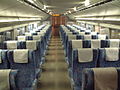 Standard class reserved car upper deck in January 2002
 -
 Standard class non-reserved car upper deck with non-reclining 3+3 seating in January 2002
 -
 Standard class reserved car lower deck in January 2002
 -
 Standard class non-reserved car lower deck in January 2002


Post-refurbishment[edit]
-
 Car 11 Green car upper deck in October 2011
 -
 Car 11 standard class reserved car lower deck in October 2011


History[edit]

The first E1 series set, M1, was delivered to Sendai Depot on 3 March 1994, sporting "DDS E1" logos (DDS standing for double-deck shinkansen).[10] ローカル鉄道途中下車の旅 The first two E1 series sets delivered entered revenue-earning service on the Tohoku Shinkansen on 15 July 1994, with the original "DDS" logos replaced by "Max" logos.[3] The original livery was "sky grey" on the upper body side and "silver grey" on the lower body side, separated by a "peacock green" stripe.[5]
From 4 December 1999, all six trainsets were transferred from Sendai Depot to Niigata Depot, with operations limited to use on Joetsu Shinkansen Max Asahi and Max Tanigawa services only.[5]
Refurbishment[edit]
.jpg)
From late 2003, the fleet underwent refurbishment, which included the installation of new seating and repainting in a new livery of "stratus white" on the upper body side and "aster blue" on the lower body side, separated by a "ibis pink" stripe.
All cars were made no-smoking from the start of the revised timetable on 18 March 2007.[5]
Withdrawal[edit]

The first two sets were officially withdrawn in April 2012: M1 on 2 April, and M2 on 14 April.[8] The remaining fleet was withdrawn from service from the start of the revised timetable on 29 September 2012.[2]
A special Thank you Max Asahi (ありがとうMaxあさひ号, Arigatō Max Asahi-gō) service ran from Niigata to Tokyo on 27 October 2012 using an E1 series set,[11] followed by a final run from Tokyo to Niigata on 28 October 2012, using set M4.[12]
Bodyside logos[edit]
Between 1 December 2001 and 31 March 2002, the E1 series fleet was adorned with "Alpen Super Express" logos as part of JR East's "JR + Snow" promotional campaign.[3]
From mid August 2012 until the fleet's final withdrawal on 28 September, the remaining three sets had a second toki crested ibis added to their logos to celebrate the rare hatching of ibis chicks in the wild.[13]
-
 Original "Max" logo in December 2003 prior to refurbishment
 -
 "Alpen Snow Express" promotional logo in March 2002
 -
 "Max" logo on a refurbished set in April 2010
 -
 Modified "Max" logo in August 2012


Preserved examples[edit]

One E1 series car is preserved: car E153-104 of set M4. This was moved to the Railway Museum in Saitama in December 2017, and is on display since spring 2018.[14]
See also[edit]
- TGV Duplex, French double-deck high speed train
- List of high speed trains
References[edit]
- Semmens, Peter (1997). High Speed in Japan: Shinkansen – The World's Busiest High-speed Railway. Sheffield, UK: Platform 5 Publishing. ISBN 1-872524-88-5.
- ^ JR全車輌ハンドブック2006 [JR Rolling Stock Handbook 2006]. Japan: Neko Publishing. 2006. ISBN 4-7770-0453-8.
- ^ a b 2012年9月ダイヤ改正について [September 2012 Timetable Revision Details] (PDF) (in Japanese). Japan: East Japan Railway Company. 6 July 2012. p. 2. Retrieved 6 July 2012.
- ^ a b c Yamanouchi, Shūichirō (2002). 東北・上越新幹線 [Tohoku & Joetsu Shinkansen]. Tokyo, Japan: JTB Can Books. p. 147. ISBN 4-533-04513-8.
- ^ JR電車編成表 2012夏 [JR EMU Formations – Summer 2012]. Japan: Kotsu Shimbunsha. May 2012. p. 14. ISBN 978-4-330-28612-9.
- ^ a b c d e f JR電車編成表 2009夏 [JR EMU Formations – Summer 2009]. Japan: JRR. June 2009. p. 8. ISBN 978-4-330-06909-8.
- ^ a b c JR電車編成表 2013冬 [JR EMU Formations – Winter 2013]. Japan: Kotsu Shimbunsha. November 2012. p. 354. ISBN 978-4-330-33112-6.
- ^ a b c JR電車編成表 2013夏 [JR EMU Formations – Summer 2013]. Japan: Kotsu Shimbunsha. May 2013. p. 355. ISBN 978-4-330-37313-3.
- ^ a b 東北新幹線 30年の歴史を振り返る [Tohoku Shinkansen: Looking back over 30 years of history]. Tetsudō Daiya Jōhō Magazine. Vol. 41, no. 339. Japan: Kotsu Shimbun. July 2012. p. 24.
- ^ The 新幹線 [The Shinkansen]. Japan: Sansuisha. 2001.
- ^ JR電車編成表 '98夏号 [JR EMU Formations – Summer 1998]. Japan: JRR. July 1998. p. 6. ISBN 4-88283-029-9.
- ^ おかげさまで上越新幹線開業30周年 [Joetsu Shinkansen 30th Anniversary Celebrations] (PDF) (in Japanese). Japan: East Japan Railway Company, Niigata Division. 12 September 2012. Archived from the original (PDF) on 20 September 2012. Retrieved 15 September 2012.
- ^ E1系,営業運転から引退 [E1 series withdrawn from revenue service]. Japan Railfan Magazine Online (in Japanese). Japan: Koyusha Co., Ltd. 29 October 2012. Retrieved 29 October 2012.
- ^ 上越新幹線E1系にも「朱鷺のひな」が誕生します [Ibis chicks also to appear on Joetsu Shinkansen E1 series trains] (PDF) (in Japanese). Niigata, Japan: East Japan Railway Company. 26 July 2012. Archived from the original (PDF) on 31 August 2012. Retrieved 27 July 2012.
- ^ 鉄道博物館にE1系が搬入される [E1 series moved to Railway Museum]. Japan Railfan Magazine Online (in Japanese). Japan: Koyusha Co., Ltd. 21 December 2017. Archived from the original on 21 December 2017. Retrieved 21 December 2017.
External links[edit]

- "E1 series Max Toki/Max Tanigawa" (in Japanese). Archived from the original on 22 July 2011. Retrieved 10 August 2008.
| Lines |
|     | ||||||||||||||||||
|---|---|---|---|---|---|---|---|---|---|---|---|---|---|---|---|---|---|---|---|---|
| Service names |
| |||||||||||||||||||
| Train types |
| |||||||||||||||||||
| Operators |
| |||||||||||||||||||
| Builders and owners |
| |||||||||||||||||||
| People | ||||||||||||||||||||


.svg)
.svg)
.svg)
.svg)
.svg)


 Multiple-units of East Japan Railway Company Multiple-units of East Japan Railway Company | |||||||||||||||||||||||||||||||||||||||||||||||||||||||||
|---|---|---|---|---|---|---|---|---|---|---|---|---|---|---|---|---|---|---|---|---|---|---|---|---|---|---|---|---|---|---|---|---|---|---|---|---|---|---|---|---|---|---|---|---|---|---|---|---|---|---|---|---|---|---|---|---|---|
| Current / active |
| ||||||||||||||||||||||||||||||||||||||||||||||||||||||||
| Future |
| ||||||||||||||||||||||||||||||||||||||||||||||||||||||||
| Retired / withdrawn |
| ||||||||||||||||||||||||||||||||||||||||||||||||||||||||
| Experimental | |||||||||||||||||||||||||||||||||||||||||||||||||||||||||