


100 Series Shinkansen
| 100 series | |
|---|---|
 100 series set G47 on the Tokaido Shinkansen in January 2003 | |
| In service | 1 October 1985 – 16 March 2012 |
| Manufacturer | Hitachi, Kawasaki Heavy Industries, Kinki Sharyo, Nippon Sharyo, Tokyu Car Corporation |
| Constructed | 1984–1992 |
| Refurbished | 2000–2004 |
| Scrapped | 1999–2012 |
| Number built | 1,056 vehicles (66 sets) |
| Number preserved | 5 vehicles |
| Formation | 4, 6, 12 or 16 cars per trainset |
| Fleet numbers | X1-X7
G1-G50 V1-V9 K51-K60 P1-P12 |
| Capacity |
|
| Operators | JNR (1985–1987) JR Central (1987–2003) JR-West (1989–2012) |
| Depots | Hakata |
| Lines served | Tokaido Shinkansen(1985-2003), Sanyo Shinkansen(1985-2012), Hakata-Minami Line(1990-2012) |
| Specifications | |
| Car body construction | Steel |
| Car length | 25 m (82 ft 0 in) (intermediate cars) 26.05 m (85 ft 6 in) (end cars) |
| Width | 3,383 mm (11 ft 1.2 in) |
| Height | 4,000 mm (13 ft 1 in) 4,488 mm (14 ft 8.7 in) (Bilevel car) |
| Doors | Two per side |
| Maximum speed |
|
| Traction system | Thyristor drive |
| Acceleration | 1.6 km/(h⋅s) (0.99 mph/s) for the former V sets) |
| Deceleration | 2.6 km/(h⋅s) (1.6 mph/s) |
| Electric system(s) | 25 kV AC, 60 Hz, overhead catenary |
| Current collector(s) | Pantograph |
| Bogies | DT202 (motored), TR7000 (trailer) |
| Safety system(s) | ATC-1 |
| Track gauge | 1,435 mm (4 ft 8+1⁄2 in) standard gauge |
The 100 series (100系, Hyaku-kei) was a Japanese Shinkansen high-speed electric multiple unit which operated between 1985 and 2012 on the Tokaido Shinkansen and Sanyo Shinkansen high-speed lines. They were introduced after the 200 series trains, but their numbering is such because in the days of Japanese National Railways (JNR), Shinkansen types running east of Tokyo were given even numbers and those west of Tokyo odd numbers, hence they were given the next odd number in line after 0, 100. The last remaining examples of the type were withdrawn from service following the last runs on 16 March 2012.
Design[edit]
.jpg)
They differed visibly from the earlier 0 series in that the nose profile was more pointed. Another less obvious difference with the 16-car sets was that not all the cars were powered; the driving cars on each end were unpowered, as were the two bi-level centre cars. Some later production sets had powered driving cars and four unpowered bi-level trailers in the middle instead. The bi-level trailer cars contained a combination of restaurant cars, and first class compartments, or open-plan first class seating and first class compartments, or open-plan first class seating and refreshment cars.
The external livery was white (White No. 3) and blue (Blue No. 20).[1]
Following their removal from front-line service, 100 series sets were later reformed into shorter four- and six-car sets for the slower Kodama services on the Sanyo Shinkansen line. These four- and six-car trains did not have bi-level cars.
Variants[edit]
Pre-series unit[edit]
Originally numbered X0, the pre-series set X1 was delivered in 1985, with test running commencing from 27 March that year.[2] The X1 set entered revenue service for passenger evaluation trials on the Hikari services from 1 October 1985.[2] This unit differed externally from later production units in having small windows aligned with each seating bay, and also had a slanting headlight arrangement. The type 116 Green (first class) car formed as car 10 initially included one two-seat and two single-seat compartments, but these were removed when the set was modified to full-production standard in 1986.[2]
Set X0 was formed as shown below, with car 1 at the Hakata end.[3]
| Car No. | 1 | 2 | 3 | 4 | 5 | 6 | 7 | 8 | 9 | 10 | 11 | 12 | 13 | 14 | 15 | 16 |
|---|---|---|---|---|---|---|---|---|---|---|---|---|---|---|---|---|
| Designation | Tc | M' | M | M' | M | M' | M5 | TDD | TsD | Ms' | M7 | M' | M | M' | M | T'c |
| Numbering | 123-9001 | 126-9001 | 125-9001 | 126-9002 | 125-9002 | 126-9003 | 125-9501 | 168-9001 | 149-9001 | 116-9001 | 125-9701 | 126-9004 | 125-9003 | 126-9005 | 125-9004 | 124-9001 |
Set X1 was withdrawn in March 2000.
-
 Pre-series unit X1 on a Kodama service in October 1998
 -
 Bilevel dining car 168-9001 carrying the original "NS" ("New Shinkansen") logo stickers in September 1985
 -
 Interior of bilevel restaurant car 168-9001 preserved at SCMaglev and Railway Park in April 2011


16-car X sets[edit]

Following passenger evaluation trials with the pre-series set X1, a total of seven X sets were built for use on Tokaido and Sanyo Shinkansen Hikari services. The first four production units entered service from 13 June 1986 as 12-car sets without bilevel trailer cars, numbered G1 to G4, and were used on Tokaido Kodama services until October in the same year.[2] These sets were formed as shown below.[4]
| Car No. | 1 | 2 | 3 | 4 | 5 | 6 | 7 | 8 | 9 | 10 | 11 | 12 |
|---|---|---|---|---|---|---|---|---|---|---|---|---|
| Designation | Tc | M' | M | M' | M7 | M' | M5 | Ms' | M | M' | M | T'c |
| Numbering | 123 | 126 | 125 | 126 | 125-700 | 126 | 125-500 | 116 | 125 | 126 | 125 | 124 |
Cars 2, 4, 6, 8, and 10 were each fitted with cross-arm pantographs.[4]
These units were subsequently renumbered as 16-car sets X2 to X5 with the inclusion of bilevel trailer cars, and were introduced on Hikari services from November 1986.[2]
The noticeable difference over previous (0 series and 200 series) shinkansen designs was the inclusion of two bilevel trailer cars in the centre of the formation. The type 168 car had a restaurant area on the upper deck with kitchen facilities and a small buffet counter on the lower deck. The adjacent type 149 car provided private compartments for Green class passengers on the lower deck, with open-plan green car accommodation on the upper deck.
From March 1998, the X sets were redeployed to Tokaido Kodama services. The restaurant cars were no longer used, and fittings were subsequently removed. The fleet of X sets contained the oldest members of the 100 series fleet, and the first withdrawals started in August 1999. From the new timetable change of 2 October 1999, X sets were no longer assigned to regular workings, with the remaining examples subsequently limited to holiday period extra trains. The last remaining units were withdrawn by April 2000.[3]
Formation[edit]
The 16-car X sets were formed as follows.[1]
| Car No. | 1 | 2 | 3 | 4 | 5 | 6 | 7 | 8 | 9 | 10 | 11 | 12 | 13 | 14 | 15 | 16 |
|---|---|---|---|---|---|---|---|---|---|---|---|---|---|---|---|---|
| Designation | Tc | M' | M | M' | M | M' | M5 | TDD | TsD | Ms' | M7 | M' | M | M' | M | T'c |
| Numbering | 123 | 126 | 125 | 126 | 125 | 126 | 125-500 | 168 | 149 | 116 | 125-700 | 126 | 125 | 126 | 125 | 124 |
| Seating capacity | 65 | 100 | 90 | 100 | 90 | 100 | 80 | 44 | 56 | 68 | 73 | 100 | 90 | 100 | 90 | 75 |
Cars 2, 6, and 12 were equipped with cross-arm pantographs.[1] (The pantographs on cars 4, 10, and 14 were removed in 1995.[3])
16-car G sets[edit]


The G sets were officially classified as "100' series", and 50 units were built from 1988. They differed from the initial X sets in having a type 148 bilevel trailer car in place of the type 168 restaurant car. This had open-plan Green car accommodation on the upper deck, and a self-service cafeteria area on the lower deck. While originally used exclusively on Hikari services, in later years, these units were more commonly seen on Tokaido Kodama services. The last remaining sets owned by JR Central and JR-West were withdrawn in September 2003 before the start of the new Tokaido Shinkansen timetable the following October.
Formation[edit]
The 16-car G sets were formed as follows.[1]
| Car No. | 1 | 2 | 3 | 4 | 5 | 6 | 7 | 8 | 9 | 10 | 11 | 12 | 13 | 14 | 15 | 16 |
|---|---|---|---|---|---|---|---|---|---|---|---|---|---|---|---|---|
| Designation | Tc | M' | M | M' | M | M' | M5 | TsD | TsD | Ms' | M7 | M' | M | M' | M | T'c |
| Numbering | 123 | 126 | 125 | 126 | 125 | 126 | 125-500 | 148 | 149 | 116 | 125-700 | 126 | 125 | 126 | 125 | 124 |
| Seating capacity | 65 | 100 | 90 | 100 | 90 | 100 | 80 | 42 | 58 | 68 | 73 | 100 | 90 | 100 | 90 | 75 |
Cars 2, 6, and 12 were equipped with cross-arm pantographs.[1]
-
 Bilevel cars 8 and 9 of set G49 in April 2003

16-car V sets (100-3000 series)[edit]

The nine V sets (also referred to as "100N") operated by JR-West included four bilevel trailer cars, which provided 2+2 standard class reserved seating accommodation on the lower decks, and restaurant and Green class accommodation on the upper decks. These sets originally ran under the marketing name Grand Hikari, but from May 2002 onwards were limited to use on the Sanyo Shinkansen only. The restaurant cars in these units were decommissioned from March 2000. Two V sets (V1, V6) were reformed as new 4-car P sets in 2000 to replace life-expired 0 series R sets on Sanyo Shinkansen Kodama services, and the remaining sets were subsequently used to donate cars as they were withdrawn. The last operational set, V2 (with four bilevel trailer cars from set V9), was withdrawn after being used on special Sayonara Grand Hikari runs in November 2002.
Formation[edit]
The 16-car V sets were formed as follows.[1]
| Car No. | 1 | 2 | 3 | 4 | 5 | 6 | 7 | 8 | 9 | 10 | 11 | 12 | 13 | 14 | 15 | 16 |
|---|---|---|---|---|---|---|---|---|---|---|---|---|---|---|---|---|
| Designation | Mc | M' | M | M' | M8 | M' | TsD | TDD | TsD | T'sD | M7 | M' | M | M' | M | M'c |
| Numbering | 121-3000 | 126-3000 | 125-3000 | 126-3000 | 125-3000 | 126-3000 | 179-3100 | 168-3000 | 179-3700 | 178-3000 | 125-3700 | 126-3000 | 125-3000 | 126-3000 | 125-3000 | 122-3000 |
| Seating capacity | 65 | 100 | 90 | 100 | 90 | 100 | 80 | 44 | 58 | 68 | 73 | 100 | 90 | 100 | 90 | 75 |
Cars 4, 6, 12, and 14 were equipped with cross-arm pantographs.[1]
-
 Interior view of 168-3000 restaurant car in July 1999

4-car P sets[edit]


The first of two reformed 4-car P sets was introduced on Sanyo Shinkansen Kodama services from October 2000. P1 was reformed from set V1, with the traction motors in the two end cars (renumbered in -5000 series) replaced by those from surplus JR-West G set cars. P2 was reformed from unit V6 in October 2000. Subsequent sets P3 and P4 were formed in 2001 by transplanting the cab sections of surplus non-powered G set cars onto powered intermediate cars renumbered into the 121-5050 and 122-5050 series. Set P1 was the first to be repainted into the new JR-West "fresh green" Kodama livery, in August 2002, and the entire fleet of twelve sets (P1–P12) had been similarly treated by March 2005.[5]
Formation[edit]
| Car No. | 1 | 2 | 3 | 4 |
|---|---|---|---|---|
| Designation | Mc | M' | M7 | M'c |
| Numbering | 121-5000 | 126-3000 | 125-3700 | 122-5000 |
| Seating capacity | 52 | 80 | 58 | 60 |
Cars 2 and 4 were equipped with cross-arm pantographs.[6]
Interior[edit]
The first three sets (P1 to P3) were refurbished in February and March 2002 with 2+2 abreast seating using former West Hikari seats. Sets from P4 onward (formed in August 2001) had 2+2 seating from the outset.
-
 Interior of set P5, showing 2+2 seating, in May 2002

Set P2 was withdrawn on 9 February 2009,[6] and moved to the JR-West training centre at Shimonoseki, where it replaced the former 0 series set Q3 as a static training set.[7] P2's role as a training set ended in March 2013.[8]
The last P sets in revenue service were withdrawn by 11 March 2011.[9]
6-car K sets[edit]


The first six-car K set (K51) was formed in January 2002 for use on Sanyo Shinkansen Kodama services from February 2002. These sets feature 2+2 abreast seating throughout, utilizing former Green class seats from withdrawn 100 series cars. Sets started appearing in the new JR-West Kodama livery from August 2002, with all ten sets (K51–K60) similarly treated by August 2004.[5]
Three K sets were returned to the original white/blue livery from July 2010.[10] The first set treated, K53, was returned to traffic on 14 July 2010.[11]
These sets were withdrawn from service on 16 March 2012.[12]
Formation[edit]
| Car No. | 1 | 2 | 3 | 4 | 5 | 6 |
|---|---|---|---|---|---|---|
| Designation | Mc | M' | M7 | M' | M7 | M'c |
| Numbering | 121-5000 | 126-3000 | 125-3700 | 126-3200 | 125-3000 | 122-5000 |
| Seating capacity | 52 | 80 | 58 | 72 | 72 | 60 |
Cars 2 and 6 were equipped with cross-arm pantographs.[6]
Preserved examples[edit]
- 123-1 (set X2) and 168-9001 (set X1) at the SCMaglev and Railway Park in Aichi Prefecture since March 2011.[13]
- 122-5003 (from set K54, formerly 122-3003 from set V3) preserved at the Kyoto Railway Museum, which opened in April 2016.[14]
- 168-3009 and 179-3009 (both from set V9) at Hakata General Depot in Fukuoka Prefecture[6][15]
-
 Preserved car 123-1 (from set X2) at the SCMaglev and Railway Park in July 2012
 -
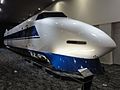 Preserved car 122-5003 (from set K54) at the Kyoto Railway Museum in May 2016
 -
 Preserved bilevel restaurant car 168-9001 (from set X1) at Hamamatsu Works in July 2007


See also[edit]
References[edit]
- ^ a b c d e f g JR電車編成表 '98夏号 [JR EMU Formations – Summer 1998]. Japan: JRR. July 1998. pp. 96–97. ISBN 4-88283-029-9.
- ^ a b c d e Ikeguchi, Eiji (May 2012). 100系・300系新幹線電車 [100 and 300 series shinkansen trains]. Tetsudō Daiya Jōhō Magazine. 41 (337). Japan: Kōtsū Shimbun: 38–47.
- ^ a b c Umehara, Jun (July 2003). 去り行く栄光の新幹線100系 [The waning years of the glorious 100 series shinkansen]. Rail Magazine (238). Japan: Neko Publishing Co., Ltd.: 5–33.
- ^ a b Ota, Yoshio (September 1986). 100系電車量産車 [100 series full-production sets]. Railway Journal (237). Japan: Tetsudō Journal: 70–75.
- ^ a b JR電車編成表 '07冬号 [JR EMU Formations - Winter 2007]. Japan: JRR. December 2006. p. 130. ISBN 4-88283-046-9.
- ^ a b c d JR電車編成表 2009夏 [JR EMU Formations – Summer 2009]. Japan: Kotsu Shimbunsha. June 2009. p. 131. ISBN 978-4-330-06909-8.
- ^ "車両の動き2008-2009". Japan Railfan Magazine. 49 (579). Japan: Koyusha Co., Ltd.: 74 July 2009.
- ^ 新下関の100系訓練用車両が使用終了に [100 series used for training at Shin-Shimonoseki taken out of use]. Japan Railfan Magazine Online (in Japanese). Japan: Koyusha Co., Ltd. 12 April 2013. Retrieved 12 April 2013.
- ^ 100系P編成 運転終了 [100 series P sets withdrawn from service]. Japan Railfan Magazine. 51 (602). Japan: Koyusha Co., Ltd.: 175 June 2011.
- ^ 100系新幹線電車が登場時の塗色に [100 series Shinkansen sets to be repainted in original livery]. Japan Railfan Magazine (in Japanese). Koyusha Co., Ltd. 5 July 2010. Archived from the original on 7 July 2010. Retrieved 5 July 2010.
- ^ 100系K53編成が登場時の塗装に [100 series set K53 repainted in original livery]. Japan Railfan Magazine (in Japanese). Koyusha Co., Ltd. 15 July 2010. Archived from the original on 16 July 2010. Retrieved 15 July 2010.
- ^ 平成24春ダイヤ改正について [March 2012 Timetable Revision Details] (PDF). News Release (in Japanese). Japan: West Japan Railway Company. 16 December 2011. Archived from the original (PDF) on 16 December 2011. Retrieved 17 December 2011.
- ^ 「リニア・鉄道館」ファーストガイド ["SCMaglev and Railway Park" First Guide]. Tetsudō Daiya Jōhō Magazine. 40 (324). Japan: Kōtsū Shimbun: 20–33. April 2011.
- ^ 京都鉄道博物館 [Kyoto Railway Museum]. Japan Railfan Magazine (in Japanese). Vol. 56, no. 662. Japan: Koyusha Co., Ltd. June 2016. p. 60.
- ^ 鉄道のテクノロジーVol1:新幹線 [Railway Technology Vol.1: Shinkansen]. Japan: Sanei Mook. April 2009. ISBN 978-4-7796-0534-5.
Further reading[edit]

- Semmens, Peter (1997). High Speed in Japan: Shinkansen – The World's Busiest High-speed Railway. Sheffield, UK: Platform 5 Publishing. ISBN 1-872524-88-5.
| Lines |
|     | ||||||||||||||||||
|---|---|---|---|---|---|---|---|---|---|---|---|---|---|---|---|---|---|---|---|---|
| Service names |
| |||||||||||||||||||
| Train types |
| |||||||||||||||||||
| Operators |
| |||||||||||||||||||
| Builders and owners |
| |||||||||||||||||||
| People | ||||||||||||||||||||


.svg)
.svg)
.svg)
.svg)
.svg)


 Multiple units of Central Japan Railway Company Multiple units of Central Japan Railway Company | ||||||||||||||||||||||||||
|---|---|---|---|---|---|---|---|---|---|---|---|---|---|---|---|---|---|---|---|---|---|---|---|---|---|---|
| Current / active |
|  | ||||||||||||||||||||||||
| Future |
| |||||||||||||||||||||||||
| Retired / withdrawn |
| |||||||||||||||||||||||||
 Multiple units of West Japan Railway Company Multiple units of West Japan Railway Company | |||||||||||||||||||||||||||||||||||
|---|---|---|---|---|---|---|---|---|---|---|---|---|---|---|---|---|---|---|---|---|---|---|---|---|---|---|---|---|---|---|---|---|---|---|---|
| Current / active |
| ||||||||||||||||||||||||||||||||||
| Retired / withdrawn |
| ||||||||||||||||||||||||||||||||||
- Central Japan Railway Company
- West Japan Railway Company
- Shinkansen train series
- Hitachi multiple units
- Train-related introductions in 1985
- Passenger trains running at least at 200 km/h in commercial operations
- 25 kV AC multiple units
- Kawasaki multiple units
- Kinki Sharyo multiple units
- Nippon Sharyo multiple units
- Tokyu Car multiple units