


E4 Series Shinkansen
| E4 series | |
|---|---|
 E4 series train set P20 on a Joetsu Shinkansen Max Tanigawa service in February 2021 | |
| In service | 20 December 1997 – 17 October 2021 |
| Manufacturer | Hitachi, Kawasaki Heavy Industries |
| Family name | Max |
| Replaced | E1 Series Shinkansen |
| Constructed | 1997–2003 |
| Entered service | December 1997 (Tohoku Shinkansen) May 2001 (Joetsu Shinkansen) |
| Scrapped | 2013–2022 |
| Number built | 208 vehicles (26 sets) |
| Number in service | None |
| Number preserved | 1 vehicle |
| Number scrapped | 207 vehicles (26 sets) |
| Successor | E7 series |
| Formation | 8 cars per trainset |
| Fleet numbers | P1–P22, P51–P52, P81–P82 |
| Capacity | 817 (54 Green + 763 Standard) |
| Operators | JR East |
| Depots | Niigata, Sendai |
| Lines served | Joetsu Shinkansen, Tōhoku Shinkansen |
| Specifications | |
| Car body construction | Aluminium |
| Car length | End cars: 25,700 mm (84 ft 3+13⁄16 in), Intermediate cars: 25,000 mm (82 ft 1⁄4 in) |
| Width | 3,380 mm (11 ft 1+1⁄16 in) |
| Doors | 2 per side |
| Maximum speed | 240 km/h (150 mph) |
| Weight | 428 t |
| Traction system | IGBT-VVVF (Mitsubishi Co.) |
| Traction motors | 16 x 420 kW (563 hp) AC traction motors |
| Power output | 6.72 MW (9,012 hp) |
| Acceleration | 1.65 km/(h⋅s) (1.03 mph/s) |
| Deceleration | 2.69 km/(h⋅s) (1.67 mph/s) (service) 4.04 km/(h⋅s) (2.51 mph/s) (emergency) |
| Electric system(s) | 25 kV AC, 50 Hz overhead catenary 25kV AC, 50Hz and 60Hz (Sets P81 and 82 only, for use on Hokuriku Shinkansen.) |
| Current collector(s) | Pantograph |
| UIC classification | 2′2′+Bo′Bo′+Bo′Bo′+2′2′+2′2′+Bo′Bo′+Bo′Bo′+2′2′ |
| Braking system(s) | Pneumatic and Regenerative |
| Safety system(s) | ATC-2, DS-ATC |
| Multiple working | 400/E3-1000/E3-2000 series |
| Track gauge | 1,435 mm (4 ft 8+1⁄2 in) standard gauge |
The E4 series (E4系) was a high-speed shinkansen train type operated by East Japan Railway Company (JR East) in Japan. They were the second series of completely bi-level Shinkansen trainsets to be built in Japan (the other being the E1 series). They previously operated on the Tōhoku and Jōetsu Shinkansen, and occasionally on the Nagano Shinkansen. E4 series trains feature double-decker cars to accommodate additional commuter traffic around Tokyo and other urban areas.[1] They were often coupled to 400 series trains on the Tōhoku Shinkansen between Tokyo and Fukushima before the latter retired in April 2010 along with the E3 series trains until September 2012. The last trains of the E4 series were withdrawn from regular service on 1 October 2021.
Two eight-car sets can be coupled together for extra capacity: a sixteen-car E4 series formation trainset carries a total of 1,634 seated passengers, the highest-capacity high-speed rail trainset in the world.[2]
26 units were built between 1997 and 2003. As with the earlier E1 series trains, maximum speed was 240 km/h (150 mph).
Formation[edit]
| Car No. | 1 | 2 | 3 | 4 | 5 | 6 | 7 | 8 |
|---|---|---|---|---|---|---|---|---|
| Designation | T1c | M1 | M2 | T | Tk | Mp | Ms | Tpsc |
| Numbering | E453-100 | E455-100 | E456-100 | E458 | E459-200 | E455 | E446 | E444 |
| Seating capacity | 75 | 133 | 119 | 124 | 110 | 122 | 91 | 43 |
Cars 4 and 6 were each equipped with a PS201 pantograph.[3]
Variants[edit]
Sets P51 and P52, delivered in January and February 2001 were designed to cope with the steep gradients of the Nagano Shinkansen for use on services to Karuizawa.[3]
Sets P81 and P82, delivered in July and November 2003 were designed to cope with the steep gradients of the Nagano Shinkansen, and are also capable of operating under 50 Hz and 60 Hz overhead power supplies for use on services to Nagano.[3]
Interior[edit]
As with the earlier E1 series, the upper deck saloons of non-reserved cars 1 to 3 were arranged 3+3 with no individual armrests, and did not recline. The lower decks of these cars, and the reserved-seating saloons in cars 4 to 8 had regular 2+3 seating. The green car saloons on the upper decks of cars 7 to 8 had 2+2 seating. The trains had a total seating capacity of 817 passengers.[4]
-
 Green class saloon (upper deck), February 2011
 -
 Standard-class reserved car lower deck with 2+3 seating
 -
 Standard-class non-reserved car upper deck with non-reclining 3+3 seating
 -
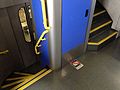 Vestibule area and stairway


History[edit]

The first E4 series set, P1, was delivered to Sendai Depot on 8 October 1997, with the first sets entering revenue-earning service on the Tohoku Shinkansen from 20 December 1997.[3]
All cars were made no-smoking from the start of the revised timetable on 18 March 2007.[3]
In March 2011, it was announced that the entire E4 series fleet would be withdrawn by around 2016.[5]
In September 2012, E4 series were entirely withdrawn from Tohoku Shinkansen services, and all allocated for use on Joetsu Shinkansen services only.[6] The trains were withdrawn from regular service on 1 October 2021,[7] and were completely retired on 17 October of the same year.
Livery change[edit]

From 2014, the fleet of 24 sets still in service began to be repainted, receiving a new livery identical to that previously carried by the E1 series trains, with a toki (crested ibis) pink stripe separating the white on the upper body and blue on the lower body. The first reliveried set, P5, was returned to service in early April 2014,[8] with the entire fleet be treated by the end of fiscal 2015.[9]
-
 The new logo, April 2014

Withdrawals[edit]
Withdrawals started in July 2013, with sets P2 and P3.[10]
Preserved examples[edit]

End car E444-1 from set P1 is displayed at the Niigata City Niitsu Railway Museum in Niitsu, Niigata.[11] It was moved by road from Niigata Depot to the museum in the early hours of 20 June 2017.[12]
Fleet list[edit]
The build details are as shown below.[3] All units retired from regular service as of 1 October 2021.
| Set No. | Manufacturer | Delivered | Reliveried | Withdrawn |
|---|---|---|---|---|
| P1 | Kawasaki HI | 8 October 1997 | 12 May 2015 | 2 April 2016[13] |
| P2 | Hitachi | 20 October 1997 | - | 3 July 2013[10] |
| P3 | Kawasaki HI | 27 October 1997 | - | 26 July 2013[10] |
| P4 | Hitachi | 10 February 1999 | 10 February 2016 | 15 September 2017 |
| P5 | Kawasaki HI | 22 February 1999 | 3 April 2014 | 5 December 2017[14] |
| P6 | Hitachi | 15 March 1999 | 11 June 2014 | 13 January 2018[14] |
| P7 | 14 April 1999 | 25 March 2015 | 29 May 2019 | |
| P8 | Kawasaki HI | 31 May 1999 | 3 July 2015 | 20 June 2019 |
| P9 | Hitachi | 21 June 1999 | 20 August 2015 | 12 July 2019 |
| P10 | Kawasaki HI | 12 July 1999 | 4 February 2015 | 7 May 2019 |
| P11 | Hitachi | 26 July 2000 | 3 March 2016 | 28 October 2021 |
| P12 | 28 August 2000 | 13 April 2016 | 24 November 2021 | |
| P13 | Kawasaki HI | 11 September 2000 | 10 May 2016 | 20 December 2021 |
| P14 | Hitachi | 13 October 2000 | 1 June 2016 | 18 January 2022 |
| P15 | Kawasaki HI | 16 October 2000 | 17 October 2016 | 17 December 2019 |
| P16 | Hitachi | 27 November 2000 | 1 May 2014 | 24 August 2020 |
| P17 | 21 March 2001 | 30 September 2014 | 14 February 2022 | |
| P18 | Kawasaki HI | 4 June 2001 | 30 April 2015 | 22 February 2021 |
| P19 | 25 June 2001 | 20 August 2015 | 18 March 2021 | |
| P20 | Hitachi | 16 July 2001 | 9 October 2015 | 26 April 2021 |
| P21 | Kawasaki HI | 9 October 2001 | 4 November 2015 | 27 May 2021 |
| P22 | 20 November 2001 | 18 December 2015 | 21 June 2021 | |
| P51 | 31 January 2001 | 7 July 2014 | 25 November 2020 | |
| P52 | 20 February 2001 | 27 August 2014 | 5 October 2021 | |
| P81 | Hitachi | 30 July 2003 | 22 July 2015 | 7 May 2021 |
| P82 | Kawasaki HI | 20 November 2003 | 19 January 2016 | 30 March 2022 |
See also[edit]
- TGV Duplex, French double-deck high speed train
- List of high-speed trains
References[edit]
- ^ JR全車輌ハンドブック2006 [JR Rolling Stock Handbook 2006]. Japan: Neko Publishing. 2006. ISBN 4-7770-0453-8.
- ^ 鉄道のテクノロジーVol1:新幹線 [Railway Technology Vol.1: Shinkansen]. Japan: Sanei Mook. April 2009. ISBN 978-4-7796-0534-5.
- ^ a b c d e f JR電車編成表 2010夏 [JR EMU Formations – Summer 2010]. Japan: Kotsu Shimbunsha. May 2010. p. 9. ISBN 978-4-330-14310-1.
- ^ Saito, Masatoshi (9 March 2011). JR東:2階建て新幹線「Max」5年後全廃 老朽化進み [JR East to withdraw all "Max" double-decker trains within 5 years]. Mainichi jp (in Japanese). Japan: The Mainichi Newspapers. Archived from the original on 10 March 2011. Retrieved 9 March 2011.
- ^ JR電車編成表 2018冬 [JR EMU Formations – Winter 2018] (in Japanese). Japan: Kotsu Shimbunsha. 15 November 2017. p. 13. ISBN 978-4-330-84117-5.
- ^ "JR East to Retire the Last Double-Decker Shinkansen Train – Japan Station". japanstation.com. Retrieved 11 August 2021.
- ^ E4系P編成が塗装変更を実施 [E4 series P sets repainted]. RM News (in Japanese). Japan: Neko Publishing Co., Ltd. 7 April 2014. Archived from the original on 9 August 2017. Retrieved 7 April 2014.
- ^ "上越新幹線(E4系)のエクステリアデザインが生まれ変わります!" [Exterior design of Joetsu Shinkansen E4 series to be updated] (PDF). News release (in Japanese). Japan: East Japan Railway Company – Niigata Division. 26 March 2014. Archived from the original (PDF) on 27 March 2014. Retrieved 27 March 2014.
- ^ a b c JR電車編成表 2014冬 [JR EMU Formations – Winter 2014]. Japan: Kotsu Shimbunsha. 1 December 2013. p. 356. ISBN 978-4-330-42413-2.
- ^ 新津鉄道資料館 新規実物車輌展示 [New rolling stock exhibits at Niigata City Niitsu Railway Museum]. Tetsudo Hobidas (in Japanese). Japan: Neko Publishing Co., Ltd. 7 June 2017. Archived from the original on 8 June 2017. Retrieved 8 June 2017.
- ^ 深夜の住宅街、新幹線ゆっくり陸送 新潟 [Shinkansen transported slowly by road late at night through residential area in Niigata]. The Asahi Shimbun (in Japanese). Japan. 21 June 2017. Archived from the original on 21 June 2017. Retrieved 21 June 2017.
- ^ JR車両のうごき [JR rolling stock changes]. Tetsudō Daiya Jōhō Magazine (in Japanese). Vol. 45, no. 389. Japan: Kōtsū Shimbun. September 2016. pp. 81, 357.
- ^ a b JR車両のうごき [JR rolling stock changes]. Tetsudo Daiya Joho Magazine (in Japanese). Vol. 47, no. 407. Japan: Kotsu Shimbun. March 2018. p. 103.
External links[edit]

- E4 Series Max Toki/Max Tanigawa (in Japanese)
| Lines |
|     | ||||||||||||||||||
|---|---|---|---|---|---|---|---|---|---|---|---|---|---|---|---|---|---|---|---|---|
| Service names |
| |||||||||||||||||||
| Train types |
| |||||||||||||||||||
| Operators |
| |||||||||||||||||||
| Builders and owners |
| |||||||||||||||||||
| People | ||||||||||||||||||||


.svg)
.svg)
.svg)
.svg)
.svg)


 Multiple-units of East Japan Railway Company Multiple-units of East Japan Railway Company | |||||||||||||||||||||||||||||||||||||||||||||||||||||||||
|---|---|---|---|---|---|---|---|---|---|---|---|---|---|---|---|---|---|---|---|---|---|---|---|---|---|---|---|---|---|---|---|---|---|---|---|---|---|---|---|---|---|---|---|---|---|---|---|---|---|---|---|---|---|---|---|---|---|
| Current / active |
| ||||||||||||||||||||||||||||||||||||||||||||||||||||||||
| Future |
| ||||||||||||||||||||||||||||||||||||||||||||||||||||||||
| Retired / withdrawn |
| ||||||||||||||||||||||||||||||||||||||||||||||||||||||||
| Experimental | |||||||||||||||||||||||||||||||||||||||||||||||||||||||||