


Mahavira
| Mahavira | |
|---|---|
24th Tirthankara | |
 Pratima of Shri Mahavir Swami at Shri Mahavir Ji temple, Kurauli Rajasthan | |
| Other names | Vira, Ativira, Vardhamana, Sanmatinatha[1][2][3][4][5] |
| Venerated in | Jainism |
| Predecessor | Parshvanatha |
| Successor | Padmanābha (first Tirthankara of the ascending next half of time-cycle) [6] |
| Mantra | Śrī Mahāvīrāya Namaḥ |
| Symbol | Lion[7] |
| Age | 72 |
| Tree | Shala |
| Complexion | Golden |
| Festivals | Mahavir Janma Kalyanak, Diwali |
| Genealogy | |
| Born | Vardhamāna c. 599 BCE[8] Kshatriyakund (Shvetambara)[1][9] Kundalpur, Nāya Republic, Vajjika League (present-day Nalanda district, Bihar, India) (Digambara)[10] |
| Died | 527 BCE[8][11] Pawapuri, Magadha, Haryanka Empire (present-day Nalanda district, Bihar, India) |
| Parents |
|
| Siblings | Nandivardhana Sudarśanā |
| Spouse | Yashoda (Śvetāmbara) Unmarried (Digambara) |
| Children | Priyadarshana, also known as Anojja (Śvetāmbara) |
| Dynasty | Ikshvaku dynasty |
| Part of a series on |
| Jainism |
|---|
 |

Mahavira (Devanagari: महावीर, Mahāvīra), also known as Vardhamana (Devanagari: वर्धमान, Vardhamāna), was the 24th Tirthankara (Supreme Preacher) of Jainism. He was the spiritual successor of the 23rd Tirthankara Parshvanatha.[12] Mahavira was born in the early 6th century BCE to a royal Kshatriya Jain family of ancient India. His mother's name was Trishala and his father's name was Siddhartha. According to the second chapter of the Śvētāmbara Ācārāṅga Sūtra, Siddhartha and his family were devotees of Parshvanatha.[13][14] Mahavira abandoned all worldly possessions at the age of about 30 and left home in pursuit of spiritual awakening, becoming an ascetic. Mahavira practiced intense meditation and severe austerities for twelve and a half years, after which he attained Kevala Jnana (omniscience). He preached for 30 years and attained moksha (liberation) in the 6th century BCE, although the year varies by sect.
Mahavira taught attainment of samyak darshan or self realization through the practice of bhedvijnāna, which involves positioning oneself as a pure soul, separate from body, mind and emotions, and being aware of the soul's true nature; and to remain grounded and steadfast in soul's unchanging essence during varying auspicious or inauspicious external circumstances. He also preached that the observance of the vows of ahimsa (non-violence), satya (truth), asteya (non-stealing), brahmacharya (chastity), and aparigraha (non-attachment) are necessary for spiritual liberation. He taught the principles of Anekantavada (many-sided reality): syadvada and nayavada. Mahavira's teachings were compiled by Indrabhuti Gautama (his chief disciple) as the Jain Agamas. The texts, transmitted orally by Jain monks, are believed to have been largely lost by about the 1st century CE.
Mahavira is usually depicted in a sitting or standing meditative posture, with the symbol of a lion beneath him. His earliest iconography is from archaeological sites in the North Indian city of Mathura, and is dated from between the 1st century BCE and the 2nd century CE. His birth is celebrated as Mahavir Janma Kalyanak and his nirvana (liberation) and also his first shishya of Gautama Swami is observed by Jains as Diwali.
Historically, Mahavira, who revived and preached Jainism in ancient India, was an older contemporary of Gautama Buddha. Jains celebrate Mahavir Janma Kalyanak every year on the 13th day of the Indian Calendar month of Chaitra.[15]
Names and epithets
[edit]Surviving early Jain and Buddhist literature uses several names (or epithets) for Mahavira, including Nayaputta, Muni, Samana, Nigantha, Brahman, and Bhagavan.[1] In early Buddhist sutras, he is referred to as Araha ("worthy") and Veyavi (derived from "Vedas", but meaning "wise").[16] He is known as Sramana in the Kalpa Sūtra, "devoid of love and hate".[17]
According to later Jain texts, Mahavira's childhood name was Vardhamāna ("the one who grows") because of the kingdom's prosperity at the time of his birth.[13] According to the Kalpasutras, he was called Mahavira ("the great hero") by the gods in the Kalpa Sūtra because he remained steadfast in the midst of dangers, fears, hardships and calamities.[17] He is also known as a tirthankara.[18]
Historical Mahavira
[edit].png)
It is universally accepted by scholars of Jainism that Mahavira lived in ancient India.[19][20] According to the Digambara Uttarapurana text, Mahavira was born in Kundagrama in the Kingdom of the Videhas;[21] the Śvētāmbara Kalpa Sūtra uses the name "Kundagrama",[1][9] said to be located in present-day Bihar, India. Although it is thought to be the town of Basu Kund, about 60 kilometres (37 miles) north of Patna (the capital of Bihar),[22][23] his birthplace remains a subject of dispute.[1][19][24] Mahavira renounced his material wealth and left home when he was twenty-eight, by some accounts[25] (thirty by others),[26] lived an ascetic life for twelve and a half years in which he did not even sit for a time, attained Kevalgyana and then preached Dharma for thirty years.[25] Where he preached has been a subject of disagreement between the two major traditions of Jainism: Śvētāmbara and Digambara traditions.[1]
It is uncertain when Mahavira was born and when he died. One view is that Mahavira was born in 540 BCE and died in 443 BCE.[8][25] The Barli Inscription in Prakrit language which was inscribed in 443 BCE (year 84 of the Vira Nirvana Samvat), contains the line Viraya Bhagavate chaturasiti vase, which can be interpreted as "dedicated to Lord Vira in his 84th year", 84 years after the Nirvana of the Mahavira.[27][28] However, palaeographic analysis dates the inscription to the 2nd-1st century BCE.[29] According to Buddhist and Jain texts, Buddha and Mahavira are believed to have been contemporaries which is supported by much ancient Buddhist literature.[8][22]
A firmly-established part of the Jain tradition is that the Vira Nirvana Samvat era began in 527 BCE (with Mahavira's nirvana).[8] The 12th-century Jain scholar Hemachandracharya placed Mahavira in the 6th century BCE.[30][31] According to Jain tradition, the traditional date of 527 BCE is accurate; the Buddha was younger than Mahavira and "might have attained nirvana a few years later".[32] The place of his nirvana, Pavapuri in present-day Bihar, is a pilgrimage site for Jains.[25]
Jain tradition
[edit]According to Jain cosmology, 24 Tirthankaras have appeared on earth; Mahavira is the last tirthankara of Avasarpiṇī (the present time cycle).[note 1][34] A tirthankara (ford-maker, saviour or spiritual teacher) signifies the founding of a tirtha, a passage across the sea of birth-and-death cycles.[35][36][37]
Birth
[edit]

Tirthankara Mahavira was born into a royal Kshatriya family of King Siddhartha of the Ikshvaku Dynasty and Queen Trishala of the Licchavi republic.[38][note 2] The Ikshvaku Dynasty was founded by the First tirthankara Rishabhanatha.[39][note 3]
According to Jains, Mahavira was born in 599 BCE. His birth date falls on the thirteenth day of the rising moon in the month of Chaitra in the Vira Nirvana Samvat calendar era.[25][41][42] It falls in March or April of the Gregorian calendar, and is celebrated by Jains as Mahavir Janma Kalyanak.[43]
Kshatriyakund (the place of Mahavira's birth) is traditionally believed to be near Vaishali, an ancient town on the Indo-Gangetic Plain. Its location in present-day Bihar is unclear, partly because of migrations from ancient Bihar for economic and political reasons.[1] According to the "Universal History" in Jain texts, Mahavira underwent many rebirths (total 27 births) before his 6th-century birth. They included a denizen of hell, a lion, and a god (deva) in a heavenly realm just before his last birth as the 24th tirthankara.[44] Svetambara texts state that his embryo first formed in a Brahman woman before it was transferred by Hari-Naigamesin (the divine commander of Indra's army) to the womb of Trishala, Siddhartha's wife.[45][46][note 4] The embryo-transfer legend is not believed by adherents of the Digambara tradition.[48][49][50]
Jain texts state that after Mahavira was born, the god Indra came from the heavens along with 56 digkumaries, anointed him, and performed his abhisheka (consecration) on Mount Meru.[44] These events, illustrated in a number of Jain temples, play a part in modern Jain temple rituals.[51] Although the Kalpa Sūtra accounts of Mahavira's birth legends are recited by Svetambara Jains during the annual Paryushana festival, the same festival is observed by the Digambaras without the recitation.[52]
Early life
[edit]Mahavira grew up as a prince. According to the second chapter of the Śvētāmbara text Ācārāṅga Sūtra, his parents were lay devotees of Parshvanatha.[13][14] Jain traditions differ about whether Mahavira married.[49][53] The Digambara tradition believes that his parents wanted him to marry Yashoda, but he refused to marry.[54][note 5] The Śvētāmbara tradition believes that he was married to Yashoda at a young age and had one daughter, Priyadarshana,[23][44] also called Anojja.[56]
Jain texts portray Mahavira as tall; his height was given as four cubits (6 feet) in the Aupapatika Sutra.[57] According to Jain texts, he was the shortest of the twenty-four tirthankaras; earlier arihants were believed to have been taller, with Neminatha or Aristanemi —the 22nd tirthankara, who lived for 1,000 years—said to have been sixty-five cubits (98 feet) in height.[58]
Renunciation
[edit]
At age thirty, Mahavira abandoned royal life and left his home and family to live an ascetic life in the pursuit of spiritual awakening.[33][59][60] He undertook severe fasts and bodily mortifications,[61] meditated under the Ashoka tree, and discarded his clothes.[33][62] The Ācārāṅga Sūtra has a graphic description of his hardships and self-mortification.[63][64] According to the Kalpa Sūtra, Mahavira spent the first forty-two monsoons of his life in Astikagrama, Champapuri, Prstichampa, Vaishali, Vanijagrama, Nalanda, Mithila, Bhadrika, Alabhika, Panitabhumi, Shravasti, and Pawapuri.[65] He is said to have lived in Rajagriha during the rainy season of the forty-first year of his ascetic life, which is traditionally dated to 491 BCE.[66]
Omniscience
[edit]
According to traditional accounts, Mahavira achieved Kevala Jnana (omniscience, or infinite knowledge) under a Sāla tree on the bank of the River Rijubalika near Jrimbhikagrama at age 43 after twelve years of rigorous penance.[59][67][68] The details of the event are described in the Jain Uttar-purāņa and Harivamśa-purāņa texts.[69] The Ācārāṅga Sūtra describes Mahavira as all-seeing. The Sutrakritanga expands it to all-knowing, and describes his other qualities.[1] Jains believe that Mahavira had a most auspicious body (paramaudārika śarīra) and was free from eighteen imperfections when he attained omniscience.[70] According to the Śvētāmbara, he traveled throughout India to teach his philosophy for thirty years after attaining omniscience.[59] However, the Digambara believe that he remained in his Samavasarana and delivered sermons to his followers.[71]
Disciples
[edit]Jain texts document eleven Brahmanas as Mahavira's first disciples, traditionally known as the eleven Ganadharas.[72] Indrabhuti Gautama is believed to have been their leader,[71] and the others included Agnibhuti, Vayubhuti, Akampita, Arya Vyakta, Sudharman, Manditaputra, Mauryaputra, Acalabhraataa, Metraya, and Prabhasa. The Ganadharas are believed to have remembered and to have verbally transmitted Mahavira's teachings after his death. His teachings became known as Gani-Pidaga, or the Jain Agamas.[73] According to Kalpa Sutra, Mahavira had 14,000 sadhus (male ascetic devotees), 36,000 sadhvis (female ascetics), 159,000 sravakas (male lay followers), and 318,000 sravikas (female lay followers).[12][74][75] Jain tradition mentions Srenika and Kunika of Haryanka dynasty (popularly known as Bimbisara and Ajatashatru) and Chetaka of Videha as his royal followers.[65][76] Mahavira initiated his mendicants with the mahavratas (Five Vows).[72] He delivered fifty-five pravachana (recitations) and a set of lectures (Uttaraadhyayana-sutra).[59] Chandana is believed to be the leader of female monastic order.[77]
Nirvana and moksha
[edit].jpg)

According to Jain texts, Mahavira's nirvana (death)[note 6] occurred in the town of Pawapuri in present-day Bihar.[79][80][81] His life as a spiritual light and the night of his nirvana are commemorated by Jains as Diwali at the same time that Hindus celebrate it.[81][82] His chief disciple, Gautama, is said to have attained omniscience the night that Mahavira achieved nirvana from Pawapuri.[83]
Accounts of Mahavira's nirvana vary among Jain texts, with some describing a simple nirvana and others recounting grandiose celebrations attended by gods and kings. According to the Jinasena's Mahapurana, heavenly beings arrived to perform his funeral rites. The Pravachanasara of Digambara tradition says that only the nails and hair of tirthankaras are left behind; the rest of the body dissolves in the air like camphor.[84] In some texts Mahavira is described, at age 72, as delivering his final preaching over a six-day period to a large group of people. The crowd falls asleep, awakening to find that he has disappeared (leaving only his nails and hair, which his followers cremate).[85]
The Jain Śvētāmbara tradition believes that Mahavira's nirvana occurred in 527 BCE, and the Digambara tradition holds that date of 468 BCE. In both traditions, his jiva (soul) is believed to abide in Siddhashila (the home of liberated souls).[82] Mahavira's Jal Mandir stands at the place where he is said to have attained nirvana (moksha).[86] Artworks in Jain temples and texts depict his final liberation and cremation, sometimes shown symbolically as a small pyre of sandalwood and a piece of burning camphor.[87]
Previous births
[edit]Mahavira's previous births are recounted in Jain texts such as the Mahapurana and Tri-shashti-shalaka-purusha-charitra. Although a soul undergoes countless reincarnations in the transmigratory cycle of saṃsāra, the birth of a tirthankara is reckoned from the time he determines the causes of karma and pursues ratnatraya. Jain texts describe Mahavira's 26 births before his incarnation as a tirthankara.[65] According to the texts, he was born as Marichi (the son of Bharata Chakravartin) in a previous life.[44]
Texts
[edit]
Yativṛṣabha's Tiloya-paṇṇatti recounts nearly all the events of Mahavira's life in a form convenient for memorisation.[88] Jinasena's Mahapurana (which includes the Ādi purāṇa and Uttara-purāṇa) was completed by his disciple, Gunabhadra, in the 8th century. In the Uttara-purāṇa, Mahavira's life is described in three parvans, or sections, (74–76) and 1,818 verses.[89]
Vardhamacharitra is a Sanskrit kāvya poem, written by Asaga in 853 CE , which narrates the life of Mahavira.[90][91][92] The Kalpa Sūtra is a collection of biographies of tirthankaras, notably Parshvanatha and Mahavira. Samavayanga Sutra is a collection of Mahavira's teachings, and the Ācārāṅga Sūtra recounts his asceticism.
Teachings
[edit]Colonial-era Indologists considered Jainism (and Mahavira's followers) a sect of Buddhism because of superficial similarities in iconography and meditative and ascetic practices.[93] As scholarship progressed, differences between the teachings of Mahavira and the Buddha were found so divergent that the religions were acknowledged as separate.[94] Mahavira, says Moriz Winternitz, taught a "very elaborate belief in the soul" (unlike the Buddhists, who denied such elaboration). His ascetic teachings have a higher order of magnitude than those of Buddhism or Hinduism, and his emphasis on ahimsa (non-violence) is greater than that in other Indian religions.[94]
Agamas
[edit]Mahavira's teachings were compiled by Gautama Swami, his Ganadhara (chief disciple).[95] The canonical scriptures are in twelve parts.[96] Mahavira's teachings were gradually lost after about 300 BCE, according to Jain tradition, when a severe famine in the Magadha kingdom dispersed the Jain monks. Attempts were made by later monks to gather, recite the canon, and re-establish it.[97] These efforts identified differences in recitations of Mahavira's teachings, and an attempt was made in the 5th century CE to reconcile the differences.[97] The reconciliation efforts failed, with Svetambara and Digambara Jain traditions holding their own incomplete, somewhat-different versions of Mahavira's teachings. In the early centuries of the common era, Jain texts containing Mahavira's teachings were written in palm-leaf manuscripts.[73] According to the Digambaras, Āchārya Bhutabali was the last ascetic with partial knowledge of the original canon. Later, some learned achāryas restored, compiled, and wrote down the teachings of Mahavira which were the subjects of the Agamas.[98] Āchārya Dharasena, in the 1st century CE, guided the Āchāryas Pushpadant and Bhutabali as they wrote down the teachings. The two Āchāryas wrote Ṣaṭkhaṅḍāgama, among the oldest-known Digambara texts, on palm leaves.
Five Vows
[edit]
The Jain Agamas enumerate five vratas (vows) which ascetics and householders must observe.[99] These ethical principles were preached by Mahavira:[59][100]
- Ahimsa (Non-violence or non-injury): Mahavira taught that every living being has sanctity and dignity which should be respected as one expects one's own sanctity and dignity to be respected. Ahimsa, Jainism's first and most important vow, applies to actions, speech, and thought.[101]
- Satya (truthfulness): Applies to oneself and others.[101]
- Asteya (non-stealing): Not "taking anything that has not been given"[102]
- Brahmacharya (chastity): Abstinence from sex and sensual pleasures for monks, and faithfulness to one's partner for householders[101][103]
- Aparigraha (non-attachment): For lay people, an attitude of non-attachment to property or worldly possessions; for mendicants, not owning anything[104]
The goal of these principles is to achieve spiritual peace, a better rebirth, or (ultimately) liberation.[105][106][107] According to Chakravarthi, these teachings help improve a person's quality of life.[108] However, Dundas writes that Mahavira's emphasis on non-violence and restraint has been interpreted by some Jain scholars to "not be driven by merit from giving or compassion to other creatures, nor a duty to rescue all creatures" but by "continual self discipline": a cleansing of the soul which leads to spiritual development and release.[109]
Mahavira is best remembered in the Indian traditions for his teaching that ahimsa is the supreme moral virtue.[59][110] He taught that ahimsa covers all living beings,[111] and injuring any being in any form creates bad karma (which affects one's rebirth, future well-being, and suffering).[112] According to Mahatma Gandhi, Mahavira was the greatest authority on ahimsa.[113][114][115]
Soul
[edit]Mahavira taught that the soul exists. There is no soul (or self) in Buddhism, and its teachings are based on the concept of anatta (non-self).[116][117][118] Mahavira taught that the soul is dravya (substantial), eternal, and yet temporary.[119]
To Mahavira, the metaphysical nature of the universe consists of dravya, jiva, and ajiva (inanimate objects).[76] The jiva is bound to saṃsāra (transmigration) because of karma (the effects of one's actions).[76] Karma, in Jainism, includes actions and intent; it colors the soul (lesya), affecting how, where, and as what a soul is reborn after death.[120]
According to Mahavira, there is no creator deity and existence has neither beginning nor end. Deities and demons however exist in Jainism , whose jivas are a part of the same cycle of birth and death.[121] The goal of spiritual practice is to liberate the jiva from its karmic accumulation and enter the realm of the siddhas, souls who are liberated from rebirth.[122] Enlightenment, to Mahavira, is the consequence of self awareness, self-cultivation and restraint from materialism.[109]
Bhedvijnāna
[edit]Mahavira also taught the concept of Bhedvijnān, or the science of distinguishing between the soul (jiva) and the non-soul (ajiva). Central to his teachings, bhedvijnān is the practice of realizing the distinction between the pure soul, which is eternal, formless, and independent, and the temporary, external aspects of existence such as body, thoughts, emotions, and karmic influences.
According to Mahavira, this understanding is crucial for attainment of nischay Samyak darshan (experiential self realization). He emphasized that human suffering arises from the false identification of the soul with material objects, including the body and mind. The teachings of bhedvijnān guide an individual to recognize what is truly the soul and what is not. By distinguishing between the pure soul and the transient elements of life, one can cultivate detachment (vairagya) and move toward liberation (moksha). This was expounded in detail in works of Acharya Kundkund, Acharya Haribhadra, Yashovijaya and Shrimad Rajchandra.
Bhedvigyan plays a key role in the progression towards self-realization. It serves as a stepping stone in the process of spiritual awakening, where the aspirant first becomes aware of their mistaken identity with the non-soul as their witness (bhed-nasti), and later become aware of the existence and true nature of the soul itself (asti). This process ultimately leads to the direct experience of the soul in a state of pure awareness, destroying karmic attachments.[123]
In Jainism, this knowledge is considered the foundation for developing right belief (samyak darshan) and attaining samyak gyan (omniscience).
Anekantavada
[edit]Mahavira taught the doctrine of anekantavada (many-sided reality).[124][125][126] Although the word does not appear in the earliest Jain literature or the Agamas, the doctrine is illustrated in Mahavira's answers to questions posed by his followers.[124] Truth and reality are complex, and have a number of aspects. Reality can be experienced, but it is impossible to express it fully with language alone; human attempts to communicate are nayas ("partial expression[s] of the truth").[124] Language itself is not truth, but a means of expressing it. From truth, according to Mahavira, language returns—not the other way around.[124][127] One can experience the "truth" of a taste, but cannot fully express that taste through language. Any attempt to express the experience is syāt: valid "in some respect", but still a "perhaps, just one perspective, incomplete".[127] Spiritual truths are also complex, with multiple aspects, and language cannot express their plurality; however, they can be experienced through effort and appropriate karma.[124]
Mahavira's anekantavada doctrine is also summarized in Buddhist texts such as the Samaññaphala Sutta (in which he is called Nigantha Nātaputta),[note 7][128] and is a key difference between the teachings of Mahavira and those of the Buddha. The Buddha taught the Middle Way, rejecting the extremes of "it is" or "it is not"; Mahavira accepted both "it is" and "it is not", with reconciliation and the qualification of "perhaps".[129]
The Jain Agamas suggest that Mahavira's approach to answering metaphysical, philosophical questions was a "qualified yes" (syāt). A version of this doctrine is also found in the Ajivika school of ancient Indian philosophy.[130][131]
According to Dundas, the anekantavada doctrine has been interpreted by many Jains as "promot[ing] a universal religious tolerance ... plurality ... [and a] ... benign attitude to other [ethical, religious] positions"; however, this misreads Jain historical texts and Mahavira's teachings.[132] Mahavira's "many pointedness, multiple perspective" teachings are a doctrine about the nature of reality and human existence, not about tolerating religious positions such as sacrificing animals (or killing them for food) or violence against nonbelievers (or any other living being) as "perhaps right".[132] The five vows for Jain monks and nuns are strict requirements, with no "perhaps".[133] Mahavira's Jainism co-existed with Buddhism and Hinduism beyond the renunciant Jain communities, but each religion was "highly critical of the knowledge systems and ideologies of their rivals".[134]
Gender
[edit]A historically contentious view in Jainism is partially attributed to Mahavira and his ascetic life; he did not wear clothing, as a sign of renunciation (the fifth vow, aparigraha). It was disputed whether a female mendicant (sadhvi) could achieve the spiritual liberation like a male mendicant (sadhu) through asceticism.[135][136]
The digambar sect (the sky-clad, naked mendicant order) believed that a woman is unable to fully practice asceticism and cannot achieve spiritual liberation because of her gender; she can, at best, live an ethical life so she is reborn as a man.[note 8] According to this view, women are seen as a threat to a monk's chastity.[138]
Mahavira had preached about men and women equality. The Svetambaras have interpreted Mahavira's teaching as encouraging both sexes to pursue a mendicant, ascetic life with the possibility of moksha (kaivalya, spiritual liberation).[138][136][139]
Rebirth and realms of existence
[edit]Rebirth and realms of existence are fundamental teachings of Mahavira. According to the Acaranga Sutra, Mahavira believed that life existed in myriad forms which included animals, plants, insects, bodies of water, fire, and wind.[112][140] He taught that a monk should avoid touching or disturbing any of them (including plants) and never swim, light (or extinguish) a fire, or wave their arms in the air; such actions might injure other beings living in those states of matter.[112]
Mahavira preached that the nature of existence is cyclic, and the soul is reborn after death in one of the trilok – the heavenly, hellish, or earthly realms of existence and suffering.[141] Humans are reborn, depending on one's karma (actions) as a human, animal, element, microbe, or other form, on earth or in a heavenly (or hellish) realm.[112][142][143] Nothing is permanent; everyone (including gods, demons and earthly beings) dies and is reborn, based on their actions in their previous life. Jinas who have reached Kevala Jnana (omniscience) are not reborn;[112] they enter the siddhaloka, the "realm of the perfected ones".[142]
Legacy
[edit]Lineage
[edit]Mahavira is erroneously called the founder of Jainism, but Jains believe that the 23 previous tirthankaras also espoused it.[61] Mahavira is placed in Parshvanatha's lineage as his spiritual successor and ultimate leader of shraman sangha.[144]
Parshvanatha was born 273 years before Mahavira. Parshvanatha, a tirthankara whom modern Western historians consider a historical figure, lived in about the 8th century BCE.[145][146][147] Jain texts suggest that Mahavira's parents were lay devotees of Parshvanatha. When Mahavira revived the Jain community in the 6th century BCE, ahimsa was already an established, strictly observed rule. The followers of Parshvanatha vowed to observe ahimsa; this obligation was part of their caujjama dhamma (Fourfold Restraint).[146][148]
According to Dundas, Jains believe that the lineage of Parshvanatha influenced Mahavira. Parshvanatha, as the one who "removes obstacles and has the capacity to save", is a popular icon; his image is the focus of Jain temple devotion.[144] Of the 24 tirthankaras, Jain iconography has celebrated Mahavira and Parshvanatha the most; sculptures discovered at the Mathura archaeological site have been dated to the 1st century BCE.[144][149][150] According to Moriz Winternitz, Mahavira may be considered a reformer of an existing Jain sect known as Niganthas (fetter-less) which was mentioned in early Buddhist texts.[93] The Barli Inscription dating back to 443 BCE contains the line Viraya Bhagavate chaturasiti vase, which can be interpreted as "dedicated to Lord Vira in his 84th year".[151]
Festivals
[edit]Two major annual Jain festivals associated with Mahavira are Mahavir Janma Kalyanak and Diwali. During Mahavir Janma Kalyanak, Jains celebrate Mahavira's birth as the 24th and last tirthankara of avasarpiṇī (the current time cycle).[43] During Mahavir JanmaKalyanak, the five auspicious events of Mahavira's life are re-enacted.[152] Diwali commemorates the anniversary of Mahavira's nirvana, and is celebrated at the same time as the Hindu festival. Diwali marks the New Year for Jains.[153]
Worship
[edit].jpg)
Samantabhadra's Svayambhustotra praises the twenty-four tirthankaras, and its eight shlokas (songs) adore Mahavira.[154] One such shloka reads:
O Lord Jina! Your doctrine that expounds essential attributes required of a potential aspirant to cross over the ocean of worldly existence (Saṃsāra) reigns supreme even in this strife-ridden spoke of time (Pancham Kaal). Accomplished sages who have invalidated the so-called deities that are famous in the world, and have made ineffective the whip of all blemishes, adore your doctrine.[155]
Samantabhadra's Yuktyanusasana is a 64-verse poem which also praises Mahavira.[156]
Influence
[edit]Michael H. Hart ranked him 100th in his 1978 book, “The 100: A Ranking of the Most Influential Persons in History”, below the Buddha (ranked 4th) and Ashoka (ranked 53rd).[157] According to Pantheon's 2024 Historical Popularity Index (HPI), Mahavira is ranked 19th among the most famous Indian people of all time.[158]
Mahavira's teachings were influential. According to Rabindranath Tagore,
Mahavira proclaimed in India that religion is a reality and not a mere social convention. It is really true that salvation can not be had by merely observing external ceremonies. Religion cannot make any difference between man and man.
An event associated with the 2,500th anniversary of Mahavira's nirvana was held in 1974:[159]
Probably few people in the West are aware that during this Anniversary year for the first time in their long history, the mendicants of the Śvētāmbara, Digambara and Sthānakavāsī sects assembled on the same platform, agreed upon a common flag (Jaina dhvaja) and emblem (pratīka); and resolved to bring about the unity of the community. For the duration of the year four dharma cakras, a wheel mounted on a chariot as an ancient symbol of the samavasaraṇa (Holy Assembly) of tīrthaṅkara Mahavira traversed to all the major cities of India, winning legal sanctions from various state governments against the slaughter of animals for sacrifice or other religious purposes, a campaign which has been a major preoccupation of the Jainas throughout their history.
Iconography
[edit]
Mahavira is usually depicted in a sitting (or standing) meditative pose, with a lion symbol beneath him;[160] each tīrthankara has a distinct emblem, which allows worshippers to distinguish similar idols.[161] Mahavira's lion emblem is usually carved below his legs. Like all tirthankaras, he is depicted with a Shrivatsa in Shetamber tradition.[note 9] The yoga pose is very common in Buddhism, Hinduism, and Jainism. Each tradition has had a distinctive auspicious chest mark that allows devotees to identify a meditating statue to symbolic icon for their theology. There are several srivasta found in ancient and medieval Jain art works, and these are not found on Buddhist or Hindu art works.[162][163] and downcast eyes in digamber tradition while in Shetamber tradition it is wide open.
Mahavira's earliest iconography is from archaeological sites in the north Indian city of Mathura, dated from the 1st century BCE to the 2nd century CE.[164][165] The srivatsa mark on his chest and his dhyana-mudra posture appears in Kushana Empire-era artwork. Differences in Mahavira's depiction between the Digambara and Svetambara traditions appear in the late 5th century CE.[164] According to John Cort, the earliest archaeological evidence of Jina iconography with inscriptions precedes its datable texts by over 250 years.[166]
Many images of Mahavira have been dated to the 12th century and earlier;[167] an ancient sculpture was found in a cave in Sundarajapuram, Theni district, Tamil Nadu. K. Ajithadoss, a Jain scholar in Chennai, dated it to the 9th century.[168]
Jivantasvami represents Mahavira as a princely state. The Jina is represented as standing in the kayotsarga pose wearing crown and ornaments.[169]
-

-

-
 Rock-cut sculpture of Mahavira in Kalugumalai Jain Beds, 8th century
 -
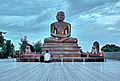
 Tallest known image of the seated Mahavira, Patnaganj
 -
 Four-sided sculpture of Mahavira in Kankali Tila, Mathura
 -
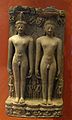 Tirthankaras Rishabhanatha (left) and Mahavira, 11th century (British Museum)
 -
 Temple relief of Mahavira, 14th century (Seattle Asian Art Museum)
 -
 Relief of Mahavira in Thirakoil, Tamil Nadu
 -
-
 Mahavira statue in Cave 32 of the Ellora Caves


Temples
[edit]Along with Rishabhanath, Parshvanath, Neminath, and Shantinath; Mahavira is one of the five tirthankaras that attract the most devotional worship among the Jains.[171] Various Jain temple complexes across India feature him, and these are important pilgrimage sites in Jainism. Pawapuri, for example, is a hilly part of southern Bihar, which is believed to have been a place where 23 out of 24 tirthankaras preached, along with Rishabha.[172][173] According to John Cort, the Mahavira temple in Osian, Jodhpur, Rajasthan is the oldest surviving Jain temple in western India; it was built in the late 8th century.[174] Important Mahavira temple complexes include Jal Mandir in Pawapuri, Trilokyanatha Temple, Meguti Jain Temple, Kumbharia Mahavira Temple, Sankighatta, Muchhal Mahavir Temple, Bhandavapur Jain Tirth, Dimapur Jain Temple, and Jain temple, Kundalpur
-
 Dharmachakra temple in Gajpanth
 -

-

-
 Jain temple, Potters Bar
 -
 Jain temple in Tirumalai
 -
 Meguti Jain temple, 5th—6th century


.jpg)


.jpg)
See also
[edit]
- Jivantasvami
- Arihant (Jainism)
- God in Jainism
- History of Jainism
- Mahavira: The Hero of Nonviolence
- Timeline of Jainism
- Bardhaman (city named after Mahaviraswami)
Notes
[edit]- ^ Heinrich Zimmer: "The cycle of time continually revolves, according to the Jainas. The present "descending" (avasarpini) period was preceded and will be followed by an "ascending" (utsarpini). Sarpini suggests the creeping movement of a "serpent" (sarpin); ava- means "down" and ut- means up."[33]
- ^ Trishala was the sister of King Chetaka of Vaishali in ancient India.[23]
- ^ The Adipurana By Acharya Jinasena mentions that Ikshvaku Dynasty was founded by Lord Rishabhadeva[40]
- ^ This mythology has similarities with those found in the mythical texts of the Vaishnavism tradition of Hinduism.[47]
- ^ On this Champat Rai Jain wrote: ""Of the two versions of Mahavira's life — the Swetambara and the Digambara— it is obvious that only one can be true: either Mahavira married, or he did not marry. If Mahavira married, why should the Digambaras deny it? There is absolutely no reason for such a denial. The Digambaras acknowledge that nineteen out of the twenty-four tirthamkaras married and had children. If Mahavira also married it would make no difference. There is thus no reason whatsoever for the Digambaras to deny a simple incident like this. But there may be a reason for the Swetambaras making the assertion; the desire to ante-date their own origin. As a matter of fact their own books contain clear refutation of the statement that Mahavira had married. In the Samavayanga Sutra (Hyderabad edition) it is definitely stated that nineteen tirthankaras lived as householders, that is, all the twenty-four excepting Shri Mahavira, Parashva, Nemi, Mallinath and Vaspujya."[55]
- ^ Not to be confused with kevalajnana (omniscience).[78]
- ^ Samaññaphala Sutta, D i.47: "Nigantha Nātaputta answered with fourfold restraint. Just as if a person, when asked about a mango, were to answer with a breadfruit; or, when asked about a breadfruit, were to answer with a mango: In the same way, when asked about a fruit of the contemplative life, visible here and now, Nigantha Nātaputta answered with fourfold restraint. The thought occurred to me: 'How can anyone like me think of disparaging a brahman or contemplative living in his realm?' Yet I [Buddha] neither delighted in Nigantha Nātaputta's words nor did I protest against them. Neither delighting nor protesting, I was dissatisfied. Without expressing dissatisfaction, without accepting his teaching, without adopting it, I got up from my seat and left."
- ^ According to Melton and Baumann, the Digambaras state that "women's physical and emotional character makes it impossible for them to genuinely engage in the intense [ascetic] path necessary for spiritual purification. (...) Only by being reborn as a man can a woman engage in the ascetic path. Later Digambara secondary arguments appealed to human physiology in order to exclude women from the path: by their very biological basis, women constantly generate and destroy (and therefore harm) life forms within their sexual organs. Svetambara oppose this view by appealing to scriptures."[137]
- ^ A special symbol that marks the chest of a tirthankara.
References
[edit]Citations
[edit]- ^ a b c d e f g h Dundas 2002, p. 25.
- ^ Davidson & Gitlitz 2002, p. 267.
- ^ Kailash Chand Jain 1991, p. 38.
- ^ Jaini 2000, p. 9.
- ^ Hubbard 1807, p. 310.
- ^ Dundas 2002, p. 276.
- ^ Tandon 2002, p. 45.
- ^ a b c d e Dundas 2002, p. 24.
- ^ a b Doniger 1999, p. 682.
- ^ "Jain Mandir, Kundalpur". Bihar State Tourism Development Corporation. Retrieved 20 May 2024.
- ^ LLP, Adarsh Mobile Applications (20 July 2024). "Lakshmi Puja Timings for Amsterdam, North Holland, Netherlands". Drikpanchang. Retrieved 20 July 2024.
- ^ a b Heehs 2002, p. 90.
- ^ a b c Kailash Chand Jain 1991, p. 32.
- ^ a b Dundas 2002, p. 30.
- ^ "Mahavir Jayanti | What, When, Why & How To Celebrate Mahavir Swami Jayanti". 17 April 2021. Retrieved 2 April 2022.
- ^ Dundas 2002, pp. 25–26.
- ^ a b Heehs 2002, p. 93.
- ^ Zimmer 1953, p. 223.
- ^ a b Potter 2007, pp. 35–36.
- ^ Dundas 2002, pp. 24–25.
- ^ Pannalal Jain 2015, p. 460.
- ^ a b Taliaferro & Marty 2010, p. 126.
- ^ a b c von Glasenapp 1925, p. 29.
- ^ Chaudhary, Pranava K. (14 October 2003). "Row over Mahavira's birthplace". The Times of India. Patna. Archived from the original on 3 November 2017. Retrieved 3 November 2017.
- ^ a b c d e Doniger 1999, p. 549.
- ^ Umakant P. Shah 1987, p. 3.
- ^ Kailash Chand Jain 1972, p. 152.
- ^ Goyala 2006.
- ^ Swarajya Prakash Gupta & K. S. Ramachandran 1979, p. 106:"The Barli inscription, which was placed by Ojha in fifth century B.C., can really be assigned to the first century B.C., on paleographic grounds."
- ^ Rapson 1955, pp. 155–156.
- ^ Cort 2010, pp. 69–70, 587–588.
- ^ Kailash Chand Jain 1991, pp. 84–88.
- ^ a b c Zimmer 1953, p. 224.
- ^ Jain & Upadhye 2000, p. 54.
- ^ Zimmer 1953, p. 181.
- ^ Upinder Singh 2016, pp. 312–313.
- ^ "Tirthankara | Definition, Names, & Facts". Encyclopaedia Britannica. Archived from the original on 15 October 2013. Retrieved 15 October 2013.
- ^ Kailash Chand Jain 1991, p. 5.
- ^ Jinasena (2003). Adipurana (in Hindi). Bhāratīya Jñānapītha. ISBN 978-81-263-0922-1.
- ^ Dowling & Scarlett 2006, p. 225.
- ^ Upinder Singh 2016, p. 313.
- ^ a b Gupta & Gupta 2006, p. 1001.
- ^ a b c d Dundas 2002, p. 21.
- ^ Dundas 2002, pp. 21, 26.
- ^ Mills, Claus & Diamond 2003, pp. 320, note: Indra is referred to as Sakra in some Indian texts..
- ^ Olivelle 2006, pp. 397 footnote 4.
- ^ Mills, Claus & Diamond 2003, p. 320.
- ^ a b Dundas 2002, p. 22.
- ^ Vyas 1995, p. 19.
- ^ Jain & Fischer 1978, pp. 5–9.
- ^ Dalal 2010, p. 284.
- ^ Umakant P. Shah 1987, pp. 99, Quote: "According to the Digambara sect, Mahavira did not marry, while the Svetambaras hold a contrary belief.".
- ^ Shanti Lal Jain 1998, p. 51.
- ^ Champat Rai Jain 1939, p. 97.
- ^ Umakant P. Shah 1987, p. 188.
- ^ Umakant P. Shah 1987, p. 95.
- ^ von Glasenapp 1925, p. 16.
- ^ a b c d e f George 2008, p. 319.
- ^ Jacobi 1964, p. 269.
- ^ a b Wiley 2009, pp. 5–7.
- ^ von Glasenapp 1925, p. 30.
- ^ Sen 1999, p. 74.
- ^ Dundas 2002, p. 27.
- ^ a b c von Glasenapp 1925, p. 327.
- ^ Kailash Chand Jain 1991, p. 79.
- ^ Jain & Upadhye 2000, p. 30.
- ^ von Glasenapp 1925, pp. 30, 327.
- ^ Jain & Upadhye 2000, p. 31.
- ^ Vijay K. Jain 2016b, p. 5.
- ^ a b Upinder Singh 2016, p. 314.
- ^ a b Wiley 2009, p. 6.
- ^ a b Wiley 2009, pp. 6–8, 26.
- ^ George 2008, p. 326.
- ^ Cort 2001, p. 47.
- ^ a b c Caillat & Balbir 2008, p. 88.
- ^ Natubhai Shah 2004, p. 44.
- ^ von Glasenapp 1925, pp. 29–31, 205–206: "At the end of almost thirty years of preaching, he died in the chancellory of King Hastipala of Pavapuri and attained Nirvana.".
- ^ Zimmer 1953, p. 222.
- ^ Dundas 2002, pp. 22–24.
- ^ a b Melton & Baumann 2010, p. 897.
- ^ a b Doniger 1999, pp. 549–550.
- ^ von Glasenapp 1925, p. 39.
- ^ Pramansagar 2008, pp. 38–39.
- ^ von Glasenapp 1925, p. 328.
- ^ "Destinations : Pawapuri". Bihar State Tourism Development Corporation. Archived from the original on 22 July 2015. Retrieved 23 July 2015.
- ^ Jain & Fischer 1978, pp. 14, 29–30.
- ^ Jain & Upadhye 2000, p. 45.
- ^ Jain & Upadhye 2000, p. 46.
- ^ Kailash Chand Jain 1991, p. 59.
- ^ Dundas 2002, p. 19.
- ^ Jain & Upadhye 2000, p. 47.
- ^ a b Winternitz 1993, p. 408.
- ^ a b Winternitz 1993, pp. 408–409.
- ^ Cort 2010, p. 225.
- ^ Vijay K. Jain 2012, p. xi.
- ^ a b Wiley 2009, pp. 6–8.
- ^ Vijay K. Jain 2012, p. xii.
- ^ Sangave 2006, p. 67.
- ^ Shah, Umakant Premanand. "Mahavira | Jaina teacher". Encyclopædia Britannica. Archived from the original on 5 September 2015. Retrieved 5 September 2015.
- ^ a b c Shah, Pravin K. "Five Great Vows (Maha-vratas) of Jainism". Harvard Faculty of Arts and Sciences, Harvard University. Archived from the original on 31 December 2014. Retrieved 31 December 2014.
- ^ Vijay K. Jain 2012, p. 68.
- ^ Long 2009, pp. 101–102.
- ^ Long 2009, p. 109.
- ^ Cort 2001, pp. 26–27.
- ^ Appleton 2014, pp. 20–45.
- ^ Adams 2011, p. 22.
- ^ Chakravarthi 2003, pp. 3–22.
- ^ a b Dundas 2002, pp. 88–89, 257–258.
- ^ Jain & Jain 2002, p. 13.
- ^ Titze 1998, p. 4.
- ^ a b c d e Taylor 2008, pp. 892–894.
- ^ Pandey 1998, p. 50.
- ^ a b Nanda 1997, p. 44.
- ^ a b "Great Men's view on Jainism". Harvard Faculty of Arts and Sciences, Harvard University. Archived from the original on 16 May 2018. Retrieved 16 May 2018.
Jainism Literature Center
- ^ "Anatta | Buddhism". Encyclopædia Britannica. Archived from the original on 10 December 2015. Retrieved 10 December 2015.
Anatta .. in Buddhism, the doctrine that there is in humans no permanent, underlying .. soul. The concept of anatta, or anatman, is a departure from the Hindu belief in atman ("the self").
- ^ Collins 1994, p. 64.
- ^ Nagel 2000, p. 33.
- ^ Charitrapragya 2004, pp. 75–76.
- ^ Dundas 2002, pp. 99–103.
- ^ Dundas 2002, pp. 90–99.
- ^ Dundas 2002, pp. 91–92, 104–105.
- ^ "Samaya Sara of Acharya Kundkund with Vijay K. Jain Vikalap Printers Dehradun".
- ^ a b c d e Charitrapragya 2004, pp. 75–79.
- ^ Dundas 2002, pp. 229–231.
- ^ Sharma & Khanna 2013, p. 18.
- ^ a b Webb, Mark Owen (14 November 2003). "Jain Philosophy". Internet Encyclopedia of Philosophy. Archived from the original on 28 May 2010. Retrieved 3 November 2017.
- ^ "Samaññaphala Sutta: The Fruits of the Contemplative Life". Access to Insight. Archived from the original on 16 June 2006. Retrieved 26 November 2012.
Translated from the Pali by Ṭhānissaro Bhikkhu 1997
- ^ Matilal 1998, pp. 128–135.
- ^ Matilal 1990, pp. 301–305.
- ^ Balcerowicz 2015, pp. 205–218.
- ^ a b Dundas 2002, pp. 232–234.
- ^ Long 2009, pp. 98–106.
- ^ Dundas 2002, p. 233.
- ^ Long 2009, pp. 36–37.
- ^ a b Harvey 2014, pp. 182–183.
- ^ Melton & Baumann 2010, p. 1396.
- ^ a b Arvind Sharma 1994, pp. 135–138.
- ^ Dundas 2002, pp. 55–59.
- ^ Chapelle 2011, pp. 263–270.
- ^ Dundas 2002, pp. 41–42, 90–93.
- ^ a b Long 2009, pp. 179–181.
- ^ Gorski 2008, pp. 125–128.
- ^ a b c Dundas 2002, pp. 30–33.
- ^ Chatterjee, Asim Kumar (2000). A comprehensive history of Jainism, 1 (2nd rev. ed.). New Delhi: Munshiram Manoharlal Publishers. p. 15. ISBN 81-215-0931-9.
- ^ a b Tähtinen, Unto (1976). Ahimsa. Non-Violence in Indian Tradition. London. p. 132.
{{cite book}}: CS1 maint: location missing publisher (link) - ^ Dundas, Paul (2002) [1992]. The Jains (Second ed.). London and New York City: Routledge. pp. 14, 19, 30. ISBN 0-415-26605-X.
- ^ Goyal, Śrīrāma (1987). A history of Indian Buddhism. Meerut: Kusumanjali Prakashan. pp. 83, 84, 85, 103.
- ^ Umakant P. Shah 1987, pp. 9–11.
- ^ Cort 2010, pp. 25–32, 120–122, 166–171, 189–192.
- ^ S. R. Goyal 2005, p. 22.
- ^ George 2008, p. 394.
- ^ Bhalla 2005, p. 13.
- ^ Vijay K. Jain 2015, pp. 164–169.
- ^ Vijay K. Jain 2015, p. 165.
- ^ Gokulchandra Jain 2015, p. 84.
- ^ "The 100: A ranking of the most influential persons in history". Business Horizons. 23 (1): 91–92. 1980. doi:10.1016/0007-6813(80)90119-6. ISSN 0007-6813.
- ^ "Top 30 Most Famous Personalities of India of All Time (2024) – Dhamma Bharat". www.dhammabharat.com. 30 July 2024. Retrieved 2 September 2024.
- ^ Jaini 2000, p. 31.
- ^ Umakant P. Shah 1987, p. 192.
- ^ Zimmer 1953, p. 225.
- ^ von Glasenapp 1925, pp. 426–428.
- ^ "Jainism: Jinas and Other Deities". Victoria and Albert Museum. Archived from the original on 26 May 2017. Retrieved 26 November 2012.
- ^ a b Vyas 1995, pp. 15–17.
- ^ Cort 2010, pp. 273–275.
- ^ Cort 2010, pp. 48–49.
- ^ Umakant P. Shah 1987, p. 193.
- ^ Saju, M. T. (3 October 2015). "Ancient Mahavira sculpture found in cave near Theni". The Times of India. Chennai. Archived from the original on 22 July 2016. Retrieved 17 May 2017.
- ^ Vyas 1995, p. 15.
- ^ Titze 1998, p. 266.
- ^ Dundas 2002, p. 40.
- ^ Cort 2010, p. 133.
- ^ Titze 1998, p. 207.
- ^ Cort 1998, p. 112.
Sources
[edit]- Adams, Simon (2011), The Story of World Religions, The Rosen Publishing Group, ISBN 978-1-4488-4791-4
- Appleton, Naomi (2014), Narrating Karma and Rebirth: Buddhist and Jain Multi-Life Stories, Cambridge University Press, ISBN 978-1-107-03393-1
- Balcerowicz, Piotr (2015), Early Asceticism in India: Ājīvikism and Jainism, Routledge, ISBN 978-1-317-53853-0
- Bhalla, Kartar Sing (2005), Let's Know Festivals of India, Star Publications, ISBN 9788176501651
- Caillat, Colette; Balbir, Nalini (1 January 2008), Jaina Studies, (in Prakrit), Motilal Banarsidass Publishing House, ISBN 978-81-208-3247-3
- Charitrapragya, Samani (2004), Sethia, Tara (ed.), Ahimsā, Anekānta, and Jaininsm, Motilal Banarsidass Publishing House, ISBN 978-81-208-2036-4
- Chakravarthi, Ram-Prasad (2003), "Non-violence and the other A composite theory of multiplism, heterology and heteronomy drawn from Jainism and Gandhi", Angelaki, 8 (3): 3–22, doi:10.1080/0969725032000154359, S2CID 143842799
- Chapelle, Christopher (2011), Murphy, Andrew R. (ed.), The Blackwell Companion to Religion and Violence, John Wiley & Sons, ISBN 978-1-4443-9573-0
- Collins, Steven (1994), Reynolds, Frank; Tracy, David (eds.), Religion and Practical Reason, State University of New York Press, ISBN 978-0-7914-2217-5
- Cort, John E., ed. (1998), Open Boundaries: Jain Communities and Cultures in Indian History, SUNY Press, ISBN 978-0-7914-3785-8
- Cort, John E. (2001), Jains in the World: Religious Values and Ideology in India, Oxford University Press, ISBN 978-0-19-513234-2
- Cort, John E. (2010), Framing the Jina: Narratives of Icons and Idols in Jain History, Oxford University Press, ISBN 978-0-19-538502-1
- Dalal, Roshen (2010), The Religions of India: A Concise Guide to Nine Major Faiths, Penguin Books, ISBN 978-0-14-341517-6
- Davidson, Linda Kay; Gitlitz, David Martin (2002), Pilgrimage: From the Ganges to Graceland : an Encyclopedia, vol. 1, ABC-CLIO, ISBN 9781576070048
- Doniger, Wendy, ed. (1999), Encyclopedia of World Religions, Merriam-Webster, ISBN 978-0-87779-044-0
- Dowling, Elizabeth M.; Scarlett, W. George, eds. (2006), Encyclopedia of Religious and Spiritual Development, SAGE Publications, ISBN 978-0-7619-2883-6
- Dundas, Paul (2002) [1992], The Jains (Second ed.), Routledge, ISBN 978-0-415-26605-5
- George, Vensus A. (2008), Paths to the Divine: Ancient and Indian, vol. XII, The Council for Research in Values and Philosophy, ISBN 978-1-56518-248-6
- Gorski, Eugene F. (2008), Theology of Religions: A Sourcebook for Interreligious Study, Paulist Press, ISBN 978-0-8091-4533-1
- Goyala, Śrīrāma (2006), Brāhmī Script: An Invention of the Early Maurya Period, Kusumanjali Book World
- Gupta, K. R.; Gupta, Amita (2006), Concise Encyclopaedia of India, vol. 3, Atlantic Publishers & Dis, ISBN 978-81-269-0639-0
- Swarajya Prakash Gupta; K. S. Ramachandran, eds. (1979). The Origin of Brahmi script. D.K.
- Harvey, Graham (2014) [2009], Religions in Focus: New Approaches to Tradition and Contemporary Practices, Routledge, ISBN 978-1-134-93690-8
- Heehs, Peter (2002), Indian Religions: A Historical Reader of Spiritual Expression and Experience, New York University Press, ISBN 978-0-8147-3650-0
- Hubbard, Thomas (1807). Asiatick Researches. Vol. 9. Kolkata: Hindoostanee Press.
- Jacobi, Hermann (1964), Max Muller (ed.), Jaina Sutras (Translation), The Sacred Books of the East, vol. XXII, Motilal Banarsidass Publishing House (original: Oxford University Press)
- Jain, Champat Rai (1939), The Change of Heart
 This article incorporates text from this source, which is in the public domain.
 - Jain, Gokulchandra (2015), Samantabhadrabhāratī (1st ed.), Budhānā, Muzaffarnagar: Achārya Shāntisāgar Chani Smriti Granthmala, ISBN 978-81-90468879
- Jain, Hiralal; Jain, Dharmachandra (1 January 2002), Jaina Tradition in Indian Thought, Sharada Publishing House, ISBN 9788185616841
- Jain, Hiralal; Upadhye, Adinath Neminath (2000) [1974], Mahavira, his times and his philosophy of life, Bharatiya Jnanpith
- Jain, Jyotindra; Fischer, Eberhard (1978), Jaina Iconography, BRILL Academic, ISBN 978-90-04-05259-8
- Jain, Kailash Chand (1972), Malwa Through The Ages, Motilal Banarsidass Publishing House, ISBN 978-81-208-0824-9
- Jain, Kailash Chand (1991), Lord Mahāvīra and His Times, Motilal Banarsidass Publishing House, ISBN 978-81-208-0805-8
- Jain, Pannalal (2015), Uttarapurāṇa of Āchārya Guṇabhadra, Bhartiya Jnanpith, ISBN 978-81-263-1738-7
- Jain, Shanti Lal (1998), ABC of Jainism, Bhopal (M.P.): Jnanodaya Vidyapeeth, ISBN 978-81-7628-000-6
- Jain, Vijay K. (2012), Acharya Amritchandra's Purushartha Siddhyupaya: Realization of the Pure Self, With Hindi and English Translation, Vikalp Printers, ISBN 978-81-903639-4-5 This article incorporates text from this source, which is in the public domain.
- Jain, Vijay K. (2015), Acarya Samantabhadra's Svayambhustotra: Adoration of The Twenty-four Tirthankara, Vikalp Printers, ISBN 978-81-903639-7-6, archived from the original on 16 September 2015 This article incorporates text from this source, which is in the public domain.
- Jain, Vijay K. (2016). Ācārya Samantabhadra's Ratnakarandaka-śrāvakācāra: The Jewel-casket of Householder's Conduct. Vikalp Printers. ISBN 978-81-903639-9-0. This article incorporates text from this source, which is in the public domain.
- Jaini, Padmanabh S. (2000), Collected Papers on Jaina Studies, Delhi: Motilal Banarsidass Publishing House, ISBN 978-81-208-1691-6
- Long, Jeffery D. (2009), Jainism: An Introduction, I. B. Tauris, ISBN 978-0-8577-3656-7
- Matilal, Bimal Krishna (1990), Logic, Language and Reality: Indian Philosophy and Contemporary Issues, Motilal Banarsidass Publishing House, ISBN 978-81-208-0717-4
- Matilal, Bimal Krishna (1998), Ganeri, Jonardon; Tiwari, Heeraman (eds.), The Character of Logic in India, State University of New York Press, ISBN 978-0-7914-3739-1
- Melton, J. Gordon; Baumann, Martin, eds. (2010), Religions of the World: A Comprehensive Encyclopedia of Beliefs and Practices, vol. One: A–B (Second ed.), ABC-CLIO, ISBN 978-1-59884-204-3
- Mills, Margaret A.; Claus, Peter J.; Diamond, Sarah, eds. (2003), Kalpa Sutra (by Jerome Bauer) in South Asian Folklore: An Encyclopedia, Routledge, ISBN 978-0-415-93919-5
- Nagel, Bruno (2000), Perrett, Roy (ed.), Philosophy of Religion: Indian Philosophy, Routledge, ISBN 978-0815336112
- Nanda, R. T. (1997), Contemporary Approaches to Value Education in India, Regency Publications, ISBN 978-81-86030-46-2
- Olivelle, Patrick (2006), Between the Empires: Society in India 300 BCE to 400 CE, Oxford University Press, ISBN 978-0-19-977507-1
- Pandey, Janardan (1998), Gandhi and 21st Century, Concept Publishing Company, ISBN 9788170226727
- Potter, Karl H. (2007), Dalsukh Malvania and Jayendra Soni (ed.), Encyclopedia of Indian Philosophies, vol. X: Jain Philosophy, Motilal Banarsidass Publishing House, ISBN 978-81-208-3169-8
- Pramansagar, Muni (2008), Jain Tattvavidya, India: Bhartiya Gyanpeeth, ISBN 978-81-263-1480-5
- Rapson, E. J. (1955), The Cambridge History of India, Cambridge University Press
- Sangave, Vilas Adinath (2006) [1990], Aspects of Jaina religion (5 ed.), Bharatiya Jnanpith, ISBN 978-81-263-1273-3
- Sen, Shailendra Nath (1999) [1998], Ancient Indian History and Civilization (2nd ed.), New Age International, ISBN 978-81-224-1198-0
- Shah, Natubhai (2004) [First published in 1998], Jainism: The World of Conquerors, vol. I, Motilal Banarsidass Publishing House, ISBN 978-81-208-1938-2
- Shah, Umakant Premanand (1987), Jaina-rūpa-maṇḍana: Jaina iconography, Abhinav Publications, ISBN 978-81-7017-208-6
- Sharma, Arvind (1994), Religion and Women, State University of New York Press, ISBN 978-0-7914-1689-1
- Sharma, Arvind; Khanna, Madhu (2013), Asian Perspectives on the World's Religions, ABC-CLIO, ISBN 978-0-313-37897-3
- Singh, Upinder (2016), A History of Ancient and Early Medieval India: From the Stone Age to the 12th Century, Pearson Education, ISBN 978-93-325-6996-6
- Sunavala, A. J. (1934), Adarsha Sadhu: An Ideal Monk (First paperback edition, 2014 ed.), Cambridge University Press, ISBN 978-1-107-62386-6
- Taliaferro; Marty (2010), A dictionary of philosophy of Religion, A&C Black, ISBN 978-1-4411-1197-5
- Tandon, Om Prakash (2002) [1968], Jaina Shrines in India (1 ed.), New Delhi: Publications Division, Ministry of Information and Broadcasting, Government of India, ISBN 978-81-230-1013-7
- Taylor, Bron (2008), Encyclopedia of Religion and Nature, Bloomsbury Academic, ISBN 978-1-4411-2278-0
- Titze, Kurt (1998), Jainism: A Pictorial Guide to the Religion of Non-Violence (2 ed.), Motilal Banarsidass Publishing House, ISBN 978-81-208-1534-6
- von Glasenapp, Helmuth (1925), Jainism: An Indian Religion of Salvation, Delhi: Motilal Banarsidass Publishing House (Reprinted 1999), ISBN 978-81-208-1376-2
- Vyas, Dr. R. T., ed. (1995), Studies in Jaina Art and Iconography and Allied Subjects, The Director, Oriental Institute, on behalf of the Registrar, M.S. University of Baroda, Vadodara, ISBN 81-7017-316-7
- Wiley, Kristi L. (2009), The A to Z of Jainism, Scarecrow Press, ISBN 978-0-8108-6821-2
- Winternitz, Moriz (1993), History of Indian Literature: Buddhist & Jain Literature, Motilal Banarsidass Publishing House, ISBN 978-81-208-0265-0
- Zimmer, Heinrich (1953) [April 1952], Campbell, Joseph (ed.), Philosophies Of India, London: Routledge & Kegan Paul Ltd, ISBN 978-81-208-0739-6
- S. R. Goyal (2005). Ancient Indian Inscriptions: Recent Finds and New Interpretations. Kusumanjali Book World.

External links
[edit] Definitions from Wiktionary
 Media from Commons
 News from Wikinews
 Quotations from Wikiquote
 Texts from Wikisource
 Textbooks from Wikibooks
 Resources from Wikiversity


| Gods | |||||
|---|---|---|---|---|---|
| Philosophy | |||||
| Branches |
| ||||
| Practices | |||||
| Literature | |||||
| Symbols | |||||
| Ascetics | |||||
| Scholars | |||||
| Community | |||||
| Jainism in |
| ||||
| Jainism and | |||||
| Dynasties and empires | |||||
| Related | |||||
| Lists | |||||
| Navboxes | |||||

| International | |
|---|---|
| National | |

- Mahavira
- Ascetics
- Indian Jain religious leaders
- Indian nonviolence advocates
- Tirthankaras
- Solar dynasty
- Indian Jain monks
- 6th-century BC Indian Jains
- 6th-century BC Jain monks
- 6th-century BC Indian monks
- 6th-century BC Indian philosophers
- 5th-century BC Indian Jains
- 5th-century BC Jain monks
- 5th-century BC Indian monks
- 5th-century BC Indian philosophers
- People from Bihar
- 6th-century BC Indian people
- People from the Vajjika League
- Nāyas
- Indian princes