


Megaregions of the United States

| Population tables of U.S. cities |
|---|
 |
| Cities |
| Urban areas |
| Populous cities and metropolitan areas |
| Metropolitan areas |
| Megaregions |
|
The megaregions of the United States are eleven regions of the United States that contain two or more roughly adjacent urban metropolitan areas that, through commonality of systems, including transportation, economies, resources, and ecologies, experience blurred boundaries between the urban centers, perceive and act as if they are a continuous urban area.[1]
Each respective region is also known as a "megalopolis", a term initially coined to define Northeastern United States, which ranges from Boston in the north to Washington, D.C. in the south. The region has an estimated population of over 50 million people as of 2022 and includes some of the nation's largest cities, including Baltimore, New York City, and Philadelphia.
Definition[edit]
In the perspective of a Texas group research group whose focus is "education, and technology transfer initiatives to improve the mobility of people and goods in urban and rural communities of megaregions," there is no single, preponderant, widely agreed upon statutory/regulatory definition of a megaregion.[2][better source needed] Historically, it is the modernised term offered to the geography, urban planning, and related communities via the America 2050[3][1] initiative to describe a group of two or more roughly adjacent metropolitan areas that, through commonality of systems—e.g., of transport, economy, resources, and ecologies—experience a blurring of the boundaries between the population centers, such that while some degree of separation may remain, their perception as a continuous urban area, e.g., "to coordinate policy at this expanded scale", is of value.[1]
Its direct antecedent, in the same organisation and scholarship, is in the term megalopolis, which was repurposed from earlier different meanings by Jean Gottmann of the University of Paris and the Institute for Advanced Study at Princeton in the late 1950s and early 1960s. Gottmann directed "A Study of Megalopolis" for The Twentieth Century Fund, applying that term to an analysis of the urbanized northeastern seaboard of the U.S. spanning from Boston in the north to Washington, D.C. in the south and including New York City, Philadelphia, and Baltimore, which was named the Northeast megalopolis,[4][5] which became known as the "Northeast megaregion" in the work of America 2050 [and its sponsor, the Regional Plan Association (RPA)].[1][3] (The RPA is an independent, New York-based, non-profit planning organization.[citation needed]) A reputable, broader American description from the same organisation defines a megaregion as a large network of metropolitan regions that share several or all of the following:
- environmental systems and topography,
- infrastructure systems,
- economic linkages
- settlement and land use patterns, and
- culture and history.[3][page needed]
According to the RPA, as of this date,[when?] more than 70 percent of the nation's population and employment opportunities are located in the 11 U.S. megaregions they have identified.[citation needed] Megaregions are spoken of as becoming the new competitive units in the global economy, characterized by the increasing movement of goods, people and capital among their metropolitan regions.[3] "The New Megas," asserts Richard Florida, "are the real economic organizing units of the world, producing the bulk of its wealth, attracting a large share of its talent and generating the lion's share of innovation."[6]
Despite these scholarly perspectives, statutory and regulatory documents have not arrived at a single definition, which has led to "variations on what should be prioritized within megaregions across jurisdictions".[2][better source needed] The megaregion concept provides cities and metropolitan regions a context within which to cooperate across jurisdictional borders, including the coordination of policies, to address specific challenges experienced at the megaregion scale, such as planning for high-speed rail, protecting large watersheds, and coordinating regional economic development strategies. However, megaregions are not formally recognized in the hierarchy of governance structure like a city or metropolitan planning organization (MPO). In cont, megaregions that cross international borders (such as the Southern California, Gulf Coast, and Arizona Sun Corridor megaregions), while having a shared history and culture, are often limited in power. Overall, planning in cross-jurisdictional megaregions can be susceptible to varying levels of regulations. This makes creating plans for megaregions surprisingly complex.[2][verification needed]
Identified U.S. megaregions[edit]

The 11 emerging megaregions identified by the RPA are:[1][7]
- Arizona Sun Corridor Megaregion (extends into Mexico).
- Cascadia Megaregion (Pacific Northwest; shared with Canada).[8] The RPA definition of this region does not include the Boise metropolitan area in Idaho,[9] though it is included in some definitions of the Pacific Northwest.[10][11] (The Boise area is removed by hundreds of miles from any other area included in the RPA's definition of "Cascadia".[9]
- Florida Megaregion. The megaregion does not cover the entire state, excluding the Panhandle and several mostly rural counties to its east. The Pensacola–Navarre and Fort Walton Beach areas in the far west of the Panhandle are instead included in the Gulf Coast Megaregion.
- Southern Rocky Mountain Megaregion. The northern end of this megaregion starts in the Colorado–Wyoming area typically called the Front Range Urban Corridor, then extends south following the Interstate 25 corridor along the eastern face of the Rocky Mountains to the range's southernmost extent in New Mexico, incorporating the Santa Fe and Albuquerque metropolitan areas. The RPA definition also includes the geographically detached Wasatch Front of Utah.
- Great Lakes Megaregion. This megalopolis extends into Canada, whose geographers, by including Ottawa, Montreal and Quebec City, take a more inclusive approach than the American RPA when defining the Canadian section of the region. The RPA definition of the American portion of the region includes the geographically detached metropolitan areas of Minneapolis–St. Paul, St. Louis, and Kansas City.
- Gulf Coast Megaregion. The RPA definition of this region includes the entirety of two metropolitan areas that straddle the Mexico–United States border, specifically Matamoros–Brownsville and Reynosa–McAllen.
- Northeast Megaregion. The United States' original "megalopolis" -- sometimes called the "Boston-Washington corridor" -- stretches from Boston, Massachusetts (in the northeast extremity), through New York City, to Philadelphia, and Baltimore, to Washington, D.C. (in the southern extremity). The RPA definition also includes the farther-south Richmond metropolitan area and the Virginia portion of Hampton Roads.
- Northern California Megaregion. The RPA definition includes the Nevada portion of Lake Tahoe, as well as the entire Truckee Meadows including Reno.
- Piedmont Atlantic Megaregion. The Piedmont Atlantic Megaregion (PAM) is a neologism created by the Regional Plan Association for an area of the Southeastern United States that includes the Atlanta, Birmingham, Charlotte, Memphis, Nashville, Research Triangle (Raleigh–Durham), and Greensboro–Winston-Salem–High Point metropolitan areas.[clarification needed][12]
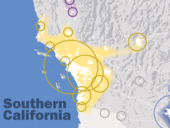
- Southern California Megaregion. The RPA definition includes the Las Vegas Valley, as well as the Tijuana area in Mexico.
- Texas Triangle Megaregion. The RPA definition includes the geographically detached Oklahoma City–Tulsa Metropolitan Corridor in Oklahoma.
Identification[edit]
The Regional Plan Association methodology for identifying the emerging megaregions included assigning each county a point for each of the following:
- It was part of a core-based statistical area;
- Its population density exceeded 200 people per square mile as of the 2000 census;
- The projected population growth rate was expected to be greater than 15 percent and total increased population was expected to exceed 1,000 people by 2025[citation needed];
- The population density was expected to increase by 50 or more people per square mile between 2000 and 2025 [citation needed]; and
- The projected employment growth rate was expected to be greater than 15 percent and total growth in jobs was expected to exceed 20,000 by 2025.[1]
Shortcomings of the RPA method[edit]
This methodology was much more successful at identifying fast-growing regions with existing metropolitan centers than more sparsely populated, slower growing regions. Nor does it include a distinct marker for connectedness between cities.[1] The RPA method omits the eastern part of the Windsor-Quebec City urban corridor in Canada.
Statistics (RPA reckoning)[edit]
Notes:
- Houston appears twice (as part of Gulf Coast and Texas Triangle).
- The populations given for megalopolises that extend into Canada and Mexico (Arizona Sun Corridor, Cascadia, Great Lakes, and Southern California) include their non-U.S. residents.
- Disconnected metropolitan areas (as defined by the RPA) are flagged with double asterisks (**). Disconnected areas in the upper Great Lakes region and southern Quebec are not included in RPA statistics.
Major cities and areas not included by the RPA[edit]
Thirteen of the top 100 American primary census statistical areas are not included in any of the 11 emerging mega-regions. However, the Lexington-based CSA in Kentucky is identified by the RPA as being part of an "area of influence" of the Great Lakes megalopolis, while the Albany and Syracuse-based CSAs in Upstate New York are shown as being within the influence of the Northeastern mega-region. Similarly, the Augusta, GA and Columbia, SC-based CMA are considered influenced by the Piedmont-Atlantic megalopolis, Jackson, MS CMA by the Gulf Coast megaregion, Little Rock, AR CMA by the Texas Triangle, and the Des Moines and Omaha-based CMAs by the Great Lakes megalopolis. The El Paso, TX CMA is roughly equidistant from two megaregions, being near the southeastern edge of the Arizona Sun Corridor area of influence and the southern tip of the Front Range area of influence. This leaves Honolulu, HI, Wichita, KS, Springfield, MO and Charleston, SC as the only top 100 American CMAs that have no mega-region affiliation of any kind as defined by the RPA.[15]
Planning[edit]
Though identification of the megaregions has gone through several iterations, the above identified are based on a set of criteria developed by Regional Plan Association, through its America 2050 initiative - a joint venture with the Lincoln Institute of Land Policy. Two historic publications helped lay the foundation for this new set of criteria, the book Megalopolis by Jean Gottmann (1961)[16] and The Regions' Growth, part of Regional Plan Association's second regional plan[citation needed].
The relationships underpinning megaregions have become more pronounced over the second half of the 20th century as a result of decentralized land development, longer daily commutes, increased business travel, and a more footloose, flexible, knowledge workforce. The identification of new geographic scales—historically based on increased population movement from the city center to lower density areas as a megaregion presents immense opportunities from a regional planning perspective, to improve the environmental, infrastructure and other issues shared among the regions within it. The most recent and only previous attempt to plan at this scale happened more than 70 years ago, with the Tennessee Valley Authority. Political issues stymied further efforts at river basin planning and development.[6]
In 1961's Megalopolis, Gottman describes the Northeastern seaboard of the United States - or Megapologis - as "... difficult to single out ... from surrounding areas, for its limits cut across established historical divisions, such as New England and the Middle Atlantic states, and across political entities, since it includes some states entirely and others only partially." On the complex nature of this regional scale, he writes:
Some of the major characteristics of Megalopolis, which set it apart as a special region within the United States, are the high degree of concentration of people, things and functions crowded here, and also their variety. This kind of crowding and its significance cannot be described by simple measurements. Its various aspects will be shown on a number of maps, and if these could all be superimposed on one base map there would be demarcated an area in which so many kinds of crowding coincide in general (though not always in all the details of their geographical distribution) that the region is quite different from all neighboring regions and in fact from any other part of North America. The essential reason for its difference is the greater concentration here of a greater variety of kinds of crowding. Crowding of population, which may first be expressed in terms of densities per square mile, will, of course, be a major characteristic to survey. As this study aims at understanding the meaning of population density, we shall have to know the foundation that supports such crowding over such a very vast area. What do these people do? What is their average income and their standard of living? What is the distribution pattern of wealth and of certain more highly paid occupations? For example, the outstanding concentration of population in the City of New York and its immediate suburbs (a mass of more than ten million people by any count) cannot be separated from the enormous concentration in the same city of banking, insurance, wholesale, entertainment, and transportation activities. These various kinds of concentration have attracted a whole series of other activities, such as management of large corporations, retail business, travel agencies, advertising, legal and technical counseling offices, colleges, research organizations, and so on. Coexistence of all these facilities on an unequaled scale within the relatively small territory of New York City, and especially of its business district...has made the place even more attractive to additional banking, insurance, and mass media organizations.[16]
in the US, megaregions have been garnering more attention at the federal level. In 2016, the United States Department of Transportation (USDOT) awarded The University of Texas at Austin a five-year grant to lead a consortium under the University Transportation Centers (UTC) program, called Cooperative Mobility for Competitive Megaregions (CM2). The center aims to advance research, education, and technology transfer initiatives to improve the mobility of people and goods in urban and rural communities of megaregions.[17] In addition, the Transportation Research Board (a division of the National Research Council of the United States), listed "megaregions" in two of its "Critical Issues in Transportation 2019" Policy Snapshot reports.[18]
Outside of the United States[edit]
The RPA report identifies megaregions that are shared between the US and Canada, and is presumably at least tangentially concerned with pan-North American issues. However, being based on largely American research, it does not clearly define the geographic extent of megaregions where they extend into Canada, a responsibility that has largely been left to Canadian geographers defining the megalopolis within their own country. The American report excludes Canadian population centres that are not deemed to be closely adjacent to US megaregions. It includes most of Southern Ontario in the Great Lakes Megaregion but excludes the St. Lawrence Valley, despite the fact that Canadian geographers usually include them as part of one larger Quebec City-Windsor Corridor.
The close relationship between large linked metropolitan regions and a nation's ability to compete in the global economy is recognized in Europe and Asia. Each has aggressively pursued strategies to manage projected population growth and strengthen economic prosperity in its large regions.
The European Spatial Development Perspective, a set of policies and strategies adopted by the European Union in 1999, is working to integrate the economies of the member regions, reduce economic disparities, and increase economic competitiveness (Faludi 2002; Deas and Lord 2006).
In East Asia, comprehensive strategic planning for large regions, centered on metropolitan areas, has become increasingly common and has progressed further than in the United States or Europe. Planning for the Hong Kong-Pearl River Delta region, for instance, aims to enhance the region's economic strength and competitiveness by overcoming local fragmentation, building on global economic cooperation, taking advantage of mutually beneficial economic factors, increasing connectivity among development nodes, and pursuing other strategic directions.[6]
See also[edit]
References[edit]
- ^ a b c d e f g Hagler, Yoav (November 2009). "Defining U.S. Megaregions" (PDF). America 2050. Retrieved February 19, 2022 – via RPA.org.
As metropolitan regions continued to expand throughout the second half of the 20th century their boundaries began to blur, creating a new scale of geography now known as the megaregion. Interlocking economic systems, shared natural resources and ecosystems, and common transportation systems link these... The challenge of identifying... emerging regions has been undertaken... The most recent iteration... has been developed by Regional Plan Association (RPA) in partnership with the Lincoln Institute of Land Policy. Eleven such megaregions have been identified... that would make cooperative integrated planning advantageous... Th[e] tradition of geographers and planners attempting to enhance the value of geographic definitions to meet the needs of new generations continued with the first identification of a scale larger than the metro regions by French geographer Jean Gottmann in his 1961 book Megalopolis. This "Megalopolis" referred specifically to the Northeastern United States ... Regional Plan Association also identified this emerging Northeast Megaregion in the 1960s.
- ^ a b c Posner, Olivia (January 2019) [Unknown]. "What are Megaregions?" (university research perspective). UTexas.edu. Austin, Tex.: Cooperative Mobility for Competitive Megaregions (CM2) [multiuniversity consortium]. Retrieved February 19, 2019.
...there is no single definition of a megaregion. Lisa Loftus-Otway, research associate... and her team at UT Austin observed this... Because the term has been defined differently, there are variations on what should be prioritized within megaregions across jurisdictions... planning in cross-jurisdictional megaregions can be susceptible to varying levels of regulations. This makes creating plans for megaregions surprisingly complex.
- ^ a b c d Regional Plan Association (2006). America 2050: A Prospectus. New York, NY: Regional Plan Association.[full citation needed]
- ^ Gottmann, Jean (1957). "Megalopolis, or the urbanization of the Northeastern Seaboard". Economic Geography. 33 (3): 189–200. doi:10.2307/142307. JSTOR 142307.
- ^ Gottmann, Jean (1961). Megalopolis: The Urbanized Northeastern Seaboard of the United States. New York, N.Y.: The Twentieth Century Fund. See also Gottmann, Jean (1954). L'Amerique. Paris, France: Hachette.[clarification needed]
- ^ a b c Dewar, Margaret and David Epstein (2006). "Planning for 'Megaregions' in the United States". Ann Arbor, MI: Urban and Regional Planning Program, University of Michigan.
- ^ Kron, Josh (November 30, 2012). "Red State, Blue City: How the Urban-Rural Divide Is Splitting America". The Atlantic. Retrieved April 10, 2015.
- ^ Abbott, Carl (2015). "Cascadian Dreams: Imagining a Region Over Four Decades". Imagined Frontiers: Contemporary America and Beyond. University of Oklahoma Press. pp. 111–139. ISBN 978-0-8061-5240-0.
- ^ a b "Defining U.S. Megaregions" (PDF). S3.us-east-1.amazonaws.com. Retrieved July 25, 2022.
- ^ Bonneville Power Administration and States of the Pacific Northwest: Hearing Before the Subcommittee on Separation of Powers of the Committee on the Judiciary, United States Senate, Ninety-seventh Congress, Second Session, on Bonneville Power Administration and States of the Pacific Northwest, Held at Helena, Montana, August 31, 1982. U.S. Government Printing Office. 1983.
- ^ Mushrooms of the Pacific Northwest. Timber Press. September 2009. ISBN 9781604691412.
- ^ Weitz, Jerry (2014). Employment Changes in the Spine of the Carolina Megapolitan Area: Implications for Megaregion Planning. Vol. 54. pp. 215–232. doi:10.1353/sgo.2014.0026. ISBN 9781469616032. ISSN 1549-6929. S2CID 129370807.
{{cite book}}:|journal=ignored (help) - ^ "Megapolitan: Arizona's Sun Corridor". Morrison Institute for Public Policy. May 2008. Archived from the original on June 15, 2008. Retrieved June 3, 2008.
- ^ "When Phoenix, Tucson Merge". The Arizona Republic. April 9, 2006. Retrieved June 3, 2008.
- ^ "Our Maps". America2050. USA: Regional Plan Association. Retrieved October 1, 2014.
- ^ a b Gottman, Jean (1961). Megalopolis: The Urbanized Northeastern Seaboard of the United States. New York: Twentieth Century Fund.
- ^ "Mission & Objectives". sites.utexas.edu. Retrieved January 28, 2019.
- ^ "Critical Issues in Transportation 2019: Policy Snapshot | The National Academies Press". www.nap.edu. Retrieved January 28, 2019.
Further reading[edit]
- "Megaregions". America2050. USA: Regional Plan Association. Archived from the original on April 30, 2009. Retrieved December 7, 2014. Home page of the historic America 2050 program of the RPA.
- "Are Mega-regions Relevant?", The Economist, April 14, 2008
- Richard Florida (May 4, 2009), "Mega-Regions and High-Speed Rail", The Atlantic
- Catherine L. Ross, ed. (2009). Megaregions: Planning for Global Competitiveness. Island Press. ISBN 978-1-61091-136-8. (Includes info on the USA)
- Jiang Xu; Anthony G.O. Yeh, eds. (2011). Governance and Planning of Mega-City Regions: An International Comparative Perspective. Routledge. ISBN 978-1-135-22913-9. (Includes info on the USA)
- John Harrison; Michael Hoyler, eds. (2015). Megaregions: Globalization's New Urban Form?. Edward Elgar Publishing. ISBN 978-1-78254-790-7. (Includes info on the USA)
- Parag Khanna (April 15, 2016), "A New Map for America", New York Times
- "What are Megaregions?", Cooperative Mobility for Competitive Megaregions (CM2)
External links[edit]
- "America2050.org". USA: Regional Plan Association. Archived from the original on April 30, 2009. Retrieved December 7, 2021.
Great Lakes megalopolis as defined by the RPA | ||
|---|---|---|
Includes all metropolitan areas that have a population of 150,000 or greater according to the most recent national census. | ||
| Great Lakes region cities |  | |
| Surrounding cities |
| |
| Cities of states south of region | ||
| Other metro-regions | ||
Metropolitan areas and cities in italics are located outside of California | ||||||||||||
|  | |||||||||||