


Church of North India
| Church of North India | |
|---|---|
 Official seal of the Church of North India | |
| Classification | Protestant |
| Orientation | United church |
| Polity | Episcopal[1][2] |
| Moderator | The Most. Revd. Bijay Kumar Nayak |
| Deputy moderator | The Rt. Revd. Paul B.P. Duphare |
| Distinct fellowships | World Council of Churches, Council for World Mission, Christian Conference of Asia, Communion of Churches in India, National Council of Churches in India |
| Associations | |
| Region | All of India except Andhra Pradesh, Telangana, Lakshadweep, Karnataka, Kerala and Tamil Nadu |
| Origin | 29 November 1970 Nagpur |
| Merger of |
|
| Separations | United Church of Northern India – Presbyterian Synod[3] |
| Congregations | 3500 congregations in 3000 parishes and 26 dioceses[4] |
| Members | 2,200,000 (Self-declared)[4] |
| Ministers | 2000+[4] |
| Hospitals | 65 hospitals and nine nursing schools. |
| Secondary schools | 564+ educational institutions and three technical schools. |
| Official website | cnisynod.org |
The Church of North India (CNI) is the dominant united Protestant church in northern India. It was established on 29 November 1970 by bringing together most of the Protestant churches working in northern India. It is a province of the worldwide Anglican Communion and a member of the World Methodist Council and the World Communion of Reformed Churches.[5][4] The merger, which had been in discussions since 1929, came eventually between the Church of India, Pakistan, Burma and Ceylon (Anglican), the Methodist Church, Disciples of Christ, and some congregations from the United Church of Northern India (Congregationalist and Presbyterian).[5]
The CNI's jurisdiction covers all states of India with the exception of the five states in the south (Andhra Pradesh, Telangana, Karnataka, Kerala and Tamil Nadu which are under the jurisdiction of the Church of South India) and has approximately 2,200,000 members (0.1% of India's population) in 3,000 pastorates.[3]
History[edit]
| Part of a series on |
| Christianity in India |
|---|
 |

Ecumenical discussions with a view to a unified church were initiated by the Australian Churches of Christ Mission, the Methodist Church of Australia, the Wesleyan Methodist Church, the Methodist Episcopal Church and the United Church of Northern India during a religious convention in Lucknow in 1929.
A negotiation committee was set up in 1951 using the plan of Church Union that resulted from the earlier consultations as its basis. The committee was composed of representatives from the Baptist Churches in Northern India; the Church of India, Pakistan, Burma and Ceylon; the Methodist Church (British and Australian conferences); the Methodist Church in Southern Asia; and the United Church of Northern India (UCNI).[6][7] The Methodist Episcopal Church, however, did not join the discussions and, in 1981, it became the Methodist Church in India (MCI).[8] In 1957, the Church of the Brethren in India and the Disciples of Christ denominations joined in the negotiations as well.
A new negotiation committee was set up in 1961 with representatives from all the above-mentioned denominations. In 1965, a finalized plan of Church Union, known as the 4th Plan of Union 1965, was made. The union was formalized on 29 November 1970 when all the negotiating churches were united as the Church of North India with the exception of the Methodist Church in Southern Asia, which decided not to join the union.
Beliefs and practices[edit]
The CNI is a trinitarian church that draws from the traditions and heritage of its constituent denominations. The basic creeds of the CNI are the Apostles' Creed and the Nicene Creed of 381 AD.
Liturgy[edit]
The liturgy of the CNI is of particular interest, as it combines many traditions, including that of the Methodists and such smaller churches as the Church of the Brethren and the Disciples of Christ. Provision is given for diverse liturgical practices and understandings of the divine revelation.
Governance[edit]
The polity of the CNI brings together the episcopal, the presbyterial and the congregational elements in an effort to reflect the polity of the churches which entered into union. The episcopacy of the CNI is both historical as well as constitutional. There are 26 dioceses, each under the supervision of a bishop. The main administrative and legislative body is the synod, which meets once every three years to elect a presiding bishop, called a moderator, and an executive committee. The moderator acts as the head of the church for a fixed term; another bishop is elected Deputy Moderator.
Social involvement[edit]
Social involvement is a major emphasis in the CNI. There are synodal boards in charge of various ministries: Secondary, Higher, Technical and Theological Education, Health Services, Social Services, Rural Development, Literature and Media. There is also a synodal Programme Office which seeks to protect and promote peace, justice, harmony and dignity of life.
The CNI currently operates 65 hospitals, nine nursing schools, 250 educational institutions and three technical schools. Some of the oldest and well-respected educational institutions in India like Scottish Church College in Calcutta, La Martiniere Calcutta, Wilson College in Mumbai, St. James' School, Calcutta, Hislop College in Nagpur, St. John's Diocesan Girls' School, Calcutta, St. Paul's School in Darjeeling, St. John's College in Agra and College Bishop Cotton School in Shimla, Christ Church College, Kanpur, Sherwood College, Nainital, Ewing Christian College, Prayagraj, Boys High School, St. Andrew's College in Gorakhpur are under the administration of the CNI.
Ecumenism[edit]
The CNI participates in many ecumenical bodies as a reflection of its commitment towards church unity. Domestically it participates in a joint council with the Church of South India and the Mar Thoma Syrian Church known as the Communion of Churches in India. It is also a member of the National Council of Churches in India. Regionally, the CNI participates in the Christian Conference of Asia and on an international level it is a member of the World Council of Churches, the Council for World Mission, World Alliance of Reformed Churches, World Methodist Council and in full communion with the Anglican Communion. The CNI is also in partnership with many other domestic, regional and international Christian agencies.
Gallery[edit]
-
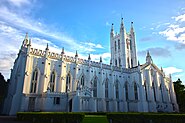 St. Paul's Cathedral, Kolkata
 -
 All Saints Cathedral, Prayagraj
 -
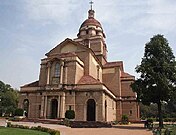 Cathedral Church of the Redemption, New Delhi
 -
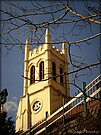 Christ Church, Shimla
 -
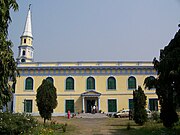 St. John's Church, Meerut
 -
 St. James' Church, New Delhi
 -
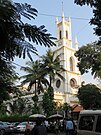 St. Thomas' Cathedral, Mumbai
 -
 The Wilson College, Mumbai
 -
 La Martiniere College, Lucknow
 -
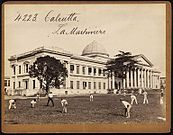 La Martiniere College, Calcutta
 -
 St. Paul's School, Darjeeling
 -
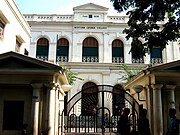 Scottish Church College, Calcutta
 -
 Holy Trinity Church, New Delhi
 -
 St. Pauls Church, Pune - photographed during British era


.jpg)

Present administrators[edit]
- Moderator: The Most. Revd. Bijay K. Nayak, Bishop, Diocese of Agra
- Deputy Moderator: The Rt. Revd. Paul B.P. Dupare, Bishop, Diocese of Nagpur
- Treasurer: Mr.Subrata Gorai
- General Secretary: The Revd. Dr. D.J. Ajith Kumar
Moderators[edit]
Since its formation in 1970, the Synod of the CNI has elected a Moderator and one Deputy every three years.[9]
| Term | Moderator | Deputy Moderator |
|---|---|---|
| April 1971 – July 1974 | Eric Nasir, Bishop in Delhi (and Rajasthan) |
Ramchandra Bhandare, Bishop in Nagpur |
| July 1974 – October 1977 | ||
| October 1977 – October 1980 | ||
| October 1980 – November 1983 | Ramchandra Bhandare, Bishop in Nagpur |
Dinesh Chandra Gorai, Bishop in Calcutta |
| November 1983 – October 1986 | Dinesh Chandra Gorai, Bishop in Calcutta |
Din Dayal, Bishop in Lucknow |
| October 1986 – October 1989 | Din Dayal, Bishop in Lucknow |
John Ghosh, Bishop in Darjeeling |
| October 1989 – October 1992 | John Ghosh, Bishop in Darjeeling |
Franklin Jonathan, Bishop in Jabalpur |
| October 1992 – October 1995 | Anand Chandu Lal, Bishop in Amritsar |
Dhirendra Mohanty, Bishop in Cuttack |
| October 1995 – October 1998 | Dhirendra Mohanty, Bishop in Cuttack |
Vinod Peter, Bishop in Nagpur |
| October 1998 – January 2001 | Vinod Peter, Bishop in Nagpur (died December 2000) |
James Terom, Bishop in Chotanagpur |
| January – October 2001 | James Terom, Bishop in Chotanagpur |
Brojen Malakar, Bishop in Barrackpore |
| October 2001 – October 2004 | James Terom, Bishop in Chotanagpur |
Joel Mal, Bishop in Chandigarh |
| October 2004 – October 2005 | ||
| October 2005 – October 2008 | Joel Mal, Bishop in Chandigarh |
Purely Lyngdoh, Bishop in North East India |
| October 2008 – October 2011 | Purely Lyngdoh, Bishop in North East India |
Philip Marandih, Bishop in Patna |
| October 2011 – October 2014 | Philip Marandih, Bishop in Patna |
Pradeep Samantaroy, Bishop in Amritsar |
| October 2014 – 3 October 2017 | Pradeep Samantaroy, Bishop in Amritsar |
Prem Singh, Bishop in Jabalpur |
| October 2017 – 23 August 2019 | Prem Singh, Bishop in Jabalpur |
Probal Dutta, Bishop in Durgapur and Kolkata |
| 23 August 2019 – 14 September 2022 | Bijay Kumar Nayak, Bishop in Phulbani | |
| 09 December 2022 – present | Bijay Kumar Nayak | Paul B.P. Duphare |
Dioceses[edit]
Diocese of Calcutta[edit]
When originally founded in 1813, the fourth overseas diocese of the Church of England covered all the subcontinent, all Australasia and some of Africa. With its 1835 split to create Madras diocese, Calcutta was made metropolitan over all its original area, and has been split many times since. The Bishop of Calcutta remained Metropolitan of India until the CNI's 1970 creation; the current diocese covers parts of Bengal and the bishop is Paritosh Canning.[10]
Diocese of Mumbai[edit]
Split from Calcutta diocese in 1837,[11] the Diocese of Bombay was the last new Indian diocese of the Church of England before all colonial dioceses became independent in 1863. Like Calcutta, Mumbai diocese has been a very large Church of England diocese, a diocese of the independent Indian Anglican church, and now a United Church diocese. The CNI diocese today covers Maharashtra, and the bishop is Prakash D. Patole.[12]
Diocese of Chotanagpur[edit]
Founded from Calcutta diocese in 1890,[11] the current diocese is based in Ranchi, its territory is Jharkhand and the bishop is B. B. Baskey.[13]
Diocese of Lucknow[edit]
Erected in 1893 from the Diocese of Calcutta. The diocese is headquartered at Allahabad and serves Uttar Pradesh.
Diocese of Nagpur[edit]
The diocese was originally created in 1902/03, from Chotanagpur diocese.[14][15]
Diocese of North East India[edit]
The CNI Northeast diocese, based in Shillong, North East India is headed by bishop Michael Herenz.[16] It originated as the Diocese of Assam, in the Anglican Church of India, erected from Calcutta in 1915;[17] and became known by the present name before 1986.[18]
Diocese of Nasik[edit]
In 1929, Nasik diocese was founded from Bombay;[19] her present bishop is Sharad Gaikwad.[20]
List of Dioceses[edit]
| Name | Founded | Headquarters | Location | Bishop | Website |
|---|---|---|---|---|---|
| Diocese of Delhi | 1947, from Lahore[21] | New Delhi | Delhi, Haryana | Paul Swarup | https://www.dioceseofdelhi.org/ |
| Diocese of Dooars | 2023 in Delhi | West Bengal & Assam | Santalpur, Mission Compound | The Rt. Revd. B.B Baksey (Moderator's Episcopal Commissary) | |
| Diocese of Amritsar | 1953, from Lahore[22] | Amritsar | Punjab, Himachal Pradesh, Jammu and Kashmir | P. K. Samantaroy[12] | www.amritsardiocesecni.org |
| Diocese of Barrackpore | 1956, from Calcutta[23] | Barrackpore | West Bengal | Rt. Rev Subrata Chakraborty[13] | |
| Diocese of Andaman and Nicobar | 1966, from Calcutta[24] | Port Blair | Andaman and Nicobar Islands | Christopher Paul[25] | |
| Diocese of Jabalpur | 1970, from Nagpur[26] | Jabalpur | Madhya Pradesh | Vacant | http://dioceseofjabalpur-cni.org/ |
| Diocese of Patna | bef. 70 | Bhagalpur | Bihar and Jharkhand | Philip P. Marandih[27] | |
| Diocese of Cuttack | 1970 | Cuttack | Cuttack, Odisha | Surendra Kumar Nanda[28] | http://www.dioceseofcuttackcni.in/ |
| Diocese of Bhopal | betw. 70-79, from Jabalpur | Indore | Madhya Pradesh | Manoj Charan | |
| Diocese of Rajasthan | 1981, from Delhi[29] | Ajmer | Rajasthan | The Rt. Revd. Manoj Charan (Moderator's Episcopal Commissary) | |
| Diocese of Gujarat | betw. 70-96 | Ahmedabad | Gujarat | Silvans Christian[30] | |
| Diocese of Kolhapur | betw. 70-96 | Kolhapur | Maharashtra | Sandeep Suresh Vibhute[12] | |
| Diocese of Durgapur | betw. 70-96 | Durgapur | West Bengal | Sameer Issac Khimla [10] | |
| Diocese of Chandigarh | 1974, from Amritsar | Ludhiana | Chandigarh, Punjab | Denzel Peoples[31] | |
| Diocese of Agra | 1976, from Lucknow[32] | Agra | Uttar Pradesh, Uttarakhand | Bijay Kumar Nayak[33] | http://cnidioceseofagra.org |
| Diocese of Eastern Himalaya | bef. 1987 — Darjeeling, renamed c. 1992,[34] from Barrackpur | Darjeeling | West Bengal, Bhutan, parts of Assam | vacant Acting: Michael Herenz[13] |
|
| Diocese of Sambalpur | bef 96[35] | Bolangir | Odisha | Pinuel Dip | |
| Diocese of Phulbani | 1997,[36] from Cuttack | Kandhmal | Odisha | Vacant | |
| Diocese of Marathwada | c. 2000[37] | Aurangabad | Maharashtra | M. U. Kasab[12] | |
| Diocese of Pune | c. 2000[37] | Pune | Maharashtra | Andrew Rathod | |
| Diocese of Chhattisgarh | 2010, from Jabalpur | Raipur | Chhattisgarh | Ajay Umesh James |
See also[edit]

References[edit]
- ^ IDOC International. IDOC-North America. 1971. p. 85.
...churches that would combine the episcopal, presbyterian and congregational forms of church polity, and would accept the historic episcopate without committing the church to any particular theological interpretation of episcopacy. This is essentially what has been done both in the Church of South India and the Church of North India.
- ^ Campbell, Ted (1996). Christian Confessions: A Historical Introduction. Westminster John Knox Press. p. 173. ISBN 978-0-664-25650-0.
The Church of South India (1947) and the Church of North India (1970) are unique and ecumenically important because they have combined the "historic episcopate" with other forms of polity
- ^ a b "United Church of Northern India - Presbyterian Synod". Address data base of Reformed churches and institutions. Stiftung Johannes a Lasco Bibliothek Grosse Kirche Emden. 2020. Retrieved 4 July 2019.
- ^ a b c d "Church of North India". World Council of Churches. n.d. Retrieved 4 July 2019.
- ^ a b "Church of North India". World Methodist Council. 9 November 2019. Retrieved 25 June 2020.
The Church of North India is a united church which came into being as the result of a union of six churches on 29th November 1970. The six churches were: The Council of the Baptist Churches in Northern India, The Church of the Brethren in India; The Disciples of Christ; The Church of India (formerly known as the Church of India, Pakistan, Burma and Ceylon); The Methodist Church (British and Australian Conferences); The United Church of Northern India. ... The Church of North India is a full member of the World Council of Churches, the Christian Conference of Asia, the Council for World Mission, the Anglican Consultative Council, the World Methodist Council and the World Alliance of Reformed Churches.
- ^ Rt Rev Frederick Hugh Wilkinson, Bishop of Toronto (9 October 1958), "Lambeth and Church Unity", The Empire Club of Canada Speeches 1958-1959, Toronto: Empire Club Foundation, pp. 23–37, archived from the original on 16 November 2006
- ^ "The Church of North India (CNI)". Archived from the original on 18 June 2006. Retrieved 2 July 2019.
{{cite web}}: CS1 maint: bot: original URL status unknown (link) - ^ Abraham, William J.; Kirby, James E. (2009). The Oxford Handbook of Methodist Studies. Oxford University Press. p. 93. ISBN 9780191607431.
While the Methodist Churches of British and Australian origin joined the two great unions of 1947 (Church of South India) and 1970 (Church of North India), the Methodist (Episcopal) Church refrained and, in 1981, was inaugurated as Methodist Church in India (MCI), autonomous, yet affiliated with the UMC.
- ^ [1] Archived 22 December 2018 at the Wayback Machine and [2] Archived 1 October 2020 at the Wayback Machine
- ^ a b [3][permanent dead link]
- ^ a b The Indian Year Book. Bennett, Coleman & Company. 1940. p. 455.
The three dioceses thus formed have been repeatedly subdivided, until in 1930 there were fourteen dioceses, the dates of their creation being as follows : Calcutta 1814; Madras 1835; Bombay 1837; Colombo 1845; Lahore 1877; Rangoon 1877; Travancore 1879; Chota Nagpur 1890; Lucknow 1893; Tinnevelly 1896; Nagpur 1903; Dornakal 1912; Assam 1915; Nasik 1929.
- ^ a b c d "Consecration of the Revd. Sandeep Suresh Vibhute, Bishop-elect, Diocese of Kolhapur, CNI". CNI Synod. 14 August 2018. Archived from the original on 9 November 2018. Retrieved 17 February 2019.
- ^ a b c "Consecration of the Revd. Paritosh Canning, Bishop-elect, Diocese of Barrackpore, CNI". CNI Synod. 14 August 2018. Archived from the original on 9 November 2018. Retrieved 17 February 2019.
- ^ "A New Indian Bishopric". Church Times. No. 2080. 5 December 1902. p. 678. ISSN 0009-658X. Retrieved 21 February 2019 – via UK Press Online archives.
- ^ "Church News". Church Times. No. 2087. 23 January 1903. p. 106. ISSN 0009-658X. Retrieved 21 February 2019 – via UK Press Online archives.
- ^ [4][permanent dead link]
- ^ "North East Diocese to observe centenary celebration". The Shillong Times. 11 January 2014. Archived from the original on 22 February 2019. Retrieved 8 June 2019.
- ^ Talibuddin, E.W. (2010). Introduction To The History Of The Anglican church In North-East India 1841-1970. ISPCK. ISBN 978-8184650105.
- ^ "The New Diocese of Nasik". Church Times. No. 3448. 22 February 1929. p. 217. ISSN 0009-658X. Retrieved 21 February 2019 – via UK Press Online archives.
- ^ "Anglican Communion Cycle of Prayer – interim listings for January to July 2019" (PDF). anglicancommunion.org. 2019. Retrieved 8 June 2019.
- ^ "The Church of North India: Historical Background: AD 1800-1970". Diocese of Delhi. 2016. Archived from the original on 1 July 2019. Retrieved 8 June 2019.
- ^ "Welcome to the official website of the Diocese of Amritsar". amritsardiocesecni.org. n.d. Archived from the original on 22 September 2013. Retrieved 8 June 2019.
- ^ "New Dioceses". Church Times. No. 4853. 10 February 1956. p. 13. ISSN 0009-658X. Retrieved 21 February 2019 – via UK Press Online archives. & "Diocese of Barrackpore". Church Times. No. 4875. 20 July 1956. p. 1. ISSN 0009-658X. Retrieved 21 February 2019 – via UK Press Online archives.
- ^ "Happy Nicobars". Church Times. No. 5381. 1 April 1966. p. 7. ISSN 0009-658X. Retrieved 21 February 2019 – via UK Press Online archives.
- ^ "Prayers for the Parishes and the People of the Diocese :1 January 2018 to 31 March 2018" (PDF). The Diocese of Saldanha Bay. n.d. p. 10. Retrieved 8 June 2019.
- ^ "Christ Church Cathedral Jabalpur History of 150 Years Since 1844". Christ Church Cathedral CNI Jabalpur. 2015. Retrieved 8 June 2019.
- ^ [5][permanent dead link]
- ^ "New Bishops visit Anglican Communion Office". anglicannews.org. 2 February 2017. Retrieved 8 June 2019.
- ^ "History of Church". Archived from the original on 22 February 2019. Retrieved 21 February 2019.
{{cite web}}: CS1 maint: bot: original URL status unknown (link) - ^ [6][permanent dead link]
- ^ "Reverend Denzel Peoples is new Bishop of CNI's Chandigarh diocese". 21 March 2022.
- ^ "Christ Church Kanpur". Diocese of Agra. Archived from the original on 15 February 2016.
- ^ "Bijay Kumar Nayak became the new bishop of Agra diocese". Live Hindustan (in Hindi). 12 February 2024. Retrieved 6 March 2024.
- ^ "Two Bishops die in car crash". anglicannews.org. 8 December 2000. Retrieved 8 June 2019.
- ^ Confirmation Lessons. ISPCK. 1998. pp. 57–. ISBN 978-81-7214-341-1.
- ^ "Welcome to CNI Phulbani Diocese". CNI Phulbani Diocese. Archived from the original on 27 June 2011.
- ^ a b "Prayer Diary". oremus.org. 1999. Retrieved 8 June 2019.
External links[edit]

 Definitions from Wiktionary
 Media from Commons
 News from Wikinews
 Quotations from Wikiquote
 Texts from Wikisource
 Textbooks from Wikibooks
 Resources from Wikiversity


- Church of North India
- Indian Christianity : The Church of North India
- Indian Christianity : CNI
- CNI Seminaries and Theological Colleges
- The Church of North India CNI
| General |  | |
|---|---|---|
| African provinces | ||
| Pan-American provinces | ||
| Asian provinces |
| |
| European provinces |
| |
| Oceanian provinces | ||
| Extra-provincial churches | ||
| Churches in full communion | ||
| International | |
|---|---|
| National | |

- Church of North India
- Anglican Communion church bodies
- Christian denominations established in the 20th century
- Church of the Brethren
- Members of the World Communion of Reformed Churches
- Protestantism in India
- Members of the World Council of Churches
- Christian organizations established in 1970
- 1970 establishments in India
- Affiliated institutions of the National Council of Churches in India
- Church of India, Burma and Ceylon