


Geosynchronous Satellite Launch Vehicle
 | |
GSLV-F14 carrying INSAT-3DS at the Satish Dhawan Space Centre Second Launch Pad | |
| Function | Medium-lift Launch System |
|---|---|
| Manufacturer | ISRO |
| Country of origin | India |
| Cost per launch | US$47 million[1] |
| Size | |
| Height | 49.13 m (161.2 ft)[2] |
| Diameter | 2.8 m (9 ft 2 in) |
| Mass | 414,750 kg (914,370 lb) |
| Stages | 3 |
| Capacity | |
| Payload to LEO | |
| Mass | 6,000 kg (13,000 lb)[3] |
| Payload to SSO | |
| Mass | 3,000 kg (6,600 lb)[3] |
| Payload to GTO | |
| Mass | 2,500 kg (5,500 lb)[2][4] |
| Launch history | |
| Status |
|
| Launch sites | Satish Dhawan Space Centre |
| Total launches | 16 |
| Success(es) | 10 |
| Failure(s) | 4 |
| Partial failure(s) | 2 |
| First flight |
|
| Last flight |
|
| Type of passengers/cargo | South Asia Satellite, NavIC |
| Boosters | |
| No. boosters | 4 L40 Hs |
| Height | 19.7 m (65 ft)[5] |
| Diameter | 2.1 m (6 ft 11 in) |
| Propellant mass | 42,700 kg (94,100 lb) each |
| Powered by | 1 L40H Vikas 2 |
| Maximum thrust | 760 kN (170,000 lbf)[6] |
| Total thrust | 3,040 kN (680,000 lbf) |
| Specific impulse | 262 s (2.57 km/s) |
| Burn time | 154 seconds |
| Propellant | N2O4 / UDMH |
| First[6][5] stage | |
| Height | 20.2 m (66 ft) |
| Diameter | 2.8 m (9 ft 2 in) |
| Propellant mass | 138,200 kg (304,700 lb) |
| Powered by | 1 S139 Booster |
| Maximum thrust | 4,846.9 kN (1,089,600 lbf) |
| Specific impulse | 237 s (2.32 km/s) |
| Burn time | 100 seconds |
| Propellant | HTPB (solid) |
| Second[6][5] stage | |
| Height | 11.6 m (38 ft) |
| Diameter | 2.8 m (9 ft 2 in) |
| Propellant mass | 39,500 kg (87,100 lb) |
| Powered by | 1 GS2 Vikas 4 |
| Maximum thrust | 846.8 kN (190,400 lbf) |
| Specific impulse | 295 s (2.89 km/s) |
| Burn time | 139 seconds |
| Propellant | N2O4 / UDMH |
| Second GS2 (GL40)[6][7] stage | |
| Height | 11.9 m (39 ft) |
| Diameter | 2.8 m (9 ft 2 in) |
| Propellant mass | 42,500 kg (93,700 lb) |
| Powered by | 1 GS2 Vikas 4 |
| Maximum thrust | 846.8 kN (190,400 lbf) |
| Specific impulse | 295 s (2.89 km/s) |
| Burn time | 149 seconds |
| Propellant | N2O4 / UDMH |
| Third[5] stage (GSLV Mk I) – CUS | |
| Height | N/A |
| Diameter | 2.8 m (9 ft 2 in) |
| Propellant mass | N/A |
| Powered by | 1 KVD-1 |
| Maximum thrust | 70 kN (16,000 lbf) |
| Specific impulse | 462 s (4.53 km/s) |
| Burn time | N/A |
| Propellant | LOX / LH2 |
| Third[5] stage (GSLV Mk II) – CUS12 | |
| Height | 8.7 m (29 ft) |
| Diameter | 2.8 m (9 ft 2 in) |
| Propellant mass | 12,800 kg (28,200 lb) |
| Powered by | 1 CE-7.5 |
| Maximum thrust | 75 kN (17,000 lbf) |
| Specific impulse | 454 s (4.45 km/s) |
| Burn time | 718 seconds |
| Propellant | LOX / LH2 |
| Third[7] stage (GSLV Mk II) – CUS15 | |
| Height | 9.9 m (32 ft) |
| Diameter | 2.8 m (9 ft 2 in) |
| Propellant mass | 15,000 kg (33,000 lb) |
| Powered by | 1 CE-7.5 |
| Maximum thrust | 75 kN (17,000 lbf) |
| Specific impulse | 454 s (4.45 km/s) |
| Burn time | 846 seconds |
| Propellant | LOX / LH2 |
.webp)
Geosynchronous Satellite Launch Vehicle (GSLV) is a class of expendable launch systems operated by the Indian Space Research Organisation (ISRO). GSLV has been used in fifteen launches since 2001.
History[edit]
The Geosynchronous Satellite Launch Vehicle (GSLV) project was initiated in 1990 with the objective of acquiring an Indian launch capability for geosynchronous satellites.[8][9]
GSLV uses major components that are already proven in the Polar Satellite Launch Vehicle (PSLV) launch vehicles in the form of the S125/S139 solid rocket booster and the liquid-fueled Vikas engine. Due to the thrust required for injecting the satellite in a geostationary transfer orbit (GTO) the third stage was to be powered by a LOX/LH2 Cryogenic engine which at that time India did not possess or have the technological expertise to build.

The first development flight of the GSLV (Mk I configuration) was launched on 18 April 2001 was a failure as the payload failed to reach the intended orbit parameters. The launcher was declared operational after the second development flight successfully launched the GSAT-2 satellite. During the initial years from the initial launch to 2014 the launcher had a checkered history with only 2 successful launches out of 7, resulting in the rocket gaining the nickname "naughty boy".[10][11]
Cryogenic engine controversy[edit]
The third stage was to be procured from Russian company Glavkosmos, including transfer of technology and design details of the engine based on an agreement signed in 1991.[9] Russia backed out of the deal after United States objected to the deal as in violation of the Missile Technology Control Regime (MTCR) in May 1992. As a result, ISRO initiated the Cryogenic Upper Stage Project in April 1994 and began developing its own cryogenic engine.[12] A new agreement was signed with Russia for 7 KVD-1 cryogenic stages and 1 ground mock-up stage with no technology transfer, instead of 5 cryogenic stages along with the technology and design as per the earlier agreement.[13] These engines were used for the initial flights and were named GSLV Mk I.[14]
Vehicle description[edit]
The 49 m (161 ft) tall GSLV, with a lift-off mass of 415 t (408 long tons; 457 short tons), is a three-stage vehicle with solid, liquid and cryogenic stages respectively. The payload fairing, which is 7.8 m (26 ft) long and 3.4 m (11 ft) in diameter, protects the vehicle electronics and the spacecraft during its ascent through the atmosphere. It is discarded when the vehicle reaches an altitude of about 115 km (71 mi).[15][needs update]
GSLV employs S-band telemetry and C-band transponders for enabling vehicle performance monitoring, tracking, range safety / flight safety and preliminary orbit determination. The Redundant Strap Down Inertial Navigation System/Inertial Guidance System of GSLV housed in its equipment bay guides the vehicle from lift-off to spacecraft injection. The digital auto-pilot and closed loop guidance scheme ensure the required altitude maneuver and guide injection of the spacecraft to the specified orbit.
The GSLV can place approximately 5,000 kg (11,000 lb) into an easterly low Earth orbit (LEO) or 2,500 kg (5,500 lb) (for the Mk II version) into an 18° geostationary transfer orbit.

Liquid boosters[edit]
The first GSLV flight, GSLV-D1 used the L40 stage. Subsequent flights of the GSLV used high pressure engines in the strap-on boosters called the L40H.[16] The GSLV uses four L40H liquid strap-on boosters derived from the L37.5 second stage, which are loaded with 42.6 tons of hypergolic propellants (UDMH and N2O4). The propellants are stored in tandem in two independent tanks 2.1 m (6 ft 11 in) diameter. The engine is pump-fed and generates 760 kN (170,000 lbf) of thrust, with a burn time of 150 seconds.
First stage[edit]
GSLV-D1 used the S125 stage which contained 125 t (123 long tons; 138 short tons) of solid propellant and had a burn time of 100 seconds. All subsequent launches have used enhanced propellant loaded S139 stage.[16] The S139 stage is 2.8 m in diameter and has a nominal burn time of 100 seconds.[17][18]

Second stage[edit]
The GS2 stage is powered by the Vikas engine. It has a diameter of 2.8 m (9 ft 2 in).[17]
Third stage[edit]
The third stage of the GSLV Mark II is propelled by the Indian CE-7.5 cryogenic rocket engine while the older defunct Mark I is propelled using a Russian made KVD-1. It uses liquid hydrogen (LH2) and liquid oxygen (LOX)[19] The Indian cryogenic engine was built at the Liquid Propulsion Systems Centre[20][21] The engine has a default thrust of 75 kN (17,000 lbf) but is capable of a maximum thrust of 93.1 kN (20,900 lbf). In GSLV-F14 mission, a new white coloured C15 stage was introduced which has more environmental-friendly manufacturing processes, better insulation properties and the use of lightweight materials.[22]

Variants[edit]
GSLV rockets using the Russian Cryogenic Stage (CS) are designated as the GSLV Mark I while versions using the indigenous Cryogenic Upper Stage (CUS) are designated the GSLV Mark II.[23][24] All GSLV launches have been conducted from the Satish Dhawan Space Centre in Sriharikota.
GSLV Mark I[edit]
The first developmental flight of GSLV Mark I had a 129 tonne (S125) first stage and was capable of launching around 1500 kg into geostationary transfer orbit. The second developmental flight replaced the S125 stage with S139. It used the same solid motor with 138 tonne propellant loading. The chamber pressure in all liquid engines were enhanced, enabling a higher propellant mass and burn time. These improvements allowed GSLV to carry an additional 300 kg of payload.[25][26] The fourth operational flight of GSLV Mark I, GSLV-F06, had a longer third stage called the C15 with 15 tonne propellant loading and also employed a 4 meter diameter payload fairing.[27][28]

GSLV Mark II[edit]
This variant uses an Indian cryogenic engine, the CE-7.5, and is capable of launching 2500 kg into geostationary transfer orbit. Previous GSLV vehicles (GSLV Mark I) have used Russian cryogenic engines.[29]
For launches from 2018, a 6% increased thrust version of the Vikas engine was developed. It was demonstrated on 29 March 2018 in the GSAT-6A launch second stage. It was used for the four Vikas engines first stage boosters on future missions.[30]
A 4m diameter Ogive payload fairing was developed and deployed for the first time in the EOS-03 launch on 12 August 2021, although this launch was a failure due to technical anomalies with the Cryogenic Upper Stage. This will allow GSLV vehicles to accommodate larger payloads.[31]
Launch statistics[edit]
As of February 17, 2024[update], rockets from the GSLV family have made 16 launches, resulting in 10 successes, four failures, and two partial failures.[32] All launches have occurred from the Satish Dhawan Space Centre, known before 2002 as the Sriharikota Range (SHAR).
- Launch system status
| Variant | Launches | Successes | Failures | Partial failures |
|---|---|---|---|---|
| GSLV Mk. I | 6 | 2 | 2 | 2 |
| GSLV Mk. II | 10 | 8 | 2 | 0 |
| Total as of February 2024[update][33] | 16 | 10 | 4 | 2 |
- Decade-wise summary of GSLV Launches
| Decade | Successful | Partial success | Failure | Total |
|---|---|---|---|---|
| 2000s | 2 | 2 | 1 | 5 |
| 2010s | 6 | 0 | 2 | 8 |
| 2020s | 2 | 0 | 1 | 3 |
| Total | 10 | 2 | 4 | 16 |
Gallery[edit]
-
 GSLV F05 take off
 -
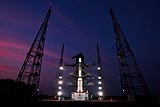 GSLV F11 vehicle at Second Launch Pad.
 -
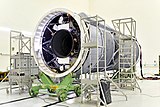 Indigenous Cryogenic Upper Stage CE-7.5 of GSLV
 -
 Fully integrated GSLV-F05 coming out of the Vehicle Assembly Building.
 -
 Launch of GSLV F11 from Second Launch Pad.
 -
 Top view of a fully Integrated GSLV-F08 inside the Vehicle Assembly Building.


See also[edit]


- SSLV
- Comparison of orbital launchers families
- Comparison of orbital launch systems
- PSLV
- LVM3
- NGLV
- ISRO
- ASLV
- SLV
References[edit]
- ^ "GAO".
- ^ a b "Geosynchronous Satellite Launch Vehicle". Archived from the original on 21 October 2015. Retrieved 21 December 2014.
- ^ a b "HSFC Presentation from International Space Conference and Exhibition 2021" (PDF). Archived from the original (PDF) on 13 September 2021. Retrieved 7 October 2022.
- ^ "ISRO developing vehicle to launch small satellites". Retrieved 29 August 2018.
- ^ a b c d e "GSLV F09 Brochure". ISRO.
- ^ a b c d "GSLV F08 Brochure". ISRO.
- ^ a b "GSLV F11 Brochure". ISRO.
- ^ "GSLV Launched Successfully" (PDF). Current Science. 80 (10): 1256. May 2001. Retrieved 12 December 2013.
- ^ a b Subramanian, T. S. (17–31 March 2001). "The GSLV Quest". Frontline. Retrieved 12 December 2013.
- ^ "GSLV Rocket, Billed 'Naughty Boy'". NDTV. Archived from the original on 11 February 2018. Retrieved 11 February 2018.
- ^ Jacob Aron. "India's hefty "naughty boy" rocket comes in from cold". New Scientist. Archived from the original on 11 February 2018. Retrieved 11 February 2018.
- ^ Raj, N Gopal (21 April 2011). "The long road to cryogenic technology". The Hindu. Chennai, India. Retrieved 12 December 2013.
- ^ Subramanian, T. S. (28 April – 11 May 2001). "The cryogenic quest". Frontline. Retrieved 13 December 2013.
- ^ "Why ISRO's New Engine and Mk III Rocket Are Reasons to Forget 1990 Cryogenic Scandal". The Wire. Retrieved 10 February 2018.
- ^ "GSLV-F04". ISRO. Archived from the original on 4 January 2014. Retrieved 15 December 2013.
- ^ a b "GSLV-D2". ISRO. Archived from the original on 9 August 2013. Retrieved 15 December 2013.
- ^ a b "GSLV Launcher". ISRO. Retrieved 17 March 2021.
- ^ "Evolution of Indian launch vehicle technologies" (PDF). Current Science. Retrieved 27 January 2014.
- ^ "GSLV-D5". Archived from the original on 6 October 2014. Retrieved 4 January 2014.
- ^ "ISRO's Cryogenic Stage Fails in Maiden Flight". SpaceNews. Archived from the original on 26 May 2012. Retrieved 27 November 2013.
- ^ "GSLV, PSLV flights put off". The Hindu. Chennai, India. 1 January 2010. Archived from the original on 5 January 2010.
- ^ "GSLV-F14/INSAT-3DS Gallery". www.isro.gov.in. Retrieved 8 February 2024.
- ^ "Space India, April-June 2003" (PDF). July 2003. p. 11. Archived (PDF) from the original on 16 August 2021. Retrieved 16 August 2021.
- ^ "GSLV-D3/GSAT-4 Brochure" (PDF). ISRO. Archived from the original (PDF) on 7 February 2014. Retrieved 15 January 2014.
- ^ R. V. Perumal; B. N. Suresh; D. Narayana Moorthi; G. Madhavan Nair (25 July 2001). "First developmental flight of geosynchronous satellite launch vehicle (GSLV-D1)" (PDF). Current Science. 81 (2): 167–174. Archived from the original (PDF) on 5 March 2016.
- ^ R. V. Perumal; D. Narayana Moorthi; N. Vedachalam; G. Madhavan Nair (10 September 2003). "Second developmental flight of Geosynchronous Satellite Launch Vehicle" (PDF). Current Science. 85 (5): 597–601. Archived from the original (PDF) on 16 February 2018.
- ^ "GSLV-F06". ISRO. Archived from the original on 10 August 2013. Retrieved 9 January 2014.
- ^ "GSLV-F06 / GSAT-5P mission brochure" (PDF). Archived (PDF) from the original on 9 September 2013.
- ^ Clark, Stephen (12 October 2010). "India may seek international help on cryogenic engine". Spaceflight Now. Retrieved 15 July 2011.
Besides the new upper stage, the GSLV Mk.2 launched in April was nearly identical to previous versions of the booster
- ^ Clark, Stephen (29 March 2018). "India tests upgraded engine tech in successful communications satellite launch". Spaceflight Now. Retrieved 30 March 2018.
- ^ "GSLV-F10/EOS-03 Brochure". ISRO. Retrieved 14 August 2021.
- ^ "List of GSLV launches". isro.org. ISRO. Archived from the original on 13 August 2021. Retrieved 14 December 2020.
- ^ "ISRO GSLV NVS-1 Navic launch highlights | India launches next-gen navigational satellite". India Today. Retrieved 29 May 2023.
External links[edit]


