


Pierce Butler (judge)
Pierce Butler | |
|---|---|
 Butler c. 1922 | |
| Associate Justice of the Supreme Court of the United States | |
| In office January 2, 1923 – November 16, 1939[1] | |
| Nominated by | Warren G. Harding |
| Preceded by | William R. Day |
| Succeeded by | Frank Murphy |
| Personal details | |
| Born | March 17, 1866 Dakota County, Minnesota, U.S. |
| Died | November 16, 1939 (aged 73) Washington, D.C., U.S. |
| Resting place | Calvary Cemetery |
| Political party | Democratic |
| Spouse |
Annie Cronin (m. 1891) |
| Children | 8 |
| Education | Carleton College (BA, BS) |
| Signature |  |
Pierce Butler (March 17, 1866 – November 16, 1939) was an American jurist who served as an associate justice of the Supreme Court of the United States from 1923 until his death in 1939. He is notable for being the first Supreme Court justice from Minnesota, and for being a Democrat appointed by a Republican president. He was a staunch conservative and was regarded as a part of the Four Horsemen, the conservative bloc that dominated the Supreme Court during the 1930s. A devout Catholic, he was also the sole dissenter in the later case Buck v. Bell, though he did not write an opinion.
Early life and education
[edit]Butler was born in Northfield, Minnesota to Patrick and Mary Ann Butler, Irish Catholic immigrants from County Wicklow, who had left the same part of Ireland due to of the Great Famine and had met in Galena, Illinois before settling on a farm near Waterford, Minnesota in 1862.[2] Born in a log cabin, he was the sixth of nine children. All but his sister lived to adulthood.[citation needed] [3]
Butler graduated from Carleton College in 1887. He received both a degree in the arts and a degree in science. He then read the law for one year before being admitted to the bar in 1888.[2] He married Annie M. Cronin in 1891.[4]
Legal career
[edit]_in_Progressive_Men_of_Minnesota,_1897.png)
He was elected as county attorney in Ramsey County in 1892, and re-elected in 1894.[2] Butler joined the law firm of How & Eller in 1896, which became How & Butler after the death of Homer C. Eller the following year. He accepted an offer to practice in St. Paul, Minnesota, where he took care of railroad-related litigation for James J. Hill. He was highly successful in representing railroads.[5]
In 1905 he returned to private practice and rejoined Jared How. He had also served as a lawyer for the company owned by his five brothers. In 1908, Butler was elected President of the Minnesota State Bar Association.
From 1912 to 1922, he worked in railroad law in Canada, alternately representing the shareholders of railroad companies and the Canadian government; he produced favorable results for both. When he was nominated for the United States Supreme Court in 1922, Butler was in the process of winning approximately $12,000,000 for the Toronto Street Railway shareholders.
Supreme Court justice
[edit]| This article is part of a series on |
| Conservatism in the United States |
|---|
 |


Nomination and confirmation
[edit]
On December 5, 1922, Butler was nominated by President Warren G. Harding as an associate justice of the Supreme Court, to succeed William R. Day.[6] Although he was Chief Justice William Howard Taft's top choice for the seat, Butler's opposition to "radical" and "disloyal" professors at the University of Minnesota (where he had served on the Board of Regents) made him a controversial Supreme Court nominee. Farmer–Labor Senator-elect Henrik Shipstead of Minnesota opposed him, as did the Progressive Senator Robert M. La Follette of Wisconsin.[5] Also against his confirmation were labor activists, some liberal magazines (The New Republic and The Nation) and the Ku Klux Klan because he was Catholic. His appointment was supported by prominent Roman Catholics, fellow lawyers (the Minnesota State Bar Association strongly endorsed him), and business groups (especially railroad companies), as well as Minnesota's incumbent senators, Republicans Knute Nelson and lame duck Frank B. Kellogg. Butler was confirmed by the United States Senate on December 21, 1922, by a 61–8 vote,[7] and took the judicial oath of office on January 2, 1923.[1]
Court service
[edit]
As an associate justice, Butler vigorously opposed regulation of business and the implementation of welfare programs by the federal government (as unconstitutional). During the Great Depression, he ruled against the constitutionality of many "New Deal" laws – the Agricultural Adjustment Administration and the National Recovery Administration – which had been supported by his fellow Democrat Franklin D. Roosevelt.[5] This earned him a place among the so-called "Four Horsemen," which also included James Clark McReynolds, George Sutherland, and Willis Van Devanter.[5][8] During his sixteen years on the bench, Justice Butler authored 327 majority opinions as well as 50 minority opinions.
He wrote the majority opinion (6–3) in United States v. Schwimmer, in which the Hungarian immigrant's application for citizenship was denied because of her candid refusal to take an oath to "take up arms" for her adopted country.
In Palko v. Connecticut, Butler was the lone dissenter; the rest of the justices believed that a state was not restrained from trying a man a second time for the same crime. Butler believed this violated the Fourteenth Amendment to the United States Constitution.[citation needed]
He sided with the majority in Pierce v. Society of Sisters, holding unconstitutional an Oregon state law that prohibited parents from sending their children to private or religious schools.[8]

In the 1927 decision for Buck v. Bell, Butler was the only Justice who dissented from the 8–1 ruling[9] and Justice Oliver Wendell Holmes Jr.'s opinion holding that the forced sterilization of an allegedly "feeble-minded" woman in Virginia was constitutional.[10] Holmes believed that Butler's religion influenced his thinking in Buck, remarking that "Butler knows this is good law, I wonder whether he will have the courage to vote with us in spite of his religion."[11] Although Butler dissented in both Buck and Palko, he did not write a dissenting opinion in either case;[12] the practice of a Justice's noting a dissent without opinion was much more common then than it would be in the later 20th and early 21st centuries.
Another consequential dissent was from the opinion expressed in Olmstead v. United States, which upheld federal wiretapping.[8] He took an expansive view of 4th Amendment protections.[13]
Death and legacy
[edit]On November 15, 1939, Butler went into a Washington, D.C., hospital for "a minor ailment" but died in the early morning hours of November 16, at the age of 73 while still on the Court. He was the last serving Supreme Court Justice appointed by President Harding. He is buried in Calvary Cemetery in St. Paul.[14][15]
The bulk of his and his family's collected papers are with the Minnesota Historical Society.[16][17] Other papers are collected elsewhere.[17]
Pierce Butler Route[18] in Saint Paul, Minnesota, is named in honor of Butler.[19]
-
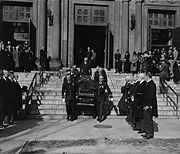 Funeral of Justice Pierce Butler, members of the Supreme Court, standing on the right, from left to right, retired Justice Willis Van Devanter, Justices Felix Frankfurter, Hugo Black, Harlan Stone; Chief Justice Charles Evans Hughes and Thomas E. Waggaman, Marshal of the United States Supreme Court, following high requiem mass at St. Matthew's Cathedral. Standing on the left, from left to right, Justices Owen J. Roberts, Stanley Forman Reed, William O. Douglas, and retired Justice George Sutherland.
 -
 The Butler family plot in St. Paul, Minnesota is marked by a large stone obelisk bearing only the name "BUTLER"; Pierce's stone and gravesite are in the foreground, obscured by tall grass.
 -
 Gravesite of Pierce Butler.


See also
[edit]- List of justices of the Supreme Court of the United States
- List of law clerks of the Supreme Court of the United States (Seat 10)
- List of United States Supreme Court justices by time in office
- List of United States Supreme Court cases by the Hughes Court
- List of United States Supreme Court cases by the Taft Court
References
[edit]- ^ a b "Justices 1789 to Present". Washington, D.C.: Supreme Court of the United States. Retrieved February 19, 2022.
- ^ a b c "Pierce Butler". Supreme Court Historical Society. Archived from the original on September 15, 2012. Retrieved July 24, 2012.
- ^ "Pierce Butler: An Inventory of His Family Papers at the Minnesota Historical Society" (PDF). Minnesota Historical Society. June 29, 2022. Retrieved February 2, 2023.
- ^ Onofrio, Jan (1994). Minnesota Biographical Dictionary: People of All Times and Places Who Have Been Important to the History and Life of the State. Scholarly Pr. p. 48. ISBN 978-0403099450.
- ^ a b c d "Pierce Butler". Encyclopædia Britannica. 2012. Archived from the original on November 23, 2011. Retrieved July 24, 2012.
- ^ "Supreme Court Nominations (1789-Present)". Washington, D.C.: United States Senate. Retrieved February 19, 2022.
- ^ "CONFIRMATION OF PIERCE BUTLER AS ASSOCIATE JUSTICE OF THE SUPREME COURT. (P.813-1)". govtrack.us. December 21, 1922.
- ^ a b c Ariens, Michael. "Pierce Butler". Michael Ariens. Archived from the original on October 16, 2002. Retrieved July 24, 2012.
- ^ Stephen Jay Gould, "Does the Stonless Plum Instruct the Thinking Reed," in Dinosaur in a Haystack (1995) p. 287.
- ^ Thompson, Phillip (February 20, 2005). "Silent Protest: A Catholic Justice Dissents in Buck v. Bell" (PDF). Catholic Lawyer. 43 (1): 125–148. Archived from the original (PDF) on January 13, 2013. Retrieved July 24, 2012.
- ^ Leuchtenburg, William E. (1995). "Mr. Justice Holmes and Three Generations of Imbeciles". The Supreme Court Reborn: The Constitutional Revolution in the Age of Roosevelt. New York: Oxford University Press. p. 15. ISBN 978-0195086133.
- ^ Fernandes, Ashley K. (2002). "The Power of Dissent: Pierce Butler and Buck v. Bell". Journal for Peace and Justice Studies. 12 (1): 115–134. doi:10.5840/peacejustice200212113. Archived from the original on April 15, 2013.
- ^ "Pierce Butler". Oyez.org. Archived from the original on August 24, 2012. Retrieved July 24, 2012.
- ^ "Christensen, George A. (1983) Here Lies the Supreme Court: Gravesites of the Justices, Yearbook". Archived from the original on September 3, 2005. Retrieved September 3, 2005.. Supreme Court Historical Society at Internet Archive.
- ^ Christensen, George A., Here Lies the Supreme Court: Revisited, Journal of Supreme Court History, Volume 33 Issue 1, Pages 17 – 41 (Feb 19, 2008), University of Alabama.
- ^ Johnson, Kathryn A. (July 1991). "Pierce Butler papers" (PDF). Minnesota Historical Society. Archived (PDF) from the original on June 21, 2015. Retrieved July 24, 2012.
- ^ a b "Pierce Butler, Research collections". Federal Judicial Center. Archived from the original on September 25, 2012. Retrieved July 24, 2012.
- ^ "Pierce Butler Route". Archived from the original on February 22, 2014. Retrieved February 7, 2014.
- ^ Empson, Donald L. (2006). The Street Where You Live A Guide to the Place Names of St. Paul. University of Minnesota Press. pp. 215–216. ISBN 978-0-8166-4729-3.
Sources
[edit]- "Pierce Butler". Federal Judicial Center.
- Danelski, David J. (1964). A Supreme Court Justice is Appointed. New York: Random House. p. 242.
- Stras, David R. (August 26, 2008). "Pierce Butler: A Supreme Technician". Vanderbilt Law Review (pdf (full paper downloadable)). 62. SSRN 1259314.
- Fernandes, Ashley K. (2002). "The Power of Dissent: Pierce Butler and Buck v. Bell". Journal for Peace and Justice Studies. 12 (1): 115–134. doi:10.5840/peacejustice200212113. Archived from the original on April 15, 2013.
Further reading
[edit]- Abraham, Henry J. (1992). Justices and Presidents: A Political History of Appointments to the Supreme Court (3rd ed.). New York: Oxford University Press. ISBN 978-0-19-506557-2.
- Abraham, Henry J. (1999). Justices, Presidents, and Senators: A History of the U.S. Supreme Court Appointments from Washington to Clinton (Revised ed.). Lanham: Rowman & Littlefield. ISBN 978-0-8476-9604-8.
- Cushman, Clare (2001). The Supreme Court Justices: Illustrated Biographies, 1789–1995 (2nd ed.). (Supreme Court Historical Society, Congressional Quarterly Books). ISBN 978-1-56802-126-3.
- Frank, John P. (1995). Friedman, Leon; Israel, Fred L. (eds.). The Justices of the United States Supreme Court: Their Lives and Major Opinions. Chelsea House Publishers. ISBN 978-0-7910-1377-9.
- Hall, Kermit L., ed. (1992). The Oxford Companion to the Supreme Court of the United States. New York: Oxford University Press. ISBN 978-0-19-505835-2.
- Martin, Fenton S.; Goehlert, Robert U. (1990). The U.S. Supreme Court: A Bibliography. Washington, D.C.: Congressional Quarterly Books. ISBN 978-0-87187-554-9.
- Schroeder, David (2009). More Than a Fraction: The Life and Work of Justice Pierce Butler (pdf). Marquette University. pp. 1–258. Archived from the original on September 15, 2015. Retrieved August 14, 2012.
{{cite book}}:|work=ignored (help) Access via Proquest Digital Dissertations. Paper AAI3357971. - Schroeder, David (July 13, 2010). "Joining the Court: Pierce Butler". Journal of Supreme Court History. 35 (2): 144–165. doi:10.1111/j.1540-5818.2010.01238.x. S2CID 145405982.
- Urofsky, Melvin I. (1994). The Supreme Court Justices: A Biographical Dictionary. New York: Garland Publishing. p. 590. ISBN 978-0-8153-1176-8.
External links
[edit]

- Pierce Butler at the Biographical Directory of Federal Judges, a publication of the Federal Judicial Center.
Justices of the Supreme Court of the United States | |||||||
|---|---|---|---|---|---|---|---|
| |||||||

| International | |
|---|---|
| National | |
| Other | |

- 1866 births
- 1939 deaths
- 20th-century American judges
- American people of Irish descent
- Carleton College alumni
- Minnesota Democrats
- Minnesota lawyers
- People from Dakota County, Minnesota
- United States federal judges appointed by Warren G. Harding
- Justices of the Supreme Court of the United States
- United States federal judges admitted to the practice of law by reading law
- Catholics from Minnesota