


Renault Mégane
 | This article includes a list of general references, but it lacks sufficient corresponding inline citations. (February 2023) |
| Renault Mégane | |
|---|---|
 | |
| Overview | |
| Manufacturer | Renault |
| Production | 1995–present (LHD) 1996–2022 (RHD) |
| Body and chassis | |
| Class | Small family car (C) |
| Body style | 3 or 5-door hatchback 4-door sedan/saloon 5-door estate 2-door coupé-cabriolet |
| Layout | Front-engine, front-wheel-drive |
| Chronology | |
| Predecessor | Renault 19 |
| Successor | Renault Megane E-Tech Electric |
The Renault Mégane (French pronunciation: [meɡan]), also spelled without the acute accent as Megane,[1] especially in languages other than French, and also known as the Renault Megavan for an LCV in Ireland, as the Renault Scala in Iran and as the Renault Mégane Grandcoupé for the saloon in Israel, Palestinian Authority and Serbia for certain generations,[2][3][4][5] is a small family car produced by the French car manufacturer Renault for the 1996 model year, and was the successor to the Renault 19. The Mégane has been offered in three- and five-door hatchback, saloon, coupé, convertible and estate bodystyles at various points in its lifetime, and having been through four generations is now in its fifth incarnation.
The first generation was largely based on its predecessor, the 19, and utilized modified versions of that car's drivetrain and chassis. The second and third generations were based on the Renault–Nissan C platform. The fourth generation is based on the CMF-CD platform, as used by the Renault Talisman and Renault Scénic.
In November 1996, the Mégane Scénic compact MPV was introduced, using the same mechanical components as the hatchback Mégane. For 2002, the Mégane entered its second generation with a substantial redesign taking place, and was voted European Car of the Year for 2003, whilst also becoming the first car in its class to receive a five star Euro NCAP rating.
The Mégane entered its third generation in 2008, with another totally different design being used; the saloon version of the Mégane became known as the Renault Fluence for this generation, and it was introduced in 2009. The fourth-generation Mégane was launched in 2015, with sales commencing in 2016.
In 2021, Renault revealed a battery electric version known as the Megane E-Tech Electric, which takes on a crossover exterior design.
First generation (X64; 1995)[edit]
| Mégane I | |
|---|---|
 | |
| Overview | |
| Also called | Renault Megavan (LCV, Ireland) |
| Production | July 1995 – 2003 2000–2009 (Colombia) 1996–2009 (Argentina) |
| Model years | 1996–2003 |
| Assembly |
|
| Designer | Michel Jardin (1991)[6] Patrick Le Quément (1991, 1992)[7] |
| Body and chassis | |
| Body style | 4-door saloon 2-door coupé 5-door hatchback 2-door convertible 5-door estate |
| Related | Renault Scénic Renault 19 |
| Powertrain | |
| Engine | Petrol: 1.4 L E7J I4 1.4 L K4J I4 1.6 L K7M I4 2.0 L F3R I4 2.0 L F5R I4 2.0 L F7R I4 Diesel: 1.9 L F8Q D I4 1.9 L F8Q dT I4 1.9 L F9Q dTi I4 1.9 L F9Q dCi I4 |
| Transmission | 4-speed automatic 5-speed manual |
| Dimensions | |
| Wheelbase | Hatchback, Sedan & Wagon: 2,580 mm (101.6 in) Coupé & Convertible: 2,468 mm (97.2 in) |
| Length | Hatchback: 4,129–4,164 mm (162.6–163.9 in) Sedan: 4,436–4,400 mm (174.6–173.2 in) Wagon: 4,437 mm (174.7 in) Coupé: 3,931–3,967 mm (154.8–156.2 in) Convertible: 4,081 mm (160.7 in) |
| Width | 1,698–1,699 mm (66.9–66.9 in) |
| Height | 1,365–1,420 mm (53.7–55.9 in) |

Development of the X64 began at the beginning of 1990, with the first sketches of X64 programme being drawn during the first six months of 1990. Very quickly, several themes were outlined and developed into four small scale (1/5) models by September 1990.
The designs retained were developed around four themes. Theme A: a six light version, evoking the Laguna; Theme B: a model with a markedly cuneiform line; Theme C: another design with ellipse shaped glasswork and rear notch; Theme D: a model with the same elliptical glazing and rounded rear.

In March 1991, all four styling proposals were developed into full scale (1:1). Theme C by Michel Jardin was chosen by Le Quement and frozen for production in April 1992. The first prototypes were built and presented to management in December 1992. Approximately 432 prototypes were built (at Rueil assembly) and destroyed during development.
In June 1993, Renault purchased production tooling for the X64, with the first test unit being assembled at the Douai plant in October 1994, and pre production units being constructed from December 1994 to the middle of 1995.
The Mégane I was unveiled in September 1995, at the Frankfurt Motor Show, as a replacement for the Renault 19. The car was essentially a reskin of its predecessor, and carried over the 19's floorpan, engines, transmissions and chassis design, albeit with much modification.
Taking its name from a Renault concept car shown in 1988, the Mégane further developed the new corporate styling theme introduced by Patrick Le Quément on the Laguna, most notably the "bird beak" front grille – a styling cue borrowed from the Renault 16 of the 1960s. Renault decided to add an acute accent to the vehicle name (Mégane), in order to assert its European identity, in a context of growing competition of newer car manufacturers coming from Japan.[8]
As with the 19 and the 11 before it, the Mégane was produced at Renault's Douai plant in northern France starting in July 1995, and at the Spanish plant of Palencia. Market launch began on 15 November 1995 in France, and 15 December 1995 for the coupé. Sales in the United Kingdom commenced in April 1996.
Safety was a key focus of the Mégane I, Renault's first car reflecting their new focus of selling on safety.
It featured a pillar mounted three-point seatbelt for the middle rear occupant (replacing the common 'lap strap'), standard front belt pre tensioners and load limiters, driver's airbag (passenger airbag from 1996) and an impressive safety structure – a specification ahead of all rivals in 1995, e.g. VW Golf Mk 3, Opel Astra F, Ford Escort etc. Some features, such as the three-point middle belt, had debuted on the Renault 19 safety concept vehicle (and this feature entered production on the Renault Laguna before the Mégane).
The car also benefited from Renault's first "System for Restraint and Protection" (SRP), essentially a system of careful optimisation of occupant restraint by interaction of the seat, seatbelt, pretensioner, load limiter and airbag. The Mégane I achieved a best in class four star crash test rating in the 1998 round of testing by Euro NCAP.[9]
November 1996 saw the introduction of the Mégane Scénic compact MPV.
Power came from the Renault E type ("Energy") engine in 1.4 L and 1.6 L, and the F-type unit in both 1.9 L diesel and 2.0 L petrol forms, although this time around there was a wider variety of 16 valve derivatives. A 1.9 L diesel engine in both normally aspirated and turbocharged forms was also available.
Renault also produced a limited number of Renaultsport edition Phase 1's with the Renaultsport bodywork; however, these were very rare. The Renaultsport kit was available to purchase for a short time direct from Renault France, but has now been discontinued, thus their value has increased.
The estate version of the original Mégane was only available in LHD form, with no RHD variants built. This could be due to the greater popularity of the Scenic in those markets, limiting the potential sales of a compact estate. The estate was added with the facelift of 1999, although pre-facelifted Mégane estates were sold from 1998 in Turkey, where it was manufactured.[10][11][12]
In Japan, Renault was formerly licensed by Yanase Co., Ltd., but in 1999 Renault acquired a stake in Japanese automaker Nissan. As a result of Renault's purchase, Yanase canceled its licensing contract for all Renault models sold in Japan, including, but not limited to, the Mégane I, in 2000, and Nissan took over as the sole licensee for Renault cars.[citation needed]
Facelift[edit]
A mild facelift in spring 1999 gave the Mégane I a modified grille, more advanced safety features and upgraded equipment, and 16 valve engines were used across the range. An Estate body style was also launched in mainland Europe with the facelift. The production continued for the Latin America Market, where it was sold alongside the Mégane II line at a considerably lower price until 2011.
-
 Pre-facelift Renault Mégane five-door
 -
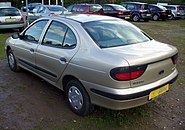 Pre-facelift Renault Mégane Classic sedan
 -
 Pre-facelift Renault Mégane Coupé
 -
 Pre-facelift interior
 -
 Post-facelift Renault Mégane five-door (hatchback)
 -
 Post-facelift Renault Mégane five-door (hatchback)
 -
 Renault Mégane Coupé (facelift)
 -
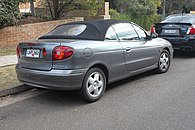 Post-facelift Renault Mégane (convertible)
 -
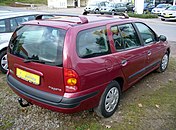 Post-facelift Renault Mégane (estate)
 -
 Post-facelift Renault Mégane Classic sedan
 -
 Post-facelift 1999 Renault Megane Coupe


.jpg)
_Privilege_convertible_(20889553963).jpg)

.jpg)

South America[edit]
In countries, such as Argentina and Colombia, the Mégane I was available until 2010, sold as a sedan and an estate, but in Venezuela, it was available only as a sedan. It features as the top line of the model the LA04 engine (16 valves, 1.6 litres and 110 HP), and was produced by both Renault Colombia and Renault Argentina, in where it was one of the best selling cars to date.
It is a car with more advanced safety features, upgraded equipment and more. The Mégane I had a lower price than the Mégane II.
In Venezuela, it was only available in one version: Unique, with a five-speed manual gearbox or a four-speed automatic one. Both of these were equipped with Abs and other extra equipment including driver and passenger front airbags, foglights, leather seats, electric mirrors and electric windows. In Argentina, not every version had features such as electric windows, electric mirrors or airbags.
Engines[edit]
| Model | Displacement | Type code | Power | Top speed | 0–100 km/h (0–62 mph) (s) |
|---|---|---|---|---|---|
| 1.4 8v Eco | 1,390 cc (84.8 cu in) | E7J | 70 hp (52 kW) | 168 km/h (104 mph) | 14.5 |
| 1.4 8v | 1,390 cc (84.8 cu in) | E7J | 75 hp (56 kW) | 170 km/h (106 mph) | 13.8 |
| 1.4 16v | 1,390 cc (84.8 cu in) | K4J | 98 hp (73 kW) | 184 km/h (114 mph) | 11.8 |
| 1.6 8v | 1,598 cc (97.5 cu in) | K7M | 90 hp (67 kW) | 184 km/h (114 mph) | 11.5 |
| 1.6 16v | 1,598 cc (97.5 cu in) | K4M | 110 hp (82 kW) | 195 km/h (121 mph) | 9.8 |
| 1.8 16v | 1,783 cc (108.8 cu in) | F4P | 120 hp (89 kW) | 198 km/h (123 mph) | 9.5 |
| 2.0 8v | 1,998 cc (121.9 cu in) | F3R | 115 hp (86 kW) | 197 km/h (122 mph) | 9.7 |
| 2.0 16v | 1,998 cc (121.9 cu in) | F4R | 139 hp (104 kW) | 213 km/h (132 mph) | 8.6 |
| 2.0 16v | 1,998 cc (121.9 cu in) | F7R | 150 hp (112 kW) | 215 km/h (134 mph) | 8.6 |
| 2.0 16v IDE | 1,998 cc (121.9 cu in) | F5R | 140 hp (104 kW) | 213 km/h (132 mph) | 8.6 |
| 1.9 8v D Eco | 1,870 cc (114.1 cu in) | F8Q | 65 hp (48 kW) | 160 km/h (99 mph) | 17.8 |
| 1.9 8v TD | 1,870 cc (114.1 cu in) | F8Q | 95 hp (71 kW) | 178 km/h (111 mph) | 12.6 |
| 1.9 8v dTi | 1,870 cc (114.1 cu in) | F9Q | 80 hp (60 kW) | 170 km/h (106 mph) | 13.8 |
| 1.9 8v dTi | 1,870 cc (114.1 cu in) | F9Q | 100 hp (75 kW) | 183 km/h (114 mph) | 12.3 |
| 1.9 8v dCi | 1,870 cc (114.1 cu in) | F9Q | 105 hp (78 kW) | 189 km/h (117 mph) | 11.5 |
Maxi Mégane[edit]
| Renault Maxi Mégane | |
|---|---|
 | |
| Overview | |
| Manufacturer | Renault Sport |
| Assembly | France |
| Body and chassis | |
| Class | F2 Kit Car |
| Body style | 2-door coupé |
| Layout | FF layout |
| Platform | Renault Mégane I |
| Related | Renault Megane I |
| Powertrain | |
| Engine | 2.0 L F7R710 I4 |
| Transmission | 7-speed sequential manual |
| Dimensions | |
| Length | 3,952 mm (155.6 in) |
| Width | 1,823 mm (71.8 in) |
| Height | 1,360 mm (53.5 in) |
| Curb weight | 960 kg (2,116 lb) |
| Chronology | |
| Predecessor | Renault Clio Williams Maxi |
During the 1990s, Renault Sport developed a rally car for the Formula 2 Kit Car regulations. This was the Clio Williams Maxi, which was the first car truly developed for the F2 Kit Car category, and first appeared in 1996. However, rivals such as Citroën and Peugeot soon introduced bigger and more powerful cars, which resulted in Renault producing an F2 version of the Mégane in 1996. The Maxi Mégane officially represented the brand in French Championship rallies in 1996 and 1997 with drivers like Philippe Bugalski, Jean Ragnotti or Serge Jordan, and the British Rally Championship from 1996 to 1999, with Grégoire De Mévius, Alain Oreille, Robbie Head, Martin Rowe, and Tapio Laukkanen. Both the French and British rally teams also compete in the World Rally Championship.
After the works programme was discontinued, many privateers continued to use the car. It was also used in the FIA 2-Litre World Rally Cup, which Renault won in 1999.[13] The car used a special version of the Renault F7R engine, and had a seven speed Sequential manual transmission.
Its most notable result was an outright victory in the 1996 Tour de Corse in the hands of Philippe Bugalski and his co driver Jean-Paul Chiaroni (in a year where the Tour de Corse was a FIA 2-Litre World Rally Cup only event);[14] but it also helped Renault to the FIA 2 Litre World Rally Cup of Manufacturer's title in 1999.[15]
In other high level competitions, Renault took back to back manufacturer's and driver's titles in the British Rally Championship in 1998 and 1999,[16][17] whilst they also took the European Rally Championship in 1999.[18]

Second generation (2002)[edit]
| Mégane II | |
|---|---|
_%E2%80%93_Frontansicht,_25._August_2013,_D%C3%BCsseldorf.jpg) Sedan (pre-facelift) | |
| Overview | |
| Production | 2002–2008 2003–2008 (Taiwan) 2006–2010 (Brazil, sedan) 2006–2012 (Brazil, estate) 2009–2012 (Iran) |
| Model years | 2003–2008 |
| Assembly |
|
| Body and chassis | |
| Body style | 4-door saloon 5-door estate 3-door hatchback 5-door hatchback 2-door convertible |
| Platform | Renault–Nissan C platform |
| Related | Mégane Renault Sport Renault Scénic Renault Koleos Nissan X-Trail Nissan Sentra Nissan Rogue Nissan Qashqai Nissan Lafesta |
| Powertrain | |
| Engine | Petrol: 1.4 L K4J I4 1.6 L K4M I4 2.0 L F4R I4 2.0 L F4RT I4 Diesel: 1.5 L K9K dCi I4 1.9 L F9Q dCi I4 2.0 L M9R dCi I4 |
| Transmission | 4-speed automatic 5-speed manual 6-speed manual |
| Dimensions | |
| Wheelbase | Hatchback: 2,625 mm (103.3 in) Sedan & Wagon: 2,686 mm (105.7 in) Convertible: 2,522 mm (99.3 in) |
| Length | Hatchback: 4,209 mm (165.7 in) Sedan & Wagon: 4,498 mm (177.1 in) Convertible: 4,355 mm (171.5 in) |
| Width | 1,777 mm (70.0 in) |
| Height | Sedan: 1,460 mm (57.5 in) Wagon: 1,505 mm (59.3 in) Convertible: 1,514 mm (59.6 in) |
| Curb weight | Hatchback: 1,175 kg (2,590 lb) |
| Chronology | |
| Successor | Renault Fluence (sedan) |

_Estival_5-door_hatchback_(2015-06-08).jpg)
_%E2%80%93_Heckansicht,_25._August_2013,_D%C3%BCsseldorf.jpg)
_Dynamic_LX_convertible_(2015-07-09)_02.jpg)


The Mégane II was launched in September 2002 for the 2003 model year,[19] and marked a completely new fresh start. The two cars bear very little resemblance, the new vehicle having been inspired by the manufacturer's new design language first seen in the Avantime.
The new Mégane was voted European Car of the Year for 2003,[20] fighting off stiff competition from Japan's Mazda 3 and PSA's Citroën C4, and achieved a five star safety rating in the Euro NCAP crash tests,[21] the first small family car to do so.
The Mégane II and the Laguna were both showcases for a great deal of innovative technologies Renault launched at the beginning of the 2000s; the Renault Card keyless ignition system, standard on the Mégane II, was a first in this class and has since been widely adopted.
Similarly, the option of a panoramic glass sunroof is another area in which Renault led where others followed. In June 2003, the first ever live crash test using a real driver rather than a crash test dummy featuring the Mégane II was conducted by Top Gear.[22]
The Mégane II sedan was assembled in Iran by Pars Khodro from 2008 to 2013.
In Brazil, Renault launched a flex fuel version, called "Hi-Flex", which is able to run either with unleaded gasoline (petrol) or ethanol. Like the Brazilian Scénic and Clio versions, the Mégane's engine can work with any mix of gasoline and ethanol, due to the use of an electronic control module.
The flex version has a 16V 110 hp (81 kW), 115 hp (85 kW) with ethanol, 1.6-litre inline-four engine developed and produced in Brazil, but the 2.0-litre, French-built engine can not be run on ethanol.
As with the previous Mégane, the range of models is wide; there is a three and five door hatchback available, named "Sport Hatch" and "Hatch" respectively, there is a four-door saloon/sedan (Sport Saloon), a five-door estate (Sport Tourer / Grandtour), and to replace both the Mégane Coupe and Convertible, a new retractable hardtop coupe designed by Karmann. Unlike the previous model, the estate version was sold in RHD for the first time.
Unlike its predecessor, the Mégane II was not licensed by Yanase Co., Ltd. for the Japanese market, as Renault had acquired a stake in Nissan when the Mégane I was still in production. Instead, the Mégane II was licensed by Nissan Motor Co., Ltd. and sold exclusively through Nissan Red Stage Store locations.
Mégane RS[edit]
The RenaultSport (RS) versions of the three door and five door Mégane hatchbacks were introduced, equipped with a turbocharged petrol 2.0 L 16v engine producing 225 PS (165 kW; 222 hp) and Turbocharged diesel 2.0L dCi 16V engine producing 175 PS (129 kW;173 hp). Along with the engine, changes were made to the front and rear suspension geometry to improve handling, and the model features a deeper, wider front bumper. The Mégane Renault Sport competes in the hot hatch segment of the market.
Facelift[edit]
The Hatchback model was revised at Motor Show Brussels in January 2006, the Wagon and Convertible model was debut at Geneva Motor Show in March 2006, with changes in interior trim (e.g. a new revised instrument cluster with the speedometer moved to the right and the tachometer moved to the left), specification levels and most notably, a new front nose. A new front suspension system borrowed from the Mégane 2.0 225 PS (165 kW; 222 hp) was adopted, improving the driving performance.[23] Also, the Nissan Sentra B16 is based on the platform from 2006 of the Renault Mégane.
Engines[edit]
| Model | Displacement | Type code | Power | Top Speed | 0–100 km/h (0–62 mph) (s) |
|---|---|---|---|---|---|
| 1.4 16v 80 | 1,390 cc (84.8 cu in) | K4J | 80 hp (60 kW; 81 PS) | 170 km/h (106 mph) | 13.5 |
| 1.4 16v 98 | 1,390 cc (84.8 cu in) | K4J | 98 PS (97 hp; 72 kW) | 183 km/h (114 mph) | 12.5 |
| 1.6 16v | 1,598 cc (97.5 cu in) | K4M | 118 PS (116 hp; 87 kW) | 196 km/h (122 mph) | 10.8 |
| 2.0 16v | 1,998 cc (121.9 cu in) | F4R | 136 PS (134 hp; 100 kW) | 205 km/h (127 mph) | 9.6 |
| 2.0 16v Turbo | 1,998 cc (121.9 cu in) | F4RT | 165 PS (163 hp; 121 kW) | 220 km/h (137 mph) | 8.3 |
| 2.0 16v Turbo RenaultSport | 1,998 cc (121.9 cu in) | F4RT | 225 PS (222 hp; 165 kW) | 236 km/h (147 mph) | 6.5 |
| 1.5 8v dCi 80 | 1,461 cc (89.2 cu in) | K9K | 80 PS (79 hp; 59 kW) | 170 km/h (106 mph) | 14.3 |
| 1.5 8v dCi 86 | 1,461 cc (89.2 cu in) | K9K | 86 PS (85 hp; 63 kW) | 174 km/h (108 mph) | 12.7 |
| 1.5 8v dCi 100 | 1,461 cc (89.2 cu in) | K9K | 100 PS (99 hp; 74 kW) | 181 km/h (112 mph) | 12.8 |
| 1.5 8v dCi 106 | 1,461 cc (89.2 cu in) | K9K | 106 PS (105 hp; 78 kW) | 185 km/h (115 mph) | 11.1 |
| 1.9 8v dCi 120 | 1,870 cc (114.1 cu in) | F9Q | 120 PS (118 hp; 88 kW) | 196 km/h (122 mph) | 10.5 |
| 1.9 8v dCi 130 | 1,870 cc (114.1 cu in) | F9Q | 130 PS (128 hp; 96 kW) | 200 km/h (124 mph) | 9.0 |
| 2.0 16v dCi 150 | 1,995 cc (121.7 cu in) | M9R | 150 PS (148 hp; 110 kW) | 210 km/h (130 mph) | 8.7 |
| 2.0 16v dCi RenaultSport | 1,995 cc (121.7 cu in) | M9R | 175 PS (173 hp; 129 kW) | 221 km/h (137 mph) | 8.5 |
Reception[edit]
During its first full year of sales, the Mégane II topped the French sales charts, with 198,874 registered in 2003.[24] It has also sold very well in Britain, being the nation's fourth most popular car in 2005 and the nation's fifth most popular car in 2004 and 2006. In 2007, however, it dipped to eighth place, with just over 55,000 examples being sold.[25]
The Mégane sedan was the best-selling car in Turkey from 2004 to 2006.[26]
Chinese copy controversy[edit]

The BYD S8, a Chinese convertible, shares a rear design with the Renault Mégane CC.
Third generation (2008)[edit]
| Mégane III | |
|---|---|
_Privilege_hatchback_(front).jpg) | |
| Overview | |
| Also called | Renault Scala (Iran) |
| Production | 2008–2016 |
| Model years | 2009–2017 |
| Assembly |
|
| Designer | François Leboine[27] |
| Body and chassis | |
| Body style | 5-door hatchback 3-door hatchback 2-door coupé cabriolet 5-door estate |
| Platform | Renault–Nissan C platform |
| Related | Mégane Renault Sport Renault Fluence Renault Samsung SM3 Renault Scénic Renault Koleos Nissan Sentra Nissan Rogue Nissan Qashqai Nissan X-Trail |
| Powertrain | |
| Engine | Petrol: 1.2 L H5Ft I4 turbo 1.4 L H4Jt I4 turbo 1.6 L K4M I4 2.0 L M4R I4 2.0 L F4RT I4 turbo Diesel: 1.5 L K9K I4 turbo 1.6 L R9M I4 turbo (2011-2017) 1.9 L F9Q I4 turbo (2008-2011) 2.0 L M9R I4 turbo (2009-2015) |
| Transmission | 5-speed manual 6-speed manual CVT 6-speed EDC (only dCi 110 FAP)[28] 6-speed automatic JATCO JF613E (only dCi 150 FAP) |
| Dimensions | |
| Wheelbase | Hatchback: 2,641 mm (104.0 in) Coupe: 2,640 mm (103.9 in) Estate: 2,703 mm (106.4 in) |
| Length | Hatchback: 4,295 mm (169.1 in) Coupe: 4,299 mm (169.3 in) Estate: 4,559 mm (179.5 in) |
| Height | Hatchback: 1,471 mm (57.9 in) Coupe: 1,423 mm (56.0 in) Estate: 1,507 mm (59.3 in) |
_Privilege_hatchback_(rear).jpg)


.jpg)
The third generation was launched in the end of 2008, to keep the range competitive. In October 2008, both the five door hatchback and Mégane Coupé were officially put on sale.[29] The two models have different designs; the Coupé has a sporty design, while the five door model is more conservative.
No automatic transmission is offered, with it being replaced by a continuously variable transmission.
A five-door estate version was introduced in June 2009, and was named the Sport Tourer.[30] Another addition to the range came in the form of the Coupé Cabriolet in June 2010.[31] That year also saw the addition of a 1.4 L turbocharged engine being added to the range.[32]
Production of the Mégane's saloon derivative, the Fluence, began in Argentina in 2011, at the firm's Córdoba plant.[33] The Mégane III was also made available for sale in Argentina that year, but was produced in Turkey, and imported into the country.[33] In Brazil, the Fluence replaced the Mégane in Renault's lineup from 2011 onwards.[34]
First facelift[edit]
The Mégane III underwent its first facelift in January 2012, which also introduced three new engines; a 1.2 L turbocharged petrol engine, a new 110 hp (112 PS; 82 kW) version of the 1.5 L dCi engine, and a new 1.6 L dCi engine.[35]
Second facelift[edit]
_%E2%80%93_Frontansicht,_13._Juli_2014,_Ratingen.jpg)
_%E2%80%93_Heckansicht,_13._Juli_2014,_Ratingen.jpg)

Another facelift followed for 2014,[36] with a more powerful 128 hp (130 PS; 95 kW) version of the 1.2 L turbocharged engine going on sale, whilst the styling of the hatchback, coupé and estate versions was updated to match Renault's new model range.[37][13]
Later that year, a 220 PS (162 kW; 217 hp) version of the 2.0 L turbocharged petrol engine was added to the range.[38]
Higher specification Mégane feature the same 2.0 dCi engine as the Mégane II. However, after 2015 the 2.0 dCi was no longer offered.
Turkish production[edit]
Mégane III's produced in Turkey (only 5-door hatchback and 4-door sedan) have visual and equipment differences due to cost cutting and factory equipment differences. For instance, there are weather stripes on the roof, covering the welds, whereas Spanish-built models have laser welds on the roof. Turkish models can only have sunroof as an option, while Spanish models can only have glassroof as an option. On Turkish cars, the spare wheels located under the vehicle rather than inside the trunk. The ride height is somewhat higher on Turkish models due to worse road conditions in Turkey. Only 1.5 diesel and 1.6 gasoline engines were offered on Turkish-built models.
There was no digital dash on Turkish, pre-facelift models. The dashboard on Turkish models also has a different silver trim piece and different air vents, different gauge clusters, and the base models have no analog fuel and temperature gauges.
Mégane GT Line[edit]

The Mégane GT Line is a sporty trim level that is equipped, among other things, with a sports suspension and unique blue paint.[39]
Special editions[edit]
Mégane Olympic[edit]
The Mégane Olympic is a special edition launched in August 2012 on the occasion of the London 2012 Olympic Games.[40]
Mégane Coupe Cabriolet Floride[edit]
The Mégane Coupe Cabriolet Floride was a special edition convertible in ivory with red and ivory two tone interior, intended as a tribute to 1960s chic.
Engines[edit]
| Petrol engine | ||||||
|---|---|---|---|---|---|---|
| Model | Displacement | Type code | Power | Torque | Top speed | 0–100 km/h (0–62 mph) (s) |
| 1.2 TCe 115 Stop & Start | 1,198 cc (73.1 cu in) | H5Ft | 115 PS (113 hp; 85 kW) @ 4500 rpm | 190 N⋅m (140 lb⋅ft) @ 2000 rpm | 190 km/h (118 mph) | 10.9 |
| 1.2 TCe 130 Stop & Start | 1,198 cc (73.1 cu in) | H5Ft | 130 PS (128 hp; 96 kW) @ 5500 rpm | 205 N⋅m (151 lb⋅ft) @ 2000 rpm | 200 km/h (124 mph) | 9.6 |
| 1.4 TCe 130 | 1,397 cc (85.3 cu in) | H4Jt | 130 PS (128 hp; 96 kW) @ 5500 rpm | 190 N⋅m (140 lb⋅ft) @ 2250 rpm | 200 km/h (124 mph) | 9.6 |
| 1.6 VVT 100 | 1,598 cc (97.5 cu in) | K4M | 100 PS (99 hp; 74 kW) @ 5500 rpm | 148 N⋅m (109 lb⋅ft) @ 4250 rpm | 190 km/h (118 mph) | 10.9 |
| 1.6 VVT 110 | 1,598 cc (97.5 cu in) | K4M | 112 PS (110 hp; 82 kW) @ 6000 rpm | 151 N⋅m (111 lb⋅ft) @ 4250 rpm | 195 km/h (121 mph) | 10.5 |
| 1.6 112 CVT | 1,598 cc (97.5 cu in) | H4M | 114 PS (112 hp; 84 kW) @ 6000 rpm | 152 N⋅m (112 lb⋅ft) @ 4250 rpm | 210 km/h (130 mph) | 11.0 |
| 2.0 16v CVT | 1,997 cc (121.9 cu in) | M4R | 143 PS (141 hp; 105 kW) @ 6000 rpm | 195 N⋅m (144 lb⋅ft) @ 3750 rpm | 195 km/h (121 mph) | 10.3 |
| 2.0 TCe 180 | 1,998 cc (121.9 cu in) | F4RT | 180 PS (178 hp; 132 kW) @ 5500 rpm | 300 N⋅m (221 lb⋅ft) @ 2250 rpm | 230 km/h (143 mph) | 7.8 |
| 2.0 TCe 220 | 1,998 cc (121.9 cu in) | F4RT | 220 PS (217 hp; 162 kW) @ 5500 rpm | 340 N⋅m (251 lb⋅ft) @ 2400 rpm | 240 km/h (149 mph) | 7.6 |
| 2.0 Turbo RS 250 | 1,998 cc (121.9 cu in) | F4RT | 250 PS (247 hp; 184 kW) @ 5500 rpm | 340 N⋅m (251 lb⋅ft) @ 3000 rpm | 250 km/h (155 mph) | 6.1 |
| 2.0 Turbo RS 265 | 1,998 cc (121.9 cu in) | F4RT | 265 PS (261 hp; 195 kW) @ 5500 rpm | 360 N⋅m (266 lb⋅ft) @ 3000 rpm | 255 km/h (158 mph) | 6.0 |
| 2.0 Turbo RS 275 | 1,998 cc (121.9 cu in) | F4RT | 273 PS (269 hp; 201 kW) @ 5500 rpm | 360 N⋅m (266 lb⋅ft) @ 3000 rpm | 255 km/h (158 mph) | 6.0 |
| 2.0 Turbo RS 275 Trophy-R | 1,998 cc (121.9 cu in) | F4RT | 273 PS (269 hp; 201 kW) @ 5500 rpm | 360 N⋅m (266 lb⋅ft) @ 3000 rpm | 255 km/h (158 mph) | 5.8 |
| Diesel engine | ||||||
| 1.5 dCi 85 | 1,461 cc (89.2 cu in) | K9K | 85 PS (84 hp; 63 kW) @ 3750 rpm | 200 N⋅m (148 lb⋅ft) @ 1750 rpm | 175 km/h (109 mph) | 12.9 |
| 1.5 dCi 90 FAP | 1,461 cc (89.2 cu in) | K9K | 90 PS (89 hp; 66 kW) @ 4000 rpm | 200 N⋅m (148 lb⋅ft) @ 1750 rpm | 180 km/h (112 mph) | 12.5 |
| 1.5 dCi 105 | 1,461 cc (89.2 cu in) | K9K | 105 PS (104 hp; 77 kW) @ 4000 rpm | 240 N⋅m (177 lb⋅ft) @ 1750 rpm | 190 km/h (118 mph) | 10.9 |
| 1.5 dCi 110 FAP | 1,461 cc (89.2 cu in) | K9K | 110 PS (108 hp; 81 kW) @ 4000 rpm | 240 N⋅m (177 lb⋅ft) @ 1750 rpm | 190 km/h (118 mph) | 12.3 |
| 1.5 Energy dCi 110 | 1,461 cc (89.2 cu in) | K9K | 110 PS (108 hp; 81 kW) @ 4000 rpm | 260 N⋅m (192 lb⋅ft) @ 1750 rpm | 190 km/h (118 mph) | 12.1 |
| 1.6 dCi 130 FAP Stop & Start | 1,598 cc (97.5 cu in) | R9M | 130 PS (128 hp; 96 kW) @ 4000 rpm | 320 N⋅m (236 lb⋅ft) @ 1750 rpm | 200 km/h (124 mph) | 9.8 |
| 1.9 dCi 130 FAP | 1,870 cc (114.1 cu in) | F9Q | 130 PS (128 hp; 96 kW) @ 3750 rpm | 300 N⋅m (221 lb⋅ft) @ 1750 rpm | 210 km/h (130 mph) | 9.5 |
| 2.0 dCi 150 FAP | 1,995 cc (121.7 cu in) | M9R | 150 PS (148 hp; 110 kW) @ 3750 rpm | 360 N⋅m (266 lb⋅ft) @ 2000 rpm | 210 km/h (130 mph) | 9.2 |
| 2.0 dCi 160 FAP | 1,995 cc (121.7 cu in) | M9R | 160 PS (158 hp; 118 kW) @ 3750 rpm | 380 N⋅m (280 lb⋅ft) @ 2000 rpm | 220 km/h (137 mph) | 8.5 |
Fourth generation (BFB; 2016)[edit]
| Mégane IV | |
|---|---|
.jpg) | |
| Overview | |
| Also called | Renault Mégane Grandcoupé (saloon, Israel,[2] Palestinian Authority,[4] Serbia[5]) |
| Production | 2015–present (LHD, AU RHD) [41] 2015–2022 (UK RHD) [42] |
| Assembly |
|
| Body and chassis | |
| Body style | 5-door hatchback 5-door estate 4-door saloon |
| Platform | Renault–Nissan CMF-CD platform |
| Related | |
| Powertrain | |
| Engine | |
| Electric motor | 50 kW (68 PS; 67 hp) electric motor, integrated into transmission (E-Tech) |
| Transmission |
|
| Hybrid drivetrain | PHEV (E-Tech) |
| Dimensions | |
| Wheelbase |
|
| Length |
|
| Width |
|
| Height |
|
| Curb weight | 1,205–1,603 kg (2,657–3,534 lb) |
| Chronology | |
| Predecessor | Renault Fluence (saloon) |
The fourth generation Mégane was launched at the September 2015 Frankfurt Motor Show,[43] production started late 2015,[44] with sales starting in July 2016. The vehicle is larger and based on an all-new CMF-CD platform shared with the Renault Scénic and Renault Talisman. The Mégane IV follows the latest design language, which has been seen on the Clio IV, Captur, Espace V and Talisman.[45][46]
An estate version (Mégane Sport Tourer/Grand tour, codenamed KFB)[47] was revealed at the 2016 Geneva Motor Show.[48] The four door fastback saloon version called the Mégane Sedan later in July of the same year.[49]
-
 Mégane hatchback (rear view)
 -
 Mégane Grandtour (rear view)
 -
 Mégane saloon (rear view)
 -
 Interior


Technical details[edit]
The fourth generation Mégane is larger and lower than its predecessor. The suspension is made of MacPherson struts on the front and a torsion beam on the rear. Brakes are discs on both axles. The driver can select between five driving modes that change the car set up.
Most Mégane's models have a head up display and a seven-inch screen (replaced with an 8.7-inch touchscreen in some trim levels).
Options include adaptive cruise control, automated emergency braking, lane departure warning, speed limit warning, blind spot monitoring, automatic headlights, reversing camera, parking sensors and a hands free parking system.
Speaking about the car, Renault's chief designer Laurens van den Acker said, "Renault can produce cars with a Latin skin and a German heart". It has nine engines available (four petrol and five diesel) with power outputs between 89 hp (65 kW) and 202 hp (149 kW).[50]
Mégane Sedan[edit]
The Mégane Sedan, launched in July 2016, resembles the Talisman, but with the front section of the Mégane IV hatchback and a fastback like sloping roofline. It has more space for the back seat passengers than the hatchback and a larger boot, with a claimed volume of 508 litre.
It is sold on the African continent, the Middle East, various Eastern Asian and Australian markets. Within Europe, it is offered in several countries including Turkey, Italy, Poland, Romania, Bulgaria, Ukraine, Serbia, Greece, Georgia and Ireland, but neither France[51] or the United Kingdom.
Depending on the market, there are two petrol engines and three diesel engines offered, with power outputs ranging from 90 to 130 bhp. Only the mid range engine is suitable to be matched with the dual clutch six speed transmission.[51]
Mégane GT[edit]
-
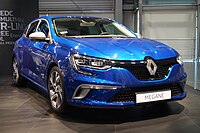 Mégane GT
 -
 Rear view
 -
 Interior
.jpg)
.jpg)
.jpg)
The Mégane GT is a high performance version based on the hatchback model with 1.6-litre I4 diesel and petrol powertrains. As standard, it incorporates a four-wheel steering system (4Control) and dual-clutch automatic gearbox with optional paddle shifting. It also has a slightly different design for the interior and the exterior.[50][52]
Mégane R.S.[edit]
The Mégane R.S. was introduced in September 2017 and went on sale in 2018. Based on the hatchback model, it is powered by a 1.8-litre turbocharged engine developed jointly with Nissan, with tweaks made by engineers working from the Renault Formula 1 engine factory in Viry-Châtillon, France. The engine produces 280 PS (276 hp; 206 kW) and 390 N⋅m (39.8 kg⋅m; 288 lb⋅ft) torque, with an option of two transmissions, which are six-speed manual or a six-speed dual-clutch automatic.[53]
-
 Mégane RS
 -
 Rear view
.jpg)
.jpg)
Mégane RS Trophy-R[edit]
_-_Renault_MEGANE_R.S._TROPHY_R_(ABA-BBM5P).jpg)
Making its public debut on May 24, 2019, at the Monaco Formula 1 Grand Prix,[54] the Mégane RS Trophy-R is a limited edition based on the regular Trophy.
It was designed to be the fastest front-wheel-drive vehicle to lap the Nürburgring, and as such it is 130 kg (290 lb) lighter due to the thinner glass used on the rear doors, a carbon fiber hood, the absence of rear seats combined with lighter front seats, a titanium exhaust and no rear wiper, among other things.[55] To save even more weight, it can be fitted with an optional carbon-ceramic brake kit at the front as well as carbon rims.[56]
Mégane RS Ultime[edit]
Announced in January 2023, the Mégane RS Ultime is a limited edition available in just 1,976 units, as a reference to the founding year of Renault Sport.[57] All are signed by Laurent Hurgon, a test driver who has broken several lap records in the Mégane RS and was actively involved in the development of the model.[58]
It is the last RS-badged model and made its public debut at the 2023 Tokyo Motor Show,[59] marking the 20th anniversary of the Mégane RS series, which was first introduced in 2003.[60]
Orders opened in March 2023 with a starting price of €53,450 (not including the green tax) in France.[61]
Facelift[edit]
In 2020, the Mégane was refreshed with facelift, with minor changes to the exterior design, a 9.3-inch touchscreen, and a plug-in hybrid version in both estate and hatchback variants marketed as the Mégane E-Tech.[62] It combines the 1.6-liter four-cylinder petrol engine with two electric motors for a total system output of 158 hp (160 PS; 118 kW) and comes with a 9.8 kWh battery that allows it to run on electricity for 50 km (31 mi) and up to a top speed of 135 km/h (84 mph) in the mixed WLTP test cycle and for 65 km (40 mi) in the city.[63]
The Mégane Sedan is facelifted in February 2021, some months after the hatchback and the estate. It receives a new 115 hp petrol engine.[64]
In June 2022, Renault launched the "E-Tech engineered" special edition for the hybrid versions of the Clio, Captur, Arkana and Mégane (hatchback and estate), with design elements inspired by the Megane E-Tech.[65]
The production of both the hatchback and the estate models is stopped in April 2024,[66] but the production in Turkey (saloon model) continues.
-
 Mégane hatchback (facelift)
 -
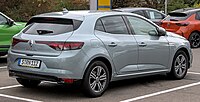 Mégane hatchback (facelift)
 -
 Mégane E-Tech (hatchback)
 -
 Mégane Grandtour (facelift)
 -
 Mégane saloon (facelift)


_IMG_3785.jpg)

Megane E-Tech[edit]

The Megane E-Tech is a battery electric car using the Megane nameplate that was launched in February 2022. It is built on a dedicated electric vehicle platform called the CMF-EV.
Nameplate usage[edit]
Mégane Scénic[edit]
.JPG)
In 1996, a compact MPV called the Mégane Scénic was introduced. It was renamed to Scénic during a facelift in 1999.
Mégane Conquest[edit]
In September 2020, the rebadged version of the South Korean-made Renault Samsung XM3/Arkana was launched in former Yugoslavian countries as the Mégane Conquest due to negative connotations with the Serbian historical war criminal Arkan.
Production[edit]
Fourth generation[edit]
| Calendar year | Hatch[66] | Estate[66] | Saloon |
|---|---|---|---|
| 2015 | 8,016 | 14 | |
| 2016 | 124,254 | 39,510 | |
| 2017 | 98,780 | 68,552 | |
| 2018 | 85,161 | 57,243 | |
| 2019 | 77,647 | 50,810 | |
| 2020 | 47,873 | 35,643 | |
| 2021 | 30,477 | 21,563 | |
| 2022 | 26,253 | 20,728 | |
| 2023 | 8,924 | 9,269 | |
| 2024 |
See also[edit]
Notes[edit]
- ^ "Renault Megane E-Tech Plug-In Hybrid". www.renault.fr (in French).
- ^ a b "רכב משפחתי חסכוני ואלגנטי - רנו מגאן גרנד קופה". Renault Israel.
- ^ "Megane Grandcoupe". www.renault.mk.
- ^ a b "Megane Grand Coupe". www.renault.ps.
- ^ a b "Otkrijte novi Renault Megane Grandcoupé". www.renault.rs.
- ^ "Renault Megane - Project Megane global design - Auto&Design". autodesignmagazine.com. 20 December 1995. Retrieved 28 March 2018.
- ^ "Megane, Bravo Compte A Rebours Pour Un Double Lancement". 18 September 1995.
- ^ The Scénic road to success - the Renault Scénic Story, retrieved 18 August 2022
- ^ Renault Megane (1998). "Renault Megane (1998)". Euroncap.com. Retrieved 16 January 2019.
{{cite web}}: CS1 maint: numeric names: authors list (link) - ^ "Tópico Renault - O Diamante!". FÓRUM MOTORGUIA ONLINE (in Portuguese). 8 February 2018. Retrieved 17 August 2021.
- ^ "Used Renault Megane , Bursa, Turkey, , Blue, Wagon, Petrol, Manual". OOYYO (in Turkish). Archived from the original on 17 August 2021. Retrieved 17 August 2021.
- ^ "Un break Mégane turc". L'Orient-Le Jour. 20 June 1998. Retrieved 27 November 2021.
- ^ a b "1999 FIA 2-Litre World Cup for Manufacturers – Final classification". RallyBase. Archived from the original on 21 June 2007. Retrieved 15 June 2013.
- ^ "40. Tour de Corse – Rallye de France 1996 – results". eWRC-results.com. Retrieved 7 December 2014.
- ^ "1999 FIA 2-Litre World Cup for Manufacturers – Final classification". RallyBase. Archived from the original on 8 July 2019. Retrieved 7 December 2014.
- ^ James, David (9 November 1998). "Provisional Mobil 1/RAC British Rally Championship Tables after this round". Mobil 1/RAC British Rally Championship. Retrieved 7 December 2014.
- ^ "British Rally Championship – Twingo Trophy – Championships". Renaultsport.co.uk. Archived from the original on 9 December 2014. Retrieved 7 December 2014.
- ^ "European Rally Championship 1999 :: Schedule and Standings". motorsport-archive.com. Retrieved 7 December 2014.
- ^ "First details of new Renault Mégane". archive.cardesignnews.com. Archived from the original on 2 January 2013. Retrieved 3 July 2007.
- ^ "Rewind to 2003: Renault Megane". Quicks. Archived from the original on 17 January 2014. Retrieved 10 January 2014.
- ^ "Renault Megane". euroncap.com. Retrieved 3 July 2007.
- ^ "Human Driver Crash Tests Megane For BBC's Top Gear". carpages.co.uk. 20 June 2003. Retrieved 24 August 2017.
- ^ "Renault Megane gets face-lift for 2006". whatcar.com. Retrieved 3 July 2007.
- ^ Fischer, Thomas (4 February 2004). "Neuheiten". Auto Motor und Sport. No. 4. Stuttgart. p. 10.
- ^ "Canadian Economic Press - Welcome". Archived from the original on 19 January 2008. Retrieved 9 January 2008.
- ^ Gasnier, Matt (14 January 2007). "Turkey 2004-2006: Renault places Megane and Clio Symbol on top". Best Selling Cars Blog. Archived from the original on 22 September 2015.
- ^ "Renault Megane - Interview : François Leboine, responsable design concept-cars chez Renault - LIGNES/Auto". lignesauto.fr. 11 February 2021. Retrieved 25 May 2021.
- ^ "Renault to offer six-speed efficient dual clutch transmission on all Megane models". Retrieved 13 May 2010.
- ^ "Renault reveals price of new Mégane". Which? Car. 30 September 2008. Archived from the original on 7 January 2016. Retrieved 6 December 2014.
- ^ Ross, David (2 September 2014). "Renault Megane Sport Tourer (09 on) – Review Summary". Parkers. Retrieved 6 December 2014.
- ^ Mahoney, John (12 December 2013). "Renault Megane Coupe Cabriolet (10 on) – Review Summary". Parkers.
- ^ Cackett, Nic (6 January 2010). "First drive: Renault Megane Coupe 1.4 TCe". AOL Cars UK. Retrieved 6 December 2014.
- ^ a b "Renault Fluence hits the streets". Buenos Aires Herald. 25 November 2010. Retrieved 6 December 2014.
- ^ Popa, Bogdan (10 December 2010). "Renault Fluence Debuts in Brazil". autoevolution. Retrieved 6 December 2014.
- ^ Popa, Bogdan (6 January 2012). "2012 Renault Megane Facelift Unveiled". autoevolution. Retrieved 6 December 2014.
- ^ Callow, Ed (6 September 2013). "2014 Renault Megane face-lift revealed". What? Car. Retrieved 6 December 2014.
- ^ Darren Moss (5 September 2013). "Renault Megane facelift unveiled | Autocar". Autocar. Retrieved 4 August 2016.
- ^ Renz, Sebastian (23 July 2014). "Ein heißer Kompakter: Renault Mégane TCe 220 GT-Line im Test". Auto Motor und Sport. Retrieved 6 December 2014.
- ^ "Renault Megane GT Line 2014 review". Auto Express. 16 January 2014.
- ^ "Renault Romania premiaza Olimpicii Londa 2012-Renault Megane Olympic". 13 August 2012.
- ^ Misoyannis, Alex (19 July 2022). "Renault Megane hatch production may end overseas, safe for Australia". Autoevolution.
- ^ Gnaticov, Cristian (20 July 2022). "And the latest victim of crossovers and EVs is the Renault Mégane!". Autoevolution.
- ^ "Renault Megane IV debuts at Frankfurt 2015 show". paultan.org. 17 September 2015.
- ^ "Renault Mégane 4 : la fabrication à l'usine de Palencia en vidéo". www.largus.fr. Retrieved 29 March 2024.
- ^ "Next-gen Renault Megane spied hiding all-new design under camouflage". worldcarfans.com. 1 March 2015. Retrieved 4 May 2015.
- ^ Allen, Lawrence (27 February 2015). "New 2016 Renault Megane caught testing for the first time". Auto Express. Retrieved 4 May 2015.
- ^ Vénier, Julie (23 December 2022). "L'usine Renault de Palencia s'est adaptée à l'hybride".
- ^ McIlroy, Jhon (1 March 2016). "New Renault Megane Sport Tourer estate arrives". Auto Express. Retrieved 12 April 2016.
- ^ "Renault Megane Sedan launched – no more Fluence!". paultan.org. 12 July 2016.
- ^ a b Holder, Jim (3 November 2015). "2016 Renault Megane revealed – exclusive studio pictures". Autocar. Retrieved 12 April 2016.
- ^ a b Sylvain Reisser (19 July 2016). "Renault Mégane Sedan, une petite Talisman". Le Figaro. Retrieved 8 August 2016.
- ^ Kingston, Lewis (10 December 2015). "2016 Renault Mégane GT review". Autocar. Retrieved 12 April 2016.
- ^ "Hot New Megane RS Is Turning Up The Heat". Motor1.com. 12 September 2017.
- ^ "NEW MÉGANE R.S. TROPHY-R: FASTEST EVER FRONT-WHEEL-DRIVE PRODUCTION CAR AT THE NÜRBURGRING". 21 May 2019.
- ^ Karkafiris, Michael (5 July 2019). "Renault Details Megane RS Trophy-R, The Purest Hot Hatch Of Them All". Carscoops.
- ^ Geyer, Niels de (16 July 2019). "Voici pourquoi la Renault Mégane RS Trophy-R coûte 80 000 €".
- ^ "Renault Mégane R.S. Ultime (2023). Infos, tarifs et date de lancement de la série limitée". www.largus.fr. 11 January 2023.
- ^ Pappas, Thanos (11 January 2023). "Renault Megane RS Ultime Is Renault Sport's Swan Song". Carscoops.
- ^ "2023 Renault Megane RS Ultime Breaks Cover As The Final RS". Motor1.com. 11 January 2023.
- ^ "Mégane R.S. Ultime, une série limitée pour célébrer la carrière d'un modèle phare dans l'histoire de Renault Sport". Newsroom Renault. 11 January 2023.
- ^ "Renault Mégane R.S. Ultime (2023). Prix et options de la dernière compacte sportive française". www.largus.fr. 17 March 2023.
- ^ "2020 Renault Megane Facelift Debuts Plug-In Hybrid And R.S. Line". Motor1.com. 3 February 2020.
- ^ Gnaticov, Cristian (3 February 2020). "2020 Renault Megane Brings Subtle Visual Tweaks, 'E-Tech' Plug-In Hybrid Variant". Carscoops.
- ^ Yıldırım, Ali (11 February 2021). "Yeni Megane Sedan ile hedef zirve". Otomobil Haberleri (in Turkish). Retrieved 27 August 2022.
- ^ Pappas, Thanos (3 June 2022). "Renault's Hybrid Models Gain E-Tech Engineered Special Edition Inspired By The New Megane". Carscoops.
- ^ a b c "Renault Mégane. La fin de la saga des berlines compactes au losange". www.largus.fr. Retrieved 29 March 2024.
External links[edit]

- Official website (UK)
- Official website (Sport Tourer: UK)



| Authority control databases: National |
|---|
