


Edward G. Robinson
Edward G. Robinson | |
|---|---|
 Robinson in 1948 | |
| Born | Emanuel Goldenberg December 12, 1893 |
| Died | January 26, 1973 (aged 79) Los Angeles, California, U.S. |
| Resting place | Beth El Cemetery, Ridgewood, Queens |
| Nationality | American |
| Occupation | Actor |
| Years active | 1913–1973 |
| Spouses | Gladys Lloyd
(m. 1927; div. 1956)Jane Robinson (m. 1958) |
| Children | Edward G. Robinson Jr. |
| Awards | |
Edward G. Robinson (born Emanuel Goldenberg; December 12, 1893 – January 26, 1973) was an American actor of stage and screen, who was popular during Hollywood's Golden Age. He appeared in 30 Broadway plays,[1] and more than 100 films, during a 50-year career,[2] and is best remembered for his tough-guy roles as gangsters in such films as Little Caesar and Key Largo. During his career, Robinson received the Cannes Film Festival Award for Best Actor for his performance in House of Strangers.
During the 1930s and 1940s, Robinson was an outspoken public critic of fascism and Nazism, which were growing in strength in Europe in the years which led up to World War II. His activism included contributing over $250,000 to more than 850 organizations that were involved in war relief, along with contributions to cultural, educational, and religious groups. During the 1950s, he was called to testify in front of the House Un-American Activities Committee during the Red Scare, but he was cleared of any deliberate Communist involvement when he claimed that he was "duped" by several people whom he named (including screenwriter Dalton Trumbo), according to the official Congressional record, "Communist infiltration of the Hollywood motion-picture industry".[3][4] As a result of being investigated, he found himself on Hollywood's graylist, people who were on the Hollywood blacklist maintained by the major studios, but could find work at minor film studios on what was called Poverty Row.
Robinson's roles included an insurance investigator in the film noir Double Indemnity, Dathan (the adversary of Moses) in The Ten Commandments, and his final performance in the science-fiction story Soylent Green.[5] Robinson received an Academy Honorary Award for his work in the film industry, which was awarded two months after he died in 1973. He is ranked number 24 in the American Film Institute's list of the 25 greatest male stars of Classic American cinema. Multiple film critics and media outlets have cited him as one of the best actors never to have received an Academy Award nomination.[6][7]
Early years and education
[edit]Robinson was born Emmanuel Goldenberg (Yiddish: עמנואל גאָלדענבערג) on December 12, 1893, in a Yiddish-speaking Romanian Jewish family in Bucharest, the fifth son of Sarah (née Guttman) and Yeshaya Moyshe Goldenberg (later called Morris in the U.S.), a builder.[8]
According to the New York Times, one of his brothers was attacked by an anti-semitic gang during a "schoolboy pogrom".[9] In the wake of that violence, the family decided to emigrate to the United States.[2] Robinson arrived in New York City on February 21, 1904.[10] "At Ellis Island I was born again," he wrote. "Life for me began when I was 10 years old."[2] In America, he assumed the name of Emanuel. He grew up on the Lower East Side,[11]: 91 and had his Bar Mitzvah at First Roumanian-American Congregation.[12] He attended Townsend Harris High School and then the City College of New York, planning to become a criminal attorney.[13] An interest in acting and performing in front of people led to him winning an American Academy of Dramatic Arts scholarship,[13] after which he changed his name to Edward G. Robinson (the G. standing for his original surname).[13]
He served in the United States Navy during World War I, but was not sent overseas.[14]
Career
[edit]


_1.jpg)

Theatre
[edit]In 1915, Robinson made his Broadway debut in Roi Cooper Megrue's "Under Fire".[15] He made his film debut in Arms and the Woman (1916).
In 1923, he made his named debut as E. G. Robinson in the silent film, The Bright Shawl.[2]
The Racket
[edit]He played a snarling gangster in the 1927 Broadway police/crime drama The Racket, which led to his being cast in similar film roles, beginning with The Hole in the Wall (1929) with Claudette Colbert for Paramount.
One of many actors who saw their careers flourish rather than falter in the new sound film era, he made only three films prior to 1930, but left his stage career that year and made 14 films between 1930 and 1932.
Robinson went to Universal for Night Ride (1930) and MGM for A Lady to Love (1930) directed by Victor Sjöström. At Universal he was in Outside the Law and East Is West (both 1930), then he did The Widow from Chicago (1931) at First National.
Little Caesar
[edit]At this point, Robinson was becoming an established film actor. What began his rise to stardom was an acclaimed performance as the gangster Caesar Enrico "Rico" Bandello in Little Caesar (1931) at Warner Bros.
Robinson signed a long-term contract with Warner Bros., casting him in another gangster film, Smart Money (1931), his only movie with James Cagney. He was reunited with Mervyn LeRoy, director of Little Caesar, in Five Star Final (1931), playing a journalist, and played a Tong gangster in The Hatchet Man (1932).
Robinson made a third film with LeRoy, Two Seconds (1932) then did a melodrama directed by Howard Hawks, Tiger Shark (1932).
Warner Bros. tried him in a biopic, Silver Dollar (1932), where Robinson played Horace Tabor; a comedy, The Little Giant (1933); and a romance, I Loved a Woman (1933).
Robinson was then in Dark Hazard (1934) and The Man with Two Faces (1934).
He went to Columbia for The Whole Town's Talking (1935), a comedy directed by John Ford. Sam Goldwyn borrowed him for Barbary Coast (1935), again directed by Hawks.
Back at Warner Bros. he did Bullets or Ballots (1936) then he went to Britain for Thunder in the City (1937). He made Kid Galahad (1937) with Bette Davis and Humphrey Bogart. MGM borrowed him for The Last Gangster (1937), then he did a comedy A Slight Case of Murder (1938). Again with Bogart in a supporting role, he was in The Amazing Dr. Clitterhouse (1938) and then he was borrowed by Columbia for I Am the Law (1938).
World War II
[edit]At the time World War II broke out in Europe, he played an FBI agent in Confessions of a Nazi Spy (1939), the first American film that portrayed Nazism as a threat to the United States.
He volunteered for military service in June 1942 but was disqualified due to his age which was 48,[16] although he became an active and vocal critic of fascism and Nazism during that period.[17]
MGM borrowed him for Blackmail, (1939). Then, to avoid being typecast, he played the biomedical scientist and Nobel laureate Paul Ehrlich in Dr. Ehrlich's Magic Bullet (1940), and played Paul Julius Reuter in A Dispatch from Reuters (1940).[18] Both films were biographies of prominent Jewish public figures. In between, he and Bogart starred in Brother Orchid (1940).[18]
Robinson was teamed up with John Garfield in The Sea Wolf (1941), and George Raft in Manpower (1941). He went to MGM for Unholy Partners (1942), and made a comedy Larceny, Inc. (1942).
Post-Warner Bros.
[edit]Robinson was one of several stars in Tales of Manhattan (1942) and Flesh and Fantasy (1943).
He did war films: Destroyer (1943) at Columbia, and Tampico (1944) at Fox. At Paramount, he was in Billy Wilder's Double Indemnity (1944), with Fred MacMurray and Barbara Stanwyck, where his riveting soliloquy on insurance actuarial tables (written by Raymond Chandler) is considered a career showstopper;[clarification needed] and at Columbia, he was in Mr. Winkle Goes to War (1944). He then performed with Joan Bennett and Dan Duryea in Fritz Lang's The Woman in the Window (1944), and Scarlet Street (1945), where he played a criminal painter.
At MGM, he was in Our Vines Have Tender Grapes (1945), and then Orson Welles' The Stranger (1946), with Welles and Loretta Young. Robinson followed it with another thriller, The Red House (1947), and starred in an adaptation of All My Sons (1948).
Robinson appeared for director John Huston as the gangster Johnny Rocco in Key Largo (1948), the last of five films that he made with Humphrey Bogart, and the only one in which Robinson played a supporting role to Bogart's character in the film. It is also the only film with Bogart where Bogart's character killed Robinson's character in a gunfight, instead of the opposite. Around the same time, he was cast in starring roles for Night Has a Thousand Eyes (1948) and House of Strangers (1949).
Greylisting
[edit]He starred in modest-budget films: Actors and Sin (1952), Vice Squad (1953), with brief appearances by second-billed Paulette Goddard, Big Leaguer (1953) with Vera-Ellen, The Glass Web (1953) with John Forsythe, Black Tuesday (1954) with Peter Graves, The Violent Men (1955) with Glenn Ford and Barbara Stanwyck, in the well-received Tight Spot (1955) with Ginger Rogers and Brian Keith, A Bullet for Joey (1955) with George Raft, Illegal (1955) with Nina Foch, and in Hell on Frisco Bay (1956) with Alan Ladd.
His career's rehabilitation received a boost in 1954, when the anti-communist film director Cecil B. DeMille cast him as the traitorous Dathan in The Ten Commandments. The film was released in 1956, as was his psychological thriller Nightmare. After a subsequent short absence from the screen, Robinson's film career — augmented by an increasing number of television roles — re-started in 1958/1959, when he was second-billed, after Frank Sinatra, in the 1959 release A Hole in the Head.
Supporting actor
[edit]Robinson went to Europe for Seven Thieves (1960). He had support roles in My Geisha (1962), Two Weeks in Another Town (1962), Sammy Going South (1963), The Prize (1963), Robin and the 7 Hoods (1964), Good Neighbor Sam (1964), Cheyenne Autumn (1964), and The Outrage (1964).
He was second-billed, under Steve McQueen, with his name above the title, in The Cincinnati Kid (1965). McQueen had idolized Robinson while growing up, and opted for him when Spencer Tracy insisted on top billing for the same role. Robinson was top-billed in The Blonde from Peking. He also appeared in Grand Slam (1967), starring Janet Leigh and Klaus Kinski.
Robinson was originally cast in the role of Dr. Zaius in Planet of the Apes (1968) and he even went so far as to film a screen test with Charlton Heston. However, Robinson dropped out of the project before its production began due to heart problems and concerns over the long hours that he would have needed to spend under the heavy ape makeup. He was replaced by Maurice Evans.
His later appearances included The Biggest Bundle of Them All (1968) starring Robert Wagner and Raquel Welch, Never a Dull Moment (1968) with Dick Van Dyke, It's Your Move (1968), Mackenna's Gold (1969) starring Gregory Peck and Omar Sharif, and the Night Gallery episode “The Messiah on Mott Street" (1971).
The last scene that Robinson filmed was a euthanasia sequence, with his friend and co-star Charlton Heston, in the science fiction film Soylent Green (1973); he died 84 days later.
Heston, as president of the Screen Actors Guild, presented Robinson with its annual award in 1969, "in recognition of his pioneering work in organizing the union, his service during World War II, and his 'outstanding achievement in fostering the finest ideals of the acting profession.'"[11]: 124
Robinson was never nominated for an Academy Award, but in 1973 he was awarded an honorary Oscar in recognition that he had "achieved greatness as a player, a patron of the arts and a dedicated citizen ... in sum, a Renaissance man".[2] He had been notified of the honor, but he died two months before the award ceremony took place, so the award was accepted by his widow, Jane Robinson.[2]
Radio
[edit]From 1937 to 1942, Robinson starred as Steve Wilson, editor of the Illustrated Press, in the newspaper drama Big Town.[19] He also portrayed hardboiled detective Sam Spade for a Lux Radio Theatre adaptation of The Maltese Falcon. During the 1940s he performed on CBS Radio's "Cadena de las Américas" network broadcasts to South America in collaboration with Nelson Rockefeller's cultural diplomacy program at the U.S. State Department's Office of the Coordinator of Inter-American Affairs.[20]
Political activism
[edit]During the 1930s, Robinson was an outspoken public critic of fascism and Nazism, donating more than $250,000 to 850 political and charitable organizations between 1939 and 1949. He was host to the Committee of 56, which gathered at his home on December 9, 1938, signing a "Declaration of Democratic Independence," which called for a boycott of all German-made products.[17] After the Nazi invasion of the Soviet Union, while he was not a supporter of Communism, he appeared at Soviet war relief rallies in order to give moral aid to America's new ally, which he said could join "together in their hatred of Hitlerism".[11]: 107
Although he attempted to enlist in the military when the United States formally entered World War II, he was unable to do so because of his age;[16] instead, the Office of War Information appointed him as a Special Representative based in London.[11]: 106 From there, taking advantage of his multilingual skills, he delivered radio addresses in over six languages to European countries that had fallen under Nazi domination.[11]: 106 His talent as a radio speaker in the U.S. had previously been recognized by the American Legion, which had given him an award for his "outstanding contribution to Americanism through his stirring patriotic appeals".[11]: 106 Robinson was also an active member of the Hollywood Democratic Committee, serving on its executive board in 1944, during which time he became an "enthusiastic" campaigner for Roosevelt's reelection that same year.[11]: 107 During the 1940s, Robinson also contributed to the cultural diplomacy initiatives of Roosevelt's Office of the Coordinator of Inter-American Affairs in support of Pan-Americanism through his broadcasts to South America on the CBS "Cadena da las Américas" radio network.[20]
In early July 1944, less than a month after the Invasion of Normandy by Allied forces, Robinson traveled to Normandy to entertain the troops, becoming the first movie star to go there for the USO.[11]: 106 [21] He personally donated $100,000 (equal to $1,730,813 today) to the USO.[11]: 107 After returning to the U.S., he continued his active involvement in the war effort by going to shipyards and defense plants in order to inspire workers, in addition to appearing at rallies in order to help sell war bonds.[11]: 107
After the war ended, Robinson publicly spoke out in support of democratic rights for all Americans, especially in demanding equality for Black workers in the workplace. He endorsed the Fair Employment Practices Commission's call to end workplace discrimination.[11]: 109 Black leaders praised him as "one of the great friends of the Negro and a great advocator of Democracy".[11]: 109 Robinson also campaigned for the civil rights of African Americans, helping many to overcome segregation and discrimination.[22]
During the years when Robinson spoke out against fascism and Nazism, he was not a supporter of Communism, but he did not criticize the Soviet Union, which he saw as an ally against Hitler. However, the film historian Steven J. Ross observes "activists who attacked Hitler without simultaneously attacking Stalin were vilified by conservative critics as either Communists, Communist dupes, or, at best, as naive liberal dupes."[11]: 128 In addition, Robinson learned that 11 out of the more than 850 charities and groups that he had helped over the previous decade were listed as Communist front organizations by the FBI.[23] As a result, he was called to testify in front of the House Un-American Activities Committee (HUAC) in 1950 and 1952, and he was also threatened with blacklisting.[24]
As shown in the full House Un-American Activities Committee transcript for April 30, 1952, Robinson repudiated some of the organizations that he had belonged to in the 1930s and 1940s.[24][25] and stated that he felt he had been duped or made use of unawares "by the sinister forces who were members, and probably in important positions in these [front] organizations."[11]: 121 When asked whom he personally knew who might have "duped" him, he replied, "Well, you had Albert Maltz, and you have Dalton Trumbo, and you have ... John Howard Lawson. I knew Frank Tuttle. I didn't know [Edward] Dmytryk at all. There are the Buchmans, that I know, Sidney Buchman and all that sort of thing. It never entered my mind that any of these people were Communists."[26] Despite accusing these persons of being duplicitous towards him about their political aims, Robinson never directly accused anyone of being a Communist. His own name was cleared, but in the aftermath, his career noticeably suffered; he was offered smaller roles infrequently. In October 1952, he wrote an article titled "How the Reds made a Sucker Out of Me", and it was published in the American Legion Magazine.[27] The chair of the committee, Francis E. Walter, told Robinson at the end of his testimonies that the Committee "never had any evidence presented to indicate that you were anything more than a very choice sucker."[11]: 122
Personal life
[edit]
Robinson married stage actress Gladys Lloyd Cassell in 1927. The couple had a son, Edward G. Robinson, Jr., known as Manny, (1933–1974), and a daughter from Robinson's wife's first marriage.[28] The couple divorced in 1956. In 1958, Robinson married Jane Bodenheimer, a dress designer professionally known as Jane Arden. He lived in Palm Springs, California.[29]
In contrast to the gangsters he portrayed in film, Robinson was a soft-spoken and cultured man.[2] He was a passionate art collector, eventually building up a significant private collection. In 1956, however, he was forced to sell his collection to pay for his divorce settlement with Gladys Robinson; his finances had also suffered due to underemployment in the early 1950s.[11]: 120
Death
[edit]Robinson died of bladder cancer at Cedars Sinai Hospital in Los Angeles[30] on January 26, 1973, just weeks after finishing Soylent Green, and months before he was to be given an honorary Academy Award later that year. He was 79. Services were conducted at Temple Israel in Los Angeles where Charlton Heston delivered the eulogy.[2] More than 1,500 friends of Robinson attended, with another 500 people outside.[11] His body was flown to New York where it was entombed in a crypt in his family's mausoleum at Beth-El Cemetery in Queens.[31] His pallbearers were Jack L. Warner, Hal B. Wallis, Mervyn Leroy, George Burns, Sam Jaffe, Frank Sinatra, Jack Karp and Alan Simpson.[2]
In popular culture
[edit] | This section has multiple issues. Please help improve it or discuss these issues on the talk page. (Learn how and when to remove these messages)
|


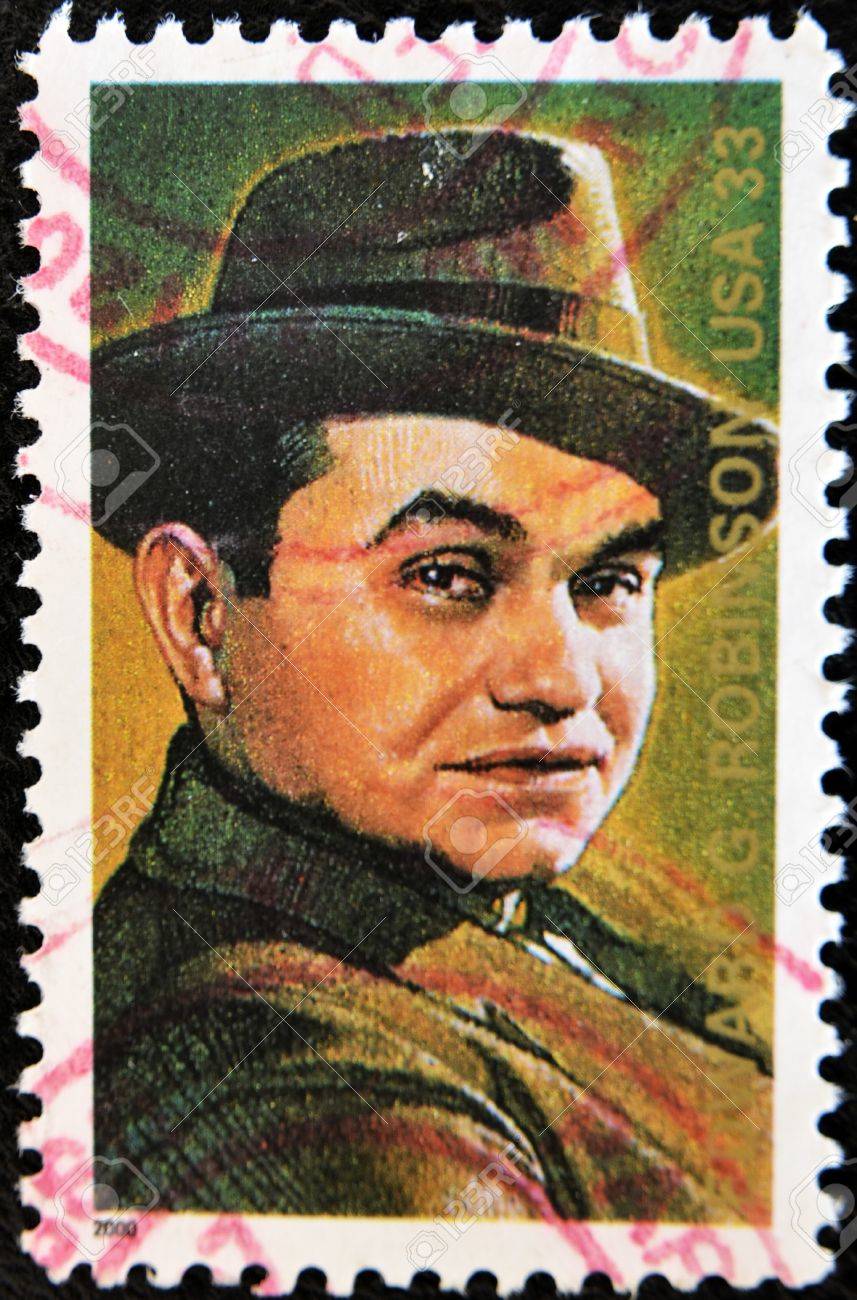
In October 2000, Robinson's image was imprinted on a U.S. postage stamp, the sixth in its Legends of Hollywood series.[11]: 125 [32]
Robinson has been the inspiration for a number of animated television characters, usually caricatures of his most distinctive 'snarling gangster' guise. An early version of the gangster character Rocky, featured in the Bugs Bunny cartoon Racketeer Rabbit, shared his likeness. This version of the character also appears briefly in Justice League, in the episode "Comfort and Joy", as an alien with Robinson's face and non-human body, who hovers past the screen as a background character.
Similar caricatures also appeared in The Coo-Coo Nut Grove, Thugs with Dirty Mugs and Hush My Mouse. Another character based on Robinson's tough-guy image was The Frog (Chauncey "Flat Face" Frog) from the cartoon series Courageous Cat and Minute Mouse. The voice of B.B. Eyes in The Dick Tracy Show was based on Robinson, with Mel Blanc and Jerry Hausner sharing voicing duties. The Wacky Races animated series character 'Clyde' from the Ant Hill Mob was based on Robinson's Little Caesar persona.
Voice actor Hank Azaria has noted that the voice of Simpsons character police chief Clancy Wiggum is an impression of Robinson.[33]
Robinson was portrayed by actor Michael Stuhlbarg in the 2015 biographical drama film Trumbo.[34]
Selected filmography
[edit]Radio appearances
[edit]| Year | Program | Episode/source |
|---|---|---|
| 1940 | Screen Guild Theatre | Blind Alley[37] |
| 1946 | Suspense | The Man Who Wanted to Be Edward G. Robinson aka The Man Who Thought He Was Edward G. Robinson[38][39] |
| 1946 | This Is Hollywood | The Stranger[40] |
| 1950 | Screen Directors Playhouse | The Sea Wolf[40] |
See also
[edit]References
[edit]- ^ "Edward G. Robinson – Broadway Cast & Staff | IBDB". IBDB. Retrieved April 10, 2020.
- ^ a b c d e f g h i "Edward G. Robinson, 79, Dies; His 'Little Caesar' Set a Style; Man of Great Kindness Edward G. Robinson Is Dead at 79 Made Speeches to Friends Appeared in 100 Films". The New York Times. January 27, 1973. Retrieved July 21, 2007.
- ^ "Communist infiltration of Hollywood motion-picture industry : Hearing before the Committee on Un-American activities, House of Representatives, Eighty-second Congress, first session". 1951.
- ^ "Actor Edward G. Robinson Confesses to HUAC — "I Was a Sucker"". Today in Civil Liberties History. March 12, 2016. Retrieved April 30, 2021.
- ^ Obituary Variety, January 31, 1973, p. 71.
- ^ Robey, Tim (February 1, 2016). "20 great actors who've never been nominated for an Oscar". The Daily Telegraph. Archived from the original on January 11, 2022. Retrieved October 17, 2022.
- ^ Singer, Leigh (February 19, 2009). "Oscars: the best actors never to have been nominated". The Guardian. UK. Retrieved September 17, 2022.
- ^ Parish, James Robert; Marill, Alvin (1972). The Cinema of Edward G. Robinson. South Brunswick, New Jersey: A. S. Barnes. p. 16. ISBN 0-498-07875-2.
- ^ "Edward G. Robinson, 79, Dies; His "Little Caesar" Set a Style", New York Times January 27, 1973, by Alden Whitman
- ^ 1904 passenger list for Manole Goldenberg. "Ancestry.com". Ancestry.com.
{{cite web}}: CS1 maint: numeric names: authors list (link) - ^ a b c d e f g h i j k l m n o p q r Ross, Steven (2011). Hollywood Left and Right. How Movie Stars Shaped American Politics. Oxford University Press. p. 125. ISBN 978-0-19-518172-2. Retrieved March 20, 2012.
- ^ Epstein (2007), p. 249
- ^ a b c Pendergast, Tom. Ed. St. James Encyclopedia of Popular Culture, Vol. 4, pp. 229–230
- ^ Beck, Robert (September 2, 2008). Edward G. Robinson Encyclopedia. McFarland. ISBN 9780786438648. Retrieved January 14, 2016.
- ^ "Edward G. Robinson – Broadway Cast & Staff | IBDB".
- ^ a b Wise, James: Stars in Khaki: Movie Actors in the Army and Air Services. Naval Institute Press, 2000. ISBN 1-55750-958-1. p. 228.
- ^ a b Ross, pp. 99–102
- ^ a b Schatz, Thomas. Boom and Bust: American Cinema in the 1940s. University of California Press, November 23, 1999, p. 99.
- ^ Dunning, John (1998). "Big Town". On the Air: The Encyclopedia of Old-Time Radio (Revised ed.). New York, NY: Oxford University Press. pp. 88–89. ISBN 978-0-19-507678-3. Retrieved October 1, 2019.
- ^ a b Dissonant Divas in Chicana Music: The Limits of La Onda Deborah R. Vargas. University of Minnesota Press, Minneapolis, 2012 p. 152-153 ISBN 978-0-8166-7316-2 Edward G. Robbinson, OCIAA, CBS radio, Pan-americanism and Cadena de las Americas on google.books.com
- ^ [1] video of Robinson with the troops in France, timestamp 25:50
- ^ Lotchin, Roger W. (2000). The Way We Really Were: The Golden State in the Second Great War. University of Illinois Press. ISBN 9780252068195.
- ^ Miller, Frank. Leading Men, Chronicle Books and TCM (2006) p. 185
- ^ a b Sabin, Arthur J. In Calmer Times: The Supreme Court and Red Monday, p. 35. Philadelphia: University of Pennsylvania Press, 1999
- ^ Bud and Ruth Schultz, It Did Happen Here: Recollections of Political Repression in America, p. 113. Berkeley: University of California Press, 1989.
- ^ https://archive.org/stream/communistinfiltr07unit/communistinfiltr07unit_djvu.txt House Un-American Activities Committee transcript
- ^ Ross, Stephen J. "Little Caesar and the McCarthyist Mob", USC Trojan Magazine. Los Angeles: University of Southern California, August 2011 issue. Accessed on January 10, 2013. "Little Caesar and the McCarthyist Mob | Autumn 2011 | Trojan Family Magazine | USC". Archived from the original on May 27, 2013. Retrieved January 10, 2013.
- ^ "Edward G. Robinson, Jr. Is Dead; Late Screen Star's Son Was 40". The New York Times. February 27, 1974. Retrieved July 21, 2007.
- ^ Meeks, Eric G. (2012). The Best Guide Ever to Palm Springs Celebrity Homes. Horatio Limburger Oglethorpe. p. 91. ISBN 978-1479328598.
- ^ Gansberg, p. 246, 252–253.
- ^ Beck, Robert (2002). The Edward G. Robinson Encyclopedia. McFarland. p. 131.
- ^ Edward G. Robinson stamp, 2000
- ^ Joe Rhodes (October 21, 2000). "Flash! 24 Simpsons Stars Reveal Themselves". TV Guide.
- ^ Vancheri, Barbara (November 25, 2015). "Michael Stuhlbarg plays Edward G. Robinson in 'Trumbo'". Pittsburgh Post-Gazette. Retrieved September 16, 2023.
- ^ Arms and the Woman at the AFI Catalog of Feature Films
- ^ Die Sehnsucht Jeder Frau at the AFI Catalog of Feature Films
- ^ "Sunday Caller". Harrisburg Telegraph. February 24, 1940. p. 17. Retrieved July 20, 2015 – via Newspapers.com.

- ^ "The Man Who Wanted to Be Edward G. Robinson". Harrisburg Telegraph. October 12, 1946. p. 17. Retrieved October 1, 2015 – via Newspapers.com.
- ^ "Suspense .. Episodic log".
- ^ a b "Those Were the Days". Nostalgia Digest. Vol. 42, no. 3. Summer 2016. p. 39.

Further reading
[edit]- Gansberg, Alan L. (2004). Little Caesar: A Biography of Edward G. Robinson. Scarecrow Press. ISBN 978-0-8108-4950-1.
- Epstein, Lawrence Jeffrey (2007). Edge of a Dream: The Story of Jewish Immigrants on New York's Lower East Side, 1880–1920. John Wiley & Sons. ISBN 978-0-7879-8622-3.
- Robinson, Edward G.; Spigelgass, Leonard (1973). All My Yesterdays; an Autobiography. Hawthorn Books. LCCN 73005443.
External links
[edit]


- 1893 births
- 1973 deaths
- 20th-century American Jews
- 20th-century American male actors
- Academy Honorary Award recipients
- Activists for African-American civil rights
- American Academy of Dramatic Arts alumni
- American anti-fascists
- American Ashkenazi Jews
- Jewish American anti-racism activists
- American anti-racism activists
- American male film actors
- American male silent film actors
- American male stage actors
- American people of Romanian-Jewish descent
- Burials in New York (state)
- California Democrats
- Cannes Film Festival Award for Best Actor winners
- City College of New York alumni
- Deaths from bladder cancer in California
- Hollywood blacklist
- Jewish American activists
- American art collectors
- Jewish art collectors
- Jewish American male actors
- Jewish American military personnel
- Jewish anti-fascists
- Male actors from Bucharest
- Male actors from Manhattan
- Male actors from Palm Springs, California
- Members of The Lambs Club
- Military personnel from New York City
- Military personnel from New York (state)
- New York (state) Democrats
- People from the Lower East Side
- People of the United States Office of War Information
- Romanian Ashkenazi Jews
- Romanian emigrants to the United States
- Screen Actors Guild Life Achievement Award
- Townsend Harris High School alumni
- United States Navy personnel of World War I
- Warner Bros. contract players
- Yiddish-speaking people
- Yiddish theatre performers