


Portal:Literature

Introduction
Literature is any collection of written work, but it is also used more narrowly for writings specifically considered to be an art form, especially prose, fiction, drama, poetry, and including both print and digital writing. In recent centuries, the definition has expanded to include oral literature, also known as orature much of which has been transcribed. Literature is a method of recording, preserving, and transmitting knowledge and entertainment, and can also have a social, psychological, spiritual, or political role.
Literature, as an art form, can also include works in various non-fiction genres, such as biography, diaries, memoir, letters, and essays. Within its broad definition, literature includes non-fictional books, articles or other written information on a particular subject. (Full article...)
General images -
-
 The Violet Fairy Book (1906)
 -
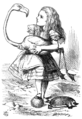 Illustration from Alice's Adventures in Wonderland, 1865 (from Children's literature)
 -
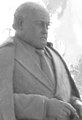 Sculpture of Alfonso Reyes writer of influential pieces of Mexican surrealism. (from Latin American literature)
 -
 Folio from the Shah Jahan Album, c. 1620, depicting the Mughal Emperor Shah Jahan (from History of books)
 -
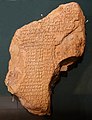 A Sumerian clay tablet, currently housed in the Oriental Institute at the University of Chicago, inscribed with the text of the poem Inanna and Ebih by the priestess Enheduanna, the first author whose name is known
 -
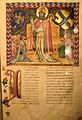 Statuta Mutine Reformata, 1420–1485; parchment codex bound in wood and leather with brass plaques worked the corners and in the center, with clasps. (from Medieval literature)
 -
 Newbery's A Little Pretty Pocket-Book, originally published in 1744 (from Children's literature)
 -
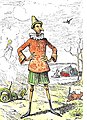 The Adventures of Pinocchio (1883) is a canonical piece of children's literature and one of the best-selling books ever published. (from Children's literature)
 -
 The first page of Beowulf (from Medieval literature)
 -
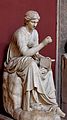
-
 Gabriel García Márquez, one of the most renowned Latin American writers (from Latin American literature)
 -
 A mother reads to her children, depicted by Jessie Willcox Smith in a cover illustration of a volume of fairy tales written in the mid to late 19th century. (from Children's literature)
 -
 Number of children's books titles published by the trade sector in 2020 (from Children's literature)
 -
 An early Mexican hornbook pictured in Tuer's History of the Horn-Book, 1896. (from Children's literature)
 -
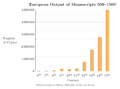 Estimated medieval output of manuscripts in terms of copies (from Medieval literature)
 -
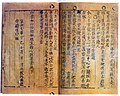 Jikji, Selected Teachings of Buddhist Sages and Seon Masters, the earliest known book printed with movable metal type, 1377. Bibliothèque Nationale de France, Paris. (from History of books)
 -
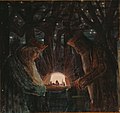 Kings' Fairy Tale, 1909, by Mikalojus Konstantinas Čiurlionis (from Fairy tale)
 -
 12-metre-high (40 ft) stack of books sculpture at the Berlin Walk of Ideas, commemorating the invention of modern book printing (from History of books)
 -
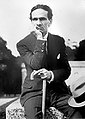 Peruvian poet César Vallejo, considered by Thomas Merton "the greatest universal poet since Dante" (from Latin American literature)
 -
 The scene in Botticelli's Madonna of the Book (1480) reflects the presence of books in the houses of richer people in his time. (from History of books)
 -
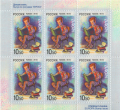 Postal stamp of Russia celebrating children's books. (from Children's literature)
 -
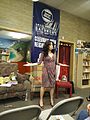 H. O. Tanager performs at a bookstore in Boise, Idaho. (from Performance poetry)
 -
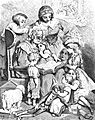
-
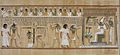 The Book of the Dead of Hunefer, c. 1275 BCE, ink and pigments on papyrus, in the British Museum (London) (from History of books)
 -
 Walter Crane's chromolithograph illustration for The Frog Prince, 1874. (from Children's literature)
 -
 The New England Primer (from Children's literature)
 -
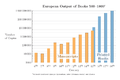 European output of books 500–1800 (from History of books)
 -
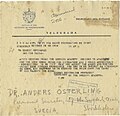 Hemingway's telegram in 1954 (the academy has alternately used for Literature and in Literature over the years, the latter becoming the norm today) (from Nobel Prize in Literature)
 -
 1900 edition of the controversial The Story of Little Black Sambo (from Children's literature)
 -
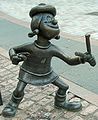 Statue of Minnie the Minx, a character from The Beano. Launched in 1938, the comic is known for its anarchic humour, with Dennis the Menace appearing on the cover. (from Children's literature)
 -
 The former Canadian Parliamentary Poet Laureate George Elliott Clarke (2015) (from Canadian literature)
 -
 A poet with a few enraptured fans (from Performance poetry)
 -
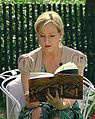 J. K. Rowling reads from her novel Harry Potter and the Philosopher's Stone (from Children's literature)
 -
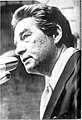 Octavio Paz helped to define modern poetry and the Mexican personality. (from Latin American literature)
 -
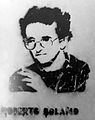 Roberto Bolaño is considered to have had the greatest United States impact of any post-Boom author (from Latin American literature)
 -
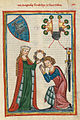 The Codex Manesse, a German book from the Middle Ages (from History of books)
 -
 Page from a Jain manuscript depicting the birth of Mahavira, c. 1400 (from History of books)
 -
 Cutlery for children. Detail showing fairy-tale scenes: Snow White, Little Red Riding Hood, Hansel and Gretel. (from Fairy tale)
 -
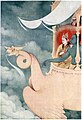 A Tagore illustration of a Hindu myth (from Children's literature)
 -
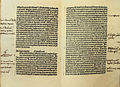 Handwritten notes by Christopher Columbus on a Latin edition of The Travels of Marco Polo (from Travel literature)
 -
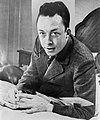 French author Albert Camus was the first African-born writer to receive the award. (from Nobel Prize in Literature)
 -
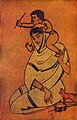 The Crescent Moon by Rabindranath Tagore illus. by Nandalal Bose, Macmillan 1913 (from Children's literature)
 -
 Folio from a manuscript of the Shanamah (Book of Kings) (from History of books)
 -
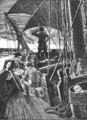 Illustration from Robert Louis Stevenson's 1883 pirate adventure Treasure Island (from Children's literature)
 -
 Hugo Ball performing at the Cabaret Voltaire (from Performance poetry)
 -
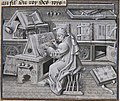 An author portrait of Jean Miélot writing his compilation of the Miracles of Our Lady, one of his many popular works. (from History of books)
 -
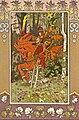 Ivan Bilibin (1876-1942)'s illustration of the Russian fairy tale about Vasilisa the Beautiful (from Fairy tale)
 -
 Natias Neutert performing Diogenes Synopsis as at Künstlerhaus Bethanien Berlin, 1986 (from Performance poetry)
 -
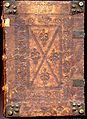 A 15th-century Incunable. Notice the blind-tooled cover, corner bosses, and clasps. (from History of books)
 -
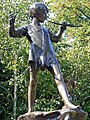
-
 Dresden Codex (page 49) (from History of books)
 -
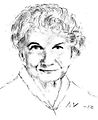 Short story writer Alice Munro won the Nobel Prize in Literature in 2013. (from Canadian literature)
 -
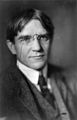 Charles G. D. Roberts was a poet that belonged to an informal group known as the Confederation Poets. (from Canadian literature)
 -
 Woman holding wax tablets in the form of the codex. Wall painting from Pompeii, before 79 CE. (from History of books)
 -
 Father Frost acts as a donor in the Russian fairy tale Father Frost, testing the heroine before bestowing riches upon her (from Fairy tale)
 -
 Pages from the 1819 edition of Kinder- und Haus-Märchen by the Brothers Grimm (from Children's literature)
 -
 The character which means "poetry", in the ancient Chinese Great Seal script style. The modern character is 詩/诗 (shī). (from History of poetry)
 -
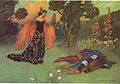
-
 Goethe's Italian Journey between September 1786 and May 1788 (from Travel literature)
 -
 The European fairy tale Little Red Riding Hood and the Wolf in a painting by Carl Larsson in 1881. (from Fairy tale)
 -
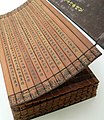 A Chinese bamboo book (from History of books)
 -
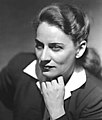 Gabrielle Roy was a notable French Canadian author. (from Canadian literature)
 -
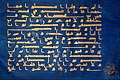 Page from the Blue Quran manuscript, ca. 9th or 10th century CE (from History of books)
 -
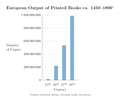 European output of printed books c. 1450–1800 (from History of books)
 -
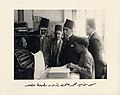 Photograph of a printing press in Egypt, c. 1922 (from History of books)
 -
 In 1901, French poet and essayist Sully Prudhomme (1839–1907) was the first person to be awarded the Nobel Prize in Literature, "in special recognition of his poetic composition, which gives evidence of lofty idealism, artistic perfection, and a rare combination of the qualities of both heart and intellect." (from Nobel Prize in Literature)
 -
-
European output of manuscripts 500–1500 (from History of books)
-
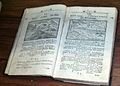 A late 18th-century reprint of Orbis Pictus by Comenius, the first children's picture book. (from Children's literature)
 -
 The Story of Mankind (1921) by Hendrik van Loon, 1st Newbery Award winner (from Children's literature)
 -
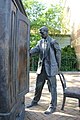 Statue of C. S. Lewis in front of the wardrobe from his Narnia book The Lion, the Witch and the Wardrobe (from Children's literature)
 -
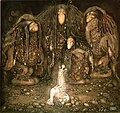 John Bauer's illustration of trolls and a princess from a collection of Swedish fairy tales (from Fairy tale)
 -
 Willy Wonka (from Roald Dahl's Charlie and the Chocolate Factory), and the Mad Hatter (from Lewis Carroll's Alice's Adventures in Wonderland) in London (from Children's literature)
 -

_(14751020284).jpg)


.jpg)


_-_1909.jpg)


_-_Google_Art_Project.jpg)


.jpg)


.jpg)

 Selected work

.jpg)
Through the stories of Lad's adventures, Terhune expresses his views on parenting, obtaining perfect obedience without force, and the nature and rights of the "well-bred". Terhune began writing the stories in 1915 at the suggestion of his Red Book Magazine editor. They gained in popularity and, as Terhune was under contractual obligation to submit something to Doubleday-Page, he collected them into novel form. After Doubleday rejected the novel, he solicited other publishers until it was picked up by Dutton. After a slow start, the novel became a best seller in the adult fiction and children's fiction markets, having been repositioned as a young adult novel by Grosset and Dunlap in the 1960s and 1970s. Selling over one million copies, it is Terhune's best-selling work and the one that propelled him to fame.
Selected biographies -
-

Du Fu (Chinese: 杜甫; Wade–Giles: Tu Fu; 712–770) was a Chinese poet and politician during the Tang dynasty. Together with his elder contemporary and friend Li Bai, Du is often considered one of the greatest Chinese poets. His greatest ambition was to serve his country as a successful civil servant, but Du proved unable to make the necessary accommodations. His life, like all of China, was devastated by the An Lushan Rebellion of 755, and his last 15 years were a time of almost constant unrest.
Although initially he was little-known to other writers, his works came to be hugely influential in both Chinese and Japanese literary culture. Of his poetic writing, nearly fifteen hundred poems have been preserved over the ages. He has been called the "Poet-Historian" and the "Poet-Sage" by Chinese critics, while the range of his work has allowed him to be introduced to Western readers as "the Chinese Virgil, Horace, Ovid, Shakespeare, Milton, Burns, Wordsworth, Béranger, Hugo or Baudelaire". (Full article...) -
Edward Wright (baptised 8 October 1561; died November 1615) was an English mathematician and cartographer noted for his book Certaine Errors in Navigation (1599; 2nd ed., 1610), which for the first time explained the mathematical basis of the Mercator projection by building on the works of Pedro Nunes, and set out a reference table giving the linear scale multiplication factor as a function of latitude, calculated for each minute of arc up to a latitude of 75°. This was in fact a table of values of the integral of the secant function, and was the essential step needed to make practical both the making and the navigational use of Mercator charts.
Wright was born at Garveston in Norfolk and educated at Gonville and Caius College, Cambridge, where he became a fellow from 1587 to 1596. In 1589 the college granted him leave after Elizabeth I requested that he carry out navigational studies with a raiding expedition organised by the Earl of Cumberland to the Azores to capture Spanish galleons. The expedition's route was the subject of the first map to be prepared according to Wright's projection, which was published in Certaine Errors in 1599. The same year, Wright created and published the first world map produced in England and the first to use the Mercator projection since Gerardus Mercator's original 1569 map. (Full article...) -
Jorge Mario Pedro Vargas Llosa, 1st Marquess of Vargas Llosa (born 28 March 1936), more commonly known as Mario Vargas Llosa (/ˌvɑːrɡəs ˈjoʊsə/, Spanish: [ˈmaɾjo ˈβaɾɣas ˈʎosa]), is a Peruvian novelist, journalist, essayist and former politician. Vargas Llosa is one of Latin America's most significant novelists and essayists and one of the leading writers of his generation. Some critics consider him to have had a larger international impact and worldwide audience than any other writer of the Latin American Boom. In 2010, he won the Nobel Prize in Literature, "for his cartography of structures of power and his trenchant images of the individual's resistance, revolt, and defeat." He also won the 1967 Rómulo Gallegos Prize, the 1986 Prince of Asturias Award, the 1994 Miguel de Cervantes Prize, the 1995 Jerusalem Prize, the 2012 Carlos Fuentes International Prize, and the 2018 Pablo Neruda Order of Artistic and Cultural Merit. In 2021, he was elected to the Académie française.
Vargas Llosa rose to international fame in the 1960s with novels such as The Time of the Hero (La ciudad y los perros, literally The City and the Dogs, 1963/1966), The Green House (La casa verde, 1965/1968), and the monumental Conversation in the Cathedral (Conversación en la catedral, 1969/1975). He writes, prolifically, across an array of literary genres, including literary criticism and journalism. His novels include comedies, murder mysteries, historical novels, and political thrillers. Several, such as Captain Pantoja and the Special Service (1973/1978) and Aunt Julia and the Scriptwriter (1977/1982), have been adapted as feature films. (Full article...) -
Joanne Rowling CH OBE FRSL (/ˈroʊlɪŋ/ ROH-ling); born 31 July 1965), better known by her pen name J. K. Rowling, is a British author and philanthropist. She wrote Harry Potter, a seven-volume fantasy series published from 1997 to 2007. The series has sold over 600 million copies, been translated into 84 languages, and spawned a global media franchise including films and video games. The Casual Vacancy (2012) was her first novel for adults. She writes Cormoran Strike, an ongoing crime fiction series, under the alias Robert Galbraith.
Born in Yate, Gloucestershire, Rowling was working as a researcher and bilingual secretary for Amnesty International in 1990 when she conceived the idea for the Harry Potter series. The seven-year period that followed saw the death of her mother, the birth of her first child, divorce from her first husband, and relative poverty until the first novel in the series, Harry Potter and the Philosopher's Stone, was published in 1997. Six sequels followed, concluding with Harry Potter and the Deathly Hallows (2007). By 2008, Forbes had named her the world's highest-paid author. (Full article...) -

Pound photographed in 1913 by Alvin Langdon Coburn
Ezra Weston Loomis Pound (30 October 1885 – 1 November 1972) was an expatriate American poet and critic, a major figure in the early modernist poetry movement, and a collaborator in Fascist Italy and the Salò Republic during World War II. His works include Ripostes (1912), Hugh Selwyn Mauberley (1920), and his 800-page epic poem, The Cantos (c. 1917–1962).
Pound's contribution to poetry began in the early 20th century with his role in developing Imagism, a movement stressing precision and economy of language. Working in London as foreign editor of several American literary magazines, he helped discover and shape the work of contemporaries such as Robert Frost, T. S. Eliot, Ernest Hemingway, and James Joyce. He was responsible for the 1914 serialization of Joyce's A Portrait of the Artist as a Young Man, the 1915 publication of Eliot's "The Love Song of J. Alfred Prufrock", and the serialization from 1918 of Joyce's Ulysses. Hemingway wrote in 1932 that, for poets born in the late 19th or early 20th century, not to be influenced by Pound would be "like passing through a great blizzard and not feeling its cold." (Full article...) -

Robert Marshall (January 2, 1901 – November 11, 1939) was an American forester, writer and wilderness activist who is best remembered as the person who spearheaded the 1935 founding of the Wilderness Society in the United States. Marshall developed a love for the outdoors as a young child. He was an avid hiker and climber who visited the Adirondack Mountains frequently during his youth, ultimately becoming one of the first Adirondack Forty-Sixers. He also traveled to the Brooks Range of the far northern Alaskan wilderness. He wrote numerous articles and books about his travels, including the bestselling 1933 book Arctic Village.
A scientist with a PhD in plant physiology, Marshall became independently wealthy after the death of his father in 1929. He had started his outdoor career in 1925 as forester with the U.S. Forest Service. He used his financial independence for expeditions to Alaska and other wilderness areas. Later he held two significant public appointed posts: chief of forestry in the Bureau of Indian Affairs, from 1933 to 1937, and head of recreation management in the Forest Service, from 1937 to 1939, both during the administration of President Franklin D. Roosevelt. During this period, he directed the promulgation of regulations to preserve large areas of roadless land that were under federal management. Many years after his death, some of those areas were permanently protected from development, exploitation, and mechanization with the passage of the Wilderness Act of 1964. (Full article...) -
Maya Angelou (/ˈændʒəloʊ/ ⓘ AN-jə-loh; born Marguerite Annie Johnson; April 4, 1928 – May 28, 2014) was an American memoirist, poet, and civil rights activist. She published seven autobiographies, three books of essays, several books of poetry, and is credited with a list of plays, movies, and television shows spanning over 50 years. She received dozens of awards and more than 50 honorary degrees. Angelou's series of seven autobiographies focus on her childhood and early adult experiences. The first, I Know Why the Caged Bird Sings (1969), tells of her life up to the age of 17 and brought her international recognition and acclaim.
She became a poet and writer after a string of odd jobs during her young adulthood. These included fry cook, sex worker, nightclub performer, Porgy and Bess cast member, Southern Christian Leadership Conference coordinator, and correspondent in Egypt and Ghana during the decolonization of Africa. Angelou was also an actress, writer, director, and producer of plays, movies, and public television programs. In 1982, she was named the first Reynolds Professor of American Studies at Wake Forest University in Winston-Salem, North Carolina. Angelou was active in the Civil Rights Movement and worked with Martin Luther King Jr. and Malcolm X. Beginning in the 1990s, she made approximately 80 appearances a year on the lecture circuit, something she continued into her eighties. In 1993, Angelou recited her poem "On the Pulse of Morning" (1993) at the first inauguration of Bill Clinton, making her the first poet to make an inaugural recitation since Robert Frost at the inauguration of John F. Kennedy in 1961. (Full article...) -
Emily Elizabeth Dickinson (December 10, 1830 – May 15, 1886) was an American poet. Little-known during her life, she has since been regarded as one of the most important figures in American poetry. Dickinson was born in Amherst, Massachusetts, into a prominent family with strong ties to its community. After studying at the Amherst Academy for seven years in her youth, she briefly attended the Mount Holyoke Female Seminary before returning to her family's home in Amherst. Evidence suggests that Dickinson lived much of her life in isolation. Considered an eccentric by locals, she developed a penchant for white clothing and was known for her reluctance to greet guests or, later in life, even to leave her bedroom. Dickinson never married, and most of her friendships were based entirely upon correspondence.
Although Dickinson was a prolific writer, her only publications during her lifetime were 10 of her nearly 1,800 poems and one letter. The poems published then were usually edited significantly to fit conventional poetic rules. Her poems were unique for her era; they contain short lines, typically lack titles, and often use slant rhyme as well as unconventional capitalization and punctuation. Many of her poems deal with themes of death and immortality (two recurring topics in letters to her friends), aesthetics, society, nature, and spirituality. (Full article...) -
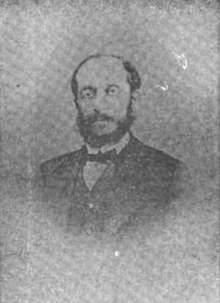
Francis bin Fathallah bin Nasrallah Marrash (Arabic: فرنسيس بن فتح الله بن نصر الله مرّاش, ALA-LC: Fransīs bin Fatḥ Allāh bin Naṣr Allāh Marrāsh; 1835, 1836, or 1837 – 1873 or 1874), also known as Francis al-Marrash or Francis Marrash al-Halabi, was a Syrian scholar, publicist, writer and poet of the Nahda or the Arab Renaissance, and a physician. Most of his works revolve around science, history and religion, analysed under an epistemological light. He traveled throughout West Asia and France in his youth, and after some medical training and a year of practice in his native Aleppo, during which he wrote several works, he enrolled in a medical school in Paris; yet, declining health and growing blindness forced him to return to Aleppo, where he produced more literary works until his early death.
Historian Matti Moosa considered Marrash to be the first truly cosmopolitan Arab intellectual and writer of modern times. Marrash adhered to the principles of the French Revolution and defended them in his own works, implicitly criticizing Ottoman rule in West Asia and North Africa. He was also influential in introducing French romanticism in the Arab world, especially through his use of poetic prose and prose poetry, of which his writings were the first examples in modern Arabic literature, according to Salma Khadra Jayyusi and Shmuel Moreh. His modes of thinking and feeling, and ways of expressing them, have had a lasting influence on contemporary Arab thought and on the Mahjari poets. (Full article...) -

Walpole c. 1920–1925
Sir Hugh Seymour Walpole, CBE (13 March 1884 – 1 June 1941) was an English novelist. He was the son of an Anglican clergyman, intended for a career in the church but drawn instead to writing. Among those who encouraged him were the authors Henry James and Arnold Bennett. His skill at scene-setting and vivid plots, as well as his high profile as a lecturer, brought him a large readership in the United Kingdom and North America. He was a best-selling author in the 1920s and 1930s but has been largely neglected since his death.
After his first novel, The Wooden Horse, in 1909, Walpole wrote prolifically, producing at least one book every year. He was a spontaneous story-teller, writing quickly to get all his ideas on paper, seldom revising. His first novel to achieve major success was his third, Mr Perrin and Mr Traill, a tragicomic story of a fatal clash between two schoolmasters. During the First World War he served in the Red Cross on the Russian-Austrian front, and worked in British propaganda in Petrograd and London. In the 1920s and 1930s Walpole was much in demand not only as a novelist but also as a lecturer on literature, making four exceptionally well-paid tours of North America. (Full article...)


.jpg)


.jpg)


Selected excerpt
| “ | All these, however, were mere terrors of the night, phantoms of the mind that walk in darkness; and though he had seen many spectres in his time, and been more than once beset by Satan in divers shapes, in his lonely perambulations, yet daylight put an end to all these evils; and he would have passed a pleasant life of it, in despite of the devil and all his works, if his path had not been crossed by a being that causes more perplexity to mortal man than ghosts, goblins, and the whole race of witches put together, and that was—a woman. | ” |
| — Washington Irving, "The Legend of Sleepy Hollow" | ||
More Did you know
- ... that Samuel Minturn Peck was the first Poet Laureate of Alabama, a title created for him, from 1930 until his death in 1938?
- ... that James McBride was described as "clearly stunned" when his novel The Good Lord Bird won the National Book Award for Fiction?
- ... that Arishima Ikuma, Japanese novelist, published his new-style poems and short stories as a vehicle to introduce the works of the French impressionist painter Paul Cézanne to the Japanese public?
- ... that German-born Jewish Egyptologist Käte Bosse-Griffiths published a novel in the Welsh language?
- ... that John Fowles' postmodern novel The French Lieutenant's Woman both emulated and parodied popular Victorian novels, like those of Charles Dickens and Thomas Hardy?
Selected illustration
-
 Artist: Unknown; Restoration: Adam CuerdenA scene from Oscar Wilde's 1895 play An Ideal Husband, originally published in a 1901 collected edition of Wilde's works. The comedy, which opened January 3, 1896, at the Haymarket Theatre in London, revolves around blackmail and political corruption, and touches on the themes of public and private honour. It has been adapted into television, radio/audio, and three films. The published version differs slightly from the performed play, for Wilde added many passages and cut others. Prominent additions included written stage directions and character descriptions. Wilde was a leader in the effort to make plays accessible to the reading public.
 -
 Painting: John BauerA watercolor illustration by John Bauer (1882–1918) titled "Still, Tuvstarr sits and gazes down into the water", which accompanied Helge Kjellin's fairy tale "The Tale of the Moose Hop and the Little Princess Cotton Grass" in the 1913 edition of Among Gnomes and Trolls. In this scene, Tuvstarr looks for her lost heart in a tarn, symbolizing innocence lost.
Born and raised in Jönköping, Sweden, Bauer moved to Stockholm at age 16 to study at the Royal Swedish Academy of Fine Arts. He painted and illustrated in a romantic nationalistic style, in part influenced by the Italian Renaissance and Sami cultures. Most of his works are watercolors or prints in monochrome or muted colours; he also produced oil paintings and frescos. -
 Artist: Unknown; Restoration: Lise BroerA scene from a late-16th century publication of Nezami Ganjavi's adaptation of the classical Persian story Layla and Majnun, which is based on the real story of Qays ibn al-Mulawwah, a young man from the northern Arabian Peninsula and his love Layla. There are two versions of the story, but in both, Majnun goes mad when her father prevents him from marrying her. In the depicted scene, the eponymous star-crossed lovers meet for the last time before their deaths. Both have fainted and Majnun's elderly messenger attempts to revive Layla while wild animals protect the pair from unwelcome intruders.
 -
 Artist: Jessie Willcox Smith; Restoration: ErikTheBikeManMrs. Bedonebyasyoudid, a character named after the Golden Rule, from The Water-Babies, A Fairy Tale for a Land Baby, a children's novel by Charles Kingsley. Published in 1863, the book was extremely popular in England, and was a mainstay of British children's literature for many decades. The book had been intended in part as a satire, a tract against child labour, as well as a serious critique of the closed-minded approaches of many scientists of the day in their response to Charles Darwin's ideas on evolution.
 -
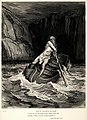 Restoration: Adam CuerdenAn engraving of Charon, in Greek mythology the ferryman of Hades who carried souls of the newly deceased across the River Styx that divided the world of the living from the world of the dead. This illustration is from French engraver Gustave Doré's 1857 set of illustrations for Dante Alighieri's Divine Comedy, an Italian epic poem depicting an allegorical vision of the Christian afterlife. Here, Charon is shown coming to ferry souls across the river Acheron to Hell. The caption is from Henry Francis Cary's translation, from which this particular copy is taken:
And, lo! toward us in a bark
Comes on an old man, hoary white with eld,
Crying "Woe to you, wicked spirits!" -
 Painting: John QuidorThe Headless Horseman is a mythical figure who has appeared in folklore around the world since at least the Middle Ages. Depending on the legend, the Horseman is either carrying his head, or missing it altogether, and is searching for it. Examples include the dullahan from Ireland, who is a demonic fairy usually depicted riding a horse and carrying his head under his arm; the titular knight from the English tale Gawain and the Green Knight; and "The Legend of Sleepy Hollow," a short story written in 1820 by American Washington Irving which has been adapted into several other works of literature and film including the 1999 Tim Burton movie Sleepy Hollow.
This picture, titled The Headless Horseman Pursuing Ichabod Crane, is an 1858 painting by American artist John Quidor, depicting a scene from "The Legend of Sleepy Hollow". It is in the collection of the Smithsonian American Art Museum in Washington, D.C. -
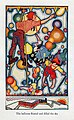 Illustration: Maud and Miska Petersham; restoration: Adam CuerdenRootabaga Stories is a children's book of interrelated short stories by Carl Sandburg, written in 1922. The stories are whimsical and sometimes melancholy, making use of nonsense language. Rootabaga Stories was originally created for Sandburg's own daughters, Margaret, Janet and Helga—whom he nicknamed "Spink", "Skabootch", and "Swipes"—and those nicknames occur in some of the Rootabaga stories. The book was born of Sandburg's desire for fairy tales to which American children could relate, rather than the traditional European stories involving royalty and knights. He therefore set the book in a fictionalized American Midwest called the "Rootabaga country", in which fairy-tale concepts were mixed with trains, sidewalks, and skyscrapers.
This picture shows the frontispiece of the 1922 edition of the book. -
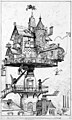 Artist: Albert RobidaA typical 20th-century aerial rotating house, as drawn by Albert Robida. The drawing shows a dwelling structure in the scientific romance style elevated above rooftops and designed to revolve and adjust in various directions. An occupant in the lower right points to an airship with a fish-shaped balloon in the sky, while a woman rides a bucket elevator on the left. Meanwhile, children fly a kite from the balcony as a dog watches from its rooftop doghouse.
 -
 Illustration: Jessie Willcox Smith; Restoration: ErikTheBikeManAn illustration from a ca. 1916 edition of The Water-Babies, A Fairy Tale for a Land Baby, a children's novel written by Charles Kingsley and originally serialised in 1862–63. The book, a didactic moral fable, tells the story of Tom (lower left), a young boy who drowns and is reincarnated as a "water-baby". He undergoes a series of adventures and eventually regains his human form. It was extremely popular during its day and through the 1920s, but has since fallen out of favour, perhaps due to Kingsley's expression of many of the common prejudices of that time period, such as against Americans, Jews, blacks, and Catholics, particularly the Irish.
 -
 Engraving: I. H. Jones; Restoration: Adam CuerdenThe frontispiece to a c. 1825 edition of Childe Harold's Pilgrimage, a lengthy narrative poem by Lord Byron. The poem describes the travels and reflections of a world-weary young man who, disillusioned with a life of pleasure and revelry, looks for distraction in foreign lands. In a wider sense, it is an expression of the melancholy and disillusionment felt by a generation weary of the wars of the post-Revolutionary and Napoleonic eras. This poem proved to be quite popular upon its publication in 1812. Byron himself said of this, "I awoke one morning and found myself famous."
 -
 Artist: Francis S. Walker; Engraving: Brothers Dalziel
Restoration: Adam CuerdenHermann Vezin in the title role of Dan'l Druce, Blacksmith, an 1876 play by W. S. Gilbert. In the story, Druce begins as a miser and drunkard whose wife has left him. Two army deserters find shelter at his house, but they rob him and abandon a baby girl there. Many years later, Druce has become a blacksmith, and the two men return to try to claim the girl. The play was a success, running for about 100 performances and enjoying tours and several revivals. -
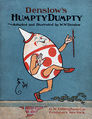 Restoration: JujutacularAn illustration of Humpty Dumpty by American artist William Wallace Denslow, depicting the title character from the nursery rhyme of the same name. He is typically portrayed as an egg, although the rhyme never explicitly states that he is, possibly because it may have been originally posed as a riddle. The earliest known version is in a manuscript addition to a copy of Mother Goose's Melody published in 1803.
 -
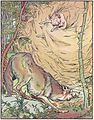 Artist: Leonard Leslie Brooke; Restoration: JujutacularThe wolf blows down the straw house in a 1904 adaptation of Three Little Pigs, a fairy tale featuring anthropomorphic animals. Printed versions date back to the 1840s, but the story itself is thought to be much older. The story in its arguably best-known form appeared in English Fairy Tales by Joseph Jacobs, first published in 1890. The phrases used in the story, and the various morals which can be drawn from it, have become embedded in western culture. The story uses the literary rule of three, expressed in this case as a "contrasting three", as the third pig's brick house turns out to be the only one which is adequate to withstand the wolf.
 -
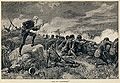 Restoration: Adam CuerdenH. Rider Haggard's iconic character Allan Quatermain, from Thure de Thulstrup's illustrations to the 1888 novel Maiwa's Revenge, a prequel to Haggard's most famous work, King Solomon's Mines. In this scene, Quatermain orders his troops to discharge their rifles, yelling, "Fire, you scoundrels!" The character served as the basis for the modern Indiana Jones.
 -
 Illustration: W. E. F. Britten; restoration: Adam Cuerden"The Sleeping Beauty" is a poem written by Alfred, Lord Tennyson, and published in 1830; it was later expanded and published in 1842 as "The Day-Dream". Based on the fairy tale Sleeping Beauty, the poem (as with many of Tennyson's adaptations of existing literary works) focuses on a single aspect of the story, the appearance of the eponymous character as she sleeps.
This illustration by W. E. F. Britten was published in 1901 to accompany a reprinting of "The Sleeping Beauty". It accompanies the poem's final lines: "She sleeps, nor dreams, but ever dwells / A perfect form in perfect rest."


.jpg)
.jpg)

,_Frontispiece.jpg)

.jpg)


Did you know (auto-generated) -

- ... that literary agent Jacques Chambrun sold unauthorized, scandalous excerpts of a Marilyn Monroe memoir to a British tabloid?
- ... that medieval literature scholar Theodore Silverstein's unit in World War II took over the Eiffel Tower to intercept communications of German aircraft?
- ... that Super Mario 64 has been the subject of medical literature showing a correlation between habitual playing of 3D platformers and increased grey matter in the brain?
- ... that May 4 is celebrated both as Literary Day and as Youth Day in honor of the May Fourth Movement?
- ... that The Inland Whale, by Theodora Kroeber, sought to demonstrate the literary merit of Indigenous American oral traditions?
- ... that Alexandre Dumas's travel book Le Corricolo, published in 1843, contains one of the earliest literary accounts of Neapolitan pizza?
Today in literature
- 1530 - Jacopo Sannazaro, Italian poet died
- 1667 - The blind, impoverished John Milton sells the copyright of Paradise Lost for £10.
- 1759 - Mary Wollstonecraft, English author born
- 1904 - Cecil Day-Lewis, Irish poet and writer born
- 1906 - Yórgos Theotokás, Greek novelist born
- 1920 - Edwin Morgan, Scottish poet born
- 1941 - Penelope Delta, Greek author died
- 1995 - Willem Frederik Hermans, Dutch writer died
Topics
| Literature: | History of literature · History of the book · Literary criticism · Literary theory · Publishing |
| By genre: | Biography · Comedy · Drama · Epic · Erotic · Fable · Fantasy · Historical fiction · Horror · Mystery · Narrative nonfiction · Nonsense · Lyric · Mythopoeia · Poetry · Romance · Satire · Science fiction · Tragedy · Tragicomedy · more... |
| By region: | African literature · Asian · European · Latin American · North American · Oceanic |
| By era: | Ancient literature · Early medieval · Medieval · Renaissance · Early Modern · Modern |
| By century: | 10th century in literature · 11th · 12th · 13th · 14th · 15th · 16th · 17th · 18th · 19th · 20th · 21st |
| Recent: | 2018 in literature· 2017 · 2016 · 2015 · 2014 · 2013 · 2012 · 2011 · 2010 · 2009 · 2008 · 2007 · more... |
Categories

Related portals
| Concepts: | |
| Genres: | |
| Religions: |


Things you can do
Related WikiProjects
WikiProjects related to literature:
| Concepts: | Biographies · Books · Comics · Magazines · Manga · Novels · Poetry · Short stories · Translation studies |
| Genres: | Alternate history · Children's literature · Crime · Fantasy · Horror · Mythology · Romance · Science fiction |
| Authors: | Honoré de Balzac · Roald Dahl · William Shakespeare |
| Series: | Artemis Fowl · Chronicles of Narnia · Discworld · Harry Potter · His Dark Materials · Hitchhiker's Guide to the Galaxy · Inheritance Cycle · James Bond · King Arthur · Middle-earth · Percy Jackson · Redwall · A Series of Unfortunate Events · Shannara · Sherlock Holmes · A Song of Ice and Fire · Star Wars · Sword of Truth · Twilight · Warriors · Water Margin · Wizard of Oz |
| Regions: | Australian literature · Indian literature · Persian literature |
Associated Wikimedia
The following Wikimedia Foundation sister projects provide more on this subject:
-
 Commons
Free media repository -
 Wikibooks
Free textbooks and manuals -
 Wikidata
Free knowledge base -
 Wikinews
Free-content news -
 Wikiquote
Collection of quotations -
 Wikisource
Free-content library -
 Wikiversity
Free learning tools -
 Wiktionary
Dictionary and thesaurus


