


Time Person of the Year
| Person of the Year | |
|---|---|
 1927 Man of the Year Charles Lindbergh, the award's inaugural winner | |
| Country | United States |
| Presented by | Time |
| Formerly called |
|
| First awarded | 1927 |
| Website | www |
Person of the Year (called Man of the Year or Woman of the Year until 1999)[1] is an annual issue of the American news magazine and website Time featuring a person, group, idea, or object that "for better or for worse ... has done the most to influence the events of the year".[2] The editors select the featured subject in a "secretive ... process", though the Time website or a partner organization also runs an annual online reader's poll that has no effect on the selection.[3][4]
Background[edit]
The tradition of selecting a "Man of the Year" began privately in 1927, with Time editors contemplating the news makers of the year after a series of "slow news days" before New Year's Day.[4] The idea originally focused on a Man of the Week before it was decided to use Lindbergh to represent the predominant story of 1927, with the magazine listing him as Man of the Year being published in early 1928.[4]
The idea was also an attempt to remedy the editorial embarrassment earlier that year of not having aviator Charles Lindbergh on its cover following his historic transatlantic flight.[4] By the end of the year, it was decided that a cover story featuring Lindbergh as the Man of the Year would serve both purposes.[5]
Before the online poll was instituted, "readers were invited to weigh in by mail."[4]
Selection[edit]
National leaders[edit]
Since the list began, every serving president of the United States has been a Man or Person of the Year at least once, with the exceptions of Calvin Coolidge (in office at the time of the first issue), Herbert Hoover (the subsequent president), and Gerald Ford (the only president never to have been elected to the office of president or vice president). Most were named Man or Person of the Year either the year they were elected or while they were in office; the only one to be given the title before being elected was Dwight D. Eisenhower, in 1944, as Supreme Commander of the Allied Invasion Force, eight years before his first election. He subsequently received the title again in 1959 while in office. Franklin D. Roosevelt became the first chosen US president and is the only person to have received the title three times, first as president-elect (1932) and later as the incumbent president (1934 and 1941).
All countries' heads of state or government to have been chosen as Man, Woman, or Person of the Year (arranged in chronological order by country name, from the most frequently selected) are:
- Notes
Winston Churchill was chosen a second time for the special "Man of the Half-Century" edition in 1949 while serving as Leader of the Opposition before his second premiership; Charles de Gaulle was chosen while being elected President of France before formally taking office; Lech Wałęsa and Nelson Mandela were chosen before being elected President of Poland and President of South Africa, respectively.
Women[edit]
Before 1999, four women were granted the title as individuals: three as "Woman of the Year"—Wallis Simpson (1936), Queen Elizabeth II (1952), and Corazon Aquino (1986)—and one as half of "Man and Wife of the Year", Soong Mei-ling (jointly with Chiang Kai-shek) in 1937.[6] "American Women" were recognized as a group in 1975. Other classes of people recognized comprise both men and women, such as "Hungarian Freedom Fighters" (1956), "U.S. Scientists" (1960), "The Inheritors" (1966), "The Middle Americans" (1969), "The American Soldier" (1950 and 2003), "You" (2006), "The Protester" (2011), and "Ebola Fighters" (2014). However, the title on the magazine remained "Man of the Year" for both the 1956 "Hungarian Freedom Fighter" and the 1966 "Twenty-five and Under" editions which both featured a woman standing behind a man, and "Men of the Year" on the 1960 "U.S. Scientists" edition which exclusively featured men on its cover. It was not until the 1969 edition on "The Middle Americans" that the title embraced "Man and Woman of the Year".
In 1999, the title was changed to the gender-neutral "Person of the Year" (its first recipient under the new name being Jeff Bezos of Amazon.com).[7] Women who have been selected for recognition after the renaming include "The Whistleblowers" (Cynthia Cooper, Coleen Rowley, and Sherron Watkins) in 2002; Melinda Gates (jointly with Bill Gates and Bono) in 2005; Angela Merkel (2015); "The Silence Breakers" (2017); Greta Thunberg (2019); Kamala Harris (jointly with Joe Biden) in 2020; and Taylor Swift (2023). To celebrate International Women's Day in 2020, Time editors released 89 new magazine covers, each showing women, in addition to the 11 already chosen, as counterparts to the Man of the Year choices from the past century.[8]
Groups and non-humans[edit]
Despite the name, the title is not just granted to individuals. Pairs of people such as married couples and political opponents, classes of people, and inanimate objects have all been selected for the special year-end issue.
Multiple named people
- Chiang Kai-shek and Soong Mei-ling, president and first lady of China (1937)
- William Anders, Frank Borman, and Jim Lovell, crew of Apollo 8 (1968)
- Richard Nixon and Henry Kissinger, political allies (1972)
- Ronald Reagan and Yuri Andropov, Cold War rivals (1983)
- Nelson Mandela and F. W. de Klerk; Yasser Arafat and Yitzhak Rabin, political leaders leading peace negotiations (1993)
- Bill Clinton and Ken Starr, key figures in the Clinton impeachment (1998)
- Cynthia Cooper, Coleen Rowley, and Sherron Watkins, whistleblowers (2002)
- Bill Gates, Melinda Gates, and Bono, philanthropists (2005)
- Joe Biden and Kamala Harris, American president-elect and vice president-elect (2020)
Classes of unnamed people
- The American fighting-man / The American soldier (1950 and 2003)
- The Hungarian freedom fighter (1956)
- U.S. scientists (1960)
- The Inheritor (1966)
- Middle Americans (1969)
- American women (1975)
- You (2006)
- The Protester (2011)
- Ebola fighters (2014)
- The Silence Breakers (2017)
- The Guardians (2018)
Inanimate objects
- The Computer (Machine of the Year, 1982)
- The Endangered Earth (Planet of the Year, 1988)
Abstract concepts
- The Spirit of Ukraine (2022)
Special editions[edit]
In 1949, Winston Churchill was named Man of the Half-Century,[9] and the last issue of 1989 named Mikhail Gorbachev as "Man of the Decade".[10] The December 31, 1999 issue of Time named Albert Einstein the "Person of the Century".[11] Both Franklin D. Roosevelt and Mahatma Gandhi were chosen as runners-up.[12] Aside from Einstein, the December 31 edition also named Persons of the Century for every century of the 2nd millennium: William the Conqueror for the 11th century, Saladin for the 12th century, Genghis Khan for the 13th century, Giotto for the 14th century, Johannes Gutenberg for the 15th century, Elizabeth I for the 16th century, Isaac Newton for the 17th century, Thomas Jefferson for the 18th century, and Thomas Edison for the 19th century.[13]
Controversial choices[edit]
Despite the magazine's frequent statements to the contrary, the designation is often regarded as an honor and spoken of as an award or prize, simply based on many previous selections of admirable people.[14] However, Time points out that controversial figures such as Adolf Hitler (1938); Joseph Stalin (1939 and 1942); Nikita Khrushchev (1957); and Ayatollah Khomeini (1979) have also been granted the title for their impact on events.[15] Nevertheless, as a result of the public backlash it received from the American audience for naming Khomeini Man of the Year in 1979, the magazine's editors have since shied away from using figures who are controversial in the United States, fearing reductions in sales or advertising revenue.[16]
Time's Person of the Year for 2001, immediately following the September 11 attacks, was Rudy Giuliani, who was then mayor of New York City.[17] The stated rules of selection—the individual or group of individuals who have had the bigger influence on the year's events—made Osama bin Laden the more likely choice that year; however, Giuliani was selected for symbolizing the American response to the attacks, in the same way that Albert Einstein was selected Person of the Century for representing a century of scientific exploration and wonder instead of Adolf Hitler, who was arguably a stronger candidate.[18] The selections were ultimately based on, as the magazine describes it, "who they believed had a stronger influence on history and who represented either the year or the century the most."
Withdrawn and alleged selections[edit]
In 1941, the fictional elephant Dumbo from Walt Disney's animated film of the same name was selected to be "Mammal of the Year", and a cover was created showing the title character in a formal portrait style. However, the attack on Pearl Harbor on December 7 pre-empted the cover. The U.S. president Franklin Delano Roosevelt was named Man of the Year for a record third time, although Dumbo's Mammal of the Year profile still appeared on the inside pages of the magazine.[19]
Filmmaker Michael Moore claims that director Mel Gibson cost him the opportunity to be Person of the Year alongside Gibson in 2004. Moore's controversial political documentary Fahrenheit 9/11 became the highest-grossing documentary of all time the same year Gibson's The Passion of the Christ became a box-office success and also caused significant controversy. Moore said in an interview "I got a call right after the '04 election from an editor from Time Magazine. He said,' Time Magazine has picked you and Mel Gibson to be Time's Person of the Year to put on the cover, Right and Left, Mel and Mike. The only thing you have to do is pose for a picture with each other. And do an interview together.' I said 'OK.' They call Mel up, he agrees. They set the date and time in LA. I'm to fly there. He's flying from Australia. Something happens when he gets home ... Next thing, Mel calls up and says, 'I'm not doing it. I've thought it over and it is not the right thing to do.' So they put Bush on the cover."[20]
On November 24, 2017, US president Donald Trump, who had this title the previous year, posted on the social media network Twitter that Time editors had told him he would "probably" be named Person of the Year for a second time, conditional on an interview and photo shoot, which he had refused. Time denied that they had made any such promises or conditions to Trump, who was named a runner-up.[21]
Persons of the Year[edit]
| Year | Image | Choice | Lifetime | Notes | Runners-up |
|---|---|---|---|---|---|
| 1927 |
|
Charles Lindbergh | 1902–1974 | Lindbergh completed the first solo transatlantic flight in May 1927 by piloting his monoplane Spirit of St. Louis from Garden City, New York to Paris, France. | |
| 1928 | 
|
Walter Chrysler | 1875–1940 | In 1928, Chrysler oversaw a merger of his company, Chrysler, with Dodge before beginning work on the Chrysler Building. | |
| 1929 | 
|
Owen D. Young | 1874–1962 | Young chaired a committee which authored 1929's Young Plan, a program for settlement of German reparations after World War I. | |
| 1930 | 
|
Mahatma Gandhi | 1869–1948 | Gandhi was the leader of India's independence movement. In 1930, he led the Salt Satyagraha, a 240-mile march to protest the imposition of taxes on salt by the British Raj. | |
| 1931 | 
|
Pierre Laval | 1883–1945 | Laval was first appointed Prime Minister of France in 1931. He was popular in the American press at the time for opposing the Hoover Moratorium, a temporary freeze on World War I debt payments that was disliked in both France and the US.[22] | |
| 1932 | 
|
Franklin D. Roosevelt | 1882–1945 | Roosevelt won the 1932 US presidential election by a landslide, defeating the incumbent, Herbert Hoover. | |
| 1933 | 
|
Hugh S. Johnson | 1882–1942 | In 1933, Johnson was appointed director of the National Recovery Administration. US President Franklin D. Roosevelt gave him the task of bringing industry, labor and government together to create codes of "fair practices" and set prices. | |
| 1934 | 
|
Franklin D. Roosevelt (2) | 1882–1945 | Roosevelt was President of the United States from 1933 to 1945. In 1934, Roosevelt's New Deal reforms were beginning to bear fruit. | |
| 1935 | 
|
Haile Selassie | 1892–1975 | Selassie was Emperor of Ethiopia in 1935, when Italian forces invaded Ethiopia, starting the Second Italo-Abyssinian War. | |
| 1936 | 
|
Wallis Simpson | 1896–1986 | In 1936, Simpson's relationship with King Edward VIII of the United Kingdom led the king to abdicate the throne to marry her. | |
| 1937 | 
|
Chiang Kai-shek | 1887–1975 | Chiang was Premier of the Republic of China at the outbreak of the Second Sino-Japanese War in 1937. | |
.jpg)
|
Soong Mei-ling | 1898–2003 | Soong was wife of Chiang Kai-shek from 1927 until his death in 1975. Addressed as Madame Chiang Kai-Shek by the magazine, she was recognized together with her husband as "Man & Wife of the Year".[6] | ||
| 1938 | 
|
Adolf Hitler | 1889–1945 | As Chancellor of Germany, Hitler oversaw the unification of Germany with Austria and the Sudetenland in 1938, after the Anschluss and Munich Agreement respectively. Instead of a conventional portrait, the cover was an illustration by Rudolph von Ripper entitled 'From the unholy organist, a hymn of hate'.[23] | |
| 1939 | .jpg)
|
Joseph Stalin | 1878–1953 | In 1939, Stalin was General Secretary of the Communist Party of the Soviet Union and de facto dictator of the Soviet Union. He oversaw the signing of a non-aggression pact with Nazi Germany before invading eastern Poland. | |
| 1940 | 
|
Winston Churchill | 1874–1965 | Churchill was Prime Minister of the United Kingdom during the Dunkirk evacuation and the Battle of Britain. | |
| 1941 |
|
Franklin D. Roosevelt (3) | 1882–1945 | Roosevelt was President of the United States in 1941 during the attack on Pearl Harbor, declaration of war against Japan and resulting entry of the United States into World War II. The editors had already chosen Dumbo as their "Mammal of the Year" before the Pearl Harbor attack, but quickly changed it to Roosevelt.[19] | |
| 1942 |
|
Joseph Stalin (2) | 1878–1953 | By 1942, Stalin was General Secretary of the Communist Party of the Soviet Union and Premier of the Soviet Union, overseeing the Battle of Stalingrad (1942–1943). | |
| 1943 | .jpg)
|
George C. Marshall | 1880–1959 | As United States Army Chief of Staff in 1943, General Marshall was instrumental in organizing US actions in World War II. | |
| 1944 | 
|
Dwight D. Eisenhower | 1890–1969 | General Eisenhower was Supreme Allied Commander in Europe during 1944's Operation Overlord. | |
| 1945 | .jpg)
|
Harry S. Truman | 1884–1972 | Truman became President of the United States after the death of Franklin D. Roosevelt in 1945, authorizing the atomic bombings of Hiroshima and Nagasaki. | |
| 1946 | 
|
James F. Byrnes | 1882–1972 | In 1946, Byrnes was United States Secretary of State during the Iran crisis of 1946, taking an increasingly hardline position in opposition to Stalin. His speech, "Restatement of Policy on Germany", set the tone of future US policy, repudiating the Morgenthau Plan economic policies and giving Germans hope for the future. | |
| 1947 |
|
George C. Marshall (2) | 1880–1959 | Appointed United States Secretary of State in 1947, Marshall was the architect of the Marshall Plan. | |
| 1948 |
|
Harry S. Truman (2) | 1884–1972 | Truman was elected in his own right as President of the United States in 1948, which is considered to be one of the greatest election upsets in American history.[24][25][26] | |
| 1949 |
|
Winston Churchill (2) | 1874–1965 | Proclaimed as the "Man of the half-century", Churchill had led Britain and the Allies to victory in WWII. In 1949, Churchill was Leader of the Opposition. | |
| 1950 | 
|
The American fighting-man | Representing US troops involved in the Korean War (1950–1953) | ||
| 1951 | 
|
Mohammad Mossadegh | 1882–1967 | In 1951, Mossadegh was appointed Prime Minister of Iran and expelled western oil companies, starting the Abadan Crisis. | |
| 1952 | 
|
Elizabeth II | 1926–2022 | In 1952, Elizabeth acceded to the throne of the United Kingdom and the other Commonwealth realms upon the death of her father, King George VI. | |
| 1953 | 
|
Konrad Adenauer | 1876–1967 | In 1953, Adenauer was re-elected as Chancellor of West Germany. | |
| 1954 | 
|
John Foster Dulles | 1888–1959 | As United States Secretary of State in 1954, Dulles was architect of the Southeast Asia Treaty Organization. | |
| 1955 | 
|
Harlow Curtice | 1893–1962 | Curtice was President of General Motors (GM) from 1953 to 1958. In 1955, GM sold five million vehicles and became the first corporation to earn US$1 billion in a single year.[27] | |
| 1956 | 
|
The Hungarian freedom fighter | Representing Hungarian revolutionaries involved in the 1956 uprising against the Soviet-dominated government, which was put down by the Soviet Army | ||
| 1957 | 
|
Nikita Khrushchev | 1894–1971 | In 1957, Khrushchev consolidated his leadership of the Soviet Union, surviving a plot to dismiss him by Stalinist members within the Presidium, and leading the Soviet Union into the Space Race with the launch of Sputnik 1. | |
| 1958 | 
|
Charles de Gaulle | 1890–1970 | De Gaulle was appointed Prime Minister of France in May 1958 and, following the collapse of the Fourth Republic and establishment of the Fifth Republic, was then elected as President of France in December. | |
| 1959 |
|
Dwight D. Eisenhower (2) | 1890–1969 | Eisenhower was President of the United States from 1953 to 1961. In 1959, Eisenhower arranged the state visit by Nikita Khrushchev to the United States and toured several countries, becoming the first US president to visit India.[28] | |
| 1960 | 
|
U.S. Scientists | Time claimed in 1960 "science is at the apogee of its power for good or evil", although it noted that "the 15 men [on the cover] include two or three whose greatest work is probably behind them".
The cover and piece spotlights the following scientists:
| ||
| 1961 | 
|
John F. Kennedy | 1917–1963 | Kennedy was inaugurated as President of the United States in 1961, ordering the failed invasion of Cuba by U.S.-trained Cuban exiles. | |
| 1962 | 
|
John XXIII | 1881–1963 | Pope of the Roman Catholic Church from 1958 to 1963. In 1962, he volunteered as a mediator in the Cuban Missile Crisis between the U.S. and USSR, gaining praise from both sides. He also initiated the Second Vatican Council that same year. | |
| 1963 | 
|
Martin Luther King Jr. | 1929–1968 | A leader of the American Civil rights movement, King delivered his famous "I Have a Dream" speech in 1963. | |
| 1964 | 
|
Lyndon B. Johnson | 1908–1973 | Johnson was elected in his own right as President of the United States in 1964, before securing the passage of the Civil Rights Act, declaring a War on poverty, and escalating US involvement in the Vietnam War. | |
| 1965 | 
|
William Westmoreland | 1914–2005 | General Westmoreland was commander of US forces in South Vietnam during the Vietnam War. | |
| 1966 | 
|
The Inheritor | Representing a generation of American men and women, aged 25 and under – the Baby Boom generation, who in 1966 made up nearly half the population and were influential both in the counterculture of the 1960s and as drafted soldiers in the Vietnam War. The face most prominently seen on the cover representing the generation was that of Thomas M. McLaughlin.[30][31] | ||
| 1967 |
|
Lyndon B. Johnson (2) | 1908–1973 | Johnson was President of the United States from 1963 to 1969. Time noted that it had been a year of setbacks and failures for Johnson, with race riots across the US, deepening involvement in the Vietnam War, and the Dump Johnson movement within his own party.[32] | |
| 1968 | 
|
The Apollo 8 astronauts | Frank Borman: 1928–2023 Jim Lovell: Born 1928 William Anders: Born 1933 |
In 1968, the American crew of Apollo 8 (William Anders, Frank Borman and Jim Lovell) became the first humans to travel beyond low Earth orbit, orbiting the Moon and paving the way for the first human Moon landings in 1969. | |
| 1969 | 
|
The Middle Americans | Conservative, small-town Americans, also referred to as the silent majority. Time saw Middle America as the driving force behind Richard Nixon's 1968 election win, the background of the American astronauts of Apollo 11, and the conservative side of debates on social issues such as school desegregation, prayer in public schools, sex education and drugs policy.[33][34] | ||
| 1970 | 
|
Willy Brandt | 1913–1992 | As Chancellor of West Germany, Brandt was acknowledged for "seeking to bring about a fresh relationship between East and West" through his "bold approach to the Soviet Union and the East Bloc". In 1970, Brandt renounced German claims on Poland and recognized East Germany, and acknowledged the Holocaust in Nazi-occupied Poland with the symbolic Kniefall von Warschau.[35] | |
| 1971 | .jpg)
|
Richard Nixon | 1913–1994 | Nixon was President of the United States from 1969 to 1974. In 1971, Nixon had withdrawn the US dollar from the gold standard, triggering the Nixon shock, created the Economic Stabilization Program, and re-opened relations with communist China.[36] | |
| 1972 |
|
Richard Nixon (2) | 1913–1994 | As President of the United States, Nixon visited China in 1972, the first U.S. president to do so. Nixon later secured the SALT I pact with the Soviet Union before being re-elected in one of the largest landslide election victories in American history. | |

|
Henry Kissinger | 1923–2023 | Kissinger, as Nixon's National Security Advisor, traveled with the President to China in 1972, and was negotiating peace in the Vietnam War. | ||
| 1973 | 
|
John Sirica | 1904–1992 | In 1973, as Chief Judge of the United States District Court for the District of Columbia, Sirica ordered President Nixon to turn over Watergate-related recordings of White House conversations. | |
| 1974 | 
|
Faisal | 1906–1975 | Faisal, King of Saudi Arabia, was acknowledged in the wake of the oil crisis of 1973–1974, caused by Saudi Arabia withdrawing its oil from world markets in protest at Western support for Israel during the Yom Kippur War. | |
| 1975 | .svg)
|
American women | Highlighting the successes of the American feminist movement and "the status of the everyday, usually anonymous woman, who moved into the mainstream of jobs, ideas and policy making".
The cover and piece spotlights the following women:
|
||
| 1976 | 
|
Jimmy Carter | Born 1924 | In 1976, Carter was elected President of the United States, defeating incumbent President Gerald Ford. | |
| 1977 | 
|
Anwar Sadat | 1918–1981 | Sadat, as President of Egypt, traveled to Israel in 1977—the first Arab leader to do so—to discuss normalization of Egypt–Israel relations. | |
| 1978 | .jpg)
|
Deng Xiaoping | 1904–1997 | Deng, as Vice Premier, overthrew Hua Guofeng to assume de facto control over China in 1978, as Paramount leader. | 4
|
| 1979 | 
|
Ruhollah Khomeini | 1902–1989 | Khomeini led the 1979 Iranian Revolution, establishing himself as Supreme Leader. | |
| 1980 | 
|
Ronald Reagan | 1911–2004 | Reagan was elected President of the United States in 1980, defeating incumbent President Jimmy Carter. | |
| 1981 | ,_FORUM_2000,_Prague_(2).jpg)
|
Lech Wałęsa | Born 1943 | Leader of the Polish Solidarity trade union and architect of the Gdańsk Agreement until his arrest by the communist authorities and the imposition of martial law in Poland in December 1981 | 4
|
| 1982 | 
|
The Computer | Denoted "Machine of the Year" to herald the dawn of the Information Age
The feature spotlights the following people, in order:
|
||
| 1983 |
|
Ronald Reagan (2) | 1911–2004 | In 1983, as President of the United States, Reagan ordered the invasion of Grenada and championed the Strategic Defense Initiative. | |

|
Yuri Andropov | 1914–1984 | Andropov, as General Secretary of the Communist Party of the Soviet Union, was a critic of the Strategic Defense Initiative and tried to revive stagnating Soviet economy. Andropov was hospitalized in August 1983 and subsequently died in 1984. | ||
| 1984 | 
|
Peter Ueberroth | Born 1937 | Ueberroth orchestrated the organization of the 1984 Summer Olympics, which involved a Soviet-led boycott. | 4
|
| 1985 |
|
Deng Xiaoping (2) | 1904–1997 | As Paramount Leader of China, Deng was acknowledged the need for "sweeping economic reforms that have challenged Marxist orthodoxies". In 1985, Deng had lifted price controls and eased the restrictions on private ownership and business.[57] | 4
|
| 1986 | 
|
Corazon Aquino | 1933–2009 | Aquino was a prominent figure in 1986's People Power Revolution, being elected president of the Philippines. | |
| 1987 | .jpg)
|
Mikhail Gorbachev | 1931–2022 | As general secretary of the Communist Party of the Soviet Union and leader of the Soviet Union, Gorbachev oversaw perestroika and glasnost political reforms in 1987, aimed at liberalizing Soviet society. | |
| 1988 | .jpg)
|
The Endangered Earth | Planet of the Year, representing the growing environmental movement as well as several natural and ecological disasters that struck in 1988: among them were the 1988–1989 North American drought, "syringe tide", 1988 Bangladesh cyclone and 1988 Armenian earthquake, as well as ozone depletion, global warming, radioactive contamination and deforestation.[64] | ||
| 1989 |
|
Mikhail Gorbachev (2) | 1931–2022 | Acknowledged as "Man of the Decade". Gorbachev, as General Secretary of the Communist Party of the Soviet Union (Soviet leader), oversaw 1989's first free Soviet elections in history before the fragmentation of the Eastern Bloc and overthrow of Soviet-dominated communist governments in Eastern Europe. | |
| 1990 | .jpg)
|
George H. W. Bush | 1924–2018 | As President of the United States, Bush oversaw U.S. involvement in the Gulf War (1990–1991). | |
| 1991 | 
|
Ted Turner | Born 1938 | Founder of CNN. The piece particularly highlighted CNN's coverage of Operation Desert Storm and the Gulf War, proclaiming it "History as it happens". | |
| 1992 | 
|
Bill Clinton | Born 1946 | Clinton was elected President of the United States in 1992, defeating incumbent President George H. W. Bush. | |
| 1993 | .svg)
|
The Peacemakers | Represented by Yasser Arafat, F. W. de Klerk, Nelson Mandela, and Yitzhak Rabin. De Klerk, as State President of South Africa, oversaw Mandela's release from prison in 1990. In 1993, the pair were negotiating the end of the Apartheid system, and had just jointly won the Nobel Peace Prize. Arafat, as President of the Palestinian National Authority, and Rabin, as Prime Minister of Israel, signed the 1993 Oslo Accord, the first face-to-face agreement between Palestinian and Israeli authorities. | ||
| 1994 | .jpg)
|
John Paul II | 1920–2005 | Pope of the Roman Catholic Church from 1978 to 2005. In 1994, he had been active in several social debates: he released a book-length interview and the English translation of the Catechism of the Catholic Church, ruled out the ordination of women, criticized the promotion of abortion and family planning at the Cairo Conference, and established relations with Israel.[69] | |
| 1995 | (crop).jpg)
|
Newt Gingrich | Born 1943 | Leader of the "Republican Revolution", a Republican Party election landslide, which led to Gingrich being elected Speaker of the House | |
| 1996 | 
|
David Ho | Born 1952 | Ho, a scientist, pioneered much AIDS research. In 1996, he had announced that a medical trial of combination therapy had reduced the viral load in HIV-positive patients to levels too low to be measured, changing the disease profile from terminal to a manageable disease.[70] | |
| 1997 | 
|
Andrew Grove | 1936–2016 | In 1997, Grove was chairman and CEO of Intel, recognized as a pioneer in the semiconductor industry and taken as a representative of the Digital Revolution and the tech boom. | |
| 1998 |
|
Bill Clinton (2) | Born 1946 | As President of the United States, Clinton was impeached in 1998 following the Lewinsky scandal. The Senate acquitted him of the charges. | |

|
Ken Starr | 1946–2022 | Starr, a lawyer investigating various figures within the Clinton administration, published his Starr Report in 1998, opening the door for the impeachment of Bill Clinton. | ||
| 1999 | _(cropped).jpeg)
|
Jeff Bezos | Born 1964 | Bezos is the founder and was the CEO of Amazon.com, at that point one of the most successful companies in the dot-com boom. | |
| 2000 | 
|
George W. Bush | Born 1946 | In 2000, Bush was elected President of the United States, defeating incumbent Vice President Al Gore. | |
| 2001 | .jpg)
|
Rudy Giuliani | Born 1944 | Giuliani, Mayor of New York City at the time of the September 11 attacks in 2001, was selected as a symbol of America's response to the attacks. | |
| 2002 | 
|
The Whistleblowers | Represented by Cynthia Cooper, Coleen Rowley, and Sherron Watkins. In 2001, Watkins uncovered accounting irregularities in the financial reports of Enron, testifying before Congressional committees the following year. In 2002, Cooper exposed a $3.8 billion fraud at WorldCom. At the time, this was the largest incident of accounting fraud in U.S. history. In 2002, Rowley, an FBI agent, gave testimony about the FBI's mishandling of information related to the September 11 attacks of 2001. | ||
| 2003 | 
|
The American soldier (2) | Representing U.S. forces around the world, especially in the Iraq War (2003–2011) | ||
| 2004 |
|
George W. Bush (2) | Born 1946 | In 2004, Bush was re-elected President of the United States, defeating John Kerry and overseeing US involvement in the Iraq War. | |
| 2005 | .JPG) 
|
The Good Samaritans | Represented by Bono, Bill Gates, and Melinda Gates. Bono, philanthropist and member of the rock band U2, helped to organise the 2005 Live 8 concerts. Bill Gates, founder of Microsoft and richest person in the world at the time, and his wife Melinda, founded the philanthropic Bill & Melinda Gates Foundation. | ||
| 2006 | You[74] | Representing individual content creators on the World Wide Web | |||
| 2007 | _(cropped).jpg)
|
Vladimir Putin[76] | Born 1952 | Putin was President of Russia from 2000 to 2008, and from 2012 onwards. In 2007, it was apparent that Putin's power would continue after his presidential term expired: he had suppressed much of the opposition to his rule, including having a suspected role in the 2006 assassination of Anna Politkovskaya and poisoning of Alexander Litvinenko, and had secured his position as Prime Minister of Russia to his loyalist successor Dmitry Medvedev. | |
| 2008 | 
|
Barack Obama[78] | Born 1961 | In 2008, Obama was elected President of the United States, defeating John McCain to become the first African-American President of the United States in January 2009. | |
| 2009 | 
|
Ben Bernanke[80] | Born 1953 | Chairman of the Federal Reserve during the financial crisis of 2007–08 and the following Great Recession | 4
|
| 2010 | _(cropped).jpg)
|
Mark Zuckerberg[82] | Born 1984 | Founder of the social-networking website Facebook. In 2010, Facebook passed half a billion users but was involved in privacy disputes, and Zuckerberg had been the subject of the Oscar-winning biographical film The Social Network. | |
| 2011 | 
|
The Protester[84] | Recognizing the historic significance of many grassroots protests across the world during that year, such as the ongoing Arab Spring and those against austerity measures in Greece and later in Spain, against corruption in India, against the drug war in Mexico, for education in Chile, for social justice in Israel, as well as the riots in England, the anti-government protests in Russia and the emerging global Occupy movement[84] | ||
| 2012 |
|
Barack Obama (2)[86] | Born 1961 | In 2012, Obama was re-elected President of the United States, defeating Mitt Romney. | |
| 2013 | .jpg)
|
Francis[88] | Born 1936 | Elected Pope of the Roman Catholic Church in 2013, following the resignation of Pope Benedict XVI | |
| 2014 | .jpg)
|
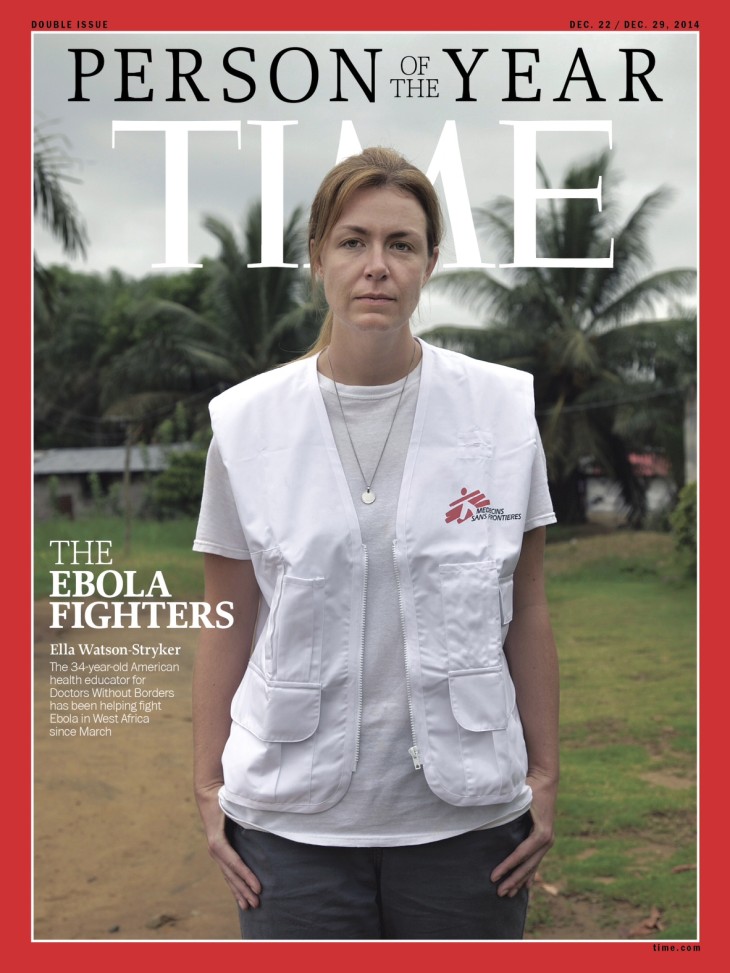
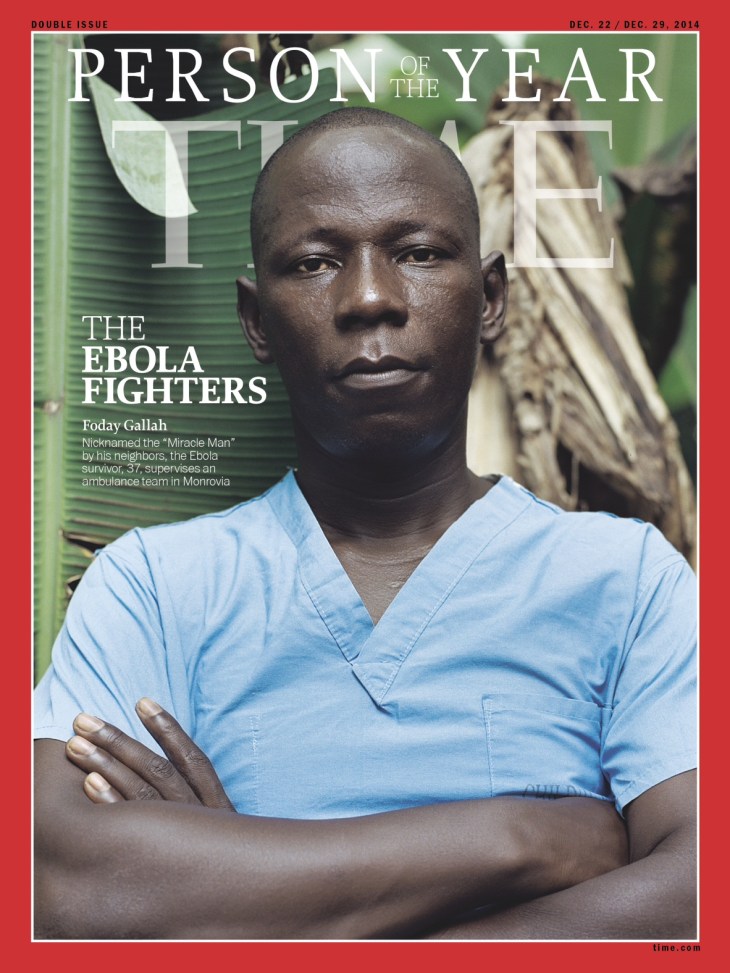
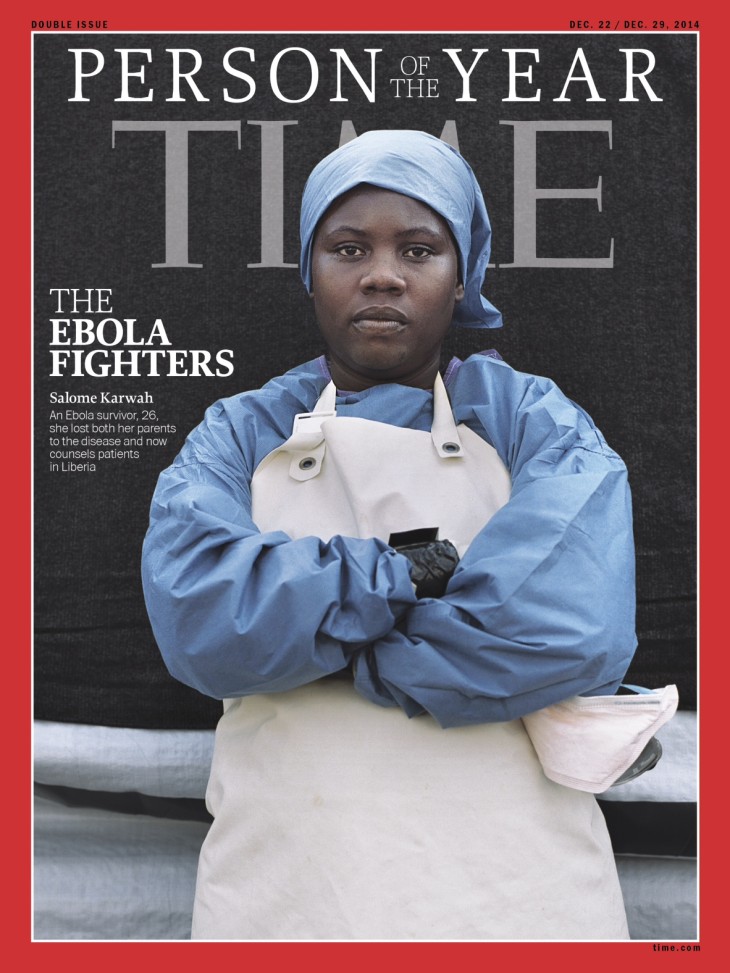
Ebola fighters[90] | "Ebola fighters" refers to health care workers who helped stop the spread of the Ebola virus during the Ebola virus epidemic in West Africa, including not only doctors and nurses, but also ambulance attendants, burial parties and others.[91]
Those represented on the covers included
|
||
| 2015 | 
|
Angela Merkel | Born 1954 | Chancellor of Germany from 2005 to 2021, recognized for leadership in the Greek debt crisis and European migrant crisis[98] | |
| 2016 | 
|
Donald Trump | Born 1946 | In 2016, Trump was elected President of the United States, defeating Hillary Clinton. | |
| 2017 | The Silence Breakers | The people who spoke out against sexual abuse and harassment, including the figureheads of the American MeToo movement. Represented on the cover by strawberry picker Isabel Pascual (pseudonym), lobbyist Adama Iwu, actress Ashley Judd, software engineer Susan Fowler, singer-songwriter Taylor Swift, and a sixth woman, a hospital worker who wished to remain anonymous and whose face cannot be seen.
The feature also specifically spotlights, in order:
|
|||
| 2018 |   
|
The Guardians |
Journalists who faced persecution, arrest or murder for their reporting. Those highlighted on four different covers were:
The feature also spotlights the following journalists, in order:
|
||
| 2019 | 
|
Greta Thunberg | Born 2003 | Swedish environmental activist and founder of the School Strike for Climate campaign[126] | |
| 2020 | 
|
Joe Biden[128] | Born 1942 | In 2020, Biden and Harris were elected President and Vice President of the United States respectively, defeating incumbent President Donald Trump and Vice President Mike Pence.[129] In January 2021, Harris became the first woman, first African American, and first Asian American vice president. | 3
|

|
Kamala Harris[128] | Born 1964 | |||
| 2021 | .jpg)
|
Elon Musk[131] | Born 1971 | CEO of Tesla, Inc., founder and CEO of SpaceX. The first person ever reported to have a net worth of over 300 billion US dollars. Recognized for the achievements of stated companies in the prior years, including the first all-civilian orbital flight, as well as his public image and controversies.[132] | Time did not release a shortlist for 2021.[133] |
| 2022 | 
|
Volodymyr Zelensky[134] | Born 1978 | President of Ukraine since 2019, and supreme commander-in-chief during the 2022 Russian invasion of Ukraine | |
|
|
The Spirit of Ukraine[136] | "The Spirit of Ukraine" represents the "resilience of the Ukrainian people and the Ukrainian resistance, as well as foreign aid to Ukraine".
The feature spotlights the following people and organizations, in order:
| |||
| 2023 | .png)
|
Taylor Swift (2) | Born 1989 | Singer-songwriter whose 2023–2024 Eras Tour became the highest-grossing concert tour of all time.[137] The tour had a significant cultural and economic impact in 2023. Time described Swift as the first Person of the Year to be recognized for their "achievement in the arts". Swift was also part of the 2017 Person of the Year, called the "Silence Breakers". She was noted by the magazine as the first woman to be recognized more than once and the first woman to appear twice on a Person of the Year cover.[138] |

Other categories[edit]
Every year, in addition to the main Person of the Year, Time (sometimes alongside a partner company) acknowledges impactful people or groups in other categories. This is a relatively recent practice, beginning in 1998 when Mark McGwire was awarded the title of Hero of the Year and becoming a regular event in 2018 with the re-introduction of the Heroes of the Year award.
Heroes of the Year was joined by Athlete of the Year, Businessperson of the Year (later renamed CEO of the Year), Entertainer of the Year and Guardians of the Year in 2019, Kid of the Year in 2020, Breakthrough Artist of the Year (later renamed Breakthrough of the Year), Dreamer of the Year, Icon of the Year and Innovator of the Year in 2022 and Team of the Year in 2023.
In 2022, Time hosted its first Person of the Year Reception at Plaza Hotel. The event featured video messages from Person of the Year Volodymyr Zelenskyy and Dreamer of the Year Donnel Baird, an interview with Icon of the Year Michelle Yeoh and a performance from Breakthrough of the Year Mickey Guyton.[139]
Hero(es) of the Year[edit]
In 2020, Heroes of the Year was awarded in partnership with State Farm.[140]
| Year | Choice | Notes |
|---|---|---|
| 1998 | Mark McGwire[141] | Baseball player for the St. Louis Cardinals, who hit 70 home runs in 1998, breaking the single-season home run record.[142] In 2010, McGwire admitted he used steroids during the 1998 season.[143] |
| 2018 | The Thai Cave Rescuers[144] | The Tham Luang cave rescue took place during June and July 2018, where a group of 12 boys and their junior soccer team's assistant coach Ekkapol Chantawong, who had been trapped in a cave for over two weeks, were successfully located and rescued through an operation involving over 10,000 people. Time's corresponding article highlights the heroic actions of Chantawong, Narongsak Osottanakorn (the governor of Chiang Rai province at the time and overseer of the rescue operation),[145] John Volanthen and Rick Stanton (two divers who first found the group alive),[146] Samarn Kunan (the rescue's only immediate casualty) and Richard Harris (the anesthesiologist and cave diver who played a crucial role in the rescue). |
| James Shaw Jr.[144] | Shaw disarmed a gunman during the Nashville Waffle House shooting on April 22, 2018, preventing the death toll from going above 4, and started a GoFundMe campaign the following day which went on to raise over $240,000 for the families of the shooting's 4 fatalities. | |
| Brad Brown[144] | Brown, a hospital chaplain at Feather River Hospital in Paradise, California, assisted with the evacuation of the hospital during Camp Fire and personally drove three immobile patients out of town, successfully getting them to a hospital in Chico after hours of potentially fatal road delays. | |
| Tammie Jo Shults[144] | Shults was the pilot of Southwest Airlines Flight 1380 on April 17, 2018, who, along with her first officer Darren Lee Ellisor, saved the lives of 143 following the failure of an engine which had fragments break off that damaged other parts of the plane and killed 1 passenger. | |
| Mamoudou Gassama[144] | On May 26, 2018, Gassama scaled four floors of an apartment building in Paris in under a minute, saving the life of a four-year-old boy dangling from a balcony and drawing comparisons to Spider-Man. | |
| 2019 | ||
| Defenders of Notre Dame[147] | Time's corresponding article discusses the actions of those who saved Notre-Dame's sacred treasures during the fire on April 15, 2019 (particularly Antoine-Marie Préaut, a conservator of Paris's historic monuments, and Laurent Prades, Notre-Dame's operational director), the ~400 firefighters who combatted the fire, and those who had begun preparing for the cathedral's reconstruction. | |
| Ryan Kyote[147] | Kyote, a nine-year-old resident of Napa, California, used his allowance to pay off his grade's $74 lunch debt. His mother posted about it on social media and the story went viral, starting a wider national movement against school lunch debt.[148] As a result, Kyote's school district reversed their lunch debt policy and a law was passed in California banning "lunch shaming" (a term for giving worse food to students with debt). | |
| Satchel Smith[147] | Smith, a 21-year-old student in Beaumont, Texas, was the sole employee trapped in a hotel alongside 90 guests for over 30 hours during Tropical Storm Imelda. He stayed awake during the whole ordeal, and was assisted by guests in making dinner and providing stranded truckers with food and water. | |
| Nicole Chamberlain[147] | On November 11, 2019, Chamberlain, a bus driver in Waukesha, Wisconsin, saw a two-year-old girl and her six-year-old brother alone in temperatures below 20 °F (−7 °C) near a busy intersection. She brought them on board her bus, warmed them up and stayed with them until their grandmother showed up alongside police officers. | |
| Keanon Lowe[147] | On May 19, 2019, Lowe, a teacher at Parkrose High School in Portland, Oregon, saw a student armed with a shotgun and successfully disarmed him, preventing his suicide and a school shooting. Immediately after, he gave the student a sympathetic hug and provided him with comforting words. | |
| Chella Phillips[147] | Phillips, who runs a dog refuge in Nassau, Bahamas, managed to protect the refuge's 82 dogs, alongside 15 other dogs, from Hurricane Dorian in her own home. During the week following the hurricane, she sent 68 of those dogs to homes and rescue groups in the United States after her story went viral there. | |
| 2020 | Australia's Volunteer Firefighters[149] | Time's corresponding article highlights the work done by volunteer firefighters during the 2019–20 Australian bushfire season, including three that died on the job. |
| Jason Chua and Hung Zhen Long[150] | Chua and Hung, co-owners of the Beng Who Cooks food stall in Singapore, committed to delivering free food to those who could not afford it during COVID-19 lockdowns from April to June 2020. In total, they spent $11,000 on ~2,500 free meals. | |
| Greg Dailey[151] | Following the rise of the COVID-19 pandemic in March 2020, Dailey, a newspaper deliveryman in Mercer County, New Jersey, began a new service of dropping off goods free of charge. During the rest of the year, he, with the help of his family, supplied over 140 homes and conducted over 1000 grocery runs in his local area. | |
| Rahul Dubey[152] | On June 1, 2020, during the George Floyd protests in Washington, D.C., Dubey provided refuge in his home to ~70 protestors who were being barricaded and pepper-sprayed by police, even letting them stay overnight to avoid curfew breaches. | |
| Pastor Reshorna Fitzpatrick and Bishop Derrick Fitzpatrick[153] | In April 2020, Reshorna and Derrick Fitzpatrick, a married couple who run Stone Temple Missionary Baptist Church in Chicago, began providing ~300 food boxes per week to people who became unemployed following the outbreak of the COVID-19 pandemic. They expanded their operation throughout the year, obtaining a supply of fresh produce from a local Black- and women-led nonprofit farm, providing hot soup every week and giving out supplies such as face masks and hand sanitizer. | |
| 2021 | Vaccine scientists[154] | The feature is dedicated to those that contributed to the creation of COVID-19 vaccines, and in particular spotlights Katalin Karikó, Barney S. Graham, Kizzmekia Corbett and Drew Weissman, pioneers of mRNA vaccine technology. |
| 2022 | Women of Iran[155] | After the death of Mahsa Amini on September 16, 2022, who was arrested for allegedly wearing her hijab improperly and later died after she had been —according to eyewitnesses— severely beaten by religious morality police officers, massive global protests began.[156] Initial protests, mostly led by women, demanded an end to the mandatory hijab law, which has been in place since the 1979 Islamic revolution.[157] According to Iran Human Rights, at least 481 protesters including 64 minors have been killed in these protests as of January 9, 2023.[158] |
Athlete of the Year[edit]
Athlete of the Year was awarded in partnership with Oura Health in 2021[159] and LG in 2022.[160]
| Year | Choice | Notes |
|---|---|---|
| 2019 | United States women's national soccer team | The international women's soccer team for the United States, who won the 2019 FIFA Women's World Cup[161] |
| 2020 | LeBron James | American basketball player, won the 2020 NBA Finals with his Los Angeles Lakers[162] |
| 2021 | Simone Biles | American gymnast, pulled out of multiple gymnastics events during the Tokyo Olympics for mental health concerns[159] |
| 2022 | Aaron Judge | American baseball outfielder, hit the most home runs in a season in the history of the American League with 62[160] |
| 2023 | Lionel Messi | Argentine footballer, won the 2022 FIFA World Cup with Argentina national team, record eighth Ballon d'Or and transferred to Inter Miami CF[163] |
CEO of the Year[edit]
In 2019 and 2020, this selection was called Businessperson of the Year.
| Year | Choice | Notes |
|---|---|---|
| 2019 | Bob Iger | CEO and executive chairman of The Walt Disney Company[164] |
| 2020 | Eric Yuan | CEO and founder of Zoom Video Communications[165] |
| 2023 | Sam Altman | CEO and co-founder of OpenAI[166] |
Entertainer of the Year[edit]
In 2022, Entertainer of the Year was awarded in partnership with Montblanc.[167]
| Year | Choice | Notes |
|---|---|---|
| 2019 | Lizzo | American rapper and singer-songwriter[168] |
| 2020 | BTS | South Korean K-pop boy band[169] |
| 2021 | Olivia Rodrigo | American singer-songwriter[170] |
| 2022 | Blackpink | South Korean K-pop girl group[167] |
Breakthrough of the Year[edit]
In 2022, this selection was called Breakthrough Artist of the Year
| Year | Choice | Notes |
|---|---|---|
| 2022 | Mickey Guyton[171] | American country music artist |
| 2023 | Alex Newell[172] | American actor |
Dreamer of the Year[edit]
Dreamer of the Year is awarded in partnership with American Family Insurance.
| Year | Choice | Notes |
|---|---|---|
| 2022 | Donnel Baird[173] | American entrepreneur and CEO of BlocPower |
| 2023 | Syd Kitson[174] | Chairman and CEO of Kitson and Partners and former professional American football guard |
Icon of the Year[edit]
| Year | Choice | Notes |
|---|---|---|
| 2022 | Michelle Yeoh[175] | Malaysian actress |
Innovator of the Year[edit]
| Year | Choice | Notes |
|---|---|---|
| 2022 | Gregory Robinson and the James Webb Space Telescope team[176] | Robinson was the telescope's program director from 2018 to 2022. |
Team of the Year[edit]
Team of the Year is awarded in partnership with Smartsheet.
| Year | Choice | Notes | Runners-up |
|---|---|---|---|
| 2023 | HP's Social Impact team[177] | The team consists of Michele Malejki, Mariama Kabia, Anshu Grover, Ina Progonati, Stephanie Bormann and Julio Vera Barajas. |
Kid of the Year[edit]
| Year | Choice | Notes |
|---|---|---|
| 2020 | Gitanjali Rao | Scientist and inventor[179] |
| 2021 | Orion Jean | Humanitarian[180] |
Guardians of the Year[edit]
In 2020, Guardians of the Year was awarded in partnership with Amazon.[181]
| Year | Choice | Notes |
|---|---|---|
| 2019 | American public servants[182] | The feature spotlights those involved in that year's impeachment inquiry against Donald Trump, particularly Marie Yovanovitch, William Taylor, Fiona Hill, Alexander Vindman, Mark Sandy, Jennifer Williams, David Holmes, Laura Cooper and the original whistleblower. |
| 2020 | Anthony Fauci and frontline health workers[181] | Recognising the actions of frontline health workers around the world that helped contain and reduce the effects of the COVID-19 pandemic. Fauci was the director of the National Institute of Allergy and Infectious Diseases at the time, and is credited with being a pivotal figure in the United States' fight against the pandemic. |
| Porche-Bennett-Bey, Assa Traoré and racial justice organizers[183] | Recognising the actions of those who organized racial justice movements such as the George Floyd protests. Bennett-Bey, a resident of Kenosha, Wisconsin, gained media attention for her activism following the shooting of Jacob Blake. Traoré is an activist and the sister of Adama Traoré, a black French man who died in police custody in 2016. The police officers accused of brutality were cleared of blame on May 29, 2020, triggering a new wave of protests against police brutality in solidarity with the at the time ongoing George Floyd protests. |
Online poll[edit]
Time also holds an online poll for the readers to vote for who they believe to be the Person of the Year. While many mistakenly believe the winner of the poll to be the Person of the Year, the title, as mentioned above, is decided by the editors of Time.[184] Time continues to annually run an online poll for the "People's Choice", but stresses the decision on whom the magazine recognizes is not made by the poll, but by the magazine's editors.[185] An online reader's choice poll was held in 1998, with professional wrestler Mick Foley and murdered college student Matthew Shepard as the top vote-getters, although the final result is unknown.[186][72]
| Year | Readers' Choice | Notes |
|---|---|---|
| 2010 | Julian Assange | Founder of WikiLeaks[187] |
| 2011 | Recep Tayyip Erdoğan | Prime Minister of Turkey[188] |
| 2012 | Kim Jong-un | Supreme Leader of North Korea[189] |
| 2013 | Abdel Fattah el-Sisi | President of Egypt[190] |
| 2014 | Narendra Modi | Prime Minister of India[191] |
| 2015 | Bernie Sanders | United States Senator from Vermont and 2016 presidential candidate[192] |
| 2016 | Narendra Modi | Prime Minister of India[193] |
| 2017 | Mohammad bin Salman | Crown Prince of Saudi Arabia[194] |
| 2018 | BTS | K-pop band[195] |
| 2019 | Hong Kong Protesters | Protesters in Hong Kong in response to the extradition bill[196] |
| 2020 | Essential Workers | Those who worked during the COVID-19 pandemic[197] |
| 2021 | Jair Bolsonaro | President of Brazil[198] |
| 2022 | Women Protesters in Iran | Women protesters in Iran who took part in the Mahsa Amini protests[199] |
See also[edit]
- Time 100: The Most Important People of the Century
- Canadian Newsmaker of the Year (Time), printed in the Canadian issue of Time until 2008
- Breakthrough of the Year
- Forbes list of the World's Most Powerful People
References[edit]
- ^ Gray, Eliza (June 26, 2015). "Inside the Love Story That Changed the Gay Marriage Battle". Time. Archived from the original on July 13, 2015.
- ^ Person of the Year: 75th Anniversary Celebration (Special Collector's ed.). New York: Time Books. 2002. OCLC 52817840.
- ^ "Here's Who Won Time's 2019 Person of the Year Reader Poll". Time. Retrieved April 25, 2021.
- ^ a b c d e Rothman, Lily (2023). Jacobs, Sam; Rothman, Lily; Benedict, Julie Blume; Cassidy, Catherine (eds.). "How Person of the Year Came to Be". Time. pp. 1–2.
- ^ Time (2002), "Person of the Year: 75th Anniversary Celebration", p. 1.
- ^ a b Levenstein, Joan (December 16, 2006). "Mme Chiang Kai-Shek: 1937". Time. Retrieved December 7, 2016.
- ^ Rothman, Lilly (December 5, 2017). "Here's the History of Time's Person of the Year Franchise". Time. Retrieved December 14, 2021.
- ^ "100 Women of the Year". Time. Retrieved November 18, 2020.
- ^ "Through War & Peace". Time. January 2, 1950. Retrieved February 13, 2008.
- ^ Morrow, Lance (January 1, 1990). "Gorbachev: The Unlikely Patron Of Change". Time. Retrieved February 13, 2008.
- ^ Golden, Frederic (January 3, 2000). "Person of the Century: Albert Einstein". Time. Retrieved February 13, 2008.
- ^ Isaacson, Walter (December 27, 1999). "Who mattered and why". CNN. Retrieved February 13, 2008.
- ^ "Person of the Century". Time. Vol. 154, no. 27. December 31, 1999. Retrieved April 10, 2023.
- ^ Time (2002), Person of the Year: 75th Anniversary Celebration, pp. 2, 79.
- ^ "Person of the Year: A Photo History – Notorious Leaders: Controversial Choices". Time. December 16, 2006. Retrieved September 27, 2013.
- ^ Time (2002), Person of the Year: 75th Anniversary Celebration, p. 79.
- ^ Pooley, Eric (December 31, 2001). "Mayor of the World". Time. Retrieved February 13, 2008.
- ^ Chowdhury, Prasenjit (June 5, 2012). "The test of time". The Times of India. Retrieved June 6, 2012.
- ^ a b "The Timely "Dumbo": Almost a Cover Boy". Walt Disney Family Museum. May 16, 2011. Retrieved December 7, 2017.
- ^ "Michael Moore Defends Cruise, Slags Gibson". Infectious Greed. September 16, 2006. Retrieved November 29, 2013.
- ^ Ball, Molly (December 6, 2017). "Donald Trump: Time Person of the Year Runner Up". Time. Retrieved December 7, 2017.
- ^ "A severe correctional and disciplinary period is indicated". Time. Vol. 19, no. 1. January 4, 1932. p. Cover. Archived from the original on July 11, 2007.
- ^ Kluger, Jeffrey. "130 Years After Hitler's Birth, He Continues to Live as a Symbol of Evil". Time.
- ^ "General Article: Presidential Politics". American Experience. PBS.
- ^ Rosegrant, Susan (April 18, 2012). University of Michigan (ed.). "ISR and the Truman/Dewey upset". isr.umich.edu. Archived from the original on April 2, 2013.
- ^ Cosgrove, Ben (October 21, 2012). "Behind the Picture: 'Dewey Defeats Truman'". Time. Archived from the original on October 22, 2012.
- ^ "Harlow H. Curtice is dead at 69". The New York Times. November 4, 1962. Retrieved October 6, 2009. (fee for article)
- ^ "THE PRESIDENCY: Man of the Year". Time. January 4, 1960. Retrieved December 12, 2022.
- ^ "Men of the Year: U.S. Scientists". January 2, 1961. Retrieved December 12, 2022.
- ^ "Man Of The Year: The Inheritor". Time. January 6, 1967. Retrieved December 12, 2022.
- ^ Waxman, Olivia B. (December 11, 2019). "When Young Americans Were Time's Person of the Year, This Man's Face Helped Inspire a 'Portrait of a Generation'". Time. Retrieved August 24, 2023.
- ^ "Man Of The Year: Lyndon B. Johnson, The Paradox of Power". Time. January 5, 1968. Retrieved December 12, 2022.
- ^ Larsen, Roy (January 5, 1970). "A Letter From The Publisher". Time. Archived from the original on October 30, 2010.
- ^ "Man and Woman of the Year: The Middle Americans". Time. January 5, 1970. Retrieved December 12, 2022.
- ^ "Man Of The Year: On the Road to a New Reality". Time. January 4, 1971. Retrieved December 14, 2022.
- ^ "Man of the Year: Nixon: Determined to Make a Difference". Time. January 3, 1972. Retrieved December 12, 2022.
- ^ "An Uncertain Year for Leaders". Time. Vol. 105, no. 1. January 6, 1975. p. 22. Retrieved April 4, 2023.
- ^ "Man Of The Year: An Uncertain Year for Leaders". Time. January 6, 1975. Retrieved April 4, 2023.
- ^ "Women of the Year: Great Changes, New Chances, Tough Choices". Time. January 5, 1976. Retrieved December 12, 2022.
- ^ "National Affairs: The Men Who Almost Made It". Time. January 5, 1976. Retrieved April 4, 2023.
- ^ "The Men Who Almost Made It". Time. Vol. 107, no. 1. January 5, 1976. p. 22. Retrieved April 4, 2023.
- ^ "Four Who Also Shaped Events". Time. Vol. 113, no. 1. January 1, 1979. p. 40. Retrieved April 4, 2023.
- ^ "Man Of The Year: Four Who Also Shaped Events". Time. January 1, 1979. Retrieved April 4, 2023.
- ^ "Four Who Also Shaped Events". Time. Vol. 113, no. 1. January 1, 1979. p. 40. Retrieved April 4, 2023.
- ^ "Others Who Stood in the Spotlight". Time. Vol. 117, no. 1. January 5, 1981. p. 38. Retrieved April 4, 2023.
- ^ "Others Who Stood in the Spotlight". Time. January 4, 1982. Retrieved April 4, 2023.
- ^ "Others Who Stood in the Spotlight". Time. Vol. 119, no. 1. January 4, 1982. p. 36. Retrieved April 4, 2023.
- ^ "A New World Dawns". Time. Vol. 121, no. 1. January 3, 1983. p. 12. Retrieved April 4, 2023.
- ^ Cocks, Jay (January 3, 1983). "The Updated Book off Jobs". Time. Retrieved April 4, 2023.
- ^ Golden, Frederic (January 3, 1983). "Other Maestros of the Micro". Time.
- ^ "Four Who Also Shaped Events". Time. Vol. 121, no. 1. January 3, 1983. p. 40. Retrieved April 4, 2023.
- ^ "Machine of the Year: The Computer Moves In". Time. January 3, 1983. Retrieved April 4, 2023.
- ^ "Four Who Also Shaped Events". Time. January 2, 1984. Retrieved April 3, 2023.
- ^ "Four Who Also Shaped Events". Time. Vol. 123, no. 1. January 2, 1984. p. 52. Retrieved April 3, 2023.
- ^ "They Also Made History". Time. Vol. 125, no. 1. January 7, 1985. p. 58. Retrieved April 3, 2023.
- ^ "Man of the Year: Peter Ueberroth". Time. Vol. 125, no. 1. January 7, 1985. Retrieved April 3, 2023.
- ^ "China: Old Wounds Deng Xiaoping". Time. January 6, 1986. Retrieved December 14, 2022.
- ^ "Four in the Spotlight". Time. Vol. 127, no. 1. January 6, 1986. p. 66. Retrieved April 3, 2023.
- ^ "Man of the Year: Deng Xiaoping". Time. Vol. 127, no. 1. January 6, 1986. Retrieved April 3, 2023.
- ^ "Others in History's Spotlight". Time. Vol. 129, no. 1. January 5, 1987. p. 35.
- ^ "Woman of the Year: Philippine President Corazon Aquino". Time. January 5, 1987. Retrieved April 3, 2023.
- ^ "'The Roughest Year'". Time. Vol. 131, no. 1. January 4, 1988. Retrieved April 4, 2023.
- ^ Friedrich, Otto (January 4, 1988). "The Roughest Year". Time. Retrieved April 4, 2023.
- ^ Sancton, Thomas (January 2, 1989). "Planet Of The Year: What on Earth Are We Doing?". Time. Retrieved September 27, 2021.
- ^ "They Also Made History". Time. Vol. 137, no. 1. January 7, 1991. p. 34. Retrieved April 4, 2023.
- ^ "The Two George Bushes". Time. January 7, 1991. Retrieved April 4, 2023.
- ^ "From the Managing Editor". Time. Vol. 139, no. 1. January 6, 1992. p. 20. Retrieved April 4, 2023.
- ^ Muller, Henry (January 6, 1992). "From The Managing Editor: Jan. 6, 1992". Time. Retrieved April 4, 2023.
- ^ "John Paul II: Empire of the Spirit". Time. December 26, 1994. Retrieved December 12, 2022.
- ^ "Dr. David Ho: The Disease Detective". Time. December 30, 1996. Retrieved December 12, 2022.
- ^ "Man of the Year 1997". Time. Archived from the original on 16 February 2017. Retrieved 16 February 2017.
- ^ a b "Time's Men of the Year (Just in time)". People. May 27, 1999. Archived from the original on October 4, 2022. Retrieved September 14, 2023.
- ^ "President-elect George W. Bush". Time. December 25, 2000. Retrieved March 27, 2023.
- ^ Grossman, Lev (December 13, 2006). "You – Yes, You – Are Time's Person of the Year". Time. Archived from the original on January 12, 2007. Retrieved December 20, 2012.
- ^ NBC News Staff (December 17, 2006). "Time magazine's 'Person of the Year' is ... You". Time.
- ^ "Person of the Year 2007". Time. 2007. Archived from the original on September 7, 2008. Retrieved July 8, 2009.
- ^ Time Staff (December 19, 2007). "Complete List – Person of the Year 2007". Time.
- ^ Von Drehle, David (December 17, 2008). "Person of the Year 2008". Time. Archived from the original on December 20, 2008. Retrieved December 17, 2008.
- ^ Time Staff (December 17, 2008). "Person of the Year 2008". Time.
- ^ Grunwald, Michael (December 16, 2009). "Person of the Year 2009". Time. Archived from the original on December 16, 2009. Retrieved December 16, 2009.
- ^ Time Staff (December 16, 2009). "Person of the Year 2009". Time.
- ^ Grossman, Lev (December 15, 2010). "Person of the Year 2010". Time. Archived from the original on December 15, 2010. Retrieved December 15, 2010.
- ^ Time Staff (December 15, 2010). "Complete List – Person of the Year 2010". Time.
- ^ a b Andersen, Kurt (December 14, 2011). "The Protester". Time. Archived from the original on August 28, 2013. Retrieved September 16, 2021.
- ^ "Full List". Time. n.d. Archived from the original on December 1, 2013. Retrieved September 16, 2021.
- ^ Scherer, Michael (December 19, 2008). "Person of the Year 2012". Time. Retrieved December 23, 2012.
- ^ "Person of the Year 2012". Time. December 19, 2012. Retrieved January 20, 2019.
- ^ "Pope Francis, The People's Pope". Time. December 11, 2013. Retrieved December 11, 2013.
- ^ "Pope Francis: Person of the Year 2013". Time. December 11, 2013.
- ^ a b "The Choice". Time. December 10, 2014. Retrieved December 10, 2014.
- ^ McLaughlin, Eliott C. (December 10, 2014). "Ebola fighters are Time's 'Person of the Year'". CNN. Retrieved July 25, 2015.
- ^ "Image: 1418243285733.jpg, (300 × 400 px)". The Sydney Morning Herald.
- ^ a b c d e "Time Person of the Year 2014: Ebola Fighters". Time.com. December 10, 2014. Retrieved July 25, 2015.
- ^ "Image: article-time2-1210.jpg (970 × 1293 px)". Daily News. New York.
- ^ "Image: 1D274907403248-ella.blocks_desktop_large.jpg, (730 × 974 px)". media2.s-nbcnews.com. Retrieved September 23, 2015.
- ^ "Image: 1D274907403249-foday.blocks_desktop_large.jpg, (730 × 974 px)". media2.s-nbcnews.com. Retrieved September 23, 2015.
- ^ "Image: 1D274907403247-salome.blocks_desktop_large.jpg, (730 × 974 px)". media4.s-nbcnews.com. Retrieved September 23, 2015.
- ^ Gibbs, Nancy (December 9, 2015). "The Choice: Why Angela Merkel is Time's Person of the Year 2015". Time.
- ^ "Time Person of the Year 2015 Runner-Up: Abu Bakr al-Baghdadi". Time. December 9, 2015.
- ^ "Time uPerson of the Year 2015 Runner-Up: Donald Trump". Time. December 9, 2015.
- ^ "Time Person of the Year 2015 Runner-Up: Black Lives Matter". Time. December 9, 2015.
- ^ "Time Person of the Year 2015 Runner-Up: Hassan Rouhani". Time. December 9, 2015.
- ^ "Time Person of the Year 2015 Runner-Up: Travis Kalanick". Time. December 9, 2015.
- ^ "Time Person of the Year 2015 Runner-Up: Caitlyn Jenner". Time. December 9, 2015.
- ^ "Hillary Clinton: Time Person of the Year 2016 Runner Up". Time. December 7, 2016.
- ^ "Hackers: Time Person of the Year 2016 Runner Up". Time. December 7, 2016.
- ^ "Recep Tayyip Erdogan: Turkish President Who Resisted a Coup". Time. December 7, 2016.
- ^ "CRISPR Technology Scientists on Their Gene Editing Tool". Time. December 7, 2016.
- ^ "Beyonce: Time Person of the Year 2016 Runner Up". Time. December 7, 2016.
- ^ Zacharek, Stephanie; Dockterman, Eliana; Edwards, Haley Sweetland. "Time Person of the Year 2017: The Silence Breakers". Time. Retrieved December 6, 2017.
- ^ Time Person of the Year 2017: The Silence Breakers, POY video posted by Time to YouTube on Dec 6, 2017
- ^ "Donald Trump: Time Person of the Year 2017 Runner Up". Time. Retrieved January 21, 2019.
- ^ "Xi Jinping: Time Person of the Year 2017 Runner Up". Time. Retrieved January 21, 2019.
- ^ "Robert Mueller: Time Person of the Year 2017 Runner Up". Time. Retrieved January 21, 2019.
- ^ "Kim Jong Un: Time Person of the Year 2017 Runner Up". Time. Retrieved January 21, 2019.
- ^ "Colin Kaepernick: Time Person of the Year 2017 Runner Up". Time. Retrieved January 21, 2019.
- ^ "Patty Jenkins: Time Person of the Year 2017 Runner Up". Time. Retrieved January 21, 2019.
- ^ Kim, Eun Kyung (December 11, 2018). "Time's 2018 Person of the Year: 'The Guardians and the War on Truth'". Today Show. Retrieved December 11, 2018.
- ^ Vick, Karl. "Time Person of the Year 2018: The Guardians". Time. Retrieved December 12, 2018.
- ^ "Donald Trump: Time Person of the Year 2018 Runner Up". Time. December 11, 2018. Retrieved January 21, 2019.
- ^ "Robert Mueller: Tine Person of the Year 2018 Runner Up". Time. December 11, 2018. Retrieved January 21, 2019.
- ^ "The Activists: Time Person of the Year 2018 Runner Up". Time. December 10, 2018. Retrieved January 21, 2019.
- ^ "Moon Jae-in: Time Person of the Year 2018 Runner Up". Time. December 10, 2018. Retrieved January 21, 2019.
- ^ "Ryan Coogler: Time Person of the Year 2018 Runner Up". Time. December 10, 2018. Retrieved January 21, 2019.
- ^ "Meghan Markle: Time Person of the Year 2018 Runner Up". Time. December 10, 2018. Retrieved January 21, 2019.
- ^ Alter, Charlotte; Haynes, Suyin; Worland, Justin. "Greta Thunberg: Time's Person of the Year 2019". Time. Retrieved December 12, 2019.
- ^ "Final 5 candidates for Time Person of the Year revealed on Today". Today.com. Retrieved December 11, 2019.
- ^ a b Alter, Charlotte (December 11, 2020). "2020 Person of the Year – Joe Biden and Kamala Harris". Time. Retrieved December 11, 2020.
- ^ "Presidential Election Results: Biden Wins". The New York Times. November 3, 2020. ISSN 0362-4331. Retrieved December 11, 2020.
- ^ Stump, Scott. "Who will be Time's 2020 Person of the Year? See the shortlist". Today.com. Retrieved December 10, 2020.
- ^ "Elon Musk Is Time's 2021 Person of the Year". Time. Retrieved December 13, 2021.
- ^ Brito, Christopher (December 13, 2021). "Elon Musk has been named Time's 2021 Person of the Year – CBS News". www.cbsnews.com. Retrieved February 10, 2024.
- ^ Flynn, Kerry (December 13, 2021). "Time Person of the Year: Elon Musk, CEO of Tesla and SpaceX, named most influential of 2021". CNN. Retrieved December 14, 2021.
- ^ "Volodymyr Zelensky Is Time's 2022 Person of the Year". Time. Retrieved December 7, 2022.
- ^ "Who will be Time's 2022 Person of the Year? See the contenders". Today. Retrieved July 12, 2022.
- ^ a b "The Spirit of Ukraine and Time's 2022 Person of the Year". Time. Retrieved December 7, 2022.
- ^ Gensler, Andy (December 8, 2023). "Taylor Swift Sets All-Time Touring Record With $1 Billion Gross". Pollstar. Archived from the original on December 8, 2023. Retrieved December 8, 2023.
- ^ Shah, Simmone (December 6, 2023). "Taylor Swift Makes History as Person of the Year". Time. Retrieved December 6, 2023.
- ^ "Here Are the Biggest Moments From Time's 2022 Person of the Year Reception". Time. December 8, 2022. Retrieved December 6, 2023.
- ^ "Time's Heroes of 2020". Time. Retrieved December 7, 2023.
- ^ "Bill Clinton and Kenneth Starr". Time. Retrieved March 20, 2023.
- ^ Okrent, Daniel (December 28, 1998). "Mark McGwire': A Mac For All Seasons". Time. Retrieved March 20, 2023.
- ^ "Mark McGwire Admits Using Steroids". www.cbsnews.com. Retrieved March 20, 2023.
- ^ a b c d e "From Cave Divers to a Fearless Flier, Here Are the Heroes of 2018". Time. December 12, 2018. Retrieved December 5, 2023.
- ^ "Thai cave rescue: Official hailed as hero of cave rescue dies". BBC. June 23, 2023. Retrieved December 5, 2023.
- ^ "Thailand cave rescue: Boys found alive after nine days". BBC. July 2, 2018. Retrieved December 5, 2023.
- ^ a b c d e f "These Heroes Went Above and Beyond in 2019". Time. December 12, 2019. Retrieved December 5, 2023.
- ^ "9-year-old uses own allowance to cover school lunch debts for his entire 3rd grade class". CBS. June 11, 2019. Retrieved December 5, 2023.
- ^ "Australia's Volunteer Firefighters Risked Everything to Keep Their Country Safe". Time. December 10, 2020. Retrieved December 5, 2023.
- ^ "The Food-Stall Owners Who Wouldn't Let Anyone Go Hungry". Time. December 10, 2020. Retrieved December 5, 2023.
- ^ "A Paper Route Driver Who Brought More Than the News". Time. December 10, 2020. Retrieved December 5, 2023.
- ^ "The Man Who Gave Shelter to Those in Need". Time. December 10, 2020. Retrieved December 5, 2023.
- ^ "The Pastors Who Transformed Their Church to Support Their Community". Time. December 10, 2020. Retrieved December 5, 2023.
- ^ "Vaccine Scientists: Heroes of the Year 2021". Time. December 13, 2021. Retrieved January 25, 2023.
- ^ "The Women of Iran Are Time's 2022 Heroes of the Year". Time. December 7, 2022. Retrieved January 25, 2023.
- ^ "Iranian woman dies 'after being beaten by morality police' over hijab law". The Guardian. September 16, 2022. Retrieved January 25, 2023.
- ^ Ghattas, Kim (October 2, 2022). "A Whole Generation Revolts Against the Iranian Regime". The Atlantic. Retrieved January 25, 2023.
- ^ "List of 109 Protesters at Risk of Execution, Death Penalty Charges or Sentences; At Least 481 Protesters Killed". Iran Human Rights. Retrieved January 25, 2023.
- ^ a b Park, Alice; Gregory, Sean. "Simone Biles Is Time's 2021 Athlete of the Year". Time. Retrieved December 14, 2021.
- ^ a b Gregory, Sean. "Aaron Judge Is Time's 2022 Athlete of the Year". Time. Retrieved December 18, 2022.
- ^ Gregory, Sean. "The U.S. Women's Soccer Team Is Time's 2019 Athlete of the Year". Time. Retrieved December 14, 2021.
- ^ Gregory, Sean. "LeBron James Is Time's 2020 Athlete of the Year". Time. Retrieved December 14, 2021.
- ^ Gregory, Sean. "Lionel Messi is Time's 2023 Athlete of the Year". Time. Retrieved December 5, 2023.
- ^ Luscombe, Belinda. "Bob Iger Is Time's 2019 Businessperson of the Year". Time. Retrieved December 14, 2021.
- ^ Chow, Andrew R. "Eric Yuan Is Time's 2020 Businessperson of the Year". Time. Retrieved December 14, 2021.
- ^ Bajekal, Naina; Perrido, Billy (December 6, 2023). "CEO of the Year 2023: Sam Altman". Time. Retrieved December 6, 2023.
- ^ a b Bruner, Raisa. "Blackpink is Time's 2022 Entertainer of the Year". Time. Retrieved December 5, 2022.
- ^ Irby, Samantha. "Lizzo Is Time's 2019 Entertainer of the Year". Time. Retrieved December 14, 2021.
- ^ Bruner, Raisa. "BTS Is Time's 2020 Entertainer of the Year". Time. Retrieved December 14, 2021.
- ^ Feldman, Lucy. "Olivia Rodrigo Is Time's 2021 Entertainer of the Year". Time. Retrieved December 14, 2021.
- ^ "Mickey Guyton: Time's 2022 Breakthrough Artist of the Year". Time. December 5, 2022. Retrieved December 7, 2023.
- ^ "Alex Newell is Time's 2023 Breakthrough of the Year". Time. December 5, 2023. Retrieved December 7, 2023.
- ^ "Meet the First-Ever Dreamer of the Year". Time. December 15, 2022. Retrieved December 7, 2023.
- ^ "Congratulations to Syd Kitson, 2023 Time Dreamer of the Year". Time. Retrieved December 7, 2023.
- ^ "Michelle Yeoh: Icon of the Year 2022". Time. December 6, 2022. Retrieved December 7, 2023.
- ^ "The James Webb Space Telescope Team: Innovator of the Year 2022". Time. December 7, 2022. Retrieved December 7, 2023.
- ^ "Meet the dream team driving HP's sustainable impact goals". Time. Retrieved December 7, 2023.
- ^ "Time's Team of the Year in partnership with Smartsheet – Meet the finalists!". Smartsheet. November 18, 2022. Retrieved December 7, 2023.
- ^ "Meet Time's First-Ever Kid of the Year". Time. Retrieved August 15, 2022.
- ^ "Orion Jean Is Time's 2021 Kid of the Year". Time. Retrieved August 15, 2022.
- ^ a b "Anthony Fauci, Frontline Workers: Guardians of the Year 2020". Time. Retrieved December 7, 2023.
- ^ "Public Servants: Time's Guardians of the Year 2019". Time. Retrieved December 7, 2023.
- ^ "Racial-Justice Organizers: Time's Guardians of the Year 2020". Time. Retrieved December 7, 2023.
- ^ "Time's 'Person of the Year' is Barack Obama". The World from PRX. Retrieved December 13, 2021.
- ^ Leasca, Stacey (December 19, 2012). "Time's 'Person of the Year' is Barack Obama". Global Post. Retrieved November 29, 2013.
- ^ Buechner, M. M. (December 21, 1998). "Time Man of the Year Poll Roils Internet". Time. Retrieved March 27, 2023.
- ^ Friedman, Megan (December 13, 2010). "Julian Assange: Readers' Choice for Time's Person of the Year 2010". Time. ISSN 0040-781X. Retrieved December 13, 2021.
- ^ Carbone, Nick (December 12, 2011). "And the readers' choice for Time's Person of the Year is..." Time. ISSN 0040-781X. Retrieved December 13, 2021.
- ^ Conniff, Kelly (December 13, 2012). "And the Winner of Time's Person of the Year Reader Poll Is …". Time. ISSN 0040-781X. Retrieved December 13, 2021.
- ^ Rayman, Noah (December 5, 2013). "Egypt's Sisi Wins Reader Poll for Time Person of the Year". Time. ISSN 0040-781X. Retrieved December 13, 2021.
- ^ "Narendra Modi Wins Reader Poll for Time Person of the Year". Time. Retrieved December 13, 2021.
- ^ "Bernie Sanders Wins Readers' Poll for Time Person of the Year". Time. Retrieved December 13, 2021.
- ^ "Narendra Modi Wins Reader's Poll for Time Person of the Year". Time. Retrieved December 13, 2021.
- ^ "Here's the Winner of the Reader Poll for Time's 2017 Person of the Year". Time. Retrieved December 13, 2021.
- ^ "BTS Wins Reader's Poll for Time Person of the Year". Time. Retrieved December 13, 2021.
- ^ "Here's Who Won Time's 2019 Person of the Year Reader Poll". Time. Retrieved December 13, 2021.
- ^ "Here's Who Won Time's 2020 Person of the Year Reader Poll". Time. Retrieved December 13, 2021.
- ^ "Here's Who Won Time's 2021 Person of the Year Reader Poll". Time. Retrieved December 13, 2021.
- ^ "Women Protesters in Iran Win Time's 2022 Person of the Year Reader Poll". Time. Retrieved December 7, 2023.


External links[edit]

- "Time's Person of the Year 1927–2011". Time. 2011. Archived from the original on December 20, 2009. Retrieved December 8, 2016.