


Canton Tower
| Canton Tower | |
|---|---|
广州塔 | |
.jpg) The Canton Tower in June 2022 | |
  Location within Guangdong | |
| Former names | Guangzhou TV Astronomical and Sightseeing Tower |
| Record height | |
| Tallest in the world from August 2009 to March 2011[I] | |
| Preceded by | CN Tower |
| Surpassed by | Tokyo Skytree |
| General information | |
| Type | Mixed use: Restaurant, Observation, Telecommunications |
| Architectural style | Structural expressionism |
| Address | Yuejiang Road West/Yiyuan Road, Haizhu District, Guangzhou, Guangdong |
| Coordinates | 23°6′32″N 113°19′8″E / 23.10889°N 113.31889°E |
| Groundbreaking | c. 2005 |
| Construction started | November 2005 |
| Topped-out | August 2009 |
| Completed | 2010 |
| Opening | 30 September 2010 |
| Cost | CNY ¥ 2,803,635,000.00 (US$450,000,000.00)[1] |
| Height | |
| Tip | 602 m (1,975 ft)[2][3] |
| Roof | 462.2 m (1,516 ft) |
| Top floor | 488 m (1,601 ft) |
| Observatory | 449 m (1,473 ft) |
| Technical details | |
| Floor count | 112 2 basement floors |
| Floor area | 114,054 m2 (1,227,700 sq ft) |
| Lifts/elevators | 9 |
| Design and construction | |
| Architect(s) | IBA: Mark Hemel & Barbara Kuit |
| Structural engineer | Arup |
| Website | |
| www | |
| References | |
| [4][5][6][7][8][9][10][11][12][1][13] | |
| Canton Tower | |||||||||||||
|---|---|---|---|---|---|---|---|---|---|---|---|---|---|
| Simplified Chinese | 广州塔 | ||||||||||||
| Traditional Chinese | 廣州塔 | ||||||||||||
| Cantonese Yale | Gwóngjāu Taap | ||||||||||||
| |||||||||||||
| Guangzhou TV Astronomical and Sightseeing Tower | |||||||||||||
| Simplified Chinese | 广州电视台天文及观光塔 | ||||||||||||
| Traditional Chinese | 廣州電視台天文及觀光塔 | ||||||||||||
| Cantonese Yale | Gwóngjāu Dihnsihtòih Tīnmán Kahp Gūngwōng Taap | ||||||||||||
| |||||||||||||
The Canton Tower (Chinese: 广州塔), formally Guangzhou TV Astronomical and Sightseeing Tower (Chinese: 广州电视台天文及观光塔), is a 602-meter (1,975 ft)-tall multipurpose observation tower in the Haizhu District of Guangzhou (alternatively romanized as Canton).[6][14][15] The tower was topped out in 2009 and it became operational on 29 September 2010 in time to 2010 Asian Games.[16] The tower briefly held the title of tallest tower in the world, replacing the CN Tower, before being surpassed by the Tokyo Skytree.[17][failed verification] It was the tallest structure in China prior to the topping out of the Shanghai Tower on 3 August 2013, and is now the second-tallest tower and the fifth-tallest freestanding structure in the world.
Naming and etymology
[edit]
There had been a long discussion about the naming of the Canton Tower since the commencement of its construction in 2005 after the groundbreaking ceremony. In September 2020, at the request of the tower's investor, Guangzhou Daily launched a contest for naming proposals. The contest attracted over 180,000 valid entries, among which "Haixin Tower" (Chinese: 海心塔; lit. 'Tower in the Sea') was awarded the first prize. The name alluded to the city's historical setting as the start of the Maritime Silk Road and the tower's geographical proximity to Haixinsha Island. However, this name was considered obscure to people unfamiliar with the history of the city.[18] Local residents continued to refer to the tower by various nicknames including "Slim Waist" (Chinese: 小蛮腰), "Twisted Firewood" (Chinese: 扭纹柴; a metaphor for "stubborn" in Cantonese) and "Yangdianfeng" (Chinese: 羊巅峰; lit. 'Peak of the Ram City'; homophone of "epilepsy" in colloquial Chinese).[10][11][19][20]
The Naming was reconsidered in 2010. After surveying a broad range of public opinions, "Canton Tower" was decided as the official English name and announced at the end of September 2010. The new English name, which alludes to the city's prosperous past, was considered the most identifying and least ambiguous among the multitude of proposals.[10][11][20][21]
History
[edit]Canton Tower was constructed by Guangzhou New Television Tower Group. It was designed by the Dutch architects Mark Hemel and Barbara Kuit of Information Based Architecture, together with Arup, the international design, engineering and business consulting firm headquartered in London, United Kingdom. In 2004, Information Based Architecture and Arup won the international competition, in which many internationally large architectural offices participated. In the same year, the IBA – Arup team in Amsterdam developed the tower's concept design. In later stages, IBA cooperated mainly with the local Chinese office of Arup and a Local Design Institute. Subsequently, in 2005, the groundbreaking of the Canton Tower took place.[11][20]
The tower, although not fully completed, opened to the public on 1 October 2010 in time for the 16th Asian Games, hosted by Guangzhou in November 2010.[22][23] The rooftop observatory finally received its official opening in December 2011.[10][11][12]
Structure and construction
[edit]The Canton Tower's twisted shape or hyperboloid structure corresponds to the Russian Empire patent No. 1896, dated 12 March 1899 received by Vladimir Shukhov, the Russian engineer and architect.[24] The structure is similar to the Adziogol Lighthouse (designed by Vladimir Shukhov in 1910) in Ukraine's Dnepr delta.[10][11][12][25]
Structural concept
[edit]
The tower was designed by Information Based Architecture and Arup. The Arup team led by structural engineer Prof. Dr. Joop Paul introduced near mass customization to the joint design, in combination with parametric design methods, and applied a simple structural concept of three elements: columns, rings and braces, to this more complex geometry.[8][9][10][11]
The waist of the tower contains a 180 m (590 ft) open-air skywalk where visitors can physically climb the tower. There are outdoor gardens set within the structure, and at the top, just above 452 m (1,483 ft), a large open-air observation deck.[8][10][11]
The interior of the tower is subdivided into programmatic zones with various functions, including TV and radio transmission facilities, observatory decks, revolving restaurants, computer gaming, restaurants, exhibition spaces, conference rooms, shops, and 4D cinemas.[8][10][11]
A deck at the base of the tower hides the tower's functional workings. All infrastructural connections – metro and bus stations – are situated underground. This level also includes exhibition spaces, a food court, a commercial space, a parking area for cars and coaches. There are two types of elevators: slow-speed panoramic and high-speed double-decker.[10][11]
The zone from 80 to 170 m (260 to 560 ft) consists of a 4D cinema, a play-hall area, restaurants, coffee shops and outdoor gardens with teahouses. The highest and longest open-air staircase in the world, the Skywalk, starts at the height of 170 m (558 ft) and spirals almost 170 m (558 ft) higher, all the way through the waist. Parts of the skywalk's floors are laid with transparent glass.[10][11][26]

The top zone of the tower begins above the stairway, housing various technical functions as well as a two-story rotating restaurant, a tuned mass damper and the upper observation levels. From the upper observation levels it is possible to ascend even higher, via a further set of the stairs, to a terraced observation square rising above the tower's top ring.[10][11][12]
The twist
[edit]The form, volume and structure of the towers is generated by two ellipses, one at foundation level and the other at a horizontal plane at 450 m (1,480 ft). These two ellipses are rotated relative to another. The tightening caused by the rotation between the two ellipses forms a "waist" and a densification of material halfway up the tower. This means that the lattice structure, which at the bottom of the tower is porous and spacious, becomes denser at waist level. The waist itself becomes tight, like a twisted rope; transparency is reduced and views to the outside are limited. Further up the tower the lattice opens again, accentuated here by the tapering of the structural column-tubes.[10][11][12]
Rooftop observatory
[edit]The indoor public observatory is 449 m above the ground, which takes the form of a terraced elliptical space, roughly half the size of a standard football field. Opened in December 2011, the rooftop at 488 m was the highest and largest outdoor observation deck in the world, taking over the title from the observation deck of Burj Khalifa at 452m.[27] This remained the case until 14 October 2014, when the record of highest outdoor observatory was retaken by Burj Khalifa when it opened its new observatory called at the Top – Sky, at a height of 555m.[28]
Sixteen transparent "crystal" passenger cars, each with a diameter of 3.2 m (10 ft) and able to carry four to six people, travel on a track round the edge of the tower's roof, taking between 20 and 40 minutes to circumnavigate the rooftop.[22] The installation is described by the media as a Ferris wheel; however, its passenger cars are not suspended from the rim of a wheel and remain horizontal without being fully rotated, and the track, which follows the incline of the roof, is closer to the horizontal than the vertical.[29][30]
Architectural lighting design
[edit]At night, the tower glows and emits light, rather than being uplit. Lighting designer Rogier van der Heide is known for this concept, which he also applied at the Marunouchi Building in Tokyo. Each node in the lighting design is individually controllable to allow for animations and color changes across the entire height of the tower. As all lighting is based on LED technology, and all fixtures are located on the structure itself, the lighting scheme consumes only 15% of the allowed maximum for façade lighting.[8][20]
At the time of the design of Canton Tower, lighting designer Rogier van der Heide was Global Leader of Arup Lighting.[8][10][11][12][20]
Measurements
[edit]The Canton Tower's main body stands at 450 m (1,476 ft). Combined with the tower's 150-meter-long (492 ft) antenna, the Canton Tower has a total height of 604 m (1,982 ft), making it the second tallest tower in the world, second tallest in Asia, and the tallest in the People's Republic of China. The tower has a total of 112 floors.[1][6]
The Canton Tower weighs a total of 100,000 t (100,000,000 kg), including the tower's antenna which weighs 1,550 t (1,550,000 kg) and the main body, which includes all the features of the tower, which weighs a total of 98,450 t (98,450,000 kg).[1]
The Canton Tower occupies a total floor area of 175,458 m2 (1,888,610 sq ft). In addition, the tower's net usable area measures 114,054 m2 (1,227,670 sq ft).[1]
Events
[edit]
- In lieu of a traditional stadium setting, the opening ceremonies of the 2010 Asian Games in Guangzhou were held on Haixinsha Island. The Canton Tower and Pearl River were used as a focal point of the event.[10][11][12]
- The Canton Tower hosted an annual Christmas Concert on Christmas Eve inside the tower's ground floor, making it the first concert to be held in the Canton Tower. Celebrated on Christmas Eve, the concert was held on 24 December 2012.[10][11][12][31]
Geography
[edit]The Canton Tower is situated alongside the Yiyuan Road (Yuejiang Road West), in the Haizhu District of Guangzhou, and is situated south of the Zhujiang New Town. Additionally, several famous landmarks surround the tower, including pagodas, a park towards the south, and several high-rise apartments, buildings, and skyscrapers, both commercial and residential.
Gallery
[edit]-
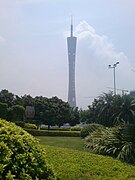 Canton Tower as viewed from the front entrance of Hongcheng Park.
 -
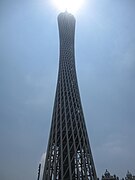 Canton Tower at noon.
 -
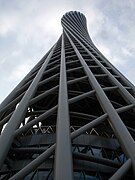 Canton Tower early in the afternoon, shot from the ground.
 -
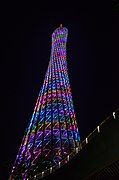 The Canton Tower lit up at night.
 -
 Red fireworks from the Canton Tower during the 2010 Asian Games opening ceremony, hosted in Guangzhou
 -
 Red fireworks coming out from the Canton Tower during the 2010 Asian Games


.JPG)


Construction history
[edit]-
 February 2007
 -
 November 2007
 -
 August 2008
 -
 June 2009
 -
 Post-construction – 2010 Asian Games opening ceremony
 -
 Post-construction – March 2011


Diagrams
[edit]
-
 Outline of the Canton Tower.
 -
 Diagram of the world's tallest buildings and structures.
 -
 Diagram of the world's tallest buildings and structures with public observation facilities.


See also
[edit]


- 2010 Asian Games
- 2010 Asian Para Games
- Cantonese architecture
- Guangzhou Broadcasting Network
- Guangzhou TV Tower
- List of hyperboloid structures
- List of tallest freestanding structures in the world
- List of tallest towers in the world
References
[edit]- ^ a b c d e "Facts and visitor information on the Canton Tower in China >> The World Federation of Great Towers". Great-towers.com. Archived from the original on 7 March 2014. Retrieved 4 January 2013.
- ^ "Canton Tower – the Skyscraper Center".
- ^ "Canton Tower, Guangzhou – SkyscraperPage.com".
- ^ "Canton Tower". CTBUH Skyscraper Center.
- ^ "Emporis building ID 220692". Emporis. Archived from the original on 5 March 2016.
- ^ a b c "Canton Tower". SkyscraperPage.
- ^ Andrew Rosenberg (19 November 2010). "Canton Tower / Information Based Architecture". ArchDaily. Retrieved 27 July 2011.
- ^ a b c d e f "Canton Tower | Arup". Arup.com. Retrieved 31 December 2012.
- ^ a b "IBA – Information Based Architecture Mark Hemel + Barbara Kuit". Hemel.dircon.co.uk. Retrieved 31 December 2012.
- ^ a b c d e f g h i j k l m n o Canton Tower 广州塔 – Guangzhou TV Tower. Gztvtower.info. Retrieved 1 January 2013.
- ^ a b c d e f g h i j k l m n o p "Canton Tower official website". Cantontower.com. Archived from the original on 31 January 2013. Retrieved 1 January 2013.
- ^ a b c d e f g h "Guangzhou Tower, Guangzhou New TV Tower, Tower official website of Guangzhou :: GuangzhouTower.cc". Guangzhoutower.cc. Archived from the original on 16 December 2012. Retrieved 1 January 2013.
- ^ 揭秘广州塔 小蛮腰你知多少. Guangzhou daily. Retrieved 11 January 2016.[permanent dead link]
- ^ "Guangzhou's new television tower named Canton Tower". The People's Government of Guangzhou Municipality. 30 September 2010. Archived from the original on 23 July 2011. Retrieved 27 July 2011.
- ^ "The Canton Tower". Canton Tower. 2010. Retrieved 27 July 2011.
- ^ "600-meter-high Canton Tower begins operations". Guangzhou Asian Games Organizing Committee. 2 October 2010. Archived from the original on 23 July 2011. Retrieved 27 July 2011.
- ^ "List of tallest towers in the world". Council on Tall Buildings and Urban Habitat (CTBUH). 2011. Archived from the original on 25 December 2015. Retrieved 27 July 2011.
- ^ 广州新电视塔命名敲定 市民不知"海心"内涵. Information Times (in Chinese). 16 November 2009. Archived from the original on 21 July 2011. Retrieved 27 July 2011.
- ^ 从"大裤衩"到"羊巅峰",民众智慧可怕?. YCWB (in Chinese). 22 September 2010. Archived from the original on 24 July 2011. Retrieved 27 July 2011.
- ^ a b c d e Van der Heide, Rogier. "Canton Tower Lighting Inaugurated". Rogiervanderheide.com. Archived from the original on 15 March 2012. Retrieved 1 January 2013.
- ^ 为地标命名 为城市喝彩. Guangzhou Daily (in Chinese). 29 September 2010. Archived from the original on 20 July 2011. Retrieved 27 July 2011.
- ^ a b "World's highest ferris wheel coming to Guangzhou". Guangzhou Asian Games Organizing Committee. 18 March 2009. Archived from the original on 23 July 2011. Retrieved 27 July 2011.
- ^ Lotte Haagsma; Piet Vollaard (11 October 2010). "Six years building the tallest TV tower in the world". Archined. Retrieved 27 July 2011.
- ^ Graefe, Rainer; Šuchov, V. G. (1990). Vladimir Grigorʹevič Šuchov : 1853–1939; die Kunst der sparsamen Konstruktion. Stuttgart: Deutsche Verlags-Anstalt. pp. 78–103, 177. ISBN 3-421-02984-9.
- ^ Hyperboloid Adziogol Lighthouse by Vladimir Shukhov in Ukraine
- ^ Ren, Jielu. 实拍:广州塔蜘蛛侠栈道漫步高空. Southcn. Retrieved 24 April 2015.
- ^ "Cloud Top 488 on Canton Tower Opened to public". The People`s Government of Guangzhou Municipality. 19 December 2011. Archived from the original on 25 May 2012. Retrieved 23 January 2012.
- ^ "At The Top, Burj Khalifa Sky is world's highest observation deck". Gulf News. 14 October 2014. Retrieved 12 December 2014.
- ^ Caixiong, Zheng. "Tallest Ferris wheel planned in Guangzhou". China Daily. Retrieved 27 July 2011.
- ^ "Tallest Ferris wheel planned". People's Daily. Retrieved 27 July 2011.
- ^ "Canton Tower Christmas Concert – YouTube". Archived from the original on 17 March 2013. Retrieved 1 January 2013 – via YouTube.
External links
[edit]
- Canton Tower official website
- Canton Tower official website :: GzTvTower.info
 Geographic data related to Canton Tower at OpenStreetMap


.JPG)


| International | |
|---|---|
| National | |
| Geographic | |
