


Territories of the United States
Territories of the United States | |
|---|---|
.svg) | |
 Incorporated, unorganized territory
Unincorporated, organized territory
Unincorporated, unorganized territory | |
| Languages | |
| Demonym(s) | American |
| Territories |
9 uninhabited 2 claimed |
| Leaders | |
| Joe Biden | |
| List | |
| Area | |
• Total | 22,294.19 km2 (8,607.83 sq mi) |
| Population | |
• 2020 census | 3,623,895[2][3] |
| Currency | United States dollar |
| Date format | mm/dd/yyyy (AD) |
| This article is part of a series on |
| Political divisions of the United States |
|---|
 |
| First level |
|
|
| Second level |
|
| Third level |
|
|
| Fourth level |
| Other areas |
|
|
 United States portal |
Territories of the United States are sub-national administrative divisions overseen by the federal government of the United States. The various American territories differ from the U.S. states and Indian reservations as they are not sovereign entities.[note 2] In contrast, each state has a sovereignty separate from that of the federal government and each federally recognized Native American tribe possesses limited tribal sovereignty as a "dependent sovereign nation."[4] Territories are classified by incorporation and whether they have an "organized" government through an organic act passed by the Congress.[5] American territories are under American sovereignty and, consequently, may be treated as part of the United States proper in some ways and not others (i.e., territories belong to, but are not considered to be a part of, the United States).[6] Unincorporated territories in particular are not considered to be integral parts of the United States,[7] and the Constitution of the United States applies only partially in those territories.[8][9][5][10][11]
The United States currently administers three[8][12] territories in the Caribbean Sea and eleven in the Pacific Ocean.[note 3][note 4] Five territories (American Samoa, Guam, the Northern Mariana Islands, Puerto Rico, and the U.S. Virgin Islands) are permanently inhabited, unincorporated, territories; the other nine are small islands, atolls, and reefs with no native (or permanent) population. Of the nine, only one is classified as an incorporated territory (Palmyra Atoll). Two additional territories (Bajo Nuevo Bank and Serranilla Bank) are claimed by the United States but administered by Colombia.[9][14][15] Historically, territories were created to administer newly acquired land, and most eventually attained statehood.[16][17] The most recent territories to become U.S. states were Alaska on January 3, 1959, and Hawaii on August 21, 1959.[18]
Politically and economically, the territories are underdeveloped. Residents of United States territories cannot vote in United States presidential elections, and they have only non-voting representation in the United States Congress.[9] According to 2012 data, territorial telecommunications and other infrastructure are generally inferior to that of the continental United States and Hawaii.[19] Poverty rates are higher in the territories than in the states.[20][21]
Organized vs. unorganized territories[edit]
Definition[edit]
Organized territories are lands under federal sovereignty (but not part of any state or the federal district) which were given a measure of self-governance by Congress through an organic act subject to the Congress's plenary powers under the territorial clause of the Constitution's Article Four, section 3.[22]
Former[edit]
The term unorganized was historically applied either to a newly acquired region not yet constituted as an organized incorporated territory (e.g. the Louisiana Purchase prior to the establishment of Orleans Territory and the District of Louisiana), or to a region previously part of an organized incorporated territory left "unorganized" after part of it had been organized and achieved the requirements for statehood (e.g. a large portion of Missouri Territory became unorganized territory for several years after its southeastern section became the state of Missouri).[citation needed]
Regions that have been admitted as states under the United States Constitution in addition to the original thirteen were, most often, prior to admission, territories or parts of territories of this kind. As the United States grew, the most populous parts of the organized territory would achieve statehood. Some territories existed only a short time before becoming states, while others remained territories for decades. The shortest-lived was Alabama Territory at two years, while New Mexico Territory and Hawaii Territory both lasted more than 50 years.
Of the current 50 states, 31 were at one time or another part of an organized, incorporated U.S. territory. In addition to the original 13, six subsequent states never were: Kentucky, Maine, and West Virginia were each set off from an already existing state;[23] Texas and Vermont were both sovereign states (only de facto sovereignty in Vermont's case, as the region was claimed by New York) at the time when they entered the Union; and California was set off from unorganized land ceded to the United States by Mexico in 1848 at the end of the Mexican–American War.
One former territory did not go on to subnational statehood. The Republic of the Philippines, once an organized territory through the passage of an organic act, successfully petitioned for greater autonomy which eventually led to independence in 1946.[24][25][26][27]
Current status[edit]
All of the five major U.S. territories are permanently inhabited and have locally elected territorial legislatures and executives and some degree of political autonomy. Four of the five are "organized", but American Samoa is technically "unorganized". All of the U.S. territories without permanent non-military populations are unorganized.
Federal administration[edit]
The Office of Insular Affairs coordinates federal administration of the U.S. territories and freely associated states, except for Puerto Rico.[28]
On March 3, 1849, the last day of the 30th Congress, a bill was passed to create the U.S. Department of the Interior to take charge of the internal affairs of United States territory. The Interior Department has a wide range of responsibilities (which include the regulation of territorial governments, the basic responsibilities for public lands, and other various duties).[citation needed]
In contrast to similarly named Departments in other countries, the United States Department of the Interior is not responsible for local government or for civil administration except in the cases of Indian reservations, through the Bureau of Indian Affairs (BIA), and island dependencies administered by the Office of Insular Affairs.[citation needed]
Permanently inhabited territories[edit]
The U.S. has five permanently inhabited territories: Puerto Rico and the U.S. Virgin Islands in the Caribbean Sea, Guam and the Northern Mariana Islands in the North Pacific Ocean, and American Samoa in the South Pacific Ocean.[note 5] American Samoa is in the Southern Hemisphere, while the other four are in the Northern Hemisphere.[29] In 2020, their combined population was about 3.62 million, over 90% of which is accounted for by Puerto Rico alone.[2][3]
People born in Puerto Rico, the U.S. Virgin Islands, Guam and the Northern Mariana Islands acquire U.S. citizenship by birth, and foreign nationals residing there may apply for U.S. citizenship by naturalization.[30][31][32][note 6] People born in American Samoa acquire U.S. nationality but not U.S. citizenship by birth if they do not have a U.S. citizen parent.[note 7] U.S. nationals without U.S. citizenship may hold U.S. passports and reside in any part of the United States without restriction.[36] However, to become U.S. citizens they must apply for naturalization, like foreigners, and may only do so while residing in parts of the United States other than American Samoa.[37][note 8] Foreign nationals residing in American Samoa cannot apply for U.S. citizenship or U.S. nationality at all.[39][40]
Each territory is self-governing[10] with three branches of government, including a locally elected governor and a territorial legislature.[9] Each territory elects a non-voting member (a non-voting resident commissioner in the case of Puerto Rico) to the U.S. House of Representatives.[9][41][42] Although they cannot vote on the passage of legislation, they can introduce legislation, have floor privileges to address the house, be members of and vote in committees, are assigned offices and staff funding, and may nominate constituents from their territories to the Army, Naval, Air Force and Merchant Marine academies.[43]
As of the 118th Congress, the territories are represented by Aumua Amata Radewagen (R) of American Samoa, James Moylan (R) of Guam, Gregorio Sablan (D) of Northern Mariana Islands, Jenniffer González-Colón (R-PNP) of Puerto Rico and Stacey Plaskett (D) of U.S. Virgin Islands.[44] The District of Columbia's delegate is Eleanor Holmes Norton (D); like the district, the territories have no vote in Congress and no representation in the Senate.[45][46] Additionally, the Cherokee Nation has delegate-elect Kimberly Teehee, who has not been seated by Congress.
Every four years, U.S. political parties nominate presidential candidates at conventions which include delegates from the territories.[47] U.S. citizens living in the territories can vote for presidential candidates in these primary elections but not in the general election.[9][45]
The territorial capitals are Pago Pago (American Samoa), Hagåtña (Guam), Saipan (Northern Mariana Islands), San Juan (Puerto Rico) and Charlotte Amalie (U.S. Virgin Islands).[48][49][50][51][52][53][54] Their governors are Lemanu Peleti Mauga (American Samoa), Lou Leon Guerrero (Guam), Ralph Torres (Northern Mariana Islands), Pedro Pierluisi (Puerto Rico) and Albert Bryan (U.S. Virgin Islands).
Among the inhabited territories, Supplemental Security Income (SSI) is available only in the Northern Mariana Islands;[note 9] however, in 2019 a U.S. judge ruled that the federal government's denial of SSI benefits to residents of Puerto Rico is unconstitutional.[55] This ruling was later overturned by the U.S. Supreme Court, allowing for the exclusion of territories from such programs.[56] In the decision, the court explained that the exemption of island residents from most federal income taxes provides a "rational basis" for their exclusion from eligibility for SSI payments.[57]
American Samoa is the only U.S. territory with its own immigration system (a system separate from the United States immigration system).[58][59] American Samoa also has a communal land system in which 90% of the land is communally owned; ownership is based on Samoan ancestry.[60]
| Name (abbreviation) | Location | Area | Population (2020)[2][3] |
Capital | Largest town | Status | Acquired |
|---|---|---|---|---|---|---|---|
 American Samoa (AS) American Samoa (AS)
|
Polynesia (South Pacific) | 197.1 km2 (76 sq mi) | 49,710 | Pago Pago | Tafuna | Unincorporated, unorganized[note 10] | April 17, 1900 |
 Guam (GU) Guam (GU)
|
Micronesia (North Pacific) | 543 km2 (210 sq mi) | 153,836 | Hagåtña | Dededo | Unincorporated, organized | April 11, 1899 |
 Northern Mariana Islands (MP) Northern Mariana Islands (MP)
|
Micronesia (North Pacific) | 463.63 km2 (179 sq mi) | 47,329 | Saipan[note 11] | Saipan[note 12] | Unincorporated, organized (Commonwealth) | November 4, 1986[note 13][62][61] |
 Puerto Rico (PR) Puerto Rico (PR)
|
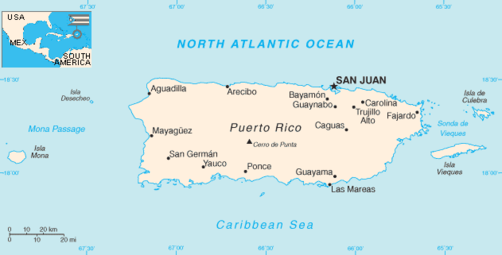
Caribbean (North Atlantic) | 9,104 km2 (3,515 sq mi) | 3,285,874 | San Juan | San Juan | Unincorporated, organized (Commonwealth) | April 11, 1899[63] |
 U.S. Virgin Islands (VI) U.S. Virgin Islands (VI)
|
Caribbean (North Atlantic) | 346.36 km2 (134 sq mi) | 87,146 | Charlotte Amalie | Charlotte Amalie | Unincorporated, organized | March 31, 1917[64] |
History[edit]
- American Samoa: territory since 1900; after the end of the Second Samoan Civil War, the Samoan Islands were divided into two regions. The U.S. took control of the eastern half of the islands.[65][29] In 1900, the Treaty of Cession of Tutuila took effect.[66] The Manuʻa islands became part of American Samoa in 1904, and Swains Island became part of American Samoa in 1925.[66] Congress ratified American Samoa's treaties in 1929.[66] For 51 years, the U.S. Navy controlled the territory.[38] American Samoa is locally self-governing under a constitution last revised in 1967.[29][note 14] The first elected governor of American Samoa was in 1977, and the first non-voting member of Congress was in 1981.[38] By jus soli, people born in American Samoa are U.S. nationals, but not U.S. citizens.[30][29] American Samoa is technically unorganized,[29] and its main island is Tutuila.[29]
- Guam: territory since 1899, acquired at the end of the Spanish–American War.[68] Guam is the home of Naval Base Guam and Andersen Air Force Base. It was organized under the Guam Organic Act of 1950, which granted U.S. citizenship to Guamanians and gave Guam a local government.[68] In 1968, the act was amended to permit the election of a governor.[68]
- Northern Mariana Islands: A commonwealth since 1986,[62][61] the Northern Mariana Islands together with Guam were part of the Spanish Empire until 1899 when the Northern Marianas were sold to the German Empire after the Spanish–American War.[69] Beginning in 1919, they were administered by Japan as a League of Nations mandate until the islands were captured by the United States in the Battle of Saipan and Battle of Tinian (June–August 1944) and the surrender of Aguigan (September 1945) during World War II.[69] They became part of the United Nations Trust Territory of the Pacific Islands (TTPI) in 1947, administered by the United States as U.N. trustee.[69][61] The other constituents of the TTPI were Palau, the Federated States of Micronesia and the Marshall Islands.[70] Following failed efforts in the 1950s and 1960s to reunify Guam and the Northern Marianas,[71] a covenant to establish the Northern Mariana Islands as a commonwealth in political union with the United States was negotiated by representatives of both political bodies; it was approved by Northern Mariana Islands voters in 1975, and came into force on March 24, 1976.[69][50] In accordance with the covenant, the Northern Mariana Islands constitution partially took effect on January 9, 1978, and became fully effective on November 4, 1986.[50] In 1986, the Northern Mariana Islands formally left U.N. trusteeship.[62] The abbreviations "CNMI" and "NMI" are both used in the commonwealth. Most residents in the Northern Mariana Islands live on Saipan, the main island.[50]
- Puerto Rico: unincorporated territory since 1899;[63] Puerto Rico was acquired at the end of the Spanish–American War,[72] and has been a U.S. commonwealth since 1952.[73] Since 1917, Puerto Ricans have been granted U.S. citizenship.[74] Puerto Rico was organized under the Puerto Rico Federal Relations Act of 1950 (Public Law 600). In November 2008, a U.S. District Court judge ruled that a series of Congressional actions have had the cumulative effect of changing Puerto Rico's status from unincorporated to incorporated.[75] The issue is proceeding through the courts, however,[76] and the U.S. government still refers to Puerto Rico as unincorporated. A Puerto Rican attorney has called the island "semi-sovereign".[77] Puerto Rico has a statehood movement, whose goal is to make the territory the 51st state.[46][78] See also Political status of Puerto Rico.
- U.S. Virgin Islands: purchased by the U.S. from Denmark in 1917 and organized under the Revised Organic Act of the Virgin Islands in 1954. U.S. citizenship was granted in 1927.[79] The main islands are Saint Thomas, Saint John and Saint Croix.[52]
Statistics[edit]
Except for Guam, the inhabited territories lost population in 2020. Although the territories have higher poverty rates than the mainland U.S., they have high Human Development Indexes. Four of the five territories have another official language, in addition to English.[80][81]
| Territory | Official language(s)[80][81] | Pop. change (2021 est.) [48][49][50][51][52] |
Poverty rate[82][83] | Life expectancy in 2018–2020 (years) [84][48][49][50][51][52] |
HDI[85][86] | GDP ($)[87] | Traffic flow | Time zone | Area code (+1) | Largest ethnicity |
|---|---|---|---|---|---|---|---|---|---|---|
| American Samoa | Samoan, English | −2.1% | 65% (2017)[note 15] | 74.8 | 0.827 | $0.636 billion | Right | Samoan Time (UTC−11) | 684 | Pacific Islander (Samoan)[89] |
| Guam | English, Chamorro | +0.18% | 22.9% (2009) | 79.86 | 0.901 | $5.92 billion | Right | Chamorro Time (UTC+10) | 671 | Pacific Islander (Chamorro)[90] |
| Northern Mariana Islands | English, Chamorro, Carolinian | −0.36% | 52.3% (2009) | 76.1 | 0.875 | $1.323 billion | Right | Chamorro Time | 670 | Asian[91] |
| Puerto Rico | Spanish, English | −1.46% | 43.1% (2018) | 79.78 | 0.845 | $104.98 billion | Right | Atlantic Time (UTC−4) | 787, 939 | Hispanic/ |
| U.S. Virgin Islands | English | −0.42% | 22.4% (2009) | 79.57 | 0.894 | $3.85 billion | Left | Atlantic Time | 340 | African-American[93] |
The territories do not have administrative counties.[note 17] The U.S. Census Bureau counts Puerto Rico's 78 municipalities, the U.S. Virgin Islands' three main islands, all of Guam, the Northern Mariana Islands' four municipalities, and American Samoa's three districts and two atolls as county equivalents.[94][95] The Census Bureau also counts each of the U.S. Minor Outlying Islands as county equivalents.[94][95][96]
For statistical purposes, the U.S. Census Bureau has a defined area called the "Island Areas" which consists of American Samoa, Guam, the Northern Mariana Islands, and the U.S. Virgin Islands (every major territory except Puerto Rico).[97][98][99] The U.S. Census Bureau often treats Puerto Rico as its own entity or groups it with the states and D.C. (for example, Puerto Rico has a QuickFacts page just like the states and D.C.)[100] Puerto Rico data is collected annually in American Community Survey estimates (just like the states), but data for the other territories is collected only once every ten years.[101]
Governments and legislatures[edit]

The five major inhabited territories contain the following governments and legislatures:
| Government | Legislature | Legislature form |
|---|---|---|
| Government of American Samoa | American Samoa Fono | Bicameral |
| Government of Guam | Legislature of Guam | Unicameral |
| Government of the Northern Mariana Islands | N. Mariana Islands Commonwealth Legislature | Bicameral |
| Government of Puerto Rico | Legislative Assembly of Puerto Rico | Bicameral |
| Government of the U.S. Virgin Islands | Legislature of the Virgin Islands | Unicameral |
Political party status[edit]
The following is the political party status of the governments of the U.S. territories following completion of the 2022 United States elections. Instances where local and national party affiliation differs, the national affiliation is listed second. Guam and the U.S. Virgin Islands have unicameral territorial legislatures.
| Territory | Governor | Territory Senate | Territory House | U.S. House of Representatives |
|---|---|---|---|---|
| American Samoa | Non-Partisan Democratic |
Non-Partisan | Non-Partisan | Republican |
| Guam | Democratic | Democratic 9–6 | Republican | |
| Northern Mariana Islands | Independent | Republican 4–2–3[a] | Independent 13–4–3[b] | Democratic |
| Puerto Rico | New Progressive Democratic |
Popular Democratic 12–10–2–1–1–1[c] |
Popular Democratic 25–21–2–1–1–1[d] |
New Progressive Republican |
| U.S. Virgin Islands | Democratic | Democratic 11–4[e] | Democratic | |
- ^ Republicans hold a nominal majority with 4 seats; however, the 3 independents and 2 Democrats formed a coalition government for the 23rd Senate, leaving the Republicans in the minority.
- ^ Independents hold a majority with 13 seats, Democrats hold 4, and Republicans hold 3. A governing coalition was formed with 12 independents and the 4 Democrats.
- ^ Popular Democratic Party has 12 seats, New Progressive Party 10, Citizen's Victory Movement 2, Puerto Rico Independence Party 1, Project Dignity 1, and Independent 1
- ^ The Popular Democratic Party has 25 seats, New Progressive 21, Citizen's Victory Movement 2, Puerto Rico Independence Party 1, Project Dignity 1, and Independent 1
- ^ Democrats hold 11 seats with independents holding the remaining 4
Courts[edit]

Each of the five major territories has its own local court system:
- High Court of American Samoa
- Supreme Court of Guam
- Supreme Court of the Northern Mariana Islands
- Supreme Court of Puerto Rico
- Supreme Court of the Virgin Islands
Of the five major territories, only Puerto Rico has an Article III federal district court (i.e., equivalent to the courts in the fifty states); it became an Article III court in 1966.[102] This means that, unlike other U.S. territories, federal judges in Puerto Rico have life tenure.[102] Federal courts in Guam, the Northern Mariana Islands and the U.S. Virgin Islands are Article IV territorial courts.[102][103] The following is a list of federal territorial courts, plus Puerto Rico's court:
- District Court of Guam (Ninth Circuit)
- District Court for the Northern Mariana Islands (Ninth Circuit)
- District Court for the District of Puerto Rico (not a territorial court) (First Circuit)
- District Court of the Virgin Islands (Third Circuit)
American Samoa does not have a federal territorial court, and so federal matters in American Samoa are sent to either the District court of Hawaii or the District court of the District of Columbia.[104] American Samoa is the only permanently inhabited region of the United States with no federal court.[104]
Demographics[edit]
While the U.S. mainland is majority non-Hispanic White,[105] this is not the case for the U.S. territories. In 2010, American Samoa's population was 92.6% Pacific Islander (including 88.9% Samoan); Guam's population was 49.3% Pacific Islander (including 37.3% Chamorro) and 32.2% Asian (including 26.3% Filipino); the population of the Northern Mariana Islands was 34.9% Pacific Islander and 49.9% Asian; and the population of the U.S. Virgin Islands was 76.0% African American.[106] In 2019, Puerto Rico's population was 98.9% Hispanic or Latino, 67.4% white, and 0.8% non-Hispanic white.[107]
Throughout the 2010s, the U.S. territories (overall) lost population. The combined population of the five inhabited territories was 4,100,594 in 2010,[97] and 3,569,284 in 2020.[48][49][50][51][52][107]
The U.S. territories have high religiosity rates—American Samoa has the highest religiosity rate in the United States (99.3% religious and 98.3% Christian).[48]
Economies[edit]
The economies of the U.S. territories vary from Puerto Rico, which has a GDP of $104.989 billion in 2019, to American Samoa, which has a GDP of $636 million in 2018.[87] In 2018, Puerto Rico exported about $18 billion in goods, with the Netherlands as the largest destination.[108]
Guam's GDP shrank by 0.3% in 2018, the GDP of the Northern Mariana Islands shrank by 19.6% in 2018, Puerto Rico's GDP grew by 1.18% in 2019, and the U.S. Virgin Islands' GDP grew by 1.5% in 2018.[109][110][51][111][112] In 2017, American Samoa's GDP shrank by 5.8%, but then grew by 2.2% in 2018.[113]
American Samoa has the lowest per capita income in the United States—it has a per capita income comparable to that of Botswana.[114] In 2010, American Samoa's per capita income was $6,311.[115] As of 2010, the Manu'a District in American Samoa had a per capita income of $5,441, the lowest of any county or county-equivalent in the United States.[115] In 2018, Puerto Rico had a median household income of $20,166 (lower than the median household income of any state).[107][116] Also in 2018, Comerío Municipality, Puerto Rico had a median household income of $12,812 (the lowest median household income of any populated county or county-equivalent in the U.S.)[117] Guam has much higher incomes (Guam had a median household income of $48,274 in 2010.)[118]
Minor Outlying Islands[edit]
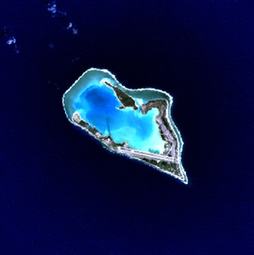
The United States Minor Outlying Islands are small uninhabited islands, atolls, and reefs. Baker Island, Howland Island, Jarvis Island, Johnston Atoll, Kingman Reef, Midway Atoll, Palmyra Atoll, and Wake Island are in the Pacific Ocean while Navassa Island is in the Caribbean Sea. The additional claimed territories of Bajo Nuevo Bank and Serranilla Bank are also located in the Caribbean Sea. Palmyra Atoll (formally known as the United States Territory of Palmyra Island)[119] is the only incorporated territory, a status it has maintained since Hawaii became a state in 1959.[12] All are uninhabited except for Midway Atoll, whose approximately 40 inhabitants (as of 2004) were employees of the U.S. Fish and Wildlife Service and their services provider;[120] Palmyra Atoll, whose population varies from four to 20 Nature Conservancy and Fish and Wildlife staff and researchers;[121] and Wake Island, which has a population of about 100 military personnel and civilian employees.[122] The two-letter abbreviation for the islands collectively is "UM".[96]
The status of several islands is disputed. Navassa Island is disputed by Haiti,[123] Wake Island is disputed by the Marshall Islands,[122] Swains Island (a part of American Samoa) is disputed by Tokelau,[124][48] and Bajo Nuevo Bank and Serranilla Bank (both administered by Colombia) are disputed by Colombia and Jamaica.[9][125]
| Name | Location | Area | Status | Notes |
|---|---|---|---|---|
| Baker Island[a] | Polynesia (North Pacific) | 2.1 km2 (0.81 sq mi) | Unincorporated, unorganized | Claimed under the Guano Islands Act on October 28, 1856.[126][127] Annexed on May 13, 1936, and placed under the jurisdiction of the United States Department of the Interior.[128] |
| Howland Island[a] | Polynesia (North Pacific) | 4.5 km2 (1.7 sq mi) | Unincorporated, unorganized | Claimed under the Guano Islands Act on December 3, 1858.[126][127] Annexed on May 13, 1936, and placed under the jurisdiction of the Interior Department.[128] |
| Jarvis Island[a] | Polynesia (South Pacific) | 4.75 km2 (1.83 sq mi) | Unincorporated, unorganized | Claimed under the Guano Islands Act on October 28, 1856.[126][127] Annexed on May 13, 1936, and placed under the jurisdiction of the Interior Department.[128] |
| Johnston Atoll[a] | Polynesia (North Pacific) | 2.67 km2 (1.03 sq mi) | Unincorporated, unorganized | Last used by the U.S. Department of Defense in 2004. |
| Kingman Reef[a] | Polynesia (North Pacific) | 18 km2 (6.9 sq mi) | Unincorporated, unorganized | Claimed under the Guano Islands Act on February 8, 1860.[126][127] Annexed on May 10, 1922, and placed under the jurisdiction of the Navy Department on December 29, 1934.[129] |
| Midway Atoll | Polynesia (North Pacific) | 6.2 km2 (2.4 sq mi) | Unincorporated, unorganized | Territory since 1859; primarily a National Wildlife Refuge and previously under the jurisdiction of the Navy Department. |
| Navassa Island | Caribbean (North Atlantic) | 5.4 km2 (2.1 sq mi) | Unincorporated, unorganized | Territory since 1857; also claimed by Haiti.[123] |
| Palmyra Atoll | Polynesia (North Pacific) | 12 km2 (5 sq mi) | Incorporated, unorganized | Partially privately owned by The Nature Conservancy, with much of the rest owned by the federal government and managed by the Fish and Wildlife Service.[130][131] It is an archipelago of about fifty small islands with a land area of about 1.56 sq mi (4.0 km2), about 1,000 miles (1,600 km) south of Oahu. The atoll was acquired through the annexation of the Republic of Hawaii in 1898. When the Territory of Hawaii was incorporated on April 30, 1900, Palmyra Atoll was incorporated as part of that territory. When Hawaii became a state in 1959, however, an act of Congress excluded the atoll from the state. Palmyra remained an incorporated territory, but received no new, organized government.[12] U.S. sovereignty over Palmyra Atoll (and Hawaii) is disputed by the Hawaiian sovereignty movement.[132][133] |
| Wake Island[a] | Micronesia (North Pacific) | 7.4 km2 (2.9 sq mi) | Unincorporated, unorganized | Territory since 1898; host to the Wake Island Airfield, administered by the U.S. Air Force. Wake Island is claimed by the Marshall Islands.[122] |
Claimed territories[edit]
The following two territories are claimed by multiple countries (including the United States)[9] and are not included in ISO 3166-2:UM. However, they are sometimes grouped with the U.S. Minor Outlying Islands. According to the GAO, "the United States conducts maritime law enforcement operations in and around Serranilla Bank and Bajo Nuevo [Bank] consistent with U.S. sovereignty claims."[9]
| Name | Location | Area | Status | Notes |
|---|---|---|---|---|
| Bajo Nuevo Bank | Caribbean (North Atlantic) | 110 km2 (42 sq mi) | Claimed | Controlled by Colombia. Claimed by the United States (under the Guano Islands Act) and Jamaica. A claim by Nicaragua was resolved in 2012 in favor of Colombia by the International Court of Justice, although the U.S. was not a party to that case and does not recognize the ICJ's compulsory jurisdiction.[134] |
| Serranilla Bank | Caribbean (North Atlantic) | 350 km2 (140 sq mi) | Claimed | Controlled by Colombia; site of a naval garrison. Claimed by the United States (since 1879 under the Guano Islands Act) and Jamaica. A claim by Nicaragua was resolved in 2012 in favor of Colombia by the International Court of Justice, although the United States was not a party to that case and does not recognize the ICJ's compulsory jurisdiction.[134] A claim by Honduras was settled in a 1986 treaty over maritime boundaries with Colombia.[135]
|
Incorporated vs. unincorporated territories[edit]


.jpg)

Pursuant to a series of Supreme Court rulings, Congress decides whether a territory is incorporated or unincorporated. The U.S. Constitution applies to each incorporated territory (including its local government and inhabitants) as it applies to the local governments and residents of a state. Incorporated territories are considered to be integral parts of the U.S., rather than possessions.[7][136]
In unincorporated territories, "fundamental rights apply as a matter of law, but other constitutional rights are not available", raising concerns about how citizens in these territories can influence politics in the United States.[137] Selected constitutional provisions apply, depending on congressional acts and judicial rulings according to U.S. constitutional practice, local tradition, and law.[citation needed] As a result, these territories are often considered colonies of the United States.[138][139]
All modern inhabited territories under the control of the federal government can be considered as part of the "United States" for purposes of law as defined in specific legislation.[140] However, the judicial term "unincorporated" was coined to legitimize the late-19th-century territorial acquisitions without citizenship and their administration without constitutional protections temporarily until Congress made other provisions. The case law allowed Congress to impose discriminatory tax regimes with the effect of a protective tariff upon territorial regions which were not domestic states.[141] In 2022, the United States Supreme Court in United States v. Vaello Madero held that the territorial clause of the constitution allowed wide congressional latitude in mandating "reasonable" tax and benefit schemes in Puerto Rico and the other territories, which are different from the states, but did not address the incorporated/unincorporated distinction. In a concurrence with the court's overall ruling on the propriety of the differential tax structures, one of the justices opined that it was time to overrule the incorporation doctrine, as wrongly decided and founded in racism, the dissent agreed.[142][143]
Insular Cases[edit]
The U.S. Supreme Court, in its 1901–1905 Insular Cases opinions, ruled that the Constitution extended ex proprio vigore (i.e., of its own force) to the continental territories. The Court also established the doctrine of territorial incorporation, in which the Constitution applies fully to incorporated territories (such as the then-territories of Alaska and Hawaii) and partially in the unincorporated territories of Puerto Rico, Guam and, at the time, the Philippines (which is no longer a U.S. territory).[144][145][146]
In the 1901 Supreme Court case Downes v. Bidwell, the Court said that the U.S. Constitution did not fully apply in unincorporated territories because they were inhabited by "alien races".[147][148]
The U.S. had no unincorporated territories (also known as overseas possessions or insular areas) until 1856. Congress enacted the Guano Islands Act that year, authorizing the president to take possession of unclaimed islands to mine guano. The U.S. has taken control of (and claimed rights on) many islands and atolls, especially in the Caribbean Sea and the Pacific Ocean, under this law; most have been abandoned. It also has acquired territories since 1856 under other circumstances, such as under the Treaty of Paris (1898) which ended the Spanish–American War. The Supreme Court considered the constitutional position of these unincorporated territories in 1922 in Balzac v. People of Porto Rico, and said the following about a U.S. court in Puerto Rico:
The United States District Court is not a true United States court established under article 3 of the Constitution to administer the judicial power of the United States ... It is created ... by the sovereign congressional faculty, granted under article 4, 3, of that instrument, of making all needful rules and regulations respecting the territory belonging to the United States. The resemblance of its jurisdiction to that of true United States courts, in offering an opportunity to nonresidents of resorting to a tribunal not subject to local influence, does not change its character as a mere territorial court.[149]: 312
In Glidden Company v. Zdanok, the Court cited Balzac and said about courts in unincorporated territories: "Upon like considerations, Article III has been viewed as inapplicable to courts created in unincorporated territories outside the mainland ... and to the consular courts established by concessions from foreign countries".[150]: 547 The judiciary determined that incorporation involves express declaration or an implication strong enough to exclude any other view, raising questions about Puerto Rico's status.[151]
In 1966, Congress made the United States District Court for the District of Puerto Rico an Article III district court. This (the only district court in a U.S. territory) sets Puerto Rico apart judicially from the other unincorporated territories, and U.S. district judge Gustavo Gelpí has expressed the opinion that Puerto Rico is no longer unincorporated:
The court ... today holds that in the particular case of Puerto Rico, a monumental constitutional evolution based on continued and repeated congressional annexation has taken place. Given the same, the territory has evolved from an unincorporated to an incorporated one. Congress today, thus, must afford Puerto Rico and the 4,000,000 United States citizens residing therein all constitutional guarantees. To hold otherwise, would amount to the court blindfolding itself to continue permitting Congress per secula seculorum to switch on and off the Constitution.[152]
In Balzac, the Court defined "implied":[149]: 306
Had Congress intended to take the important step of changing the treaty status of Puerto Rico by incorporating it into the Union, it is reasonable to suppose that it would have done so by the plain declaration, and would not have left it to mere inference. Before the question became acute at the close of the Spanish War, the distinction between acquisition and incorporation was not regarded as important, or at least it was not fully understood and had not aroused great controversy. Before that, the purpose of Congress might well be a matter of mere inference from various legislative acts; but in these latter days, incorporation is not to be assumed without express declaration, or an implication so strong as to exclude any other view.
On June 5, 2015, the U.S. Court of Appeals for the District of Columbia ruled 3–0 in Tuaua v. United States to deny birthright citizenship to American Samoans, ruling that the guarantee of such citizenship to citizens in the Fourteenth Amendment does not apply to unincorporated U.S. territories. In 2016 the U.S. Supreme Court declined to review the appellate court's decision.[153]
In 2018, the United States Court of Appeals for the 7th Circuit upheld the District Court decision in Segovia v. United States, which ruled that former Illinois residents living in Puerto Rico, Guam, and the U.S. Virgin Islands did not qualify to cast overseas ballots according to their last registered address on the U.S. mainland.[154] (Residents of the Northern Marianas and American Samoa, however, were still allowed to cast such ballots.) In October 2018, the U.S. Supreme Court declined to review the 7th Circuit's decision.
On June 15, 2021, the United States Court of Appeals for the Tenth Circuit ruled 2–1 in Fitisemanu v. United States to deny birthright citizenship to American Samoans and not to overrule the Insular Cases. The court cited Downes and ruled that "neither constitutional text nor Supreme Court precedent" demands that American Samoans should be given automatic birthright citizenship.[155] The case was denied certiorari by the U.S. Supreme Court.[156] On April 21, 2022, in the case United States v. Vaello Madero, Justice Gorsuch urged the Supreme Court to overrule the Insular Cases when possible as they "rest on a rotten foundation" and called the cases "shameful".[157][158][159]
In analyzing the Insular Cases, Christina Duffy Ponsa (Juris Doctor, Yale Law School, 1998; former law clerk for Justice Stephen Breyer[160]) wrote in the New York Times: "To be an unincorporated territory is to be caught in limbo: although unquestionably subject to American sovereignty, they are considered part of the United States for certain purposes but not others. Whether they are part of the United States for purposes of the Citizenship Clause remains unresolved. "[6]
Supreme Court decisions about current territories[edit]
The 2016 Supreme Court case Puerto Rico v. Sanchez Valle ruled that territories do not have their own sovereignty.[4] That year, the Supreme Court declined to rule on a lower-court ruling in Tuaua v. United States that American Samoans are not U.S. citizens at birth.[33][34]
The Supreme Court ruled in 2022 in United States v. Vaello-Madero that Congress is not required to extend all benefits to Puerto Ricans, and that the exclusion of Puerto Ricans from the Supplemental Security Income program was constitutional.[161]
Supreme Court decisions about former territories[edit]
In Rassmussen v. U.S., the Supreme Court quoted from Article III of the 1867 treaty for the purchase of Alaska:
"The inhabitants of the ceded territory ... shall be admitted to the enjoyment of all the rights, advantages, and immunities of citizens of the United States ..." This declaration, although somewhat changed in phraseology, is the equivalent ... of the formula, employed from the beginning to express the purpose to incorporate acquired territory into the United States, especially in the absence of other provisions showing an intention to the contrary.[162]: 522
The act of incorporation affects the people of the territory more than the territory itself by extending the Privileges and Immunities Clause of the Constitution to them, such as its extension to Puerto Rico in 1947; however, Puerto Rico remains unincorporated.[151]
Alaska Territory[edit]
Rassmussen arose from a criminal conviction by a six-person jury in Alaska under federal law. The court held that Alaska had been incorporated into the U.S. in the treaty of cession with Russia,[163] and the congressional implication was strong enough to exclude any other view:[162]: 523
That Congress, shortly following the adoption of the treaty with Russia, clearly contemplated the incorporation of Alaska into the United States as a part thereof, we think plainly results from the act of July 20, 1868, concerning internal revenue taxation ... and the act of July 27, 1868 ... extending the laws of the United States relating to customs, commerce, and navigation over Alaska, and establishing a collection district therein ... And this is fortified by subsequent action of Congress, which it is unnecessary to refer to.
Concurring justice Henry Brown agreed:[162]: 533–34
Apparently, acceptance of the territory is insufficient in the opinion of the court in this case, since the result that Alaska is incorporated into the United States is reached, not through the treaty with Russia, or through the establishment of a civil government there, but from the act ... extending the laws of the United States relating to the customs, commerce, and navigation over Alaska, and establishing a collection district there. Certain other acts are cited, notably the judiciary act ... making it the duty of this court to assign ... the several territories of the United States to particular Circuits.
Florida Territory[edit]
In Dorr v. U.S., the court quoted Chief Justice John Marshall from an earlier case:[164]: 141–2
The 6th article of the treaty of cession contains the following provision: "The inhabitants of the territories which His Catholic Majesty cedes the United States by this treaty shall be incorporated in the Union of the United States as soon as may be consistent with the principles of the Federal Constitution and admitted to the enjoyment of the privileges, rights, and immunities of the citizens of the United States ..." This treaty is the law of the land and admits the inhabitants of Florida to the enjoyment of the privileges, rights, and immunities of the citizens of the United States. It is unnecessary to inquire whether this is not their condition, independent of stipulation. They do not, however, participate in political power; they do not share in the government till Florida shall become a state. In the meantime Florida continues to be a territory of the United States, governed by virtue of that clause in the Constitution which empowers Congress "to make all needful rules and regulations respecting the territory or other property belonging to the United States".
In Downes v. Bidwell, the court said: "The same construction was adhered to in the treaty with Spain for the purchase of Florida ... the 6th article of which provided that the inhabitants should 'be incorporated into the Union of the United States, as soon as may be consistent with the principles of the Federal Constitution'."[165]: 256
Southwest Territory[edit]
Justice Brown first mentioned incorporation in Downes:[165]: 321–22
In view of this it cannot, it seems to me, be doubted that the United States continued to be composed of states and territories, all forming an integral part thereof and incorporated therein, as was the case prior to the adoption of the Constitution. Subsequently, the territory now embraced in the state of Tennessee was ceded to the United States by the state of North Carolina. To ensure the rights of the native inhabitants, it was expressly stipulated that the inhabitants of the ceded territory should enjoy all the rights, privileges, benefits, and advantages set forth in the ordinance of the late Congress for the government of the western territory of the United States.
Louisiana Territory[edit]
In Downes, the court said:
Owing to a new war between England and France being upon the point of breaking out, there was need for haste in the negotiations, and Mr. Livingston took the responsibility of disobeying his (Mr. Jefferson's) instructions, and, probably owing to the insistence of Bonaparte, consented to the 3d article of the treaty (with France to acquire the territory of Louisiana), which provided that "the inhabitants of the ceded territory shall be incorporated in the Union of the United States, and admitted as soon as possible, according to the principles of the Federal Constitution, to the enjoyment of all the rights, advantages, and immunities of citizens of the United States; and in the meantime they shall be maintained and protected in the free enjoyment of their liberty, property, and the religion which they profess." [8 Stat. at L. 202.] This evidently committed the government to the ultimate, but not to the immediate, admission of Louisiana as a state ...[165]: 252
Modern Puerto Rico[edit]
Scholars agreed as of 2009 in the Boston College Law Review, "Regardless of how Puerto Rico looked in 1901 when the Insular Cases were decided, or in 1922, today, Puerto Rico seems to be the paradigm of an incorporated territory as modern jurisprudence understands that legal term of art".[166] In November 2008, a district court judge ruled that a sequence of prior Congressional actions had the cumulative effect of changing Puerto Rico's status to incorporated.[167] In 2022, the United States Supreme Court held that the territorial clause of the constitution allowed wide congressional latitude in mandating "reasonable" tax and benefit schemes in Puerto Rico and the other territories that are different from the states, but did not address the incorporated/unincorporated distinction. In a concurrence, one of the justices opined that it was time to overrule the Insular Cases and the incorporation doctrine, as wrongly decided.[142]
Former territories and administered areas[edit]

Formerly unorganized territories[edit]
At various times during the 19th century, large parts of the Great Plains were unorganized territory. After the Louisiana Purchase from France in 1803, the entire region was part of the Louisiana Territory until 1812 and the Missouri Territory until 1821. In 1821, the Missouri Compromise created the State of Missouri from the territory, and the rest of the region was left unorganized. The Kansas–Nebraska Act of 1854 created the Kansas and Nebraska Territories, bringing organized government to the region once again. The creation of Kansas and Nebraska left the Indian Territory as the only unorganized territory in the Great Plains.
In 1858, the western part of the Minnesota Territory became unorganized when it was not included in the new state of Minnesota; this area was organized in 1861 as part of the Dakota Territory. On May 2, 1890, the western half of the Indian Territory was organized as Oklahoma. The remainder was incorporated into the State of Oklahoma upon its admission to the union in 1907.
Alaska was an unorganized territory between its acquisition from Russia in 1867 and the creation of Alaska Territory in 1912. Hawaii was as well from the time of its annexation by the U.S. in 1898 until organized as Hawaii Territory in 1900.
Former organized incorporated territories[edit]
- (All areas that have become U.S. states outside of the Thirteen Colonies)
Former unincorporated territories[edit]
- Swan Islands (1863–1972): claimed under the Guano Islands Act; sovereignty ceded to Honduras in a 1972 treaty.[168]
- Republic of Hawaii (1898–1900): became the Territory of Hawaii after it was incorporated by the Hawaiian Organic Act on April 30, 1900.[169]
- Philippines: military government, 1899–1902; insular government, 1902–1935; commonwealth government, 1935–1942 and 1945–1946 (islands under Japanese occupation, 1942–1945 and puppet state, 1943–1945); granted independence on July 4, 1946.[170]
- Puerto Rico: military government, 1899–1900; insular government, 1900–1952; became a commonwealth on July 25, 1952.
Former U.S.-administered areas[edit]
- American Concession in Shanghai (1848–1863): A former enclave in modern-day Shanghai China
- Puerto Rico (1898–1899)
- Philippines (1898–1899)
- Cuba (1898–1902)
- Panama Canal (1903–1999): Canal Zone abolished on October 1, 1979, after the signing of the Torrijos–Carter Treaties in 1977. The U.S. retained a military base on the former Canal Zone until December 31, 1999, when joint U.S.-Panama control of the Panama Canal ended.
- Corn Islands (1914–1971): leased for 99 years under the Bryan–Chamorro Treaty, but returned to Nicaragua after the treaty was annulled in 1970
- Canton and Enderbury Islands (1939–1979): Condominium jointly administered by the United States and the United Kingdom
- Nanpō Islands and Marcus Island (1945–1968): Occupied after World War II, and returned to Japan by mutual agreement
- Trust Territory of the Pacific Islands (1947–1986): U.N. trust territory administered by the U.S.; included the Marshall Islands, the Federated States of Micronesia, and Palau, which are sovereign states (that have entered into a Compact of Free Association with the U.S.), along with the Commonwealth of the Northern Mariana Islands
- Ryukyu Islands, including Okinawa (1952–1972): returned to Japan in an agreement including the Daitō Islands[171]
Former U.S. military occupations[edit]
- Provisional Government of Cuba (1906–1909)
- United States occupation of Nicaragua (1912–1933)
- United States occupation of Veracruz (1914)
- United States occupation of Haiti (1915–1934)
- United States occupation of the Dominican Republic (1916–1924)
- Sugar Intervention (1917–1922)
- Participation in the Occupation of Austria-Hungary (1918–1919)
- Participation in the Occupation of the Rhineland (1918–1921)
- Participation in the Occupation of Constantinople (1918–1923)
- Occupation of Greenland in World War II (1941–1945)[172]
- Occupation of Iceland in World War II (1941–1946);[172] military base retained until 2006
- Allied Military Government for Occupied Territories, in Allied-controlled sections of Italy from the July 1943 invasion of Sicily until the September armistice with Italy. AMGOT continued in newly liberated areas of Italy until the end of the war, and also existed in France.[citation needed]
- Clipperton Island (1944–1945): occupied territory, returned to France on October 23, 1945
- United States Army Military Government in Korea: Occupation south of the 38th parallel from 1945 to 1948
- American zones of Allied-occupied Germany (1945–1949)
- Occupation of Japan (1945–1952) after World War II
- American occupation zones in Allied-occupied Austria and Vienna (1945–1955)
- American occupation zone in West Berlin (1945–1990)
- Free Territory of Trieste (1947–1954): The U.S. co-administered a portion of the territory (between the Kingdom of Italy and the former Kingdom of Yugoslavia) with the United Kingdom
- Dominican Civil War (1965–66)
- Grenada invasion and occupation (1983)
- Panama invasion and occupation (1989–1990)
- Operation Uphold Democracy (1994–1995)
- Coalition Provisional Authority (Iraq, 2003–2004)
- Green Zone, Iraq (March 20, 2003 – December 31, 2008)[173]
Flora and fauna[edit]
The territories of the United States have many plant and animal species found nowhere else in the United States. All U.S. territories have tropical climates and ecosystems.[174]
Forests[edit]

The USDA says the following about the U.S. territories (plus Hawaii):
[The U.S. territories, plus Hawaii] include virtually all the Nation's tropical forests as well as other forest types including subtropical, coastal, subalpine, dry limestone, and coastal mangrove forests. Although distant from America's geographic center and from each other—and with distinctive flora and fauna, land use history, and individual forest issues—these rich and diverse ecosystems share a common bond of change and challenge.[174]
Forests in the U.S. territories are vulnerable to invasive species and new housing developments.[174] El Yunque National Forest in Puerto Rico is the only tropical rain forest in the United States National Forest system.[175]
American Samoa has 80.84% forest cover and the Northern Mariana Islands has 80.37% forest cover—these are among the highest forest cover percentages in the United States (only Maine and New Hampshire are higher).[176][note 18]
Birds[edit]


U.S. territories have many bird species that are endemic (not found in any other location).[174]
Introduction of the invasive brown tree snake has harmed Guam's native bird population—nine of twelve endemic species have become extinct, and the territorial bird (the Guam rail) is extinct in the wild.[174]
Puerto Rico has several endemic bird species, such as the critically endangered Puerto Rican parrot, the Puerto Rican flycatcher, and the Puerto Rican spindalis.[177] The Northern Mariana Islands has the Mariana swiftlet, Mariana crow, Tinian monarch and golden white-eye (all endemic).[178] Birds found in American Samoa include the many-colored fruit dove,[179] the blue-crowned lorikeet, and the Samoan starling.[180]
The Wake Island rail (now extinct) was endemic to Wake Island,[181] and the Laysan duck is endemic to Midway Atoll and the Northwest Hawaiian Islands.[182] Palmyra Atoll has the second-largest red-footed booby colony in the world,[183] and Midway Atoll has the largest breeding colony of Laysan albatross in the world.[184][185]
The American Birding Association currently excludes the U.S. territories from their "ABA Area" checklist.[186]
Other animals[edit]
American Samoa has several reptile species, such as the Pacific boa (on the island of Ta‘ū) and Pacific slender-toed gecko.[187] American Samoa has only a few mammal species, such as the Pacific (Polynesian) sheath-tailed bat, as well as oceanic mammals such as the Humpback whale.[188][189] Guam and the Northern Mariana Islands also have a small number of mammals, such as the Mariana fruit bat;[190] oceanic mammals include Fraser's dolphin and the Sperm whale. The fauna of Puerto Rico includes the common coquí (frog),[191] while the fauna of the U.S. Virgin Islands includes species found in Virgin Islands National Park (including 302 species of fish).[192]
American Samoa has a location called Turtle and Shark which is important in Samoan culture and mythology.[193]
Protected areas[edit]
There are two National Parks in the U.S. territories: the National Park of American Samoa, and Virgin Islands National Park.[194][195] The National Park Service also manages War in the Pacific National Historical Park on Guam.[196] There are also National Natural Landmarks, National Wildlife Refuges (such as Guam National Wildlife Refuge), El Yunque National Forest in Puerto Rico, and the Pacific Remote Islands Marine National Monument (which includes the U.S. Minor Outlying Islands).
Public image[edit]

In The Not-Quite States of America, his book about the U.S. territories, essayist Doug Mack said:
It seemed that right around the turn of the twentieth century, the territories were part of the national mythology and the everyday conversation ... A century or so ago, Americans didn't just know about the territories but cared about them, argued about them. But what changed? How and why did they disappear from the national conversation?[197] The territories have made us who we are. They represent the USA's place in the world. They've been a reflection of our national mood in nearly every period of American history.[198]
Representative Stephanie Murphy of Florida said about a 2018 bill to make Puerto Rico the 51st state, "The hard truth is that Puerto Rico's lack of political power allows Washington to treat Puerto Rico like an afterthought."[199] According to Governor of Puerto Rico Ricardo Rosselló, "Because we don't have political power, because we don't have representatives, [no] senators, no vote for president, we are treated as an afterthought."[200] Rosselló called Puerto Rico the "oldest, most populous colony in the world".
Rosselló and others have referred to the U.S. territories as American "colonies".[201][202][203][204][6] David Vine of The Washington Post said the following: "The people of [the U.S. territories] are all too accustomed to being forgotten except in times of crisis. But being forgotten is not the worst of their problems. They are trapped in a state of third-class citizenship, unable to access full democratic rights because politicians have long favored the military's freedom of operation over protecting the freedoms of certain U.S. citizens."[204] In his article "How the U.S. Has Hidden Its Empire", Daniel Immerwahr of The Guardian writes, "The confusion and shoulder-shrugging indifference that mainlanders displayed [toward territories] at the time of Pearl Harbor hasn't changed much at all. [...] [Maps of the contiguous U.S.] give [mainlanders] a truncated view of their own history, one that excludes part of their country."[202] The 2020 U.S. Census excludes non-citizen U.S. nationals in American Samoa—in response to this, Mark Stern of Slate said, "The Census Bureau's total exclusion of American Samoans provides a pertinent reminder that, until the courts step in, the federal government will continue to treat these Americans with startling indifference."[205]
Galleries[edit]
Members of the House of Representatives (non-voting)[edit]
-
 Amata Coleman Radewagen (R), (American Samoa)
 -
 James Moylan (R), (Guam)
 -
 Gregorio Sablan (D), (Northern Mariana Islands)
 -
 Jenniffer González (R), (Puerto Rico)
 -
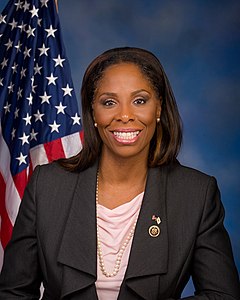 Stacey Plaskett (D), (U.S. Virgin Islands)

.jpg)


.jpg)
Territorial governors[edit]
-
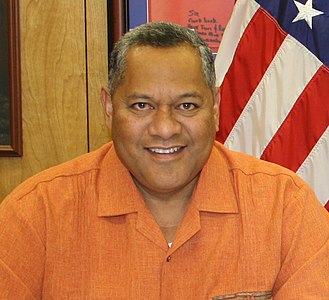 Lemanu Peleti Mauga (NP-D), (American Samoa)
 -
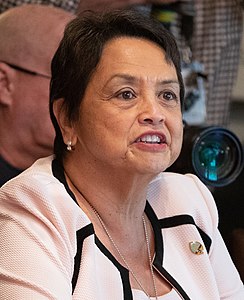 Lou Leon Guerrero (D), (Guam)
 -
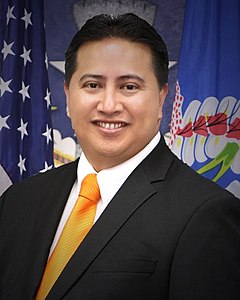
-

-
 Albert Bryan (D), (U.S. Virgin Islands)


Satellite images[edit]


-
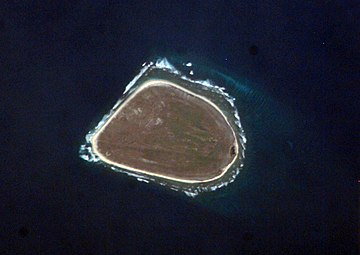 Baker Island
 -
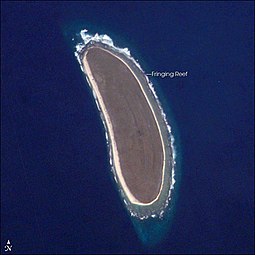 Howland Island
 -
 Jarvis Island
 -
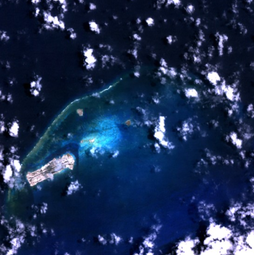 Johnston Atoll
 -
 Kingman Reef
 -
 Midway Atoll
 -
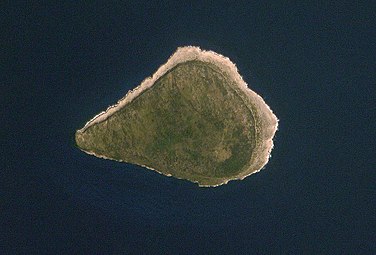 Navassa Island
 -
 Palmyra Atoll
 -
 Wake Island


Maps[edit]
-
 American Samoa
 -
 Guam
Guam -
 Northern Mariana Islands
 -
 Puerto Rico
 -
 U.S. Virgin Islands
 -


_-_GUM_-_UNOCHA.svg)

.png)


See also[edit]

More detail on all current territories[edit]
- Article indexes: AS, GU, MP, PR, VI
- Congressional districts: AS, GU, MP, PR, VI
- Geography: AS, GU, MP, PR, VI
- Geology: AS, GU, MP, PR, VI
- List of museums in the unincorporated territories of the United States
- List of U.S. National Historic Landmarks in the U.S. territories
- Outlines: AS, GU, MP, PR, VI
- Per capita income: AS, GU, MP, PR, VI
- Territories of the United States on stamps
- U.S. National Historic Places: AS, GU, MP, PR, VI, UM
Related topics[edit]
- Colony of Liberia, established by Americans but never under administration of the United States
- Enabling act (United States)
- Guantanamo Bay Naval Base, a military base of the United States Navy in Cuba under a perpetual lease
- Historic regions of the United States
- Insular area
- List of extreme points of the United States
- List of states and territories of the United States
- Organic act
- Organized incorporated territories of the United States
- Territorial evolution of the United States
- U.S. territorial sovereignty
- U.S. Caribbean region
Notes[edit]
- ^ "Commonwealth" does not describe a political status, and has been applied to states and territories. When used for U.S. non-states, the term describes a self-governed area with a constitution whose right of self-government will not be unilaterally withdrawn by Congress.[1]
- ^ According to the 2016 Supreme Court ruling Puerto Rico v. Sanchez Valle, territories are not sovereign[4]
- ^ Two additional territories (Bajo Nuevo Bank and Serranilla Bank) are claimed by the United States but administered by Colombia—if these two territories are counted, the total number of U.S. territories is sixteen.
- ^ The U.S. General Accounting Office reports, "Some residents of the Stewart Islands in the Solomon Islands group [ Sikaiana ] ... claim that they are native Hawaiians and U.S. citizens. ... They base their claim on the assertion that the Stewart Islands were ceded to King Kamehameha IV and accepted by him as part of the Kingdom of Hawaii in 1856 and, thus, were part of the Republic of Hawaii (which was declared in 1893) when it was annexed to the United States by law in 1898." However, Sikaiana was not included within "Hawaii and its dependencies".[13]
- ^ Two territories (Puerto Rico and the Northern Mariana Islands) are called "commonwealths".
- ^ The New York Times notes, "Even in [the four] territories, where statutory birthright citizenship has provided a makeshift solution for many decades, doubt, confusion and anxiety over the extent to which citizenship is constitutionally guaranteed have persisted for more than a century."[6]
- ^ In Tuaua v. United States, the DC Circuit ruled that citizenship-at-birth is not a right in unincorporated regions of the U.S.—current citizenship-at-birth in Puerto Rico, the U.S. Virgin Islands, Guam and the Northern Mariana Islands exists only because the U.S. Congress passed legislation granting it for those territories, and Congress has not done so for American Samoa.[30] The Supreme Court declined to rule on the case.[33][34] In 2021, the 10th Circuit ruled similarly in Fitisemanu v. United States.[35]
- ^ In parts of the United States other than American Samoa, non-citizen U.S. nationals cannot work in certain government jobs, vote or be elected for federal, state or most local government offices.[32][38] For those who apply for naturalization, there is no guarantee that they will become U.S. citizens.[32]
- ^ SSI benefits are available only in the fifty states, the District of Columbia and the Northern Mariana Islands
- ^ American Samoa, technically unorganized, is de facto organized.
- ^ The administrative center of the Northern Mariana Islands is Capitol Hill, Saipan. However, because Saipan is governed as a single municipality, most publications refer to the capital as "Saipan".
- ^ The largest village within Saipan is Garapan.
- ^ U.S. sovereignty took effect on November 3, 1986 (Eastern Time) and on November 4, 1986 (local Northern Mariana Islands Chamorro Time).[61]
- ^ The revised constitution of American Samoa was approved on June 2, 1967, by Stewart L. Udall, then U.S. Secretary of the Interior, under authority granted on June 29, 1951. It became effective on July 1, 1967.[67]
- ^ 2017 poverty rate;[20] in 2009, American Samoa's poverty rate was 57.8%[88]
- ^ The largest racial group is white, in addition to Hispanic/Latino.[51]
- ^ American Samoa is divided into counties, but the U.S. Census Bureau treats them as minor civil divisions.[94][95]
- ^ The forest cover percentage for the Northern Mariana Islands is for the three main islands only (Saipan, Tinian, and Rota).
References[edit]
- ^ "Definition of Terms—1120 Acquisition of U.S. Nationality in U.S. Territories and Possessions". U.S. Department of State Foreign Affairs Manual Volume 7—Consular Affairs. U.S. Department of State. Archived from the original (PDF) on December 22, 2015. Retrieved January 10, 2016.
- ^ a b c "Table A. Apportionment Population, Resident Population, and Overseas Population: 2020 Census and 2010 Census" (PDF). U.S. Census Bureau. Archived (PDF) from the original on April 26, 2021. Retrieved February 11, 2023.
- ^ a b c "2020 Population of U.S. Island Areas Just Under 339,000". U.S. Census Bureau. Archived from the original on November 21, 2021. Retrieved February 11, 2023.
- ^ a b c Wolf, Richard (June 9, 2016). "Puerto Rico not sovereign, Supreme Court says". USA Today. Archived from the original on December 17, 2019. Retrieved January 19, 2018.
- ^ a b "Definitions of Insular Area Political Organizations". U.S. Department of the Interior. June 12, 2015. Archived from the original on July 13, 2018. Retrieved September 27, 2017.
- ^ a b c d Duffy Ponsa, Christina (June 8, 2016). "Are American Samoans American?". The New York Times. Archived from the original on September 4, 2020. Retrieved July 4, 2019.
- ^ a b "Chapter 2: Introduction." (PDF). Renewable Resource Management for U.S. Insular Areas—Integrated. Princeton.edu (Report). p. 40. Retrieved July 4, 2019.
- ^ a b "What Are The US Territories?". worldatlas.com. Archived from the original on July 24, 2020. Retrieved July 4, 2019.
- ^ a b c d e f g h i "U.S. Insular Areas: application of the U.S. Constitution" (PDF). U.S. General Accounting Office Report. November 1997. pp. 10 / 1, 6, 39 / 8, 14, 26–28. Archived from the original (PDF) on November 3, 2013. Retrieved June 30, 2019.
- ^ a b "Introduction – Harvard Law Review". April 10, 2017. Archived from the original on July 31, 2020. Retrieved July 5, 2019. Harvard Law Review—U.S. Territories: Introduction. April 10, 2017. Retrieved July 2019.
- ^ Perez, Lisa Marie (June 2008). "Citizenship Denied: The 'Insular Cases' and the Fourteenth Amendment". Virginia Law Review. 94 (4): 1029–1081. JSTOR 25470577. Archived from the original on July 21, 2019. Retrieved December 9, 2021.
- ^ a b c "Palmyra Atoll". U.S. Department of the Interior Office of Insular Affairs. Archived from the original on September 10, 2015. Retrieved June 23, 2010.
- ^ U.S. Insular Areas. Application of the U.S. Constitution (PDF) (Report). United States General Accounting Office. November 1997. p. 39. Retrieved September 19, 2018.
- ^ Van Dyke, Jon M.; Richardson, William S. (March 23, 2007). "Unresolved Maritime Boundary Problems in the Caribbean" (PDF). Harte Research Institute for Gulf of Mexico Studies. Archived from the original (PDF) on January 31, 2018. Retrieved January 30, 2018.
- ^ "Bajo Nuevo Bank (Petrel Islands) and Serranilla Bank". Wondermondo.com. October 2012. Archived from the original on January 31, 2018. Retrieved January 30, 2018.
- ^ United States Summary, 2010: Population and housing unit counts. U.S. Department of Commerce, Economics and Statistics Administration, U.S. Census Bureau. 2012. Archived from the original on June 30, 2023. Retrieved September 26, 2020.
- ^ Smith, Gary Alden (February 28, 2011). State and National Boundaries of the United States. McFarland. p. 170. ISBN 9781476604343. Archived from the original on June 30, 2023. Retrieved September 26, 2020.
- ^ "The last time Congress created a new state". Philadelphia, Pennsylvania: National Constitution Center. March 12, 2020. Archived from the original on February 8, 2023. Retrieved February 6, 2023.
- ^ Murph, Darren. "The most expensive internet in America: fighting to bring affordable broadband to American Samoa". Engadget. Archived from the original on December 1, 2017. Retrieved November 24, 2017.
- ^ a b Sagapolutele, Fili (March 2, 2017). "American Samoa Governor Says Small Economies 'Cannot Afford Any Reduction In Medicaid' | Pacific Islands Report". www.pireport.org. Archived from the original on February 24, 2021. Retrieved January 9, 2018.
- ^ "Poverty Determination in U.S. Insular Areas" (PDF). Archived (PDF) from the original on April 12, 2019. Retrieved January 9, 2018.
- ^ U.S. Const. art. IV, § 3, cl. 2 ("The Congress shall have Power to dispose of and make all needful Rules and Regulations respecting the Territory or other Property belonging to the United States ...").
- ^ Riccards, Michael P. (1997). "Lincoln and the Political Question: The Creation of the State of West Virginia". Presidential Studies Quarterly. 27 (3): 549–564. Archived from the original on June 28, 2011.
- ^ Philippine Organic Act of 1902, Ch. 1369, 32 Stat. 691
- ^ Jones Law of 1916, 39 Stat. 545
- ^ Tydings-McDuffie Act, 48 Stat. 456
- ^ Truman, Harry S. (July 4, 1946). "Independence of the Philippines, Proclamation 2695 s 1946". The American Presidench Project, UC Santa Barbara.
- ^ "Puerto Rico". www.doi.gov. June 11, 2015. Archived from the original on August 4, 2021. Retrieved August 30, 2021.
- ^ a b c d e f "American Samoa | Culture, History, & People". Encyclopedia Britannica. Archived from the original on August 31, 2022. Retrieved November 12, 2018.
- ^ a b c "American Samoa and the Citizenship Clause: A Study in Insular Cases Revisionism". Harvard Law Review. April 10, 2017. Archived from the original on December 18, 2019. Retrieved January 5, 2018.
- ^ "Am Samoans aren't actually citizens". Samoa News. April 8, 2018. Archived from the original on January 30, 2020. Retrieved July 1, 2019.
- ^ a b c Brady, Heather (March 30, 2018). "Why Are American Samoans Not U.S. Citizens?". National Geographic. Archived from the original on March 31, 2018. Retrieved July 1, 2019.
- ^ a b Savage, David G. (June 13, 2016). "Supreme Court rejects citizenship for American Samoans". Los Angeles Times. Archived from the original on January 31, 2018. Retrieved January 30, 2018.
- ^ a b "About the Case – Equally American". Equal Rights Now. Archived from the original on January 17, 2018. Retrieved January 30, 2018.
- ^ Pampuro, Amanda (June 16, 2021). "American Samoans Are Not Born Into US Citizenship". Courthouse News Service. Archived from the original on September 13, 2021. Retrieved September 14, 2021.
- ^ "8 FAM 301.1-1(b)", State Department Foreign Affairs Manual (FAM), vol. 8, archived from the original on May 2, 2019, retrieved January 21, 2021
- ^ Keating, Joshua (June 15, 2015). "How Come American Samoans Still Don't Have U.S. Citizenship at Birth?". Slate. Archived from the original on October 19, 2018. Retrieved January 1, 2018.
- ^ a b c Simmons, Ann M. (April 6, 2018). "American Samoans Aren't Actually U.S. Citizens: Does That Violate The Constitution?". Los Angeles Times. Archived from the original on July 26, 2019. Retrieved July 1, 2019.
- ^ "Who is eligible for naturalization?" (PDF), A Guide to Naturalization, U.S. Citizenship and Immigration Services, archived (PDF) from the original on January 14, 2021, retrieved November 14, 2021
- ^ "Op-ed: "Lamentations of a third-class American Samoan citizen". Samoa News. July 23, 2018. Archived from the original on January 12, 2021. Retrieved November 14, 2021.
- ^ "Common Core Document of the United States of America". U.S. Department of State. December 30, 2011. Archived from the original on October 26, 2019. Retrieved September 3, 2015.
- ^ "The United Nations and Decolonization". United Nations. Archived from the original on February 27, 2014. Retrieved September 3, 2015.
- ^ "The House Explained". U.S. House of Representatives. Archived from the original on November 11, 2017. Retrieved January 26, 2013.
- ^ "United States House of Representatives Directory". Archived from the original on March 5, 2018. Retrieved February 11, 2023.
- ^ a b Locker, Melissa (March 9, 2015). "Watch John Oliver Cast His Ballot for Voting Rights for U.S. Territories". Time. Retrieved January 1, 2018.
- ^ a b Cohn, Alicia (September 19, 2018). "Puerto Rico governor asks Trump to consider statehood". The Hill. Archived from the original on November 30, 2019. Retrieved September 22, 2018.
- ^ "2016 Presidential Primaries, Caucuses, and Conventions Alphabetically by State". Green Papers. Archived from the original on January 30, 2022. Retrieved September 3, 2015.
- ^ a b c d e f g The World Factbook Archived January 29, 2021, at the Wayback Machine CIA World Factbook. American Samoa. Retrieved July 4, 2019.
- ^ a b c d e The World Factbook Archived January 26, 2021, at the Wayback Machine CIA World Factbook—Guam. Retrieved July 4, 2019.
- ^ a b c d e f g h "Australia—Oceania :: Northern Mariana Islands—The World Factbook—Central Intelligence Agency". CIA World Factbook. Archived from the original on January 24, 2021. Retrieved June 30, 2019.
- ^ a b c d e f g The World Factbook Archived January 5, 2021, at the Wayback Machine CIA World Factbook—Puerto Rico. Retrieved July 4, 2019.
- ^ a b c d e f The World Factbook Archived January 13, 2021, at the Wayback Machine CIA World Factbook—Virgin Islands (U.S.) Retrieved July 4, 2019.
- ^ "Dependencies and Areas of Special Sovereignty". U.S. Department of State. Archived from the original on June 21, 2022. Retrieved May 22, 2019.
- ^ Mack, Doug (2017). The Not-Quite States of America: Dispatches from the Territories and Other Far-Flung Outposts of the USA. W. W. Norton & Company. ISBN 978-0-393-24760-2.
- ^ Coto, Danica (February 4, 2019). "Judge's Ruling Pushes Puerto Rico to Pursue SSI Benefits". StarTribune. Archived from the original on February 5, 2019. Retrieved July 4, 2019.
- ^ Hurley, Lawrence (April 21, 2022). "U.S. Supreme Court allows Puerto Rico's exclusion from welfare program". Reuters. Archived from the original on April 21, 2022. Retrieved April 21, 2022.
- ^ "High Court upholds excluding Puerto Ricans from aid for disabled and blind". NPR. April 21, 2022. Archived from the original on April 22, 2022. Retrieved April 22, 2022.
- ^ "American Samoa". U.S. Department of the Interior. June 11, 2015. Archived from the original on March 9, 2018. Retrieved July 4, 2019.
- ^ "Immigration Office". American Samoa Department of Legal Affairs. Archived from the original on March 27, 2022. Retrieved February 28, 2020.
- ^ "American Samoa". Department of the Interior – American Samoa. Archived from the original on December 3, 2018. Retrieved July 26, 2020.
- ^ a b c d "8 FAM 302.2 Acquisition by Birth in the Commonwealth of the Northern Mariana Islands". fam.state.gov. Archived from the original on August 9, 2022. Retrieved June 9, 2020.
- ^ a b c Reagan, Ronald (November 3, 1986). – via Wikisource.
- ^ a b Firestone, Michelle (September 25, 2017). "Puerto Rico's Status Explained. ECSU Takes A Look At Island's History" (PDF). Archived from the original (PDF) on February 16, 2019. Retrieved November 13, 2018.
- ^ "Today in History – March 31 | Library of Congress". Library of Congress. Archived from the original on April 5, 2019. Retrieved July 5, 2019. Library of Congress. Today in History—March 31 (Virgin Islands). Retrieved July 4, 2019.
- ^ "History of Samoa—Samoa.travel". www.samoa.travel. Archived from the original on October 29, 2019. Retrieved November 12, 2018.
- ^ a b c "American Samoa". Pacific Islands Benthic Habitat Mapping Center. Archived from the original on January 30, 2022. Retrieved September 22, 2018.
- ^ IBP USA (2009), SAMOA American Country Study Guide: Strategic Information and Developments, Int'l Business Publications, pp. 49–64, ISBN 978-1-4387-4187-1, archived from the original on December 27, 2011, retrieved October 20, 2011
- ^ a b c "Guam | History, Geography, & Points of Interest". Encyclopedia Britannica. Archived from the original on January 25, 2021. Retrieved November 12, 2018.
- ^ a b c d "Northern Mariana Islands | history—geography". Encyclopedia Britannica. Archived from the original on January 26, 2021. Retrieved October 31, 2018.
- ^ "Trust Territory of the Pacific Islands | former United States territory, Pacific Ocean". Encyclopedia Britannica. Archived from the original on July 13, 2022. Retrieved October 31, 2018.
- ^ Farrel, Don (October 13, 2019). "History of Efforts to Reunify the Mariana Islands". Guampedia. Archived from the original on March 3, 2021. Retrieved February 21, 2021.
- ^ "Milestones: 1866–1898 - The Spanish-American War, 1898". Office of the Historian. Archived from the original on June 19, 2019. Retrieved November 12, 2018.
- ^ Amaya, Nigel (July 16, 2018). "When Did Puerto Rico Become a Commonwealth?". WorldAtlas. Archived from the original on April 5, 2020. Retrieved July 5, 2019. Worldatlas.com. "When Did Puerto Rico Become A Commonwealth?" Retrieved July 4, 2019.
- ^ "Puerto Rico – History and Heritage | Travel | Smithsonian Magazine". Archived from the original on August 1, 2019. Retrieved July 5, 2019. Smithsonian Magazine. Puerto Rico—History and Heritage. Retrieved July 4, 2019.
- ^ "Consejo de Salud Playa Ponce v. Johnny Rullan" (PDF). Archived (PDF) from the original on October 23, 2013. Retrieved January 28, 2013.
- ^ Gelpí, Hon. Gustavo A. "The Insular Cases: A Comparative Historical Study of Puerto Rico, Hawai'i, and the Philippines" (PDF). The Federal Lawyer (March/April 2011): 25. Archived from the original (PDF) on December 27, 2019. Retrieved February 18, 2019.
- ^ Stern, Mark Joseph (January 14, 2016). "The Supreme Court Ponders Whether Puerto Rico Is a Fake State or a Real Colony". Slate Magazine. Archived from the original on September 30, 2018. Retrieved January 19, 2018.
- ^ Mosbergen, Dominique (June 28, 2018). "Bipartisan Bill Seeks To Make Puerto Rico The 51st U.S. State By 2021". Huffington Post. Archived from the original on March 8, 2019. Retrieved September 22, 2018.
- ^ "8 U.S. Code § 1406—Persons living in and born in the Virgin Islands". LII / Legal Information Institute. Archived from the original on September 22, 2018. Retrieved September 21, 2018.
- ^ a b "Language situation in the U.S. | About World Languages". aboutworldlanguages.com. Archived from the original on April 17, 2019. Retrieved January 17, 2018.
- ^ a b "Virgin Islands Language". Virgin Islands. Archived from the original on April 7, 2016. Retrieved January 17, 2018.
- ^ "POVERTY STATUS IN 2009 BY AGE Universe: Population for whom poverty status is determined more information 2010 U.S. Virgin Islands Summary File". U. S. Census Bureau. Archived from the original on January 17, 2019. Retrieved January 9, 2018.
"POVERTY STATUS IN 2009 BY AGE Universe: Population for whom poverty status is determined more information 2010 Guam Summary File". U. S. Census Bureau. Archived from the original on January 17, 2019. Retrieved January 9, 2018.
"POVERTY STATUS IN 2009 BY AGE Universe: Population for whom poverty status is determined more information 2010 Commonwealth of the Northern Mariana Islands Summary File". U. S. Census Bureau. Archived from the original on January 17, 2019. Retrieved January 9, 2018.
"POVERTY STATUS IN 2009 BY AGE Universe: Population for whom poverty status is determined more information 2010 American Samoa Summary File". U. S. Census Bureau. Archived from the original on January 17, 2019. Retrieved January 9, 2018. - ^ "U.S. Census Bureau QuickFacts: Puerto Rico". U. S. Census Bureau. Archived from the original on March 30, 2021. Retrieved January 9, 2018.
- ^ "Life expectancy at birth, total (years) – Puerto Rico, Guam, Virgin Islands (U.S.) | Data". Archived from the original on July 27, 2020. Retrieved July 27, 2020. Worldbank.org. Life Expectancy at birth (Puerto Rico, Guam, Virgin Islands (U.S.)) Retrieved July 26, 2020.
- ^ A. Hastings, David. "Filling Gaps In The Human Development Index: Findings For Asia And The Pacific" (PDF). United Nations Economic and Social Commission for Asia and the Pacific (ESCAP). Archived (PDF) from the original on November 29, 2014. Retrieved January 9, 2018.
- ^ R. Fuentes-Ramírez, Ricardo (May 14, 2017). "Human Development Index Trends and Inequality in Puerto Rico 2010–2015". Ceteris Paribus. Archived from the original on October 20, 2017. Retrieved January 9, 2018.
- ^ a b "American Samoa | Data". data.worldbank.org. Archived from the original on August 30, 2019. Retrieved June 30, 2019.
"Virgin Islands (U.S.) | Data". data.worldbank.org. Archived from the original on September 9, 2022. Retrieved June 30, 2019.
"Northern Mariana Islands | Data". data.worldbank.org. Archived from the original on September 9, 2022. Retrieved June 30, 2019.
"Guam | Data". data.worldbank.org. Archived from the original on September 9, 2022. Retrieved June 30, 2019.
"Puerto Rico | Data". data.worldbank.org. Archived from the original on February 15, 2020. Retrieved June 30, 2019. - ^ "GAO—American Samoa and the Commonwealth of the Northern Mariana Islands—Economic Indicators Since Minimum Wage Increases Began" (PDF). U.S. Government Accountability Office. March 2014. p. 39. Archived (PDF) from the original on January 18, 2021. Retrieved October 7, 2018.
- ^ "Profile of General Demographic Characteristics: 2010. 2010 American Samoa Demographic Profile Data". American Factfinder. Archived from the original on May 3, 2017.
- ^ "Profile of General Demographic Characteristics: 2010. 2010 Guam Demographic Profile Data". American FactFinder. Archived from the original on February 14, 2020. Retrieved July 4, 2019.
- ^ "Profile of General Demographic Characteristics: 2010. 2010 Commonwealth of the Northern Mariana Islands Demographic Profile Data". American Factfinder. Archived from the original on February 12, 2020. Retrieved July 4, 2019.
- ^ "ACS Demographic and Housing Estimates. 2013–2017 American Community Survey 5-Year Estimates". American Factfinder. Archived from the original on February 14, 2020. Retrieved July 4, 2019.
- ^ "Profile of General Demographic Characteristics: 2010. 2010 U.S. Virgin Islands Demographic Profile Data". American FactFinder. Retrieved July 4, 2019.[permanent dead link]
- ^ a b c "2010 FIPS Codes for Counties and County Equivalent Entities". Census.gov. Archived from the original on March 12, 2016. Retrieved September 22, 2018.
- ^ a b c "States, Counties, and Statistically Equivalent Entities (Chapter 4)" (PDF). Archived (PDF) from the original on May 13, 2019. Retrieved September 22, 2018.
- ^ a b "American National Standards Institute (ANSI) Codes for States". Archived from the original on August 3, 2020. Retrieved July 27, 2020. U.S. Census Bureau. Census Bureau Code Lists. American National Standards Institute (ANSI) Codes for States. Retrieved July 26, 2020.
- ^ a b "United States Summary: 2010. Population and Housing Unit Counts" (PDF). September 2012. p. 1 (Page 49 of PDF). Archived (PDF) from the original on October 19, 2012. Retrieved July 4, 2019.
- ^ "U.S. Virgin Islands Demographic Profile Summary File" (PDF). March 2014. p. 7-1 (page 79 of the PDF). Archived (PDF) from the original on May 1, 2021. Retrieved July 4, 2019.
- ^ "U.S. State Boundaries – CKAN". August 5, 2021. Archived from the original on July 8, 2019. Retrieved July 5, 2019. Data.gov Catalog. U.S. State Boundaries. Retrieved July 1, 2019.
- ^ "U.S. Census Bureau QuickFacts: Puerto Rico". Archived from the original on March 30, 2021. Retrieved January 10, 2018. U.S. Census Bureau. QuickFacts—Puerto Rico. Retrieved July 4, 2019.
- ^ "Frequently Asked Questions to Accompany the Estimates of at Least the Top 15 Languages Spoken by Individuals with Limited English Proficiency under Section 1557 of the Affordable Care Act (ACA)" (PDF). U.S. Department of Health and Human Services, Office for Civil Rights (OCR). p. 2. Archived (PDF) from the original on December 12, 2019. Retrieved July 4, 2019.
- ^ a b c "Territorial Courts". Federal Judicial Center. Archived from the original on June 30, 2023. Retrieved July 5, 2019.
- ^ "Article IV Territorial Courts – Explained – The Business Professor, LLC". Archived from the original on August 18, 2021. Retrieved July 5, 2019. The Business Professor. Article IV Territorial Courts. Retrieved July 4, 2019.
- ^ a b "American Samoa: Issues Associated with Some Federal Court Options | U.S. GAO". Archived from the original on October 16, 2019. Retrieved July 5, 2019. GAO (U.S. Government Accountability Office. AMERICAN SAMOA: Issues Associated with Some Federal Court Options. September 18, 2008. Retrieved July 2019.
- ^ "ACS Demographic and Housing Estimates. 2013–2017 American Community Survey 5-Year Estimates". American Factfinder. United States Census Bureau. Archived from the original on February 14, 2020. Retrieved September 2, 2019. Geography set to "United States". "United States" in this case excludes the U.S. territories
- ^ "American FactFinder". United States Census Bureau. Archived from the original on May 3, 2017.
"American Factfinder". United States Census Bureau. Archived from the original on April 13, 2016.
"American Factfinder". United States Census Bureau. Archived from the original on November 6, 2018.
"American Factfinder". United States Census Bureau.[permanent dead link] - ^ a b c "QuickFacts – Puerto Rico". U.S. Census Bureau. Retrieved July 26, 2020.
- ^ "Detection Screen". Archived from the original on October 16, 2011. Retrieved July 5, 2019. ITA. International Trade Administration. 2018 NAICS Total All Merchandise Exports from Puerto Rico. Retrieved July 4, 2019.
- ^ "Gross Domestic Product for Guam, 2018 | U.S. Bureau of Economic Analysis (BEA)". Archived from the original on July 27, 2020. Retrieved July 27, 2020. BEA.gov. Gross Domestic Product for Guam, 2018. Retrieved July 26, 2020.
- ^ "Gross Domestic Product for the Commonwealth of the Northern Mariana Islands (CNMI), 2018 | U.S. Bureau of Economic Analysis (BEA)". Archived from the original on July 27, 2020. Retrieved July 27, 2020. BEA.gov. Gross Domestic Product for the Commonwealth of the Northern Mariana Islands (CNMI), 2018. Retrieved July 26, 2020.
- ^ "Gross Domestic Product for the U.S. Virgin Islands (USVI), 2018 | U.S. Bureau of Economic Analysis (BEA)". Archived from the original on August 3, 2020. Retrieved July 27, 2020. BEA.gov. Gross Domestic Product for the U.S. Virgin Islands (USVI), 2018. Retrieved July 26, 2020.
- ^ "GDP growth (annual %) – Puerto Rico | Data". Archived from the original on July 27, 2020. Retrieved July 27, 2020. WorldBank. GDP Growth (Puerto Rico. Retrieved July 26, 2020.
- ^ "American Samoa GDP Increases in 2018 | U.S. Bureau of Economic Analysis (BEA)". Archived from the original on August 28, 2019. Retrieved September 2, 2019. BEA.gov. American Samoa GDP Increases in 2018. Retrieved September 2, 2019.
- ^ "Making a Visible Difference In American Samoa (Final Report)" (PDF). US EPA Region 9. May 2017. Archived (PDF) from the original on May 1, 2021. Retrieved September 2, 2019.
- ^ a b "Profile of Selected Economic Characteristics: 2010. 2010 American Samoa Demographic Profile Data". American FactFinder. United States Census Bureau. Archived from the original on February 14, 2020. Retrieved August 30, 2019. Geography set to "Manu'a District, American Samoa" or "American Samoa"
- ^ "Income in the Past 12 Months (in 2017 Inflation-Adjusted Dollars). 2013–2017 American Community Survey 5-Year estimates". American FactFinder. United States Census Bureau. Archived from the original on February 14, 2020. Retrieved August 30, 2019. Geography set to "Puerto Rico".
- ^ "U.S. Census Bureau QuickFacts: Comerío Municipio, Puerto Rico". Archived from the original on July 27, 2020. Retrieved July 27, 2020. U.S. Census Bureau. QuickFacts – Comerio Municipio, Puerto Rico. Retrieved July 26, 2020.
- ^ "Profile of Selected Economic Characteristics: 2010. 2010 Guam Demographic Profile Data". American FactFinder. United States Census Bureau.[permanent dead link]
- ^ Act of Admission, § 2, Pub. L. No. 86-3, 73 Stat. 4 (March 18, 1959).
- ^ "Australia-Oceania: Midway Islands". CIA World Factbook. Archived from the original on January 21, 2019. Retrieved March 23, 2024.
- ^ "Australia-Oceania: United States Pacific Island Wildlife Refuges". CIA World Factbook. Archived from the original on April 8, 2022. Retrieved March 2, 2019.
- ^ a b c "Australia-Oceania: Wake Island". CIA World Factbook. Archived from the original on January 20, 2021. Retrieved March 2, 2019.
- ^ "Geography". Archived from the original on October 17, 2019. Retrieved July 5, 2019. Government of Tokelau—Geography. Retrieved July 4, 2019.
- ^ "Dependencies and Areas of Special Sovereignty". U.S. Department of State. Archived from the original on June 21, 2022. Retrieved May 22, 2019.
Chart, under "Sovereignty", lists nine places under U.S. sovereignty that are administered by the U.S. Department of the Interior: Baker Island, Howland Island, Jarvis Island, Johnston Atoll, Kingman Reef, the Midway Islands, Navassa Island, Palmyra Atoll, and Wake Island.
- ^ a b c d Moore, John Bassett (1906). "A Digest of International Law as Embodied in Diplomatic Discussions, Treaties and Other International Agreements, International Awards, the Decisions of Municipal Courts, and the Writings of Jurists and Especially in Documents, Published and Unpublished, Issued by Presidents and Secretaries of State of the United States, the Opinions of the Attorneys-General, and the Decisions of Courts, Federal and State". Washington, D. C.: U.S. Government Printing Office. pp. 566–580. Archived from the original on June 30, 2023. Retrieved November 21, 2020.
- ^ a b c d "Acquisition Process of Insular Areas". United States Department of the Interior Office of Insular Affairs. June 12, 2015. Archived from the original on August 15, 2016. Retrieved July 15, 2016.
- ^ a b c Exec. Order No. 7368 (May 13, 1936; in English) President of the United States
- ^ "Kingman Reef". Office of Insular Affairs. June 12, 2015. Archived from the original on August 15, 2016. Retrieved July 15, 2016.
- ^ "AUSTRALIA-OCEANIA :: UNITED STATES PACIFIC ISLAND WILDLIFE REFUGES (TERRITORIES OF THE US)". The World Factbook. Central Intelligence Agency. September 22, 2021. Archived from the original on April 8, 2022. Retrieved January 24, 2021.
- ^ "DOI Office of Insular Affairs (OIA)—Palmyra Atoll". October 31, 2007. Archived from the original on October 31, 2007.
- ^ "U.S. PURCHASE OF PALMYRA HITS IMPASSE | Pacific Islands Report". Archived from the original on January 31, 2018. Retrieved July 5, 2019. Pireport.org. U.S. Purchase of Palmyra Hits Impasse. February 10, 2000. Retrieved July 4, 2019.
- ^ "The Struggle For Hawaiian Sovereignty – Introduction | Cultural Survival". Archived from the original on January 31, 2018. Retrieved July 5, 2019. Trask, Haunani-Kay. "The Struggle For Hawaiian Sovereignty—Introduction". Retrieved June 2019.
- ^ a b International Court of Justice (2012). "Territorial and maritime dispute (Nicaragua vs Colombia)". Archived (PDF) from the original on May 1, 2013. Retrieved May 27, 2023.
- ^ "Maritime Delimitation Treaty between Colombia and Honduras" (PDF). U.N. Delimitation Treaties InfoBase. August 2, 1986. Archived (PDF) from the original on May 23, 2022. Retrieved May 27, 2023.
- ^ "Definitions of insular area political organizations". Office of Insular Affairs, U.S. Department of the Interior. June 12, 2015. Archived from the original on July 13, 2018. Retrieved September 30, 2017.
- ^ U.S. Insular Areas Application of the U.S. Constitution Archived November 3, 2013, at the Wayback Machine, GAO Nov 1997 Report, p. 24. Viewed June 14, 2013.
- ^ "Non-Self-Governing Territories". The United Nations. Archived from the original on May 3, 2021. Retrieved October 16, 2020.
- ^ David Vine (September 28, 2017). "Most countries have given up their colonies. Why hasn't America?". The Washington Post. Archived from the original on April 29, 2021. Retrieved October 16, 2020.
- ^ See 8 U.S.C. § 1101(a)(36) and 8 U.S.C. § 1101(a)(38) Providing the term "State" and "United States" definitions on the U.S. Federal Code, Immigration and Nationality Act. 8 U.S.C. § 1101a
- ^ Vignarajah, Krishanti. Political roots of judicial legitimacy: explaining the enduring validity of the 'Insular Cases'. Archived May 14, 2013, at the Wayback Machine, University of Chicago Law Review, 2010, p. 790. Viewed June 13, 2013.
- ^ a b Romoser, James (April 21, 2022). "Excluding Puerto Rico from safety-net benefits doesn't violate Constitution, court says". SCOTUSblog. Archived from the original on April 22, 2022. Retrieved April 22, 2022.
- ^ Weiss, Debra. "'Shameful' insular cases should be overruled, Gorsuch says, as SCOTUS rules against Puerto Rico resident". A. B. A. Journal. Archived from the original on April 22, 2022. Retrieved April 22, 2022.
- ^ Consejo de Salud Playa de Ponce v. Johnny Rullan, Secretary of Health of the Commonwealth of Puerto Rico (PDF) (Court case). pp. 6–7. Retrieved June 19, 2013..
- ^ Consejo de Salud Playa de Ponce v. Johnny Rullan, Secretary of Health of the Commonwealth of Puerto Rico (PDF) (Court case). pp. 6–7. Archived from the original (PDF) on May 10, 2011. Retrieved February 4, 2010.
{{cite book}}: Unknown parameter|agency=ignored (help) - ^ "The Insular Cases: The Establishment of a Regime of Political Apartheid (2007) Juan R. Torruella" (PDF). Archived from the original (PDF) on August 8, 2019. Retrieved February 5, 2010.
- ^ "John Oliver Explains Outdated, Racist Logic Behind Restricting Puerto Rican Voting Rights | HuffPost Communities". March 9, 2015. Archived from the original on October 24, 2020. Retrieved July 5, 2019. The Huffington Post. John Oliver Explains Outdated, Racist Logic Behind Restricting Puerto Rican Voting Rights. Roque Planas. March 9, 2015. Retrieved July 1, 2019.
- ^ Love, David (October 19, 2017). "The Insular Cases: Why Puerto Rico and the U.S. Virgin Islands Are Colonies and Not States". Atlanta Black Star. Archived from the original on July 24, 2020. Retrieved July 24, 2020.
- ^ a b Balzac v. People of Porto Rico (Court case). April 10, 1922. Retrieved October 4, 2017 – via FindLaw.
{{cite book}}: Unknown parameter|agency=ignored (help) - ^ Glidden Company v. Zdanok (Court case). June 25, 1962. Retrieved October 4, 2017 – via FindLaw.
{{cite book}}: Unknown parameter|agency=ignored (help) - ^ a b Eva Lloréns Vélez (February 13, 2017). "Is Puerto Rico On A Path To Incorporation?". Caribbean Business. Archived from the original on January 18, 2018. Retrieved January 18, 2018.
- ^ Consejo de Salud Playa de Ponce, et al Plaintiffs v. Johnny Rullan, Secretary of Health of the Commonwealth of Puerto Rico, portion III.iii (PDF) (Court case). December 2, 2008. Retrieved August 8, 2018.
{{cite book}}: Unknown parameter|agency=ignored (help) - ^ "Tuaua v. United States, No. 13-5272 (D.C. Cir. 2015)". Justia Law. Archived from the original on April 24, 2022. Retrieved June 20, 2022.
- ^ Cordova, Andres L. (January 29, 2018). "The contradictions of America's unincorporated territory". The Hill. Archived from the original on September 8, 2018. Retrieved July 4, 2019.
- ^ "Fitisemanu v. United States" (PDF). The Court of Appeals for the Tenth Circuit. June 15, 2021. Archived (PDF) from the original on June 20, 2022. Retrieved June 20, 2022.
- ^ "Fitisemanu v. United States (Writ of Certiorari)" (PDF). The Supreme Court of the United States. April 27, 2022. Archived (PDF) from the original on July 29, 2022. Retrieved June 20, 2022.
- ^ "The U.S. Supreme Court Cases Built on a "Rotten Foundation"". National Constitution Centre. May 2, 2022. Archived from the original on July 6, 2022. Retrieved June 20, 2022.
- ^ Liptak, Adam (May 2, 2022). "Gorsuch Calls for Overruling 'Shameful' Cases on U.S. Territories". The New York Times. ISSN 0362-4331. Archived from the original on June 20, 2022. Retrieved June 20, 2022.
- ^ "United States v. Vaello Madero" (PDF). Supreme Court of the United States. April 21, 2022. Archived (PDF) from the original on June 24, 2022. Retrieved June 20, 2022.
- ^ Burnett, Christina Duffy (2005). "Untied States: American expansion and territorial deannexation". The University of Chicago Law Review. 72 (3): 797–880. JSTOR 4495514. Archived from the original on January 23, 2023. Retrieved January 23, 2023.
- ^ "United States v. Vaello-Madero". SCOTUSblog. Archived from the original on May 29, 2022. Retrieved July 2, 2022.
- ^ a b c Rassmussen v. U.S (Court case). April 10, 1905. Retrieved October 4, 2017 – via FindLaw.
{{cite book}}: Unknown parameter|agency=ignored (help) - ^ Juan R. Torruella (2007). "The Insular Cases: The Establishment of a Regime of Political Apartheid" (PDF). pp. 318–319. Archived from the original (PDF) on August 8, 2019. Retrieved February 7, 2010.
- ^ Dorr v. U.S (Court case). May 31, 1904. Retrieved October 4, 2017 – via FindLaw.
{{cite book}}: Unknown parameter|agency=ignored (help) - ^ a b c Downes v. Bidwell (Court case). May 27, 1901. Retrieved October 4, 2017 – via FindLaw.
{{cite book}}: Unknown parameter|agency=ignored (help) - ^ Lawson, Gary; Sloane, Robert. "Puerto Rico's legal status reconsidered" (PDF). Boston College Law Review: 53. Archived from the original (PDF) on July 14, 2014. Retrieved June 21, 2013.
- ^ Consejo de Salud Playa Ponce v. Johnny Rullan (PDF) (Court case). p. 28.
The Congressional incorporation of Puerto Rico throughout the past century has extended the entire Constitution to the island...
- ^ United States Department of the Interior. "Formerly Disputed Islands". Retrieved December 28, 2023.
- ^ United States Department of Interior. "Palmyra Atoll". Retrieved September 24, 2023.
- ^ Zaide, Sonia M. (1994). The Philippines: A Unique Nation. All-Nations Publishing Co., Inc. p. 279. ISBN 978-9716420715. Archived from the original on June 30, 2023. Retrieved October 20, 2011.
- ^ Okinawa Reversion Agreement—1971 Archived May 29, 2019, at the Wayback Machine, The Contemporary Okinawa Website. Accessed June 5, 2007.
- ^ a b Committee, America First (January 1, 1990). In Danger Undaunted: The Anti-interventionist Movement of 1940–1941 as Revealed in the Papers of the America First Committee. Hoover Institution Press. p. 331. ISBN 9780817988418. Archived from the original on June 30, 2023. Retrieved November 12, 2015 – via Google Books.
- ^ Campbell Robertson; Stephen Farrell (December 31, 2008), "Green Zone, Heart of U.S. Occupation, Reverts to Iraqi Control", The New York Times, archived from the original on July 22, 2016, retrieved February 25, 2017
- ^ a b c d e Stein, Susan M.; Carr, Mary A.; Liknes, Greg C.; Comas, Sara J. (August 2014). Islands on the Edge: Housing Development and Other Threats to America's Pacific and Caribbean Island Forests (PDF). U.S. Department of Agriculture. Archived (PDF) from the original on December 12, 2019. Retrieved July 4, 2019.
- ^ "El Yunque National Forest". United States Department of Agriculture. Archived from the original on June 22, 2019. Retrieved July 4, 2019.
- ^ "Forest Inventory And Analysis Fiscal Year 2016 Business Report" (PDF). U.S. Department of Agriculture. August 2017. p. 70 (78 of PDF). Archived (PDF) from the original on July 26, 2022. Retrieved July 4, 2019.
- ^ "Puerto Rico bird checklist". Avibase – Bird Checklists of the World. Archived from the original on October 23, 2020. Retrieved June 1, 2019.
- ^ "Northern Marianas bird checklist". Avibase – Bird Checklists of the World. Archived from the original on October 23, 2020. Retrieved July 4, 2019.
- ^ "Bird Checklist – National Park of American Samoa (U.S. National Park Service)". U.S. National Park Service. Archived from the original on July 12, 2019. Retrieved July 4, 2019.
- ^ "American Samoa bird checklist". Avibase – Bird Checklists of the World. Archived from the original on October 23, 2020. Retrieved June 1, 2019.
- ^ Platt, John R. (May 25, 2018). "Memorializing the Wake Island Rail: An Extinction Caused by War". The Revelator. Archived from the original on June 2, 2019. Retrieved July 4, 2019.
- ^ "Laysan Duck". U.S. Fish & Wildlife Service. Hawaiian Islands National Wildlife Refuge. Archived from the original on July 26, 2017. Retrieved June 1, 2019.
- ^ "Wildlife & Habitat – Palmyra Atoll". U.S. Fish & Wildlife Service. Palmyra Atoll National Wildlife Refuge (U.S. Minor Outlying Islands). Archived from the original on December 29, 2018. Retrieved July 4, 2019.
- ^ Lapointe, Dennis; Atkinson, Carter; Klavitter, John (January 25, 2016). "Avian disease assessment in seabirds and non-native passerine birds at Midway Atoll NWR". University of Hawai‘i at Hilo. Archived from the original on October 21, 2020. Retrieved July 4, 2019.
- ^ "Wisdom, The Laysan Albatross". U.S. Fish and Wildlife Service. Midway Atoll National Wildlife Refuge and Battle of Midway National Memorial. Archived from the original on December 1, 2017. Retrieved July 4, 2019.
- ^ "The Case for Adding the U.S. Territories in the Caribbean to the ABA Area – 10,000 Birds". 10000birds.com. Archived from the original on June 19, 2019. Retrieved July 4, 2019.
- ^ "Marine mammal & reptile checklist for American Samoa" (PDF). U.S. National Park Service. Archived (PDF) from the original on November 1, 2021. Retrieved March 4, 2022.
- ^ "Pacific Sheath-tailed Bat Facts". Earth's Endangered Creatures. Archived from the original on October 24, 2020. Retrieved July 4, 2019.
- ^ "IUCN Red List of Threatened Species". IUCN.com. Archived from the original on May 9, 2021. Retrieved June 1, 2019. Search results: American Samoa + Taxonomy Mammalia (search filters)
- ^ "Mariana Fruit Bat". U.S. Fish & Wildlife Service. Guam National Wildlife Refuge. Archived from the original on December 30, 2018. Retrieved July 4, 2019.
- ^ "Here's Why The Coquí Frog is the Symbol of Puerto Rico". Culture Trip. March 5, 2018. Archived from the original on May 12, 2019. Retrieved June 1, 2019.
- ^ "Animals – Virgin Islands National Park". U.S. National Park Service. Archived from the original on June 13, 2019. Retrieved June 1, 2019.
- ^ "National Register of Historic Places Registration Form—Turtle and Shark" (PDF). U.S. National Park Service. Archived from the original (PDF) on February 16, 2017.
- ^ "National Park of American Samoa". U.S. National Park Service. Archived from the original on October 13, 2010. Retrieved July 26, 2020.
- ^ "Virgin Islands National Park". U.S. National Park Service. Archived from the original on August 30, 2010. Retrieved July 26, 2020.
- ^ "War In The Pacific National Historical Park". U.S. National Park Service. Archived from the original on October 10, 2021. Retrieved October 13, 2021.
- ^ Mack 2017, pp. xxii–xxiii.
- ^ Mack 2017, p. 274.
- ^ Mosbergen, Dominique (June 28, 2018). "Bipartisan Bill Seeks To Make Puerto Rico The 51st U.S. State By 2021". HuffPost Latest News. Archived from the original on March 8, 2019. Retrieved September 19, 2018.
- ^ Hulse, Carl (January 9, 2018). "Advocates of Puerto Rico Statehood Plan to Demand Representation". The New York Times. Archived from the original on September 19, 2018. Retrieved September 19, 2018.
- ^ Wagner, John (September 20, 2018). "Puerto Rico's governor ramps up push for statehood on anniversary of Maria". The Washington Post. Archived from the original on September 22, 2018. Retrieved September 22, 2018.
- ^ a b Immerwahr, Daniel (February 15, 2019). "How the US has hidden its empire". The Guardian. Archived from the original on June 16, 2019. Retrieved July 4, 2019.
- ^ Bevacqua, Michael Lujan (March 9, 2017). "Bevacqua: Guam is a colony of the U.S." Pacific Daily News. Hagåtña, Guam. Retrieved July 4, 2019.
- ^ a b Vine, David (September 28, 2017). "Most countries have given up their colonies. Why hasn't America?". The Washington Post. Archived from the original on April 29, 2021. Retrieved July 4, 2019.
- ^ Stern, Mark Joseph (March 30, 2018). "The census' new citizenship question leaves out American Samoa". Slate. Archived from the original on July 3, 2019. Retrieved July 4, 2019.
External links[edit]
- The United States and its Territories: 1870–1925: The Age of Imperialism (a Digital Library special collection at the University of Michigan)
- FindLaw: Downes v. Bidwell, 182 U.S. 244 (1901) regarding the distinction between incorporated and unincorporated territories
- FindLaw: People of Puerto Rico v. Shell Co., 302 U.S. 253 (1937) regarding the application of U.S. law to organized but unincorporated territories
- FindLaw: United States v. Standard Oil Company, 404 U.S. 558 (1972) Archived September 11, 2007, at the Wayback Machine regarding the application of U.S. law to unorganized unincorporated territories
- Office of Insular Affairs
- Application of the U.S. Constitution in U.S. Insular Areas Archived November 3, 2013, at the Wayback Machine
- Department of the Interior Definitions of Insular Area Political Organizations
- United States District Court decision addressing the distinction between Incorporated vs Unincorporated territories
- USDA—Islands on the Edge: Housing Development and Other Threats to America's Pacific and Caribbean Island Forests
- Harvard Law Review—U.S. Territories: Introduction
- The Washington Post—Most countries have given up their colonies. Why hasn't America?
- LGBT issues in the U.S. territories (includes background information about the U.S. territories)
| |
| |
| |
| |
| |
| |


| National | |
|---|---|
| Other | |
