


Foreign relations of the United States

The United States has formal diplomatic relations with most nations. This includes all United Nations members and observer states other than Bhutan, Iran, North Korea and Syria, and the UN observer State of Palestine, the last of which the U.S. does not recognize. Additionally, the U.S. has diplomatic relations with Kosovo and the European Union.
The United States federal statutes relating to foreign relations can be found in Title 22 of the United States Code. The United States has the most diplomatic posts of any state.
History[edit]
Diplomatic relations[edit]
List of countries which the United States of America maintains diplomatic relations with:[1]
| # | Country | Date |
|---|---|---|
| 1 |  Morocco Morocco
|
20 December 1777 |
| 2 |  France France
|
6 August 1778 |
| 3 |  Netherlands Netherlands
|
19 April 1782 |
| 4 |  Spain Spain
|
20 February 1783 |
| 5 |  United Kingdom United Kingdom
|
1 June 1785 |
| 6 |  Portugal Portugal
|
13 May 1791 |
| 7 |  Denmark Denmark
|
12 October 1801 |
| 8 |  Russia Russia
|
14 July 1809 |
| 9 |  Sweden Sweden
|
29 April 1818 |
| 10 |  Colombia Colombia
|
19 June 1822 |
| 11 |  Mexico Mexico
|
12 December 1822 |
| 12 |  Argentina Argentina
|
27 December 1823 |
| 13 |  Chile Chile
|
23 April 1824 |
| 14 |  Brazil Brazil
|
26 May 1824 |
| 15 |  Guatemala Guatemala
|
4 August 1824 |
| 16 |  Nicaragua Nicaragua
|
4 August 1824 |
| 17 |  Peru Peru
|
21 May 1827 |
| 18 |  Turkey Turkey
|
13 September 1831 |
| 19 |  Belgium Belgium
|
6 January 1832 |
| 20 |  Venezuela Venezuela
|
30 June 1835 |
| 21 |  Ecuador Ecuador
|
12 August 1848 |
| 22 |  Germany Germany
|
13 September 1848 |
| 23 |  Bolivia Bolivia
|
3 January 1849 |
| 24 |  Costa Rica Costa Rica
|
24 March 1851 |
| 25 |  Honduras Honduras
|
19 April 1853 |
| 26 |  Switzerland Switzerland
|
29 June 1853 |
| 27 |  Japan Japan
|
29 July 1858 |
| 28 |  Italy Italy
|
11 April 1861 |
| 29 |  Paraguay Paraguay
|
26 November 1861 |
| 30 |  Haiti Haiti
|
1 October 1862 |
| 31 |  El Salvador El Salvador
|
15 June 1863 |
| 32 |  Liberia Liberia
|
23 February 1864 |
| 33 |  Uruguay Uruguay
|
2 October 1867 |
| 34 |  Greece Greece
|
16 June 1868 |
| 35 |  Romania Romania
|
11 June 1880 |
| 36 |  Thailand Thailand
|
23 October 1882 |
| 37 |  Serbia Serbia
|
10 November 1882 |
| — |  Iran (severed) Iran (severed)
|
11 June 1883 |
| 38 |  Dominican Republic Dominican Republic
|
26 March 1884 |
| 39 |  Cuba Cuba
|
27 May 1902 |
| 40 |  Luxembourg Luxembourg
|
17 July 1903 |
| 41 |  Bulgaria Bulgaria
|
19 September 1903 |
| 42 |  Panama Panama
|
13 November 1903 |
| 43 |  Ethiopia Ethiopia
|
27 December 1903 |
| 44 |  Norway Norway
|
30 October 1905 |
| 45 |  Czech Republic Czech Republic
|
12 November 1918 |
| 46 |  Poland Poland
|
2 May 1919 |
| 47 |  Finland Finland
|
27 May 1919 |
| 48 |  Austria Austria
|
24 August 1921 |
| 49 |  Hungary Hungary
|
29 August 1921 |
| 50 |  Egypt Egypt
|
26 April 1922 |
| 51 |  Albania Albania
|
4 December 1922 |
| 52 |  Ireland Ireland
|
7 October 1924 |
| 53 |  Canada Canada
|
18 February 1927 |
| 54 |  South Africa South Africa
|
5 November 1929 |
| 55 |  Iraq Iraq
|
30 March 1931 |
| 56 |  Afghanistan Afghanistan
|
4 May 1935 |
| 57 |  Australia Australia
|
8 January 1940 |
| 58 |  Saudi Arabia Saudi Arabia
|
4 February 1940 |
| 59 |  Iceland Iceland
|
30 September 1941 |
| 60 |  New Zealand New Zealand
|
16 February 1942 |
| 61 |  Lebanon Lebanon
|
16 November 1944 |
| — |  Syria (severed) Syria (severed)
|
17 November 1944 |
| 62 |  Yemen Yemen
|
4 March 1946 |
| 63 |  Philippines Philippines
|
4 July 1946 |
| 64 |  India India
|
1 November 1946 |
| 65 |  Pakistan Pakistan
|
15 August 1947 |
| 66 |  Myanmar Myanmar
|
18 September 1947 |
| 67 |  Nepal Nepal
|
16 February 1948 |
| 68 |  Sri Lanka Sri Lanka
|
29 October 1948 |
| 69 |  Jordan Jordan
|
18 February 1949 |
| 70 |  South Korea South Korea
|
25 March 1949 |
| 71 |  Israel Israel
|
28 March 1949 |
| 72 |  Indonesia Indonesia
|
28 December 1949 |
| 73 |  Vietnam Vietnam
|
17 February 1950 |
| 74 |  Cambodia Cambodia
|
11 July 1950 |
| 75 |  Laos Laos
|
29 July 1950 |
| 76 |  Libya Libya
|
24 December 1951 |
| 77 |  Sudan Sudan
|
15 February 1956 |
| 78 |  Tunisia Tunisia
|
6 June 1956 |
| 79 |  Ghana Ghana
|
6 March 1957 |
| 80 |  Malaysia Malaysia
|
31 August 1957 |
| 81 |  Guinea Guinea
|
13 February 1959 |
| 82 |  Cameroon Cameroon
|
1 January 1960 |
| 83 |  Togo Togo
|
27 April 1960 |
| 84 |  Mali Mali
|
20 June 1960 |
| 85 |  Madagascar Madagascar
|
25 June 1960 |
| 86 |  Democratic Republic of the Congo Democratic Republic of the Congo
|
30 June 1960 |
| 87 |  Somalia Somalia
|
1 July 1960 |
| 88 |  Benin Benin
|
1 August 1960 |
| 89 |  Niger Niger
|
3 August 1960 |
| 90 |  Burkina Faso Burkina Faso
|
5 August 1960 |
| 91 |  Ivory Coast Ivory Coast
|
7 August 1960 |
| 92 |  Chad Chad
|
11 August 1960 |
| 93 |  Central African Republic Central African Republic
|
13 August 1960 |
| 94 |  Republic of the Congo Republic of the Congo
|
15 August 1960 |
| 95 |  Cyprus Cyprus
|
16 August 1960 |
| 96 |  Gabon Gabon
|
17 August 1960 |
| 97 |  Senegal Senegal
|
24 September 1960 |
| 98 |  Nigeria Nigeria
|
1 October 1960 |
| 99 |  Mauritania Mauritania
|
28 November 1960 |
| 100 |  Sierra Leone Sierra Leone
|
27 April 1961 |
| 101 |  Kuwait Kuwait
|
22 September 1961 |
| 102 |  Tanzania Tanzania
|
9 December 1961 |
| 103 |  Burundi Burundi
|
1 July 1962 |
| 104 |  Rwanda Rwanda
|
1 July 1962 |
| 105 |  Jamaica Jamaica
|
16 August 1962 |
| 106 |  Trinidad and Tobago Trinidad and Tobago
|
31 August 1962 |
| 107 |  Algeria Algeria
|
29 September 1962 |
| 108 |  Uganda Uganda
|
9 October 1962 |
| 109 |  Kenya Kenya
|
2 March 1964 |
| 110 |  Malawi Malawi
|
6 July 1964 |
| 111 |  Malta Malta
|
21 September 1964 |
| 112 |  Zambia Zambia
|
24 October 1964 |
| 113 |  Gambia Gambia
|
9 August 1965 |
| 114 |  Singapore Singapore
|
4 April 1966 |
| 115 |  Maldives Maldives
|
9 April 1966 |
| 116 |  Guyana Guyana
|
26 May 1966 |
| 117 |  Botswana Botswana
|
30 September 1966 |
| 118 |  Lesotho Lesotho
|
4 October 1966 |
| 119 |  Barbados Barbados
|
30 November 1966 |
| 120 |  Mauritius Mauritius
|
12 March 1968 |
| 121 |  Eswatini Eswatini
|
6 September 1968 |
| 122 |  Equatorial Guinea Equatorial Guinea
|
12 November 1968 |
| 123 |  Samoa Samoa
|
14 July 1971 |
| 124 |  Fiji Fiji
|
22 July 1971 |
| 125 |  Bahrain Bahrain
|
21 September 1971 |
| 126 |  Qatar Qatar
|
19 March 1972 |
| 127 |  United Arab Emirates United Arab Emirates
|
20 March 1972 |
| 128 |  Oman Oman
|
17 April 1972 |
| 129 |  Bangladesh Bangladesh
|
18 May 1972 |
| 130 |  Tonga Tonga
|
6 November 1972 |
| 131 |  Bahamas Bahamas
|
10 July 1973 |
| 132 |  Grenada Grenada
|
29 November 1974 |
| 133 |  Cape Verde Cape Verde
|
19 July 1975 |
| 134 |  Guinea-Bissau Guinea-Bissau
|
3 September 1975 |
| 135 |  Papua New Guinea Papua New Guinea
|
16 September 1975 |
| 136 |  Mozambique Mozambique
|
23 September 1975 |
| 137 |  São Tomé and Príncipe São Tomé and Príncipe
|
10 October 1975 |
| 138 |  Suriname Suriname
|
25 November 1975 |
| 139 |  Seychelles Seychelles
|
1 July 1976 |
| 140 |  Nauru Nauru
|
24 October 1976 |
| 141 |  Djibouti Djibouti
|
27 June 1977 |
| 142 |  Comoros Comoros
|
15 August 1977 |
| 143 |  Solomon Islands Solomon Islands
|
9 October 1978 |
| 144 |  China China
|
1 January 1979 |
| 145 |  Tuvalu Tuvalu
|
10 May 1979 |
| 146 |  Saint Lucia Saint Lucia
|
11 June 1979 |
| 147 |  Dominica Dominica
|
18 July 1979 |
| 148 |  Zimbabwe Zimbabwe
|
18 April 1980 |
| 149 |  Kiribati Kiribati
|
12 August 1980 |
| 150 |  Belize Belize
|
29 October 1981 |
| 151 |  Antigua and Barbuda Antigua and Barbuda
|
1 November 1981 |
| 152 |  Saint Vincent and the Grenadines Saint Vincent and the Grenadines
|
8 November 1981 |
| 153 |  Saint Kitts and Nevis Saint Kitts and Nevis
|
20 September 1983 |
| – |  Holy See Holy See
|
10 January 1984 |
| 154 |  Brunei Brunei
|
28 May 1984 |
| 155 |  Vanuatu Vanuatu
|
30 September 1986 |
| 156 |  Federated States of Micronesia Federated States of Micronesia
|
3 November 1986 |
| 157 |  Mongolia Mongolia
|
27 January 1987 |
| 158 |  Marshall Islands Marshall Islands
|
26 July 1989 |
| 159 |  Namibia Namibia
|
21 March 1990 |
| 160 |  Estonia Estonia
|
4 September 1991 |
| 161 |  Latvia Latvia
|
5 September 1991 |
| 162 |  Lithuania Lithuania
|
6 September 1991 |
| 163 |  Armenia Armenia
|
25 December 1991 |
| 164 |  Belarus Belarus
|
25 December 1991 |
| 165 |  Kazakhstan Kazakhstan
|
25 December 1991 |
| 166 |  Kyrgyzstan Kyrgyzstan
|
25 December 1991 |
| 167 |  Ukraine Ukraine
|
25 December 1991 |
| 168 |  Moldova Moldova
|
18 February 1992 |
| 169 |  Azerbaijan Azerbaijan
|
19 February 1992 |
| 170 |  Tajikistan Tajikistan
|
19 February 1992 |
| 171 |  Turkmenistan Turkmenistan
|
19 February 1992 |
| 172 |  Uzbekistan Uzbekistan
|
19 February 1992 |
| 173 |  Georgia Georgia
|
23 April 1992 |
| 174 |  Bosnia and Herzegovina Bosnia and Herzegovina
|
6 August 1992 |
| 175 |  Croatia Croatia
|
6 August 1992 |
| 176 |  Slovenia Slovenia
|
6 August 1992 |
| 177 |  Slovakia Slovakia
|
4 January 1993 |
| 178 |  Eritrea Eritrea
|
11 June 1993 |
| 179 |  North Macedonia North Macedonia
|
3 December 1993 |
| 180 |  Angola Angola
|
14 July 1994 |
| 181 |  Andorra Andorra
|
21 February 1995 |
| 182 |  Palau Palau
|
6 December 1996 |
| 183 |  Liechtenstein Liechtenstein
|
10 February 1997 |
| 184 |  East Timor East Timor
|
20 May 2002 |
| 185 |  Montenegro Montenegro
|
15 August 2006 |
| 186 |  San Marino San Marino
|
22 November 2006 |
| 187 |  Monaco Monaco
|
8 December 2006 |
| – |  Kosovo Kosovo
|
18 February 2008 |
| 188 |  South Sudan South Sudan
|
18 October 2011 |
| – |  Cook Islands[2] Cook Islands[2]
|
25 September 2023 |
| – |  Niue[3] Niue[3]
|
25 September 2023 |
Bilateral relations[edit]
North and South America[edit]
| Country | Formal relations began | Notes |
|---|---|---|
| Argentina |
1823[4] | See Argentina–United States relations
.jpg) Argentina was integrated into the British international economy in the late 19th century; there was minimal trade with the United States. When the United States began promoting the Pan American Union, some Argentines were suspicious that it was indeed a device to lure the country into the U.S. economic orbit, but most businessmen responded favorably and bilateral trade grew briskly. The United States has a positive bilateral relationship with Argentina based on many common strategic interests, including non-proliferation, counternarcotics, counter-terrorism, the fight against human trafficking, and issues of regional stability, as well as the strength of commercial ties. Argentina is a participant in the Three-Plus-One regional mechanism (Argentina, Brazil, Paraguay, and the United States), which focuses on coordination of counter-terrorism policies in the tri-border region. Argentina has endorsed the Proliferation Security Initiative, and has implemented the Container Security Initiative and the Trade Transparency Unit, both of which are programs administered by the US Department of Homeland Security/Immigration and Customs Enforcement. |
| Belize |
1981[5] | See Belize–United States relations |
| Bolivia |
1849[6] | See Bolivia–United States relations
The United States and Bolivia have had a tradition of cordial and cooperative relations. Development assistance from the United States to Bolivia dates from the 1940s, and the United States remains a major partner for economic development, improved health, democracy, and the environment. In 1991, the U.S. government forgave all of the $341 million debt owed by Bolivia to the United States Agency for International Development (USAID) as well as 80% ($31 million) of the amount owed to the United States Department of Agriculture for food assistance. The United States has also been a strong supporter of forgiveness of Bolivia's multilateral debt under the HIPC initiatives. |
| Brazil |
1824[7] | See Brazil–United States relations
.jpg) The United States was the first country to recognize the independence of Brazil, doing so in 1808. Brazil-United States relations have a long history, characterized by some moments of remarkable convergence of interests but also by sporadic and critical divergences on sensitive international issues.[8] The United States has increasingly regarded Brazil as a significant power, especially in its role as a stabilizing force and skillful interlocutor in Latin America.[9] As a significant political and economic power, Brazil has traditionally preferred to cooperate with the United States on specific issues rather than seeking to develop an all-encompassing, privileged relationship with the United States.[10] |
| Canada |
1926[11] | See Canada–United States relations
 Relations between Canada and the United States span more than two centuries, marked by a shared British colonial heritage, conflict during the early years of the US, and the eventual development of one of the most successful international relationships in the modern world. The most serious breach in the relationship was the War of 1812, which saw an American invasion of then British North America and counter invasions from British-Canadian forces. The border was demilitarized after the war and, apart from minor raids, has remained peaceful. Military collaboration began during the World Wars and continued throughout the Cold War, despite Canadian doubts about certain American policies. A high volume of trade and migration between the United States and Canada has generated closer ties. The current bilateral relationship between Canada and the United States is of notable importance to both countries. About 75–85% of Canadian trade is with the United States, and Canada is the United States' largest trading partner and chief supplier of oil. While there are disputed issues between the two nations, relations are close and the two countries share the "world's longest undefended border".[12] A high volume of trade and migration between the United States and Canada since the 1850s has generated closer ties, despite continued Canadian fears of being culturally overwhelmed by its neighbor, which is nine times larger in terms of population and eleven times larger in terms of economy.[13][14] The two economies have increasingly merged since the North American Free Trade Agreement (NAFTA) of 1994, which also includes Mexico. This economic merger of these two countries was shifted when the Trump era United States–Mexico–Canada Agreement (USMCA) was ratified. |
| Chile |
1824[15] | See Chile–United States relations
.jpg) Relations between Chile and the United States have been better in the period 1988 to 2008 than any other time in history. In the late 1980s and early 1990s, the United States government applauded the rebirth of democratic practices in Chile, Regarded as one of the least corrupt and most vibrant democracies in South America, with a healthy economy, Chile is noted as being a valuable ally of the United States in the Southern Hemisphere. A prime example of cooperation includes the landmark 2003 Chile–United States Free Trade Agreement. |
| Colombia |
1822[16] | See Colombia–United States relations
 Relations between Colombia and the United States have evolved from mutual cordiality during most of the 19th and early 20th centuries[17] to a recent partnership that links the governments of both nations around several key issues, including fighting communism, the War on Drugs, and especially since 9/11, the threat of terrorism. During the last fifty years, different American governments and their representatives have become involved in Colombian affairs through the implementation of policies concerned with the above issues. Some critics of current United States policies in Colombia, such as Law Professor John Barry, consider that US influences have catalyzed internal conflicts and substantially expanded the scope and nature of human rights abuses in Colombia.[18] Supporters, such as Under Secretary of State Marc Grossman, consider that the US has promoted respect for human rights and the rule of law in Colombia, in addition to the fight against drugs and terrorism.[19] |
 Costa Rica Costa Rica |
1851[20] | See Costa Rica–United States relations |
| Ecuador |
1832[21] | See Ecuador–United States relations |
| El Salvador |
1824; 1849[22] | See El Salvador–United States relations.jpg) |
| Guatemala |
1824; 1844[23] | See Guatemala–United States relations |
| Guyana |
1966[24] | See Guyana–United States relations |
| Honduras |
1824; 1853[25] | See Honduras–United States relations
Honduras and the United States have had formal relations since 1830. There is close cooperation between the two countries, particularly in the areas of the War on Drugs, while the National Port Authority in Puerto Cortés is part of the U.S. Bureau of Customs and Border Protection's Container Security Initiative. |
| Mexico |
1822[26] | See Mexico–United States relations
.jpg) The United States shares a unique and often complex relationship with the United Mexican States. A history of armed conflict goes back to the Texas Revolution in the 1830s, the Mexican–American War in the 1840s, and an American invasion in the 1910s. Important treaties include the Gadsden Purchase, and multilaterally with Canada, the North American Free Trade Agreement which was changed in the Trump era to the United States–Mexico–Canada Agreement. The two countries have close economic ties, being each other's first and third largest trading partners. They are also closely connected demographically, with over one million U.S. citizens living in Mexico and Mexico being the largest source of immigrants to the United States. Illegal immigration and illegal trade in drugs and firearms have been causes of differences but also of cooperation.[27][28] |
| Nicaragua |
1824; 1849[29] | See Nicaragua–United States relations
Nicaragua and the United States have had diplomatic relations since 1824. Between 1912 and 1933, the United States occupied Nicaragua (see United States occupation of Nicaragua). Following the United States occupation of Nicaragua, in 1933 the Somoza family political dynasty came to power, and would rule Nicaragua until their ouster on July 19, 1979, during the Nicaraguan Revolution. The era of Somoza family rule was characterized by rising inequality and political corruption, strong U.S. support for the government and its military, as well as a reliance on U.S.-based multinational corporations. This led to international condemnation of the regime, and in 1977 the Carter administration cut off aid to the Somoza regime due to its human rights violations. Then during the Reagan administration the diplomatic relations escalated during the Iran-Contra affair and the United States embargo against Nicaragua. Then in 1990, after Violeta Chamorro won the 1990 Nicaraguan general election, the diplomatic relations began to improve greatly. The United States has promoted national reconciliation, encouraging Nicaraguans to resolve their problems through dialogue and compromise. In the Summer 2003 Nicaragua sent around 370 soldiers to the Iraq War as part of the coalition of countries that were engaging in war in this country. Immediately after April 2004 these troops were withdrawn by President Enrique Bolanos. Although President Daniel Ortega has been publicly critical of U.S. policies, the United States and Nicaragua have normal diplomatic relations. |
| Panama |
1903[30] | See Panama–United States relations
Panama gained its independence in 1901 due in part to American interest in building the Panama Canal. Relations have been generally strong, with 25,000 U.S. citizens present in Panama and a mutual healthcare program. The United States invaded Panama in 1989 to remove then Panamanian leader Manual Noriega. |
| Paraguay |
1852[31] | See Paraguay–United States relations.jpg) |
 Peru Peru |
1826[32] | See Peru–United States relations |
| Suriname |
1975[33] | See Suriname–United States relations |
| Uruguay |
1836[34] | See Uruguay - United States relations
 In 2002, Uruguay and the United States created a Joint Commission on Trade and Investment (JCTI) to exchange ideas on a variety of economic topics. In March 2003, the JCTI identified six areas of concentration until the eventual signing of the Free Trade Area of the Americas (FTAA): customs issues, intellectual property protection, investment, labor, environment, and trade in goods. In late 2004, Uruguay and the United States signed an Open Skies Agreement, which was ratified in May 2006. In November 2005, they signed a Bilateral investment treaty (BIT), which entered into force on November 1, 2006. A Trade and Investment Framework Agreement (TIFA) was signed in January 2007. More than 80 US-owned companies operate in Uruguay, and many more market US goods and services. |
 Venezuela Venezuela |
1835[35] | See Venezuela - United States relations and Venezuelan presidential crisis
Both countries maintained mutual diplomatic relationships since the early-19th century traditionally been characterized by an important trade and investment relationship and cooperation in controlling the production and transit of illegal drugs. Relations were strong under democratic governments in Venezuela, such as those of Carlos Andrés Pérez and Rafael Caldera. After the election of Presidents Hugo Chávez of Venezuela and George W. Bush of the United States, tensions between the countries escalated, reaching a high in September 2008 when Venezuela broke off diplomatic relations with the United States. In January 2019, after US President Donald Trump recognized Juan Guaidó as the Interim President of Venezuela, President Nicolás Maduro cut all diplomatic ties to the United States. |
Caribbean[edit]


_Event_jointly_hosted_by_US_President_Biden_and_EC_President_von_der_Leyen_held_in_the_margins_of_-COP26_(51650896053).jpg)


.jpg)
.jpg)
Europe[edit]
American relations with Eastern Europe are influenced by the legacy of the Cold War. Since the collapse of the Soviet Union, former Communist-bloc states in Europe have gradually transitioned to democracy and capitalism. Many have also joined the European Union and NATO, strengthening economic ties with the broader Western world and gaining the military protection of the United States via the North Atlantic Treaty.
| Country | Formal relations began | Notes |
|---|---|---|
| Albania |
1922[51] | See Albania–United States relations |
| Andorra |
1995[52] | See Andorra–United States relations |
| Austria |
1921[53] | See Austria–United States relations |
| Belarus |
1991[54] | See Belarus–United States relations The United States has tense relations with Belarus relating to Belarus' human rights record and election irregularities. |
| Belgium |
1832[55] | See Belgium–United States relations.jpg) |
| Bosnia and Herzegovina |
1992[56] | See Bosnia and Herzegovina–United States relations |
| Bulgaria |
1903[57] | See Bulgaria–United States relations |
| Croatia |
1992[58] | See Croatia–United States relations |
| Cyprus |
1960[59] | See Cyprus–United States relations |
| Czech Republic |
1993[60] | See Czech Republic–United States relations
.jpg) |
| Denmark |
1801[61] | See Denmark–United States relations.jpg) |
| Estonia |
1922; 1991[62] | See Estonia–United States relations |
| Finland |
1919[63] | See Finland–United States relations.jpg) |
| France |
1778[64] | See France–United States relations
.jpg) France was the first foreign state to establish diplomatic relations with the United States. |
| Georgia |
1992[65] | See Georgia–United States relations |
| Germany |
1797[66] | See Germany–United States relations
 In the political sphere, Germany stands at the center of European Union affairs and plays a key leadership role as a member of the G-7, G-20, the North Atlantic Treaty Organization (NATO) and the Organization on Security and Cooperation in Europe (OSCE). The United States recognizes that the security and prosperity of the United States and Germany significantly depend on each other.[67] |
| Greece |
1868[68] | See Greece–United States relations.jpg) |
| Holy See |
1984[69] | See Holy See–United States relations |
| Hungary |
1921[70] | See Hungary–United States relations |
| Iceland |
1944[71] | See Iceland–United States relations |
| Ireland |
1924[72] | See Ireland–United States relations |
| Italy |
1861[73] | See Italy–United States relations
.jpg) |
| Kazakhstan |
1991[74] | See Kazakhstan–United States relations |
| Kosovo |
1999[75] | See Kosovo–United States relations The United States was one of the first countries to recognize Kosovo. The UN Security Council divided on the question of Kosovo's declaration of independence. Kosovo declared its independence on February 17, 2008, whilst Serbia objected that Kosovo is part of its territory. Of the five members with veto power in the UN Security Council, the US, UK, and France recognized the declaration of independence, and China has expressed concern, while Russia considers it illegal. "In its declaration of independence, Kosovo committed itself to the highest standards of democracy, including freedom and tolerance and justice for citizens of all ethnic backgrounds", President George W. Bush said on February 19, 2008.[76][77] Both countries enjoy excellent relationships. |
| Latvia |
1922; 1991[78] | See Latvia–United States relations |
| Liechtenstein |
1997[79] | See Liechtenstein–United States relations |
| Lithuania |
1922; 1991[80] | See Lithuania–United States relations
 |
| Luxembourg |
1903[81] | See Luxembourg–United States relations |
| Malta |
1964[82] | See Malta–United States relations |
| Moldova |
1992[83] | See Moldova–United States relations |
| Monaco |
2006[84] | See Monaco–United States relations |
| Montenegro |
1905; 2006[85] | See Montenegro–United States relations |
| Netherlands |
1781[86] | See Netherlands–United States relations.jpg) |
| North Macedonia |
1995[87] | See North Macedonia–United States relations |
| Norway |
1905[88] | See Norway–United States relations.jpg) |
| Poland |
1919[89] | See Poland–United States relations
.jpg) |
| Portugal |
1791[90] | See Portugal–United States relations |
| Romania |
1880[91] | See Romania–United States relations.jpg) |
| Russia |
1809; 1991[92] | See Russia–United States relations |
| San Marino |
1861[93] | See San Marino–United States relations |
| Serbia |
1882; 2002[94] | See Serbia–United States relations |
| Slovakia |
1993[95] | See Slovakia–United States relations |
| Slovenia |
1992[96] | See Slovenia–United States relations |
| Spain |
1783[97] | See Spain–United States relations.jpg) |
| Sweden |
1783[98] | See Sweden–United States relations.jpg) |
| Switzerland |
1853[99] | See Switzerland–United States relations |
| Turkey |
1831[100] | See Turkey–United States relations
.jpg)
|
| Ukraine |
1991[101] | See Ukraine–United States relations |
| United Kingdom |
1783[102] | See United Kingdom–United States relations Since World War II, the two countries have shared a Special Relationship as part of the Anglosphere. While both the United States and the United Kingdom maintain close relationships with many other nations around the world, the level of cooperation in military planning, execution of military operations, nuclear weapons technology, and intelligence sharing with each other has been described as "unparalleled" among major powers throughout the 20th and early 21st century.[103] The United States and Britain share the world's largest foreign direct investment partnership. American investment in the United Kingdom reached $255.4 billion in 2002, while British direct investment in the United States totaled $283.3 billion.[104] |
 European Union European Union |
See United States–European Union relations
.jpg) The European Union and the United States have the largest bilateral trade and investment relationship and enjoy the most integrated economic relationship in the world. Although overtaken by China in 2021 as the largest EU import source for goods, the US remains the EU's largest trade and investment partner, even without the Transatlantic Trade and Investment Partnership.[105] |
Africa[edit]
North Africa[edit]
| Country | Formal relations began | Notes |
|---|---|---|
| Algeria |
1962[106] | See Algeria–United States relations
The official US presence in Algeria is expanding following over a decade of limited staffing, reflecting the general improvement in the security environment. During the past three years, the US embassy has moved toward more normal operations and now provides most embassy services to the American and Algerian communities. |
| Egypt |
1922[107] | See Egypt–United States relations
.jpg) After the 1973 Arab-Israeli War, Egyptian foreign policy began to shift as a result of the change in Egypt's leadership from President Gamal Abdel-Nasser to Anwar Sadat and the emerging peace process between Egypt and Israel. Sadat realized that reaching a settlement of the Arab-Israeli conflict is a precondition for Egyptian development. To achieve this goal, Sadat ventured to enhance Egypt–United States relations to foster a peace process with Israel. |
| Libya |
1951[108] | See Libya–United States relations
In 2011, the United States cut diplomatic relations with the Gaddafi regime. The United States recognized the National Transitional Council as the legitimate government of Libya on July 15, 2011.[109] |
| Morocco |
1786[110] | See Morocco–United States relations Morocco was the first sovereign nation to recognize the United States in 1777. American-Moroccan relations were formalized in a 1786 treaty, which is still in force and is the oldest unbroken bilateral treaty in American history. |
| Sudan |
1956[111] | See Sudan–United States relations |
| Tunisia |
1795[112] | See Tunisia–United States relations |
 Arab League Arab League |
See Arab–American relations
 The Arab League has a representation headquarter, and several offices in the U.S. |
Sub-Saharan Africa[edit]
| Country | Formal relations began | Notes |
|---|---|---|
| Angola |
1994[113] | See Angola–United States relations
Relations were tense during the Angolan Civil War when the US government backed UNITA rebels, but have warmed since the Angolan government renounced Marxism in 1992. |
| Benin |
1960[114] | See Benin–United States relations
The two nations have had an excellent history of relations in the years since Benin embraced democracy. The US government continues to assist Benin with the improvement of living standards that are key to the ultimate success of Benin's experiment with democratic government and economic liberalization, and are consistent with US values and national interest in reducing poverty and promoting growth. The bulk of the US effort in support of consolidating democracy in Benin is focused on long-term human resource development through USAID programs.[115] |
| Botswana |
1966[116] | See Botswana–United States relations |
| Burkina Faso |
1960[117] | See Burkina Faso–United States relations |
| Burundi |
1962[118] | See Burundi–United States relations |
| Cameroon |
1960[119] | See Cameroon–United States relations |
| Cape Verde |
1975[120] | See Cape Verde–United States relations |
| Central African Republic |
1960[121] | See Central African Republic–United States relations |
| Chad |
1960[122] | See Chad–United States relations |
| Comoros |
1977[123] | See Comoros–United States relations |
| Côte d'Ivoire |
1960[124] | See Côte d'Ivoire–United States relations |
| Democratic Republic of the Congo |
1960[125] | See Democratic Republic of the Congo–United States relations |
| Djibouti |
1977[126] | See Djibouti–United States relations |
| Equatorial Guinea |
1968[127] | See Equatorial Guinea–United States relations |
| Eritrea |
1993[128] | See Eritrea–United States relations |
| Eswatini |
1968[129] | See Eswatini–United States relations |
| Ethiopia |
1903[130] | See Ethiopia–United States relations |
| Gabon |
1960[131] | See Gabon–United States relations |
| Ghana |
1957[132] | See Ghana–United States relations |
| Guinea |
1959[133] | See Guinea–United States relations |
| Guinea-Bissau |
1975[134] | See Guinea-Bissau–United States relations |
| Kenya |
1964[135] | See Kenya–United States relations |
| Lesotho |
1966[136] | See Lesotho–United States relations |
| Liberia |
1864[137] | See Liberia–United States relations |
| Madagascar |
1874[138] | See Madagascar–United States relations |
| Malawi |
1964[139] | See Malawi–United States relations |
| Mali |
1960[140] | See Mali–United States relations |
| Mauritania |
1960[141] | See Mauritania–United States relations |
| Mauritius |
1968[142] | See Mauritius–United States relations |
| Mozambique |
1975[143] | See Mozambique–United States relations |
| Namibia |
1990[144] | See Namibia–United States relations |
| Niger |
1960[145] | See Niger–United States relations |
| Nigeria |
1960[146] | See Nigeria–United States relations |
| Republic of the Congo |
1960[147] | See Republic of the Congo–United States relations |
| Rwanda |
1962[148] | See Rwanda–United States relations |
| São Tomé and Príncipe |
1976[149] | See São Tomé and Príncipe–United States relations |
| Senegal |
1960[150] | See Senegal–United States relations |
| Seychelles |
1976[151] | See Seychelles–United States relations |
| Sierra Leone |
1961[152] | See Sierra Leone–United States relations |
| Somalia |
1960[153] | See Somalia–United States relations |
| South Africa |
1929[154] | See South Africa–United States relations |
| South Sudan |
2011[155] | See South Sudan–United States relations |
| Tanzania |
1961[156] | See Tanzania–United States relations |
| The Gambia |
1965[157] | See The Gambia–United States relations |
| Togo |
1960[158] | See Togo–United States relations |
| Uganda |
1962[159] | See Uganda–United States relations Bilateral relations between the United States and Uganda have been good since Yoweri Museveni assumed power, and the United States has welcomed his efforts to end human rights abuses and to pursue economic reform. Uganda is a strong supporter of the Global War on Terror. The United States is helping Uganda achieve export-led economic growth through the African Growth and Opportunity Act and provides a significant amount of development assistance. At the same time, the United States is concerned about continuing human rights problems and the pace of progress toward the establishment of genuine political pluralism. |
| Zambia |
1964[160] | See United States–Zambia relations
The diplomatic relationship between the United States and Zambia can be characterized as warm and cooperative. The United States works closely with the Zambian Government to defeat the HIV/AIDS pandemic that is ravaging Zambia, to promote economic growth and development, and to effect political reform needed to promote responsive and responsible government. The United States is also supporting the government's efforts to root out corruption. Zambia is a beneficiary of the African Growth and Opportunity Act (AGOA). The US government provides a variety of technical assistance and other support that is managed by the Department of State, USAID, Millennium Challenge Corporation (MCC) Threshold Program, Centers for Disease Control and Prevention, Department of the Treasury, Department of Defense, and the Peace Corps. The majority of US assistance is provided through the President's Emergency Plan for AIDS Relief (PEPFAR), in support of the fight against HIV/AIDS. |
| Zimbabwe |
1980[161] | See United States–Zimbabwe relations
After Morgan Tsvangirai, Mugabe's rival and leader of the Movement for Democratic Change, became Prime Minister of Zimbabwe under a power-sharing agreement, the Barack Obama administration extended its congratulations to Tsvangirai, but said that the US would wait for evidence of Mugabe's cooperation with the MDC before it would consider lifting its sanctions.[162] In early March 2009, Obama proclaimed that US sanctions would be protracted provisionally for another year, because Zimbabwe's political crisis is as yet unresolved.[163] |
Asia[edit]
West Asia and Middle East[edit]
The United States has many important allies in the Greater Middle East region. These allies are Turkey, Saudi Arabia, Morocco, Jordan, Afghanistan (formerly), Israel, Egypt, Kuwait, Bahrain and Qatar. Israel and Egypt are leading recipients of United States foreign aid, receiving $2.775 billion[164] and 1.75 billion[165] in 2010. Turkey is an ally of the United States through its membership in NATO, while all of the other countries except Saudi Arabia and Qatar are major non-NATO allies.
The United States toppled the government of Saddam Hussein during the 2003 invasion of Iraq.[166] Turkey is host to approximately 90 B61 nuclear bombs at Incirlik Air Base.[167] Other allies include Qatar, where 3,500 US troops are based,[168] and Bahrain, where the United States Navy maintains NSA Bahrain, home of NAVCENT and the Fifth Fleet.
| Country | Formal relations began | Notes |
|---|---|---|
| Armenia |
1920; 1991[169] | See Armenia–United States relations
|
| Azerbaijan |
1918-1928, 1991[170] | See Azerbaijan–United States relations |
| Bahrain |
1971[171] | See Bahrain–United States relations |
| Cyprus |
1960[59] | See Cyprus–United States relations |
| Georgia |
1992[65] | See Georgia–United States relations |
| Iran |
Diplomatic relations severed on 1980[172] | See Iran–United States relations
The United States and the Sublime State of Iran recognized each other in 1850. Diplomatic relations were established in 1883 and severed in 1980. |
| Iraq |
1931; 1984; 2004[173] | See Iraq–United States relations |
| Israel |
1949[174] | See Israel–United States relations.jpg) |
| Jordan |
1949[175] | See Jordan–United States relations
.jpg) |
| Kuwait |
1961[176] | See Kuwait–United States relations |
| Lebanon |
1944[177] | See Lebanon–United States relations |
| Oman |
1972[178] | See Oman–United States relations |
| Qatar |
1972[179] | See Qatar–United States relations,_May_2017.jpg) |
| Saudi Arabia |
1940[180] | See Saudi Arabia–United States relations |
| Syria |
Diplomatic relations severed on 2012[181] | See Syria–United States relations
The Syrian Arab Republic cut off relations with United States in 2012 in response to American support of the Syrian rebels. |
| Turkey |
1831[100] | See Turkey–United States relations
|
| United Arab Emirates |
1972[182] | See United Arab Emirates–United States relations
.jpg) The United States was the third country to establish formal diplomatic relations with the UAE and has had an ambassador resident in the UAE since 1974. The two countries have enjoyed friendly relations with each other and have developed into friendly government-to-government ties which include security assistance. UAE and US had enjoyed private commercial ties, especially in petroleum. The quality of UAE–US relations increased dramatically as a result of the US-led coalition's campaign to end the Iraqi occupation of Kuwait. UAE ports host more US Navy ships than any port outside the US. |
| Yemen |
1946[183] | See United States–Yemen relations
Traditionally, United States – Yemen relations have been tepid, as the lack of strong military-to-military ties, commercial relations, and support of Yemeni President Ali Abdullah Saleh has hindered the development of strong bilateral ties. During the early years of the George W. Bush administration, relations improved under the rubric of the War on Terror, though Yemen's lack of policies toward wanted terrorists has stalled additional US support.[184] |
Central Asia[edit]
| Country | Formal relations began | Notes |
|---|---|---|
| Kazakhstan |
1991[74] | See Kazakhstan–United States relations |
| Kyrgyzstan |
1993[185] | See Kyrgyzstan–United States relations |
| Tajikistan |
1991[186] | See Tajikistan–United States relations |
| Turkmenistan |
1991[187] | See Turkmenistan–United States relations
The US embassy, USAID, and the Peace Corps are located in Ashgabat, Turkmenistan. The United States and Turkmenistan continue to disagree about the country's path toward democratic and economic reform. The United States has publicly advocated industrial privatization, market liberalization, and fiscal reform, as well as legal and regulatory reforms to open up the economy to foreign trade and investment, as the best way to achieve prosperity and true independence and sovereignty. |
| Uzbekistan |
1991[188] | See United States–Uzbekistan relations
Relations improved slightly in the latter half of 2007, but the U.S.A. continues to call for Uzbekistan to meet all of its commitments under the March 2002 Declaration of Strategic Partnership between the two countries. The declaration covers not only security and economic relations but political reform, economic reform, and human rights. Uzbekistan has Central Asia's largest population and is vital to US, regional, and international efforts to promote stability and security. |
South Asia[edit]
| Country | Formal relations began | Notes |
|---|---|---|
| Afghanistan |
1935[189] | See Afghanistan–United States relations
In 2021, the Taliban overthrew the U.S.-backed Islamic Republic of Afghanistan concurrent with the withdrawal of U.S. troops, leading to the relocation of the U.S. Embassy in Kabul to Doha, Qatar.[190] On November 12, 2021, the U.S. announced that an interests section would open at the Embassy of Qatar in Kabul on December 31, to serve as the protecting power for the U.S. in Afghanistan.[191] The Islamic Republic's diplomatic missions to the U.S. operated independently for several months before shutting down operations and transferring custody of the properties to the U.S. State Department on March 16, 2022. Afghanistan has no protecting power in the U.S.[192][193][194] |
| Bangladesh |
1972[195] | See Bangladesh–United States relations
Today the relationship between the two countries is based on what is described by American diplomats as the "three Ds", meaning Democracy, Development and Denial of space for terrorism. The United States is closely working with Bangladesh in combating Islamic extremism and terrorism and is providing hundreds of millions of dollars every year in economic assistance. |
 Bhutan Bhutan |
Does not have formal, only informal relations[196] | See Bhutan–United States relations
While the United States has no formal diplomatic relations with Bhutan, it maintains informal contact through its embassy in New Delhi, India. The US has offered to resettle 60,000 of the 107,000 Bhutanese refugees of Nepalese origin now living in seven UN refugee camps in southeastern Nepal. |
| India |
1947[197] | See India–United States relations.jpg) The relationships between India in the days of the British Raj and the US were thin.[198] Swami Vivekananda promoted Yoga and Vedanta in America at the World's Parliament of Religions in Chicago, during the World's Fair in 1893. Mark Twain visited India in 1896[199] and described it in his travelogue Following the Equator with both revulsion and attraction before concluding that India was the only foreign land he dreamed about or longed to see again.[200] Regarding India, Americans learned more from English writer Rudyard Kipling.[201] Mahatma Gandhi had an important influence on the philosophy of non-violence promoted by Martin Luther King Jr. in the 1950s. At present, India and the US share an extensive and expanding cultural, strategic, military, and economic relationship[202][203][204][205][206] which is in the phase of implementing confidence building measures (CBM) to overcome the legacy of trust deficit – brought about by adversarial US foreign policies[207][208][209][210] and multiple instances of technology denial[211][212][213][214][215] – which have plagued the relationship over several decades.[216][217] Unrealistic expectations after the conclusion of the 2008 India–United States Civil Nuclear Agreement (which underestimated negative public opinion regarding the long-term viability of nuclear power generation and civil-society endorsement for contractual guarantees on safeguards and liability) has given way to pragmatic realism and refocus on areas of cooperation which enjoy favourable political and electoral consensus. |
| Maldives |
1965[218] | See Maldives–United States relations |
| Nepal |
1947[219] | See Nepal–United States relations |
| Pakistan |
1947[220] | See Pakistan–United States relations
The United States relationship with Pakistan weakened after the United States troops withdraws Afghanistan in 2021.[221] Pakistan declined an invitation to the US's 'Summit for Democracy' under the Biden administration.[222] |
| Sri Lanka |
1947[223] | See Sri Lanka–United States relations |
East Asia[edit]
| Country | Formal relations began | Notes |
|---|---|---|
| People's Republic of China |
1844 (Qing)[224] 1979 (PRC) |
See China–United States relations and East Asia island arcs The United States and the People's Republic of China have extensive yet complex economic relationships and partnerships. A great amount of trade between the two countries necessitates positive economic relations, although occasional disagreements over tariffs, currency exchange rates, intellectual property theft, and the political status of Taiwan occurs. The United States has criticized China on such human rights issues as the 1989 Tiananmen Square protests, the persecution of Falun Gong, and more recently the mass detaining of Uyghurs, Kazakhs, and other ethnic and religious minorities in Xinjiang, as well the forced sinicization of Mongols and Tibetans. China has criticized the United States on human rights issues in response and accused the latter of "interfering in China's internal affairs". The United States acknowledges the PRC's One-China policy. The relations deteriorated sharply under Chinese Communist Party general secretary Xi Jinping, with issues such as China's militarization of the South China Sea and Chinese espionage in the United States arising. U.S. president Donald Trump launched a trade war against China, banned U.S. companies from selling equipment to Huawei, increased visa restrictions on Chinese students and scholars, and designated China as a "currency manipulator".[225][226][227][228][229] The more confrontational policy has endured during the Biden administration, which focuses on China's treatment of Hong Kong, the threats against Taiwan, the persecution of Uyghurs in China, and Chinese cyberwarfare. In response, China has adopted "wolf warrior diplomacy" to counter allegations they see as incorrect and damaging to the American-Chinese dialogue. |
 Republic of China (Taiwan) Republic of China (Taiwan) |
1844 (Qing)[224] 1911 (ended in 1979) 1979 (Taiwan Relations Act - unofficial) 2018 (Taiwan Travel Act) - high-level working partnership |
See Taiwan–United States relations The United States recognized the Nationalist Government as the legitimate government of all of China throughout the Chinese Civil War. The U.S. continued to recognize the Republic of China until 1979, when it shifted its recognition to the People's Republic of China in accordance with the One China policy, where the U.S. 'acknowledge', or take note of, the Chinese position on Taiwan but not 'recognizing' or accepting it, which allows the U.S. flexibility to pursue unofficial but robust relations with Taipei. The U.S. continued to provide Taiwan with military aid after 1979, and continued informal relations through the American Institute in Taiwan, and Taiwan is considered to be a strong Asian ally and supporter of the United States.[230] The U.S. Congress passed the Taiwan Travel Act on February 28, 2018, and the bill was subsequently signed into federal law by President Donald Trump, formalizing high-level communications between Washington and Taipei as well as permitting intergovernmental contact at the highest level.[231] |
 Hong Kong Hong Kong |
1992[232] |
See Hong Kong–United States relations
U.S. foreign policy toward Hong Kong, grounded in a determination to promote Hong Kong's prosperity, autonomy, and way of life, is stated in the U.S.–Hong Kong Policy Act of 1992. It rules that the U.S. would continue to treat Hong Kong apart from the People's Republic of China even after the 1997 transfer of sovereignty marking the end of British rule. The United States maintains substantial economic and political interests in Hong Kong. The United States supports Hong Kong's autonomy by concluding and implementing bilateral agreements; promoting trade and investment; arranging high-level visits; broadening law enforcement cooperation; bolstering educational, academic, and cultural links; and supporting the large community of U.S. citizens and visitors. |
 Macau Macau |
1999[233] |
See Macau–United States relations
In recognition of Macau's high degree of autonomy, the United States continues to treat Macau as a "special area" distinct from the People's Republic of China. Macau's clothes and textiles continued to enter the United States under quotas separated from those of China. Under the terms of a September 2000 bilateral Memorandum of Understanding, Macau and the U.S. government cooperate in enforcing textile quotas and preventing illegal trans-shipment. The United States continued periodic visits by U.S. Customs Textile Production Verification Teams to ensure compliance with Macau bilateral textile commitments. |
| Japan |
1854, 1952[234] |
See Japan–United States relations
.jpg) The relationship began in the 1850s, as the United States was a major factor in forcing Japan to resume contacts with the outer world beyond a very restricted role. In the late 19th century, the Japanese sent many delegations to Europe, and some to the U.S., to discover and copy the latest technology and thereby modernize Japan very rapidly and allow it to build its own empire. There was some friction over control of Hawaii and the Philippines, but Japan stood aside as the U.S. annexed those lands in 1898. Likewise, the U.S. did not object when Japan took control of Korea. The two nations cooperated with the European powers in suppressing the Boxer Rebellion in China in 1900, but the U.S. was increasingly troubled about Japan's denial of the Open Door Policy that would ensure that all nations could do business with China on an equal basis.[235] President Theodore Roosevelt admired Japan's strength as it defeated a major European power, Russia. He brokered an end to the war between Russia and Japan in 1905–6. Anti-Japanese sentiment (especially on the West Coast) soured relations in the 1907–24 era. In the 1930s, the U.S. protested vehemently against Japan's seizure of Manchuria (1931), its war against China (1937–45), and its seizure of Indochina (Vietnam) 1940–41. American sympathies were with China and Japan rejected increasingly angry American demands that Japan pull out of China. The two nations fought an all-out war 1941–45; the U.S. won a total victory, with heavy bombing (including two atomic bombs on Hiroshima and Nagasaki) that devastated Japan's 50 largest industrial cities. The U.S. Army under Douglas MacArthur occupied and ruled Japan, 1945–51, with the successful goal of sponsoring a peaceful, prosperous and democratic nation.[236] In 1951, the United States and Japan signed Treaty of San Francisco and Security Treaty Between the United States and Japan, subsequently revised as Treaty of Mutual Cooperation and Security between the United States and Japan in 1960, relations since then have been excellent. The United States considers Japan to be one of its closest allies, and it is both a Major Non-NATO ally and NATO contact country. The United States has several military bases in Japan including Yokosuka, which harbors the US 7th Fleet. The JSDF, or Japanese Self Defense Force, cross-train with the U.S. military, often providing auxiliary security and conducting war games. |
| Mongolia |
1987[237] | See Mongolia–United States relations
.jpg) |
 North Korea North Korea |
1882 (Joseon);[238] Only Informal Relations with the DPRK[239] | See North Korea–United States relations Diplomatic relations severed in 2018[240]  |
| South Korea |
1882 (Joseon);[238] 1949 (Republic)[241] | See South Korea–United States relations
.jpg) South Korea–United States relations have been most extensive since 1945, when the United States helped establish capitalism in South Korea and led the UN-sponsored Korean War against North Korea and China (1950–53).[242] South Korea's rapid economic growth, democratization and modernization greatly reduced its U.S. dependency. Large numbers of U.S. forces remain in South Korea. On September 24, 2018, U.S. president Donald Trump signed a renegotiated trade agreement with South Korean President Moon Jae-in.[243] |
Southeast Asia[edit]
Many countries in the Association of Southeast Asian Nations (ASEAN) are important partners for United States in both economic and geostrategic aspects. ASEAN's geostrategic importance stems from many factors, including: the strategic location of member countries, the large shares of global trade that pass through regional waters, and the alliances and partnerships which the United States shares with ASEAN member states. In July 2009, the United States signed ASEAN's Treaty of Amity and Cooperation, which establishes guiding principles intended to build confidence among its signatories with the aim of maintaining regional peace and stability.[244] Trade flows are robust and increasing between America and the ASEAN region.
| Country | Formal relations began | Notes |
|---|---|---|
| Brunei |
1984[245] | See Brunei–United States relations
The United States welcomed Brunei Darussalam's full independence from the United Kingdom on January 1, 1984, and opened an embassy in Bandar Seri Begawan on that date. Brunei opened its embassy in Washington, D.C. in March 1984. Brunei's armed forces engage in joint exercises, training programs, and other military cooperation with the US. A memorandum of understanding on defense cooperation was signed on November 29, 1994. The Sultan of Brunei visited Washington in December 2002. |
| Cambodia |
1950[246] | See Cambodia–United States relations |
| East Timor |
2002[247] | See East Timor–United States relations |
| Indonesia |
1949[248] | See Indonesia–United States relations.jpg) As the largest ASEAN member, Indonesia has played an active and prominent role in developing the organization.[249] For United States, Indonesia is important for dealing with certain issues; such as terrorism,[250] democracy, and how United States project its relations with Islamic world, since Indonesia has the world's largest Islamic population, and one that honors and respects religious diversity.[251] The United States views Indonesia as a potential strategic ally in Southeast Asia.[252] During his stately visit to Indonesia, US president Barack Obama has held up Indonesia as an example of how a developing nation can embrace democracy and diversity.[253][254] |
| Laos |
1950[255] | See Laos–United States relations |
| Malaysia |
1957[255] | See Malaysia–United States relations
Despite increasingly strained relations under the Mahathir Mohamad government, ties have been thawed under Najib Razak's administration. Economic ties are particularly robust, with the United States being Malaysia's largest trading partner and Malaysia is the tenth-largest trading partner of the US. Annual bilateral trade amounts to $50 billion. The United States and Malaysia launched negotiations for a bilateral free trade agreement (FTA) in June 2006. The United States and Malaysia enjoy strong security cooperation. Malaysia hosts the Southeast Asia Regional Center for Counterterrorism (SEARCCT), where over 2000 officials from various countries have received training. The United States is among the foreign countries that has collaborated with the center in conducting capacity building programmes. The United States and Malaysia share a strong military-to-military relationship with numerous exchanges, training, joint exercises, and visits. |
| Myanmar |
1948[256] | See Myanmar–United States relations Bilateral ties have generally been strained but are slowly improving. The United States has placed broad sanctions on Burma because of the military crackdown in 1988 and the military regime's refusal to honour the election results of the 1990 People's Assembly election. Similarly, the European Union has placed embargoes on Burma, including an arms embargo, cessation of trade preferences, and suspension of all aid with the exception of humanitarian aid.[257] US and European government sanctions against the military government, alongside boycotts and other types direct pressure on corporations by western supporters of the Burmese democracy movement, have resulted in the withdrawal from Burma of most United States and many European companies. However, several Western companies remain due to loopholes in the sanctions.[258] Asian corporations have generally remained willing to continue investing in Myanmar and to initiate new investments, particularly in natural resource extraction. Ongoing reforms have improved relations between Burma and the United States. However the Rohingya Crisis has been deteriorating ties.[259] |
| Philippines |
1946[260] | See Philippines–United States relations
 The Philippines and the United States have an extremely strong relationship with each other due to their long-standing alliance. The Philippine-USA links stretch back in time. The first Asians in the Americas were the Filipinos.[261] The first recorded advent of Filipinos in what is now the United States date to October 1587 around Morro Bay, California,[262] with the first permanent settlement in Louisiana in 1763,[263] they were named "Manilamen" and they served in the Battle of New Orleans during the closing stages of the War of 1812, when the British Empire and American Republic once again went to war against each other as Filipinos in Saint Malo supported the American side against the British Empire. One American state, due to it being a former Spanish territory, Texas, was even once called "The New Philippines", so named since the Spanish wanted to replicate the prosperity they achieved in the Philippines, in that territory in the Americas.[264] The Spanish government ceded the Philippines to the United States in the 1898 Treaty of Paris that ended the Spanish–American War and led to the Philippine–American War. The Philippines was a United States colony from 1898 to 1946. The United States finally recognized Philippine independence on July 4, 1946, in the Treaty of Manila.[265] July 4 was observed in the Philippines as Independence Day until August 4, 1964, when, upon the advice of historians and the urging of nationalists, President Diosdado Macapagal signed into law Republic Act No. 4166 designating June 12 as the country's Independence Day.[266] The United States and the Philippines have fought together in many conflicts such as World War I, World War II, the Korean War, Vietnam War, Islamic insurgency in the Philippines, Gulf War and the War on Terror. The Philippines and the United States still maintain close, friendly, diplomatic, political and military relations with more than 100,000 US citizens and nationals living in the Philippines and more than 4 million Filipinos living in the United States. Both countries actively cooperate in the trade, investment and financial sectors. The US is also the largest investor in the Philippine economy with an estimated total worth of $63 billion. The United States and the Philippines conduct joint military exercises called the Balikatan that take place once a year to boost relations between the two countries. The US military also conducts humanitarian and aid missions in the Philippines. The Philippines is one out of two major US allies in South East Asia. Since 2003 the US has designated the Philippines as a Major non-NATO ally. However, relations between the United States and the Philippines began to deteriorate in 2016 with Philippines president Rodrigo Duterte wanting to form an alliance with China and Russia and separating the country from all connections and ties with the United States, both economically and socially. |
| Singapore |
1965[267] | See Singapore–United States relations |
| Thailand |
1833[268] | See Thailand–United States relations Thailand and the United States are both former Southeast Asia Treaty Organization (SEATO) members, being close partners throughout the Cold War, and are still close allies. Since 2003, the United States has designated Thailand as a major non-NATO ally. |
| Vietnam |
1950[269] | See United States–Vietnam relations
.jpg) After a 20-year hiatus of severed ties, President Bill Clinton announced the formal normalization of diplomatic relations with Vietnam on July 11, 1995. Subsequent to President Clinton's normalization announcement, in August 1995, both nations upgraded their Liaison Offices opened during January 1995 to embassy status. As diplomatic ties between the nations grew, the United States opened a consulate general in Ho Chi Minh City, and Vietnam opened a consulate in San Francisco. Today, the United States views Vietnam as a potential strategic ally in Southeast Asia.[252] |
Oceania[edit]
| Country | Formal relations began | Notes |
|---|---|---|
| Australia |
1940[270] | See Australia–United States relations
.jpg) Australia and the United States have long been close and strategic allies and have traditionally been aligned with the Commonwealth of Nations. The two countries have a shared history, both have previously been British Colonies and many Americans flocked to the Australian goldfields in the 19th century. At the strategic level, the relationship really came to prominence in the Second World War, when the two nations worked extremely closely in the Pacific War against Japan, with General Douglas MacArthur undertaking his role as Supreme Allied Commander based in Australia, effectively having Australian troops and resources under his command. During this period, the cultural interaction between Australia and the United States were elevated to a higher level as over 1 million US military personnel moved through Australia during the course of the war. The relationship continued to evolve throughout the second half of the 20th century, and today now involves strong relationships at the executive and mid levels of government and the military, leading Assistant Secretary of State for East Asian and Pacific Affairs, Kurt M. Campbell to declare that "in the last ten years, [Australia] has ascended to one of the closest one or two allies [of the US] on the planet".[271] It was also strengthened its relationship with the United States as Britain's influence in Asia declined. At the governmental level, United States-Australia relations are formalized by the ANZUS treaty and the Australia–United States Free Trade Agreement.[citation needed] |
| Cook Islands |
1995 | See Cook Islands–United States relations
The Cook Islands are an Associated State of New Zealand and has consular relations with the United States, in addition as early as 1980, the two sides signed the Cook Islands-United States Maritime Boundary Treaty. On September 25, 2023, the two sides established diplomatic relations.[272] |
| Fiji |
1971[273] | See Fiji–United States relations
Relations are currently steady since Fiji's elections in September 2014. The United States had opposed Fiji's unelected government, which came to power through a military coup in December 2006. The United States suspended $2.5 million in aid money pending a review of the situation, following the 2006 coup.[274] |
| Kiribati |
1980[275] | See Kiribati–United States relations
Relations between Kiribati and the United States are excellent. Kiribati signed a treaty of friendship with the United States after independence in 1979. The United States has no consular or diplomatic facilities in the country. Officers of the American Embassy in Suva, Fiji, are concurrently accredited to Kiribati and make periodic visits. The US Peace Corps maintained a program in Kiribati from 1974 to 2008. |
| Marshall Islands |
1986 | See Marshall Islands–United States relations
The Marshall Islands is a sovereign nation in "free association" with the United States. The Marshall Islands and the United States maintain excellent relations. After more than a decade of negotiation, the Marshall Islands and the United States signed the Compact of Free Association on June 25, 1983. The Compact gives the US full authority and responsibility over defense of the Marshall Islands. The Marshall Islands and the United States both lay claim to Wake Island. The Compact that binds the Marshall Islands and the United States is the same one that binds the United States and the Federated States of Micronesia and Palau. |
| Federated States of Micronesia |
1986[276] | See Federated States of Micronesia–United States relations Reflecting a strong legacy of Trusteeship cooperation, over 25 US federal agencies continue to maintain programs in the FSM. The United States and the FSM share very strong relations. Under the Amended Compact, the US has full authority and responsibility for the defense of the FSM. This security relationship can be changed or terminated by mutual agreement. The Compact that binds the US and the FSM is the same one that binds the United States to the Marshall Islands and to Palau. |
| Nauru |
1976[277] | See Nauru–United States relations
Relations between Nauru and the United States are complicated. While the new US ambassador to Fiji has promised Nauru assistance in economic development, there have been disagreements about Cuba and Foreign policy of the United States, and the United States does not have an embassy in Nauru; instead, the US embassy staff in Suva, Fiji make periodical visits. |
| New Zealand |
1942[278] | See New Zealand–United States relations
.jpg) United States-New Zealand relations are strong, but complex. The United States has historically assisted New Zealand in times of turmoil; for instance, during World War II, US bombing Hiroshima and Nagasaki, and with the September 2010 Canterbury earthquake and the February 2011 Christchurch earthquake. New Zealand has reciprocated; for example, by participating in the Korean War and the Vietnam War. However, the United States suspended its mutual defense obligations to New Zealand because of the state's non-nuclear policies. In 1996, the United States under President Bill Clinton reinstated New Zealand's status from a 'friend' to an 'ally' by designating New Zealand as a Major non-NATO ally. Despite disagreements between the two countries, the bilateral trade, security, and cultural relationship continued to flourish. New Zealand continued to play a supportive role in international conflicts in Somalia, Bosnia, and the Persian Gulf. New Zealand and the United States are close collaborators in the international intelligence alliance, Five Eyes, which is one of the most comprehensive known espionage alliances in history. Following the 9/11 attacks on the United States in 2001, New Zealand supported international counter-terrorism efforts and assisted the United States throughout the war in Afghanistan. Throughout the 2000s, the United States has remained New Zealand's fourth-largest trading partner and third-largest source of visitors. |
| Niue |
25 September 2023[3] | Niue is an Associated State of New Zealand. In 1997, the United States and Niue signed a maritime boundary treaty that included the following statement: "Prior to signing the treaty, the political status of Niue was addressed. Niue is in free association with New Zealand. On internal matters it is self-governing. Niue conducts its foreign affairs in conjunction with New Zealand. Niue has declared and does manage its exclusive economic zone. The United States requested, and received, confirmation from New Zealand that the Government of Niue had the competence to enter into this agreement with the United States." On September 25, 2023, the two sides established diplomatic relations.[272][3] |
| Palau |
1996[279] | See Palau–United States relations
On October 1, 1994, after five decades of US administration, the country of Palau became the last component of the Trust Territory of the Pacific Islands to gain its independence. In 1978, Palau decided not to join the Federated States of Micronesia, due to culture and language differences, and instead sought independence. In 1986, the Compact of Free Association agreement between Palau and the United States was approved, paving the way for Palau's independence. |
| Papua New Guinea |
1975[280] | See Papua New Guinea–United States relations |
| Samoa |
1962[281] | |
| Solomon Islands |
1978[282] | |
| Tonga |
1886; 1972[283] | See Tonga–United States relations |
| Tuvalu |
1978[283] | See Tuvalu–United States relations
Relations between the two countries are generally amicable, or neutral, but there have been notable disagreements regarding the issues of climate change and the Kyoto Protocol. |
| Vanuatu |
1986[284] | See United States–Vanuatu relations
The United States and Vanuatu established diplomatic relations on September 30, 1986 - three months to the day after Vanuatu had established diplomatic relations with the Soviet Union.[285] Relations were often tense in the 1980s, under the prime ministership of Father Walter Lini in Vanuatu, but eased after that. At present, bilateral relations consist primarily in United States aid to Vanuatu. |
Countries with strained relations with the United States[edit]
Current[edit]
 Afghanistan[a]
 Belarus
 China
China Cuba
Cuba Eritrea
 Iran[b]
 Mali
Mali Myanmar
 Nicaragua
 Niger
Niger North Korea[c]
 Russia[286]
 Syria[d]
 Venezuela
 Zimbabwe

Tepid Relations[edit]
Formerly[edit]
- Afghanistan (1978-1992, 1996-2001) (Again currently)
 Albania (1946-1976)
 Algeria (1967-1974)
 Angola (1976-1993)
 Benin (1975–1990)
 Bolivia (2006-2019)
 Bulgaria (1946–1990)
 Burundi (2015-2021)[290]
 Cambodia (1965-1969, 1975-1994)
 Chile (1970-1973)
- China (1949-1972, 1989-2001) (Again currently)
 Republic of the Congo (1965-1977)
 Czechoslovakia (1948-1990)
 East Germany (1949-1990)
 Ecuador (2012-2017)
 Equatorial Guinea (1976-1979)
 Egypt (1965-1974)
 Ethiopia (1980-1992)
 Germany (1941-1945)
 Grenada (1979–1983)
 Haiti (1986, 1993-1994)
 Hungary (1949–1989)
 Iraq (1990-2003)
 Italy (1941-1945)
 Japan (1931-1945)
 Kyrgyzstan (2006)
 Laos (1975-1992)
 Liberia (1971-1980)
 Libya (1969-2011)
 Mongolia (1940s-1987)
 Mozambique (1977-1983)
 Myanmar (1988-2011) (Again currently)
- Nicaragua (1978, 1981-1990, 2016-2018) (Again currently)
 Nigeria (1969-1977, 1993-1998)
 Pakistan (1990-1998)
 Panama (1988-1989)
 Poland (1947-1989)
 Rhodesia (1965-1979)
 Serbia and Montenegro (1990-2003)
 South Yemen (1970–1990)
 Soviet Union (1950-1991)
 Sudan (1974-1976, 1989-2019)
 Uganda (1972-1979)
 Vietnam (1975-1994)


Countries with visa services suspended[edit]
Countries with no embassy[edit]
- Afghanistan (Since 2021, the U.S. Embassy has been operating out of Qatar. There is also a U.S. Interests Section at the Qatari Embassy in Kabul.)[191][190]
 Andorra (the U.S. ambassador to Spain is also accredited to Andorra; the U.S. Consul General in Barcelona is responsible for day-to-day relations)[292]
 Antigua and Barbuda (U.S. embassy and consulates for Antigua and Barbuda are located in Barbados)
 Bhutan (Contact is made via the Government of India at the U.S. embassy in New Delhi.)
 Comoros (the U.S. ambassador to Madagascar is also accredited to Comoros.)[293]
 Dominica (U.S. embassy and consulates for Dominica are located in Barbados)
- Grenada (U.S. embassy and consulates for Grenada are located in Barbados)
 Guinea-Bissau (Contact is made at the U.S. embassy in Senegal, and there is also a presence of the United States in Guinea-Bissau through a Liaison Office in Bissau and a virtual presence post online; there currently are no Guinea-Bissauan consulates for the United States, except for a permanent mission to the UN in New York)
- Iran (inactive, U.S. Interests Section at the Swiss Embassy acts as a de facto embassy. Since December 2011, the U.S. has also maintained a virtual embassy online.)
 Kiribati (the U.S. ambassador to Fiji is also accredited to Kiribati.)[294]
 Liechtenstein (the U.S. ambassador to Switzerland is also accredited to Liechtenstein.)[295]
 Maldives (the U.S. ambassador to Sri Lanka is also accredited to Maldives.)[296]
 Monaco (the U.S. ambassador to France is also accredited to Monaco; the U.S. Consul General in Marseilles is responsible for day-to-day relations.)[297]
 Nauru (the U.S. ambassador to Fiji is also accredited to Nauru.)[298]
- North Korea (Contact is made via the government of Sweden through its embassy in Pyongyang)
 Saint Kitts and Nevis (U.S. embassy and consulates for Saint Kitts and Nevis are located in Barbados)
 Saint Lucia (U.S. embassy and consulates for Saint Lucia are located in Barbados)
 Saint Vincent and the Grenadines (U.S. embassy and consulates for Saint Vincent and the Grenadines are located in Barbados)
 Samoa (the U.S. ambassador to New Zealand is also accredited to Samoa.)[299]
 San Marino (the U.S. ambassador to Italy is also accredited to San Marino; the U.S. Consul General in Florence is responsible for day-to-day relations.)[300]
 São Tomé and Príncipe (the U.S. ambassador to Gabon is also accredited to São Tomé and Príncipe.)[301]
 Seychelles (the U.S. ambassador to Mauritius is also accredited to Seychelles.)[302]
 Tonga (the U.S. ambassador to Fiji is also accredited to Tonga.)[303]
 Tuvalu (the U.S. ambassador to Fiji is also accredited to Tuvalu.)[304]
 Vanuatu (the U.S. ambassador to Papua New Guinea is also accredited to Vanuatu.)[305]
- other:
 Palestine (UN observer state; the United States does not recognize the State of Palestine. The United States formerly was represented through a consulate in Jerusalem accredited to the Palestinian Authority, which was merged with its Jerusalem embassy to Israel)

Unrecognized countries with only informal relations with the United States[edit]
 Taiwan (from 1979)
Former countries[edit]
- Grand Duchy of Baden
- Kingdom of Bavaria
- Duchy of Brunswick-Lüneburg
- Federal Republic of Central America
- Greater Republic of Central America
- Congo Free State
- Czechoslovakia
- East Germany
- Republic of Genoa
- German Empire
- Kingdom of Hanover
- Hanseatic Republics
- Hawaiian Kingdom
- Grand Duchy of Hesse
- Mecklenburg-Schwerin
- Mecklenburg-Strelitz
- Duchy of Nassau
- North German Confederation
- Grand Duchy of Oldenburg
- Orange Free State
- Ottoman Empire
- Papal States
- Duchy of Parma
- Prussia
- Russian Empire
- Ryukyu Kingdom
- Kingdom of Sardinia
- Principality of Schaumburg-Lippe
- Soviet Union
- Republic of Texas
- Grand Duchy of Tuscany
- Kingdom of the Two Sicilies
- Kingdom of Württemberg
- Yugoslavia
See also[edit]
- Criticism of United States foreign policy
- East Asia–United States relations
- Emigration from the United States
- Foreign policy of the United States
- History of United States foreign policy
- Immigration to the United States
- List of diplomatic missions in the United States
- List of diplomatic missions of the United States
- Major non-NATO ally
- United States foreign aid
- Visa policy of the United States
- State Sponsors of Terrorism (U.S. list)
- United States foreign adversaries
Notes[edit]
- ^ The current government led by the Taliban is unrecognized by the United States government.
- ^ Since 1979, Iran and the U.S. have had hostile relations, with official relations being severed in 1980.
- ^ North Korea does not have formal relations with the U.S.
- ^ Relations have been severed since 2012.
References[edit]
 This article incorporates public domain material from U.S. Bilateral Relations Fact Sheets. United States Department of State.
- ^ "All Countries". Office of the Historian. Retrieved November 12, 2021.
- ^ "On the Establishment of Diplomatic Relations between the United States and the Cook Islands". United States Department of State. Retrieved September 26, 2023.
- ^ a b c "On the Establishment of Diplomatic Relations Between the United States and Niue". September 25, 2023. Retrieved September 25, 2023.
- ^ "Argentina - Countries - Office of the Historian". Retrieved February 19, 2015.
- ^ "Belize - Countries - Office of the Historian". Retrieved February 19, 2015.
- ^ "Bolivia - Countries - Office of the Historian". Retrieved February 19, 2015.
- ^ "Brazil - Countries - Office of the Historian". Retrieved February 19, 2015.
- ^ Developing a partnership with Brazil - An emerging power Bassoli, Douglas. US Army War College. April 3, 2004.
- ^ http://www.wilsoncenter.org/news/docs/RL33456.pdf Archived July 10, 2009, at the Wayback Machine
- ^ US Congress Report on Brazil-US Relations Archived July 10, 2009, at the Wayback Machine
- ^ "Canada - Countries - Office of the Historian". Retrieved February 19, 2015.
- ^ John Herd Thompson, and Stephen J. Randall, Canada and the United States: Ambivalent Allies (4th ed. McGill-Queen's University Press, 2008) is the standard scholarly survey
- ^ "5. Report for Selected Countries and Subjects". International Monetary Fund. November 9, 2011. Retrieved November 9, 2011.
15,064 billions (figure for 2011) 313 million persons
- ^ "Canada". International Monetary Fund. Retrieved November 5, 2011.
- ^ "Chile - Countries - Office of the Historian". Retrieved February 19, 2015.
- ^ "Colombia - Countries - Office of the Historian". Retrieved February 19, 2015.
- ^ "Colombia - Relations with the United States". countrystudies.us. Retrieved November 9, 2022.
- ^ John Barry, From Drug War to Dirty War: Plan Colombia and the U.S. Role in Human Rights Violations in Colombia, 12 Transnat'l L. & Contemp. Probs. 161, 164 (Spring, 2002).
- ^ Marc Grossman. Subsecretario de Estado para Asuntos Políticos. Universidad de Georgetown. Conferencia Uniendo esfuerzos por Colombia. US Embassy of Colombia (September 2, 2002). Available at "Uniendo esfuerzos por Colombia / Joining Efforts for Colombia". Archived from the original on April 11, 2005. Retrieved March 27, 2006.. Retrieved on March 27, 2006. (Spanish) (English version available)
- ^ "Costa Rica - Countries - Office of the Historian". Retrieved February 19, 2015.
- ^ "Ecuador - Countries - Office of the Historian". Retrieved February 19, 2015.
- ^ "El Salvador - Countries - Office of the Historian". Retrieved February 19, 2015.
- ^ "Guatemala - Countries - Office of the Historian". Retrieved February 19, 2015.
- ^ "Guyana - Countries - Office of the Historian". Retrieved February 19, 2015.
- ^ "Honduras - Countries - Office of the Historian". Retrieved February 19, 2015.
- ^ "Mexico - Countries - Office of the Historian". Retrieved February 19, 2015.
- ^ Padgett, Tim (May 19, 2010). "Mexico's Calderón Needs to Listen, Not Just Lecture U.S." Time. Archived from the original on May 20, 2010.
- ^ Burton Kirkwood, The History of Mexico (2010) pp 97–99, 138–52, 216
- ^ "Nicaragua - Countries - Office of the Historian". Retrieved February 19, 2015.
- ^ "Panama - Countries - Office of the Historian". Retrieved February 19, 2015.
- ^ "Paraguay - Countries - Office of the Historian". Retrieved February 19, 2015.
- ^ "Peru - Countries - Office of the Historian". Retrieved February 19, 2015.
- ^ "Suriname - Countries - Office of the Historian". Retrieved February 19, 2015.
- ^ "Uruguay - Countries - Office of the Historian". Retrieved February 19, 2015.
- ^ "Venezuela - Countries - Office of the Historian". Retrieved February 19, 2015.
- ^ "Antigua and Barbuda - Countries - Office of the Historian". Retrieved February 19, 2015.
- ^ "The Bahamas - Countries - Office of the Historian". Retrieved February 19, 2015.
- ^ "Barbados - Countries - Office of the Historian". Retrieved February 19, 2015.
- ^ "Cuba - Countries - Office of the Historian". Retrieved February 19, 2015.
- ^ "Cuban Democracy Act of 1992". State Department.
- ^ Scott, Eugene (July 2015). "Obama announces re-establishment of U.S.-Cuba diplomatic ties". CNN. Retrieved July 7, 2015.
- ^ "Dominican Republic - Countries - Office of the Historian". Retrieved February 19, 2015.
- ^ "Dominica - Countries - Office of the Historian". Retrieved February 19, 2015.
- ^ "Grenada - Countries - Office of the Historian". Retrieved February 19, 2015.
- ^ "Haiti - Countries - Office of the Historian". Retrieved February 19, 2015.
- ^ "Jamaica - Countries - Office of the Historian". Retrieved February 19, 2015.
- ^ "Saint Kitts and Nevis - Countries - Office of the Historian". Retrieved February 19, 2015.
- ^ "Saint Lucia - Countries - Office of the Historian". Retrieved February 19, 2015.
- ^ "Saint Vincent and the Grenadines - Countries - Office of the Historian". Retrieved February 19, 2015.
- ^ "Trinidad and Tobago - Countries - Office of the Historian". Retrieved February 19, 2015.
- ^ "Albania - Countries - Office of the Historian". Retrieved February 19, 2015.
- ^ "Andorra - Countries - Office of the Historian". Retrieved February 19, 2015.
- ^ "Austria - Countries - Office of the Historian". Retrieved February 19, 2015.
- ^ "Belarus - Countries - Office of the Historian". Retrieved February 19, 2015.
- ^ "Belgium - Countries - Office of the Historian". Retrieved February 19, 2015.
- ^ "Bosnia-Herzegovina - Countries - Office of the Historian". Retrieved February 19, 2015.
- ^ "Bulgaria - Countries - Office of the Historian". Retrieved February 19, 2015.
- ^ "Croatia - Countries - Office of the Historian". Retrieved February 19, 2015.
- ^ a b "Cyprus - Countries - Office of the Historian". Retrieved February 19, 2015.
- ^ "Czechia - Countries - Office of the Historian". Retrieved August 16, 2021.
- ^ "Denmark - Countries - Office of the Historian". Retrieved February 19, 2015.
- ^ "Estonia - Countries - Office of the Historian". Retrieved February 19, 2015.
- ^ "Finland - Countries - Office of the Historian". Retrieved February 19, 2015.
- ^ "France - Countries - Office of the Historian". Retrieved February 19, 2015.
- ^ a b "Georgia - Countries - Office of the Historian". Retrieved February 19, 2015.
- ^ "Germany - Countries - Office of the Historian". Retrieved February 19, 2015.
- ^ "U.S. Relations With Germany". United States Department of State. Retrieved October 2, 2021.
 This article incorporates text from this source, which is in the public domain.
- ^ "Greece - Countries - Office of the Historian". Retrieved February 19, 2015.
- ^ "Holy See - Countries - Office of the Historian". Retrieved February 19, 2015.
- ^ "Hungary - Countries - Office of the Historian". Retrieved February 19, 2015.
- ^ "Iceland - Countries - Office of the Historian". Retrieved February 19, 2015.
- ^ "Ireland - Countries - Office of the Historian". Retrieved February 19, 2015.
- ^ "Italy - Countries - Office of the Historian". Retrieved February 19, 2015.
- ^ a b "Kazakhstan - Countries - Office of the Historian". Retrieved February 19, 2015.
- ^ "Kosovo - Countries - Office of the Historian". Retrieved February 19, 2015.
- ^ Bush Hails Kosovo Independence Archived August 21, 2008, at the Wayback Machine, US Department of State's Bureau of International Information Programs
- ^ Bush insists Kosovo must be independent and receives hero's welcome in Albania, The Guardian
- ^ "Latvia - Countries - Office of the Historian". Retrieved February 19, 2015.
- ^ "Liechtenstein - Countries - Office of the Historian". Retrieved February 19, 2015.
- ^ "Lithuania - Countries - Office of the Historian". Retrieved February 19, 2015.
- ^ "Luxembourg - Countries - Office of the Historian". Retrieved February 19, 2015.
- ^ "Malta - Countries - Office of the Historian". Retrieved February 19, 2015.
- ^ "Moldova - Countries - Office of the Historian". Retrieved February 19, 2015.
- ^ "Monaco - Countries - Office of the Historian". Retrieved February 19, 2015.
- ^ "Montenegro - Countries - Office of the Historian". Retrieved February 19, 2015.
- ^ "The Netherlands - Countries - Office of the Historian". Retrieved February 19, 2015.
- ^ "North Macedonia - Countries - Office of the Historian". Retrieved August 16, 2021.
- ^ "Norway - Countries - Office of the Historian". Retrieved February 19, 2015.
- ^ "Poland - Countries - Office of the Historian". Retrieved February 19, 2015.
- ^ "Portugal - Countries - Office of the Historian". Retrieved February 19, 2015.
- ^ "Romania - Countries - Office of the Historian". Retrieved February 19, 2015.
- ^ "Russia - Countries - Office of the Historian". Retrieved February 19, 2015.
- ^ "San Marino - Countries - Office of the Historian". Retrieved February 19, 2015.
- ^ "Serbia - Countries - Office of the Historian". Retrieved February 19, 2015.
- ^ "Slovakia - Countries - Office of the Historian". Retrieved February 19, 2015.
- ^ "Slovenia - Countries - Office of the Historian". Retrieved February 19, 2015.
- ^ "Spain - Countries - Office of the Historian". Retrieved February 19, 2015.
- ^ "Sweden - Countries - Office of the Historian". Retrieved February 19, 2015.
- ^ "Switzerland - Countries - Office of the Historian". Retrieved February 19, 2015.
- ^ a b "Turkey - Countries - Office of the Historian". history.state.gov. Retrieved March 12, 2023.
- ^ "Ukraine - Countries - Office of the Historian". Retrieved February 19, 2015.
- ^ "The United Kingdom - Countries - Office of the Historian". Retrieved February 19, 2015.
- ^ James, Wither (March 2006). "An Endangered Partnership: The Anglo-American Defence Relationship in the Early Twenty-first Century". European Security. 15 (1): 47–65. doi:10.1080/09662830600776694. ISSN 0966-2839. S2CID 154879821.
- ^ US Department of State, Background Note on the United Kingdom
- ^ "United States - Trade - European Commission". ec.europa.eu. Retrieved October 2, 2021.
 Text was copied from this source, which is available under a Creative Commons Attribution 4.0 International License.
- ^ "Algeria - Countries - Office of the Historian". Retrieved February 19, 2015.
- ^ "Egypt - Countries - Office of the Historian". Retrieved February 19, 2015.
- ^ "Libya - Countries - Office of the Historian". Retrieved February 19, 2015.
- ^ "U.S. formally recognizes Libyan rebels as legitimate government". Kansas City star. July 15, 2011. Retrieved July 16, 2011.
- ^ "Morocco - Countries - Office of the Historian". Retrieved February 19, 2015.
- ^ "Sudan - Countries - Office of the Historian". Retrieved February 19, 2015.
- ^ "Tunisia - Countries - Office of the Historian". Retrieved February 19, 2015.
- ^ "Angola - Countries - Office of the Historian". Retrieved February 19, 2015.
- ^ "Benin (Dahomey) - Countries - Office of the Historian". Retrieved February 19, 2015.
- ^ "Background Note: Benin". US Department of State (June 2008). This article incorporates text from this source, which is in the public domain.
- ^ "Botswana - Countries - Office of the Historian". Retrieved February 19, 2015.
- ^ "Burkina Faso (Upper Volta) - Countries - Office of the Historian". Retrieved February 19, 2015.
- ^ "Burundi - Countries - Office of the Historian". Retrieved February 19, 2015.
- ^ "Cameroon - Countries - Office of the Historian". Retrieved February 19, 2015.
- ^ "Cape Verde - Countries - Office of the Historian". Retrieved February 19, 2015.
- ^ "Central African Republic - Countries - Office of the Historian". Retrieved February 19, 2015.
- ^ "Chad - Countries - Office of the Historian". Retrieved February 19, 2015.
- ^ "Comoros - Countries - Office of the Historian". Retrieved February 19, 2015.
- ^ "Cote D'Ivoire (Ivory Coast) - Countries - Office of the Historian". Retrieved February 19, 2015.
- ^ "Democratic Republic of the Congo - Countries - Office of the Historian". Retrieved February 19, 2015.
- ^ "Djibouti - Countries - Office of the Historian". Retrieved February 19, 2015.
- ^ "Equatorial Guinea - Countries - Office of the Historian". Retrieved February 19, 2015.
- ^ "Eritrea - Countries - Office of the Historian". Retrieved February 19, 2015.
- ^ "Eswatini - Countries - Office of the Historian". Retrieved February 19, 2015.
- ^ "Ethiopia - Countries - Office of the Historian". Retrieved February 19, 2015.
- ^ "Gabon - Countries - Office of the Historian". Retrieved February 19, 2015.
- ^ "Ghana - Countries - Office of the Historian". Retrieved February 19, 2015.
- ^ "Guinea - Countries - Office of the Historian". Retrieved February 19, 2015.
- ^ "Guinea-Bissau - Countries - Office of the Historian". Retrieved February 19, 2015.
- ^ "Kenya - Countries - Office of the Historian". Retrieved February 19, 2015.
- ^ "Lesotho - Countries - Office of the Historian". Retrieved February 19, 2015.
- ^ "Liberia - Countries - Office of the Historian". Retrieved February 19, 2015.
- ^ "Madagascar - Countries - Office of the Historian". Retrieved February 19, 2015.
- ^ "Malawi - Countries - Office of the Historian". Retrieved February 19, 2015.
- ^ "Mali - Countries - Office of the Historian". Retrieved February 19, 2015.
- ^ "Mauritania - Countries - Office of the Historian". Retrieved February 19, 2015.
- ^ "Mauritius - Countries - Office of the Historian". Retrieved February 19, 2015.
- ^ "Mozambique - Countries - Office of the Historian". Retrieved February 19, 2015.
- ^ "Namibia - Countries - Office of the Historian". Retrieved February 19, 2015.
- ^ "Niger - Countries - Office of the Historian". Retrieved February 19, 2015.
- ^ "Nigeria - Countries - Office of the Historian". Retrieved February 19, 2015.
- ^ "Republic of the Congo - Countries - Office of the Historian". Retrieved February 19, 2015.
- ^ "Rwanda - Countries - Office of the Historian". Retrieved February 19, 2015.
- ^ "Sao Tome and Principe - Countries - Office of the Historian". Retrieved February 19, 2015.
- ^ "Senegal - Countries - Office of the Historian". Retrieved February 19, 2015.
- ^ "Seychelles - Countries - Office of the Historian". Retrieved February 19, 2015.
- ^ "Sierra Leone - Countries - Office of the Historian". Retrieved February 19, 2015.
- ^ "Somalia - Countries - Office of the Historian". Retrieved February 19, 2015.
- ^ "South Africa - Countries - Office of the Historian". Retrieved February 19, 2015.
- ^ "South Sudan - Countries - Office of the Historian". Retrieved February 19, 2015.
- ^ "Tanzania - Countries - Office of the Historian". Retrieved February 19, 2015.
- ^ "The Gambia - Countries - Office of the Historian". Retrieved February 19, 2015.
- ^ "Togo - Countries - Office of the Historian". Retrieved February 19, 2015.
- ^ "Uganda - Countries - Office of the Historian". Retrieved February 19, 2015.
- ^ "Zambia - Countries - Office of the Historian". Retrieved February 19, 2015.
- ^ "Zimbabwe - Countries - Office of the Historian". Retrieved February 19, 2015.
- ^ "Obama congratulates Tsvangirai". NewsToday.co.za. February 13, 2009. Archived from the original on August 6, 2009.
- ^ AFP 2009.
- ^ "Page Not Found". www.jewishvirtuallibrary.org. Retrieved October 14, 2017.
{{cite web}}: Cite uses generic title (help) - ^ Anne Davies (January 2, 2010). "US aid tied to purchase of arms". The Sydney Morning Herald. Retrieved October 14, 2017.
- ^ Amy Belasco. "The Cost of Iraq, Afghanistan, and Other Global War on Terror Operations Since 9/11" (PDF). Fas.org. Retrieved October 14, 2017.
- ^ "Report: US considers withdrawing nuclear bombs from Turkey". Todayszaman.com. April 3, 2010. Archived from the original on October 15, 2014. Retrieved August 18, 2014.
- ^ Sciutto, Jim. "U.S. Troops Preparing for War in Qatar - ABC News". Abcnews.go.com. Retrieved August 18, 2014.
- ^ "Armenia - Countries - Office of the Historian". Retrieved February 19, 2015.
- ^ "Azerbaijan - Countries - Office of the Historian". Retrieved February 19, 2015.
- ^ "Bahrain - Countries - Office of the Historian". Retrieved February 19, 2015.
- ^ "Iran - Countries - Office of the Historian". Retrieved February 19, 2015.
- ^ "Iraq - Countries - Office of the Historian". Retrieved February 19, 2015.
- ^ "Israel - Countries - Office of the Historian". Retrieved February 19, 2015.
- ^ "Jordan - Countries - Office of the Historian". Retrieved February 19, 2015.
- ^ "Kuwait - Countries - Office of the Historian". Retrieved February 19, 2015.
- ^ "Lebanon - Countries - Office of the Historian". Retrieved February 19, 2015.
- ^ "Oman - Countries - Office of the Historian". Retrieved February 19, 2015.
- ^ "Qatar - Countries - Office of the Historian". Retrieved February 19, 2015.
- ^ "Saudi Arabia - Countries - Office of the Historian". Retrieved February 19, 2015.
- ^ "Syria - Countries - Office of the Historian". Retrieved February 19, 2015.
- ^ "The United Arab Emirates - Countries - Office of the Historian". Retrieved February 19, 2015.
- ^ "Yemen - Countries - Office of the Historian". Retrieved February 19, 2015.
- ^ Sharp, Jeremy M. Yemen: Background and U.S. Relations (RL34170) (PDF). Congressional Research Service (January 22, 2009). This article incorporates text from this source, which is in the public domain.
- ^ "Kyrgyzstan - Countries - Office of the Historian". Retrieved February 19, 2015.
- ^ "Tajikistan - Countries - Office of the Historian". Retrieved February 19, 2015.
- ^ "Turkmenistan - Countries - Office of the Historian". Retrieved February 19, 2015.
- ^ "Uzbekistan - Countries - Office of the Historian". Retrieved February 19, 2015.
- ^ "Afghanistan - Countries - Office of the Historian". Retrieved February 19, 2015.
- ^ a b Jakes, Lara (August 30, 2021). "In a final blow of the 20-year war, U.S. envoys close their embassy and exit Kabul". The New York Times. ISSN 0362-4331. Retrieved April 23, 2022.
- ^ a b Beitsch, Rebecca; Rai, Sarakshi (November 12, 2021). "Qatar to formally represent US interests in Afghanistan". The Hill. Retrieved April 3, 2022.
- ^ Jakes, Lara (March 11, 2022). "Afghan Embassy, Now Out of Money, Will Shut Down, U.S. Says". The New York Times. Retrieved April 2, 2022.
- ^ Detsch, Jack; Gramer, Robbie (March 15, 2022). "'Nowhere to Turn to': U.S. Forces Closure of Afghan Embassy". Foreign Policy. Retrieved April 2, 2022.
- ^ Iqbal, Anwar (March 27, 2022). "Afghan embassy, consulates in US shut their doors". Dawn. Retrieved April 2, 2022.
- ^ "Bangladesh - Countries - Office of the Historian". Retrieved February 19, 2015.
- ^ "Bhutan". US Department of State. Retrieved February 19, 2015.
- ^ "India - Countries - Office of the Historian". Retrieved February 19, 2015.
- ^ Holden Furber, "Historical and Cultural Aspects of Indo-American Relations", Journal of the University of Bombay (1965), Vol. 34 Issue 67/68, pp 95-116.
- ^ Barbara Schmidt. "Chronology of Known Mark Twain Speeches, Public Readings, and Lectures". marktwainquotes.com. Retrieved January 1, 2013.
- ^ Gupta, Vipin; Saran, Pankaj (2007). David Leninson; Karen Christensen (eds.). Global Perspectives on the United States: A Nation by Nation Survey, Volume 1. Great Barrington, MA: Berkshire Publishing Group. pp. 294–300. ISBN 978-1-933782-06-5.
- ^ Isaacs, Scratches on Our Minds: American Views of China and India (1980) p 241
- ^ Teresita C. Schaffer, India and the United States in the 21st Century: Reinventing Partnership (2010)
- ^ "India-U.S. Economic and Trade Relations" (PDF). Federation of American Scientists. Retrieved March 25, 2018.
- ^ "The Evolving India-U.S. Strategic Relationship: A Compendium of Articles and Analyses". Retrieved April 2, 2016.
- ^ "Indo-U.S. Relations: Moving Beyond the Plateau". Foreign Policy. July 30, 2015.
- ^ "21st Century is India's Century: IBM Chief Virginia Rometty". NDTV. July 14, 2015.
- ^ "Beyond the immediate present". The Hindu. January 26, 2015.
- ^ "Collateral Damage". The New York Times. September 27, 2013.
- ^ "Nixon's dislike of 'witch' Indira". BBC World Service. June 29, 2005.
- ^ "Clinton Imposes Full Sanctions On India". Business Standard. May 14, 1998.
- ^ "India overcame US sanctions to develop cryogenic engine". The Times of India. January 6, 2014.
- ^ "How Kargil spurred India to design own GPS". The Times of India. April 5, 2014.
- ^ "India working on building fastest supercomputer". Deccan Herald. November 13, 2014.
- ^ "Indian scientists thwart Western embargo on manufacture of carbon composites". Centre for Science and Environment. August 30, 1992.
- ^ "The Wassenaar effect". Hindu Business Line. September 3, 2015.
- ^ "The geopolitical context of India-US ties". Zee News. September 23, 2015.
- ^ "The geopolitical context of India-US ties". Zee News. September 23, 2014.
- ^ "Maldives - Countries - Office of the Historian". Retrieved February 19, 2015.
- ^ "Nepal - Countries - Office of the Historian". Retrieved February 19, 2015.
- ^ "Pakistan - Countries - Office of the Historian". Retrieved February 19, 2015.
- ^ "US 'clearly distanced' itself from Pakistan, says former military chief Mike Mullen". DAWN. April 2, 2022. Retrieved April 2, 2022.
- ^ "Pakistan declines US democracy summit invitation". The Express Tribune. December 8, 2021.
- ^ "Sri Lanka - Countries - Office of the Historian". Retrieved February 19, 2015.
- ^ a b "China - Countries - Office of the Historian". Retrieved February 19, 2015.
- ^ Meredith, Sam (August 6, 2019). "China responds to US after Treasury designates Beijing a 'currency manipulator'". CNBC. Retrieved August 6, 2019.
- ^ Sevastopulo, Demetri; Smith, Colby (August 6, 2019). "US Treasury officially labels China a currency manipulator". Financial Times. Retrieved August 6, 2019.
- ^ "China-US trade war: Sino-American ties being torn down brick by brick". www.aljazeera.com. Archived from the original on September 4, 2019. Retrieved August 18, 2019.
- ^ "For the U.S. and China, it's not a trade war anymore — it's something worse". Los Angeles Times. May 31, 2019. Retrieved August 18, 2019.
- ^ "NDR 2019: Singapore will be 'principled' in approach to China-US trade dispute; ready to help workers". CNA. Archived from the original on May 15, 2021. Retrieved August 18, 2019.
- ^ Nancy Bernkopf Tucker, ed., Dangerous Strait: The U.S.-Taiwan-China Crisis (2005)
- ^ Chabot, Steve (March 16, 2018). "Text - H.R.535 - 115th Congress (2017-2018): Taiwan Travel Act". www.congress.gov. Retrieved October 25, 2019.
- ^ "U.S. Relations With Hong Kong". US Department of State. Retrieved June 26, 2017.
- ^ "U.S. Relations With Macau". US Department of State. Retrieved June 26, 2017.
- ^ "Japan - Countries - Office of the Historian". Retrieved February 19, 2015.
- ^ Foster Rhea Dulles, Yankees and Samurai: America's Role in the Emergence of Modern Japan, 1791–1900 (1965)
- ^ Walter LaFeber, The Clash: A History of US–Japan Relations (W.W. Norton, 1997)
- ^ "Mongolia - Countries - Office of the Historian". Retrieved February 19, 2015.
- ^ a b "Korea - Countries - Office of the Historian". Retrieved February 19, 2015.
- ^ 2018 North Korea–United States summit
- ^ "North Korea". U.S. Department of State. Retrieved November 28, 2016.
- ^ "Republic of Korea (South Korea) - Countries - Office of the Historian". Retrieved February 19, 2015.
- ^ Jae Ho Chung, Between Ally and Partner: Korea-China Relations and the United States (2008) excerpt and text search
- ^ "Trump and South Korean President Moon Jae-in sign trade deal | CNN Politics". CNN. September 24, 2018.
- ^ Daniel Seah, "The Treaty of Amity and Cooperation in Southeast Asia: The Issue of Non-Intervention and its Accession by Australia and the USA", Chinese Journal of International Law (2012) 11#4 pp. 785–822 online
- ^ "Brunei - Countries - Office of the Historian". Retrieved February 19, 2015.
- ^ "Cambodia - Countries - Office of the Historian". Retrieved February 19, 2015.
- ^ "Timor-Leste - Countries - Office of the Historian". Retrieved February 19, 2015.
- ^ "Indonesia - Countries - Office of the Historian". Retrieved February 19, 2015.
- ^ See "Editorial: The ASEAN cage Jakarta Post7 July 2011".
- ^ U.S.-Indonesia Military Relations in The Anti-Terror War Archived October 12, 2006, at the Wayback Machine
- ^ "Truman Project". Trumanproject.org. Archived from the original on April 21, 2012. Retrieved October 14, 2017.
- ^ a b "US Eyes Indonesia, Vietnam as Potential Strategic Allies in Southeast Asia". AFP. May 1, 2005. Archived from the original on March 31, 2012. Retrieved February 18, 2015.
- ^ "BBC News – Obama hails Indonesia as example for world". BBC News. November 10, 2010. Retrieved February 18, 2015.
- ^ Obama delivers a speech in the University of Indonesia Archived November 4, 2011, at the Wayback Machine
- ^ a b "Laos - Countries - Office of the Historian". Retrieved February 19, 2015.
- ^ "Burma - Countries - Office of the Historian". Retrieved February 19, 2015.
- ^ "The EU's relations with Burma / Myanmar". European Union. Archived from the original on July 25, 2006. Retrieved July 13, 2006.
- ^ The List: Burma's Economic Lifelines Archived January 6, 2009, at the Wayback Machine. Foreign Policy. October 2007
- ^ "U.S. Pulls Military Assistance to Myanmar over Rohingya Abuses". October 24, 2017.
- ^ "Philippines - Countries - Office of the Historian". Retrieved February 19, 2015.
- ^ Loni Ding (2001). "Part 1. COOLIES, SAILORS AND SETTLERS". NAATA. PBS. Archived from the original on May 16, 2012. Retrieved August 20, 2011.
Most people think of Asians as recent immigrants to the Americas, but the first Asians—Filipino sailors—settled in the bayous of Louisiana a decade before the Revolutionary War.
- ^ Bonus, Rick (2000). Locating Filipino Americans: Ethnicity and the Cultural Politics of Space. Temple University Press. p. 191. ISBN 978-1-56639-779-7. Archived from the original on January 26, 2021. Retrieved May 19, 2017.
"Historic Site". Michael L. Baird. Archived from the original on June 24, 2011. Retrieved April 5, 2009. - ^ Eloisa Gomez Borah (1997). "Chronology of Filipinos in America Pre-1989" (PDF). Anderson School of Management. University of California, Los Angeles. Archived from the original (PDF) on February 8, 2012. Retrieved February 25, 2012.
- ^ Guadalupe Curiel Defossé (2016). "Tierra incógnita, tierra de misiones y presidios - El noreste novohispano según fray Juan Agustín Morfi, 1673-1779" (PDF). Históricas Digital. Historia Novohispana (in Spanish). 98. Instituto de Investigaciones Históricas - Universidad Nacional Autónoma de México: 110. Retrieved September 2, 2021.
Se trata de Juan Antonio de la Peña, Derrotero de la expedición en la provincia de los Texas, Nuevo Reino de Filipinas
- ^ Treaty of General Relations Between the United States of America and the Republic of the Philippines. Signed at Manila, On 4 July 1946 (PDF), United Nations, archived from the original (PDF) on July 23, 2011, retrieved December 10, 2007
- ^ Republic Act No. 4166 – An Act Changing the Date of Philippine Independence Day from July Four to June Twelve, and Declaring July Four As Philippine Republic Day, Further Amending for the Purpose Section Twenty-Nine of the Revised Administrative Code, Chanrobles law library, August 4, 1964, retrieved June 11, 2008
- ^ "Singapore - Countries - Office of the Historian". Retrieved February 19, 2015.
- ^ "Thailand - Countries - Office of the Historian". Retrieved February 19, 2015.
- ^ "Vietnam - Countries - Office of the Historian". Retrieved February 19, 2015.
- ^ "A Guide to the United States' History of Recognition, Diplomatic, and Consular Relations, by Country, since 1776: Australia".
The United States recognized Australia on January 8, 1940, when the Governments of the United States and Australia announced the establishment of bilateral diplomatic relations.
- ^ "Q+A: Guyon Espiner interviews Kurt Campbell". Television New Zealand. October 11, 2009. Retrieved September 30, 2011.
- ^ a b "US recognizes Cook Islands and Niue as independent states | CNN Politics". CNN. September 25, 2023.
- ^ "Fiji - Countries - Office of the Historian". state.gov.
- ^ "Fiji military stages coup, U.S. suspends aid". Reuters. December 5, 2006. Archived from the original on December 17, 2006.
- ^ "Kiribati - Countries - Office of the Historian". state.gov.
- ^ "Micronesia - Countries - Office of the Historian". state.gov.
- ^ "Nauru - Countries - Office of the Historian". Retrieved February 19, 2015.
- ^ "New Zealand - Countries - Office of the Historian". Retrieved February 19, 2015.
- ^ "Palau - Countries - Office of the Historian". Retrieved February 19, 2015.
- ^ "Papua New Guinea - Countries - Office of the Historian". Retrieved February 19, 2015.
- ^ "Samoa - Countries - Office of the Historian". Retrieved February 19, 2015.
- ^ "The Solomon Islands - Countries - Office of the Historian". Retrieved February 19, 2015.
- ^ a b "Tonga - Countries - Office of the Historian". Retrieved February 19, 2015.
- ^ "Vanuatu - Countries - Office of the Historian". Retrieved February 19, 2015.
- ^ HUFFER, Elise, Grands hommes et petites îles: La politique extérieure de Fidji, de Tonga et du Vanuatu, Paris: Orstom, 1993, ISBN 978-2-7099-1125-2, p.278
- ^ "Why are US-Russia relations so challenging?". Brookings. Retrieved October 10, 2023.
- ^ https://carnegieendowment.org/2023/12/13/examining-u.s.-relations-with-authoritarian-countries-pub-91231 [bare URL]
- ^ https://carnegieendowment.org/2023/12/13/examining-u.s.-relations-with-authoritarian-countries-pub-91231 [bare URL]
- ^ https://carnegieendowment.org/2023/12/13/examining-u.s.-relations-with-authoritarian-countries-pub-91231 [bare URL]
- ^ "Termination of Burundi Sanctions Program".
- ^ a b "Countries with Limited or No U.S. Visa Services". Archived from the original on February 23, 2018. Retrieved February 21, 2018.
- ^ "U.S. Relations With Andorra". US Department of State. Retrieved May 26, 2015.
- ^ "U.S. Relations With Comoros". US Department of State. Retrieved May 26, 2015.
- ^ "U.S. Relations With Kiribati". U.S. Department of State. Retrieved May 26, 2015.
- ^ "U.S. Relations With Liechtenstein". U.S. Department of State. Retrieved May 26, 2015.
- ^ "U.S. Relations With Maldives". U.S. Department of State. Retrieved May 26, 2015.
- ^ "U.S. Relations With Monaco". US Department of State. Retrieved May 26, 2015.
- ^ "U.S. Relations With Nauru". U.S. Department of State. Retrieved May 26, 2015.
- ^ "U.S. Relations With Samoa". U.S. Department of State. Retrieved May 26, 2015.
- ^ "U.S. Relations With San Marino". US Department of State. Retrieved May 26, 2015.
- ^ "US Relations With Sao Tome and Principe". U.S. Department of State. Retrieved May 26, 2015.
- ^ "U.S. Relations With Seychelles". U.S. Department of State. Retrieved May 26, 2015.
- ^ "U.S. Relations With Tonga". U.S. Department of State. Retrieved May 26, 2015.
- ^ "U.S. Relations With Tuvalu". U.S. Department of State. Retrieved May 26, 2015.
- ^ "US Relations With Vanuatu". U.S. Department of State. Retrieved May 26, 2015.

External links[edit]

Foreign relations in the Americas | ||
|---|---|---|
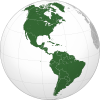 | ||
| Sovereign states |
| |
| ||