


Tate Britain
_(2).jpg) | |
  Location within Central London | |
| Established | 1897 |
|---|---|
| Location | Millbank London, SW1 |
| Coordinates | 51°29′27″N 0°07′38″W / 51.490833°N 0.127222°W |
| Visitors | 525,144 (2021)[1] |
| Director | Alex Farquharson[2] |
| Public transit access |  Pimlico Pimlico |
| Website | tate.org.uk |
| Tate | |
Tate Britain, known from 1897 to 1932 as the National Gallery of British Art and from 1932 to 2000 as the Tate Gallery, is an art museum on Millbank in the City of Westminster in London, England.[3] It is part of the Tate network of galleries in England, with Tate Modern, Tate Liverpool and Tate St Ives. Founded by Sir Henry Tate, it houses a substantial collection of the art of the United Kingdom since Tudor times, and in particular has large holdings of the works of J. M. W. Turner, who bequeathed all his own collection to the nation. It is one of the largest museums in the country. The museum had 525,144 visitors in 2021, an increase of 34 percent from 2020 but still well below pre- COVID-19 pandemic levels. In 2021 it ranked 50th on the list of most-visited art museums in the world.[4]
History
[edit]The gallery is on Millbank, on the site of the former Millbank Prison. Construction, undertaken by Higgs and Hill,[5] commenced in 1893, and the gallery opened on 21 July 1897 as the National Gallery of British Art. However, from the start it was commonly known as the Tate Gallery, after its founder Sir Henry Tate, and in 1932 it officially adopted that name.[6] Before 2000, the gallery housed and displayed both British and modern collections, but the launch of Tate Modern saw Tate's modern collections move there, while the old Millbank gallery became dedicated to the display of historical and contemporary British art. As a consequence, it was renamed Tate Britain in March 2000.
The front part of the building was designed by Sidney R. J. Smith with a classical portico and dome behind, and the central sculpture gallery was designed by John Russell Pope. Tate Britain includes the Clore Gallery of 1987, designed by James Stirling, which houses work by J. M. W. Turner. The Clore Gallery has been regarded as an important example of Postmodern architecture, especially in the use of contextual irony: each section of the external facade quotes liberally from the building next to it in regard to materials and detailing.[7]

Crises during its existence include flood damage to artworks from the River Thames spilling its banks, and bomb damage during World War II. However, most of the collection was in safe storage elsewhere during the war, and a large Stanley Spencer painting, deemed too big to move, had a protective brick wall built in front of it.[citation needed] In anticipation of the threat to London, more than 700 artworks were secretly transported to Muncaster Castle in Cumbria on 24 August 1939.[8]
In 1970, the building was given Grade II* listed status.[9]
In 2012, Tate Britain announced that it had raised the £45 million[10] required to complete a major renovation, largely thanks to a £4.9 million grant from the Heritage Lottery Fund and £1 million given by Tate Members.[11] The museum stayed open throughout the three phases[12] of renovation.[10] Completed in 2013, the newly designed sections were conceived by the architects Caruso St John and included a total of nine new galleries, with reinforced flooring to accommodate heavy sculptures. A second part was unveiled later that year, the centrepiece being the reopening of the building's Thames-facing entrance as well as a new spiral staircase beneath its rotunda.[12] The circular balcony of the rotunda's domed atrium, closed to visitors since the 1920s, was reopened. The gallery also now has a dedicated schools' entrance and reception beneath its entrance steps on Millbank and a new archive gallery for the presentation of temporary displays.[13]
Facilities
[edit]
The front entrance is accessible by steps. A side entrance at a lower level has a ramp for wheelchair access. The gallery provides a restaurant and a café, as well as a Friends room, open only to members of the Tate. This membership is open to the public on payment of an annual subscription. As well as administration offices the building complex houses the Prints and Drawings Rooms (in the Clore galleries),[14] as well as the Library[15] and Archive[16] in the Hyman Kreitman Reading Rooms.[17] The restaurant features a mural by Rex Whistler, The Expedition in Pursuit of Rare Meats. Protests over the depiction of the enslavement of Black children and the stereotyping of Chinese figures in the mural has led to the closure of the restaurant.[18]
Tate Britain and Tate Modern are now connected by a river bus along the River Thames, which runs from Millbank Millennium Pier immediately outside Tate Britain. The boat is decorated with spots, based on paintings of similar appearance by Damien Hirst. The lighting artwork incorporated in the pier's structure is by Angela Bulloch.[19]
Displays
[edit]The main display spaces show the permanent collection of historic British art, as well as contemporary work. It has rooms dedicated to works by one artist, such as: Tracey Emin, John Latham, Douglas Gordon, Sam Taylor-Wood, Tacita Dean, and Marcus Gheeraerts II, though these works, like the rest of the collection, are subject to rotation.
The gallery also organises career retrospectives of British artists and temporary major exhibitions of British Art. Every three years the gallery stages a Triennial exhibition in which a guest curator provides an overview of contemporary British Art. The 2003 Tate Triennial was called Days Like These.[20] Art Now is a small changing show of a contemporary artist's work in a dedicated room.
Tate Britain is the home of the annual and usually controversial Turner Prize exhibition, featuring four artists selected by a jury chaired by the director of Tate Britain. This is spread out over the year with the four nominees announced in May, the show of their work opened in October and the prize itself given in December. Each stage of the prize generates media coverage, and there have also been a number of demonstrations against the prize, notably since 2000 an annual picket by Stuckist artists. In recent years the exhibition and award ceremony have taken place at locations other than in Tate Britain: for example, in Liverpool (2007), Derry (2013), Glasgow (2015) and Hull (2017).
Tate Britain has attempted to reach out to a different and younger audience with Late at Tate Britain on the first Friday of every month, with half-price admission to exhibitions, live music and performance art.[21] Other public involvement has included the display of visitors', as opposed to curators', interpretation of certain artworks.
Regular free tours operate on the hour, and at 1:15 pm on Tuesday, Wednesday and Thursday short 15-minute talks are given on paintings, artists and artistic styles.[22]
Permanent collection
[edit]Tate Britain is the national gallery of British art from 1500 to the present day. As such, it is the most comprehensive collection of its kind in the world (only the Yale Center for British Art can claim similar expansiveness, but with less depth).[citation needed] More recent artists include David Hockney, Peter Blake and Francis Bacon. Works in the permanent Tate collection, which may be on display at Tate Britain include:
- Unknown 17th-century artist: The Cholmondeley Ladies
- Francis Bacon: Three Studies for Figures at the Base of a Crucifixion
- William Blake: Newton
- David Bomberg: The Mud Bath
- Hamad Butt: Familiars
- John Constable: Flatford Mill
- Richard Dadd, The Fairy Feller's Master-Stroke
- Herbert James Draper: The Lament for Icarus
- William Dyce: Pegwell Bay, Kent – a Recollection of 5 October 1858
- Augustus Egg: Past and Present
- Thomas Gainsborough: Giovanna Baccelli
- Mark Gertler: Merry-Go-Round
- Joseph Highmore: Pamela is Married
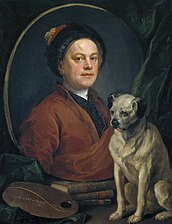
- William Hogarth: The Painter and his Pug
- William Holman Hunt: The Awakening Conscience
- John Martin: The Great Day of His Wrath
- Henry Moore: Recumbent Figure 1938
- Sir John Everett Millais: Ophelia
- Sir Joshua Reynolds: Three Ladies Adorning a Term of hymen
- Dante Gabriel Rossetti: Ecce Ancilla Domini, Beata Beatrix
- Sir Peter Paul Rubens, Sketch for the Banqueting House Ceiling
- John Singer Sargent, Ellen Terry as Lady Macbeth
- Stanley Spencer: The Resurrection, Cookham
- George Stubbs: Horse Attacked by a Lion
- Henry Scott Tuke: August Blue
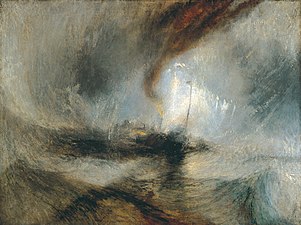
- J. M. W. Turner: The Golden Bough, Norham Castle, Sunrise
- Henry Wallis: The Death of Chatterton
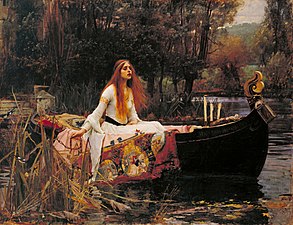
- John William Waterhouse: The Lady of Shalott, The Magic Circle
- James Abbott McNeill Whistler: Symphony in White, No. 2: The Little White Girl, Nocturne: Blue and Gold – Old Battersea Bridge
- Rose Wylie: Pin Up and Porn Queen Jigsaw
- Gillian Wise: Looped Network Suspended in Pictorial Space
- Alison Wilding: Assembly
- Rachel Whiteread: Untitled (Floor/Ceiling)
- Joanna Mary Wells: Gretchen
- Paule Vézelay: Five Forms
- Annie Louisa Swynnerton: Oreads
- Helen Saunders: Monochrome Abstract Composition
- Eva Rothschild: The Fallowfield
- Bridget Riley: Achæan
- Paula Rego: War
- Fiona Rae: Maybe you can live on the moon in the next century
- Grace Pailthorpe: December 4th, 1938
- Mabel Nicholson: Family Group
- Jessica Dismorr: Abstract Composition
- Lucy McKenzie: Side Entrance
- Mary Martin (artist): Inversions
- Hilary Lloyd: One Minute of Water
- Kim Lim: Shogun
- Liliane Lijn: Headborn
- Claudette Johnson: Standing Figure with African Masks
- Gwen John: Nude Girl
- Frances Hodgkins: Flatford Mill
- Susan Hiller: Belshazzar's Feast, the Writing on Your Wall
- Amelia Robertson Hill: Percy Bysshe Shelley
- Barbara Hepworth: Spring, 1957 (Project for Sculpture)
- Dora Gordine: Javanese Head
Gallery
[edit]-
-
 Thomas Gainsborough, Giovanna Baccelli, 1782
 -
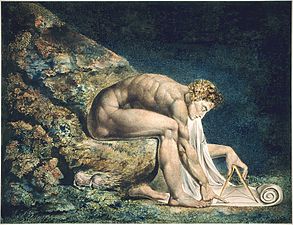 William Blake, Newton, 1785
 -

-

-
 David Wilkie, Newsmongers, 1821
 -
 William Blake, Satan Smiting Job with Sore Boils, c. 1826
 -

-
-

-

-
 Sir John Everett Millais, Ophelia, 1851–52
 -
 Dante Gabriel Rossetti, The Beloved, 1865–66
 -

-
-

-

-
 George Frederic Watts, Hope, 1886
 -
-
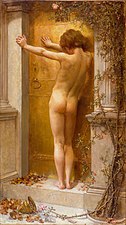 Anna Lea Merritt, Love Locked Out, 1890
 -
 David Bomberg, The Mud Bath, 1914


_by_John_Constable,_Tate_Britain.JPG)
_-_Newsmongers_-_N00331_-_National_Gallery.jpg)


Statue of Millais
[edit]
When the Pre-Raphaelite painter and President of the Royal Academy, John Everett Millais, died in 1896, the Prince of Wales (later to become King Edward VII) chaired a memorial committee, which commissioned a statue of the artist.[23] The sculpture, by Thomas Brock, was installed at the front of the gallery in the garden on the east side in 1905. On 23 November that year, The Pall Mall Gazette called it "a breezy statue, representing the man in the characteristic attitude in which we all knew him".[23]
In 1953, Tate Director, Sir Norman Reid, attempted to have it replaced by Rodin's John the Baptist, and in 1962 again proposed its removal, calling its presence "positively harmful". His efforts were frustrated by the statue's owner, the Ministry of Works. Ownership was transferred from the Ministry to English Heritage in 1996, and by them in turn to the Tate.[23] In 2000 the statue was removed to the rear of the building.[23]
Controversy
[edit]BP Sponsorship
[edit]Starting in 1990, oil company BP began a sponsorship of Tate Britain, which was to become 'the longest and most consistent sponsorship of any permanent art collection in the UK' according to the Tate itself.[24] Although BP renewed its support in 2011, offering a fresh commitment to last a further decade,[25] the following year BP announced the termination of its support for Tate Britain, blaming the 'extremely challenging business environment'.[26] Although the company denied that the decision was influenced by climate change protests, BP's support for Tate Britain had drawn the attention of activists to the gallery. In 2015, a collective called Liberate Tate had occupied part of Tate Britain and attributed BP's move to climate activism, which has since become a focus of academic study.[27]
Transport connections
[edit]| Service | Station/Stop | Lines/Routes served | Distance from Tate Britain |
|---|---|---|---|
London Buses  |
Tate Britain  |
87 | |
| London Underground |
Pimlico |  |
0.4-mile walk[28] |
National Rail  |
Vauxhall | South Western Railway | 0.5-mile walk[29] |
London River Services  |
Millbank Millennium Pier |
Tate to Tate | 0.2-mile walk[30] |
See also
[edit]Notes and references
[edit]- ^ "The Art Newspaper list of most-visited art museums in 2020, March 28,2022
- ^ Press Release: New Director of Tate Britain Appointed, Tate online, 29 July 2015. Retrieved 14 July 2016.
- ^ Tate. "History of Tate". Tate. Retrieved 30 July 2021.
- ^ The Art Newspaper, 28 March, 2022
- ^ 'General introduction', Survey of London: volume 26: Lambeth: Southern area (1956), pp. 1–17. Date accessed: 27 March 2010.
- ^ Tate: History of Tate – The gallery at Millbank, London Linked 15 May 2013
- ^ "British Architecture", Architectural Design, London, 1982, p.78.
- ^ "Muncaster Castle's secret wartime art mission". BBC News. 22 February 2024. Retrieved 24 February 2024.
- ^ Historic England. "Tate Gallery (1222913)". National Heritage List for England. Retrieved 31 August 2016.
- ^ a b Sulcas, Roslyn (18 November 2013). "Tate Britain Completes Renovation". New York Times. Retrieved 19 November 2013.
- ^ "Tate Britain hits £45m renovation target". BBC News. 17 May 2012. Retrieved 19 November 2013.
- ^ a b Merrick, Jay (18 November 2013). "Tate Britain's redesign: It may not be cool but it's restrained, and elegant, and it works". The Independent. Archived from the original on 26 May 2022. Retrieved 19 November 2013.
- ^ "'Transformed' Tate Britain unveiled". BBC News. 18 November 2013. Retrieved 19 November 2013.
- ^ "Prints and Drawings Rooms". Tate. Retrieved 15 August 2010.
- ^ "Research services: library", Tate online.
- ^ "Research services:archive", Tate online.
- ^ "Research services: Hyman Kreitman Reading Rooms", Tate online.
- ^ Lanre Bakare (7 December 2020). "Future of Tate Britain's 'offensive' Rex Whistler mural under review". The Guardian. Retrieved 7 December 2020.
- ^ "Millbank Pier web site". Millbankpier.co.uk. 22 May 2003. Retrieved 15 August 2010.
- ^ "Days Like These", Tate online.
- ^ "events education", Tate online.
- ^ Tate Britain Archived 9 February 2012 at the Wayback Machine, LondonBoard.co.uk, Accessed 8 February 2012.
- ^ a b c d Birchall, Heather. "Sir Thomas Brock 1847–1922", Tate online, February 2002. Retrieved 5 April 2008.
- ^ "BP ends 27-year sponsorship of Tate as falling oil price takes toll". The Financial Times. 11 March 2016. Retrieved 1 August 2024.
- ^ "Press Release: BP and leading UK cultural institutions extend partnerships with 10 million sponsorship". BP website. 18 December 2011.
- ^ "BP ends 27-year sponsorship of Tate as falling oil price takes toll". The Financial Times. 11 March 2016. Retrieved 1 August 2024.
- ^ "When Climate Activism Succeeds: The Story Of Liberate Tate – ETHICAL UNICORN". 14 January 2021. Retrieved 1 August 2024.
- ^ "Walking directions to Tate Britain from Pimlico tube station". Google Maps. 1 January 1970. Retrieved 15 August 2010.
- ^ "Walking directions to Tate Britain from Vauxhall station". Google Maps. Retrieved 15 August 2010.
- ^ "Walking directions to Tate Britain from Millbank Millenium Pier". Google Maps. Retrieved 8 April 2011.
External links
[edit]


| International | |
|---|---|
| National | |
| Geographic | |
| Artists | |
| Other | |


.jpg)

- Tate galleries
- 2000 establishments in England
- Art museums and galleries in London
- Art museums and galleries established in 2000
- British art
- Buildings and structures completed in 1897
- Grade II* listed buildings in the City of Westminster
- Grade II* listed museum buildings
- Museums in the City of Westminster
- Museums on the River Thames
- Museums sponsored by the Department for Culture, Media and Sport
- Millbank