


First Dynasty of Egypt
First Dynasty of Egypt | |||||||||
|---|---|---|---|---|---|---|---|---|---|
| c. 3100 BC–c. 2900 BC | |||||||||
.jpg) Narmer Palette (c. 3200–3000 BC) | |||||||||
| Capital | Thinis | ||||||||
| Common languages | Egyptian language | ||||||||
| Religion | Ancient Egyptian religion | ||||||||
| Government | Absolute monarchy | ||||||||
| Historical era | Bronze Age | ||||||||
• Established | c. 3100 BC | ||||||||
• Disestablished | c. 2900 BC | ||||||||
| |||||||||

| Periods and dynasties of ancient Egypt |
|---|
|
All years are BC |
The First Dynasty of ancient Egypt (Dynasty I)[1] covers the first series of Egyptian kings to rule over a unified Egypt. It immediately follows the unification of Upper and Lower Egypt, possibly by Narmer,[2] and marks the beginning of the Early Dynastic Period, when power was centered at Thinis.
The date of this period is subject to scholarly debate about the Egyptian chronology. It falls within the early Bronze Age and is variously estimated to have begun anywhere between the 34th and the 30th centuries BC. In a 2013 study based on radiocarbon dates, the accession of Hor-Aha, the second king of the First Dynasty, was placed between 3111 and 3045 BC with 68% confidence, and between 3218 and 3035 with 95% confidence.[3] The same study placed the accession of Den, the sixth king of the dynasty, between 2928 and 2911 BC with 68% confidence,[3] although a 2023 radiocarbon analysis placed Den's accession potentially earlier, between 3011 and 2921, within a broader window of 3104 to 2913.[4]
The dynasty[edit]
Information about this dynasty is derived from a few monuments and other objects bearing royal names, the most important being the Narmer Palette and Narmer Macehead, as well as Den and Qa'a king lists.[5][6][7] No detailed records of the first two dynasties have survived, except for the terse lists on the Palermo Stone. The account in Manetho's Aegyptiaca contradicts both the archeological evidence and the other historical records: Manetho names nine rulers of the First Dynasty, only one of whose names matches the other sources, and offers information for only four of them.[8] Egyptian hieroglyphs were fully developed by then, and their shapes would be used with little change for more than three thousand years.[citation needed]
Alena Buis noted:
"Large tombs of pharaohs at Abydos and Naqada, in addition to cemeteries at Saqqara and Helwan near Memphis, reveal structures built largely of wood and mud bricks, with some small use of stone for walls and floors. Stone was used in quantity for the manufacture of ornaments, vessels, and occasionally, for statues. Tamarix ("tamarisk" or "salt cedar") was used to build boats such as the Abydos boats. One of the most important indigenous woodworking techniques was the fixed mortise and tenon joint. A fixed tenon was made by shaping the end of one timber to fit into a mortise (hole) that is cut into a second timber. A variation of this joint using a free tenon eventually became one of the most important features in Mediterranean and Egyptian shipbuilding. It creates a union between two planks or other components by inserting a separate tenon into a cavity (mortise) of the corresponding size cut into each component."
— Alena Buis, PhD[9]
A study on First Dynasty crania from the royal tombs in Abydos noted affinities with Kerma Kushites. The general results demonstrate greater affinity with Upper Nile Valley groups, but also suggest clear change from earlier craniometric trends. The gene flow and movement of northern officials to the important southern city may explain the findings.[10]
-
 The Narmer Palette
 -

-
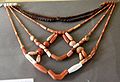 Necklaces with different types of beads. Carnelian, coral, and garnet.
 -
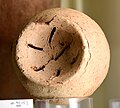 Pottery jar with integral strainer.


Human sacrifice[edit]
Human sacrifice was practiced as part of the funerary rituals associated with all of the pharaohs of the first dynasty. It is clearly demonstrated as existing during this dynasty by retainers being buried near each pharaoh's tomb as well as animals sacrificed for the burial. The tomb of Djer is associated with the burials of 338 individuals.[11] The people and animals sacrificed, such as donkeys, were expected to assist the pharaoh in the afterlife. For unknown reasons, this practice ended with the conclusion of the dynasty.
According to historian and linguist Christopher Ehret, the ritual practice of retainer sacrifice originated from the southern region in the Middle Nile. Ehret also stated that this cultural practice was shared with the Kerma kingdom of the Upper Nubian Nile region.[12]
Rulers[edit]
Known rulers in the history of Egypt for the First Dynasty are as follows:
| Name | Image | Comments | Dates | Family |
|---|---|---|---|---|
| Narmer |  |
Believed to be the same person as Menes and to have unified Upper and Lower Egypt. Possibly married Neithhotep. | Around 3100 BC
|
Married with Neithotep,and father of Hor-Aha |
| Hor-Aha |  |
Greek form: Athotís. Led an expedition against the Nubians. Married Benerib and Khenthap. | Around 3050 BC
|
Son of Narmer and Neithotep,spouse of Khenthap,Benerib,and father of Djer |
| Djer |  |
Greek form: Uenéphes (after his Gold name In-nebw); His name and titulary appear on the Palermo Stone. His tomb was later thought to be the legendary tomb of Osiris. | 54 years[13]
|
Son of Hor-Aha,and father of Djet and Merneith |
| Djet |  |
Greek form: Usapháis. Possibly married Ahaneith. | 10 years[14]
|
Spouse of Merneith,and father of Den |
| Merneith |  |
Possibly first female Pharaoh
(or ruled as regent to her son Den or ruled as both king/queen and regent). Merneith was buried close to Djet and Den. Her tomb is of the same scale as the tombs of the (other) kings of that period.[15] |
Around 2950 BC[16]
|
Mother of Den |
| Den |  |
Greek form: Kénkenes (after the ramesside diction of his birthname: Qenqen[17]). First pharaoh depicted wearing the double crown of Egypt, first pharaoh with a full niswt bity-name. | 42 years[14]
|
Son of Merneith and Djet |
| Anedjib |  |
Greek form: Miebidós. Known for his ominous nebwy-title.[18] | 10 years
|
Son of Den |
| Semerkhet |  |
Greek form: Semempsés. First Egyptian ruler with a fully developed Nebty name. His complete reign is preserved on the Cairo stone. | 8+1⁄2 years[14]
|
Son of Anedjib |
| Qa'a |  |
Greek form: Bienéches. Ruled a long time, his tomb is the last one with subsidiary tombs. | 34 years
|
Son of Semerkhet,and father of Hotepsekhemwy |
| Sneferka |  |
Very short reign, correct chronological position unknown. | Around 2900 BC
| |
| Horus Bird |  |
Very short reign, correct chronological position unknown. | Around 2900 BC
|
See also[edit]
- Dynasties of ancient Egypt
- Early Dynastic Period (Egypt)
- Predynastic Egypt
- First Dynasty of Egypt family tree
References[edit]
Citations[edit]
- ^ Kuhrt (1995), p. 118.
- ^ Heagy, Thomas C. (2014). "Who was Menes?". Archeo-Nil. 24: 59–92. Available online "[1]".
- ^ a b Dee, M.; Wengrow, D.; Shortland, A.; Stevenson, A.; Brock, F.; Girdland Flink, L.; Bronk Ramsey, C. (4 September 2013). "An absolute chronology for early Egypt using radiocarbon dating and Bayesian statistical modelling". Proceedings of the Royal Society A: Mathematical, Physical and Engineering Sciences. 469 (2159): 20130395. Bibcode:2013RSPSA.46930395D. doi:10.1098/rspa.2013.0395. PMC 3780825. PMID 24204188.
- ^ Quiles, Anita; Tristant, Yann (2023). "Radiocarbon-Based Modeling of the Reign of King den (1St Dynasty, Egypt) and the Start of the Old Kingdom". Radiocarbon. 65 (2): 485–504. Bibcode:2023Radcb..65..485Q. doi:10.1017/RDC.2023.15. ISSN 0033-8222.
- ^ "Qa'a and Merneith lists", Xoomer, IT: Virgilio.
- ^ The Narmer Catalog http://narmer.org/inscription/1553 Archived 2020-02-08 at the Wayback Machine
- ^ The Narmer Catalog http://narmer.org/inscription/4048 Archived 2020-02-19 at the Wayback Machine
- ^ Manetho, Fr. 6, 7a, 7b. Text and translation in Manetho, translated by W.G. Waddell (Cambridge: Harvard University, 1940), pp. 27–35
- ^ Buis, Alena (2022). "Predynastic and Early Dynastic Art". Art and Visual Culture: Prehistory to Renaissance.
Large tombs of pharaohs at Abydos and Naqada, in addition to cemeteries at Saqqara and Helwan near Memphis, reveal structures built largely of wood and mud bricks, with some small use of stone for walls and floors. Stone was used in quantity for the manufacture of ornaments, vessels, and occasionally for statues. Tamarix was used to build boats such as the Abydos Boats. One of the most important indigenous woodworking techniques was the fixed mortise and tenon joint, where the fixed tenon was made by shaping the end of one timber to fit into a mortise (or hole) that is cut into a second timber. A variation of this joint using a free tenon eventually became one of the most important features in Mediterranean and Egyptian shipbuilding. It creates a union between two planks or other components by inserting a separate tenon into a cavity (mortise) of the corresponding size cut into each component.
- ^ Keita, S. O. Y. (1992). "Further studies of crania from ancient Northern Africa: An analysis of crania from First Dynasty Egyptian tombs, using multiple discriminant functions". American Journal of Physical Anthropology. 87 (3): 245–254. doi:10.1002/ajpa.1330870302. ISSN 1096-8644. PMID 1562056.
- ^ Shaw (2000), p. 68.
- ^ Ehret, Christopher (20 June 2023). Ancient Africa: A Global History, to 300 CE. Princeton University Press. p. 114. ISBN 978-0-691-24409-9.
- ^ Wolfgang Helck: Untersuchungen zur Thinitenzeit (= Ägyptologische Abhandlungen (ÄA), Vol. 45). Harrassowitz, Wiesbaden 1987, ISBN 3-447-02677-4, p. 124.
- ^ a b c Wolfgang Helck: Untersuchungen zur Thinitenzeit (Agyptologische Abhandlungen), ISBN 3-447-02677-4, O. Harrassowitz (1987), p. 124
- ^ Tyldesley, J. (2006). Chronicle of the Queens of Egypt. Thames & Hudson.
- ^ Teeter, Emily, ed. (2011). Before the Pyramids, The Origins of Egyptian Civilization. The Oriental Institute of the University of Chicago. p. 207.
- ^ William Matthew Flinders Petrie: The Royal Tombs of the Earliest Dynasties. Cambridge University Press, New York 2013 (reprint of 1901), ISBN 1-108-06612-7, p. 49.
- ^ Nicolas-Christophe Grimal: A History of Ancient Egypt. Blackwell, Oxford UK/ Cambridge USA 1992, ISBN 978-0-631-19396-8, p. 53.
Bibliography[edit]
- Kuhrt, Amélie (1995), The Ancient Near East: c. 3000–330 BC, London: Routledge, ISBN 978-0-415-01353-6.
- Shaw, Ian (2000), The Oxford History of Ancient Egypt, Oxford: Oxford University Press, ISBN 0-19-280458-8


| Pharaohs |  | |
|---|---|---|
| Regents | ||
| Queen consorts | ||
| Officials | ||
| Other people | ||
| Artefacts and monuments | ||
| Capital | ||
- First Dynasty of Egypt
- States and territories established in the 4th millennium BC
- States and territories disestablished in the 3rd millennium BC
- Dynasties of ancient Egypt
- 31st century BC in Egypt
- 30th century BC in Egypt
- 29th century BC in Egypt
- 4th-millennium BC establishments
- 3rd-millennium BC disestablishments in Egypt
- 4th millennium BC in Egypt
- 3rd millennium BC in Egypt