


Fisher Building
Fisher Building | |
.jpg) Fisher Building in December 2021 | |
   | |
 Interactive map | |
| Location | 3011 W. Grand Blvd. Detroit, Michigan |
|---|---|
| Coordinates | 42°22′9.5″N 83°4′37″W / 42.369306°N 83.07694°W |
| Area | 486,991 square feet (45,242.9 m2) |
| Architect | Albert Kahn Associates with Joseph Nathaniel French as chief architect |
| Architectural style | Art Deco |
| NRHP reference No. | 07000847 |
| Significant dates | |
| Added to NRHP | October 14, 1980[2] |
| Designated NHL | June 29, 1989[1] |
| Designated MSHS | October 21, 1975 |
The Fisher Building is a landmark skyscraper located at 3011 West Grand Boulevard in the heart of the New Center area of Detroit, Michigan. The ornate 30-story building, completed in 1928, is one of the major works of architect Albert Kahn, and is designed in an Art Deco style, faced with limestone, granite, and several types of marble. The Fisher family financed the building with proceeds from the sale of Fisher Body to General Motors. It was designed to house office and retail space.[3]
The building, which contains the elaborate 2,089-seat Fisher Theatre,[4][5] was designated a National Historic Landmark on June 29, 1989. It also houses the headquarters for the Detroit Public Schools and the studios of radio stations WJR, WDVD, and WUFL.
History[edit]
.jpg)
Initially, architect Joseph Nathaniel French of Albert Kahn Associates planned for a complex of three buildings, with two 30-story structures flanking a 60-story tower. However, the Great Depression caused the project to be scaled back to a single tower.[6]
The Fisher brothers located the building across from the General Motors Building, now Cadillac Place, as General Motors had recently purchased the Fisher Body Company. The two massive buildings spurred the development of a New Center for the city, a business district north of its downtown area.
The building's hipped roof was originally covered with gold leaf tiles, but during World War II these tiles were covered in asphalt because it was feared that the reflective surface would attract enemy bombers.[3] After the war, the asphalt could not be removed from the gold tiles without harming them, so they were replaced with green tiles. Since the 1980s, these tiles have been illuminated at night with colored lights to give them a gold appearance. On St. Patrick's Day, the lights are changed to green and, in recent years, to celebrate the NHL playoffs, the tower is illuminated with red lights in honor of the Detroit Red Wings.
In 1974, Tri-Star Development purchased the Fisher Building and adjoining New Center Building for approximately $20 million.[7]
In 2001, FK Acquisition LLC, a real estate firm based in Southfield, purchased the two buildings from TrizecHahn Corporation for $31 million.[8] FK Acquisition LLC lost the buildings to its lender in 2015.
In 2002, Detroit Public Schools (DPS) paid the owner of the Fisher Building $24.1 million to purchase five floors to house administrative offices, citing the high cost of renovations needed at the Maccabees Building, the previous headquarters, to comply with building and safety codes.[9][10]
In July 2015, Southfield-based developer Redico LLC, in partnership with HFZ Capital Group of New York City and Peter Cummings of The Platform, a Detroit-based development company, taking advantage of the general decline in Detroit real estate values, purchased the Fisher Building and adjacent Albert Kahn Building, plus 2,000 parking spaces in two parking structures and three surface lots in New Center for only $12.2 million at auction. Redico said the partnership plans to transform the two buildings, which are connected by an underground pedestrian concourse, into what it called a "true urban" mixed-use development, with a mix of office, retail, residential and entertainment uses. The multi-year project has a potential cost of $70 million to $80 million in addition to the purchase price. The Redico interest was purchased by Cummings and his partner in The Platform, Dietrich Knoer, in 2016.[11][12]
In 2023, Michigan State University acquired 79% of the owner of the Fisher Building, which means MSU now owns the building.[13]
Architecture[edit]
The Fisher Building rises 30 stories with a roof height of 428 feet (130 m), a top floor height of 339 feet (103 m), and the spire reaching 444 feet (135 m). The building has 21 elevators. Albert Kahn and Associates designed the building with Joseph Nathaniel French serving as chief architect.[14] French took inspiration from Eliel Saarinen's Tribune Tower design of 1922, seen in the emphasis on verticality and the stepped-back upper stories. The building is unlike any other Albert Kahn production.[15] It has been called "Detroit's largest art object".[3]
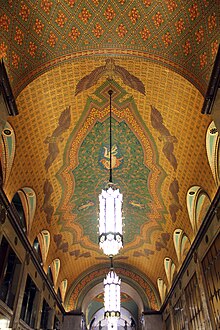
In 1929, the Architectural League of New York honored the Fisher Building with a silver medal in architecture.[16] The opulent three-story barrel vaulted lobby is constructed with forty different kinds of marble, decorated by Hungarian artist Géza Maróti, and is highly regarded by architects.[4][5] The sculpture on the exterior of the building was supplied by several sculptors including Maróti, Corrado Parducci, Anthony De Lorenzo and Ulysses Ricci.[17]
-

-
-
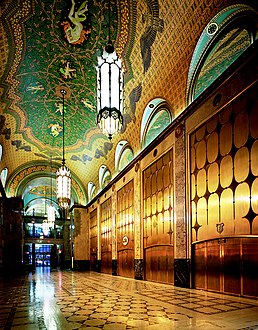 Arcade and theatre entrance
 -

-

-


.jpg)
.jpg)


Radio[edit]
Designs called for two flagpoles atop the gilt roof. While they were installed, they were essentially unusable as a radio antenna was installed when one of the building's oldest tenants, radio station WJR, leased space in December 1928. On-air hosts often mention that broadcasts originate "from the golden tower of the Fisher Building." This was a requirement of the station's original lease in exchange for a nominal rent.[18] Two other radio stations, WDVD-FM (the former WJR-FM) and WUFL, also have broadcast studios in the building.
In 1970, building employees discovered a storage room sealed with tape. None of the staff knew what the room contained or why it was sealed. When they located the key, they found the flags of 75 nations that apparently were created in 1928 and intended to be flown for foreign visitors.[3]
Fisher Theatre[edit]
The building is also home to the Fisher Theatre, one of Detroit's oldest live theatre venues. The theatre, designed by the Chicago-based architectural firm of Anker S. Graven & Arthur G. Mayger, originally featured a lavish Aztec-themed interior in the Mayan Revival style, and once had Mexican-Indian art, banana trees, and live macaws that its patrons could feed.[19] After the Depression, the theatre operated primarily as a movie house until 1961. Originally containing 3,500 seats, the interior was renovated into a 2,089-seat playhouse that allowed for more spacious seating and lobbies for patrons at a cost of $3.5 million. The decor was changed to a simple mid-century design.
The Nederlander Organization opened the "new" Fisher Theatre on October 2, 1961 and operated it until April 2021 when it sold the venue to the Ambassador Theatre Group.[20][21] It primarily features traveling productions of Broadway shows and has hosted numerous out-of-town tryouts.
Pre-Broadway Engagements at the Fisher:[22][23]
- 1961: The Gay Life
- 1962: No Strings, Bravo Giovanni, Oliver!
- 1963: Sophie, Here's Love, Jennie, Hello, Dolly!
- 1964: Foxy, Fiddler on the Roof, Golden Boy, I Had a Ball
- 1965: Pleasures and Palaces, Pickwick, Skyscraper, Sweet Charity
- 1966: Pousse-Café, Walking Happy
- 1967: Illya Darling, Henry, Sweet Henry
- 1968: George M!, I'm Solomon, Lovers and Other Strangers, Maggie Flynn
- 1969: La Strada
- 1970: Applause, The Rothschilds, Not Now, Darling
- 1972: Tricks
- 1973: Seesaw, Lorelei, Turtlenecks, Gigi
- 1974: Good News, London Assurance, The Wiz
- 1979: Sugar Babies, Oklahoma!
- 1982: Seven Brides for Seven Brothers
- 1986: Into the Light
- 1996: Big
Art[edit]
Befitting the Fisher Building's history in association with art, three nationally recognized fine-art galleries have occupied space in the structure including the Gertrude Kasle Gallery and London Fine Arts Group.
- Gertrude Kasle Gallery: Located in Suite 310 of the Fisher Building from 1965 to 1976 was a nationally recognized fine-art gallery hosting exhibits for some of the most highly respected artists of the second half of the 20th century including Willem de Kooning, Jim Dine, Helen Frankenthaler, Robert Goodnough, Adolph Gottlieb, Phillip Guston, Grace Hartigan, Ian Hornak, Ray Johnson, Robert Motherwell, Lowell Nesbitt, Claes Oldenburg, Robert Rauschenberg and Jack Tworkov.
- London Fine Arts Group: Located in a large portion of the third floor of the Fisher Building during the 1970s and 1980s, London Fine Arts Group acted as a publishing company assisting in producing limited edition art works for many internationally recognized artists including Yaacov Agam, Karel Appel, Arman, Romare Bearden, Gene Davis, Don Eddy, Alberto Giacometti, Ian Hornak, Lester Johnson, Alex Katz, Richard Lindner, Roberto Matta, Lowell Nesbitt, Robert Rauschenberg, Harry Bertoia, Donald Sultan, Victor Vasarely and Larry Zox.
Tenants[edit]
- Detroit Public Schools
- Girl Scouts of Southeastern Michigan
- Children's Hospital of Michigan Foundation - Suite 218[43]
- City Bakery
- The Allen Law Group, PC - Suite 2500
In 2017 The Platform LLC converted the fourth floor into rental space for arts-based groups.[46]
See also[edit]


- Cadillac Place
- Guardian Building
- Albert Kahn Building
- Pewabic Pottery
- List of tallest buildings in Detroit
- List of National Historic Landmarks in Michigan
- National Register of Historic Places listings in Downtown and Midtown Detroit
References[edit]
- Notes
- ^ "Fisher Building". National Historic Landmark summary listing. National Park Service. Archived from the original on October 6, 2012. Retrieved June 27, 2008.
- ^ "National Register Information System". National Register of Historic Places. National Park Service. April 15, 2008.
- ^ a b c d Houston, Kay; Culpepper, Linda (March 20, 2001). "Michigan History: The most beautiful building in the world". The Detroit News. Archived from the original on January 2, 2013. Retrieved April 7, 2010.
- ^ a b Mazzei, Rebecca (November 30, 2005). "Still Standing". Metro Times. Retrieved April 7, 2010.
- ^ a b AIA Detroit Urban Priorities Committee (January 10, 2006). "Top 10 Detroit Interiors". Model D Media. Retrieved April 7, 2010.
- ^ Gallagher, John; Rochan, Dick (October 27, 1991). "Unbuilt Detroit". Detroit Free Press Magazine. Archived from the original on November 7, 2010. Retrieved September 6, 2010.
- ^ "Tri-Star Purchases 2 Detroit Buildings". The New York Times. January 4, 1974. Retrieved May 26, 2011.
- ^ Gallagher, John (June 22, 2015). "Bidding heats up as Detroit Fisher Building auction begins". Detroit Free Press. Retrieved October 16, 2015.
- ^ Oosting, Jonathan (September 24, 2009). "Audit: Detroit Public Schools Overpaid Millions for Real Estate After Middle-Man Markups". MLive. Retrieved November 7, 2009.
- ^ "Real Estate Report". Detroit Public Schools. October 7, 2011. p. iii. Retrieved January 26, 2018.[permanent dead link]
- ^ Gallagher, John (June 25, 2015). "Local developers join HFZ in Fisher Building purchase". Detroit Free Press. Retrieved July 16, 2015.
- ^ Pinho, Kirk (June 25, 2015). "Redico is local partner buying Fisher, Kahn buildings for $12.2 million". Crain's Detroit Business. Retrieved July 16, 2015.
- ^ Reindl, JC (June 13, 2023). "MSU buys majority stake in Fisher Building in Detroit". Detroit Free Press. Retrieved June 15, 2023.
- ^ "Joseph N. French, Fairlane Architect". Detroit Free Press. March 2, 1975. p. C16. Retrieved March 21, 2011.
In the meantime he had served as chief architect for the Fisher Building...
- ^ Hitchcock, Henry Russell (1977). Architecture: Nineteenth and Twentieth Centuries. Pelican History of Art. Vol. 215 (4 ed.). Yale University Press. pp. 483–484. ISBN 0300053207.
- ^ "The Broad Sweep of American Architecture". The New York Times. April 21, 1929. p. 139. Retrieved May 8, 2014.
- ^ Broddie, Joan, Decoration of the Fisher Building Lobby, Master's Essay, University of Michigan, 1978 p. 19
- ^ "The Story of WJR". News/Talk WJR. Archived from the original on February 12, 2010. Retrieved May 26, 2011.
- ^ Schneider, Andrew (August 16, 2016). Exclusive: Rare photos inside the original Fisher Theatre. Curbed Detroit. Retrieved August 17, 2016.
- ^ Stetson, Damon (October 2, 1961). "Detroit Theatre Will Open Today". The New York Times. p. 34. Retrieved May 26, 2011.
- ^ Chessler, Suzanne (April 15, 2021). "The Nederlander Company Sells the Fisher Theatre to U.K. Theater Group". The Detroit Jewish News. Retrieved October 1, 2021.
- ^ "Fisher Theatre". Broadway in Detroit. Archived from the original on June 3, 2011. Retrieved May 26, 2011.
- ^ "Fisher Theatre". Ovrtur. Retrieved June 14, 2014.
- ^ "Department of State and Federal Programs Archived January 27, 2018, at the Wayback Machine." Detroit Public Schools. Retrieved on November 30, 2015. "Fisher Building – 450 3011 W. Grand Boulevard Detroit, MI 48202"
- ^ "Office of the Secretary of the Board Archived January 27, 2018, at the Wayback Machine." Detroit Public Schools. Retrieved on November 30, 2015. "Location 6th Floor, Fisher Building 3011 W. Grand Boulevard Detroit, Michigan 48202"
- ^ "Office of Athletics Archived January 25, 2018, at the Wayback Machine." Detroit Public Schools. Retrieved on November 29, 2015. "9th Floor Fisher Building 3011 West Grand Boulevard Detroit, MI 48202"
- ^ "Office of Literacy Archived November 25, 2017, at the Wayback Machine." Detroit Public Schools. Retrieved on November 29, 2015. "Office of Literacy 9th Floor, Fisher Building 3011 West Grand Blvd. Detroit, MI 48202 "
- ^ "Multilingual-Multicultural Education in DPS Archived July 1, 2017, at the Wayback Machine." Detroit Public Schools. Retrieved on November 29, 2015. "9th Floor Fisher Building, Suite 119 3011 West Grand Blvd Detroit, MI 48202"
- ^ "Office of Specialized Student Service" (Brochure). (Archived September 6, 2015, at the Wayback Machine). Detroit Public Schools. Retrieved on November 30, 2015. "Fisher Building 3031 W Grand Blvd., 9th Floor Detroit MI. 48201 "
- ^ "Office of Innovation Archived July 26, 2017, at the Wayback Machine." Detroit Public Schools. Retrieved on November 30, 2015. "DPS Office of Innovation Fisher Building, 9th Floor 7321 Second Avenue Detroit MI 48202"
- ^ "Division of Talent Archived December 22, 2017, at the Wayback Machine." Detroit Public Schools. Retrieved on November 30, 2015. "Fisher Building, 10th Floor 3011 W Grand Blvd Detroit, MI 48202"
- ^ "Division of Labor Relations Archived July 1, 2017, at the Wayback Machine." Detroit Public Schools. Retrieved on November 30, 2015. "Fisher Building, 10th Floor 3011 W Grand Blvd Detroit, MI 48202"
- ^ "Division of Technology and Information Services Archived January 15, 2018, at the Wayback Machine." Detroit Public Schools. Retrieved on November 30, 2015. "Fisher Building, 10th Floor, Ste. 1000 3011 W. Grand Blvd. Detroit, MI 48202 "
- ^ "Division of Finance Archived January 27, 2018, at the Wayback Machine." Detroit Public Schools. Retrieved on November 30, 2015. "Fisher Building – 11th Floor 3011 West Grand Blvd. Detroit, MI 48202"
- ^ "Office of Payroll Archived January 6, 2018, at the Wayback Machine." Detroit Public Schools. Retrieved on November 29, 2015. "Fisher Building 11th Floor Detroit, MI 48202" and "The Office of Payroll to distribute Aline cards to employees from the Payroll Dept. on the 11th Floor of the Fisher Building. "
- ^ "Office of Risk Management Archived January 27, 2018, at the Wayback Machine." Detroit Public Schools. Retrieved on November 29, 2015. "Fisher Building – Suite 1100 3011 W. Grand Boulevard Detroit, MI 48202"
- ^ "Rutherford Elementary Operator" (PDF). Detroit Public Schools. March 1, 2012. Archived from the original (PDF) on August 11, 2014. Retrieved May 8, 2014.
Fisher Building – 14th Floor; 3011 W. Grand Boulevard; Detroit, MI 48202-2710
- ^ "Office of the Emergency Manager Archived June 25, 2016, at the Wayback Machine." Detroit Public Schools. Retrieved on November 30, 2015. "14th Floor, Fisher Building 3011 West Grand Blvd. Detroit, MI 48202"
- ^ "Office of the Inspector General Archived November 25, 2017, at the Wayback Machine." Detroit Public Schools. Retrieved on November 30, 2015. "Fisher Building, 14th Floor 3011 West Grand Blvd. Detroit, MI 48202"
- ^ "Operations Group Archived December 22, 2017, at the Wayback Machine." Detroit Public Schools. Retrieved on November 30, 2015. "Fisher Building – 14th Floor 3011 W. Grand Blvd. Detroit, MI 48202"
- ^ "Locations". Girl Scouts of Southeastern Michigan. Retrieved November 30, 2015. "Detroit Service Center / Council Shop 3011 W. Grand Blvd. 500 Fisher Bldg. Detroit, MI 48202[...]SHOP HOURS (1st Floor):"
- ^ "GSSEM Service Centers & Council Shops". Girl Scouts of Southeastern Michigan. Archived from the original on 25 April 2014. Retrieved 8 May 2014.
- ^ "Contact Us." Children's Hospital of Michigan Foundation. Retrieved on January 2, 2018. "Children's Hospital of Michigan Foundation 3011 West Grand Blvd Suite 218 Detroit, MI 48202"
- ^ Nagl, Kurt (January 26, 2018). "City Bakery to open Monday in Fisher Building". Crain's Detroit Business. Retrieved January 29, 2018.
- ^ Houck, Brenna (June 7, 2017). "New York Landmark City Bakery Is Expanding to Detroit". Eater.com Detroit. Retrieved January 2, 2018.
- ^ Welch, Sherri (August 17, 2017). "The Platform to convert Fisher Building floor to subsidized studios for local creatives". Crain's Detroit Business. Retrieved January 2, 2018.
- Bibliography
- Fogelman, Randall (2004). Detroit's New Center. Arcadia. ISBN 0-7385-3271-1.
- Hill, Eric J.; John Gallagher (2002). AIA Detroit: The American Institute of Architects Guide to Detroit Architecture. Wayne State University Press. ISBN 0-8143-3120-3.
- Meyer, Katherine Mattingly and Martin C.P. McElroy with Introduction by W. Hawkins Ferry, Hon A.I.A. (1980). Detroit Architecture A.I.A. Guide Revised Edition. Wayne State University Press. ISBN 0-8143-1651-4.
{{cite book}}: CS1 maint: multiple names: authors list (link) - Savage, Rebecca Binno; Greg Kowalski (2004). Art Deco in Detroit (Images of America). Arcadia. ISBN 0-7385-3228-2.
- Sharoff, Robert (2005). American City: Detroit Architecture. Wayne State University Press. ISBN 0-8143-3270-6.
External links[edit]

- Fisher Building on Facebook
- Fisher Building website
- "Emporis building ID 118477". Emporis. Archived from the original on April 10, 2015.
- "Fisher Building". SkyscraperPage.
- Metro Times review of American City: Detroit Architecture
- Boxoffice Magazine 1962 story on Fisher Theatre remodel
- Motion Picture News 1929 Fisher Theatre pictorial


| Venues |
|  |
|---|---|---|
| Organizations |
| |
.svg) | ||

| Lists by county |
|   |
|---|---|---|
| Other lists | ||
- Art Deco architecture in Michigan
- Art Deco skyscrapers
- Arts centers in Michigan
- Buildings and structures completed in 1928
- Albert Kahn (architect) buildings
- Buildings with sculpture by Corrado Parducci
- Concert halls in Michigan
- Culture of Detroit
- Event venues established in 1929
- Mayan Revival architecture
- National Historic Landmarks in Metro Detroit
- National Register of Historic Places in Detroit
- Skyscraper office buildings in Detroit
- Performing arts centers in Michigan
- Theatres in Detroit
- 1928 establishments in Michigan
- Event venues on the National Register of Historic Places in Michigan
- Detroit Public Schools Community District