


Kentucky State Capitol
 | This article needs additional citations for verification. (June 2011) |
Kentucky State Capitol | |
.jpg) Kentucky State Capitol Front Exterior | |
| Location | 700 Capital Avenue, Frankfort, Kentucky |
|---|---|
| Coordinates | 38°11′12″N 84°52′31″W / 38.1867°N 84.8753°W |
| Built | 1905–1909[2] |
| Architect | Frank Mills Andrews |
| Architectural style | Beaux-Arts |
| NRHP reference No. | 73000804 [1] |
| Added to NRHP | April 13, 1973 |


The Kentucky State Capitol is located in Frankfort and is the house of the three branches (executive, legislative, judicial) of the state government of the Commonwealth of Kentucky. The building is listed on the National Register of Historic Places.
History[edit]
Previous buildings[edit]

From 1792 to 1830, two buildings were used as the capitol, both of which burned completely.[2]
In 1830, another capitol was built and was used until 1910. During a bitterly contested 1899 state governor election, Democratic Party claimant William Goebel was assassinated at the capitol on his way to be inaugurated. The need for a larger building for a growing state government resulted in the replacement of that capitol building, which is now a museum operated by the Kentucky Historical Society.[3]
Current 1910 building[edit]
In 1904, the Kentucky General Assembly chose Frankfort (rather than Lexington or Louisville) as the location for the state capital and appropriated $1 million for the construction of a permanent state capitol building, to be located in southern Frankfort. The official ground-breaking was August 14, 1905 and construction was completed in 1909 at a cost of $1,180,434.80.[2] The building was dedicated on June 2, 1910.[4]
The capitol was designed by Frank Mills Andrews, a distinguished and award-winning architect. He used the Beaux-Arts style and included many classical French interior designs. The staircases, for example, are replicas of those of the Opéra Garnier in Paris.[5]

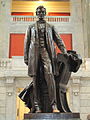
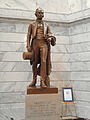
Between 1912 and 1963, five statues of historical figures from Kentucky were erected in the rotunda of the capitol.[6] The first was a bronze statue of Abraham Lincoln, which was donated in 1912. Statues of Henry Clay and Ephraim McDowell were added in 1930. Both of these are the bronzed plaster models used for the bronze statues that represent Kentucky in the National Statuary Hall in the U.S. Capitol in Washington, D.C.[7] In 1936, a marble statue of Jefferson Davis, president of the Confederate States of America, was placed in the rotunda. The statue of Davis was paid for by both donations and public funds, and erected under the auspices of the United Daughters of the Confederacy.[7] The Kentucky General Assembly voted to fund a bronze statue of Alben Barkley, former Vice President of the United States, and it was added to the rotunda in 1963.[7]
In 2018, a plaque in front of the statue of Jefferson Davis, which referred to Davis as a "patriot" and a "hero", was removed by the Kentucky Historic Properties Commission.[8] On June 4, 2020, Governor Andy Beshear stated that he believed the statue of Davis should be removed.[9] On June 13, 2020, the Kentucky Historic Properties Commission voted 11–1 to remove the statue from the Capitol. The Davis statue was to be moved to the Jefferson Davis Monument State Historic Site situated in Fairview, Kentucky, the birthplace of Davis.[10]
In November 2022, a bronze statue of Nettie Depp by Amanda Matthews, Depp's great-great niece, was unveiled inside that capitol. It is the first permanent large-scale monument of a woman inside the state capitol. While Nettie's influence was not statewide, the Historic Properties Advisory Commission considered her a representative example of Kentucky women who achieved professional and personal success. The statue's unveiling occurred in November 2022.[11][12]

Layout[edit]
.jpg)
The main part of the Capitol has three floors. The first floor contains the offices of the governor (and his or her staff), lieutenant governor, secretary of state, and attorney general. It also features a rotunda with statues of famous Kentuckians and other exhibits, including Kentucky Women Remembered.
The rotunda contains four statues of notable historical figures from Kentucky.[7] In the center of the rotunda stands a bronze statue of President Abraham Lincoln. Three more statues line the walls of the rotunda: bronze statues of Henry Clay, Vice President Alben Barkley, and Ephraim McDowell.
The second floor contains the courtroom of the state Supreme Court, as well as the chambers of the justices. The state law library is nearby. The State Reception Room is also located on the second floor.
The chambers of the House of Representatives and Senate face each other on opposite ends of the third floor. Some high-level legislative offices (such as for the Speaker of the House and the President of the Senate) are also located there.
The Capitol also has a partial fourth floor which houses the galleries of the House and Senate, as well as a few offices for legislative committee staffers.
In addition, there is a partially buried basement level with mostly offices for clerks and maintenance personnel. However, it also contains a small gift shop and lunch counter as well as a tunnel to the neighboring Capitol Annex building. The Annex houses General Assembly committee rooms, General Assembly members offices and a cafeteria.
People who have lain in state in the Rotunda[edit]
- Rebecca Boone, wife of Daniel Boone, 1845
- Daniel Boone, explorer, 1845
- Joseph Clay Stiles Blackburn, United States Senator, 1918
- Augustus Owsley Stanley, Governor, 1958
- Tom Garrett, state senator, 1979
- Col. Harland Sanders, founder of Kentucky Fried Chicken, 1980
- A.B. "Happy" Chandler, Governor and United States Senator, 1991
- Bert T. Combs, Governor, 1991
- Thelma Stovall, Lt. Governor, 1994
- Lawrence W. Wetherby, Governor, 1994
- Wilson W. Wyatt, Lt. Governor, 1996
- Vic Hellard Jr., Executive Director of the Kentucky Legislative Research Commission, 1996
- Mary Louise Foust, State Auditor, 1999.
- Wendell P. Butler, Superintendent of Public Instruction, 2000
- Robert F. Stephens, Chief Justice of the Kentucky Supreme Court, 2002
- Kenny Rapier, State Senator, 2002
- Edward T. "Ned" Breathitt, Governor, 2003
- Louie B. Nunn, Governor, 2004
- William E. McAnulty Jr., Justice on the Kentucky Supreme Court, 2008
- Mike Haydon, Governor's Chief of Staff, 2012
- Wendell Ford, Governor and United States Senator, 2015
- Georgia Davis Powers, State Senator, 2016[13]
- John Y. Brown Jr., Governor and business mogul, 2022[14]
Security[edit]
The Capitol used to be completely open during normal business hours, and local residents often used the marble hallways for exercise (the Frankfort equivalent of "mall walking"). Currently, anyone without proper state credentials must go through a metal detector. Security for the complex is provided by officers from the Facilities Security Branch of the Kentucky State Police along with specifically assigned state troopers.
See also[edit]
Gallery[edit]
-
 Kentucky State Capitol Dome seen from the US 60 lookout
 -
 Kentucky State Capitol seen from the Daniel Boone grave site
 -
 Capitol dome illuminated at night
 -
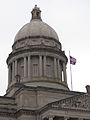 Capitol Dome, seen from outside main entrance
 -
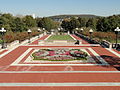 Main Entrance to the Capitol
 -
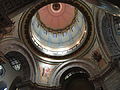 The rotunda
 -
 One of the marble staircases
 -
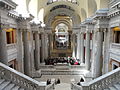 The main corridor
 -
 Office of the Governor of Kentucky
 -
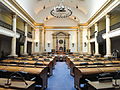 Senate Chamber
 -
 House of Representatives
 -
 Supreme Court Chamber
 -
 State Reception Room
 -
-
-
 The Kentucky State Capitol on September 3, 2023.


References[edit]
- ^ "National Register Information System". National Register of Historic Places. National Park Service. March 15, 2006.
- ^ a b c Buchta, David L. (2010). Kentucky's State Capitol. United States: Arcadia Publishing. ISBN 9780738585789. Retrieved on 2013-08-08
- ^ Kentucky State Capitol Timeline Retrieved 2013-08-08
- ^ Kentucky State Capitol: The Commonwealth's Magnificient [sic] Edifice Archived 2013-10-04 at the Wayback Machine Kentucky Division of Historic Properties. Retrieved 2013-08-08
- ^ Architecture of Frankfort Archived 2013-05-08 at the Wayback Machine City of Frankfort. Retrieved 2013-08-08
- ^ "Stop #14 State Capitol Pediment, Statuary & Murals". Frankfort Public Art. 2012. Retrieved 4 June 2020.
- ^ a b c d "Capitol Rotunda Statuary". Historic Properties. 2020. Retrieved 4 June 2020.
- ^ Novelly, Thomas (March 29, 2018). "A plaque calling Jefferson Davis a 'patriot' was removed from his Kentucky Capitol statue". The Courier-Journal. Retrieved 4 June 2020.
- ^ Aulbach, Lucas (June 4, 2020). "Jefferson Davis statue needs to be removed from Kentucky Capitol, Andy Beshear says". The Courier-Journal. Retrieved 4 June 2020.
- ^ Bailey, Phillip M. "'Sins of our past': After 84 years, Jefferson Davis statue removed from Kentucky Capitol". The Courier-Journal.
- ^ Brammer, Jack (22 December 2017). "In 2018, Kentucky's Capitol will finally get a life-size statue of a woman". Lexington Herald-Leader. Retrieved 27 December 2017.
- ^ Simonson, Aya Elamroussi, Amy (November 11, 2022). "Kentucky unveils statue of Nettie Depp, the first woman to have a permanent large-scale monument inside the state Capitol". CNN.
{{cite web}}: CS1 maint: multiple names: authors list (link) - ^ Gerth, Joseph (February 4, 2016). "22 have lain in state in Kentucky's Capitol". Louisville Courier-Journal. Louisville, Kentucky. Retrieved February 4, 2022.
- ^ Watkins, Morgan (November 29, 2022). "Former Gov. John Y. Brown lies in state at Kentucky Capitol". Louisville Courier Journal. Retrieved November 29, 2022.
External links[edit]

- Official website of the Kentucky State Capitol
- Kentucky's State Capitols Kentucky Department for Libraries and Archives
- Kentucky Historical Society page on the Old State Capitol
- Kentucky Secretary of State
| Subject areas |  | |
|---|---|---|
| Top subjects | ||
| Prominent suburbs | ||

| International | |
|---|---|
| Geographic | |

- Government of Kentucky
- State capitols in the United States
- Government buildings in Kentucky
- Government buildings with domes
- Tourist attractions in Franklin County, Kentucky
- Government buildings completed in 1905
- Government buildings on the National Register of Historic Places in Kentucky
- 1905 establishments in Kentucky
- National Register of Historic Places in Frankfort, Kentucky
- Beaux-Arts architecture in Kentucky
- Buildings and structures in Frankfort, Kentucky
- Central Frankfort Historic District