


Serbia in the Eurovision Song Contest
| Serbia in the Eurovision Song Contest | |
|---|---|
| |
| Participating broadcaster | Radio-televizija Srbije (RTS) |
| Participation summary | |
| Appearances | 15 (12 finals) |
| First appearance | 2007 |
| Highest placement | 1st: 2007 |
| Host | 2008 |
| Related articles | |
| External links | |
Serbia's page at Eurovision.tv  | |
 For the most recent participation see For the most recent participation seeSerbia in the Eurovision Song Contest 2024 | |
Serbia has participated in the Eurovision Song Contest 15 times since making its debut in 2007. Serbia previously participated as part of Yugoslavia (both the Socialist Federal Republic of Yugoslavia from 1961 to 1991 and the Federal Republic of Yugoslavia in 1992) and as Serbia and Montenegro (2004–2006). Serbia won the contest on its debut as an independent country in 2007, with "Molitva" by Marija Šerifović. The country's other top five results are third place in 2012 with "Nije ljubav stvar" by Željko Joksimović, and fifth place in 2022 with "In corpore sano" by Konstrakta. Serbia's other top ten results are sixth place (2008) and tenth place (2015).
History[edit]
2000s[edit]
As Serbia was part of Yugoslavia, it had the opportunity to participate in the Eurovision Song Contest after Yugoslavia's debut at the contest in 1961. It debuted the same year as Spain and Finland and became the first and, for three decades, only socialist country to participate in the competition. The best result of Yugoslavia occurred in 1989 when it won with "Rock Me", sung in Serbo-Croatian and English by Riva. Yugoslavia participated regularly until its breakup between 1991 and 1992.
After a period of absence from 1993 until 2003, Serbia and Montenegro returned to the contest in 2004. They finished in second place with song "Lane moje" performed by Željko Joksimović. By 2006, Serbia and Montenegro split, and with Serbia making its debut entry as an independent nation with the ballad "Molitva" by Marija Šerifović. "Molitva" won the 2007 contest, receiving 268 points, making Serbia the first country to win with a debut entry after Switzerland's win at the first edition. Subsequently, Serbia was host of the 2008 contest in its capital Belgrade.
The second Serbian entry, performed in Belgrade was written by past entrant for Serbia as part of Serbia and Montenegro and contest host Željko Joksimović. The song "Oro", an ethnic ballad, performed by Jelena Tomašević came 6th and received 160 points in the overall rankings.
In 2009, Serbia selected Marko Kon and Milaan to represent them in the second semi-final on 14 May. The duo failed to qualify for the final, marking it the first time Serbia failed to qualify for the final since the introduction of semi-finals.
2010s[edit]
In 2010, Milan Stanković was selected to represent the country in the contest with "Ovo je Balkan", an upbeat song with ethno elements, and is about a love story set in Belgrade. It qualified for the final and in the end achieved 13th place with 72 points. In 2011, Nina was selected with her 1960s inspired song, "Čaroban". She was accompanied with three other singers who would be dancing throughout the performance. In the semi-finals She performed 6th and qualified for the final. In the final, she performed 24th and achieved 14th place. After finishing second in 2004 when representing Serbia and Montenegro, Željko Joksimović returned to compete in 2012 with the song "Nije ljubav stvar". On the second semi-final he took second place, while he finished third in the final, below second-placed Russia and the winner, Sweden. Moje 3 represented Serbia in the Eurovision Song Contest 2013 in Malmö with the song "Ljubav je svuda". They would finish 11th in the first semi-final, therefore not qualifying for the final. This was the second time that Serbia did not qualify for the final. On 22 November 2013, Serbian broadcaster Radio Television of Serbia (RTS) announced that it would not participate in the 2014 contest due to financial difficulties and a lack of available sponsorship for a potential Serbian entry.[1] They did, however, broadcast all three shows.
On 26 September 2014, it was reported that Serbia had decided to return to the 2015 contest to be held in Austrian capital, Vienna.[2] On 15 February 2015 Serbia chose their own representative in the TV show "Odbrojavanje za Beč". Odbrojavanje za Beč (English: Countdown for Vienna) was the national final organised by RTS in order to select the Serbian entry for the Eurovision Song Contest 2015. The selection featured three songs composed by Vladimir Graić, the composer of Serbia's winning entry "Molitva" in 2007. Two of the songs were performed by established Serbian artists Bojana Stamenov and Aleksa Jelić, while one was performed by Danica Krstić, a new talent chosen by Graić through a scouting process. Bojana Stamenov was selected as the Serbian representative for Vienna through a 50:50 voting system, where both the audience and the jury voted for her song "Ceo svet je moj" (The whole world is mine) to represent Serbia in Austria. It was later announced that she would perform her song in English (a first for a Serbian entry) titled "Beauty Never Lies". Despite being low with the odds and fan votings, Bojana surprised everyone in the first semifinal and became one of the big press and fan favourites. She qualified to the final with 9th place in Semi-Final 1, but managed to achieve another top 10 result for Serbia in the Grand Final, scoring 53 points and the 10th place.
In March 2016, Radio Television of Serbia internally decided for Sanja Vučić to represent Serbia in Stockholm, Sweden with the song "Goodbye (Shelter)".[3] In the Eurovision 2016, she performed in the second semi-final, qualifying through. In the grand final, Vučić placed 18th by scoring 115 points.[4] The following Eurovision, Serbia was represented by Tijana Bogićević in Kyiv, Ukraine, again chosen by the national broadcaster.[5] She failed to qualify from the second semi-final by finishing 11th.[6]
In February 2018, Sanja Ilić and the world music group Balkanika were declared the winners of the returning Beovizija contest.[7] They performed in the second semi-final of the Eurovision 2018, hosted in Lisbon, Portugal. In the final, Sanja Ilić and Balkanika finished in 19th place with 113 points.[8] Subsequently, the Beovizija 2019 was won by Nevena Božović and "Kruna", who therefore represented Serbia in Tel Aviv, Israel.[9] Božović, who qualified from the first semi-final, scored 89 points in the final and thus placed 18th.[10]
2020s[edit]
On March 1, 2020, girl group Hurricane won Beovizija 2020 with "Hasta la vista" and were supposed to compete in Rotterdam, Netherlands.[11] The Eurovision 2020 was, however, eventually cancelled due the COVID-19 pandemic. In December 2020, Radio Television of Serbia selected Hurricane internally to represent Serbia in the Eurovision 2021.[12] Hurricane performed their new entry, "Loco loco", in the second semi-final, going through. In the final they went on to place 15th with 102 points.[13]
The following year, Beovizija was replaced by the newly-established national selection contest, Pesma za Evroviziju. The contest's first edition, held in March 2022, was won by Konstrakta and "In corpore sano", who was therefore chosen to represent Serbia in the Eurovision 2022, hosted in Turin, Italy.[14] Konstrakta qualified from the semi-final 2. In the final she placed 5th with 312 points.[15] "In corpore sano" became the most successful Serbian entry since 2012. Furthermore, Konstrakta also won the Artistic Marcel Bezençon Award and two Eurovision Awards - the Most Innovative Staging and the Best Lyrics.[16][17]
At the beginning of March 2023, RTS organized Pesma za Evroviziju '23, where Luke Black with "Samo mi se spava" was declared the winner and Serbian representative in Liverpool, United Kingdom.[18] In Liverpool, Luke finished in 24th place with 30 points.
Pesma za Evroviziju '24 was held to select the Serbian representative in 2024,[19] resulting as Teya Dora with the song "Ramonda".
Participation overview[edit]
Prior to Yugoslavia and Serbia and Montenegro's dissolution, artists from the Serbian federal unit represented Yugoslavia in 1961, 1962, 1974, 1982, 1991 and as a republic unit in 1992 and 2004.
| 1 | First place |
| 2 | Second place |
| 3 | Third place |
| X | Entry selected but did not compete |
| † | Upcoming event |
| Year | Artist | Song | Language | Final | Points | Semi | Points |
|---|---|---|---|---|---|---|---|
| 2007 | Marija Šerifović | "Molitva" (Молитва) | Serbian | 1 | 268 | 1 | 298 |
| 2008 | Jelena Tomašević feat. Bora Dugić | "Oro" (Оро) | Serbian | 6 | 160 | Host country | |
| 2009 | Marko Kon and Milaan | "Cipela" (Ципела) | Serbian | Failed to qualify | 10[a] | 60 | |
| 2010 | Milan Stanković | "Ovo je Balkan" (Ово је Балкан) | Serbian | 13 | 72 | 5 | 79 |
| 2011 | Nina | "Čaroban" (Чаробан) | Serbian | 14 | 85 | 8 | 67 |
| 2012 | Željko Joksimović | "Nije ljubav stvar" (Није љубав ствар) | Serbian | 3 | 214 | 2 | 159 |
| 2013 | Moje 3 | "Ljubav je svuda" (Љубав је свуда) | Serbian | Failed to qualify | 11 | 46 | |
| 2015 | Bojana Stamenov | "Beauty Never Lies" | English | 10 | 53 | 9 | 63 |
| 2016 | Sanja Vučić Zaa | "Goodbye (Shelter)" | English | 18 | 115 | 10 | 105 |
| 2017 | Tijana Bogićević | "In Too Deep" | English | Failed to qualify | 11 | 98 | |
| 2018 | Sanja Ilić and Balkanika | "Nova deca" (Нова деца) | Serbian | 19 | 113 | 9 | 117 |
| 2019 | Nevena Božović | "Kruna" (Круна) | Serbian | 18 | 89 | 7 | 156 |
| 2020 | Hurricane | "Hasta la vista" | Serbian | Contest cancelled[b] X | |||
| 2021 | Hurricane | "Loco loco" | Serbian | 15 | 102 | 8 | 124 |
| 2022 | Konstrakta | "In corpore sano" | Serbian, Latin | 5 | 312 | 3 | 237 |
| 2023 | Luke Black | "Samo mi se spava" (Само ми се спава) | Serbian, English | 24 | 30 | 10 | 37 |
| 2024 | Teya Dora | "Ramonda" (Рамонда) | Serbian | Upcoming † | |||
Hostings[edit]
| Year | Location | Venue | Presenters | Image |
|---|---|---|---|---|
| 2008 | Belgrade | Belgrade Arena | Jovana Janković and Željko Joksimović | 
|
Awards[edit]
Marcel Bezençon Awards[edit]
| Year | Category | Performer | Song | Final | Points | Host city | Ref. |
|---|---|---|---|---|---|---|---|
| 2007 | Artistic Award | Marija Šerifović | "Molitva" (Молитва) | 1 | 268 |  Helsinki Helsinki
|
|
| 2022 | Artistic Award | Konstrakta | "In corpore sano" | 5 | 312 |  Turin Turin
|
Winner by OGAE members[edit]
| Year | Song | Performer | Final | Points | Host city | Ref. |
|---|---|---|---|---|---|---|
| 2007 | "Molitva" (Молитва) | Marija Šerifović | 1 | 268 | Helsinki
|
Barbara Dex Award[edit]
| Year | Performer | Host city | Ref. |
|---|---|---|---|
| 2010 | Milan Stanković |  Oslo Oslo
|
|
| 2013 | Moje 3 |  Malmö Malmö
|
Related involvement[edit]
Heads of delegations[edit]
| Year | Head of delegation | Ref. |
|---|---|---|
| 2007–2009 | Anja Rogljić | |
| 2010–2016 | Dragan Ilić | |
| 2017–2022 | Anja Rogljić | |
| 2023–present | Uroš Marković |
Commentators and spokespersons[edit]
All the events were broadcast on RTS1, except the 2013 final and the 2015 second semi-final, which were broadcast on RTS2 and 2023 semi-finals which were broadcast on cable channel RTS3.
| Year | Commentator | Spokesperson | Ref. |
|---|---|---|---|
| 2007 | Duška Vučinić-Lučić | Maja Nikolić | |
| 2008 | Dragan Ilić, Mladen Popović | Dušica Spasić | [28] |
| 2009 | Dragan Ilić (semi-final 1) Duška Vučinić-Lučić (semi-final 2, final) |
Jovana Janković | |
| 2010 | Duška Vučinić-Lučić (semi-final 1, final) Dragan Ilić (semi-final 2) |
Maja Nikolić | |
| 2011 | Marina Nikolić (semi-final 1) Dragan Ilić (semi-final 2) Duška Vučinić-Lučić (final) |
Dušica Spasić | [29] |
| 2012 | Dragan Ilić (semi-final 1) Duška Vučinić-Lučić (semi-final 2, final) |
Maja Nikolić | [30] |
| 2013 | Duška Vučinić-Lučić (semi-final 1) Marina Nikolić (semi-final 2) Silvana Grujić (final) |
[31][32] | |
| 2014 | Silvana Grujić (all shows) Dragan Ilić (final) |
Did not participate | [33][34] |
| 2015 | Duška Vučinić-Lučić (semi-final 1, final) Silvana Grujić (semi-final 2) |
Maja Nikolić | [35][36][37] |
| 2016 | Dragan Ilić (semi-final 1) Duška Vučinić-Lučić (semi-final 2, final) |
Dragana Kosjerina | [38][39][40] |
| 2017 | Silvana Grujić, Olga Kapor (semi-final 1) Duška Vučinić-Lučić (semi-final 2, final) |
Sanja Vučić | [41][42][43] |
| 2018 | Silvana Grujić, Tamara Petković (semi-final 1) Duška Vučinić-Lučić (semi-final 2, final) |
Dragana Kosjerina | [44][45][46] |
| 2019 | Duška Vučinić-Lučić (semi-final 1, final) Tamara Petković, Katarina Epštajn (semi-final 2) |
[47][48][49] | |
| 2021 | Duška Vučinić-Lučić | [50][51][52] | |
| 2022 | Silvana Grujić (semi-final 1) Duška Vučinić-Lučić (semi-final 2, final) |
[53][54][55] | |
| 2023 | Duška Vučinić-Lučić | [56][57] |
- From 1961 until 1992, Serbia competed as part of Yugoslavia and from 2004 to 2005 as part of Serbia and Montenegro.
Kosovan entrants[edit]
After Kosovo's declaration of independence from Serbia in 2008, its broadcaster RTK was applying for EBU membership, and wished to enter Kosovo independently into the Eurovision Song Contest 2009.[58][59] Kosovo is partially recognised and not a member of the United Nations, and UN membership is required to obtain full EBU membership. As of 2013, RTK has observer status within the EBU and has participated in the Eurovision Young Dancers once.[60][61] Several Kosovo Albanian artists have competed in Festivali i Këngës, the national selection for Albania organised by RTSH. The most notable Kosovo Albanian participants to date are Rona Nishliu, Lindita, and Albina Kelmendi and her family, who represented Albania in 2012, 2017 and 2023, respectively.
Several Kosovo Serb artists have competed in the Serbian national selections organised by RTS. Kosovo-born Nevena Božović represented Serbia in the Junior Eurovision Song Contest and twice in the Eurovision Song Contest, first as a member of Moje 3 in 2013 and later as a solo artist in 2019.
Photogallery[edit]
-
 Marija Šerifović in Helsinki (2007)
 -

-

-
 Milan Stanković in Oslo (2010)
 -
 Željko Joksimović in Baku (2012)
 -

-
 Bojana Stamenov in Vienna (2015)
 -
 Sanja Vučić in Stockholm (2016)
 -
 Tijana Bogićević in Kyiv (2017)
 -

-
 Nevena Božović in Tel Aviv (2019)
 -
 Konstrakta in Turin (2022)
 -
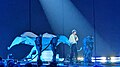 Luke Black in Liverpool (2023)


.jpg)
See also[edit]
- Serbia in the Junior Eurovision Song Contest
- Serbia and Montenegro in the Eurovision Song Contest
- Serbia and Montenegro in the Junior Eurovision Song Contest
- Yugoslavia in the Eurovision Song Contest
- Kosovo in the Eurovision Song Contest
- Kosovo in the Eurovision Young Dancers
Notes[edit]
- ^ In 2008 and 2009 the top nine countries in each semi-final as determined by televoting qualified automatically, with the tenth place determined based on the votes of the back-up juries among the remaining countries. This resulted in Croatia advancing to the final instead of Serbia in 2009.
- ^ The 2020 contest was cancelled due to the COVID-19 pandemic.
References[edit]
- ^ Juhász, Ervin (22 November 2013). "Serbia: RTS not going to Copenhagen". escXtra.com. Archived from the original on 25 November 2013. Retrieved 23 November 2013.
- ^ Jiandani, Sanjay (26 September 2014). "Serbia: RTS confirms participation- opts for a national final". esctoday.com. ESCToday. Retrieved 26 September 2014.
- ^ "Sanja Vučić ZAA predstavlja Srbiju na Evroviziji". N1 (in Serbian). 7 March 2016. Retrieved 11 May 2023.
- ^ "Grand Final of Stockholm 2016". Eurovision.tv. Retrieved 11 May 2023.
- ^ "Tijana Bogićević predstavlja Srbiju na Evroviziji". N1 (in Serbian). 27 February 2017. Retrieved 11 May 2023.
- ^ "Semi-Final of Kyiv 2017". Eurovision.tv. Retrieved 11 May 2023.
- ^ "Sanja Ilić i "Balkanika" predstavnici Srbije na "Evrosongu"!". RTS (in Serbian). 20 February 2018. Retrieved 11 May 2023.
- ^ "Grand Final of Lisbon 2018". Eurovision.tv. Retrieved 11 May 2023.
- ^ "Nevena Božović predstavlja Srbiju na Pesmi Evrovizije". Danas.rs (in Serbian). 3 March 2019. Retrieved 11 May 2023.
- ^ "Grand Final of Tel Aviv 2019". Eurovision.tv. Retrieved 11 May 2023.
- ^ "Grupa "Hurricane" predstavlja Srbiju na Evroviziji 2020". Danas.rs (in Serbian). 2 March 2020. Retrieved 11 May 2023.
- ^ "RTS odlučio: Hurricane idu na Evroviziju 2021". Nova.rs (in Serbian). 17 December 2020. Retrieved 11 May 2023.
- ^ "Grand Final of Rotterdam 2021". Eurovision.tv. Retrieved 11 May 2023.
- ^ "Konstrakta predstavlja Srbiju na Pesmi Evrovizije". Danas.rs (in Serbian). 6 March 2022. Retrieved 11 May 2023.
- ^ "Grand Final of Turin 2022". Eurovision.tv. Retrieved 11 May 2023.
- ^ Krkeljić, B. (14 May 2022). "Sat vremena pre finala, Konstrakta dobila još jednu nagradu na Evroviziji". Nova.rs (in Serbian). Retrieved 11 May 2023.
- ^ Krkeljić, B. (27 December 2022). "Konstrakta pobedila i Ukrajince: Dobila veliku evrovizijsku nagradu". Nova.rs (in Serbian). Retrieved 11 May 2023.
- ^ "Luk Blek će ići u Liverpul!". RTS (in Serbian). 4 March 2023. Retrieved 11 May 2023.
- ^ RTS [@SerbiaESC] (October 20, 2023). "PZE23 from an analogue perspective — something to inspire us while counting down to the next one" (Tweet). Retrieved 2023-10-22 – via Twitter.
- ^ "Marcel Bezençon Awards". eurovision.tv. July 2019. Archived from the original on 16 July 2019. Retrieved 8 December 2019.
- ^ "2022 Marcel Bezençon Award Winners". eurovision.tv. 14 May 2022. Retrieved 14 May 2022.
- ^ Cobb, Ryan (21 April 2017). "Analysing ten years of OGAE voting: "Underneath the fan favourite bias is a worthwhile indicator"". escxtra.com. Retrieved 8 December 2019.
- ^ a b Adams, William Lee (9 July 2015). "Poll: Who was the worst dressed Barbara Dex Award winner?". Wiwibloggs. Retrieved 8 December 2019.
- ^ "РТС 7. марта саопштава представника Србије на "Евросонгу"". rts.rs. Radio Television of Serbia. 2016-03-04. Retrieved 2023-02-12.
- ^ "TIJANA, SREĆNO U KIJEVU!". vesti.rs. Radio Television of Serbia. 2017-04-29. Retrieved 2023-02-12.
- ^ "Anja Rogljić: Peto mesto je veliki uspeh za našu zemlju, Konstrakta je pravi profesionalac". rts.rs. Radio Television of Serbia. 2022-05-16. Retrieved 2023-02-12.
- ^ "Serbia: Luke Black's Team Plan Minor Changes Following First Rehearsal". eurovoix.com. Eurovoix. 2023-05-01. Retrieved 2023-05-01.
- ^ "Eurosong finale". b92.net. Retrieved 2008-05-24.
- ^ "Pesma Evrovizije 2011". RTS. 8 May 2011. Retrieved 8 May 2011.
- ^ "Pesma Evrovizije 2012". RTS (in Serbian). 19 May 2012. Archived from the original on 21 May 2012. Retrieved 19 May 2012.
- ^ Песма Евровизије 2013 – друго полуфинале, пренос [Eurovision Song Contest 2013 – first semi-final] (in Serbian). Radio Television of Serbia. 15 May 2013. Archived from the original on 8 June 2013. Retrieved 15 May 2013.
- ^ Финале Песме Евровизије 2013 [Final of the Eurovision Song Contest 2013] (in Serbian). Radio Television of Serbia. 17 May 2013. Archived from the original on 2 October 2013. Retrieved 17 May 2013.
- ^ РТС преноси "Евросонг" 2014. [RTS transmissions "Eurovision Song Contest" in 2014.] (in Serbian). RTS. 7 April 2014. Archived from the original on 9 April 2014. Retrieved 7 April 2014.
- ^ Песма Евровизије 2014. – Полуфинале 1 [Eurovision Song Contest in 2014. – Semifinal 1] (in Serbian). RTS. 29 April 2014. Archived from the original on 30 April 2014. Retrieved 29 April 2014.
- ^ "Песма Евровизије 2015: Прво полуфинале, пренос" [Eurovision 2015: First semi-final transfer] (in Serbian). Radio Television of Serbia. 15 May 2015. Retrieved 15 May 2015.
- ^ "Песма Евровизије 2015: Друго полуфинале, пренос" [Eurovision 2015: Second semi-final transfer] (in Serbian). Radio Television of Serbia. 20 May 2015. Retrieved 20 May 2015.
- ^ "Песма Евровизије 2015: Финале, пренос" [Eurovision 2015: Grand Final transfer] (in Serbian). Radio Television of Serbia. 22 May 2015. Retrieved 22 May 2015.
- ^ "Pesma Evrovizije 2016, polufinale 1, prenos". rts.rs (in Serbian). RTS. Retrieved 10 May 2016.
- ^ "Pesma Evrovizije 2016, polufinale 2, prenos". rts.rs (in Serbian). RTS. Retrieved 10 May 2016.
- ^ "Pesma Evrovizije 2016, Finale, prenos". rts.rs (in Serbian). RTS. Retrieved 13 May 2016.
- ^ Serbia, RTS, Radio-televizija Srbije, Radio Television of. "Песма Евровизије 2017, полуфинале 1, пренос" (in Serbian). Retrieved 8 May 2017.
{{cite news}}: CS1 maint: multiple names: authors list (link) - ^ Serbia, RTS, Radio-televizija Srbije, Radio Television of. "Песма Евровизије 2017, полуфинале 2, пренос" (in Serbian). Retrieved 10 May 2017.
{{cite news}}: CS1 maint: multiple names: authors list (link) - ^ Serbia, RTS, Radio-televizija Srbije, Radio Television of. "Песма Евровизије 2017, финале, пренос" (in Serbian). Retrieved 12 May 2017.
{{cite news}}: CS1 maint: multiple names: authors list (link) - ^ Serbia, RTS, Radio-televizija Srbije, Radio Television of. "Песма Евровизије 2018, полуфинале 1, пренос" (in Serbian). Retrieved 7 May 2018.
{{cite news}}: CS1 maint: multiple names: authors list (link) - ^ Serbia, RTS, Radio-televizija Srbije, Radio Television of. "Песма Евровизије 2018, полуфинале 2, пренос" (in Serbian). Retrieved 9 May 2018.
{{cite news}}: CS1 maint: multiple names: authors list (link) - ^ Serbia, RTS, Radio-televizija Srbije, Radio Television of. "Песма Евровизије 2018, финале, пренос" (in Serbian). Retrieved 11 May 2018.
{{cite news}}: CS1 maint: multiple names: authors list (link) - ^ Serbia, RTS, Radio-televizija Srbije, Radio Television of. "Песма Евровизије 2019, полуфинале 1, пренос" (in Serbian). Archived from the original on 6 May 2019. Retrieved 6 May 2019.
{{cite news}}: CS1 maint: multiple names: authors list (link) - ^ Serbia, RTS, Radio-televizija Srbije, Radio Television of. "Песма Евровизије 2019, полуфинале 2, пренос" (in Serbian). Archived from the original on 10 May 2019. Retrieved 10 May 2019.
{{cite news}}: CS1 maint: multiple names: authors list (link) - ^ Serbia, RTS, Radio-televizija Srbije, Radio Television of. "Песма Евровизије 2019, финале, пренос" (in Serbian). Archived from the original on 17 May 2019. Retrieved 17 May 2019.
{{cite news}}: CS1 maint: multiple names: authors list (link) - ^ Serbia, RTS, Radio-televizija Srbije, Radio Television of. "Песма Евровизије 2021, полуфинале 1, пренос" (in Serbian). Retrieved 17 May 2021.
{{cite news}}: CS1 maint: multiple names: authors list (link) - ^ "Песма Евровизије 2021, полуфинале 2, пренос". RTS (in Serbian). Retrieved 19 May 2021.
- ^ "Финале такмичења за Песму Евровизије 2021". RTS (in Serbian). Retrieved 21 May 2021.
- ^ "Песма Евровизије 2022, полуфинале 1, пренос". RTS (in Serbian). Retrieved 6 May 2022.
- ^ "Песма Евровизије 2022, полуфинале 2, пренос". RTS (in Serbian). Retrieved 11 May 2022.
- ^ "Песма Евровизије 2022, финале, пренос". RTS (in Serbian). Retrieved 13 May 2022.
- ^ "Песма Евровизије 2023, полуфинале 1, пренос". RTS (in Serbian). Retrieved 4 May 2023.
- ^ "Песма Евровизије 2023, финале, пренос". RTS (in Serbian). Retrieved 12 May 2023.
- ^ "Kosovo: RTK wants to enter Eurovision in 2009". oikotimes.com. Archived from the original on 3 January 2010. Retrieved 22 May 2008.
- ^ "NDR on the Kosovo potential participation in Eurovision" Archived 2012-03-29 at the Wayback Machine oikotimes.com 22 May 2008 Link accessed 27/05/08
- ^ Albavision (2011-04-07). "Kosovo new steps in ebu agreement". albavision.tk. Retrieved 25 July 2011.
- ^ "Participant Profile - Kosovo". European Broadcasting Union. 2011. Archived from the original on 3 October 2011. Retrieved 25 July 2011.
External links[edit]
- Points to and from Serbia eurovisioncovers.co.uk
