


Italy in the Eurovision Song Contest
| Italy in the Eurovision Song Contest | |
|---|---|

| |
| Participating broadcaster | Radiotelevisione italiana (RAI) |
| Participation summary | |
| Appearances | 48 |
| First appearance | 1956 |
| Highest placement | 1st: 1964, 1990, 2021 |
| Host | 1965, 1991, 2022 |
| Related articles | |
| External links | |
| RAI page | |
Italy's page at Eurovision.tv  | |
 For the most recent participation see For the most recent participation seeItaly in the Eurovision Song Contest 2024 | |
Italy has participated in the Eurovision Song Contest 48 times since making its debut as one of only seven countries to compete at the first contest in 1956, which took inspiration from the Sanremo Music Festival.[1] Italy competed at the contest without interruption until 1980, discontinuing its participation on a number of occasions during the 1980s and 1990s. After a 13-year absence starting in 1998, the country returned to the contest in 2011. Italy has won the contest three times, along with an additional 16 top-five finishes. Italy hosted the contest in Naples (1965), Rome (1991) and Turin (2022).
In 1958, Domenico Modugno finished third with the song "Nel blu, dipinto di blu". Commonly known as "Volare", the song became a huge international hit, topping the US Billboard Hot 100 and winning two Grammy Awards at its first edition. Emilio Pericoli also finished third in 1963, before Italy won for the first time in 1964 with Gigliola Cinquetti and "Non ho l'età". Cinquetti returned to the contest in 1974 and finished second with the song "Sì", losing to ABBA's "Waterloo". Italy then finished third in 1975 with Wess and Dori Ghezzi and the song "Era". The country's best result of the 1980s was Umberto Tozzi and Raf finishing third in 1987. Italy's second victory in the contest came in 1990 with Toto Cutugno and the song "Insieme: 1992". Other good 1990s results were Mia Martini in 1992 and Jalisse in 1997, who both finished fourth. After 1997, Italy withdrew from the competition.
On 31 December 2010, the European Broadcasting Union (EBU) announced that Italy would be returning to the contest as part of the "Big Five", thereby granting the country automatic qualification for the final.[2] Italy's return to the contest has proved to be successful, finishing in the top ten in 10 of the last 12 contests (2011–23), including second places for Raphael Gualazzi (2011) and Mahmood (2019), and third place for Il Volo (2015). Il Volo won the televote, receiving votes from all countries, but came sixth with the juries. This was the first time since the introduction of the mixed jury/televote system in 2009 that the televote winner did not end up winning the contest. Italy achieved its third victory in the contest in 2021, with the rock band Måneskin and the song "Zitti e buoni".
History[edit]
Absences[edit]
Italy has withdrawn from the Eurovision Song Contest a number of times. The first withdrawal was in 1981, when RAI stated that interest had diminished in the country.[3] This absence continued through 1982, before Italy returned in 1983. Italy again withdrew in 1986 when RAI decided not to enter the contest.[4] From 1994 to 1996, Italy withdrew again, with RAI citing a lack of interest in participating. Italy returned in 1997, before withdrawing again without explanation, and the country did not participate again until 2011.[5]
None of the 20th century Eurovision-winning songs were particularly successful in the Italian charts. "Non ho l'età" by Gigliola Cinquetti was a hit in February 1964 when the song won the 1964 contest, but according to the official "Hit Parade Italia" website, "Waterloo", "Ding-a-dong", "Puppet on a String", "Save Your Kisses for Me" and even Italy's own winning entry of 1990, "Insieme: 1992", all failed to enter the top ten of the records sales charts. A notable exception to this rule was the 1984 entry "I treni di Tozeur" by Alice and Franco Battiato, which shared fifth place in the final, but still became a #3 hit in Italy and also placed at #20 on the chart of the best-selling Italian singles in 1984.
TV censorship of the 1974 contest[edit]
RAI refused to broadcast the 1974 contest live because their competing song, sung by Gigliola Cinquetti, coincided with the intense political campaigning for the 1974 Italian divorce referendum which was to be held a month later in May. Despite the Eurovision Song Contest taking place more than a month before the planned vote, Italian censors refused to allow the contest and song to be shown or heard. RAI censors felt that the song, titled "Sì" (Yes), and contained lyrics constantly repeating the aforementioned word could be subject to accusation of being subliminal messaging and a form of propaganda to influence the Italian voting public to vote 'yes' in the referendum (thus to repeal the law that allowed divorce).[6] The song thus remained censored on most Italian state TV and radio stations for over a month. At the contest in Brighton, Cinquetti finished second, losing to ABBA. "Sì" went on to be a UK top ten hit, peaking at number eight. It also reached the German top 20.[citation needed] The contest was broadcast in June.
The 2008–2010 period[edit]
In 2008, two notable Italian musicians, Vince Tempera (who was the conductor for Malta in 1975 and had helped San Marino take part in the ESC in 2008) and Eurovision winner Toto Cutugno expressed their sorrow at Italy's non-participation and called for the country to return to the contest.[7][8]
Contestants from the 2008 contest, starting with the winner Dima Bilan appeared on the Italian show Carramba! Che fortuna, hosted by Raffaella Carrà on Rai Uno. Whether this was an initiative by Carrà (who presented three shows in TVE concerning the event) to try to bring Eurovision back to Italy is not clear, but Sietse Bakker, then-Manager Communications & PR of the Eurovision Song Contest, reiterated that "Italy is still very much welcome to take part in the competition."[9][10]
Shortly after revealing the list of participants for the 2009 contest, the EBU announced that they would work harder to bring Italy back into the contest, along with former participants Monaco and Austria.[11]
Return (2011–present)[edit]
At a press conference presenting the fourth edition of the Italian X Factor, Rai 2 director Massimo Liofredi announced that the winner of the competition might advance to represent Italy in the Eurovision Song Contest, rather than participate in the Sanremo Festival, as in previous years. On 2 December 2010, it was officially announced by the EBU that Italy had applied to compete in the 2011 contest.[12] Their participation was further confirmed on 31 December with the announcement of the official participant list.[2]
Italy's return to the contest after a 13-year absence has been successful, finishing in the top ten in 10 of the last 12 contests (2011–23). In 2011, Raphael Gualazzi finished second, then Italy's best result since 1990. Italy came first with the jury vote, but only 11th in the televote to place second overall behind eventual winner Azerbaijan. Nina Zilli in 2012 and Marco Mengoni in 2013 placed in the top ten (ninth and seventh, respectively); the latter scored 126 points, exactly doubling the points total of the other "Big Five" countries that year. This trend had a stop in 2014, when internally-selected Emma Marrone finished in 21st place. In 2015, Il Volo finished third with 292 points, behind winner Sweden and runner-up Russia, placing first in the televote but sixth in the jury vote. Since the introduction of the 50/50 split voting system, this was the first time that the televote winner did not win the contest overall. Francesca Michielin, selected among the competitors of Sanremo 2016 after the waiver of the winners Stadio, ended in 16th place. Francesco Gabbani came in sixth place in 2017. The year after, although not initially a big favourite with the bookmakers, Ermal Meta and Fabrizio Moro returned Italy to the top five, aided significantly by finishing third in the televote, which heavily counterbalanced the 17th place by the jury, finishing fifth overall. In 2019, Mahmood placed second with 472 points, Italy's best result since 2011, until Måneskin won the contest in 2021 with 524 points. Måneskin's victory marked the band's breakthrough on the international music scene. Mahmood returned in 2022 as the host entrant alongside Blanco, placing sixth, followed by Mengoni returning in 2023, placing fourth.
Sanremo Music Festival[edit]
The Sanremo Music Festival is the most popular Italian song contest and awards ceremony, held annually in the city of Sanremo, Liguria. First held in 1951 and itself the basis and inspiration for the Eurovision Song Contest, the festival has often been used as a method of choosing the Italian entry for the European contest, with some exceptions over the years. Since 2015, the winner of the festival has been given the right of first refusal to represent Italy in the contest.[1][13]
Italy and the "Big Five"[edit]
Since 1999, four countries – France, Germany, Spain and the United Kingdom – have automatically qualified for the Eurovision final regardless of their results in previous contests.[14] These countries earned this special status by being the four biggest financial contributors to the EBU, and subsequently became known as the "Big Four". In a meeting with OGAE Serbia in 2007, then-Executive Supervisor of the Contest Svante Stockselius stated that, if Italy were to return to the contest in the future, the country would also automatically qualify for the final, becoming part of a "Big Five".[15][16] However, with the official announcement of the return of Italy, it was not confirmed whether the country would compete in one of the two semi-finals or be part of the "Big Five", as RAI, third largest contributor to the EBU, had not applied for "Big Five" membership.[17] On 31 December 2010, it was announced that Italy would take part in the 2011 contest and confirmed that the country would automatically qualify for the final as part of the "Big Five".[2]
Italy is currently the most successful Big Five country in the Eurovision Song Contest following the introduction of the rule, finishing in the top ten in 10 of the last 12 contests (2011–23), including a victory for Måneskin (2021), second places for Raphael Gualazzi (2011) and Mahmood (2019), and third place for Il Volo (2015). It is one of the only two countries of the Big Five – since it was introduced – to have won, the other being Germany in 2010.
Participation overview[edit]
| 1 | First place |
| 2 | Second place |
| 3 | Third place |
| ◁ | Last place |
| X | Entry selected but did not compete |
| † | Upcoming event |
Congratulations: 50 Years of the Eurovision Song Contest[edit]
| Artist | Song | Language | At Congratulations | At Eurovision | |||||
|---|---|---|---|---|---|---|---|---|---|
| Final | Points | Semi | Points | Year | Place | Points | |||
| Domenico Modugno | "Nel blu, dipinto di blu" | Italian | 2 | 267 | 2 | 200 | 1958 | 3 | 13 |
Hostings[edit]
| Year | Location | Venue | Presenters |
|---|---|---|---|
| 1965 | Naples | Auditorium RAI | Renata Mauro |
| 1991 | Rome | Teatro 15 di Cinecittà | Gigliola Cinquetti and Toto Cutugno |
| 2022 | Turin | PalaOlimpico | Alessandro Cattelan, Laura Pausini and Mika |
Awards[edit]
Marcel Bezençon Awards[edit]
| Year | Category | Song | Performer | Final | Points | Host city | Ref. |
|---|---|---|---|---|---|---|---|
| 2015 | Press Award | "Grande amore" | Il Volo | 3 | 292 |  Vienna Vienna
|
|
| 2017 | Press Award | "Occidentali's Karma" | Francesco Gabbani | 6 | 334 |  Kyiv Kyiv
|
|
| 2019 | Composer Award | "Soldi" | Mahmood | 2 | 465 |  Tel Aviv Tel Aviv
|
|
| 2023 | Composer Award | "Due vite" | Marco Mengoni | 4 | 350 |  Liverpool Liverpool
|
Winner by OGAE members[edit]
| Year | Song | Performer | Final result |
Points | Host city | Ref. |
|---|---|---|---|---|---|---|
| 2015 | "Grande amore" | Il Volo | 3 | 292 | Vienna
|
|
| 2017 | "Occidentali's Karma" | Francesco Gabbani | 6 | 334 | Kyiv
|
|
| 2019 | "Soldi" | Mahmood | 2 | 465 | Tel Aviv
|
Related involvement[edit]
Conductors[edit]
| Year | Eurovision Conductor | Musical Director | Notes | Ref. |
|---|---|---|---|---|
| 1956 | Gian Stellari | N/A | [25] | |
| 1957 | Armando Trovajoli | |||
| 1958 |  Alberto Semprini Alberto Semprini
|
|||
| 1959 | William Galassini | |||
| 1960 | Cinico Angelini | |||
| 1961 | Gianfranco Intra | |||
| 1962 | Cinico Angelini | |||
| 1963 | Gigi Chichellero | |||
| 1964 | Gianfranco Monaldi | |||
| 1965 | Gianni Ferrio | [c] | ||
| 1966 | Angelo Giacomazzi | N/A | [d] | |
| 1967 | Giancarlo Chiaramello | |||
| 1968 | ||||
| 1969 | Ezio Leoni | |||
| 1970 | Mario Capuano | [26] | ||
| 1971 | Enrico Polito | |||
| 1972 | Gian Franco Reverberi | |||
| 1973 | Enrico Polito | |||
| 1974 | Gianfranco Monaldi | |||
| 1975 | Natale Massara | |||
| 1976 | Maurizio Fabrizio | |||
| 1977 | ||||
| 1978 | Nicola Samale | |||
| 1979 | No conductor | [e] | ||
| 1980 | Del Newman
|
[27] | ||
| 1983 | Maurizio Fabrizio | |||
| 1984 | Giusto Pio | |||
| 1985 | Fiorenzo Zanotti | |||
| 1987 | Gianfranco Lombardi | |||
| 1988 | No conductor | [e] | ||
| 1989 | Mario Natale | |||
| 1990 | Gianni Madonini | |||
| 1991 | Bruno Canfora | |||
| 1992 | Marco Falagiani | N/A | ||
| 1993 | Vittorio Cosma | |||
| 1997 | Lucio Fabbri | |||
Heads of delegation[edit]
| Year | Head of delegation | Ref. |
|---|---|---|
| 2011–2019 | Nicola Caligiore | |
| 2020–2021 | Simona Martorelli | |
| 2022–present | Mariangela Borneo |
Commentators and spokespersons[edit]
 | This section needs additional citations for verification. (January 2020) |
| Year | Final commentator | Semi-final commentator | Spokesperson | Ref. |
|---|---|---|---|---|
| 1956 | Bianca Maria Piccinino | No semi-finals | No spokesperson | |
| 1957 | Nunzio Filogamo | |||
| 1958 | Fulvia Colombo | |||
| 1959 | Enzo Tortora | |||
| 1960 | Giorgio Porro | |||
| 1961 | Corrado Mantoni | |||
| 1962 | Renato Tagliani | |||
| 1963 | ||||
| 1964 | Rosanna Vaudetti | |||
| 1965 | Daniele Piombi | |||
| 1966 | Enzo Tortora | |||
| 1967 | Mike Bongiorno | |||
| 1968 | ||||
| 1969 | ||||
| 1970 | Enzo Tortora | |||
| 1971 | No spokesperson | |||
| 1972 | ||||
| 1973 | ||||
| 1974 | Rosanna Vaudetti | Anna Maria Gambineri | ||
| 1975 | Silvio Noto | |||
| 1976 | Rosanna Vaudetti | |||
| 1977 | Mariolina Cannuli | |||
| 1978 | Rosanna Vaudetti | |||
| 1979 | Paola Perissi | |||
| 1980 | Michele Gammino | Mariolina Cannuli | ||
| 1981–1982 | No broadcast | Did not participate | ||
| 1983 | Paolo Frajese | No semi-finals | Paola Perissi | |
| 1984 | Antonio De Robertis | Mariolina Cannuli | ||
| 1985 | Rosanna Vaudetti | Beatrice Cori | ||
| 1986 | No broadcast | Did not participate | ||
| 1987 | Rosanna Vaudetti | No semi-finals | Mariolina Cannuli | |
| 1988 | Daniele Piombi | |||
| 1989 | Gabriella Carlucci | Peppi Franzelin | ||
| 1990 | Peppi Franzelin | Paolo Frajese | ||
| 1991 | No commentator | Rosanna Vaudetti | ||
| 1992 | Peppi Franzelin | Nicoletta Orsomando | ||
| 1993 | Ettore Andenna | Ettore Andenna | Peppi Franzelin | |
| 1994–1996 | No broadcast | Did not participate | ||
| 1997 | Ettore Andenna | No semi-finals | Peppi Franzelin | |
| 1998–2002 | No broadcast | Did not participate | ||
| 2003 | Fabio Canino and Paolo Quilici | No semi-finals | ||
| 2004–2010 | No broadcast | |||
| 2011 | Raffaella Carrà and Bob Sinclar | Raffaella Carrà | Raffaella Carrà | |
| 2012 | Filippo Solibello and Marco Ardemagni | Federica Gentile | Ivan Bacchi | |
| 2013 | Filippo Solibello, Marco Ardemagni and Natasha Lusenti | Federica Gentile | ||
| 2014 | Linus and Nicola Savino | Marco Ardemagni and Filippo Solibello | Linus | |
| 2015 | Federico Russo and Valentina Correani (TV) Marco Ardemagni and Filippo Solibello (radio) |
Federico Russo | ||
| 2016 | Flavio Insinna and Federico Russo | Claudia Andreatti | ||
| 2017 | Andrea Delogu and Diego Passoni | Giulia Valentina | ||
| 2018 | Serena Rossi and Federico Russo (TV) Carolina Di Domenico and Ema Stokholma (radio) |
Carolina Di Domenico and Saverio Raimondo | ||
| 2019 | Flavio Insinna and Federico Russo (TV) Ema Stokholma and Gino Castaldo (radio) |
Federico Russo and Ema Stokholma | Ema Stokholma | |
| 2021 | Gabriele Corsi and Cristiano Malgioglio (TV) Ema Stokholma and Gino Castaldo (radio) |
Ema Stokholma and Saverio Raimondo | Carolina Di Domenico | |
| 2022 | Gabriele Corsi, Cristiano Malgioglio and Carolina Di Domenico (TV) Ema Stokholma, Gino Castaldo and Saverio Raimondo (radio) |
|||
| 2023 | Gabriele Corsi and Mara Maionchi (TV) Mariolina Simone, Diletta Parlangeli and Saverio Raimondo (radio) |
Kaze | ||
| 2024 | Gabriele Corsi and Mara Maionchi (TV) Diletta Parlangeli and Matteo Osso (radio) |
TBA | ||
Other shows[edit]
| Show | Commentator | Channel | Ref. |
|---|---|---|---|
| Eurovision: Europe Shine a Light | Flavio Insinna and Federico Russo | Rai 1 | |
| Gino Castaldo and Ema Stokholma | Rai 4 Rai Radio 2 |
Photogallery[edit]
-
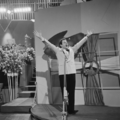 Domenico Modugno in Hilversum (1958)
 -
 Bobby Solo in Naples (1965)
 -
 Gianni Morandi in Amsterdam (1970)
 -

-
 Raphael Gualazzi in Düsseldorf (2011)
 -
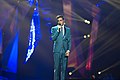 Marco Mengoni in Malmö (2013)
 -

-
-
 Francesca Michielin in Stockholm (2016)
 -
 Francesco Gabbani in Kyiv (2017)
 -
-

-

-
 Marco Mengoni in Liverpool (2023)


,_Bestanddeelnr_923-3708.jpg)


.jpg)


.jpg)
.jpg)

.jpg)
See also[edit]
- Italy in the Junior Eurovision Song Contest – Junior version of the Eurovision Song Contest.
- Italy in the Eurovision Young Dancers – A competition organised by the EBU for younger dancers aged between 16 and 21.
- Italy in the Eurovision Young Musicians – A competition organised by the EBU for musicians aged 18 years and younger.
Notes and references[edit]
Notes[edit]
- ^ a b The 1956 contest had secret voting and, apart from the winner, no results were released.
- ^ The 2020 contest was cancelled due to the COVID-19 pandemic.
- ^ Ferrio also conducted the Austrian and Irish entries
- ^ Giacomazzi was originally brought in to conduct the Italian entry, but the Luxembourgish orchestra didn't perform it to singer Domenico Modugno's satisfaction. The Italian performance was then accompanied by a small ensemble of musicians, with Giacomazzi playing the piano. Therefore, the Italian entry didn't technically feature the orchestra, but Giacomazzi was still credited as the entry's conductor.
- ^ a b The Italian entry was performed without orchestral accompaniment.
References[edit]
- ^ a b "Sanremo - the festival that inspired Eurovision". Eurovision.tv. EBU. 8 February 2017. Archived from the original on 4 March 2021. Retrieved 15 March 2021.
- ^ a b c Bakker, Sietse (31 December 2010). "43 nations on 2011 participants list". Eurovision.tv. Archived from the original on 27 February 2017. Retrieved 31 December 2010.
- ^ "History - Eurovision Song Contest 1981". European Broadcasting Union. Archived from the original on 14 July 2014. Retrieved 17 September 2008.
- ^ Palmer, Katie (14 May 2022). "Eurovision 2022: Double win for Italy after advantage uncovered". Express.co.uk. Archived from the original on 3 October 2022. Retrieved 29 May 2022.
- ^ "Italy - Eurovision Song Contest". European Broadcasting Union. Archived from the original on 2 August 2017. Retrieved 23 May 2021.
- ^ "Sì - lyrics - Diggiloo Thrush". www.diggiloo.net. Archived from the original on 21 June 2021. Retrieved 26 May 2021.
- ^ Kasapoglou, Yiorgos (7 March 2008). "Italy: Maestro Tempera calls Italy back to Eurovision". ESCToday. Archived from the original on 23 September 2016. Retrieved 7 March 2008.
- ^ Bakker, Sietse (16 June 2008). "Cutugno: "Italy's absence unfortunate"". European Broadcasting Union. Archived from the original on 16 April 2015. Retrieved 16 June 2008.
- ^ Hondal, Víctor (19 September 2008). "Italy: Eurovision stars guests on Rai Uno". ESCToday. Archived from the original on 23 September 2016. Retrieved 20 September 2008.
- ^ Siim, Jarmo (17 September 2008). "Eurovision stars going to Italy!". European Broadcasting Union. Archived from the original on 29 February 2012. Retrieved 20 September 2008.
- ^ floras, stella (13 January 2009). "EBU working for Eurovision full house in 2010". ESCToday. Archived from the original on 25 May 2021. Retrieved 30 July 2009.
- ^ Bakker, Sietse (2 December 2010). "Italy applied for 2011 Eurovision Song Contest!". European Broadcasting Union. Archived from the original on 3 February 2011. Retrieved 2 December 2010.
- ^ "Måneskin will represent Italy at the Eurovision Song Contest". Eurovision.tv. EBU. 7 March 2021. Archived from the original on 7 March 2021. Retrieved 21 April 2022.
- ^ O'Connor, John Kennedy (2005). The Eurovision Song Contest 50 Years The Official History. London: Carlton Books Limited. ISBN 1-84442-586-X.
- ^ "Svante Stockselius meets members of OGAE Serbia". Oikotimes. 22 June 2007. Archived from the original on 12 February 2010. Retrieved 24 May 2009.
- ^ Fulton, Rick (14 May 2007). "The East V West Song Contest". Daily Record. Archived from the original on 14 May 2021. Retrieved 24 May 2009.
- ^ "Italy made no motion for Big 5 membership yet". Oikotimes. 3 December 2010. Retrieved 3 December 2010.[permanent dead link]
- ^ "Winners of the Marcel Bezençon Awards 2015". eurovision.tv. 25 May 2015. Archived from the original on 8 December 2019. Retrieved 8 December 2019.
- ^ "Winners of the Marcel Bezençon Awards 2017". eurovision.tv. 14 May 2017. Archived from the original on 6 August 2020. Retrieved 8 December 2019.
- ^ "Here are the winners of the 2019 Marcel Bezençon Awards". eurovision.tv. 18 May 2019. Archived from the original on 3 August 2019. Retrieved 8 December 2019.
- ^ "The 2023 Marcel Bezençon Award Winners". Eurovision.tv. European Broadcasting Union. 14 May 2023. Retrieved 14 May 2023.
- ^ Cobb, Ryan (21 April 2017). "Analysing ten years of OGAE voting: "Underneath the fan favourite bias is a worthwhile indicator"". escxtra.com. Archived from the original on 8 December 2019. Retrieved 8 December 2019.
- ^ Gallagher, Robyn (30 April 2017). "OGAE Poll 2017 final results: Italy confirmed as winner, Belgium second, Sweden third". Wiwibloggs. Archived from the original on 8 December 2019. Retrieved 8 December 2019.
- ^ Herbert, Emily (30 April 2019). "Eurovision 2019: Italy Wins OGAE Poll 2019". eurovoix.com. Archived from the original on 2 May 2019. Retrieved 8 December 2019.
- ^ Roxburgh, Gordon (2012). Songs for Europe: The United Kingdom at the Eurovision Song Contest. Vol. One: The 1950s and 1960s. Prestatyn: Telos Publishing. pp. 93–101. ISBN 978-1-84583-065-6.
- ^ Roxburgh, Gordon (2014). Songs for Europe: The United Kingdom at the Eurovision Song Contest. Vol. Two: The 1970s. Prestatyn: Telos Publishing. pp. 142–168. ISBN 978-1-84583-093-9.
- ^ Roxburgh, Gordon (2016). Songs for Europe: The United Kingdom at the Eurovision Song Contest. Vol. Three: The 1980s. Prestatyn: Telos Publishing. ISBN 978-1-84583-118-9.
- ^ Granger, Anthony (10 November 2019). "Italy: Nicola Caligiore to Step Down as Head of Delegation". eurovoix.com. Archived from the original on 10 November 2019. Retrieved 5 December 2019.
- ^ Granger, Anthony (14 May 2020). "Italy: Simona Martorelli Named as New Head of Delegation". Eurovoix. Archived from the original on 3 October 2022. Retrieved 15 May 2020.
- ^ Dammacco, Beppe (16 February 2023). "Junior Eurovision 2023, Mariangela Borneo (Rai) entra nello Steering Group". Eurofestival News (in Italian). Retrieved 17 February 2023.
- ^ "Enrico Ruggeri Sole d'Europa Eurofestival 1993". youtube.com. 26 October 2008. Archived from the original on 21 December 2021. Retrieved 8 January 2020.
- ^ Lombardini, Emanuele; Pigliavento, Alessandro (2012). "Guida all'EUROVISION SONG CONTEST 2012" (PDF). Eurovision Italia. Archived from the original (PDF) on 2 December 2013. Retrieved 23 November 2013.
- ^ "Natascha Lusenti affiancherà Ardemagni-Solibello nel commento all'Eurovision 2013" (in Italian). Eurofestival.ws. 5 April 2013. Archived from the original on 4 January 2022. Retrieved 19 May 2013.
- ^ Gordon Roxburgh (18 May 2013). "Good evening Malmö - Voting order revealed". Eurovision.tv. European Broadcasting Union. Archived from the original on 7 June 2013. Retrieved 19 May 2013.
- ^ https://www.rai.it/dl/doc/1557818030923_RDTV_13maggio_down.pdf Archived 14 May 2019 at the Wayback Machine (pagina 14)
- ^ "Eurovision 2021: Date e dove vederlo. Quando sono i Maneskin". 14 May 2021. Archived from the original on 17 May 2021. Retrieved 17 May 2021.
- ^ Lombardini, Emanuele (29 March 2022). "Eurovision 2022: Carolina Di Domenico al commento insieme a Corsi e Malgioglio". Eurofestival News (in Italian). Archived from the original on 30 March 2022. Retrieved 30 March 2022.
- ^ Dammacco, Beppe (29 March 2023). "Eurovision 2023: via Malgioglio, Mara Maionchi al commento insieme a Gabriele Corsi". Eurofestival News (in Italian). Retrieved 29 March 2023.
- ^ "Mara Maionchi e Gabriele Corsi i conduttori di Eurovision Song Contest 2023". RAI Ufficio Stampa (in Italian). 29 March 2023. Retrieved 29 March 2023.
- ^ Dammacco, Beppe (5 May 2023). "Eurovision 2023, la conferenza stampa Rai. Kaze sarà la spokesperson". Eurofestival News (in Italian). Retrieved 5 May 2023.
- ^ Lombardini, Emanuele (23 February 2024). "Eurovision 2024, la Rai conferma al commento la coppia Corsi-Maionchi" [Eurovision 2024, Rai confirms the Corsi-Maionchi couple for commentary]. Eurofestival News (in Italian). Retrieved 23 February 2024.
- ^ "Eurovision Song Contest, Angelina Mango si esibisce il 9 maggio" [Eurovision Song Contest, Angelina Mango performs on 9 May] (in Italian). ANSA. 27 March 2024. Retrieved 27 March 2024.
- ^ "Eurovision, Europe Shine a Light: il 16 maggio alle 20.35 su Rai1, Radio2 e RaiPlay" [Eurovision, Europe Shine a Light: on 16 May at 20:35 on Rai1, Radio2 and RaiPlay]. eurofestivalnews.com. 10 April 2020. Archived from the original on 17 April 2020. Retrieved 28 July 2020.
External links[edit]
- Italian Eurovision Website
- Esc-Time.com – Italian website daily updated about Eurovision
- Points to and from Italy (until 2015) eurovisioncovers.co.uk
 'Rock and roll never dies': Italy wins Eurovision after 30 years at Wikinews

