


Eurovision Song Contest 1968
| Eurovision Song Contest 1968 | |
|---|---|
 | |
| Dates | |
| Final | 6 April 1968 |
| Host | |
| Venue | Royal Albert Hall London, United Kingdom |
| Presenter(s) | Katie Boyle |
| Musical director | Norrie Paramor |
| Directed by | Stewart Morris |
| Executive supervisor | Clifford Brown |
| Executive producer | Tom Sloan |
| Host broadcaster | British Broadcasting Corporation (BBC) |
| Website | eurovision |
| Participants | |
| Number of entries | 17 |
| Debuting countries | None |
| Returning countries | None |
| Non-returning countries | None |
| |
| Vote | |
| Voting system | Ten-member juries distributed ten points among their favourite songs. |
| Winning song |  Spain Spain"La La La" |

The Eurovision Song Contest 1968 was the 13th edition of the annual Eurovision Song Contest. It took place in London, United Kingdom, following the country's first victory at the 1967 contest with the song "Puppet on a String" by Sandie Shaw. Despite having won for the first time the year before, it was actually the third time that the United Kingdom had hosted the competition, having previously done so in 1960 and 1963, both of which also took place in London. Organised by the European Broadcasting Union (EBU) and host broadcaster British Broadcasting Corporation (BBC), the contest was held at Royal Albert Hall on 6 April 1968, and was hosted by Katie Boyle for the third time. It was notably also the first time that the contest was broadcast in colour.
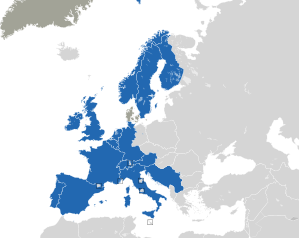
Seventeen countries participated in the contest, the same countries that had participated the previous year.
The winner was Spain with the song "La La La" by Massiel, and written/composed by Manuel de la Calva and Ramón Arcusa. This was Spain's first victory - and their first ever top five placing - in the contest.
Location[edit]

The contest was held at the Royal Albert Hall in London. The Royal Albert Hall is known for hosting the world's leading artists from several performance genres, sports, award ceremonies, the annual summer Proms concerts and other events since its opening in 1871, and has become one of the United Kingdom's most treasured and distinctive buildings. At the time of the contest in 1968, the hall had a capacity of 7,000 seats.[1]
Participating countries[edit]
| Eurovision Song Contest 1968 – Participation summaries by country | |
|---|---|
All countries that had participated in 1967 also participated in 1968.[2]
Originally Spanish broadcaster Televisión Española (TVE) entered Joan Manuel Serrat to sing "La La La", but his demand to sing in Catalan was an affront to the Francoist State dictatorship. Therefore, Massiel, who was on tour in Mexico, was brought in as a late replacement. In just two weeks, she had to rush back to Spain, learn the song, record it in several languages, travel to Paris to get a dress and go to London for rehearsals. She sang the song in the contest in Castilian Spanish with the new arrangement made to fit her. In her winning reprise, she performed part of her song in English, in addition to the original version, becoming the first winner to do so.[2][3]
| Country | Broadcaster | Artist | Song | Language | Songwriter(s) | Conductor |
|---|---|---|---|---|---|---|
 Austria Austria
|
ORF | Karel Gott | "Tausend Fenster" | German |
|
Robert Opratko |
 Belgium Belgium
|
RTB | Claude Lombard | "Quand tu reviendras" | French |
|
Henri Segers |
 Finland Finland
|
YLE | Kristina Hautala | "Kun kello käy" | Finnish |
|
Ossi Runne |
 France France
|
ORTF | Isabelle Aubret | "La Source" | French |
|
Alain Goraguer |
 Germany Germany
|
HR[a] | Wencke Myhre | "Ein Hoch der Liebe" | German |
|
Horst Jankowski |
 Ireland Ireland
|
RTÉ | Pat McGeegan | "Chance of a Lifetime" | English | John Kennedy | Noel Kelehan |
 Italy Italy
|
RAI | Sergio Endrigo | "Marianne" | Italian | Sergio Endrigo | Giancarlo Chiaramello |
 Luxembourg Luxembourg
|
CLT | Chris Baldo and Sophie Garel | "Nous vivrons d'amour" | French |
|
André Borly |
 Monaco Monaco
|
TMC | Line and Willy | "À chacun sa chanson" | French |
|
Michel Colombier |
 Netherlands Netherlands
|
NTS | Ronnie Tober | "Morgen" | Dutch |
|
Dolf van der Linden |
 Norway Norway
|
NRK | Odd Børre | "Stress" | Norwegian |
|
Øivind Bergh |
 Portugal Portugal
|
RTP | Carlos Mendes | "Verão" | Portuguese |
|
Joaquim Luís Gomes |
| Spain
|
TVE | Massiel | "La La La" | Spanish |
|
Rafael Ibarbia |
 Sweden Sweden
|
SR | Claes-Göran Hederström | "Det börjar verka kärlek, banne mej" | Swedish | Peter Himmelstrand | Mats Olsson |
 Switzerland Switzerland
|
SRG SSR | Gianni Mascolo | "Guardando il sole" | Italian |
|
Mario Robbiani |
 United Kingdom United Kingdom
|
BBC | Cliff Richard | "Congratulations" | English | Norrie Paramor | |
 Yugoslavia Yugoslavia
|
JRT | Lući Kapurso and Hamo Hajdarhodžić | "Jedan dan" (Један дан) | Serbo-Croatian |
|
Miljenko Prohaska |
Returning artists[edit]
Bold indicates a previous winner.
| Artist | Country | Previous year(s) |
|---|---|---|
| Isabelle Aubret | France
|
1962 |
Format[edit]
1968 was the first time that the Eurovision Song Contest was broadcast in colour.[1] The countries that broadcast it in colour were France, Germany, the Netherlands, Norway, Switzerland, Sweden and the United Kingdom, although in the UK it was broadcast as an encore presentation in colour on BBC Two the next day. Many Eastern European countries as well as Tunisia broadcast the contest.
Prior to the contest, the bookmakers were sure of another British victory, as the English singer Cliff Richard, who was already dominating the music charts at that time, was hotly tipped as the favourite to win, but in the end he lost out to Spain's song by a margin of just one point.
Contest overview[edit]
| R/O | Country | Artist | Song | Points | Place |
|---|---|---|---|---|---|
| 1 | Portugal
|
Carlos Mendes | "Verão" | 5 | 11 |
| 2 | Netherlands
|
Ronnie Tober | "Morgen" | 1 | 16 |
| 3 | Belgium
|
Claude Lombard | "Quand tu reviendras" | 8 | 7 |
| 4 | Austria
|
Karel Gott | "Tausend Fenster" | 2 | 13 |
| 5 | Luxembourg
|
Chris Baldo and Sophie Garel | "Nous vivrons d'amour" | 5 | 11 |
| 6 | Switzerland
|
Gianni Mascolo | "Guardando il sole" | 2 | 13 |
| 7 | Monaco
|
Line and Willy | "À chacun sa chanson" | 8 | 7 |
| 8 | Sweden
|
Claes-Göran Hederström | "Det börjar verka kärlek, banne mej" | 15 | 5 |
| 9 | Finland
|
Kristina Hautala | "Kun kello käy" | 1 | 16 |
| 10 | France
|
Isabelle Aubret | "La Source" | 20 | 3 |
| 11 | Italy
|
Sergio Endrigo | "Marianne" | 7 | 10 |
| 12 | United Kingdom
|
Cliff Richard | "Congratulations" | 28 | 2 |
| 13 | Norway
|
Odd Børre | "Stress" | 2 | 13 |
| 14 | Ireland
|
Pat McGeegan | "Chance of a Lifetime" | 18 | 4 |
| 15 | Spain
|
Massiel | "La La La" | 29 | 1 |
| 16 | Germany
|
Wencke Myhre | "Ein Hoch der Liebe" | 11 | 6 |
| 17 | Yugoslavia
|
Lući Kapurso and Hamo Hajdarhodžić | "Jedan dan" | 8 | 7 |
Spokespersons[edit]
Each country nominated a spokesperson who was responsible for announcing the votes for their respective country via telephone. Known spokespersons at the 1968 contest are listed below.
 Finland – Poppe Berg[10]
 Sweden – Edvard Matz[11]
 United Kingdom – Michael Aspel[5]
Detailed voting results[edit]
Due to a misunderstanding by the hostess, Katie Boyle, Switzerland were erroneously awarded 3 points by Yugoslavia, instead of 2. The scrutineer asked for the Yugoslav votes from TV Skopje to be announced a second time.
Total score
|
Portugal
|
Netherlands
|
Belgium
|
Austria
|
Luxembourg
|
Switzerland
|
Monaco
|
Sweden
|
Finland
|
France
|
Italy
|
United Kingdom
|
Norway
|
Ireland
|
Spain
|
Germany
|
Yugoslavia
| ||
|---|---|---|---|---|---|---|---|---|---|---|---|---|---|---|---|---|---|---|---|
Contestants
|
Portugal | 5 | 2 | 3 | |||||||||||||||
| Netherlands | 1 | 1 | |||||||||||||||||
| Belgium | 8 | 1 | 1 | 1 | 3 | 1 | 1 | ||||||||||||
| Austria | 2 | 2 | |||||||||||||||||
| Luxembourg | 5 | 1 | 1 | 1 | 1 | 1 | |||||||||||||
| Switzerland | 2 | 2 | |||||||||||||||||
| Monaco | 8 | 2 | 1 | 3 | 1 | 1 | |||||||||||||
| Sweden | 15 | 1 | 1 | 1 | 2 | 6 | 4 | ||||||||||||
| Finland | 1 | 1 | |||||||||||||||||
| France | 20 | 3 | 6 | 2 | 3 | 3 | 1 | 2 | |||||||||||
| Italy | 7 | 1 | 2 | 2 | 2 | ||||||||||||||
| United Kingdom | 28 | 1 | 2 | 2 | 1 | 4 | 5 | 3 | 2 | 4 | 1 | 1 | 2 | ||||||
| Norway | 2 | 1 | 1 | ||||||||||||||||
| Ireland | 18 | 1 | 1 | 1 | 4 | 1 | 4 | 6 | |||||||||||
| Spain | 29 | 4 | 2 | 1 | 4 | 3 | 4 | 3 | 1 | 1 | 6 | ||||||||
| Germany | 11 | 1 | 1 | 2 | 5 | 2 | |||||||||||||
| Yugoslavia | 8 | 1 | 1 | 1 | 1 | 3 | 1 | ||||||||||||
Broadcasts[edit]
Each participating broadcaster was required to relay the contest via its networks. Non-participating EBU member broadcasters were also able to relay the contest as "passive participants". Broadcasters were able to send commentators to provide coverage of the contest in their own native language and to relay information about the artists and songs to their television viewers.[14]
Known details on the broadcasts in each country, including the specific broadcasting stations and commentators are shown in the tables below. In addition to the participating countries, the contest was also reportedly broadcast in Tunisia, and in Bulgaria, Czechoslovakia, East Germany, Hungary, Poland, Romania and the Soviet Union via Intervision.[5][1]
| Country | Broadcaster | Channel(s) | Commentator(s) | Ref(s) |
|---|---|---|---|---|
 Czechoslovakia Czechoslovakia
|
ČST | ČST | Miroslav Horníček | [40][41] |
 Hungary Hungary
|
MTV | MTV | [42] | |
 Malta Malta
|
MBA | MTS, National Network | [43][44] | |
 Poland Poland
|
TP | Telewizja Polska | [45] | |
 Puerto Rico Puerto Rico
|
WKAQ[e] | [46] | ||
 Romania Romania
|
TVR | TVR | [47] | |
Notes[edit]
- ^ On behalf of the German public broadcasting consortium ARD[8]
- ^ Deferred broadcast on NRK at 22:30 CET (21:30 UTC)[26]
- ^ Delayed broadcast on 8 April at 22:30 CET (21:30 UTC)[32]
- ^ Re-broadcast in colour on BBC2 on 7 April at 16:30 BST (15:30 UTC)[34][35]
- ^ Delayed broadcast on 30 April at 20:30 AST (12:30 UTC)[46]
References[edit]
- ^ a b c René-Roger (9 April 1968). "La chanson espagnole triomphe devant 200 millions de spectateurs" [Spanish song triumphs in front of 200 million spectators]. La Croix (in French). p. 3. ISSN 0242-6056. OCLC 1367977519.
- ^ a b "Eurovision Song Contest 1968". EBU. Retrieved 16 June 2012.
- ^ "Winners of the 1960s - What happened to them?". EBU. 23 July 2011. Retrieved 20 October 2021.
- ^ "Participants of London 1968". European Broadcasting Union. Archived from the original on 23 March 2023. Retrieved 7 July 2023.
- ^ a b c d e Roxburgh, Gordon (2012). Songs for Europe: The United Kingdom at the Eurovision Song Contest. Volume One: The 1950s and 1960s. Prestatyn: Telos Publishing. pp. 454–470. ISBN 978-1-84583-065-6.
- ^ "1968 – 13th edition". diggiloo.net. Archived from the original on 8 August 2022. Retrieved 7 July 2023.
- ^ "Detailed overview: conductors in 1968". And the conductor is... Retrieved 7 July 2023.
- ^ "Alle deutschen ESC-Acts und ihre Titel" [All German ESC acts and their songs]. www.eurovision.de (in German). ARD. Archived from the original on 12 June 2023. Retrieved 12 June 2023.
- ^ "Final of London 1968". European Broadcasting Union. Archived from the original on 8 April 2021. Retrieved 8 April 2021.
- ^ a b "Jatkoajalla Euroviisut" [Eurovision in overtime]. Helsingin Sanomat (in Finnish). 6 April 1968. p. 37. Retrieved 23 December 2022.
- ^ a b Thorsson, Leif; Verhage, Martin (2006). Melodifestivalen genom tiderna : de svenska uttagningarna och internationella finalerna [Melodifestivalen through the ages: the Swedish selections and international final] (in Swedish). Stockholm: Premium Publishing. pp. 74–75. ISBN 91-89136-29-2.
- ^ "Results of the Final of London 1968". European Broadcasting Union. Archived from the original on 8 April 2021. Retrieved 8 April 2021.
- ^ "Eurovision Song Contest 1968 – Scoreboard". European Broadcasting Union. Archived from the original on 9 July 2015. Retrieved 14 June 2021.
- ^ "The Rules of the Contest". European Broadcasting Union. 31 October 2018. Archived from the original on 4 October 2022. Retrieved 19 December 2022.
- ^ "Austria – London 1968". European Broadcasting Union. Archived from the original on 13 May 2018. Retrieved 3 January 2023.
- ^ a b c d "Radio-Télévision". Luxemburger Wort (in German and French). Luxembourg City, Luxembourg. 5 April 1968. p. 23. Retrieved 3 January 2023.
- ^ a b c "Radio en tv programma" [Radio and tv programs]. Trouw (in Dutch). Meppel, Netherlands. 6 April 1968. p. 4. Retrieved 3 January 2023 – via Delpher.
- ^ a b "Radio ja televisio" [Radio and television]. Helsingin Sanomat (in Finnish). 6 April 1968. p. 37. Retrieved 23 December 2022.
- ^ a b c "TV – samedi 6 avril" [TV – Saturday 6 April]. Radio TV - Je vois tout (in French). Lausanne, Switzerland: Héliographia SA. 4 April 1968. pp. 78–79. Retrieved 3 January 2023.
- ^ "Programmes radio – samedi 6 avril" [Radio programmes – Saturday 6 April]. Radio TV - Je vois tout (in French). Lausanne, Switzerland: Héliographia SA. 4 April 1968. pp. 53–54. Retrieved 3 January 2023.
- ^ "Television and Radio". The Irish Times. 6 April 1968. p. 18. Retrieved 22 December 2022.
- ^ Gray, Ken (11 April 1968). "Pop and bedazzlement". The Irish Times. p. 12. Retrieved 22 December 2022.
- ^ "Oggi alla televisione" [Today on television]. La Stampa (in Italian). Turin, Italy. 6 April 1968. p. 6. Retrieved 3 January 2023.
- ^ "Sabato, 6 aprile" [Saturday, 6 April]. Radiocorriere TV (in Italian). April 1968. p. 98. Retrieved 23 January 2023.
- ^ "Monaco – London 1968". European Broadcasting Union. Archived from the original on 13 May 2018. Retrieved 3 January 2023.
- ^ a b c "TV radio". Oppland Arbeiderblad (in Norwegian). Gjøvik, Norway. 6 April 1968. pp. 26–27. Retrieved 3 January 2023 – via National Library of Norway.
- ^ "Boletim do dia" [Bulletin of the day]. Diário de Lisboa (in Portuguese). Lisbon, Portugal. 6 April 1968. p. 30. Retrieved 3 January 2023 – via Casa Comum.
- ^ a b "Programas de Radio y TV" [Programs of Radio and Television]. La Vanguardia (in Spanish). 6 April 1968. p. 59. Retrieved 3 January 2023.
- ^ HerGar, Paula (28 March 2018). "Todos los comentaristas de la historia de España en Eurovisión (y una única mujer en solitario)" [All the commentators in the history of Spain in Eurovision (and only a single woman)] (in Spanish). Los 40. Archived from the original on 26 September 2021. Retrieved 14 December 2022.
- ^ "Spanish Eurovision commentator José María Iñigo passed away". European Broadcasting Union. 5 May 2018. Archived from the original on 5 May 2018. Retrieved 3 January 2023.
- ^ "Fernsehen" [Television]. Die Tat (in German). Zürich, Switzerland. 6 April 1968. p. 23. Retrieved 3 January 2023 – via e-newspaperarchives.ch.
- ^ a b "Programmes radio – lundi 8 avril" [Radio programmes – Saturday 6 April]. Radio TV - Je vois tout (in French). Lausanne, Switzerland: Héliographia SA. 4 April 1968. pp. 56–57. Retrieved 3 January 2023.
- ^ "Settimana dal 6 al 12 4. 1968" [Week from 6 to 12 4. 1968]. Eco di Locarno (in Italian). Locarno, Switzerland. 6 April 1968. p. 13. Retrieved 3 January 2023 – via Sistema bibliotecario ticinese.
- ^ a b "Eurovision Song Contest – BBC1". Radio Times. 6 April 1968. Retrieved 3 January 2023 – via BBC Genome Project.
- ^ "Eurovision Song Contest – BBC2". Radio Times. 6 April 1968. Retrieved 3 January 2023 – via BBC Genome Project.
- ^ "Eurovision Song Contest – BBC Radio 2". Radio Times. 6 April 1968. Retrieved 3 January 2023 – via BBC Genome Project.
- ^ "Schedule – BBC Radio 1 – 6 April 1968". Radio Times. 6 April 1968. Retrieved 10 January 2023 – via BBC Genome Project.
- ^ "Televizija – sobota – 6. aprila" [Television – Saturday – 6 April] (PDF). Glas (in Slovenian). Kranj, SR Slovenia, Yugoslavia. 6 April 1968. p. 22. Archived (PDF) from the original on 3 January 2023. Retrieved 3 January 2023.
- ^ "Televizija – Subota 6. travnja" [Television – 6 April]. Slobodna Dalmacija (in Serbo-Croatian). Split, SR Croatia, Yugoslavia. 6 April 1968. p. 8. Retrieved 3 January 2023.
- ^ "Sobota 6.4.1968" [Saturday 6.4.1968]. Týdeník Československé televize. 1968 (in Czech). Vol. 14. Praha: ORBIS. 1 April 1968. p. 8.
- ^ "Program 68". Česká televize. Česká televize. 1 August 2018. Retrieved 13 January 2024.
- ^ "TV – szombat IV.6" [TV – Saturday IV.6]. Rádió- és Televízió-újság (in Hungarian). 1 April 1968. p. 13. Archived from the original on 3 January 2023. Retrieved 3 January 2023 – via MTVA Archívum.
- ^ "Your Listening and Viewing". Times of Malta. 6 April 1968. p. 6.
- ^ Barry, Fred (6 April 1968). "Eurovision Song Contest – Tonight's 17-Nation Event". Times of Malta. p. 13.
- ^ "Telewizja" [Television]. Dziennik Polski (in Polish). Kraków, Poland. 6 April 1968. p. 6. Retrieved 18 March 2024 – via Digital Library of Małopolska.
- ^ a b "¡Lo que 200 millones de personas escucharon y admiraron en toda Europa!" [What 200 million people heard and admired across Europe!]. El Mundo (in Spanish). San Juan, Puerto Rico. 30 April 1968. p. 25. Retrieved 17 March 2024 – via Global Press Archive.
- ^ "TV – sîmbătă 6 aprilie" [TV – Saturday 6 April]. Radio TV (in Romanian). p. 15. Archived from the original on 3 January 2023. Retrieved 3 January 2023.
External links[edit]


