Eurovision Song Contest 1984

| Eurovision Song Contest 1984 | |
|---|---|
 | |
| Dates | |
| Final | 5 May 1984 |
| Host | |
| Venue | Théâtre Municipal Luxembourg City, Luxembourg |
| Presenter(s) | Désirée Nosbusch |
| Musical director | Pierre Cao |
| Director | René Steichen |
| EBU scrutineer | Frank Naef |
| Executive producer | Ray van Cant |
| Host broadcaster | Radio Télévision Luxembourg (RTL) |
| Website | eurovision |
| Participants | |
| Number of entries | 19 |
| Debuting countries | None |
| Returning countries |  Ireland Ireland |
| Non-returning countries | |
| |
| Vote | |
| Voting system | Each country awarded 12, 10, 8-1 point(s) to their ten favourite songs |
| Winning song |  Sweden Sweden"Diggi-Loo Diggi-Ley" |


The Eurovision Song Contest 1984 was the 29th edition of the Eurovision Song Contest, held on 5 May 1984 in the Théâtre Municipal in Luxembourg City, Luxembourg. Organised by the European Broadcasting Union (EBU) and host broadcaster Radio Télévision Luxembourg (RTL), the contest was held in Luxembourg following the country's victory at the 1983 contest with the song "Si la vie est cadeau" by Corinne Hermès. The event was presented by Désirée Nosbusch, who, at 19 years old, remains the youngest person to have hosted the contest as of 2024[update].
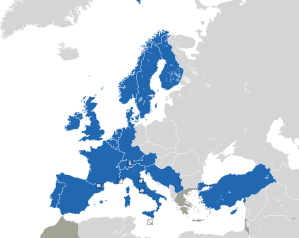
Nineteen countries participated in the contest, with Ireland returning after a one-year absence, and Greece and Israel, which had participated in the previous year's event, declining to enter. The winner was Sweden with the song "Diggi-Loo Diggi-Ley", composed by Torgny Söderberg, written by Britt Lindeborg and performed by the group Herreys. This was Sweden's second contest victory, coming ten years after ABBA's win in the 1974 contest. Ireland finished as runner-up, Spain and Denmark placed third and fourth, respectively, and Belgium and Italy tied for fifth place.
Location
[edit]
The 1984 contest took place in Luxembourg City, Luxembourg, following the country's victory at the 1983 contest with the song "Si la vie est cadeau" performed by Corinne Hermès. It was the fourth time that Luxembourg had hosted the event, following the contests held in 1962, 1966 and 1973.[1] The chosen venue was the Grand Théâtre, also known as the Nouveau Théâtre or Théâtre Municipal, an arts venue inaugurated in 1964, and which had previously hosted the contest in 1973.[2][3][4][5] Luxembourgish broadcaster Radio Télévision Luxembourg (RTL) initially had difficulty in finding a suitable venue to host the contest and eventually settled on the Grand Théâtre, which was smaller compared to the venue used at the 1983 contest.[6] The theatre's main auditorium usually holds an audience around 950 people, however this was reduced with the addition of technical equipment and commentator's boxes.[2] As a result, only press, members of each country's delegation and diplomatic representatives were allowed to watch the live show at the venue.[6]
Participating countries
[edit]| Eurovision Song Contest 1984 – Participation summaries by country | |
|---|---|

Entries from a total of 19 countries participated in the event. Ireland returned to the contest after a one-year absence, however Israel and Greece decided not to participate. Israel declined to enter as the date of the contest coincided with Yom HaZikaron, while Greece, which had originally planned to participate in the contest, reportedly withdrew its planned participation as the quality of the songs submitted to the Greek broadcaster for consideration was deemed to be of too low a quality.[2][6]
A number of the participating artists in this year's event had previously competed in past editions of the contest. Germany's Mary Roos had finished third in 1972 and made a second appearance for the country in 1984;[7][8] Izolda Barudžija, who had been a member of the group Aska that represented Yugoslavia in 1982, participated again this year alongside Vlado Kalember;[9][10] Kit Rolfe, lead singer of the United Kingdom's Belle and the Devotions, had previously performed in the 1983 contest as a backing vocalist for the British entry Sweet Dreams[11][12] and Gary Lux, who had represented Austria in 1983 as a member of the group Westend, returned as a backing vocalist for the Austrian singer Anita.[13]
| Country | Broadcaster | Artist | Song | Language | Songwriter(s) | Conductor |
|---|---|---|---|---|---|---|
 Austria Austria
|
ORF | Anita | "Einfach weg" | German |
|
Richard Oesterreicher |
 Belgium Belgium
|
RTBF | Jacques Zegers | "Avanti la vie" | French |
|
Jo Carlier |
 Cyprus Cyprus
|
CyBC | Andy Paul | "Anna Mari-Elena" (Άννα Μαρί-Έλενα) | Greek | Andy Paul | Pierre Cao |
 Denmark Denmark
|
DR | Hot Eyes | "Det' lige det" | Danish | Henrik Krogsgaard | |
 Finland Finland
|
YLE | Kirka | "Hengaillaan" | Finnish |
|
Ossi Runne |
 France France
|
Antenne 2 | Annick Thoumazeau | "Autant d'amoureux que d'étoiles" | French |
|
François Rauber |
 Germany Germany
|
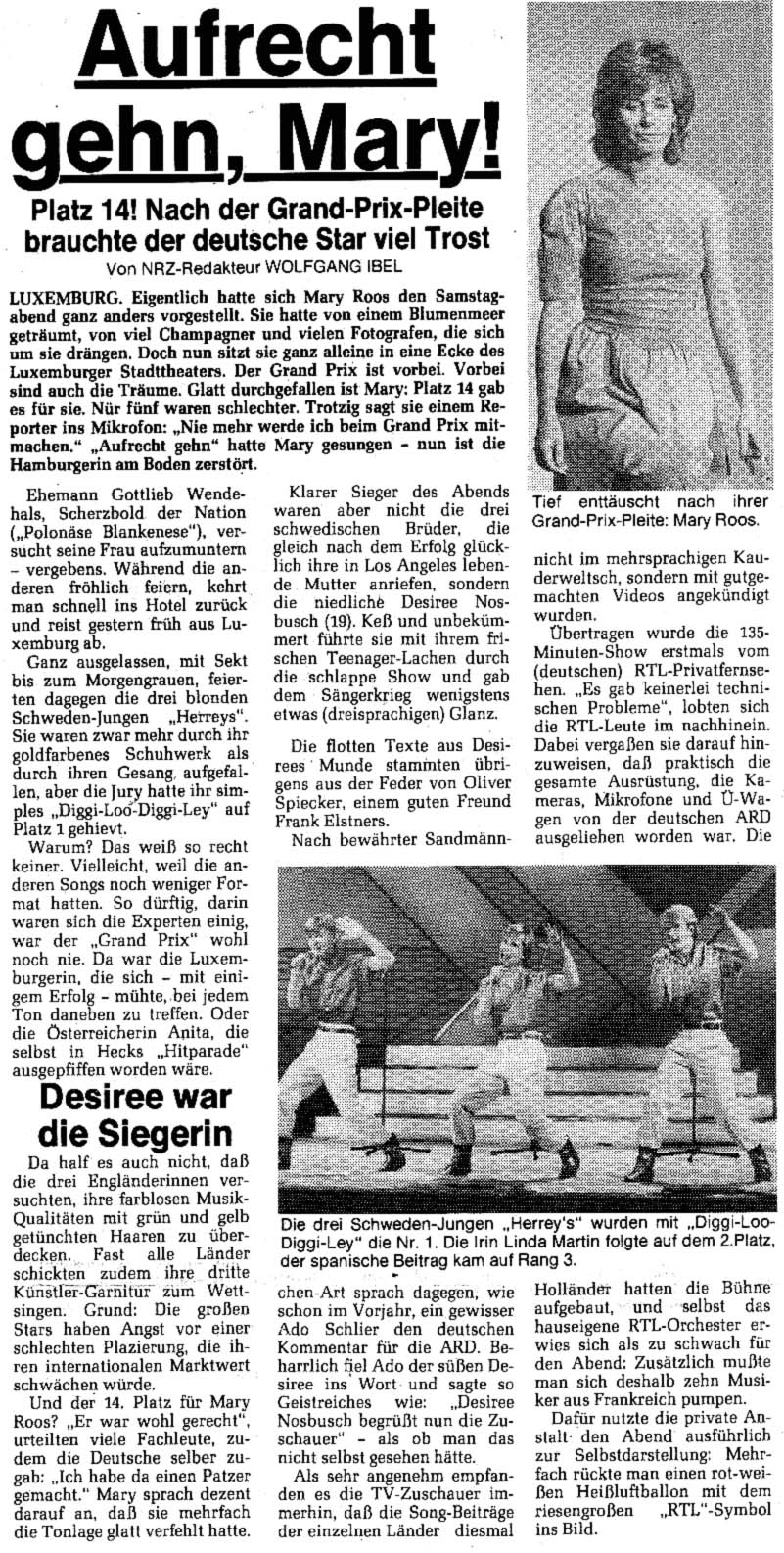
BR[a] | Mary Roos | "Aufrecht geh'n" | German |
|
Pierre Cao |
| Ireland
|
RTÉ | Linda Martin | "Terminal 3" | English | Johnny Logan | Noel Kelehan |
 Italy Italy
|
RAI | Alice and Franco Battiato | "I treni di Tozeur" | Italian |
|
Giusto Pio |
 Luxembourg Luxembourg
|
CLT | Sophie Carle | "100% d'amour" | French |
|
Pascal Stive |
 Netherlands Netherlands
|
NOS | Maribelle | "Ik hou van jou" | Dutch |
|
Rogier van Otterloo |
 Norway Norway
|
NRK | Dollie de Luxe | "Lenge leve livet" | Norwegian | Sigurd Jansen | |
 Portugal Portugal
|
RTP | Maria Guinot | "Silêncio e tanta gente" | Portuguese | Maria Guinot | Pedro Osório |
 Spain Spain
|
TVE | Bravo | "Lady, Lady" | Spanish |
|
Eddy Guerin |
| Sweden
|
SVT | Herreys | "Diggi-Loo Diggi-Ley" | Swedish | Curt-Eric Holmquist | |
 Switzerland Switzerland
|
SRG SSR | Rainy Day | "Welche Farbe hat der Sonnenschein" | German | Günter Loose | Mario Robbiani |
 Turkey Turkey
|
TRT | Beş Yıl Önce, On Yıl Sonra | "Halay" | Turkish |
|
Selçuk Basar |
 United Kingdom United Kingdom
|
BBC | Belle and the Devotions | "Love Games" | English |
|
John Coleman |
 Yugoslavia Yugoslavia
|
JRT | Ida and Vlado | "Ciao, amore" | Serbo-Croatian |
|
Mato Došen |
Production and format
[edit]The Eurovision Song Contest 1984 was produced by the Luxembourgish public broadcaster Radio Télévision Luxembourg (RTL). Ray van Cant served as executive producer, Hubert Terheggen served as producer, René Steichen served as director, Roland de Groot served as designer, and Pierre Cao served as musical director, leading the orchestra.[6][16] A separate musical director could be nominated by each country to lead the orchestra during their performance, with the host musical director also available to conduct for those countries which did not nominate their own conductor.[7] On behalf of the contest organisers, the European Broadcasting Union (EBU), the event was overseen by Frank Naef as scrutineer.[16][17][18][19] The overall costs to organise the event were around 35 million Luxembourgish francs.[20]
Each participating broadcaster submitted one song, which was required to be no longer than three minutes in duration and performed in the language, or one of the languages, of the country which it represented.[21][22] A maximum of six performers were allowed on stage during each country's performance.[21][23] Each entry could utilise all or part of the live orchestra and could use instrumental-only backing tracks, however any backing tracks used could only include the sound of instruments featured on stage being mimed by the performers.[23][24]
The results of the 1984 contest were determined through the same scoring system as had first been introduced in 1975: each country awarded twelve points to its favourite entry, followed by ten points to its second favourite, and then awarded points in decreasing value from eight to one for the remaining songs which featured in the country's top ten, with countries unable to vote for their own entry.[25] The points awarded by each country were determined by an assembled jury of 11 individuals, who were all required to be members of the public with no connection to the music industry, with a recommendation that there should be a balance between the sexes and that half should be under 25 years old. Each jury member voted in secret and awarded between one and five votes to each participating song, excluding that from their own country and with no abstentions permitted. The votes of each member were collected following the country's performance and then tallied by the non-voting jury chairperson to determine the points to be awarded. In any cases where two or more songs in the top ten received the same number of votes, a show of hands by all jury members was used to determine the final placing.[26][27][28]
Rehearsals for the participating artists began on 30 April 1984. Two technical rehearsals were conducted for each participating delegation in the week approaching the contest, with countries rehearsing in the order in which they would perform. The first rehearsals of 40 minutes were held on 30 April and 1 May 1984, followed by a press conference for each delegation and the accredited press. Each country's second rehearsals were held on 2 and 3 May and lasted 20 minutes total. Three dress rehearsals were held with all artists, two held in the afternoon and evening of 4 May and one final rehearsal in the afternoon of 5 May, with an invited audience present for the second dress rehearsal.[2]
Dutch designer Roland de Groot was in charge of the set design of the contest for the fourth time, having previously done so 1970, 1976 and 1980, the three previous contests staged in the Netherlands. For the 1984 contest, de Groot's design centred around various shapes which were suspended over the performance area on a series of pulleys and which could be moved around the stage in between the competing acts; this allowed for different backdrops to be created for each entry.[3][29] Each entry was preceded by a video postcard which served as an introduction to that country, as well as creating a transition between entries to allow stage crew to make changes on stage.[30][31] The postcards for the 1984 contest featured a troupe of actors referred to during the contest as "the Tourists", and focused on the various cultural stereotypes of each of the competing countries and portrayed these a humorous context, often with heavy use of computer animation.[3][29]
Contest overview
[edit].jpg)
The contest was held on 5 May 1984, beginning at 21:00 (CEST) and lasting 2 hours and 12 minutes.[6][7] The event was presented by the Luxembourgish television presenter and actress Désirée Nosbusch, who compèred the contest in French, German, Luxembourgish and English; at 19 years old, Nosbusch remains the youngest individual to have hosted the Eurovision Song Contest as of 2024[update].[6][32][33] Among the invited guests present in the audience was Prince Henri, then heir to the Luxembourger throne.[2] The contest's interval act featured a performance by the Prague Theatre of Illuminated Drawings.[29][34][35] The medallions awarded to the winners were presented by the previous year's winning artist Corinne Hermès.[29][34]
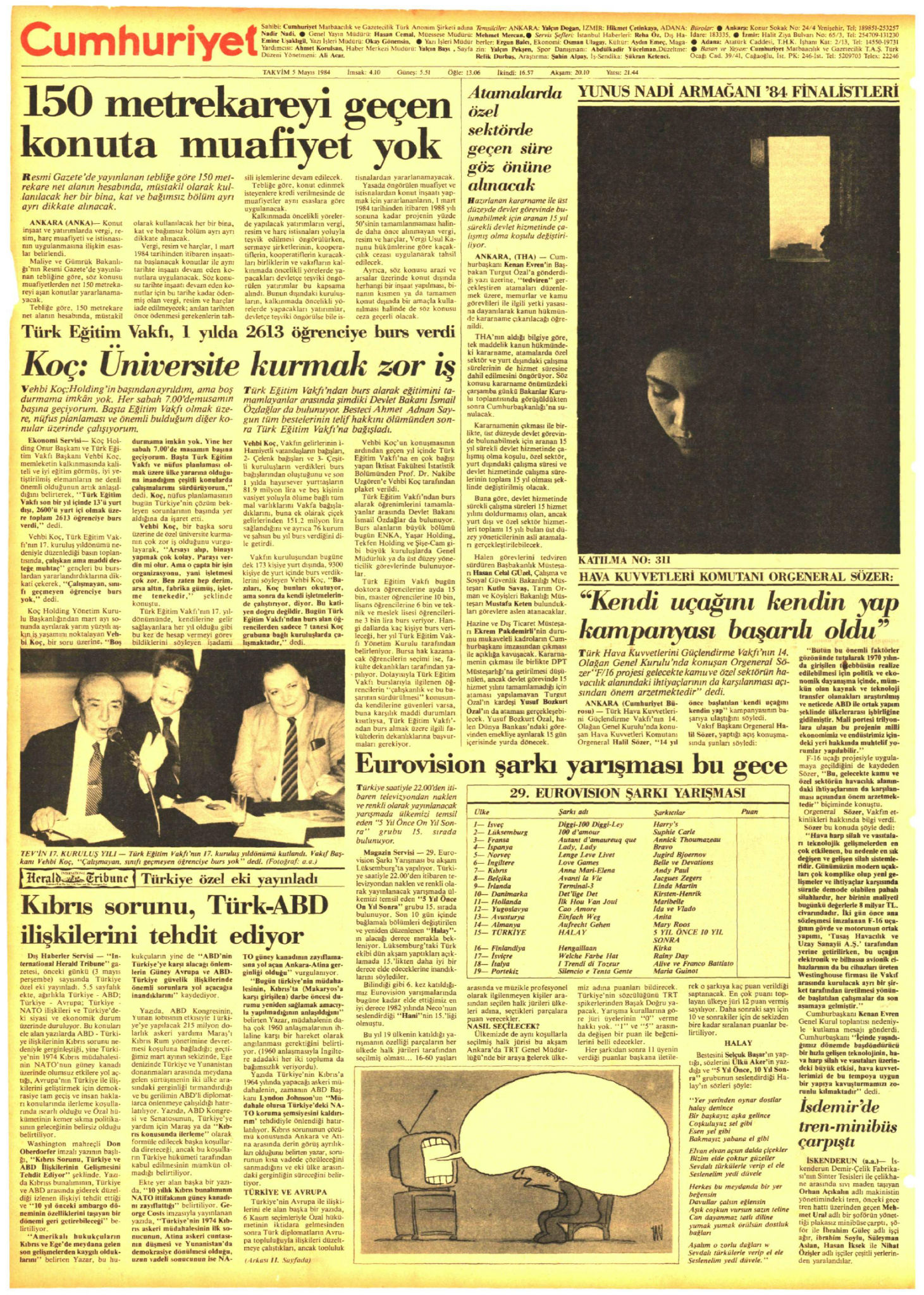
The 1984 contest featured one of the first instances of booing to be heard at the Eurovision Song Contest, which occurred immediately after the UK's entry. Various reasons for the booing have been proposed: these include being a response to football hooliganism which occurred in Luxembourg by English football fans during the qualifying stage of the 1984 European Championship, the use of off-stage backing vocalists during the UK's performance which gave an impression that members of Belle and the Devotions were lip syncing, and allegations that their song, "Love Games", which was heavily inspired by 1960s Motown tracks, had plagiarised previous tracks by the Supremes.[3][6][7][36]
The winner was Sweden represented by the song "Diggi-Loo Diggi-Ley", composed by Torgny Söderberg, written by Britt Lindeborg and performed by Herreys, comprising brothers Per, Richard and Louis Herrey.[37] It was Sweden's second contest win, ten years after ABBA's victory in 1974.[38] It was also the third – and, as of 2024[update], last – time that the winning entry was the first to be performed, following the 1975 and 1976 contests.[26][39][40] During the traditional winner's reprise performance, the group sung part of the winning song in English, with lyrics written by Per Herrey.[29][41]
| R/O | Country | Artist | Song | Points | Place |
|---|---|---|---|---|---|
| 1 | Sweden
|
Herreys | "Diggi-Loo Diggi-Ley" | 145 | 1 |
| 2 | Luxembourg
|
Sophie Carle | "100% d'amour" | 39 | 10 |
| 3 | France
|
Annick Thoumazeau | "Autant d'amoureux que d'étoiles" | 61 | 8 |
| 4 | Spain
|
Bravo | "Lady, Lady" | 106 | 3 |
| 5 | Norway
|
Dollie de Luxe | "Lenge leve livet" | 29 | 17 |
| 6 | United Kingdom
|
Belle and the Devotions | "Love Games" | 63 | 7 |
| 7 | Cyprus
|
Andy Paul | "Anna Mari-Elena" | 31 | 15 |
| 8 | Belgium
|
Jacques Zegers | "Avanti la vie" | 70 | 5 |
| 9 | Ireland
|
Linda Martin | "Terminal 3" | 137 | 2 |
| 10 | Denmark
|
Hot Eyes | "Det' lige det" | 101 | 4 |
| 11 | Netherlands
|
Maribelle | "Ik hou van jou" | 34 | 13 |
| 12 | Yugoslavia
|
Ida and Vlado | "Ciao, amore" | 26 | 18 |
| 13 | Austria
|
Anita | "Einfach weg" | 5 | 19 |
| 14 | Germany
|
Mary Roos | "Aufrecht geh'n" | 34 | 13 |
| 15 | Turkey
|
Beş Yıl Önce, On Yıl Sonra | "Halay" | 37 | 12 |
| 16 | Finland
|
Kirka | "Hengaillaan" | 46 | 9 |
| 17 | Switzerland
|
Rainy Day | "Welche Farbe hat der Sonnenschein" | 30 | 16 |
| 18 | Italy
|
Alice and Franco Battiato | "I treni di Tozeur" | 70 | 5 |
| 19 | Portugal
|
Maria Guinot | "Silêncio e tanta gente" | 38 | 11 |
Spokespersons
[edit]Each country nominated a spokesperson, connected to the contest venue via telephone lines and responsible for announcing, in English or French, the votes for their respective country.[21][43] Known spokespersons at the 1984 contest are listed below.
 Netherlands – Flip van der Schalie[44]
 Sweden – Agneta Bolme Börjefors[45]
 Turkey – Başak Doğru[28]
 United Kingdom – Colin Berry[26]
Detailed voting results
[edit]Jury voting was used to determine the points awarded by all countries.[26] The announcement of the results from each country was conducted in the order in which they performed, with the spokespersons announcing their country's points in English or French in ascending order.[26][29] The detailed breakdown of the points awarded by each country is listed in the tables below.
Total score
|
Sweden
|
Luxembourg
|
France
|
Spain
|
Norway
|
United Kingdom
|
Cyprus
|
Belgium
|
Ireland
|
Denmark
|
Netherlands
|
Yugoslavia
|
Austria
|
Germany
|
Turkey
|
Finland
|
Switzerland
|
Italy
|
Portugal
| ||
|---|---|---|---|---|---|---|---|---|---|---|---|---|---|---|---|---|---|---|---|---|---|
Contestants
|
Sweden | 145 | 6 | 6 | 4 | 10 | 7 | 12 | 7 | 12 | 12 | 10 | 4 | 12 | 12 | 3 | 8 | 10 | 6 | 4 | |
| Luxembourg | 39 | 7 | 7 | 5 | 5 | 8 | 4 | 3 | |||||||||||||
| France | 61 | 2 | 2 | 6 | 3 | 10 | 12 | 8 | 4 | 7 | 7 | ||||||||||
| Spain | 106 | 10 | 8 | 10 | 6 | 4 | 6 | 3 | 7 | 7 | 2 | 2 | 6 | 12 | 3 | 8 | 12 | ||||
| Norway | 29 | 8 | 7 | 1 | 3 | 2 | 6 | 2 | |||||||||||||
| United Kingdom | 63 | 3 | 1 | 3 | 8 | 2 | 2 | 8 | 1 | 4 | 1 | 2 | 7 | 1 | 4 | 10 | 6 | ||||
| Cyprus | 31 | 4 | 1 | 4 | 10 | 12 | |||||||||||||||
| Belgium | 70 | 12 | 12 | 2 | 3 | 8 | 3 | 4 | 5 | 10 | 1 | 10 | |||||||||
| Ireland | 137 | 12 | 5 | 3 | 10 | 4 | 8 | 10 | 12 | 3 | 7 | 10 | 10 | 10 | 7 | 12 | 12 | 2 | |||
| Denmark | 101 | 5 | 3 | 8 | 6 | 12 | 12 | 5 | 8 | 10 | 3 | 6 | 4 | 5 | 2 | 5 | 1 | 5 | 1 | ||
| Netherlands | 34 | 2 | 7 | 8 | 1 | 6 | 5 | 5 | |||||||||||||
| Yugoslavia | 26 | 2 | 3 | 8 | 3 | 8 | 2 | ||||||||||||||
| Austria | 5 | 1 | 4 | ||||||||||||||||||
| Germany | 34 | 4 | 7 | 2 | 6 | 2 | 5 | 1 | 2 | 5 | |||||||||||
| Turkey | 37 | 6 | 5 | 4 | 2 | 1 | 10 | 3 | 6 | ||||||||||||
| Finland | 46 | 7 | 5 | 1 | 5 | 4 | 6 | 3 | 5 | 1 | 6 | 3 | |||||||||
| Switzerland | 30 | 1 | 10 | 1 | 5 | 8 | 1 | 4 | |||||||||||||
| Italy | 70 | 10 | 12 | 1 | 7 | 6 | 7 | 12 | 7 | 8 | |||||||||||
| Portugal | 38 | 4 | 5 | 6 | 7 | 8 | 8 | ||||||||||||||
12 points
[edit]The below table summarises how the maximum 12 points were awarded from one country to another. The winning country is shown in bold. Sweden received the maximum score of 12 points from five of the voting countries, with Ireland receiving four sets of 12 points, Belgium, Denmark, Italy and Sweden each receiving two sets of 12 points, and Cyprus and France receiving one maximum score each.[46][47]
| N. | Contestant | Nation(s) giving 12 points |
|---|---|---|
| 5 | Sweden |
Austria, Cyprus, Denmark, Germany, Ireland
|
| 4 | Ireland |
Belgium, Italy, Sweden, Switzerland
|
| 2 | Belgium |
France, Luxembourg
|
| Denmark |
Norway, United Kingdom
| |
| Italy |
Spain, Finland
| |
| Spain |
Portugal, Turkey
| |
| 1 | Cyprus |
Yugoslavia
|
| France |
Netherlands
|
Broadcasts
[edit]Each participating broadcaster was required to relay the contest via its networks. Non-participating member broadcasters were also able to relay the contest as "passive participants".[23] Broadcasters were able to send commentators to provide coverage of the contest in their own native language and to relay information about the artists and songs to their viewers. These commentators were typically sent to the venue to report on the event, and were able to provide commentary from small booths constructed at the back of the venue.[48][49] The contest was reportedly broadcast in 30 countries, with an estimated audience of 500 million viewers.[50][51] Known details on the broadcasts in each country, including the specific broadcasting stations and commentators are shown in the tables below.
| Country | Broadcaster | Channel(s) | Commentator(s) | Ref. |
|---|---|---|---|---|
 Australia Australia
|
SBS | Network 0–28[f] | [87] | |
 Czechoslovakia Czechoslovakia
|
ČST | ČST2[g] | [88] | |
 Faroe Islands Faroe Islands
|
SvF[h] | [89] | ||
| Greenland
|
KNR | KNR[i] | [90] | |
 Iceland Iceland
|
RÚV | Sjónvarpið | [91] | |
 Jordan Jordan
|
JTV | JTV2 | [92] | |
 Netherlands Antilles Netherlands Antilles
|
TeleCuraçao[j] | [93] | ||
 Poland Poland
|
TP | TP1[k] | [94] | |
Notes and references
[edit]Notes
[edit]- ^ On behalf of the German public broadcasting consortium ARD[15]
- ^ Delayed broadcast on 20 June 1984 at 20:02 (AST)[62]
- ^ a b Deferred broadcast at 22:10 (CEST)[67][68]
- ^ Deferred broadcast at 22:50 (CEST)[70]
- ^ a b Broadcast through a second audio programme on TV DRS[78]
- ^ Deferred broadcast the following day at 20:30 (AEST)[87]
- ^ Delayed broadcast on 3 June 1984 at 14:55 (CEST)[88]
- ^ Delayed broadcast on 11 May 1984 at 20:00 (WET)[89]
- ^ Delayed broadcast on 19 May 1984 at 20:45 (WGST)[90]
- ^ Delayed broadcast on 7 July 1984 at 21:30 (ADT)[93]
- ^ Delayed broadcast on 26 May 1984 at 20:00 (CEST)[94]
References
[edit]- ^ "Luxembourg – Participation history". European Broadcasting Union (EBU). Archived from the original on 31 May 2022. Retrieved 24 November 2023.
- ^ a b c d e Roxburgh 2016, pp. 200–201.
- ^ a b c d O'Connor 2010, pp. 96–99.
- ^ "Grand Théâtre". Luxembourg City. Archived from the original on 18 April 2024. Retrieved 18 April 2024.
- ^ Clarinval, France (15 January 2014). "Grand Théâtre: 50 ans de scènes" [Grand Theatre: 50 years of scenes] (in French). Paperjam. Archived from the original on 18 April 2024. Retrieved 18 April 2024.
- ^ a b c d e f g "Luxembourg 1984". European Broadcasting Union (EBU). Archived from the original on 31 May 2022. Retrieved 11 April 2024.
- ^ a b c d e f Roxburgh 2016, pp. 202–208.
- ^ "Mary Roos: Biografie der deutschen ESC-Teilnehmerin" (in German). ARD. Archived from the original on 24 February 2017. Retrieved 15 April 2024.
- ^ Yazıcıtunc, Gunec Gulun (22 April 2021). "Eurovision 1984: Yugoslavia's Vlado and Isolda in focus". EuroVisionary. Archived from the original on 25 April 2021. Retrieved 15 April 2024.
- ^ "Turci su zabranili Izoldin spot, a Jugosloveni ih obožavali: Gde su nestale sestre Barudžija, kojima se divio Balkan?" [The Turks banned Izolda's music video, and the Yugoslavs adored them: To where did the Barudžija sisters, whom the Balkans admired, disappear?] (in Serbian (Latin script)). Espreso. 21 August 2023. Archived from the original on 21 August 2023. Retrieved 15 April 2024.
- ^ Roxburgh 2016, pp. 184–186.
- ^ Smith, Christopher (18 June 2022). "Where Are They Now? Belle and The Devotions". Talk About Pop Music. Archived from the original on 18 June 2022. Retrieved 15 April 2024.
- ^ "Gary Lux über den Song Contest: 'Damals kannte mich wirklich jeder'" [Gary Lux on the song contest: 'Back then everyone really knew me']. Kurier (in German). 16 May 2019. Archived from the original on 24 January 2022. Retrieved 28 October 2023.
- ^ "Luxembourg 1984 – Participants". European Broadcasting Union (EBU). Archived from the original on 31 March 2023. Retrieved 4 July 2023.
- ^ "Alle deutschen ESC-Acts und ihre Titel" [All German ESC acts and their songs] (in German). ARD. Archived from the original on 12 June 2023. Retrieved 12 June 2023.
- ^ a b Roxburgh 2016, p. 211.
- ^ "The Organisers behind the Eurovision Song Contest". European Broadcasting Union (EBU). Archived from the original on 25 September 2024. Retrieved 31 October 2024.
- ^ "Former Eurovision scrutineer Frank Naef shares his backstage recollections". European Broadcasting Union (EBU). 10 February 2017. Archived from the original on 13 May 2018. Retrieved 1 November 2024.
- ^ O'Connor 2010, p. 210.
- ^ Owing, Nina (5 May 1984). "600 millioner ser Dollie i kveld". Rana Blad (in Norwegian). Mo i Rana, Norway. p. 6. Retrieved 19 December 2024 – via National Library of Norway.
- ^ a b c "How it works". European Broadcasting Union (EBU). 18 May 2019. Archived from the original on 31 May 2022. Retrieved 2 November 2022.
- ^ "Jerusalem 1999". European Broadcasting Union (EBU). Archived from the original on 21 June 2022. Retrieved 29 June 2022.
- ^ a b c "The Rules of the Contest". European Broadcasting Union (EBU). 31 October 2018. Archived from the original on 4 October 2022. Retrieved 24 October 2023.
- ^ Escudero, Victor M. (18 April 2020). "#EurovisionAgain travels back to Dublin 1997". European Broadcasting Union (EBU). Archived from the original on 23 May 2022. Retrieved 24 October 2023.
- ^ "In a Nutshell". European Broadcasting Union (EBU). 31 March 2017. Archived from the original on 26 June 2022. Retrieved 8 October 2022.
- ^ a b c d e Roxburgh 2016, pp. 208–210.
- ^ Roxburgh 2014, pp. 189–193.
- ^ a b "Eurovision şarkı yarışması bu gece" [Eurovision song contest tonight]. Cumhuriyet (in Turkish). Istanbul, Turkey. 5 May 1984. p. 12. Archived from the original on 13 January 2023. Retrieved 13 January 2023.
- ^ a b c d e f Concours Eurovision de la Chanson 1984 [Eurovision Song Contest 1984] (Television programme) (in English, French, German, and Luxembourgish). Luxembourg City, Luxembourg: Radio Télévision Luxembourg (RTL). 5 May 1984.
- ^ Egan, John (22 May 2015). "All Kinds of Everything: a history of Eurovision Postcards". ESC Insight. Archived from the original on 24 May 2015. Retrieved 24 June 2022.
- ^ Kurris, Denis (1 May 2022). "Eurovision 2022: The theme of this year's Eurovision postcards". ESC Plus. Archived from the original on 1 May 2022. Retrieved 24 June 2022.
- ^ Petit, Mélissa (23 April 2023). "Douze points: 40th anniversary of Luxembourg's fifth and last victory in the Eurovision Song Contest". RTL Today. Archived from the original on 23 April 2023. Retrieved 11 April 2024.
- ^ Levy, Izhar (12 September 2020). "10 reasons why we loved Luxembourg at the Eurovision Song Contest". Wiwibloggs. Retrieved 11 April 2024.
- ^ a b O'Connor 2010, p. 217.
- ^ Dodd, Joshua (6 April 2018). "The definitive guide to Eurovision interval acts". ESCplus. Archived from the original on 15 May 2020. Retrieved 19 April 2024.
- ^ a b Langerak, Henk (7 May 1984). "Herrey's gladde winnaars festival" [Herreys smooth contest winners]. Algemeen Dagblad (in Dutch). Rotterdam, Netherlands. p. 7. Retrieved 13 January 2023 – via Delpher.
- ^ "Luxembourg 1984 – Herrey's". European Broadcasting Union (EBU). Archived from the original on 29 September 2022. Retrieved 3 April 2024.
- ^ "Sweden – Participation history". European Broadcasting Union (EBU). Archived from the original on 27 November 2023. Retrieved 3 April 2024.
- ^ "Museum Monday Week Three: Herrey's". European Broadcasting Union (EBU). 13 June 2016. Archived from the original on 13 May 2018. Retrieved 19 April 2024.
- ^ Escudero, Victor M. (17 October 2019). "The winner always comes from the second half?". European Broadcasting Union (EBU). Archived from the original on 15 April 2020. Retrieved 19 April 2024.
- ^ Roxburgh 2016, p. 210.
- ^ "Luxembourg 1984 – Scoreboard". European Broadcasting Union (EBU). Archived from the original on 15 April 2021. Retrieved 15 April 2021.
- ^ "Lugano to Liverpool: Broadcasting Eurovision". National Science and Media Museum. 24 May 2021. Archived from the original on 12 May 2023. Retrieved 23 October 2023.
- ^ a b c "Radio en televisie, programma's" [Radio and television, programmes]. Limburgs Dagblad (in Dutch). Heerlen, Netherlands. 5 May 1984. p. 7. Retrieved 13 January 2023 – via Delpher.
- ^ Thorsson & Verhage 2006, pp. 172–173.
- ^ a b c "Luxembourg 1984 – Detailed voting results". European Broadcasting Union (EBU). Archived from the original on 15 April 2021. Retrieved 15 April 2021.
- ^ a b c "Eurovision Song Contest 1984 – Scoreboard". European Broadcasting Union (EBU). Archived from the original on 24 September 2015. Retrieved 21 October 2021.
- ^ "Commentator's guide to the commentators". European Broadcasting Union (EBU). 15 May 2011. Archived from the original on 12 November 2018. Retrieved 2 November 2024.
- ^ Escudero, Victor M. (14 May 2017). "Commentators: The national hosts of Eurovision". European Broadcasting Union (EBU). Archived from the original on 16 May 2017. Retrieved 2 November 2024.
- ^ a b "télévision | radio" [television | radio]. Le Drapeau rouge (in French). Brussels, Belgium. 5–6 May 1984. pp. 10–11. Retrieved 30 November 2024 – via BelgicaPress.
- ^ "Zweden wint Songfestival" [Sweden wins Eurovision Song Contest]. Leeuwarder Courant (in Dutch). Leeuwarden, Netherlands. 7 May 1984. p. 2. Retrieved 17 December 2024 – via Delpher.
- ^ "Programm – 18. Folge vom 29.4. bis 5.5. 1984 – Samstag 5. Mai" [Schedule – Issue 18 from 29/04 to 05/05 1984 – Saturday 4 May]. Erlafthal-Bote (in German). Scheibbs, Austria. 25 April 1984. p. 12. Retrieved 27 June 2024 – via Austrian National Library.
- ^ Halbhuber, Axel (22 May 2015). "Ein virtueller Disput der ESC-Kommentatoren" [A virtual dispute between Eurovision commentators]. Kurier (in German). Archived from the original on 23 May 2015. Retrieved 5 January 2023.
- ^ "TV vandaag" [TV today]. Trouw (in Dutch). Meppel, Netherlands. 5 May 1984. p. 19. Retrieved 13 January 2023 – via Delpher.
- ^ "Τηλεσημερινη" [Today's TV]. I Simerini (in Greek). Nicosia, Cyprus. 5 May 1984. p. 4. Retrieved 4 March 2024 – via Press and Information Office.
- ^ "Ραδιόφωνο" [Radio]. O Phileleftheros (in Greek). Nicosia, Cyprus. 5 May 1984. p. 2. Retrieved 4 March 2024 – via Press and Information Office.
- ^ "Alle tiders programoversigter – Lørdag den 5. maj 1984" [All-time programme overviews – Saturday 5 May 1984] (in Danish). DR. Retrieved 2 April 2024.
- ^ "Radio · TV". Helsingin Sanomat (in Finnish). Helsinki, Finland. 5 May 1984. p. 61. Archived from the original on 23 December 2022. Retrieved 23 December 2022.
- ^ "Kirkan vuoro kuudentenatoista" [Kirka's turn at number sixteen]. Helsingin Sanomat (in Finnish). Helsinki, Finland. 5 May 1984. p. 61. Archived from the original on 23 December 2022. Retrieved 23 December 2022.
- ^ "Télévision – Samedi 5 mai" [Television – Saturday 5 May]. Le Monde Loisirs. Paris, France. 5 May 1984. p. 7. Retrieved 18 June 2024 – via Internet Archive.
- ^ "Samedi 5 mai" [Saturday 5 May]. FAN L'Express magazine (in French). Neuchâtel, Switzerland. 5 May 1984. p. 2. Retrieved 13 January 2023 – via E-newspaperarchives.ch.
- ^ a b "Television : voir et entendre, entendre pour comprendre, mais comprendre pour critiquer" [Television: seeing and hearing, hearing to understand, but understanding to criticise]. Le Progressiste (in French). Fort-de-France, Martinique. 20 June 1984. p. 4. Retrieved 17 June 2024 – via Digital Library of the Caribbean.
- ^ "Fernsehen•Rundfunk" [Television•Radio]. Die Welt (in German). Hamburg, West Germany. 5 May 1984. p. 21. Retrieved 24 May 2024 – via Internet Archive.
- ^ Ibel, Wolfgang. "Aufrecht gehn, Mary!" [Walk tall, Mary!]. Neue Ruhr Zeitung (in German). Essen, West Germany. Archived from the original on 3 May 2012. Retrieved 18 January 2023.
- ^ "Saturday – Television". RTÉ Guide. 4 May 1984.
- ^ "Radio – Saturday". RTÉ Guide. 4 May 1984.
- ^ a b "TV | Sabato SA 5 maggio" [TV | Saturday Sat 5 May]. Radiocorriere TV (in Italian). Vol. 61, no. 18. 28 April – 5 May 1985. pp. 52–55. Retrieved 7 June 2024.
- ^ a b "Stereo | Sabato SA 5 maggio" [Stereo | Saturday Sat 5 May]. Radiocorriere TV (in Italian). Vol. 61, no. 18. 28 April – 5 May 1985. p. 71. Retrieved 7 June 2024.
- ^ "Samstag, 5. Mai" [Saturday 5 May]. Revue Agenda (in French and German). No. 18. 5–11 May 1984. pp. 10–11. Archived from the original on 15 May 2024. Retrieved 15 May 2024 – via National Library of Luxembourg.
- ^ a b "Radio · TV". Arbeiderbladet (in Norwegian). Oslo, Norway. 5 May 1984. p. 46. Archived from the original on 13 January 2023. Retrieved 13 January 2023 – via National Library of Norway.
- ^ "Televisão – Hoje" [Television – Today]. Diário de Lisboa (in Portuguese). Lisbon, Portugal. 5 May 1984. p. 17. Archived from the original on 13 January 2023. Retrieved 13 January 2023 – via Casa Comum.
- ^ "Rádio" [Radio]. Diário de Lisboa (in Portuguese). Lisbon, Portugal. 5 May 1984. p. 18. Archived from the original on 13 January 2023. Retrieved 13 January 2023 – via Casa Comum.
- ^ "Programas de TVE – Para hoy" [TVE Programmes – For today]. Diario de Ávila (in Spanish). Ávila, Spain. 5 May 1984. p. 14. Retrieved 17 July 2024 – via Biblioteca Virtual de Prensa Histórica.
- ^ HerGar, Paula (28 March 2018). "Todos los comentaristas de la historia de España en Eurovisión (y una única mujer en solitario)" [All the commentators in the history of Spain in Eurovision (and only a single woman)] (in Spanish). Los 40. Archived from the original on 26 September 2021. Retrieved 13 January 2023.
- ^ "tv-programmen" [tv programmes]. Svenska Dagbladet (in Swedish). Stockholm, Sweden. 5 May 1984. p. 21.
- ^ "Fernsehen + Radio" [Television + Radio]. Freiburger Nachrichten (in German). Fribourg, Switzerland. 5 May 1984. p. 31. Retrieved 13 January 2023 – via E-newspaperarchives.ch.
- ^ "Grand Prix d'Eurovision: Sonnenschein für Rainy Day?" [Eurovision Grand Prix: Sunshine for Rainy Day?]. Freiburger Nachrichten (in German). Fribourg, Switzerland. 5 May 1984. p. 31. Retrieved 13 January 2023 – via E-newspaperarchives.ch.
- ^ a b "TV – samedi 5 mai" [TV – Saturday 5 May]. Radio TV – Je vois tout (in French). No. 18. Lausanne, Switzerland. 3 May 1984. pp. 22–23. Retrieved 13 January 2023 – via Scriptorium.
- ^ "Programmi tv" [TV programmes]. Gazzetta Ticinese (in Italian). Lugano, Switzerland. 5 May 1984. p. 15. Retrieved 20 June 2024 – via Sistema bibliotecario ticinese.
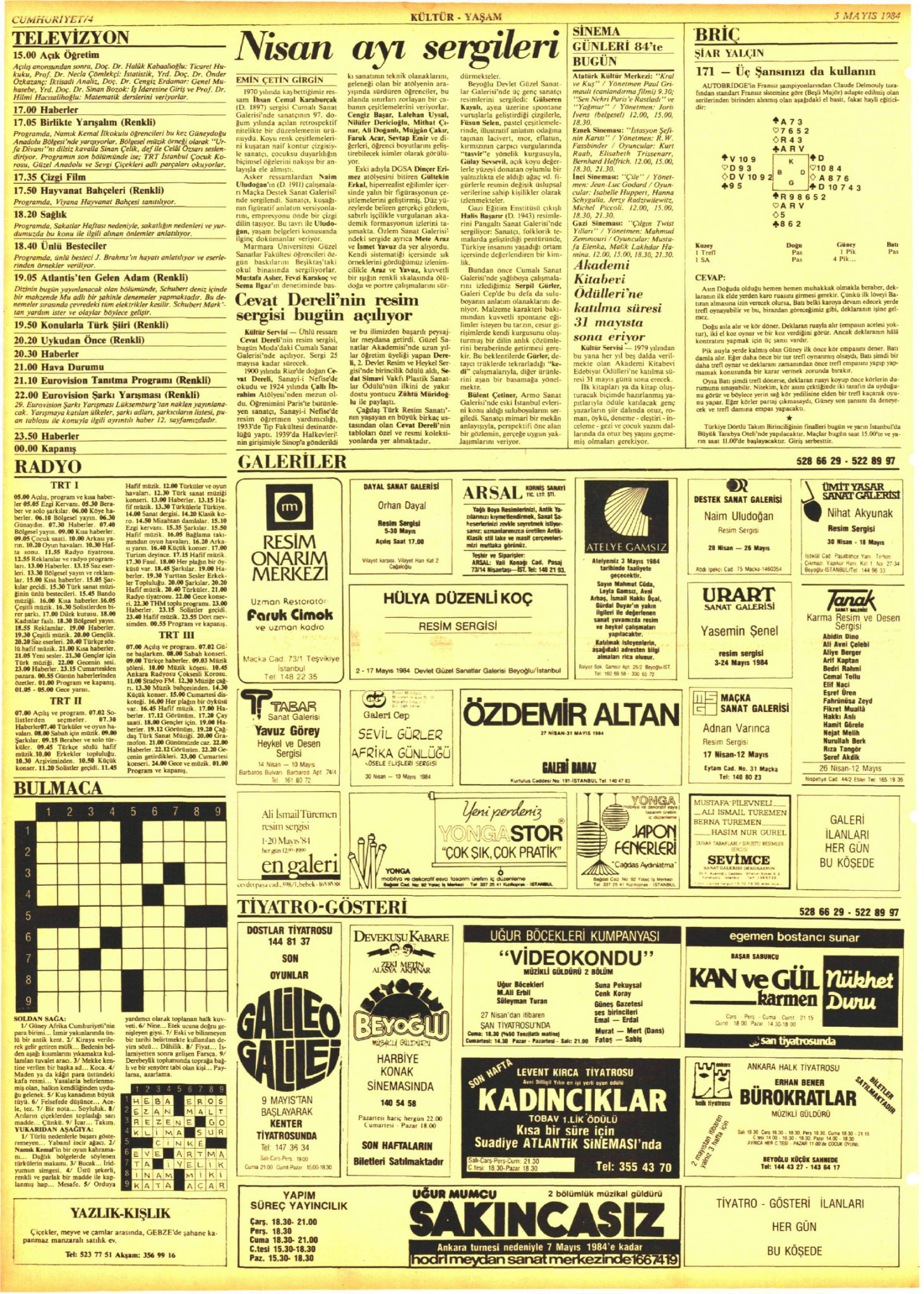
- ^ "Televizyon" [Television]. Cumhuriyet (in Turkish). Istanbul, Turkey. 5 May 1984. p. 4. Archived from the original on 13 January 2023. Retrieved 13 January 2023.
- ^ "Haydi 'Halay'" [Come on 'Halay']. Renk (in Turkish). Istanbul, Turkey. 5 May 1984. p. 1. Retrieved 5 November 2024.
- ^ "Eurovision Song Contest 1984 – BBC1". Radio Times. 5 May 1984. Archived from the original on 13 January 2023. Retrieved 13 January 2023 – via BBC Genome Project.
- ^ a b "Телевизија" [Television]. Borba (in Serbo-Croatian (Cyrillic script)). Belgrade, SR Serbia, Yugoslavia. 5–6 May 1984. p. 10. Archived from the original on 24 March 2024. Retrieved 24 May 2024 – via Belgrade University Library.
- ^ "Televizió" [Television]. Magyar Szó (in Hungarian). Novi Sad, SAP Vojvodina, Yugoslavia. 5 May 1984. p. 24. Retrieved 18 June 2024 – via Vajdasági Magyar Digitális Adattár.
- ^ "TV Zagreb". Glas Podravine (in Serbo-Croatian). Koprivnica, SR Croatia, Yugoslavia. 27 April 1984. p. 9. Retrieved 29 May 2024 – via Faculty of Organization and Informatics in Varaždin, University of Zagreb.
- ^ "RTV – Televizija danes" [RTV – Television today]. Delo (in Slovenian). Ljubljana, SR Slovenia, Yugoslavia. 5 May 1984. p. 4. Retrieved 28 October 2024 – via Digital Library of Slovenia.
- ^ a b "Television". The Canberra Times. Canberra, Australian Capital Territory, Australia. 6 May 1984. p. 10. Archived from the original on 13 January 2023. Retrieved 13 January 2023 – via Trove.
- ^ a b "ne 3. června" [Sun 3 June]. Rozhlasový týdeník (in Czech). No. 23. 21 May 1984. p. 15. Retrieved 21 June 2024 – via Kramerius.
- ^ a b "Sjónvarp – Fríggjadagin 11. mai" [Television – Friday, 11 May]. Oyggjatíðindi (in Faroese and Danish). Hoyvík, Faroe Islands. 11 May 1984. p. 13. Retrieved 15 July 2024 – via Infomedia.
- ^ a b "KNR-TV – Arfininngorneq 19. maj/Lørdag den 19. maj" [KNR-TV – Saturday 19 May]. Atuagagdliutit (in Kalaallisut and Danish). Nuuk, Greenland. 9 May 1984. p. 55. Retrieved 15 July 2024 – via Timarit.is.
- ^ "Sjónvarp – Laugardagur 5. maí" [Television – Saturday 5 May]. DV (in Icelandic). Reykjavík, Iceland. 5 May 1984. p. 19. Archived from the original on 13 January 2023. Retrieved 13 January 2023 – via Timarit.is.
- ^ "TV & Radio | Jordan Television – Foreign Channel". The Jordan Times. Amman, Jordan. 5 May 1984. p. 2. Retrieved 11 June 2024 – via Internet Archive.
- ^ a b "Telecuraçao – Zaterdag" [Telecuraçao – Saturday]. Amigoe. Willemstad, Curaçao. 7 July 1984. p. 2. Retrieved 17 July 2024 – via Delpher.
- ^ a b "Telewizja – sobota – 26 V" [Television – Saturday – 26/05]. Dziennik Polski (in Polish). Kraków, Poland. 25 May 1984. p. 6. Retrieved 14 January 2023 – via Digital Library of Małopolska.
Bibliography
[edit]- O'Connor, John Kennedy (2010). The Eurovision Song Contest: The Official History (2nd ed.). London, United Kingdom: Carlton Books. ISBN 978-1-84732-521-1.
- Roxburgh, Gordon (2014). Songs for Europe: The United Kingdom at the Eurovision Song Contest. Vol. Two: The 1970s. Prestatyn, United Kingdom: Telos Publishing. ISBN 978-1-84583-093-9.
- Roxburgh, Gordon (2016). Songs for Europe: The United Kingdom at the Eurovision Song Contest. Vol. Three: The 1980s. Prestatyn, United Kingdom: Telos Publishing. ISBN 978-1-84583-163-9.
- Thorsson, Leif; Verhage, Martin (2006). Melodifestivalen genom tiderna : de svenska uttagningarna och internationella finalerna [Melodifestivalen through the ages: the Swedish selections and international finals] (in Swedish). Stockholm, Sweden: Premium Publishing. ISBN 91-89136-29-2.
External links
[edit]