


Eurovision Song Contest 1963
| Eurovision Song Contest 1963 | |
|---|---|
 | |
| Dates | |
| Final | 23 March 1963 |
| Host | |
| Venue | BBC Television Centre London, United Kingdom |
| Presenter(s) | Katie Boyle |
| Musical director | Eric Robinson |
| Directed by | Yvonne Littlewood |
| Executive producer | Harry Carlisle |
| Host broadcaster | British Broadcasting Corporation (BBC) |
| Website | eurovision |
| Participants | |
| Number of entries | 16 |
| Debuting countries | None |
| Non-returning countries | None |
| |
| Vote | |
| Voting system | Twenty-member juries awarded points to their five favourite songs. |
| Winning song |  Denmark Denmark"Dansevise" |

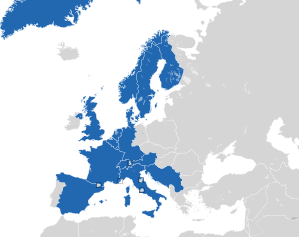
The Eurovision Song Contest 1963 was the eighth edition of the annual Eurovision Song Contest and took place in London, United Kingdom. It was organised by the European Broadcasting Union (EBU) and host broadcaster British Broadcasting Corporation (BBC), who agreed to stage the event after France, who had won the 1962 edition, declined to host it due to financial shortcomings, also having hosted the competition in 1959 and 1961. The contest was held at the BBC Television Centre on Saturday 23 March 1963 and was hosted by Katie Boyle for a second time.
Sixteen countries participated in the contest, the same countries that had participated the previous year.
The contest this year was won by Denmark with the song "Dansevise", performed by Grethe and Jørgen Ingmann. This was the first victory for any of the Nordic countries. Four countries got nul points, with Finland, Norway and Sweden failing to score any points for the first time and the Netherlands for the second time, becoming the first country to go two years in a row without scoring a single point.[1]
Location[edit]

The BBC was willing to host the contest instead of the previous year's winner France, as was the case in 1960. They would do so again in 1972 and 1974 because the winning broadcasters from the year before could not afford to produce the contest. The host venue was the BBC Television Centre, White City, London, which opened in 1960. It is one of the most readily recognisable facilities of its type having appeared as the backdrop for many BBC programmes. It remained to be one of the largest such facilities in the world until it redeveloped in March 2013.[2]
Participating countries[edit]
| Eurovision Song Contest 1963 – Participation summaries by country | |
|---|---|
All countries which participated in the 1962 edition also participated in the 1963 edition.
Returning artists[edit]
| Artist | Country | Previous year(s) |
|---|---|---|
| Ronnie Carroll |  United Kingdom United Kingdom
|
1962 |
Production and format[edit]
The production mode was unusual in comparison with other Eurovision Song Contests: In contrast to most previous and following editions which were filmed in concert halls or theatres, the staging of 1963 was done in television studios.[8] Two studios (TC3 and TC4) were used: one for the mistress of ceremonies Katie Boyle, the audience, and the scoreboard (TC3); the other for the performers and the orchestra accompanying them (TC4). Unusually, a boom microphone (normally used for drama and comedy shows) was employed – the viewer could not see this, so it appeared as if the artists were miming to their vocals. This was not the case, but this innovation was to create a new look for the contest.[1] The use of television studios allowed a broader variety of staging elements not seen before in the contest, and the use of close-ups so to create an atmosphere of intimacy for television viewers.[8]
After the 1962 edition was the only one to be held on a Sunday, the contest was held on a Saturday again in 1963.
Contest overview[edit]
| R/O | Country | Artist | Song | Points | Place |
|---|---|---|---|---|---|
| 1 | United Kingdom
|
Ronnie Carroll | "Say Wonderful Things" | 28 | 4 |
| 2 |  Netherlands Netherlands
|
Annie Palmen | "Een speeldoos" | 0 | 13 |
| 3 |  Germany Germany
|
Heidi Brühl | "Marcel" | 5 | 9 |
| 4 |  Austria Austria
|
Carmela Corren | "Vielleicht geschieht ein Wunder" | 16 | 7 |
| 5 |  Norway Norway
|
Anita Thallaug | "Solhverv" | 0 | 13 |
| 6 |  Italy Italy
|
Emilio Pericoli | "Uno per tutte" | 37 | 3 |
| 7 |  Finland Finland
|
Laila Halme | "Muistojeni laulu" | 0 | 13 |
| 8 | Denmark
|
Grethe and Jørgen Ingmann | "Dansevise" | 42 | 1 |
| 9 |  Yugoslavia Yugoslavia
|
Vice Vukov | "Brodovi" | 3 | 11 |
| 10 |  Switzerland Switzerland
|
Esther Ofarim | "T'en va pas" | 40 | 2 |
| 11 |  France France
|
Alain Barrière | "Elle était si jolie" | 25 | 5 |
| 12 |  Spain Spain
|
José Guardiola | "Algo prodigioso" | 2 | 12 |
| 13 |  Sweden Sweden
|
Monica Zetterlund | "En gång i Stockholm" | 0 | 13 |
| 14 |  Belgium Belgium
|
Jacques Raymond | "Waarom?" | 4 | 10 |
| 15 |  Monaco Monaco
|
Françoise Hardy | "L'amour s'en va" | 25 | 5 |
| 16 |  Luxembourg Luxembourg
|
Nana Mouskouri | "À force de prier" | 13 | 8 |
Spokespersons[edit]
Each country nominated a spokesperson who was responsible for announcing the votes for their respective country via telephone. Known spokespersons at the 1963 contest are listed below.
 Sweden – Edvard Matz[10]
Detailed voting results[edit]
Each country had 20 jury members who awarded their five favourite songs 5, 4, 3, 2, and 1 points in order. All those points would then be added up and the five songs with the most points got 5, 4, 3, 2, and 1 votes in order. Errors in the Norwegian (see below) and the Monegasque votes meant their scores had to be announced twice, with an adjustment to the scores being made in each case before the final score was verified.
One controversy this year was during the voting. When it was Norway's turn to announce their votes, the spokesman in Oslo did not use the correct procedure in that the song number, followed by the name of the country, should have been announced before awarding the points. Boyle asked Norway to repeat their results, but the Norwegian spokesman asked Boyle to return to them after all the other results were in. When Boyle went back to Norway again the votes had been altered, thus changing the outcome of the contest and giving the victory to Denmark at Switzerland's expense. In fact, the Norwegian spokesman had not given the correct votes on the first occasion, because votes from the 20 jury members were still being tallied.[1]
Monaco was also asked to repeat their voting a second time as initially Monaco gave one point to both the United Kingdom and Luxembourg. However, when Boyle went back to Monaco to receive the votes again Monaco's one vote to Luxembourg was efficiently discarded (although this did not have any effect on the positions of the countries).[1]
Total score
|
United Kingdom
|
Netherlands
|
Germany
|
Austria
|
Norway
|
Italy
|
Finland
|
Denmark
|
Yugoslavia
|
Switzerland
|
France
|
Spain
|
Sweden
|
Belgium
|
Monaco
|
Luxembourg
| ||
|---|---|---|---|---|---|---|---|---|---|---|---|---|---|---|---|---|---|---|
Contestants
|
United Kingdom | 28 | 3 | 5 | 3 | 3 | 3 | 3 | 5 | 2 | 1 | |||||||
| Netherlands | 0 | |||||||||||||||||
| Germany | 5 | 2 | 3 | |||||||||||||||
| Austria | 16 | 4 | 4 | 1 | 2 | 3 | 2 | |||||||||||
| Norway | 0 | |||||||||||||||||
| Italy | 37 | 2 | 1 | 3 | 2 | 5 | 4 | 5 | 3 | 3 | 5 | 4 | ||||||
| Finland | 0 | |||||||||||||||||
| Denmark | 42 | 3 | 5 | 2 | 3 | 4 | 2 | 5 | 3 | 5 | 5 | 5 | ||||||
| Yugoslavia | 3 | 1 | 2 | |||||||||||||||
| Switzerland | 40 | 5 | 4 | 5 | 1 | 5 | 4 | 4 | 1 | 4 | 4 | 3 | ||||||
| France | 25 | 4 | 1 | 2 | 4 | 5 | 4 | 1 | 1 | 2 | 1 | |||||||
| Spain | 2 | 2 | ||||||||||||||||
| Sweden | 0 | |||||||||||||||||
| Belgium | 4 | 4 | ||||||||||||||||
| Monaco | 25 | 1 | 2 | 5 | 1 | 3 | 1 | 1 | 5 | 4 | 2 | |||||||
| Luxembourg | 13 | 3 | 1 | 1 | 2 | 2 | 4 | |||||||||||
5 points[edit]
Below is a summary of all 5 points received:
| N. | Contestant | Nation(s) giving 5 points |
|---|---|---|
| 5 | Denmark
|
Belgium, Finland, Luxembourg, Netherlands, Sweden
|
| 3 | Italy
|
Denmark, Monaco, Switzerland
|
| Switzerland
|
Austria, Italy, United Kingdom
| |
| 2 | United Kingdom
|
Norway, Spain
|
| Monaco
|
France, Germany
| |
| 1 | France
|
Yugoslavia
|
Broadcasts[edit]
Each participating broadcaster was required to relay the contest via its networks. Non-participating EBU member broadcasters were also able to relay the contest as "passive participants". Broadcasters were able to send commentators to provide coverage of the contest in their own native language and to relay information about the artists and songs to their television viewers.[13]
Known details on the broadcasts in each country, including the specific broadcasting stations and commentators are shown in the tables below.
| Country | Broadcaster | Channel(s) | Commentator(s) | Ref(s) |
|---|---|---|---|---|
 Ireland Ireland
|
RÉ | Telefís Éireann | [32] | |
 Portugal Portugal
|
RTP | RTP | Federico Gallo | [4][33] |
Notes[edit]
References[edit]
- ^ a b c d "Eurovision Song Contest 1963". EBU. Retrieved 7 August 2021.
- ^ "Dyke accused of conflict of interest over £6m holding in rival TV firm". The Independent. London. 17 January 2000.[dead link]
- ^ "Participants of London 1963". European Broadcasting Union. Archived from the original on 5 February 2023. Retrieved 15 June 2023.
- ^ a b c d e f g h i j k l m n o p q r s Roxburgh, Gordon (2012). Songs for Europe: The United Kingdom at the Eurovision Song Contest. Volume One: The 1950s and 1960s. Prestatyn: Telos Publishing. pp. 291–299. ISBN 978-1-84583-065-6.
- ^ "1963 – 8th edition". diggiloo.net. Archived from the original on 1 January 2022. Retrieved 15 June 2023.
- ^ "Detailed overview: conductors in 1963". And the conductor is... Retrieved 15 June 2023.
- ^ "Alle deutschen ESC-Acts und ihre Titel". www.eurovision.de (in German). ARD. Archived from the original on 12 June 2023. Retrieved 12 June 2023.
- ^ a b Pajala, Mari (2023). "The Eurovision Song Contest and European television history: continuity, adaption, experimentation". In Dubin, Adam; Vuletic, Dean; Obregón, Antonio (eds.). The Eurovision Song Contest as a cultural phenomenon : from concert halls to the halls of academia. London: Routledge, Taylor & Francis Group. p. 192. doi:10.4324/9781003188933-16. ISBN 978-1-03-203774-5. OCLC 1296690839.
- ^ "Final of London 1963". European Broadcasting Union. Archived from the original on 30 March 2021. Retrieved 30 March 2021.
- ^ a b Thorsson, Leif; Verhage, Martin (2006). Melodifestivalen genom tiderna : de svenska uttagningarna och internationella finalerna (in Swedish). Stockholm: Premium Publishing. pp. 46–47. ISBN 91-89136-29-2.
- ^ "Results of the Final of London 1963". European Broadcasting Union. Archived from the original on 30 March 2021. Retrieved 30 March 2021.
- ^ "Eurovision Song Contest 1963 – Scoreboard". European Broadcasting Union. Archived from the original on 9 July 2015. Retrieved 14 June 2021.
- ^ "The Rules of the Contest". European Broadcasting Union. 31 October 2018. Archived from the original on 4 October 2022. Retrieved 19 December 2022.
- ^ a b c "Das Fernsehen und sein Programm" [Television and its programs]. Die Tat (in German). Zürich, Switzerland. 23 May 1963. p. 15. Retrieved 19 December 2022 – via e-newspaperarchives.ch.
- ^ a b c d e "Programma voor morgen" [Programs for tomorrow]. Limburgs Dagblad (in Dutch). 22 March 1963. p. 9. Retrieved 19 December 2022 – via Delpher.
- ^ a b c "Radio-Télévision". Luxemburger Wort (in German and French). 22 March 1963. p. 5. Retrieved 19 December 2022.
- ^ "Alle tiders programoversigter – Lørdag den 23. marts 1963" [All-time programme overviews – Saturday 23 March 1963] (in Danish). DR. Retrieved 22 March 2024.
- ^ "Radio ja televisio" [Radio and television]. Helsingin Sanomat (in Finnish). 23 March 1963. p. 23. Retrieved 7 November 2022.
- ^ a b "Programme TV" [TV Program]. Radio TV - Je vois tout (in French). Lausanne, Switzerland: Héliographia SA. 14 March 1963. pp. 28–30. Retrieved 19 December 2022.
- ^ "Oggi alla TV" [Today on TV]. La Stampa (in Italian). 23 March 1963. p. 4. Retrieved 19 December 2022.
- ^ "Annie heeft een 'hele mooie jurk'" [Annie has a 'very beautiful dress']. Limburgs Dagblad (in Dutch). 23 March 1963. p. 7. Retrieved 19 December 2022 – via Delpher.
- ^ "Radioreportage van het Songfestival" [Radio report of the Eurovision Song Contest]. Nieuwe Leidsche Courant (in Dutch). 23 March 1963. p. 7. Retrieved 16 February 2023.
- ^ a b "Klart for Melodie Grand Prix 1963" [Ready for Melodie Grand Prix 1963]. Oppland Arbeiderblad (in Norwegian). 23 March 1963. p. 12. Retrieved 19 December 2022 – via National Library of Norway.
- ^ "Grand Prix". Morgenposten (in Norwegian). 18 March 1963. p. 14. Retrieved 21 July 2023 – via National Library of Norway.
Grythe was supposed to refer from this year's 'sound Olympiad', but now he has withdrawn in favour of Øyvind Johnssen from the steam radio's entertainment department. Grythe has so many irons in the fire that he simply does not have time to travel to London. [original: Grythe skulle refere årets «lyd-olympiade», men nå har han trakket seg til fordel for Øyvind Johnssen i dampradioens underholdningsavdeling. Grythe har så mange jern i ilden at han simpelthen ikke rekker å reise til London.]
- ^ a b c "Radio y TV" [Radio and TV]. La Vanguardia (in Spanish). 23 March 1963. p. 42. Retrieved 19 December 2022.
- ^ HerGar, Paula (28 March 2018). "Todos los comentaristas de la historia de España en Eurovisión (y una única mujer en solitario)" [All the commentators in the history of Spain in Eurovision (and only a single woman)] (in Spanish). Los 40. Archived from the original on 26 September 2021. Retrieved 14 December 2022.
- ^ "Programmes radiophoniques – samedi 23 mars" [Radio programmes – Saturday 23 March]. Radio TV - Je vois tout (in French). Lausanne, Switzerland: Héliographia SA. 14 March 1963. pp. 62–64. Retrieved 19 December 2022.
- ^ a b "Wochenprogram für Radio und Fernsehen" [Weekly program for radio and television]. Freiburger Nachrichten (in German). Fribourg, Switzerland. 23 March 1963. p. 8. Retrieved 19 December 2022 – via e-newspaperarchives.ch.
- ^ "Eurovision Song Contest Grand Prix 1963". Radio Times. 23 March 1963. Retrieved 23 December 2022 – via BBC Genome Project.
- ^ "Televizija – sobota – 23. marca" [Television – Saturday – 23 March] (PDF). Panorama glasova (in Slovenian). 23 March 1963. pp. 6–7. Archived (PDF) from the original on 19 December 2022. Retrieved 19 December 2022.
- ^ "Televizija" [Television]. Slobodna Dalmacija (in Croatian). 23 March 1963. p. 8. Retrieved 22 July 2022.
- ^ "To-Day's TV Programmes". The Irish Times. 23 March 1963. p. 6. Retrieved 19 December 2022.
- ^ "Boletim do dia" [Bulletin of the day]. Diário de Lisboa (in Portuguese). 23 March 1963. p. 15. Retrieved 19 December 2022 – via Casa Comum.
External links[edit]
 Media related to Eurovision Song Contest 1963 at Wikimedia Commons

